
T 3 Session The National ITS Architecture ITS
- Slides: 42
T 3 Session: The National ITS Architecture & ITS Standards National ITS Architecture and ITS Standards
Your Session Leaders HOST: Pamela Kordenbrock Architecture Implementation Program Manager Office of Transportation Management FHWA Office of Operations (Washington, DC) PRESENTER: Mac Lister ITS Specialist Operations Technical Service Team FHWA Resource Center (Olympia Fields, IL) National ITS Architecture and ITS Standards
Learning Objectives You will be able to: • Describe in general terms the National ITS Architecture, the need for it, and associated benefits • Explain the connection between the National Architecture and ITS standards National ITS Architecture and ITS Standards
System Architecture System architecture is a conceptual framework that: • Supports system planning, definition, and integration • Describes how system components interact and work together to achieve the system goals • Describes the system operation, what each component does, and what information is exchanged among the components National ITS Architecture and ITS Standards
What does an ITS Architecture do? • Provides a framework for an intelligent transportation system • Functionally defines – The pieces of the system – The information that is exchanged between them National ITS Architecture and ITS Standards
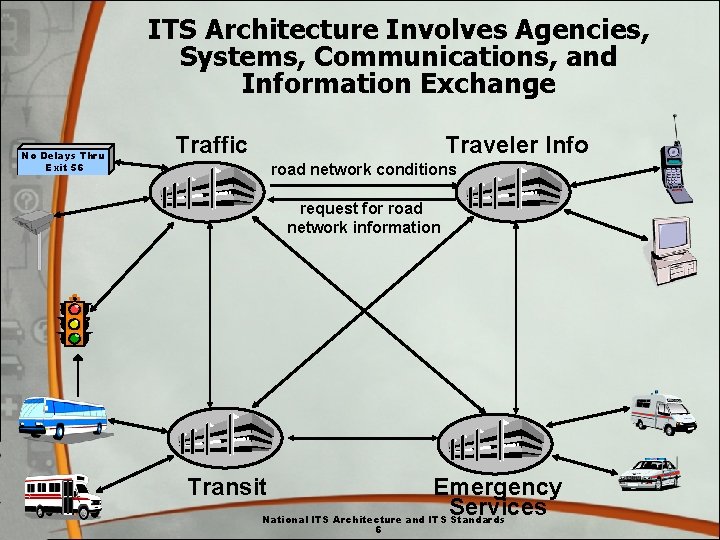
ITS Architecture Involves Agencies, Systems, Communications, and Information Exchange No Delays Thru Exit 56 Traffic Traveler Info road network conditions request for road network information Emergency Services National ITS Architecture and ITS Standards Transit 6
The National ITS Architecture: FRAMEWORK and TEMPLATE for use in the development of ITS ARCHITECTURES National ITS Architecture and ITS Standards
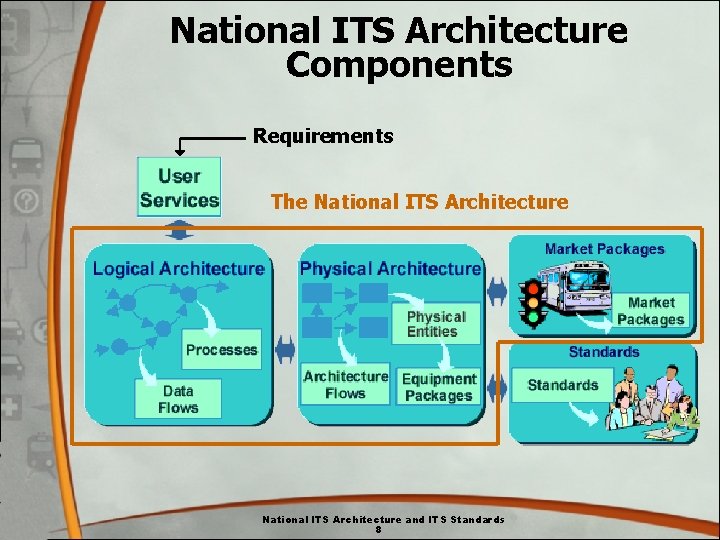
National ITS Architecture Components Requirements The National ITS Architecture and ITS Standards 8
User Services National ITS Architecture and ITS Standards
User Services • 33 transportation services describing what, from the user’s perspective, the system should do • NOTE: A selected subset of all possible transportation services • Each User Service has associated User Service Requirements National ITS Architecture and ITS Standards
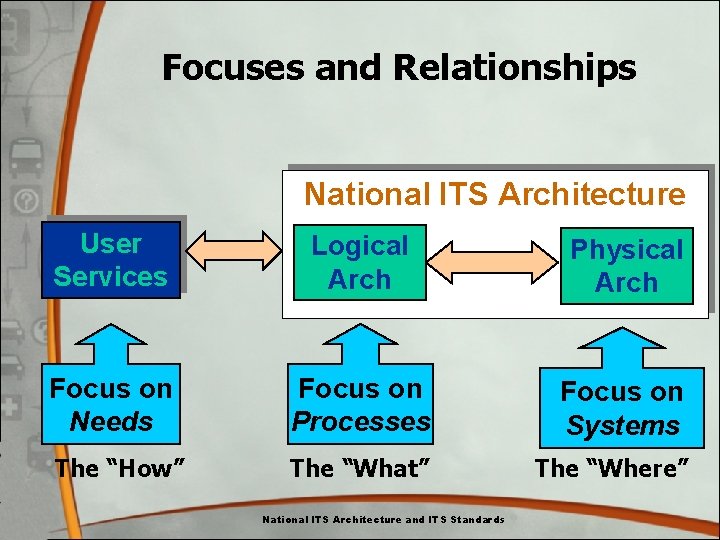
Focuses and Relationships National ITS Architecture User Services Logical Arch Physical Arch Focus on Needs Focus on Processes Focus on Systems The “How” The “What” The “Where” National ITS Architecture and ITS Standards
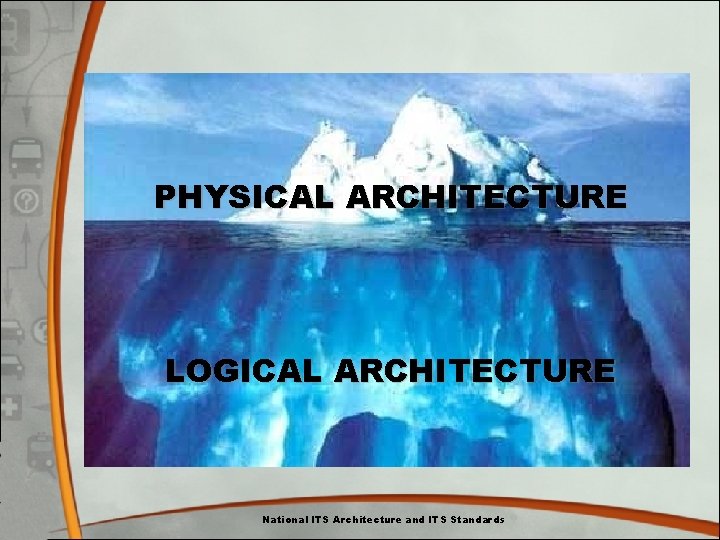
PHYSICAL ARCHITECTURE LOGICAL ARCHITECTURE National ITS Architecture and ITS Standards
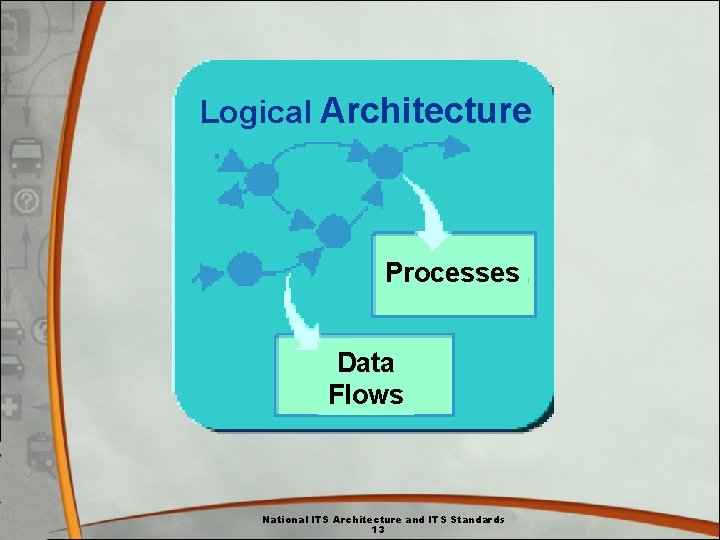
Logical Architecture Processes Data Flows National ITS Architecture and ITS Standards 13
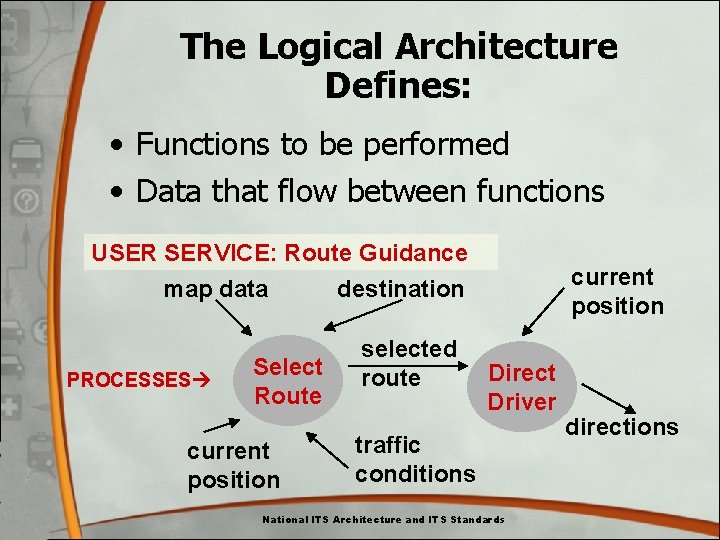
The Logical Architecture Defines: • Functions to be performed • Data that flow between functions USER SERVICE: Route Guidance map data destination PROCESSES Select Route current position selected route current position Direct Driver traffic conditions National ITS Architecture and ITS Standards directions
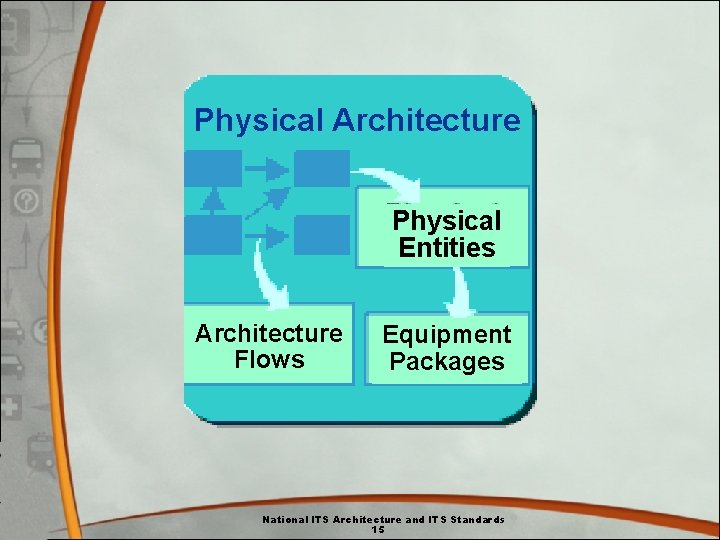
Physical Architecture Physical Entities Architecture Flows Flow Equipment Packages National ITS Architecture and ITS Standards 15
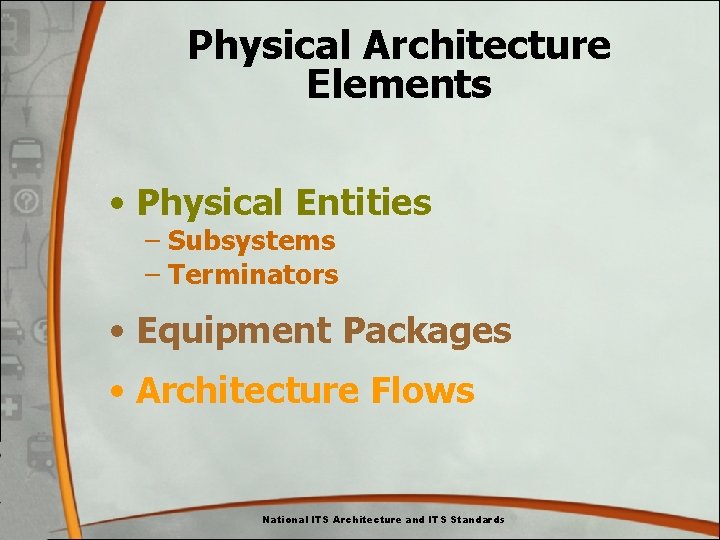
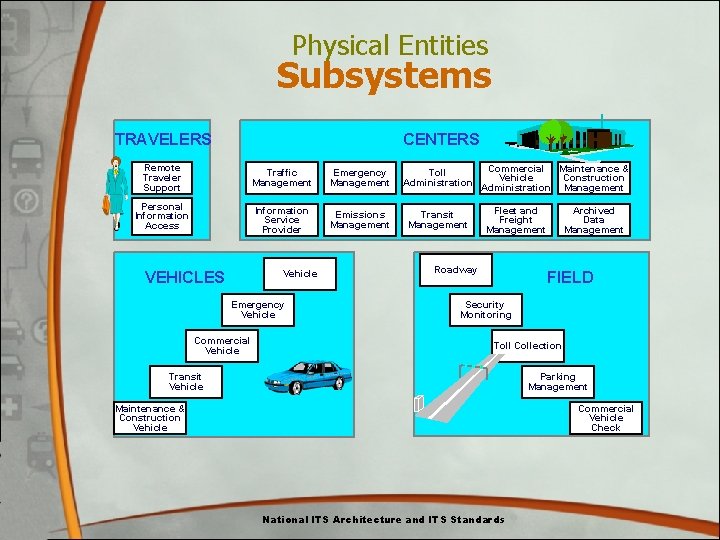
Physical Architecture Elements • Physical Entities – Subsystems – Terminators • Equipment Packages • Architecture Flows National ITS Architecture and ITS Standards
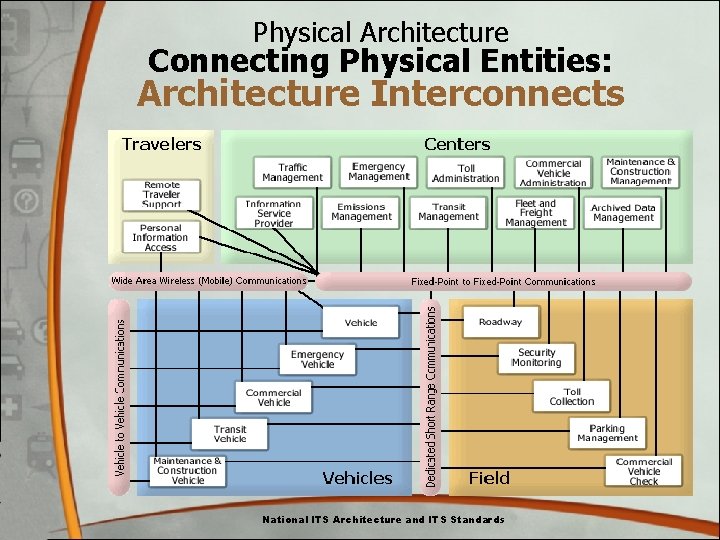
Physical Entities Subsystems TRAVELERS CENTERS Remote Traveler Support Traffic Management Emergency Management Personal Information Access Information Service Provider Emissions Management Vehicle VEHICLES Emergency Vehicle Commercial Maintenance & Toll Vehicle Construction Administration Management Transit Management Fleet and Freight Management Roadway Archived Data Management FIELD Security Monitoring Toll Collection Transit Vehicle Parking Management Maintenance & Construction Vehicle Commercial Vehicle Check National ITS Architecture and ITS Standards
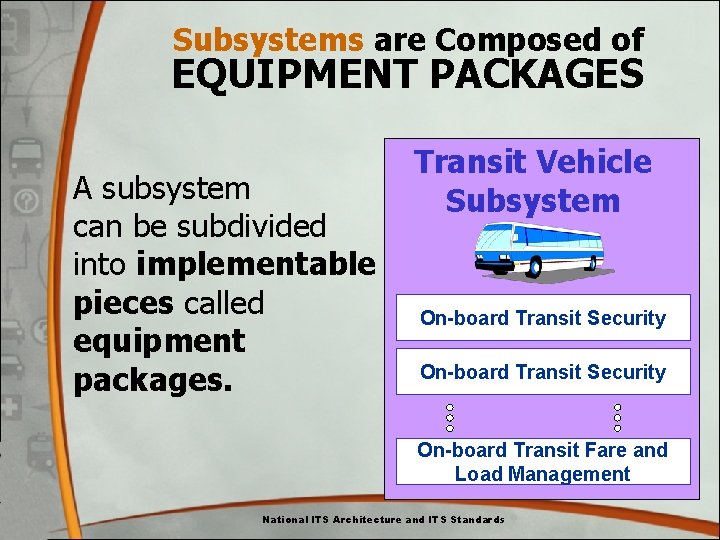
Subsystems are Composed of EQUIPMENT PACKAGES A subsystem can be subdivided into implementable pieces called equipment packages. Transit Vehicle Subsystem On-board Transit Security On-board Transit Fare and Load Management National ITS Architecture and ITS Standards
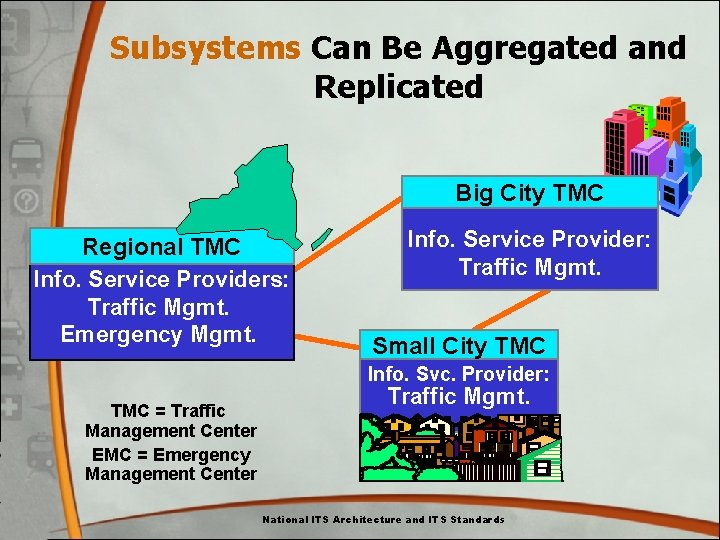
Subsystems Can Be Aggregated and Replicated Big City TMC Regional TMC Info. Service Providers: Traffic Mgmt. Emergency Mgmt. Info. Service Provider: Traffic Mgmt. Small City TMC Info. Svc. Provider: TMC = Traffic Management Center EMC = Emergency Management Center Traffic Mgmt. National ITS Architecture and ITS Standards
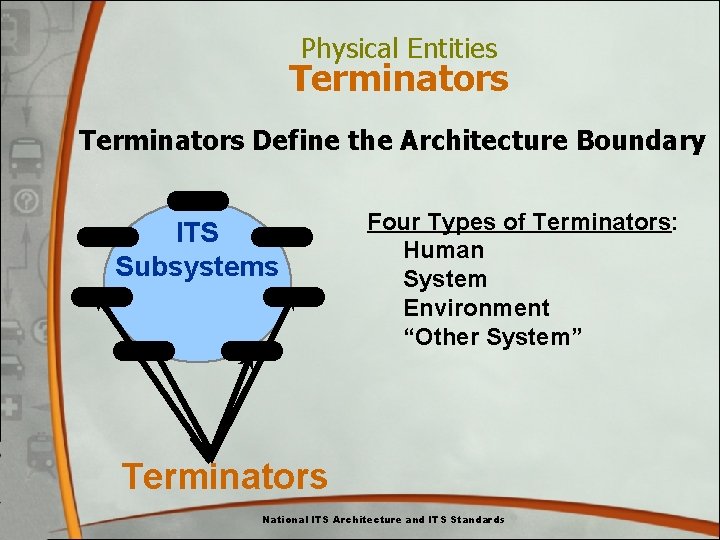
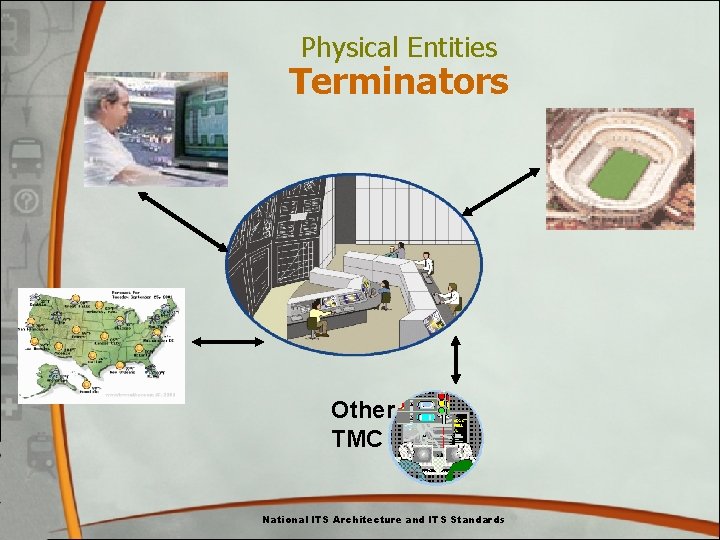
Physical Entities Terminators Define the Architecture Boundary ITS Subsystems Four Types of Terminators: Human System Environment “Other System” Terminators National ITS Architecture and ITS Standards
Physical Entities Terminators Other TMC National ITS Architecture and ITS Standards
Physical Architecture Flows: Exchanges of information between subsystems and terminators in the Physical Architecture that collectively result in an integrated system National ITS Architecture and ITS Standards
Physical Architecture Connecting Physical Entities: Architecture Interconnects National ITS Architecture and ITS Standards
Architecture Interconnects: The Telecommunications Backbone • Fixed-point to Fixed-point • Wide-Area Wireless (Mobile) • Dedicated Short-Range Communications (DSRC) • Vehicle-to-Vehicle National ITS Architecture and ITS Standards
Implementation Strategy Market Packages National ITS Architecture and ITS Standards
Physical Architecture Market Packages • Identify the pieces of the Physical Architecture that are required to implement a particular transportation service • Are tailored to fit real-world transportation problems and needs • Collect together several different: – Equipment packages – Architecture Flows National ITS Architecture and ITS Standards
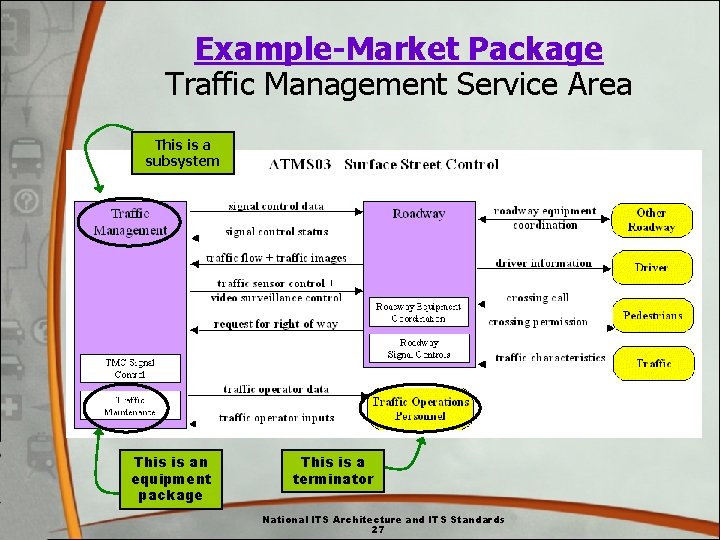
Example-Market Package Traffic Management Service Area This is a subsystem This is an equipment package This is a terminator National ITS Architecture and ITS Standards 27
Standards National ITS Architecture and ITS Standards 28
RELATION BETWEEN THE NATIONAL ITS ARCHITECTURE AND ITS STANDARDS • The National ITS Architecture defines a common framework for ITS integration • The ITS standards define how the system components operate within the framework • Use of non-proprietary ITS standards facilitates interoperability within a system and between systems – ITS devices within an agency – ITS devices between regional agencies National ITS Architecture and ITS Standards
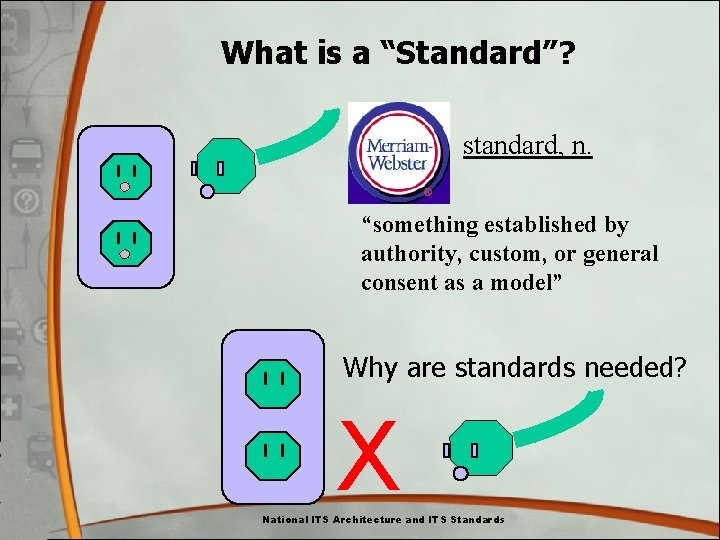
What is a “Standard”? standard, n. “something established by authority, custom, or general consent as a model” Why are standards needed? X National ITS Architecture and ITS Standards
Transportation Standards: Examples Transportation systems already use standards in traditional settings in order for the industry to operate safely and efficiently: • Manual on Uniform Traffic Control Devices (MUTCD) • Highway Capacity Manual 2000 • Rail gauges • Pavement marking standards National ITS Architecture and ITS Standards
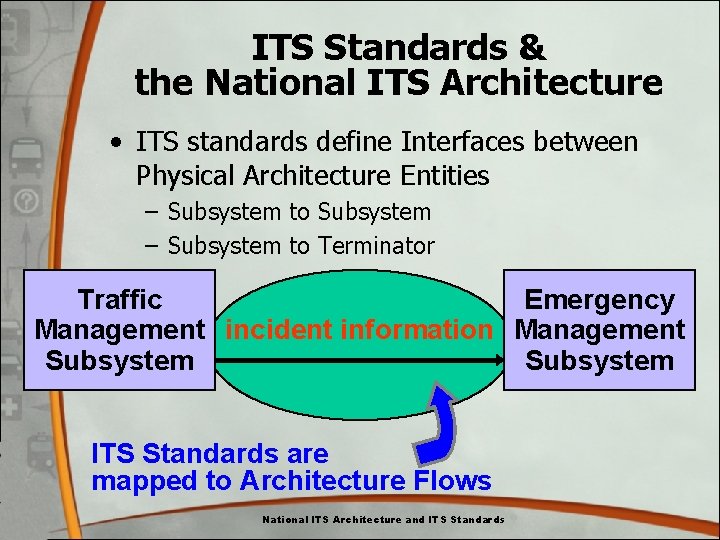
ITS Standards & the National ITS Architecture • ITS standards define Interfaces between Physical Architecture Entities – Subsystem to Subsystem – Subsystem to Terminator Traffic Emergency Management incident information Management Subsystem ITS Standards are mapped to Architecture Flows National ITS Architecture and ITS Standards
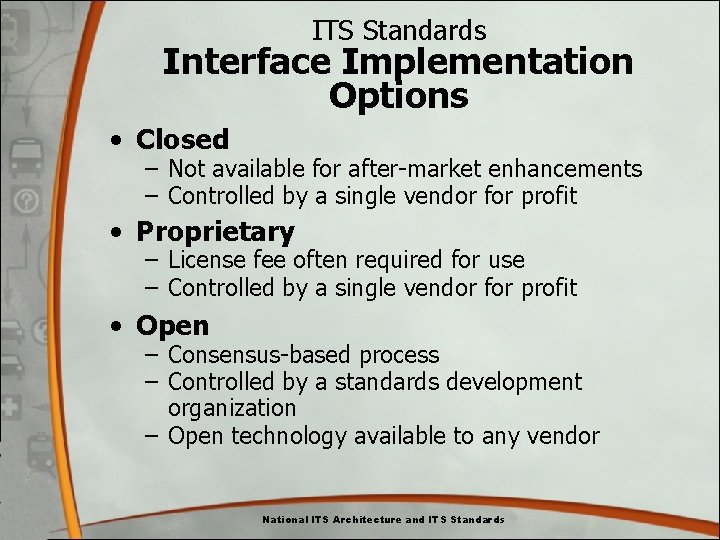
ITS Standards Interface Implementation Options • Closed – Not available for after-market enhancements – Controlled by a single vendor for profit • Proprietary – License fee often required for use – Controlled by a single vendor for profit • Open – Consensus-based process – Controlled by a standards development organization – Open technology available to any vendor National ITS Architecture and ITS Standards
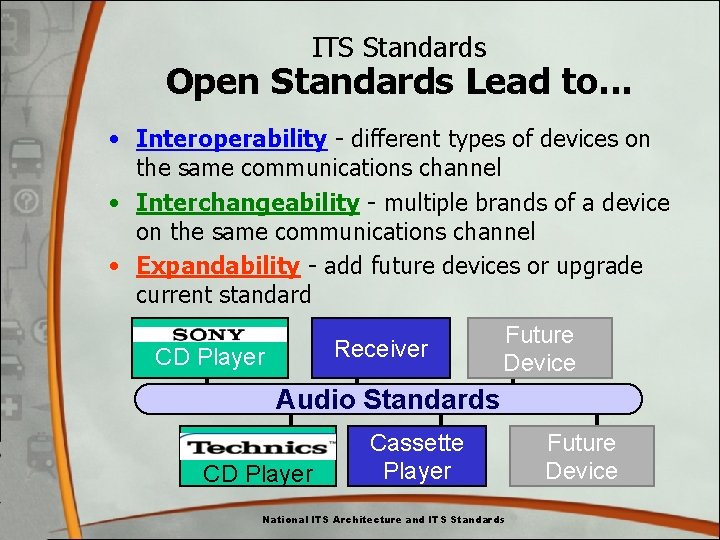
ITS Standards Open Standards Lead to. . . • Interoperability - different types of devices on the same communications channel • Interchangeability - multiple brands of a device on the same communications channel • Expandability - add future devices or upgrade current standard Receiver CD Player Future Device Audio Standards CD Player Cassette Player National ITS Architecture and ITS Standards Future Device
US DOT ITS STANDARDS PROGRAM • Working toward widespread use of ITS standards to encourage interoperability within and between transportation modes • Cooperative agreements with seven standards development organizations (SDOs) • Accelerated development of ITS standards that are: – Non-proprietary, consensus-based – Developed with input from public sector transportation professionals National ITS Architecture and ITS Standards
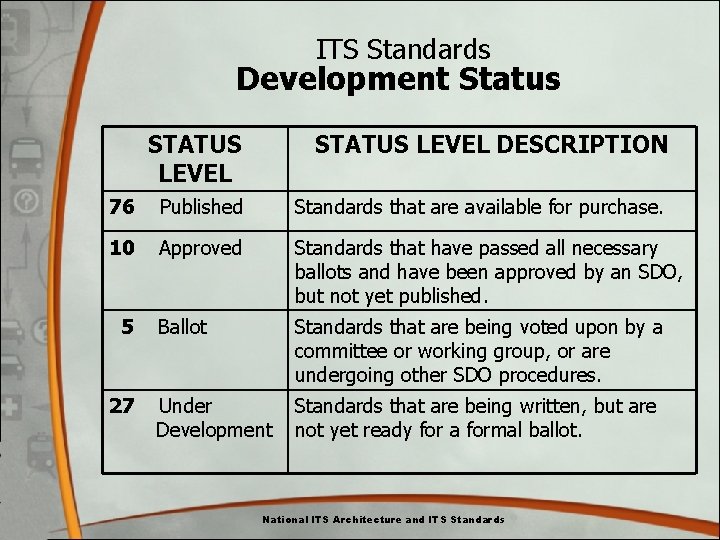
ITS Standards Development Status STATUS LEVEL DESCRIPTION 76 Published Standards that are available for purchase. 10 Approved Standards that have passed all necessary ballots and have been approved by an SDO, but not yet published. 5 Ballot Standards that are being voted upon by a committee or working group, or are undergoing other SDO procedures. 27 Under Development Standards that are being written, but are not yet ready for a formal ballot. National ITS Architecture and ITS Standards
ITS Standards Are Standards Required? • NO. A standard is not required unless it is adopted through US DOT rulemaking • Rulemaking is an option but not the US DOT’s preferred way of getting standards into ITS deployments --rather, quality standards combined with technical assistance • If rulemaking takes place, likely the standard would have already been considered the de facto standard National ITS Architecture and ITS Standards
GUIDANCE for STAKEHOLDERS On the Use of ITS Standards • US DOT strongly urges agencies to use ITS standards • The Standards Program offers many resources to agencies – Technical Assistance through ITS Specialists – Peer-to-Peer Assistance – Individual, intensive support through Standards Field Support Team (SFST) – Visit www. standards. its. dot. gov National ITS Architecture and ITS Standards
Further Information on Architecture and Standards National ITS Architecture: www. its. dot. gov www. iteris. com/itsarch/ ITS Standards (current status, fact sheets, links to other SDO sites): http: //www. standards. its. dot. gov /standards. htm National ITS Architecture and ITS Standards
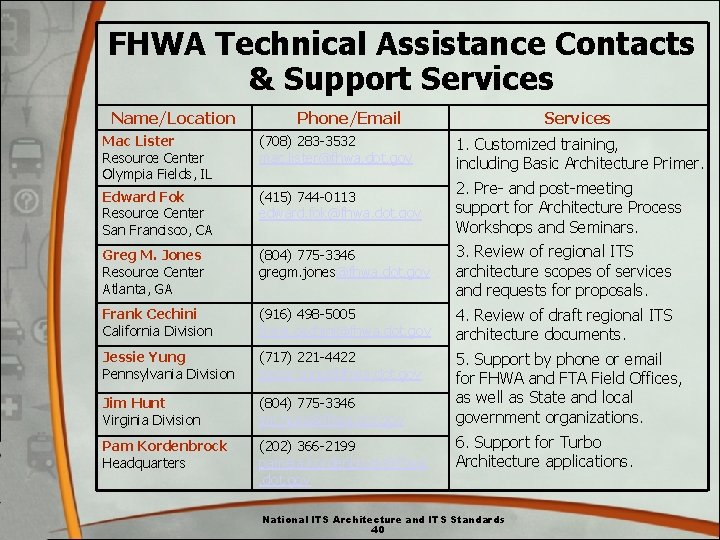
FHWA Technical Assistance Contacts & Support Services Name/Location Phone/Email Services Mac Lister Resource Center Olympia Fields, IL (708) 283 -3532 mac. lister@fhwa. dot. gov 1. Customized training, including Basic Architecture Primer. Edward Fok Resource Center San Francisco, CA (415) 744 -0113 edward. fok@fhwa. dot. gov 2. Pre- and post-meeting support for Architecture Process Workshops and Seminars. Greg M. Jones Resource Center Atlanta, GA (804) 775 -3346 gregm. jones@fhwa. dot. gov 3. Review of regional ITS architecture scopes of services and requests for proposals. Frank Cechini California Division (916) 498 -5005 frank. cechini@fhwa. dot. gov 4. Review of draft regional ITS architecture documents. Jessie Yung Pennsylvania Division (717) 221 -4422 jessie. yung@fhwa. dot. gov Jim Hunt Virginia Division (804) 775 -3346 jim. hunt@fhwa. dot. gov 5. Support by phone or email for FHWA and FTA Field Offices, as well as State and local government organizations. Pam Kordenbrock Headquarters (202) 366 -2199 pamela. kordenbrock@fhwa. dot. gov 6. Support for Turbo Architecture applications. National ITS Architecture and ITS Standards 40
Training • www. pcb. its. dot. gov • CITE - Introduction to the National ITS Architecture • CITE - Interoperability: ITS System Architecture & Standards • NHI - Deploying the ITS Architecture • NTI - Complying with FTA's Policy on ITS Architecture Consistency • ITE - ITS Standards Outreach, Education and Training (series) • http: //www. standards. its. dot. gov/train 4. htm National ITS Architecture and ITS Standards
Review: Learning Objectives ü Describe in general terms the National ITS Architecture, the need for it, and associated benefits ü Explain the connection between the National Architecture and ITS standards National ITS Architecture and ITS Standards