
T 2 8 Base e and Natural Logs
T. 2. 8 – Base e and Natural Logs IB Math SL 1 - Santowski
(A) Introducing Base e � � � � � One way to introduce the number e is to use compounding as in the following example: Take $1000 and let it grow at a rate of 10% p. a. Then determine value of the $1000 after 2 years under the following compounding conditions: (i) compounded annually =1000(1 +. 1/1)(2 x 1) (ii) compounded quarterly =1000(1 + 0. 1/4)(2 x 4) (iii) compounded daily =1000(1 + 0. 1/365)(2 x 365) (iv) compounded n times per year =1000(1+0. 1/n)(2 xn) Math SL 1 - Santowski 12/17/2021 2 2
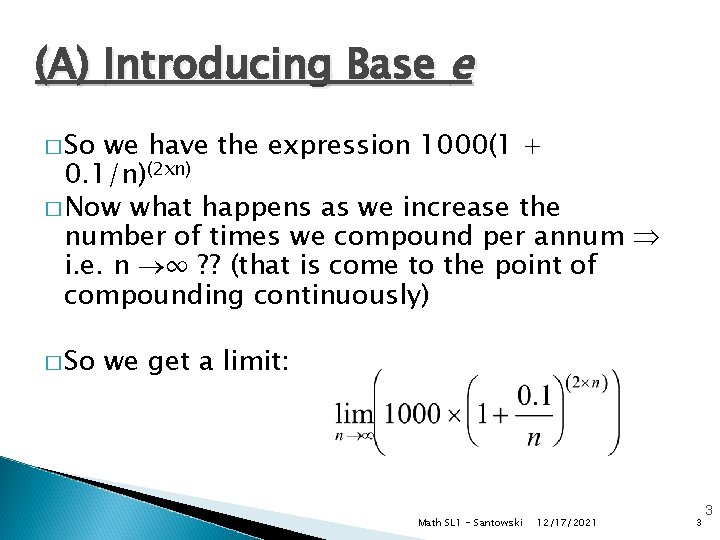
(A) Introducing Base e � So we have the expression 1000(1 + 0. 1/n)(2 xn) � Now what happens as we increase the number of times we compound per annum i. e. n ∞ ? ? (that is come to the point of compounding continuously) � So we get a limit: Math SL 1 - Santowski 12/17/2021 3 3
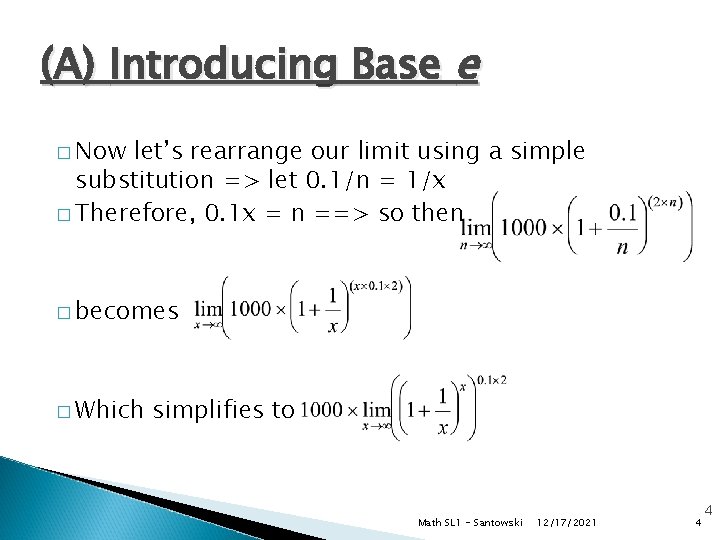
(A) Introducing Base e � Now let’s rearrange our limit using a simple substitution => let 0. 1/n = 1/x � Therefore, 0. 1 x = n ==> so then � becomes � Which simplifies to Math SL 1 - Santowski 12/17/2021 4 4
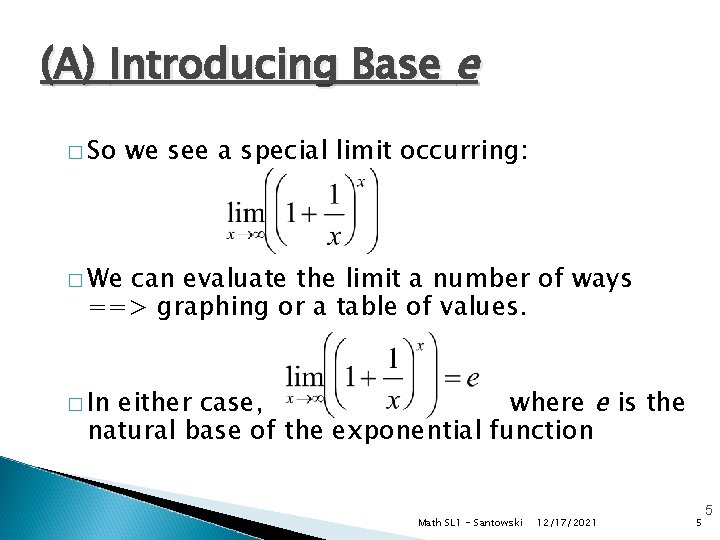
(A) Introducing Base e � So we see a special limit occurring: � We can evaluate the limit a number of ways ==> graphing or a table of values. either case, where e is the natural base of the exponential function � In Math SL 1 - Santowski 12/17/2021 5 5
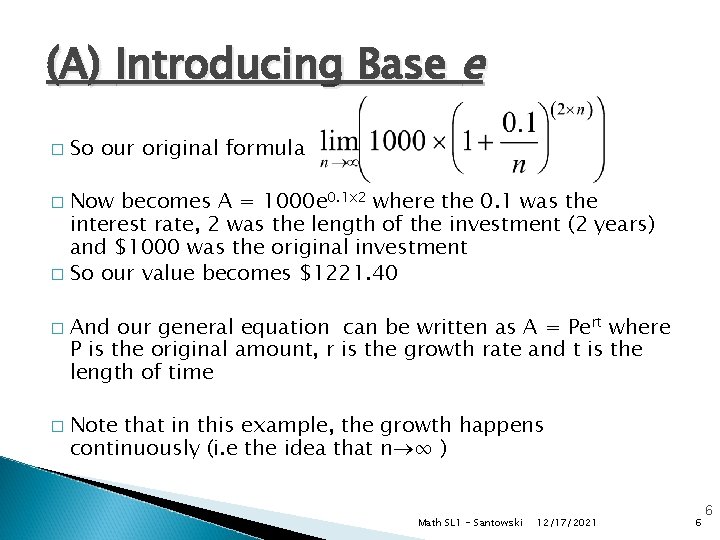
(A) Introducing Base e � So our original formula Now becomes A = 1000 e 0. 1 x 2 where the 0. 1 was the interest rate, 2 was the length of the investment (2 years) and $1000 was the original investment � So our value becomes $1221. 40 � � � And our general equation can be written as A = Pert where P is the original amount, r is the growth rate and t is the length of time Note that in this example, the growth happens continuously (i. e the idea that n ∞ ) Math SL 1 - Santowski 12/17/2021 6 6
(B) Working with A = Pert � So our formula for situations featuring continuous change becomes A = Pert � In the formula, if r > 0, we have exponential growth and if r < 0, we have exponential decay � P represents an initial amount Math SL 1 - Santowski 12/17/2021 7 7
(C) Examples � � (i) I invest $10, 000 in a funding yielding 12% p. a. compounded continuously. ◦ (a) Find the value of the investment after 5 years. ◦ (b) How long does it take for the investment to triple in value? (ii) The population of the USA can be modeled by the eqn P(t) = 227 e 0. 0093 t, where P is population in millions and t is time in years since 1980 ◦ (a) What is the annual growth rate? ◦ (b) What is the predicted population in 2015? ◦ (c) What assumptions are being made in question (b)? ◦ (d) When will the population reach 500 million? Math SL 1 - Santowski 12/17/2021 8 8
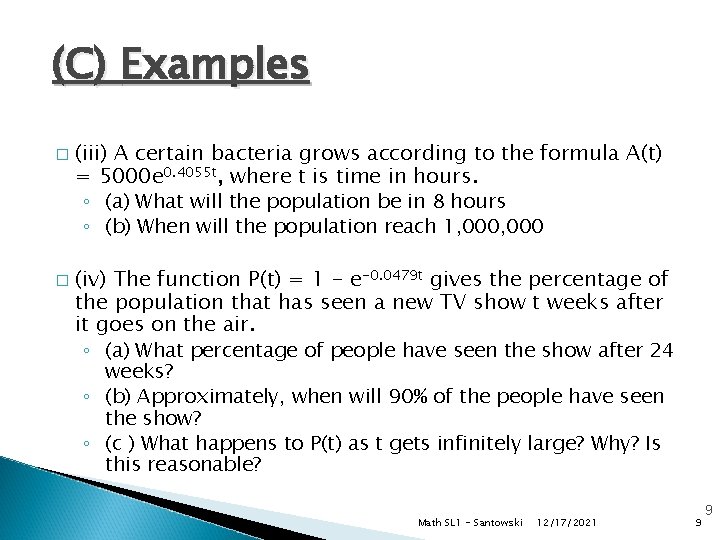
(C) Examples � � (iii) A certain bacteria grows according to the formula A(t) = 5000 e 0. 4055 t, where t is time in hours. ◦ (a) What will the population be in 8 hours ◦ (b) When will the population reach 1, 000 (iv) The function P(t) = 1 - e-0. 0479 t gives the percentage of the population that has seen a new TV show t weeks after it goes on the air. ◦ (a) What percentage of people have seen the show after 24 weeks? ◦ (b) Approximately, when will 90% of the people have seen the show? ◦ (c ) What happens to P(t) as t gets infinitely large? Why? Is this reasonable? Math SL 1 - Santowski 12/17/2021 9 9
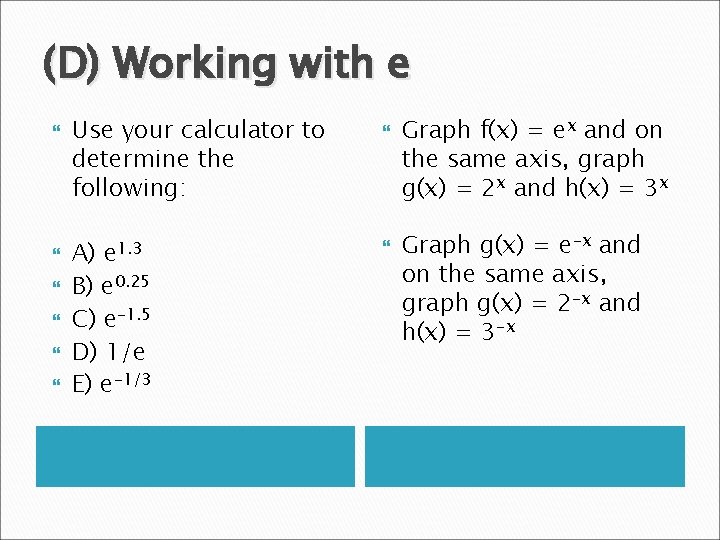
(D) Working with e Use your calculator to determine the following: e 1. 3 A) B) e 0. 25 C) e-1. 5 D) 1/e E) e-1/3 Graph f(x) = ex and on the same axis, graph g(x) = 2 x and h(x) = 3 x Graph g(x) = e-x and on the same axis, graph g(x) = 2 -x and h(x) = 3 -x
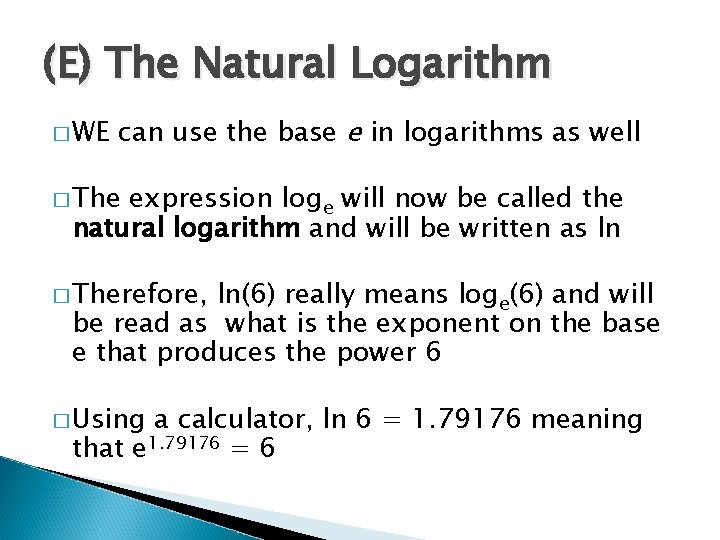
(E) The Natural Logarithm � WE can use the base e in logarithms as well � The expression loge will now be called the natural logarithm and will be written as ln � Therefore, ln(6) really means loge(6) and will be read as what is the exponent on the base e that produces the power 6 � Using a calculator, ln 6 = 1. 79176 meaning that e 1. 79176 = 6
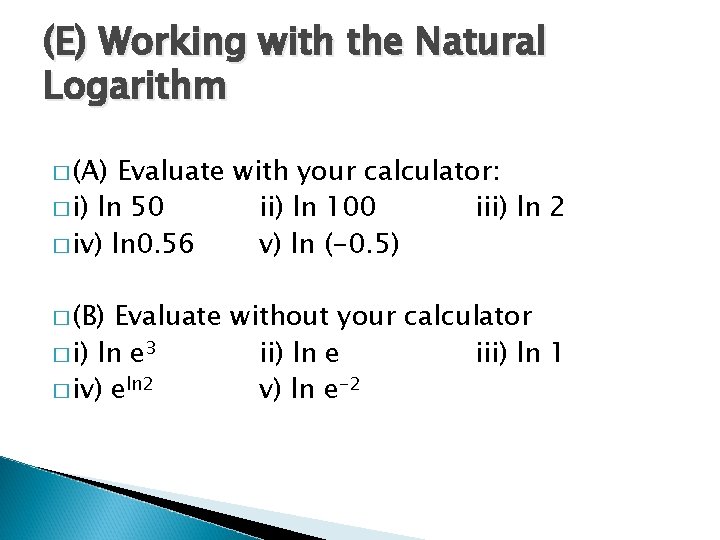
(E) Working with the Natural Logarithm � (A) Evaluate with your calculator: � i) ln 50 ii) ln 100 iii) ln 2 � iv) ln 0. 56 v) ln (-0. 5) � (B) Evaluate without your calculator � i) ln e 3 ii) ln e iii) ln 1 � iv) eln 2 v) ln e-2
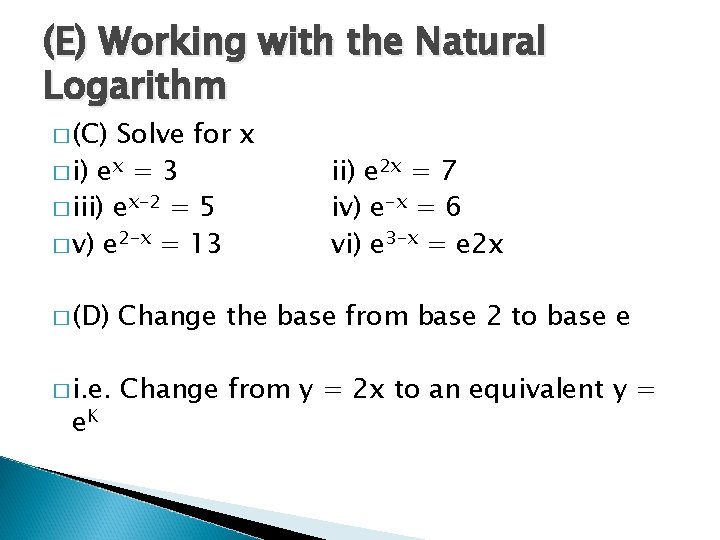
(E) Working with the Natural Logarithm � (C) Solve for x � i) ex = 3 � iii) ex-2 = 5 � v) e 2 -x = 13 ii) e 2 x = 7 iv) e-x = 6 vi) e 3 -x = e 2 x � (D) Change the base from base 2 to base e � i. e. Change from y = 2 x to an equivalent y = e. K
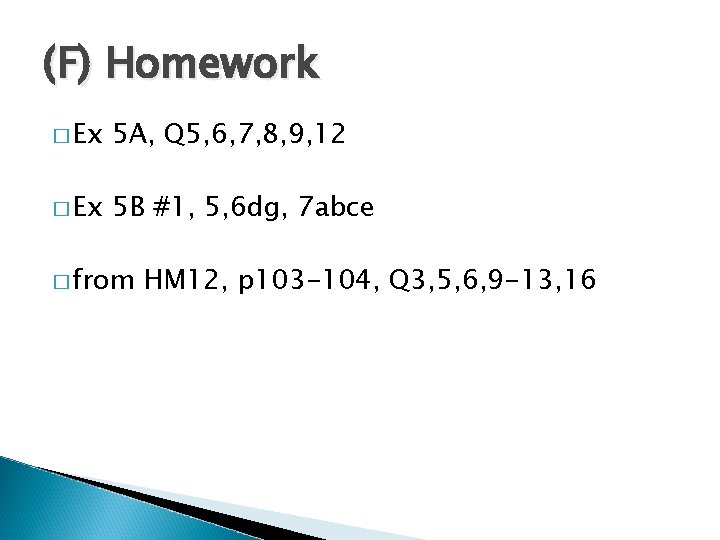
(F) Homework � Ex 5 A, Q 5, 6, 7, 8, 9, 12 � Ex 5 B #1, 5, 6 dg, 7 abce � from HM 12, p 103 -104, Q 3, 5, 6, 9 -13, 16
- Slides: 14