
T 15 14 Spectroscoic Analysis of Alcohols and
- Slides: 5
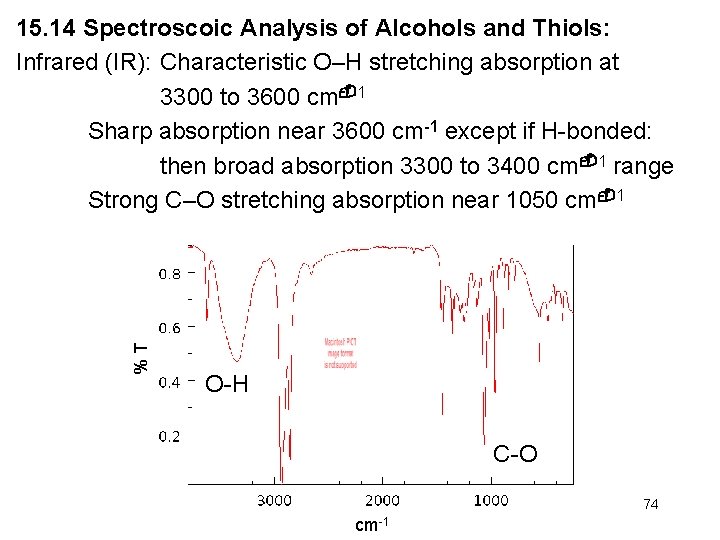
%T 15. 14 Spectroscoic Analysis of Alcohols and Thiols: Infrared (IR): Characteristic O–H stretching absorption at 3300 to 3600 cm 1 Sharp absorption near 3600 cm-1 except if H-bonded: then broad absorption 3300 to 3400 cm 1 range Strong C–O stretching absorption near 1050 cm 1 O-H C-O 74 cm-1
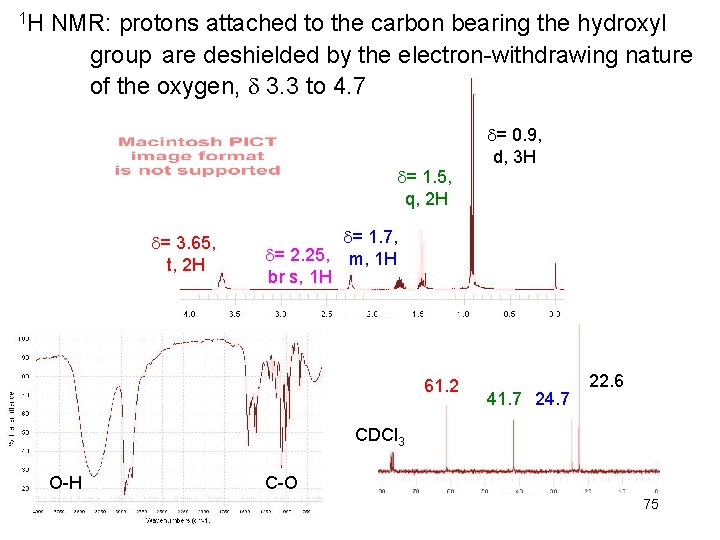
1 H NMR: protons attached to the carbon bearing the hydroxyl group are deshielded by the electron-withdrawing nature of the oxygen, 3. 3 to 4. 7 = 1. 5, q, 2 H = 3. 65, t, 2 H = 0. 9, d, 3 H = 1. 7, = 2. 25, m, 1 H br s, 1 H 61. 2 41. 7 24. 7 22. 6 CDCl 3 O-H C-O 75
Usually no spin-spin coupling between the O–H proton and neighboring protons on carbon due to exchange reaction The chemical shift of the -OH proton occurs over a large range (2. 0 - 5. 5 ppm). It chemical shift is dependent upon the sample concentration and temperature. This proton is often observed as a broad singlet (br s). Exchangable protons are often not to be observed at all. 76
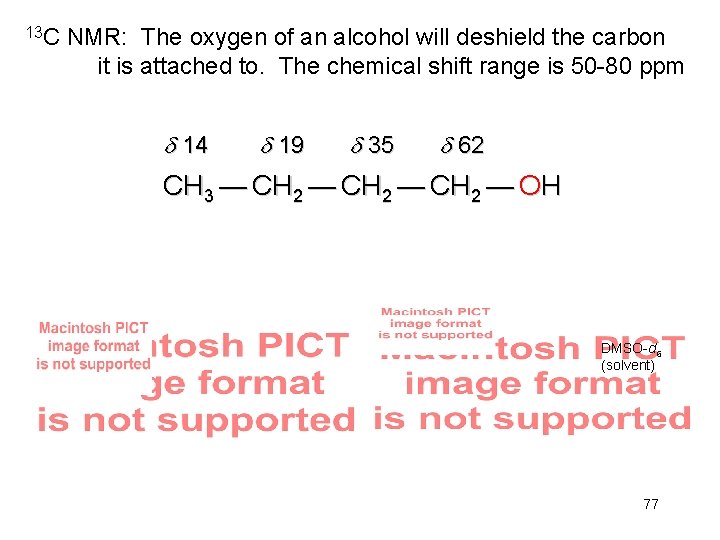
13 C NMR: The oxygen of an alcohol will deshield the carbon it is attached to. The chemical shift range is 50 -80 ppm 14 19 35 62 CH 3 — CH 2 — OH DMSO-d 6 (solvent) 77
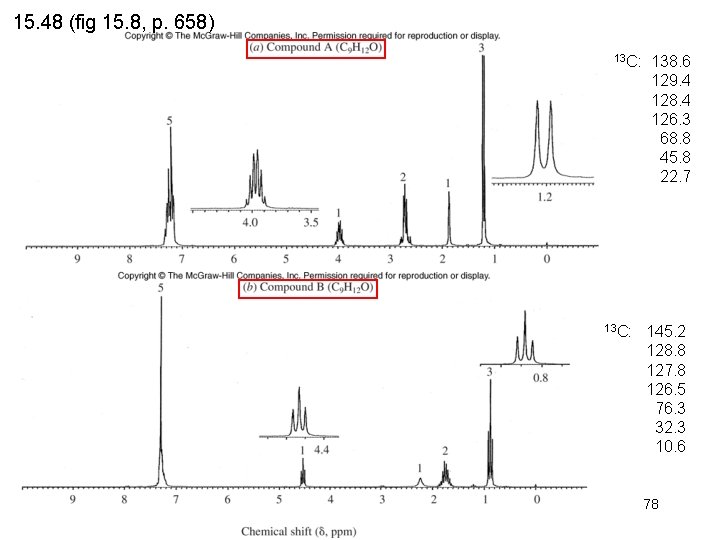
15. 48 (fig 15. 8, p. 658) 13 C: 138. 6 129. 4 128. 4 126. 3 68. 8 45. 8 22. 7 145. 2 128. 8 127. 8 126. 5 76. 3 32. 3 10. 6 78