
T 11 1 Chapter Outline Chapter 11 Project
- Slides: 25
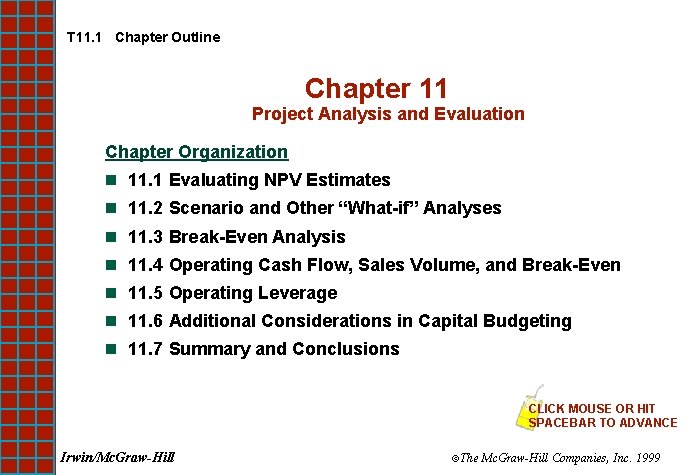
T 11. 1 Chapter Outline Chapter 11 Project Analysis and Evaluation Chapter Organization n 11. 1 Evaluating NPV Estimates n 11. 2 Scenario and Other “What-if” Analyses n 11. 3 Break-Even Analysis n 11. 4 Operating Cash Flow, Sales Volume, and Break-Even n 11. 5 Operating Leverage n 11. 6 Additional Considerations in Capital Budgeting n 11. 7 Summary and Conclusions CLICK MOUSE OR HIT SPACEBAR TO ADVANCE Irwin/Mc. Graw-Hill ©The Mc. Graw-Hill Companies, Inc. 1999
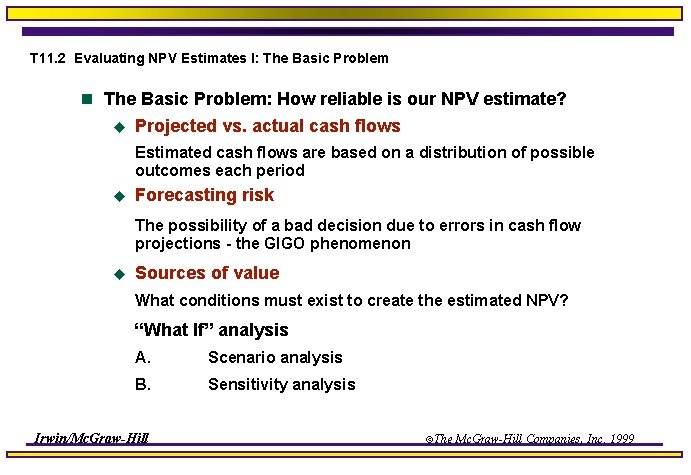
T 11. 2 Evaluating NPV Estimates I: The Basic Problem n The Basic Problem: How reliable is our NPV estimate? u Projected vs. actual cash flows Estimated cash flows are based on a distribution of possible outcomes each period u Forecasting risk The possibility of a bad decision due to errors in cash flow projections - the GIGO phenomenon u Sources of value What conditions must exist to create the estimated NPV? “What If” analysis A. Scenario analysis B. Sensitivity analysis Irwin/Mc. Graw-Hill ©The Mc. Graw-Hill Companies, Inc. 1999
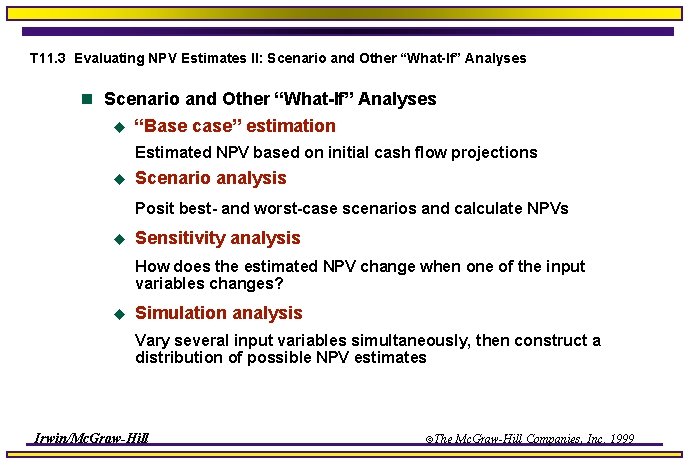
T 11. 3 Evaluating NPV Estimates II: Scenario and Other “What-If” Analyses n Scenario and Other “What-If” Analyses u “Base case” estimation Estimated NPV based on initial cash flow projections u Scenario analysis Posit best- and worst-case scenarios and calculate NPVs u Sensitivity analysis How does the estimated NPV change when one of the input variables changes? u Simulation analysis Vary several input variables simultaneously, then construct a distribution of possible NPV estimates Irwin/Mc. Graw-Hill ©The Mc. Graw-Hill Companies, Inc. 1999
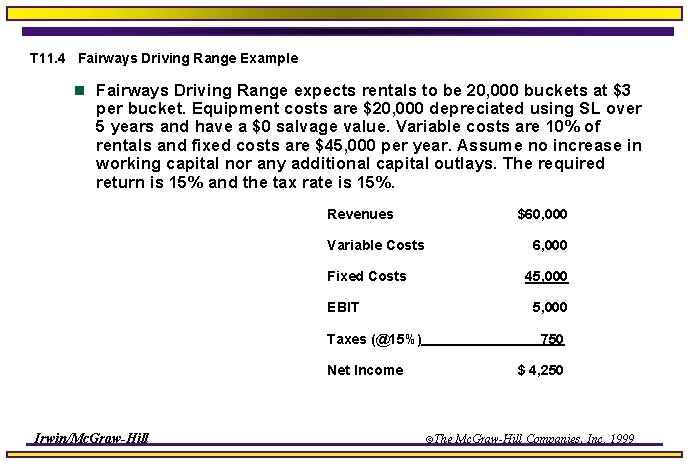
T 11. 4 Fairways Driving Range Example n Fairways Driving Range expects rentals to be 20, 000 buckets at $3 per bucket. Equipment costs are $20, 000 depreciated using SL over 5 years and have a $0 salvage value. Variable costs are 10% of rentals and fixed costs are $45, 000 per year. Assume no increase in working capital nor any additional capital outlays. The required return is 15% and the tax rate is 15%. Revenues $60, 000 Variable Costs 6, 000 Fixed Costs 45, 000 EBIT 5, 000 Taxes (@15%) 750 Net Income Irwin/Mc. Graw-Hill $ 4, 250 ©The Mc. Graw-Hill Companies, Inc. 1999
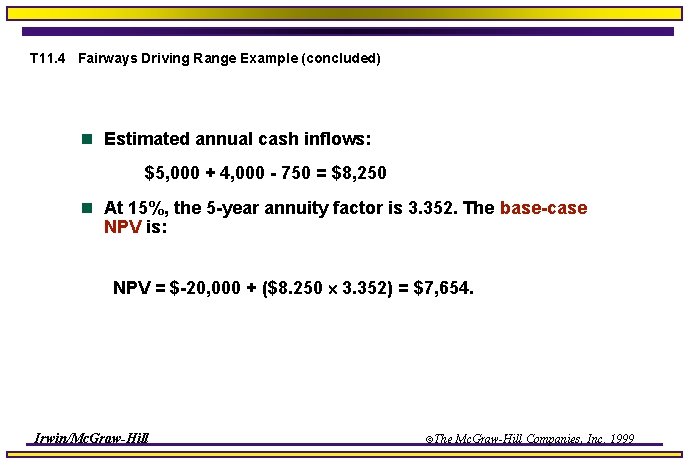
T 11. 4 Fairways Driving Range Example (concluded) n Estimated annual cash inflows: $5, 000 + 4, 000 - 750 = $8, 250 n At 15%, the 5 -year annuity factor is 3. 352. The base-case NPV is: NPV = $-20, 000 + ($8. 250 3. 352) = $7, 654. Irwin/Mc. Graw-Hill ©The Mc. Graw-Hill Companies, Inc. 1999
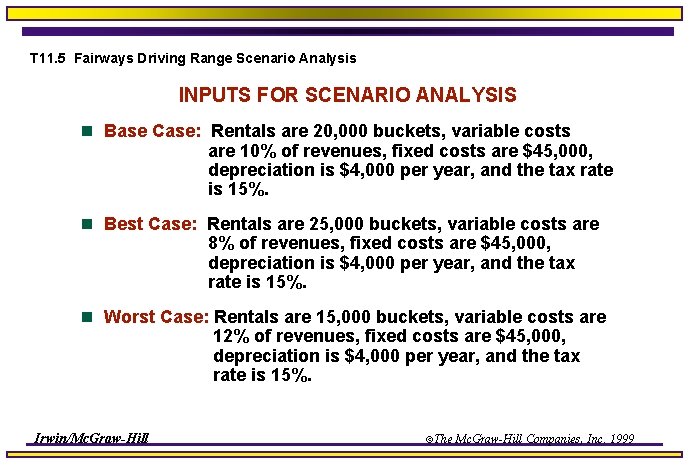
T 11. 5 Fairways Driving Range Scenario Analysis INPUTS FOR SCENARIO ANALYSIS n Base Case: Rentals are 20, 000 buckets, variable costs are 10% of revenues, fixed costs are $45, 000, depreciation is $4, 000 per year, and the tax rate is 15%. n Best Case: Rentals are 25, 000 buckets, variable costs are 8% of revenues, fixed costs are $45, 000, depreciation is $4, 000 per year, and the tax rate is 15%. n Worst Case: Rentals are 15, 000 buckets, variable costs are 12% of revenues, fixed costs are $45, 000, depreciation is $4, 000 per year, and the tax rate is 15%. Irwin/Mc. Graw-Hill ©The Mc. Graw-Hill Companies, Inc. 1999
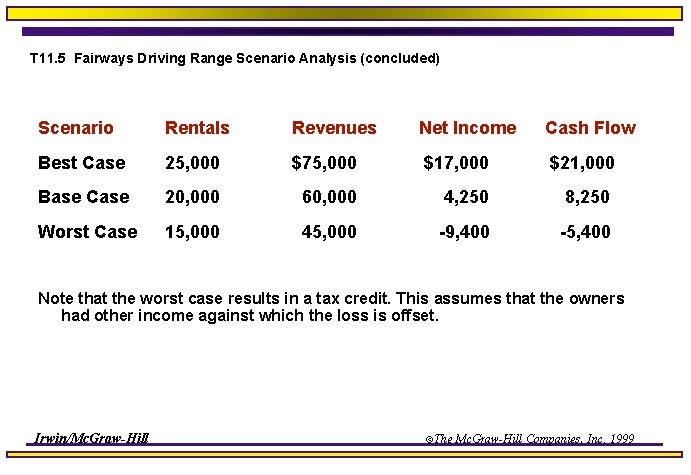
T 11. 5 Fairways Driving Range Scenario Analysis (concluded) Scenario Rentals Revenues Net Income Cash Flow Best Case 25, 000 $75, 000 $17, 000 $21, 000 Base Case 20, 000 60, 000 4, 250 8, 250 Worst Case 15, 000 45, 000 -9, 400 -5, 400 Note that the worst case results in a tax credit. This assumes that the owners had other income against which the loss is offset. Irwin/Mc. Graw-Hill ©The Mc. Graw-Hill Companies, Inc. 1999
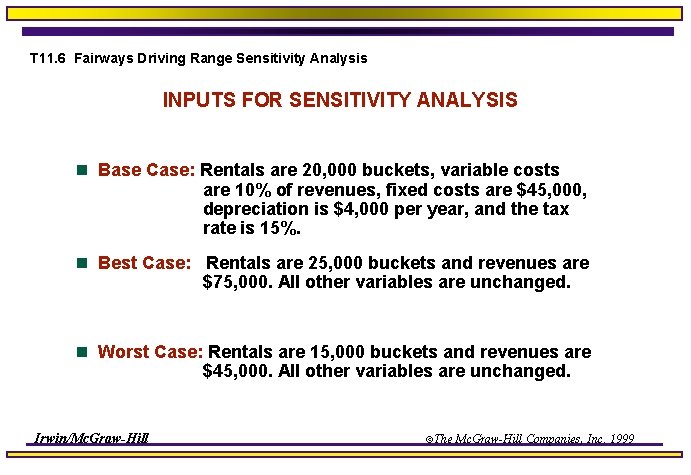
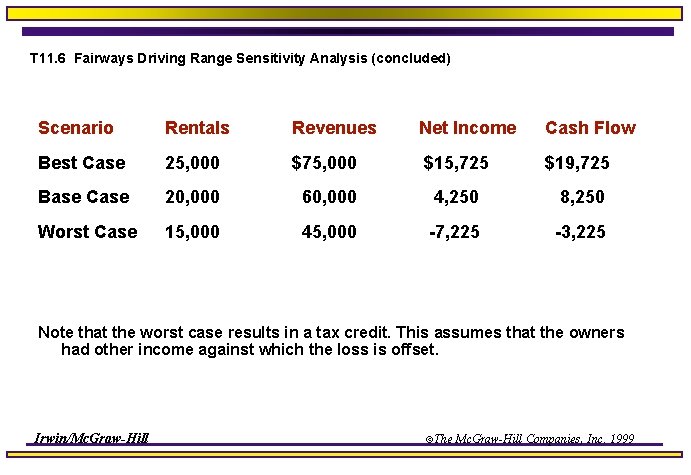
T 11. 6 Fairways Driving Range Sensitivity Analysis INPUTS FOR SENSITIVITY ANALYSIS n Base Case: Rentals are 20, 000 buckets, variable costs are 10% of revenues, fixed costs are $45, 000, depreciation is $4, 000 per year, and the tax rate is 15%. n Best Case: Rentals are 25, 000 buckets and revenues are $75, 000. All other variables are unchanged. n Worst Case: Rentals are 15, 000 buckets and revenues are $45, 000. All other variables are unchanged. Irwin/Mc. Graw-Hill ©The Mc. Graw-Hill Companies, Inc. 1999
T 11. 6 Fairways Driving Range Sensitivity Analysis (concluded) Scenario Rentals Revenues Net Income Cash Flow Best Case 25, 000 $75, 000 $15, 725 $19, 725 Base Case 20, 000 60, 000 4, 250 8, 250 Worst Case 15, 000 45, 000 -7, 225 -3, 225 Note that the worst case results in a tax credit. This assumes that the owners had other income against which the loss is offset. Irwin/Mc. Graw-Hill ©The Mc. Graw-Hill Companies, Inc. 1999
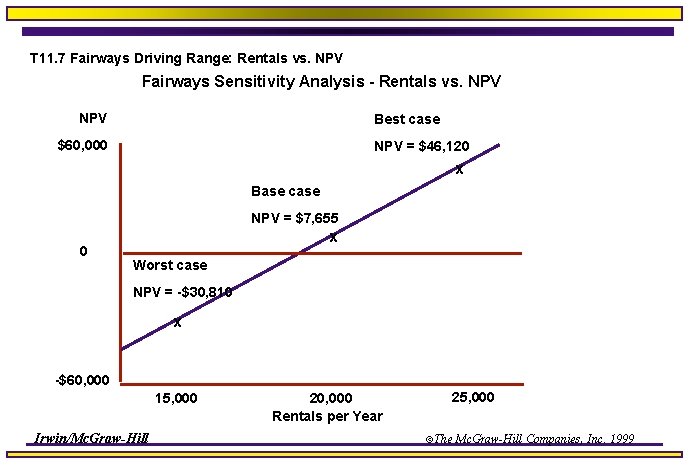
T 11. 7 Fairways Driving Range: Rentals vs. NPV Fairways Sensitivity Analysis - Rentals vs. NPV Best case $60, 000 NPV = $46, 120 x Base case NPV = $7, 655 0 x Worst case NPV = -$30, 810 x -$60, 000 15, 000 Irwin/Mc. Graw-Hill 20, 000 Rentals per Year 25, 000 ©The Mc. Graw-Hill Companies, Inc. 1999
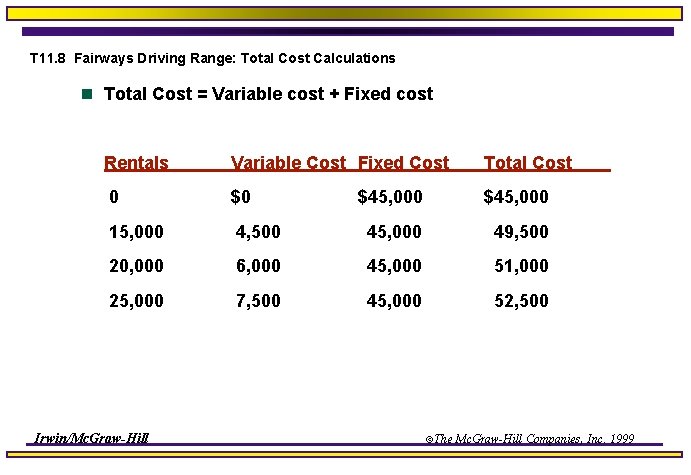
T 11. 8 Fairways Driving Range: Total Cost Calculations n Total Cost = Variable cost + Fixed cost Rentals Variable Cost Fixed Cost Total Cost 0 $0 $45, 000 15, 000 4, 500 45, 000 49, 500 20, 000 6, 000 45, 000 51, 000 25, 000 7, 500 45, 000 52, 500 Irwin/Mc. Graw-Hill ©The Mc. Graw-Hill Companies, Inc. 1999
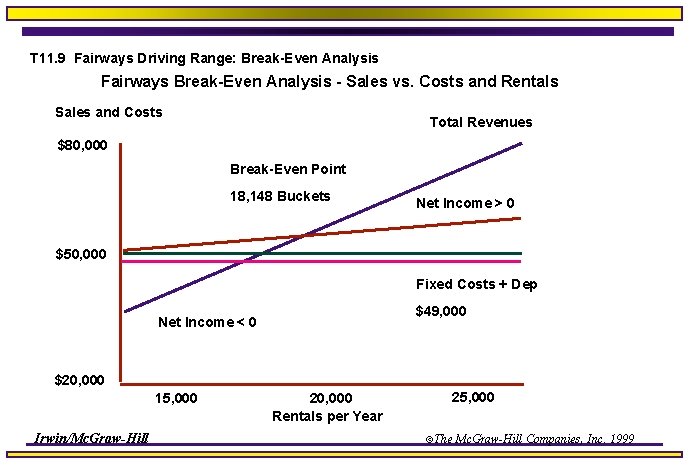
T 11. 9 Fairways Driving Range: Break-Even Analysis Fairways Break-Even Analysis - Sales vs. Costs and Rentals Sales and Costs Total Revenues $80, 000 Break-Even Point 18, 148 Buckets Net Income > 0 $50, 000 Fixed Costs + Dep $49, 000 Net Income < 0 $20, 000 15, 000 Irwin/Mc. Graw-Hill 20, 000 Rentals per Year 25, 000 ©The Mc. Graw-Hill Companies, Inc. 1999
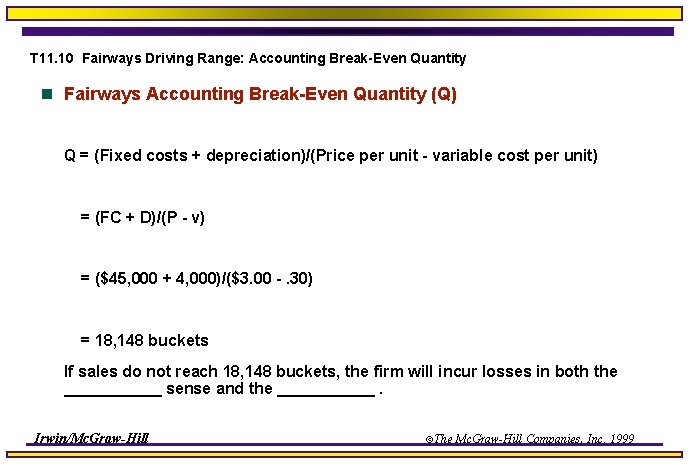
T 11. 10 Fairways Driving Range: Accounting Break-Even Quantity n Fairways Accounting Break-Even Quantity (Q) Q = (Fixed costs + depreciation)/(Price per unit - variable cost per unit) = (FC + D)/(P - v) = ($45, 000 + 4, 000)/($3. 00 -. 30) = 18, 148 buckets If sales do not reach 18, 148 buckets, the firm will incur losses in both the ______ sense and the ______. Irwin/Mc. Graw-Hill ©The Mc. Graw-Hill Companies, Inc. 1999
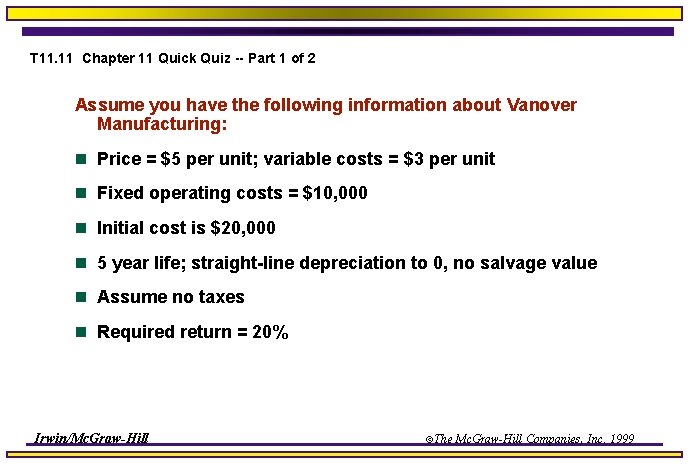
T 11. 11 Chapter 11 Quick Quiz -- Part 1 of 2 Assume you have the following information about Vanover Manufacturing: n Price = $5 per unit; variable costs = $3 per unit n Fixed operating costs = $10, 000 n Initial cost is $20, 000 n 5 year life; straight-line depreciation to 0, no salvage value n Assume no taxes n Required return = 20% Irwin/Mc. Graw-Hill ©The Mc. Graw-Hill Companies, Inc. 1999
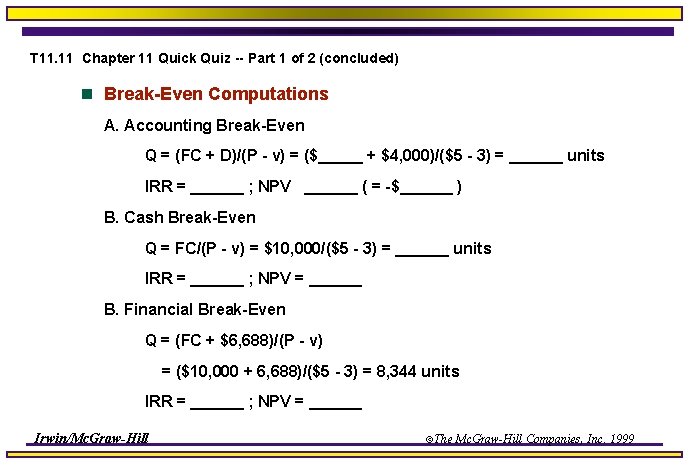
T 11. 11 Chapter 11 Quick Quiz -- Part 1 of 2 (concluded) n Break-Even Computations A. Accounting Break-Even Q = (FC + D)/(P - v) = ($_____ + $4, 000)/($5 - 3) = ______ units IRR = ______ ; NPV ______ ( = -$______ ) B. Cash Break-Even Q = FC/(P - v) = $10, 000/($5 - 3) = ______ units IRR = ______ ; NPV = ______ B. Financial Break-Even Q = (FC + $6, 688)/(P - v) = ($10, 000 + 6, 688)/($5 - 3) = 8, 344 units IRR = ______ ; NPV = ______ Irwin/Mc. Graw-Hill ©The Mc. Graw-Hill Companies, Inc. 1999
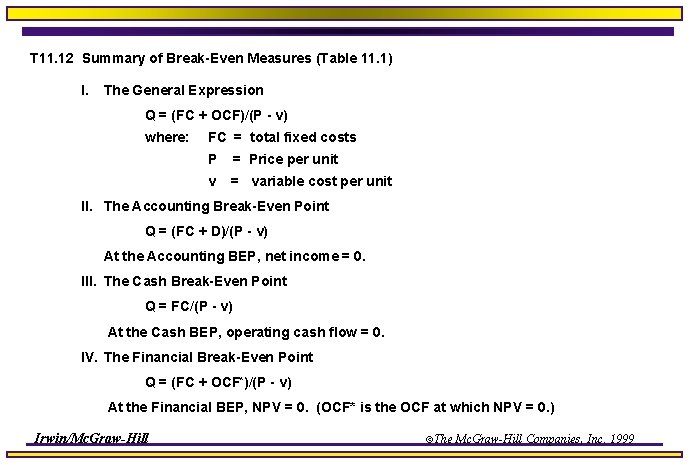
T 11. 12 Summary of Break-Even Measures (Table 11. 1) I. The General Expression Q = (FC + OCF)/(P - v) where: FC = total fixed costs P = Price per unit v = variable cost per unit II. The Accounting Break-Even Point Q = (FC + D)/(P - v) At the Accounting BEP, net income = 0. III. The Cash Break-Even Point Q = FC/(P - v) At the Cash BEP, operating cash flow = 0. IV. The Financial Break-Even Point Q = (FC + OCF*)/(P - v) At the Financial BEP, NPV = 0. (OCF* is the OCF at which NPV = 0. ) Irwin/Mc. Graw-Hill ©The Mc. Graw-Hill Companies, Inc. 1999
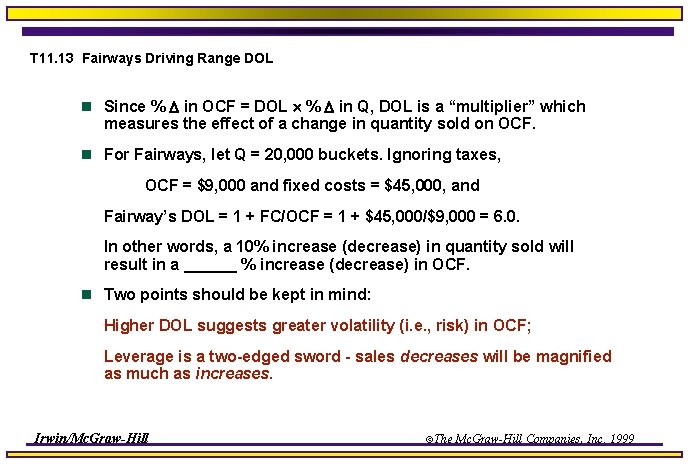
T 11. 13 Fairways Driving Range DOL n Since % in OCF = DOL % in Q, DOL is a “multiplier” which measures the effect of a change in quantity sold on OCF. n For Fairways, let Q = 20, 000 buckets. Ignoring taxes, OCF = $9, 000 and fixed costs = $45, 000, and Fairway’s DOL = 1 + FC/OCF = 1 + $45, 000/$9, 000 = 6. 0. In other words, a 10% increase (decrease) in quantity sold will result in a ______ % increase (decrease) in OCF. n Two points should be kept in mind: Higher DOL suggests greater volatility (i. e. , risk) in OCF; Leverage is a two-edged sword - sales decreases will be magnified as much as increases. Irwin/Mc. Graw-Hill ©The Mc. Graw-Hill Companies, Inc. 1999
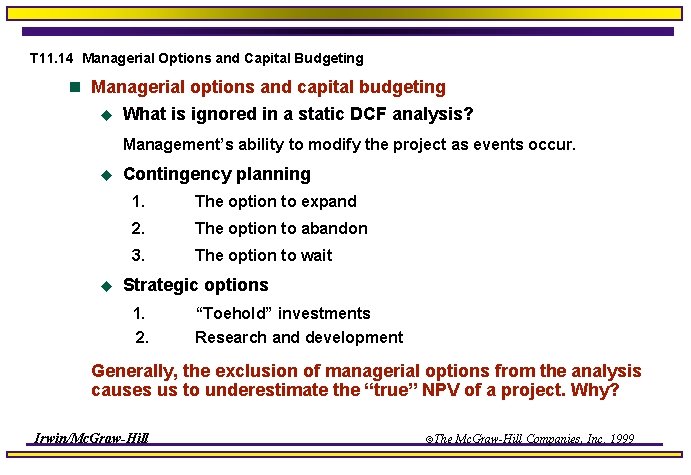
T 11. 14 Managerial Options and Capital Budgeting n Managerial options and capital budgeting u What is ignored in a static DCF analysis? Management’s ability to modify the project as events occur. u u Contingency planning 1. The option to expand 2. The option to abandon 3. The option to wait Strategic options 1. “Toehold” investments 2. Research and development Generally, the exclusion of managerial options from the analysis causes us to underestimate the “true” NPV of a project. Why? Irwin/Mc. Graw-Hill ©The Mc. Graw-Hill Companies, Inc. 1999
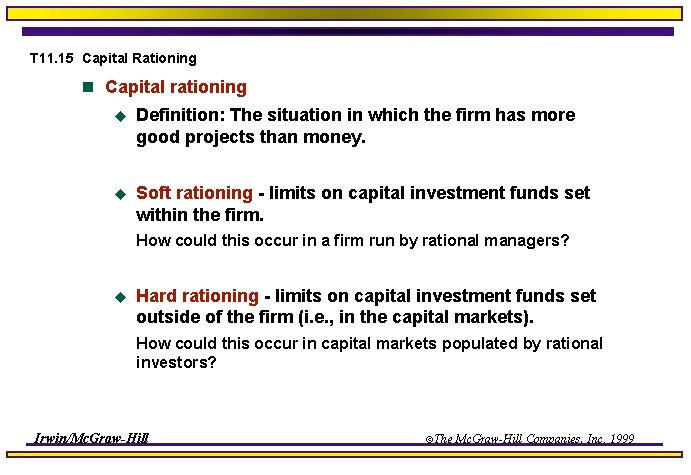
T 11. 15 Capital Rationing n Capital rationing u Definition: The situation in which the firm has more good projects than money. u Soft rationing - limits on capital investment funds set within the firm. How could this occur in a firm run by rational managers? u Hard rationing - limits on capital investment funds set outside of the firm (i. e. , in the capital markets). How could this occur in capital markets populated by rational investors? Irwin/Mc. Graw-Hill ©The Mc. Graw-Hill Companies, Inc. 1999
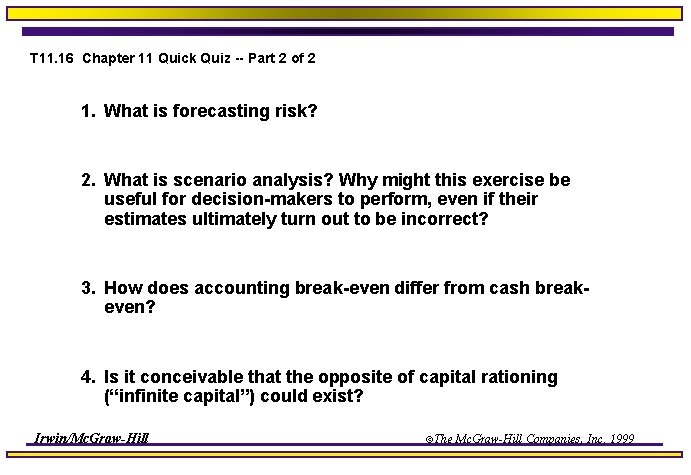
T 11. 16 Chapter 11 Quick Quiz -- Part 2 of 2 1. What is forecasting risk? 2. What is scenario analysis? Why might this exercise be useful for decision-makers to perform, even if their estimates ultimately turn out to be incorrect? 3. How does accounting break-even differ from cash breakeven? 4. Is it conceivable that the opposite of capital rationing (“infinite capital”) could exist? Irwin/Mc. Graw-Hill ©The Mc. Graw-Hill Companies, Inc. 1999
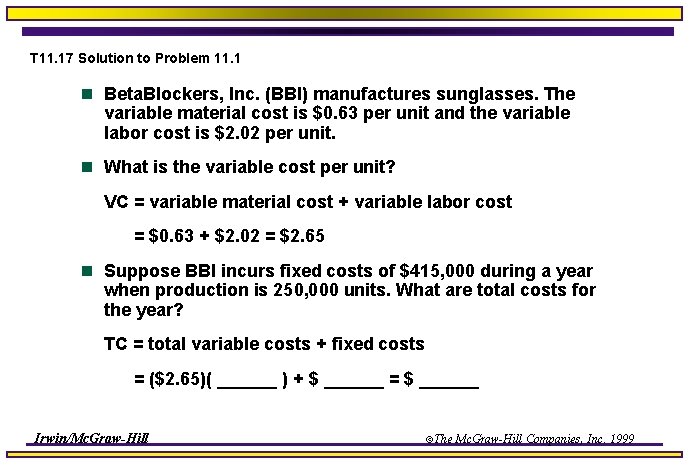
T 11. 17 Solution to Problem 11. 1 n Beta. Blockers, Inc. (BBI) manufactures sunglasses. The variable material cost is $0. 63 per unit and the variable labor cost is $2. 02 per unit. n What is the variable cost per unit? VC = variable material cost + variable labor cost = $0. 63 + $2. 02 = $2. 65 n Suppose BBI incurs fixed costs of $415, 000 during a year when production is 250, 000 units. What are total costs for the year? TC = total variable costs + fixed costs = ($2. 65)( ______ ) + $ ______ = $ ______ Irwin/Mc. Graw-Hill ©The Mc. Graw-Hill Companies, Inc. 1999
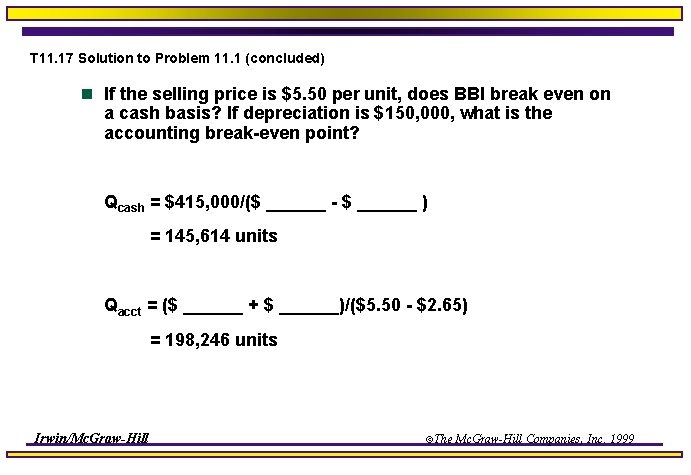
T 11. 17 Solution to Problem 11. 1 (concluded) n If the selling price is $5. 50 per unit, does BBI break even on a cash basis? If depreciation is $150, 000, what is the accounting break-even point? Qcash = $415, 000/($ ______ - $ ______ ) = 145, 614 units Qacct = ($ ______ + $ ______)/($5. 50 - $2. 65) = 198, 246 units Irwin/Mc. Graw-Hill ©The Mc. Graw-Hill Companies, Inc. 1999
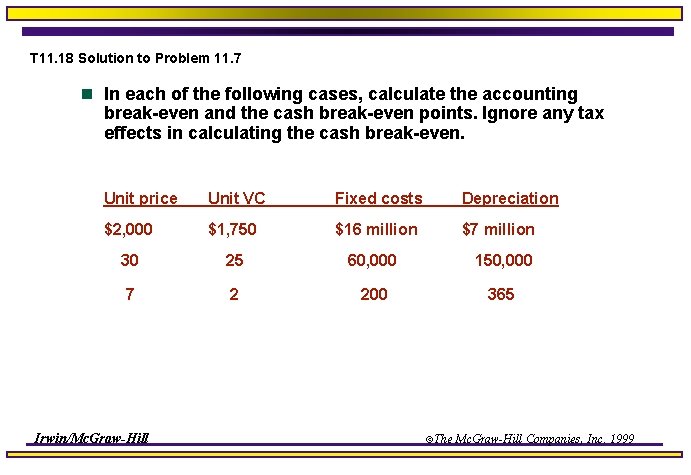
T 11. 18 Solution to Problem 11. 7 n In each of the following cases, calculate the accounting break-even and the cash break-even points. Ignore any tax effects in calculating the cash break-even. Unit price Unit VC Fixed costs Depreciation $2, 000 $1, 750 $16 million $7 million 30 25 60, 000 150, 000 7 2 200 365 Irwin/Mc. Graw-Hill ©The Mc. Graw-Hill Companies, Inc. 1999
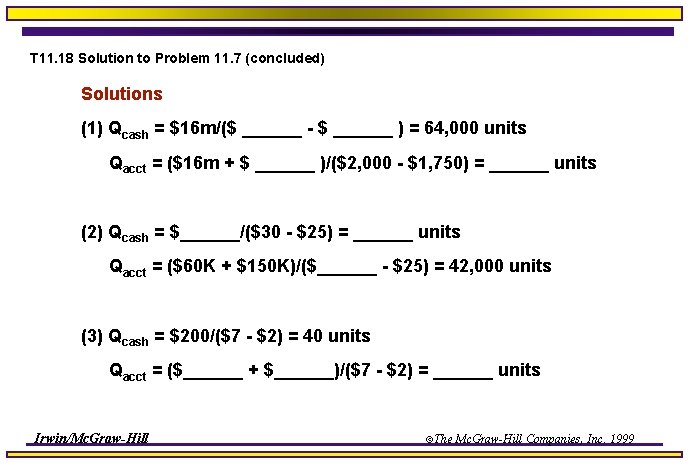
T 11. 18 Solution to Problem 11. 7 (concluded) Solutions (1) Qcash = $16 m/($ ______ - $ ______ ) = 64, 000 units Qacct = ($16 m + $ ______ )/($2, 000 - $1, 750) = ______ units (2) Qcash = $______/($30 - $25) = ______ units Qacct = ($60 K + $150 K)/($______ - $25) = 42, 000 units (3) Qcash = $200/($7 - $2) = 40 units Qacct = ($______ + $______)/($7 - $2) = ______ units Irwin/Mc. Graw-Hill ©The Mc. Graw-Hill Companies, Inc. 1999
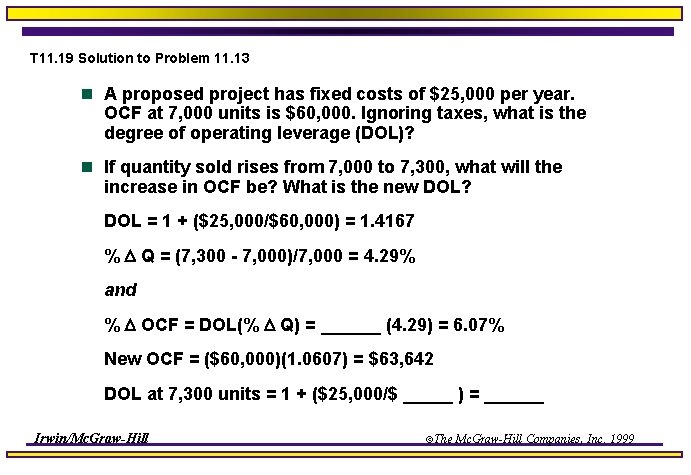
T 11. 19 Solution to Problem 11. 13 n A proposed project has fixed costs of $25, 000 per year. OCF at 7, 000 units is $60, 000. Ignoring taxes, what is the degree of operating leverage (DOL)? n If quantity sold rises from 7, 000 to 7, 300, what will the increase in OCF be? What is the new DOL? DOL = 1 + ($25, 000/$60, 000) = 1. 4167 % Q = (7, 300 - 7, 000)/7, 000 = 4. 29% and % OCF = DOL(% Q) = ______ (4. 29) = 6. 07% New OCF = ($60, 000)(1. 0607) = $63, 642 DOL at 7, 300 units = 1 + ($25, 000/$ _____ ) = ______ Irwin/Mc. Graw-Hill ©The Mc. Graw-Hill Companies, Inc. 1999