
systems tract SB sequence boundary LST lowstand systems

systems tract
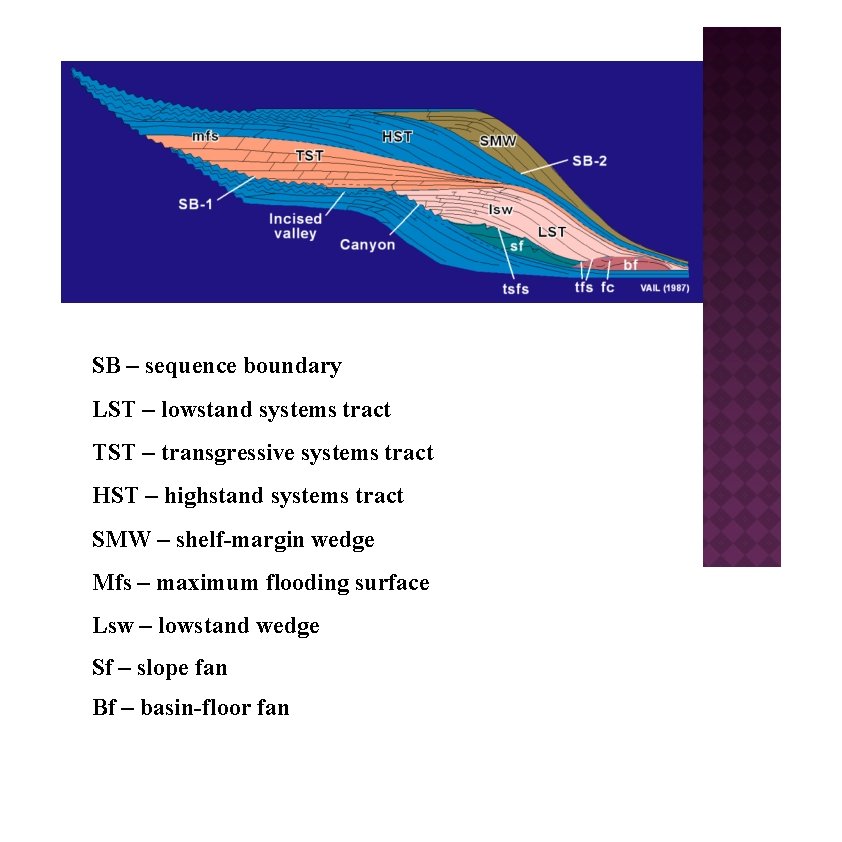
SB – sequence boundary LST – lowstand systems tract TST – transgressive systems tract HST – highstand systems tract SMW – shelf-margin wedge Mfs – maximum flooding surface Lsw – lowstand wedge Sf – slope fan Bf – basin-floor fan
Introduction The concept of systems tract was introduced to define a linkage of contemporaneous depositional systems, forming the subdivision of a sequence. Systems tracts are interpreted based on stratal stacking patterns, position within the sequence and types of bounding surfaces, and are assigned particular positions along an inferred curve of base-level changes at the shoreline.
The early Exxon sequence model accounts for the subdivision of depositional sequences into four component systems tracts. These are the lowstand, transgressive, highstand, and shelfmargin systems tracts. These systems tracts were first defined relative to a curve of eustatic fluctuations. The lowstand the shelf-margin systems tracts are similar concepts, as being both related to the same portion of the reference sea-level curve (the stage of fall— early rise), so they were used interchangeably as part of a depositional sequence

A sequence composed of lowstand, transgressive and highstand systems tracts was defined as a ‘type 1’ sequence

combination of shelf-margin, transgressive and highstand systems tracts was said to have formed a ‘type 2’ sequence
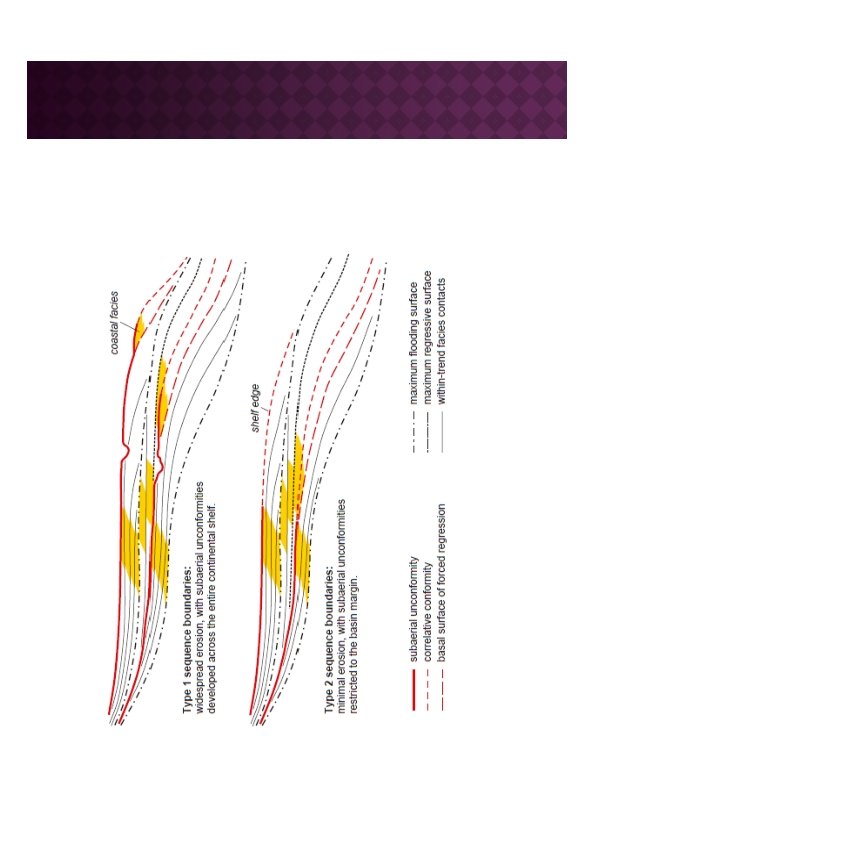
a type 1 sequence boundary forms during a stage of rapid eustatic sea-level fall, when the rates of fall are greater than the rate of subsidence at the shelf edge. By implication, as the rates of subsidence decrease in a landward direction across a continental shelf, the rates of sea-level fall exceed even more the rates of subsidence at the shoreline, leading to a fast retreat (forced regression) of the shoreline and significant erosion of the exposed shelf.
a type 2 sequence boundary forms during stages of slow eustatic sea-level fall, when the rates of fall are less than the rate of subsidence at the shelf edge. As the rates of subsidence decrease in a landward direction, such type 2 unconformities are inferred to be associated with very slow rates of relative sea-level fall at the shoreline (slow eustatic fall > slower subsidence.
Systems tract- idealized type-1 sequence shown is representative of a shelf-break margin. It was observed in the early days of seismic stratigraphy that deposition in a basin was not uniform and continuous but occurred in a series of discrete packets bounded terminations. by seismic reflection

These packages that generally were arranged in a predictable fashion in the majority of sequence are known as systems tract. A system tract is therefore a three-dimensional unit of deposition, and is recognized and defined by the nature of their boundaries (the boundaries of a system tract are depositional Boundaries of onlap, downlap, …. etc), and by their internal geometry.
Within one relative sea-level cycle, three main systems tracts are frequently enveloped. The system tract represents the fundamental mapping unit for stratigraphic prediction, because it contains a set of depositional systems with consistent palaeogeography and depositional polarity, and for which a palaeogeographic map can be drawn. Note that systems tracts should be defined on the basis of the type of boun 1 ding surface, their position 2 in a sequence and their intern 3 al geometry

Stratal geometries in a type 1 sequence on a shelf-break margin. Five separate sedimentary packages are shown, traditionally Assigned to three systems tract: lowstand, trnasgressive and Highstand.
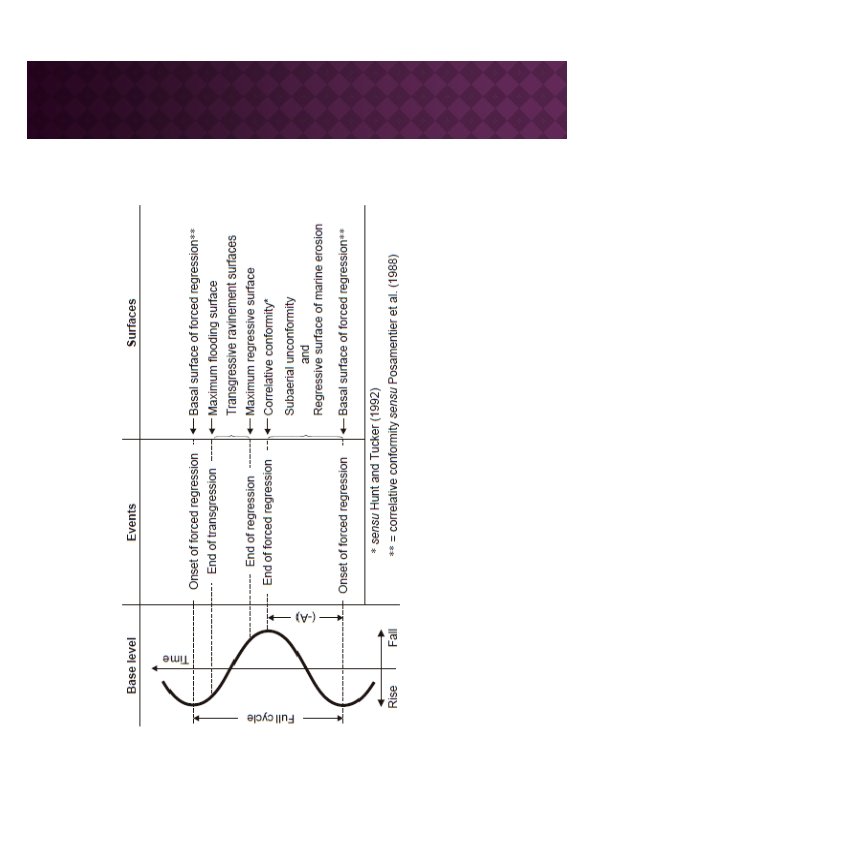
Falling Stage Systems Tract includes all the regressional deposits that accumulated after the onset of a relative sea-level fall and before the start of the next relative sea-level rise. The Falling Stage Systems Tract is the product of a forced regression (one should not confuse this with the sediments deposited during a normal regression). The FSST lies directly on the sequence boundary and is capped by the overlying Lowstand Systems Tract sediments.
This systems tract has also been termed the Early Lowstand Systems Tract (ELST) The fall of sea-level is evidenced by the erosion of the subaerially exposed sediment surface updip and the formation of a diachronous sequence boundary that caps the Highstand Systems Tract (HST).

Lowstand systems tract is the basal (stratigraphically oldest) system tract in a type 1 depositional sequence. It is deposited during an interval of relative sea-level fall at the offlap break, and subsequent slow relative sea-level rise. Falling relative sea-level at the offlap break of a shelf-break margin will have an extreme effect on the river system. Prior to relative sea-level fall, the rivers have a more or less maintained a graded river profile with erosional upper portion and a depositional lower portion (alluvial plain and coastal plain).
With relative sea-level fall at the offlap break, the river profile will have to adjust to the lowered base level. The river incises into the previous deposited topsets; i. e. the alluvial plain, coastal plain and/or shelf deposits of the previous sequence. These reworked sediments, and the fluvial load from the hinterland, are delivered directly on to the previous highstand clinoform slope.
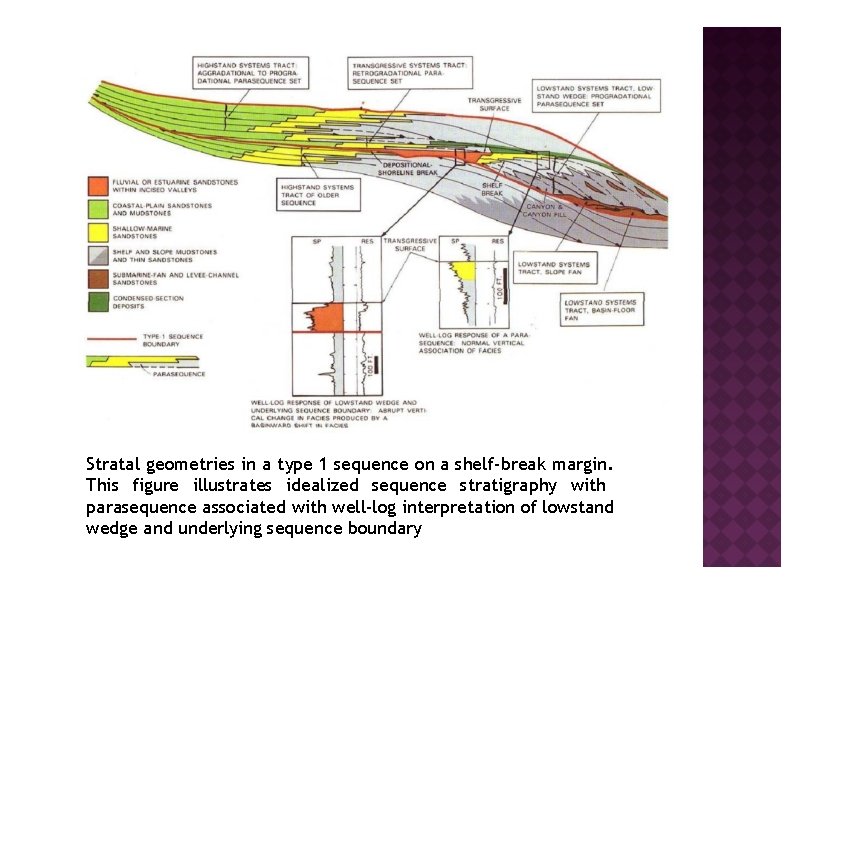
Stratal geometries in a type 1 sequence on a shelf-break margin. This figure illustrates idealized sequence stratigraphy with parasequence associated with well-log interpretation of lowstand wedge and underlying sequence boundary
The lowstand systems tract therefore consists of two parts; a unit of submarine fans deposited during falling relative sea-level, and a topsetclinoform system, initially progradational but becoming aggradational, deposited during a slow rise of relative sea-level. River sediment is trapped in these estuaries and is prevented from reaching the shelf.
Two distinctive fan units can be recognized within the lowstand submarine fan; an initial basin floor fan unit, detached from the foot of the slope, and a subsequent slope fan unit, abutting the slope, occasionally referred to as ‘slope front fill’.
characterized by Submarine fan deposits on the lower slope or basin floor (Van Wagoner et al, . 1988). Fan formation is associated with erosion of canyons into the slope and the incision of fluvial valleys into the shelf. The base of the basin-floor fan(coincident with the base of the lowstand systems tract) is correlated with the type 1 sequence boundary and the top of the fan may be a downlap surface to the subsequent lowstand prograding wedge, if it prograded far enough, or may be a downlap surface for any overlying slope fans.
Basin-floor fan deposition, canyon formation, and incised valley erosion are interpreted to occur during a fall in relative sea-level over the entire of topset area.
characterized by turbidite and debris-flow deposition on the middle or the base of the slope (Van Wagoner et al. , 1988). Slope-fan deposition can be coeval with the basin-floor fan or with the early portion of the lowstand wedge. The top of the slope fan may be a downlap surface for the middle and upper portions of the lowstand wedge.
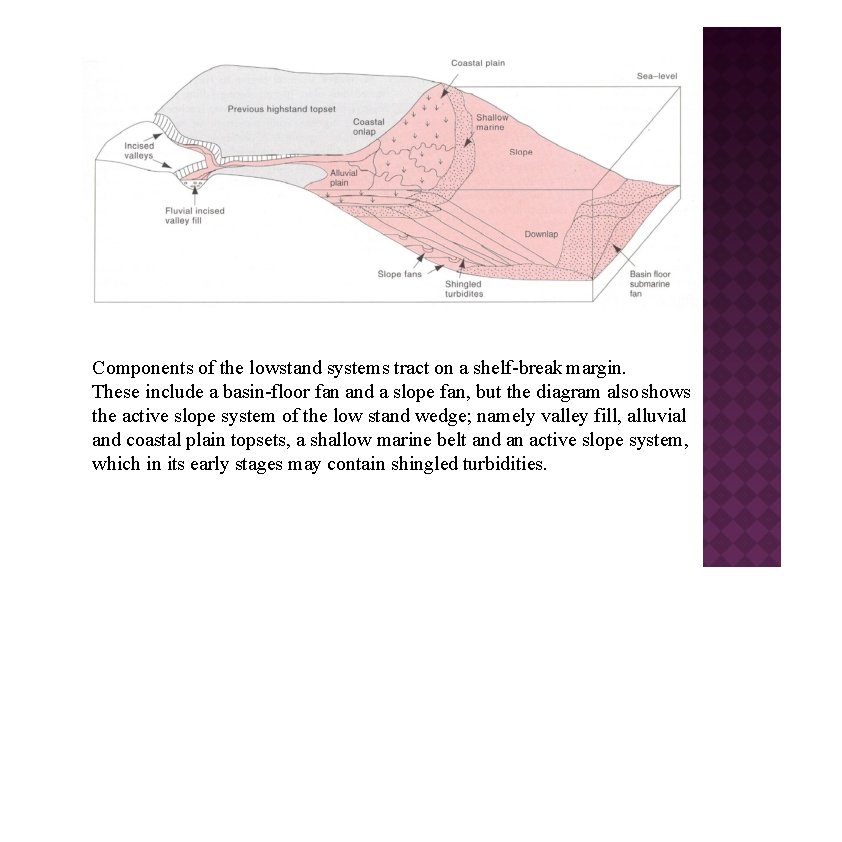
Components of the lowstand systems tract on a shelf-break margin. These include a basin-floor fan and a slope fan, but the diagram also shows the active slope system of the low stand wedge; namely valley fill, alluvial and coastal plain topsets, a shallow marine belt and an active slope system, which in its early stages may contain shingled turbidities.
Following the relative fall in sea level that produces the sequence boundary, relative sea-level begins to bottom out and eventually begins to rise slowly, but at a very slow rate. This slow rate of accommodation coupled with relatively high supply of sediment results in the progradational stacking typical of the lowstand wedge.
Lowstand prograding wedge is a topset-clinoform system deposited during accelerating relative sea-level rise. It is separated from the overlying system transgressive prograding surface, parasequences tract by marking stacking a a maximum change geometry in from progradational (in the lowstand wedge) to retrogradational (in transgressive systems tract). Deposition of the lowstand prograding wedge is confined initially to the areas around the mouths of incised rivers
- Slides: 27