
Systems Thinking How to Solve Problems So They
Systems Thinking How to Solve Problems So They Stay Solved Supplemental Self-Study Presentation

Systems Thinking: How to Solve Problems So They Stay Solved Overview

Systems Thinking: How to Solve Problems So They Stay Solved Introduction From production and marketing to customer service and fulfillment, organizations are made up of a series of interconnected parts. And while each function may appear to operate efficiently on its own, a change in just one cog can throw the whole system out of whack, creating a continuous chain reaction of problems. Systems thinking is a proactive problem-solving approach that examines the relationships between various organizational functions and how they impact each other. What makes systems thinking so powerful is that it enables you to predict the consequences—intended and unintended—of a potential change, eliminate silo thinking, adjust perspectives to see different viewpoints, and remain focused on the big picture. By understanding and implementing the systems thinking process, you will be able to help your organization find optimal solutions to complex challenges, improve innovation, and increase productivity.
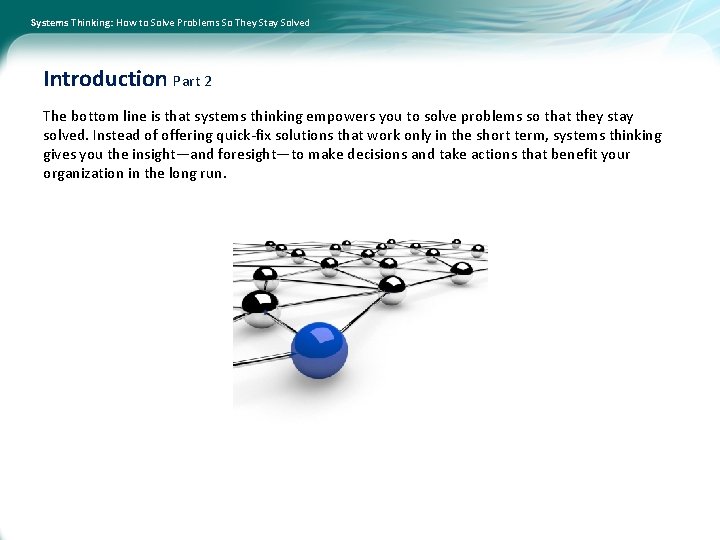
Systems Thinking: How to Solve Problems So They Stay Solved Introduction Part 2 The bottom line is that systems thinking empowers you to solve problems so that they stay solved. Instead of offering quick-fix solutions that work only in the short term, systems thinking gives you the insight—and foresight—to make decisions and take actions that benefit your organization in the long run.
Systems Thinking: How to Solve Problems So They Stay Solved Module 1: What is Systems Thinking and Why Does it Matter?
Systems Thinking: How to Solve Problems So They Stay Solved Scenario to Consider To introduce the concept of systems thinking, let’s consider the following scenario: The Environmental, Health & Safety (EH&S) department of a large corporation planned a fire drill for its campus of three buildings. They notified employees by email and text message, and when the scheduled time came, the fire drill went off without a hitch—from the EH&S department’s point of view. However, soon after the drill, they received some urgent messages. The first was from the company’s onsite daycare center. Several of the children flipped out when the alarm sounded, and the caregivers were unable to soothe them. Their parents had to be called to calm them down. The next call came from a visiting salesperson, whose migraines are triggered by loud sounds and flashing lights—unfortunately, the very things that signal a fire drill. Since he was visiting on campus, he wasn’t informed of the drill ahead of time.
Systems Thinking: How to Solve Problems So They Stay Solved Scenario to Consider Part 2 The EH&S department planned the drill with a silo mentality—as long as it was successful from their perspective, that’s all that mattered. If department employees had applied systems thinking, they would have reached out to employees throughout the organization to determine possible unintended consequences and made plans to avoid them.
Systems Thinking: How to Solve Problems So They Stay Solved Background of Systems Thinking The field of systems dynamics was founded in 1957 by Jay Forrester, a professor at MIT, primarily in response to his work with managers at General Electric. He found that economic conditions alone couldn’t explain the employee instability at one of its locations. Forrester was able to show the issue was due to the internal structure of the organization, rather than external factors such as business climate. Forrester’s approach showed how the relationships among connected elements in a system may affect the behavior of the system more than the individual elements themselves. He and others began to apply this perspective to other business systems.
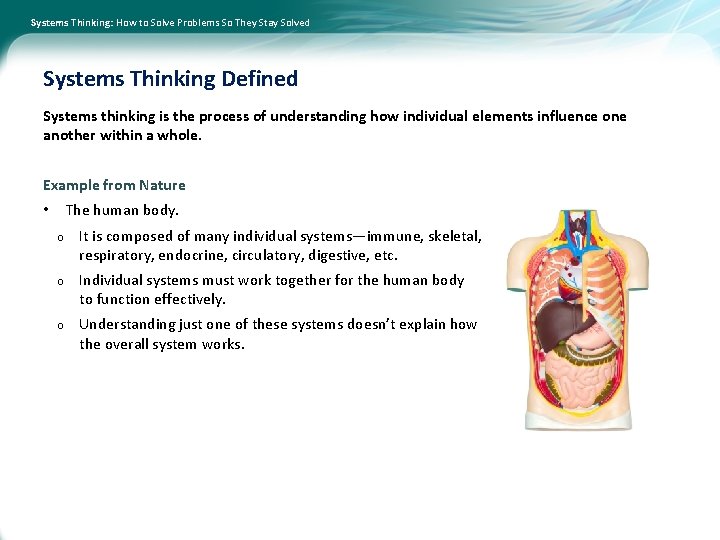
Systems Thinking: How to Solve Problems So They Stay Solved Systems Thinking Defined Systems thinking is the process of understanding how individual elements influence one another within a whole. Example from Nature The human body. • o It is composed of many individual systems—immune, skeletal, respiratory, endocrine, circulatory, digestive, etc. o Individual systems must work together for the human body to function effectively. o Understanding just one of these systems doesn’t explain how the overall system works.

Systems Thinking: How to Solve Problems So They Stay Solved Systems Thinking Defined Part 2 Example from the Man-Made World Educating a student. • o A student’s education is influenced by many factors including teachers, parents, school administration, textbooks, the physical building, extracurricular programs, etc. o A systems thinking perspective involves taking an interdisciplinary approach to learning; for example, studying the ocean by counting shells, learning the anatomy of fish, learning how different cultures relate to the ocean, and writing stories about the ocean.
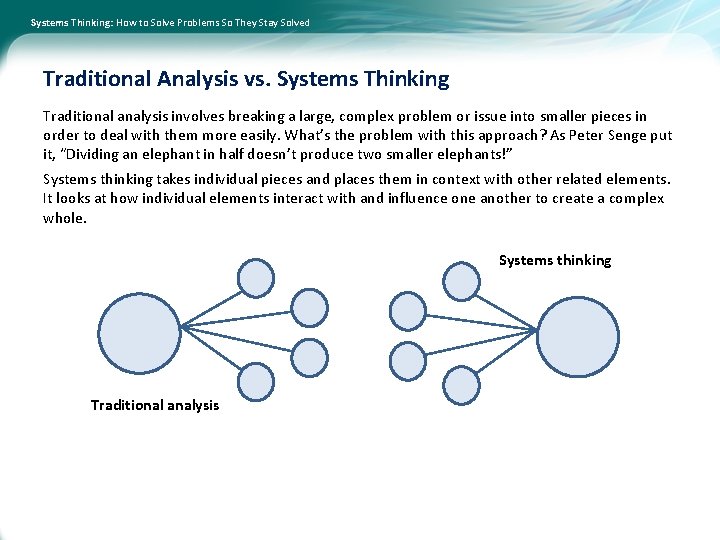
Systems Thinking: How to Solve Problems So They Stay Solved Traditional Analysis vs. Systems Thinking Traditional analysis involves breaking a large, complex problem or issue into smaller pieces in order to deal with them more easily. What’s the problem with this approach? As Peter Senge put it, “Dividing an elephant in half doesn’t produce two smaller elephants!” Systems thinking takes individual pieces and places them in context with other related elements. It looks at how individual elements interact with and influence one another to create a complex whole. Systems thinking Traditional analysis
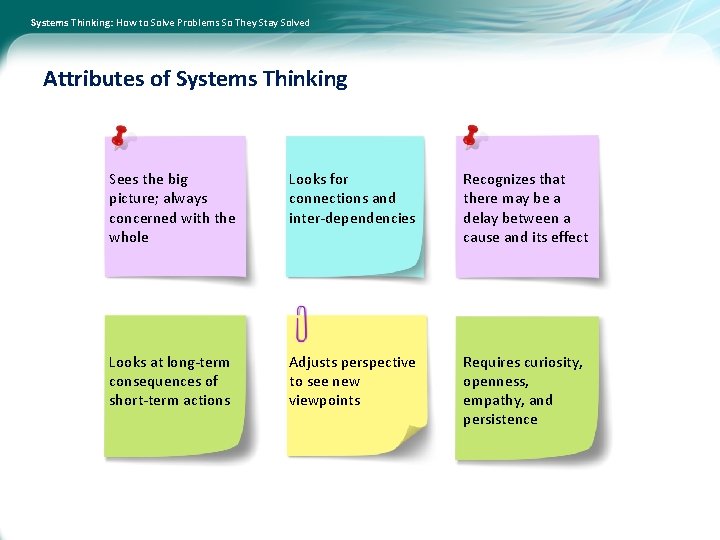
Systems Thinking: How to Solve Problems So They Stay Solved Attributes of Systems Thinking Sees the big picture; always concerned with the whole Looks for connections and inter-dependencies Recognizes that there may be a delay between a cause and its effect Looks at long-term consequences of short-term actions Adjusts perspective to see new viewpoints Requires curiosity, openness, empathy, and persistence
Systems Thinking: How to Solve Problems So They Stay Solved Benefits of Systems Thinking Systems thinking is useful in the workplace in many ways, such as: • Helping you understand relationships. • Helping you see the consequences (intended and unintended) of a potential change. • Providing a common language for examining and solving problems. • Enabling you to minimize silo thinking. • Helping you avoid making quick-fix decisions. • Making your organization more competitive and cost-effective. • Helping provide a permanent, long-term solution to a problem.
Systems Thinking: How to Solve Problems So They Stay Solved Basic Process of Systems Thinking Systems thinkers realize that all solutions have consequences. The goal is to choose the solution that has the most positive impact and the least negative impact overall. The basic process of systems thinking follows three steps. Observe events. • o Ask: “What happened? ” Identify patterns of behavior and/or underlying structures that drive those events. • o Ask: “What has been happening? What patterns or trends exist? ” Understand change the behaviors and/or structure in order to create long-term solutions to ongoing problems. • o Ask: “Why is this happening? What assumptions, structures, and forces have created or contributed to this behavior? ”
Systems Thinking: How to Solve Problems So They Stay Solved Using Systems Thinking When to Use Systems Thinking • You are faced with ongoing problems that have not been resolved successfully. • You have tried a solution that merely pushed the problem into another area (another part of the system). • You are dealing with important issues that affect various parts of the organization, especially customers or clients. Why Isn’t It Used More Often? If systems thinking is so great, why isn’t it used more often? There a variety of reasons. People don’t know or understand it. • o If individuals aren’t familiar with systems thinking or don’t feel confident using it, they will hesitate to embrace it.
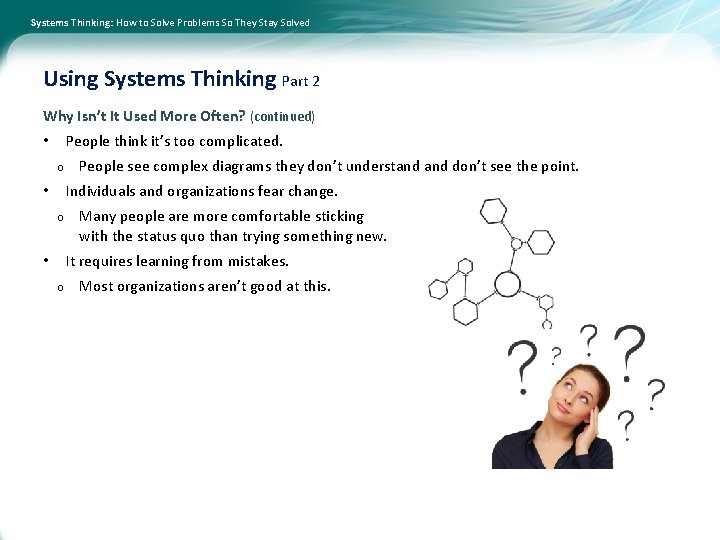
Systems Thinking: How to Solve Problems So They Stay Solved Using Systems Thinking Part 2 Why Isn’t It Used More Often? (continued) People think it’s too complicated. • o People see complex diagrams they don’t understand don’t see the point. Individuals and organizations fear change. • o Many people are more comfortable sticking with the status quo than trying something new. It requires learning from mistakes. • o Most organizations aren’t good at this.
Systems Thinking: How to Solve Problems So They Stay Solved Test Your Knowledge Read the question, then click on the answer. Which of the following is an example of systems thinking? A. Breaking down a large issue into smaller ones. B. Focusing on short-term results. C. Focusing on unintended consequences. D. Having a silo mentality.

Systems Thinking: How to Solve Problems So They Stay Solved Module 2: Systems Thinking Language and Tools
Systems Thinking: How to Solve Problems So They Stay Solved Key Terms Systems thinking terminology can feel like a new language. Here a few basic terms to learn: i • Causal loop diagram (CLD): A visual picture of how various elements in a system are connected and how they interact with one another. • Link: A cause-and-effect relationship that exists between two system elements. • Feedback loop: A change in an element of a system that eventually returns to cause a further change in that same element. • Reinforcing loop: A feedback loop where the net change of all the elements results in an exponential increase or decrease. • Balancing loop: A feedback loop where the changes of some of the elements counteract the others and the net change of all the elements results in a desired state or condition of stasis.
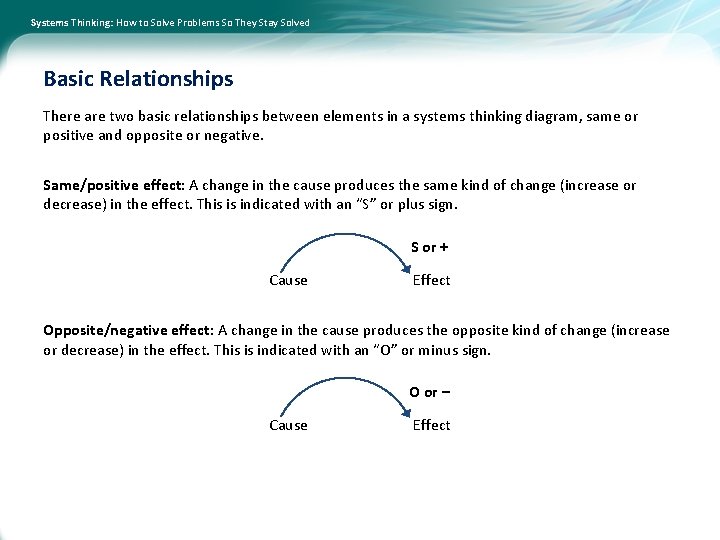
Systems Thinking: How to Solve Problems So They Stay Solved Basic Relationships There are two basic relationships between elements in a systems thinking diagram, same or positive and opposite or negative. Same/positive effect: A change in the cause produces the same kind of change (increase or decrease) in the effect. This is indicated with an “S” or plus sign. S or + Cause Effect Opposite/negative effect: A change in the cause produces the opposite kind of change (increase or decrease) in the effect. This is indicated with an “O” or minus sign. O or – Cause Effect
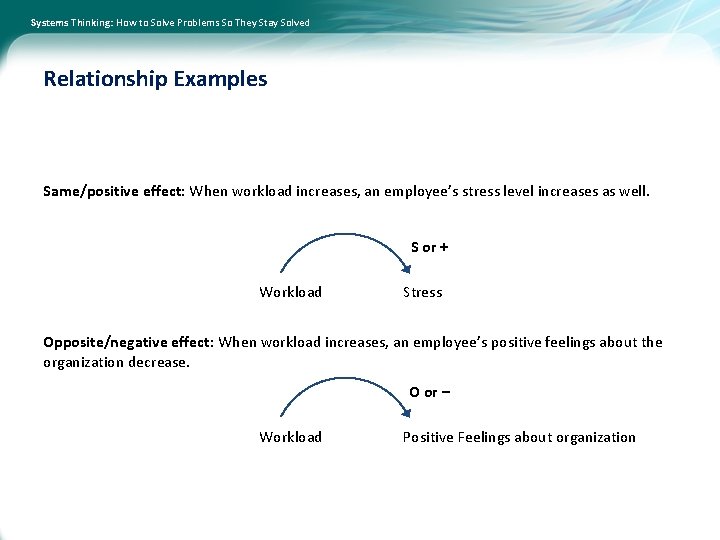
Systems Thinking: How to Solve Problems So They Stay Solved Relationship Examples Same/positive effect: When workload increases, an employee’s stress level increases as well. S or + Workload Stress Opposite/negative effect: When workload increases, an employee’s positive feelings about the organization decrease. O or – Workload Positive Feelings about organization

Systems Thinking: How to Solve Problems So They Stay Solved Determining Cause and Effect If you’re unsure how to determine cause and effect, consider these points: • The assumed cause must occur before the effect. • The effect must be present when the cause is present. • The effect must be absent when the cause is absent. • The assumed cause must be the only reasonable explanation for the effect. This will take some detective work!
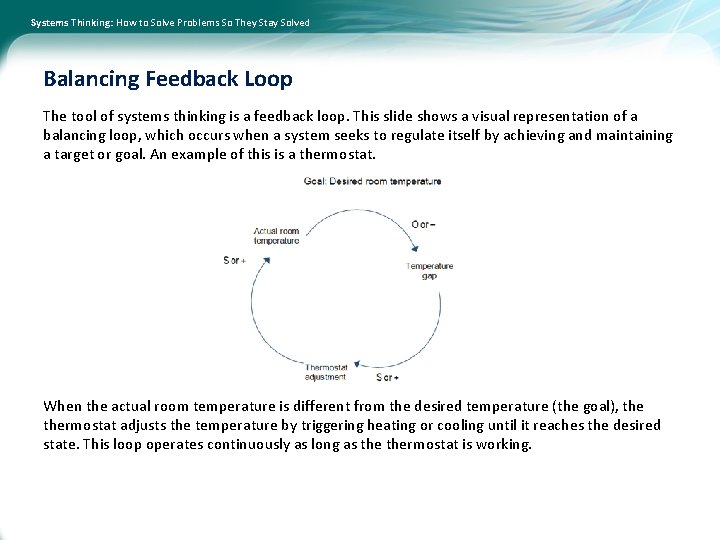
Systems Thinking: How to Solve Problems So They Stay Solved Balancing Feedback Loop The tool of systems thinking is a feedback loop. This slide shows a visual representation of a balancing loop, which occurs when a system seeks to regulate itself by achieving and maintaining a target or goal. An example of this is a thermostat. When the actual room temperature is different from the desired temperature (the goal), thermostat adjusts the temperature by triggering heating or cooling until it reaches the desired state. This loop operates continuously as long as thermostat is working.
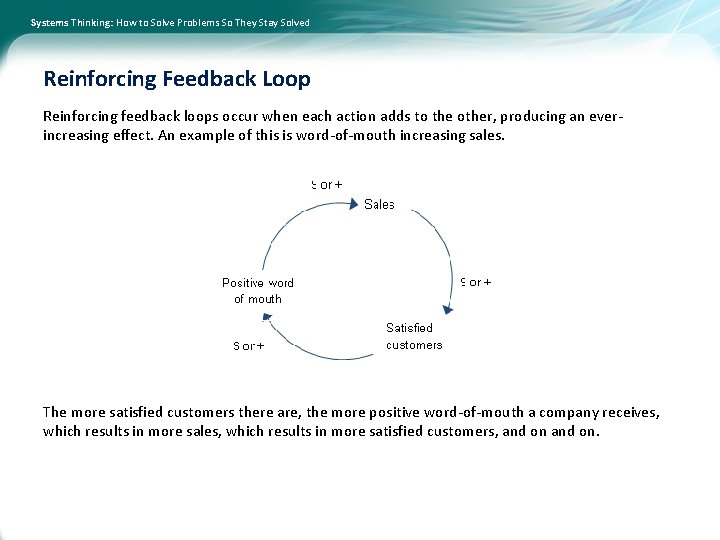
Systems Thinking: How to Solve Problems So They Stay Solved Reinforcing Feedback Loop Reinforcing feedback loops occur when each action adds to the other, producing an everincreasing effect. An example of this is word-of-mouth increasing sales. The more satisfied customers there are, the more positive word-of-mouth a company receives, which results in more sales, which results in more satisfied customers, and on.
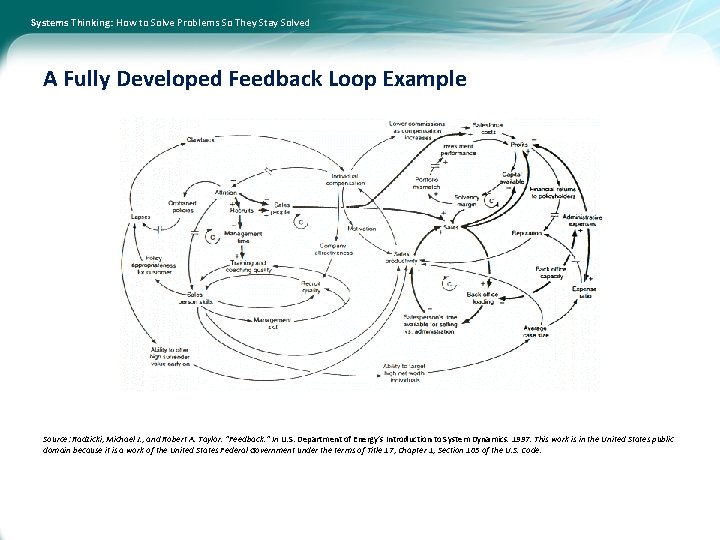
Systems Thinking: How to Solve Problems So They Stay Solved A Fully Developed Feedback Loop Example Source: Radzicki, Michael J. , and Robert A. Taylor. “Feedback. ” In U. S. Department of Energy’s Introduction to System Dynamics. 1997. This work is in the United States public domain because it is a work of the United States Federal Government under the terms of Title 17, Chapter 1, Section 105 of the U. S. Code.
Systems Thinking: How to Solve Problems So They Stay Solved Identifying and Drawing Feedback Loops An easy way to identify whether a feedback loop is balancing or reinforcing is to count the number of Os (opposite or inverse relationships). • Even number of Os = Reinforcing loop • Odd number of Os = Balancing loop Tips for Drawing Useful Feedback Loops • Start with the key issue or problem and ask, “What does this drive? ” or “What is driven by this? ” • Use nouns (not verbs) to label each item. For example, write “ability to cope” rather than “ensure we can cope. ” This helps make causes and effects more clear. • Don’t include phrases such as “increase in” or “decrease in”—that’s what the S/+ and O/– are for.
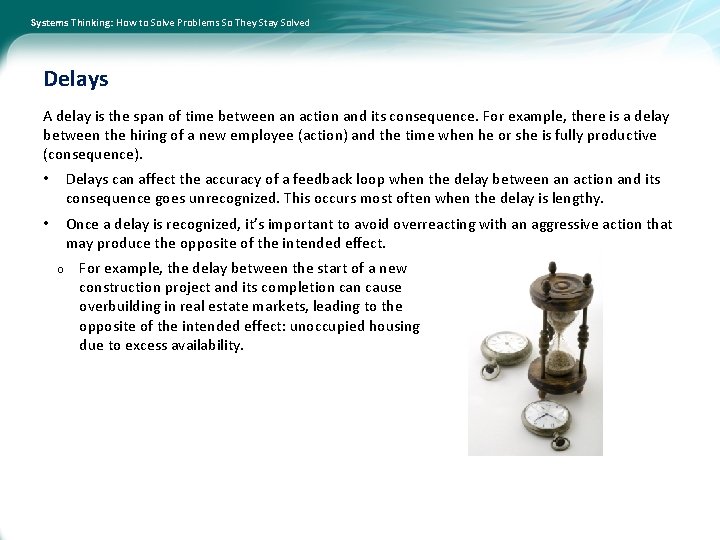
Systems Thinking: How to Solve Problems So They Stay Solved Delays A delay is the span of time between an action and its consequence. For example, there is a delay between the hiring of a new employee (action) and the time when he or she is fully productive (consequence). • Delays can affect the accuracy of a feedback loop when the delay between an action and its consequence goes unrecognized. This occurs most often when the delay is lengthy. • Once a delay is recognized, it’s important to avoid overreacting with an aggressive action that may produce the opposite of the intended effect. o For example, the delay between the start of a new construction project and its completion cause overbuilding in real estate markets, leading to the opposite of the intended effect: unoccupied housing due to excess availability.
Systems Thinking: How to Solve Problems So They Stay Solved Questions to Guide You In addition to drawing feedback loops, you will need to ask many questions in order to use systems thinking effectively. These questions can be adapted to suit just about any situation, as you’ll see in Module 4. • What is the ultimate outcome you and your organization are seeking? • What is the problem or issue? • What patterns do you notice about it? o Under what conditions does it occur? o How frequently does it occur? o How severe is it? o What variables affect it?
Systems Thinking: How to Solve Problems So They Stay Solved Questions to Guide You Part 2 • Examine the variables. What happens to the problem when each one changes? (Create causal loop diagrams. ) • Expand your view of the problem by considering the timeline. o When is the first time (you know of) that the problem occurred? o What is likely to happen if the problem isn’t resolved? o What attempts have been made to solve the problem? Expand your view of the problem by considering other stakeholders. • o How do customers or clients view the problem? What aspects are most important to them? o How do vendors or suppliers view the problem? What aspects are most important to them? o How do other departments and upper management view the problem? What aspects are most important to them?
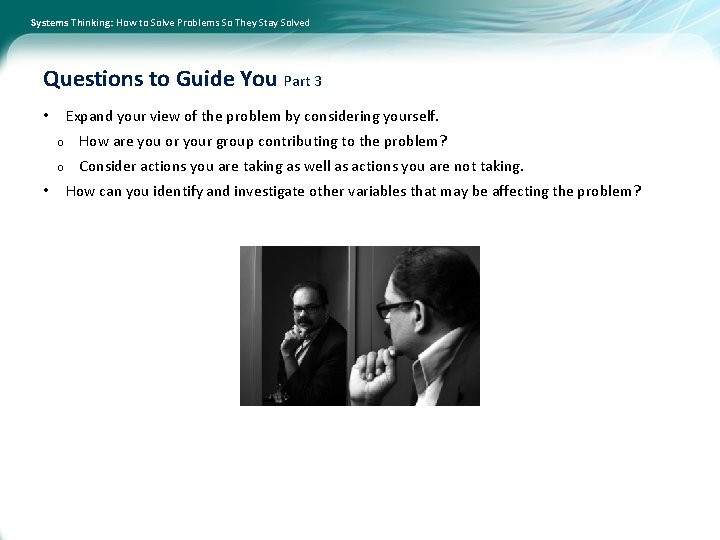
Systems Thinking: How to Solve Problems So They Stay Solved Questions to Guide You Part 3 Expand your view of the problem by considering yourself. • • o How are you or your group contributing to the problem? o Consider actions you are taking as well as actions you are not taking. How can you identify and investigate other variables that may be affecting the problem?
Systems Thinking: How to Solve Problems So They Stay Solved Test Your Knowledge Consider which is an example of a balancing loop and which is an example of a reinforcing loop. Then, click on each statement to reveal the answer. A. A budget This is an example of a balancing loop. This is an example of a reinforcing loop. B. Compound interest

Systems Thinking: How to Solve Problems So They Stay Solved Module 3: Pitfalls to Avoid
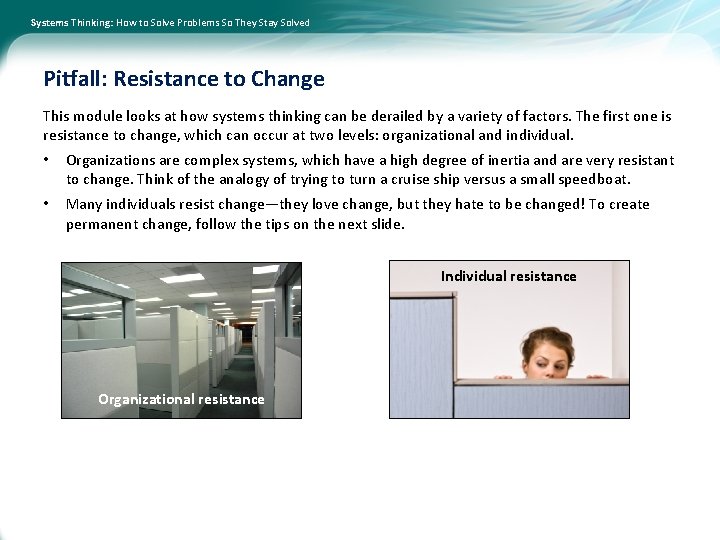
Systems Thinking: How to Solve Problems So They Stay Solved Pitfall: Resistance to Change This module looks at how systems thinking can be derailed by a variety of factors. The first one is resistance to change, which can occur at two levels: organizational and individual. • Organizations are complex systems, which have a high degree of inertia and are very resistant to change. Think of the analogy of trying to turn a cruise ship versus a small speedboat. • Many individuals resist change—they love change, but they hate to be changed! To create permanent change, follow the tips on the next slide. Individual resistance Organizational resistance
Systems Thinking: How to Solve Problems So They Stay Solved Encouraging Change Create awareness across the entire organization. • o Tell a story and make the case for change. People respond to emotion and relevance. o Provide learning resources in a variety of formats. • Go at a pace that employees will accept. • Determine the source of the resistance and see what assumptions exist that need to be addressed. • Look at change from a systems thinking point of view. o Are there embedded obstacles that make it difficult for individuals to change? Examples: The appraisal system, reward system, financial priorities, management development initiatives, etc. o Look at your failures for information about paths that are closed. o Look at your successes for information about paths that are open.
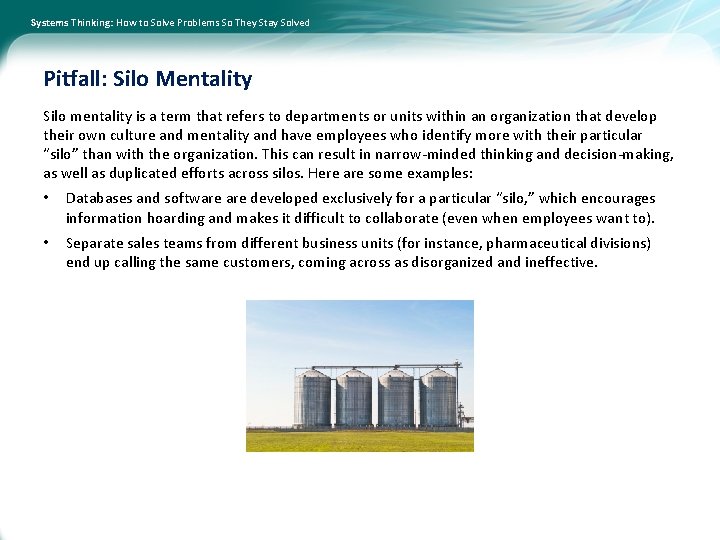
Systems Thinking: How to Solve Problems So They Stay Solved Pitfall: Silo Mentality Silo mentality is a term that refers to departments or units within an organization that develop their own culture and mentality and have employees who identify more with their particular “silo” than with the organization. This can result in narrow-minded thinking and decision-making, as well as duplicated efforts across silos. Here are some examples: • Databases and software developed exclusively for a particular “silo, ” which encourages information hoarding and makes it difficult to collaborate (even when employees want to). • Separate sales teams from different business units (for instance, pharmaceutical divisions) end up calling the same customers, coming across as disorganized and ineffective.
Systems Thinking: How to Solve Problems So They Stay Solved Pitfall: Silo Mentality Part 2 Minimizing Silos • Engage in cross-functional and bottom-up involvement in projects from the start. For example, involve sales, finance, and shipping in the development of a new marketing campaign. • Eliminate unnecessary hierarchy and formality. The fewer channels employees have to go through, the easier it will be to communicate and collaborate. • Consider physical space and layout. Create meeting spaces that allow for quick and informal collaboration. • Unify communications systems and processes. Incorporate tools that will encourage information sharing—instant messaging, shared calendars, video conferences, etc.
Systems Thinking: How to Solve Problems So They Stay Solved Pitfall: Thinking It’s a Waste of Time Some people believe that systems thinking is a waste of time because it may appear to be a “flavor of the month” program, especially if their organization has tried other initiatives that fizzled out. Even organizations with the best intentions can succumb to this. Here are some reasons why: • Resource and time constraints limit planning and implementation. • Organizational culture values idea generation and places less importance on follow-through. • Organizations place a high emphasis on short-term results, and big-picture planning is not valued. • Key stakeholders, especially end users, are not involved in planning so there is little or no commitment on their part. • There is a lack of clear and consistent communication.
Systems Thinking: How to Solve Problems So They Stay Solved Pitfall: Thinking It’s a Waste of Time Part 2 Minimizing “Flavor of the Month” Syndrome • Don’t present systems thinking as a separate initiative. Consider it a process more than an event. Analogy: Making a lifestyle change vs. going on a crash diet. • Describe the benefits of systems thinking clearly and simply. • Answer the question, “What’s in it for me? ” at all levels of the organization. • Ensure that key advocates are seen as credible and trustworthy, and that they remain committed to the process over time.
Systems Thinking: How to Solve Problems So They Stay Solved Test Your Knowledge Read the question, then click on the answer. Which of the following is a way to overcome resistance to change? A. Don’t announce the change ahead of time so employees won’t get distracted. B. Tell employees to jump in with both feet because they will adjust more easily that way. C. Don’t use a pilot program that will reveal any shortcomings of the change—it will just get negative publicity. D. Go at a pace that employees will accept.
Systems Thinking: How to Solve Problems So They Stay Solved Module 4: Applying Systems Thinking in the Workplace
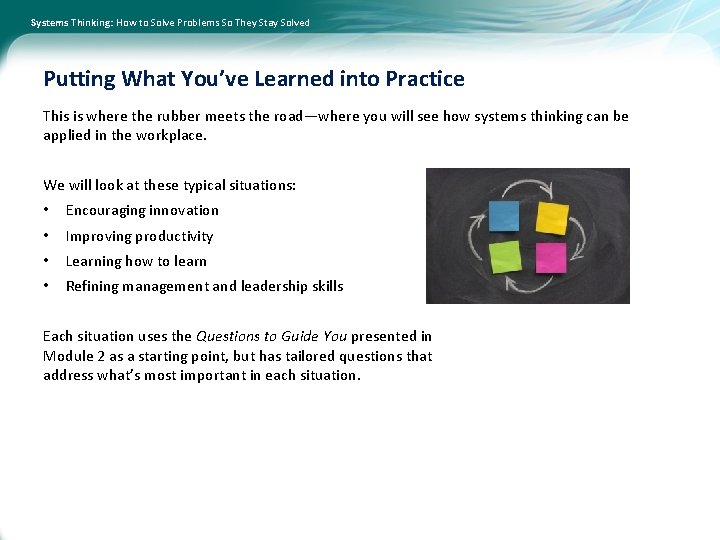
Systems Thinking: How to Solve Problems So They Stay Solved Putting What You’ve Learned into Practice This is where the rubber meets the road—where you will see how systems thinking can be applied in the workplace. We will look at these typical situations: • Encouraging innovation • Improving productivity • Learning how to learn • Refining management and leadership skills Each situation uses the Questions to Guide You presented in Module 2 as a starting point, but has tailored questions that address what’s most important in each situation.
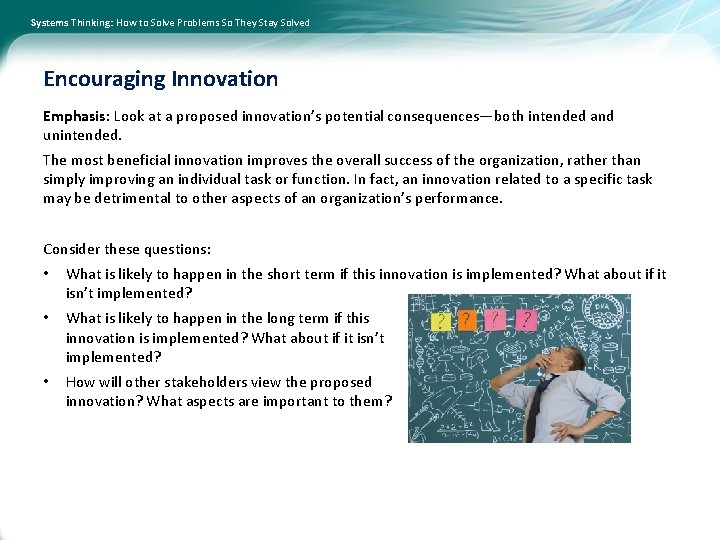
Systems Thinking: How to Solve Problems So They Stay Solved Encouraging Innovation Emphasis: Look at a proposed innovation’s potential consequences—both intended and unintended. The most beneficial innovation improves the overall success of the organization, rather than simply improving an individual task or function. In fact, an innovation related to a specific task may be detrimental to other aspects of an organization’s performance. Consider these questions: • What is likely to happen in the short term if this innovation is implemented? What about if it isn’t implemented? • What is likely to happen in the long term if this innovation is implemented? What about if it isn’t implemented? • How will other stakeholders view the proposed innovation? What aspects are important to them?
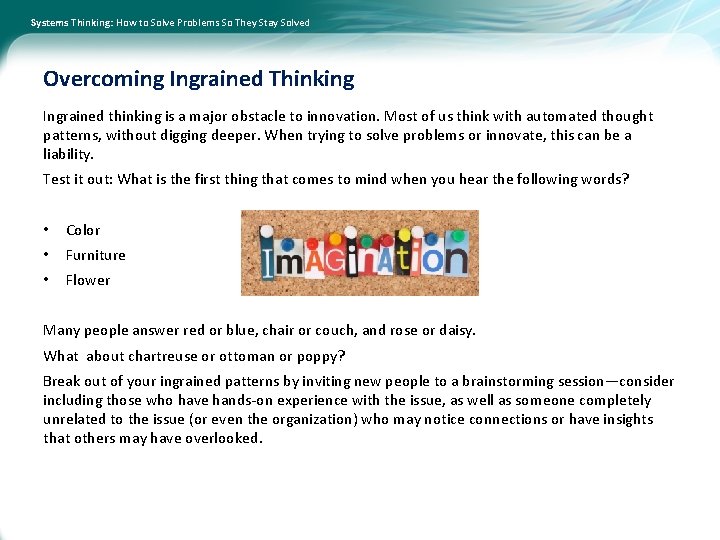
Systems Thinking: How to Solve Problems So They Stay Solved Overcoming Ingrained Thinking Ingrained thinking is a major obstacle to innovation. Most of us think with automated thought patterns, without digging deeper. When trying to solve problems or innovate, this can be a liability. Test it out: What is the first thing that comes to mind when you hear the following words? • Color • Furniture • Flower Many people answer red or blue, chair or couch, and rose or daisy. What about chartreuse or ottoman or poppy? Break out of your ingrained patterns by inviting new people to a brainstorming session—consider including those who have hands-on experience with the issue, as well as someone completely unrelated to the issue (or even the organization) who may notice connections or have insights that others may have overlooked.
Systems Thinking: How to Solve Problems So They Stay Solved Improving Productivity Emphasis: Remove constraints and obstacles. Often, the best way to increase productivity is not to pedal harder, but to ease up on the brakes. Find obstacles that are reducing efficiency and eliminate them. Systems thinking can help you do that. Questions to Ask • What are three biggest constraints limiting the growth of your organization, your unit, or yourself? • Under what conditions do they occur? What is their frequency and severity? • What are you doing to minimize their effects? If nothing, what’s stopping you? • What will be the next three constraints you tackle?
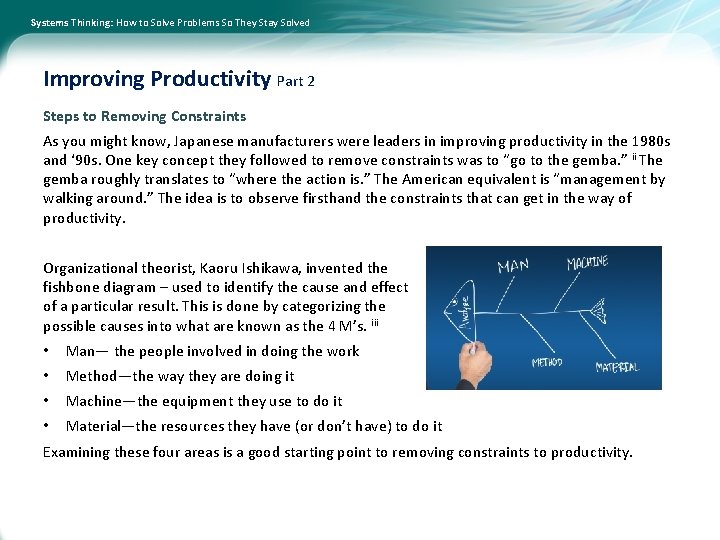
Systems Thinking: How to Solve Problems So They Stay Solved Improving Productivity Part 2 Steps to Removing Constraints As you might know, Japanese manufacturers were leaders in improving productivity in the 1980 s and ‘ 90 s. One key concept they followed to remove constraints was to “go to the gemba. ” ii The gemba roughly translates to “where the action is. ” The American equivalent is “management by walking around. ” The idea is to observe firsthand the constraints that can get in the way of productivity. Organizational theorist, Kaoru Ishikawa, invented the fishbone diagram – used to identify the cause and effect of a particular result. This is done by categorizing the possible causes into what are known as the 4 M’s. iii • Man— the people involved in doing the work • Method—the way they are doing it • Machine—the equipment they use to do it • Material—the resources they have (or don’t have) to do it Examining these four areas is a good starting point to removing constraints to productivity.
Systems Thinking: How to Solve Problems So They Stay Solved Taking Advantage of Learning Opportunities Emphasis: Examine assumptions and learn from mistakes. We can learn more from mistakes than successes when we identify and correct the mistakes. As we mentioned at the beginning of the program, organizations often are not good at this. Those that spend time blaming others miss out on learning. Organizational Mindset • People are rewarded for achievement. • Errors of commission (doing something that shouldn’t have been done) are penalized more than errors of omission (not doing something that should have been done). • Therefore, employees are tempted to hide mistakes instead of sharing what they learned from them.
Systems Thinking: How to Solve Problems So They Stay Solved Learning How to Learn Part 2 Tips to Help Change Organizational Mindset • Hand out a “best mistake of the year” award for the mistake that employees learned the most from. • Create a central depository of mistakes made and lessons learned that employees can consult before embarking on something new. • Record every decision of importance, even if the decision was to do nothing. o Include expected effects of the decision and assumptions upon which the decision was based. o Monitor the results. If they differ from the expected effects, determine the reason(s) and a course of action to correct the situation. “Mistakes are the portal of discovery. ” —James Joyce
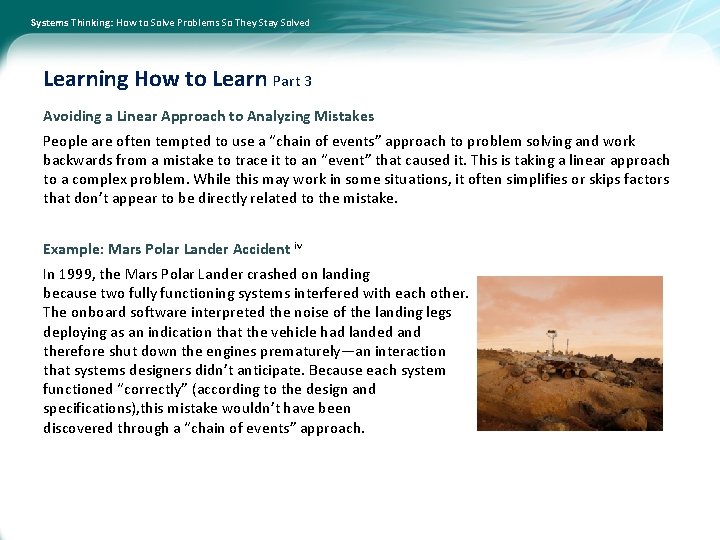
Systems Thinking: How to Solve Problems So They Stay Solved Learning How to Learn Part 3 Avoiding a Linear Approach to Analyzing Mistakes People are often tempted to use a “chain of events” approach to problem solving and work backwards from a mistake to trace it to an “event” that caused it. This is taking a linear approach to a complex problem. While this may work in some situations, it often simplifies or skips factors that don’t appear to be directly related to the mistake. Example: Mars Polar Lander Accident iv In 1999, the Mars Polar Lander crashed on landing because two fully functioning systems interfered with each other. The onboard software interpreted the noise of the landing legs deploying as an indication that the vehicle had landed and therefore shut down the engines prematurely—an interaction that systems designers didn’t anticipate. Because each system functioned “correctly” (according to the design and specifications), this mistake wouldn’t have been discovered through a “chain of events” approach.
Systems Thinking: How to Solve Problems So They Stay Solved Learning How to Learn Part 4 Questions to Ask Use these questions to learn from your mistakes and share your insights with others. • What happened and how did it affect your desired outcome? • What assumptions did you or others make that contributed to the mistake? • What happens to the mistake when each assumption changes? (Draw causal loop diagrams to figure this out. ) • What, if anything, could have been done to recognize incorrect assumptions sooner? What do you know that would have been useful earlier? • What has been done to fix the mistake and avoid repeating it? • What is likely to happen if the mistake isn’t resolved?
Systems Thinking: How to Solve Problems So They Stay Solved Refining Your Management and Leadership Skills Emphasis: Look at factors that influence performance and rewards. From a systems thinking perspective, management activities and leadership activities serve two different purposes: Management activities (planning, organizing, directing, and controlling) are predominantly balancing activities. v They are designed to bring performance and results from the current state to a desired state. • o • The manager often focuses on the situation with the largest gap between current and desired performance. Whatever situation has the largest gap captures the manager’s attention. Leadership activities (creating a vision, inspiring others, and serving as a role model) are predominantly reinforcing activities. v In other words, positive results produce more positive results.
Systems Thinking: How to Solve Problems So They Stay Solved Examine Rewards and Incentives As you know by now, systems are complex; therefore, management and leadership activities are not the only things that affect results. Employees’ motivation also affects performance results. • If employees perceive their activities and results as meaningful, that creates an intrinsic motivation and reward, which supports the reinforcing loop—positive results will produce more positive results. • If employees don’t perceive their activities and results as meaningful, they will be extrinsically motivated and focus only on achieving rewards—the rewards become the desired results.
Systems Thinking: How to Solve Problems So They Stay Solved Questions to Ask to Assess Rewards Use these questions to determine how your rewards and incentives are affecting your organization’s performance. • What rewards or incentives do you have in place to motivate employees? • What patterns do you notice when you use the rewards and strategies? Under what conditions do they occur? • What is likely to happen if the rewards and strategies continue? If they are discontinued? • What actions are you taking that are encouraging intrinsic motivation in your employees? What other actions could you take? • What actions are you taking that are discouraging intrinsic motivation? • Bottom line: What should you start doing? Stop doing? Continue doing?
Systems Thinking: How to Solve Problems So They Stay Solved Test Your Knowledge Read the question, then click on the answer. Which of the following is a systems thinking strategy to help refine your management and leadership skills? A. Remove constraints and obstacles. B. Look at factors that influence performance and rewards. C. Learn from mistakes. D. Look at potential consequences.

Systems Thinking: How to Solve Problems So They Stay Solved Review
Systems Thinking: How to Solve Problems So They Stay Solved CASE STUDY—Apply What You’ve Learned Read the case study vi and answer the questions that follow in order to put your skills into practice. Organization: The telemarketing department of a natural health and beauty products company. People: Sharon, a team supervisor, and Dan and Emily, two team members. Situation: Sharon has just finished meeting with other supervisors and their department head, reviewing data from the previous month. Telemarketing team members’ performance is measured by the number of calls made, the number of contacts made, and the number of sales made, with daily and monthly targets. Bonuses are given for meeting targets. Sharon’s team fell short compared to other telemarketing teams, so she calls a meeting to urge and encourage them to do better.

Systems Thinking: How to Solve Problems So They Stay Solved CASE STUDY—Apply What You’ve Learned Part 2 Sharon: Come on guys, I know you can do better. You are just as good as the other teams. And I know you want that bonus. What’s going on? Dan: I’m spending way too much time dealing with customers who have problems. I swear not one customer gets billed correctly! Emily: I’m having a terrible time with the lists—I’m running into so many bad numbers or customers who have already been called recently. Boy, they get mad! Sharon: Why aren’t other teams experiencing these issues? Dan: Other teams are transferring their calls to me because they know I’ll take the time to deal with them. But I won’t anymore if it means sacrificing my bonus.

Systems Thinking: How to Solve Problems So They Stay Solved CASE STUDY—Apply What You’ve Learned Part 3 Emily: Well, I was talking to Tony, and he said he has some tricks for getting around these problems and still making his quotas. Sharon: Tricks? Like good ideas, or shortcuts that ultimately backfire on the organization? Emily: Tony said once he gets hold of a good list, he hangs on to it and doesn’t share it. And if he gets a bad list, he passes it on to someone else. Sharon: Wow. That’s not supposed to happen. Emily: And like Dan already said, Tony will dump a call if the customer goes on for too long. Sharon: Sounds like we need to re-examine the metrics we’re using to hand out bonuses. Emily and Dan: You can say that again!
Systems Thinking: How to Solve Problems So They Stay Solved CASE STUDY—Questions to Consider 1. Describe or draw the causal loop diagram that represents the current thinking in the organization. 2. Where is the breakdown in systems thinking? Provide examples. 3. How can the decision makers (supervisors and the department head) engage in a systems thinking approach? Review the ideas and suggested answers provided on the following slides.
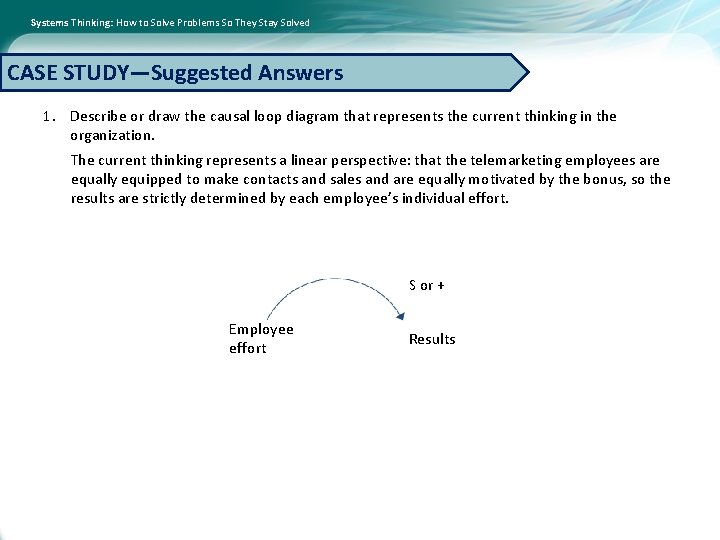
Systems Thinking: How to Solve Problems So They Stay Solved CASE STUDY—Suggested Answers 1. Describe or draw the causal loop diagram that represents the current thinking in the organization. The current thinking represents a linear perspective: that the telemarketing employees are equally equipped to make contacts and sales and are equally motivated by the bonus, so the results are strictly determined by each employee’s individual effort. S or + Employee effort Results
Systems Thinking: How to Solve Problems So They Stay Solved CASE STUDY—Suggested Answers Part 2 2. Where is the breakdown in systems thinking? Provide examples. There are several obvious examples of a lack of systems thinking. Telemarketing employees have to deal with customers’ billing issues, which reveals that a problem in one area is affecting another area and nothing has been done about it. The hoarding of lists indicates a silo mentality rather than a desire to work for the greater good of the organization. So does the fact that some employees transfer long-winded customers to other employees in order to meet their own quotas. The list hoarding is due to the quality of the lists themselves, a structural or organizational issue that has not been addressed. Finally, rewarding individual results based on the current metrics shows a lack of systems thinking—it measures activity, not purpose. Individual performance is dependent on the overall system.
Systems Thinking: How to Solve Problems So They Stay Solved CASE STUDY—Suggested Answers Part 3 3. How can the decision makers (supervisors and the department head) engage in a systems thinking approach? If supervisors and the department manager focus on improving the overall system— improving the quality of the lists, removing sources of customer dissatisfaction—individual performances will improve. For example, billing issues would never occur in the first place in a smoothly running system.
Systems Thinking: How to Solve Problems So They Stay Solved Congratulations! By now you should be able to: • Explain what systems thinking is. • Identify the benefits of using systems thinking in the workplace. • Apply the tools of systems thinking to address a problem or situation. • Minimize the unintended consequences of major decisions. • Recognize the potential pitfalls of implementing systems thinking in the workplace. • Use systems thinking to improve innovation and productivity.

Systems Thinking: How to Solve Problems So They Stay Solved Appendix
Systems Thinking: How to Solve Problems So They Stay Solved References Haines, Stephen G. The Manager’s Pocket Guide to Systems Thinking & Learning. Amherst, MA: HRD Press, 1998. Johnson, Timothy L. SWAT: Seize the Accomplishment. Des Moines, IA: Lexicon, 2010. Senge, Peter M. The Fifth Discipline: The Art & Practice of the Learning Organization. New York: Currency Doubleday, 1990. Sherwood, Dennis. Seeing the Forest for the Trees: A Manager’s Guide to Applying Systems Thinking. London: Nicholas Brealey Publishing, 2002. Sweeney, Linda Booth, and Dennis Meadows. The Systems Thinking Playbook: Exercises to Stretch and Build Learning and Systems Thinking Capabilities. White River Junction, VT: Chelsea Green Publishing Company, 1995. i Information is drawn from http: //www. public. asu. edu/~kirkwood/sysdyn/SDIntro/ch-1. pdf. ii Information is from Yoshito Kato as related on http: //www. process-improvement-japan. com/theory-of-constraints. html. iii https: //christianpaulsen 62. wordpress. com/2011/01/31/2 -reasons-you-need-to-do-a-fishbone-diagram/. iv Example is from: Leveson, Nancy G. “Applying Systems Thinking to Analyze and Learn from Events. ” Ne. TWor. K: Berlin, August 2008. v Information vi Scenario is drawn from Gene Bellinger at www. systems-thinking. org. is drawn from Simon Caulkin at www. systemsthinking. co. uk/systems. asp.

Systems Thinking: How to Solve Problems So They Stay Solved © 2012 HRDQ. All rights reserved. Published by HRDQ and the HRDQ logo are registered trademarks of Organization Design and Development, Inc. This publication is distributed under the terms and conditions of the Reproducible Content End User License Agreement (EULA). For specific details, visit www. hrdq. com/legal. For more information about this publication or to order additional copies, please contact the HRDQ Customer Service Team by phone at 610279 -2002 or by email at custserv@hrdq. com. For more information about HRDQ products, visit www. hrdq. com. ISBN 978 -1 -58854 -740 -8 Title slide image: Viorel Sima/Shutterstock. com. Images used under license from Shutterstock. com. Microsoft®, Word®, Power. Point®, and Outlook® are registered trademarks of Microsoft Corporation. 2750 E 1 STM EN-01 -DC-18
- Slides: 65