
Systems Planning Analysis and Design Chapter 12 2001
- Slides: 39
Systems Planning, Analysis, and Design Chapter 12 2001 Prentice Hall Business Publishing, Accounting Information Systems, 8/E, Bodnar/Hopwood 12 - 1
Describe the relationship of systems analysis to systems development as a whole. l l Systems development consists primarily of three phases: 1 Systems analysis 2 Systems design 3 Systems implementation This chapter discusses the first two of these phases. Systems planning involves identifying subsystems within the information system that need special attention for development. Systems analysis begins after systems planning 2001 Prentice Hall Business Publishing, Accounting Information Systems, 8/E, Bodnar/Hopwood 12 - 2
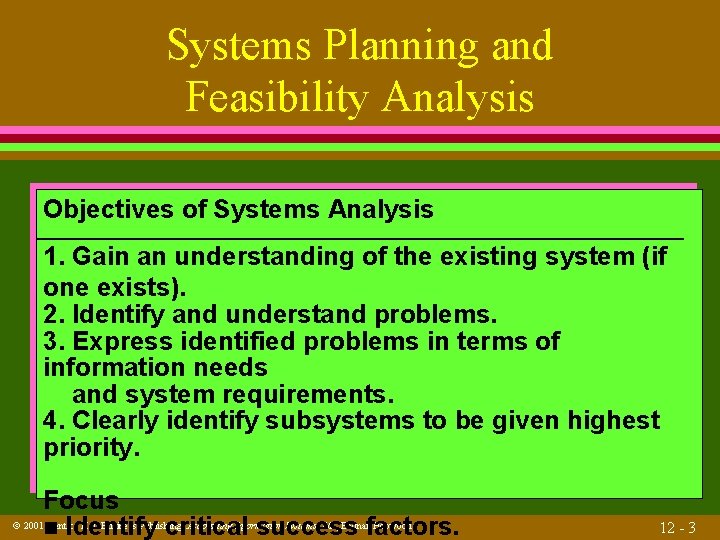
Systems Planning and Feasibility Analysis Objectives of Systems Analysis 1. Gain an understanding of the existing system (if one exists). 2. Identify and understand problems. 3. Express identified problems in terms of information needs and system requirements. 4. Clearly identify subsystems to be given highest priority. Focus n Identify critical success factors. 2001 Prentice Hall Business Publishing, Accounting Information Systems, 8/E, Bodnar/Hopwood 12 - 3
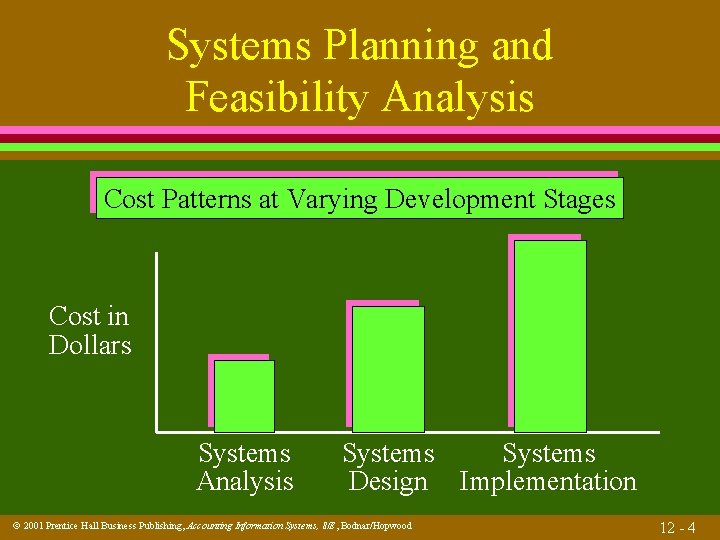
Systems Planning and Feasibility Analysis Cost Patterns at Varying Development Stages Cost in Dollars Systems Analysis Systems Design Implementation 2001 Prentice Hall Business Publishing, Accounting Information Systems, 8/E, Bodnar/Hopwood 12 - 4
Systems Planning and Feasibility Analysis l 1 2 3 An overall plan seeks to ensure the following objectives: Resources will be targeted to the subsystems where the needs are greatest. Duplication and wasted effort will be minimized. Systems development in the organization will be consistent with the overall strategic plan of the organization. 12 - 5 2001 Prentice Hall Business Publishing, Accounting Information Systems, 8/E, Bodnar/Hopwood
Systems planning and feasibility analysis involve seven phases: 1 2 3 4 5 6 Discussing and planning on the part of top management Establishing a systems planning steering committee Establishing overall objectives and constraints Developing a strategic information systems plan Identifying and prioritizing specific areas within the organization for the systems development focus Setting forth a systems proposal to serve as a basis of the analysis and preliminary design for a given subsystem Assembling a team of individuals for purposes of 12 the -6 7 2001 Prentice Hall Business Publishing, Accounting Information Systems, 8/E, Bodnar/Hopwood
Systems Planning and Feasibility Analysis l l l It is crucial that all major systems development efforts have the support of top management. A useful approach to guiding the overall systems development effort is to have a steering committee, representing top management and all major functional areas within the organization. General objectives include the overall strategic objectives relating to the company’s 2001 Prentice Hall Business Publishing, Accounting Information Systems, 8/E, Bodnar/Hopwood 12 - 7
Systems Planning and Feasibility Analysis l Key success factors must be incorporated into the objectives for systems design. l What are key success factors? These factors are those characteristics that distinguish a company from its competitors and are the keys to its success. The strategic systems plan should take the form of a written document that incorporates both shortrun and long-run goals relating to the company’s systems development effort. The strategic plan should identify specific areas to be given the highest priority. l l l 2001 Prentice Hall Business Publishing, Accounting Information Systems, 8/E, Bodnar/Hopwood 12 - 8
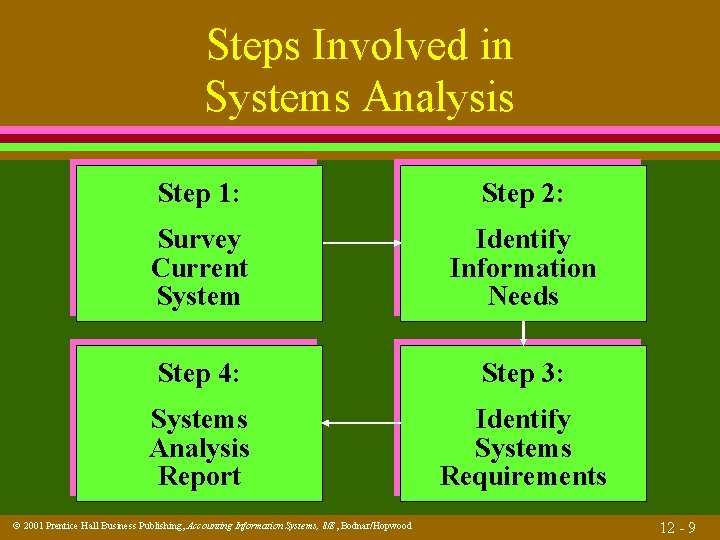
Steps Involved in Systems Analysis Step 1: Step 2: Survey Current System Identify Information Needs Step 4: Step 3: Systems Analysis Report Identify Systems Requirements 2001 Prentice Hall Business Publishing, Accounting Information Systems, 8/E, Bodnar/Hopwood 12 - 9
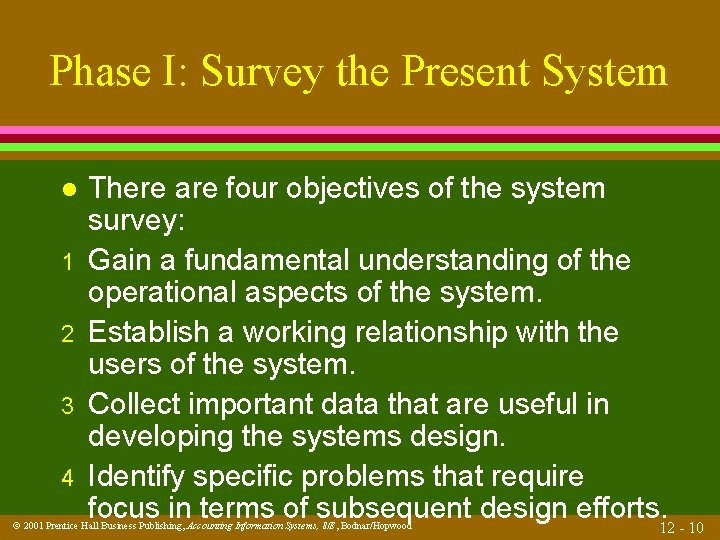
Phase I: Survey the Present System l 1 2 3 4 There are four objectives of the system survey: Gain a fundamental understanding of the operational aspects of the system. Establish a working relationship with the users of the system. Collect important data that are useful in developing the systems design. Identify specific problems that require focus in terms of subsequent design efforts. 12 - 10 2001 Prentice Hall Business Publishing, Accounting Information Systems, 8/E, Bodnar/Hopwood
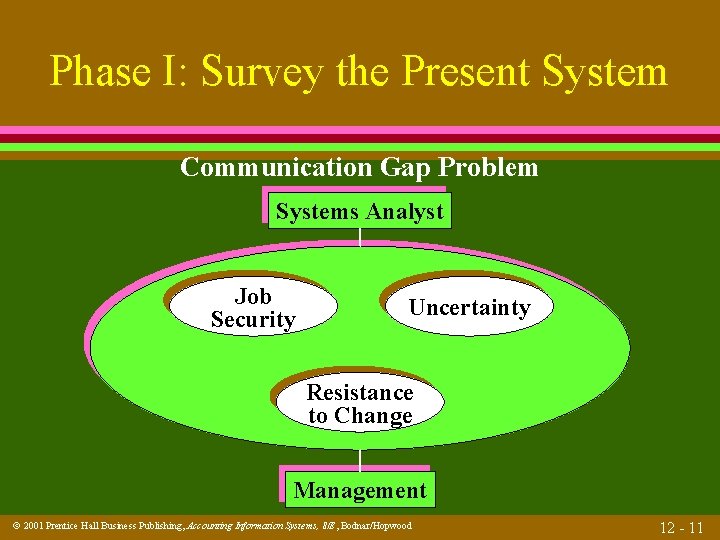
Phase I: Survey the Present System Communication Gap Problem Systems Analyst Job Security Uncertainty Resistance to Change Management 2001 Prentice Hall Business Publishing, Accounting Information Systems, 8/E, Bodnar/Hopwood 12 - 11
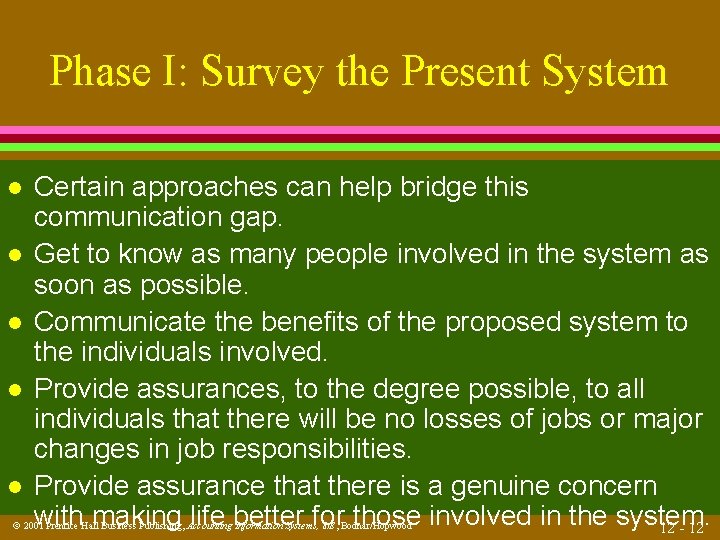
Phase I: Survey the Present System l l l Certain approaches can help bridge this communication gap. Get to know as many people involved in the system as soon as possible. Communicate the benefits of the proposed system to the individuals involved. Provide assurances, to the degree possible, to all individuals that there will be no losses of jobs or major changes in job responsibilities. Provide assurance that there is a genuine concern with making life better for those involved in the system. 12 - 12 2001 Prentice Hall Business Publishing, Accounting Information Systems, 8/E, Bodnar/Hopwood
Phase I: Survey the Present System When the survey has been completed, the strengths and weaknesses of the subsystem under study should be thoroughly analyzed. l What are some questions that might be asked in evaluating the present system? l Is a given procedure necessary? l Does the procedure involve 12 - 13 unnecessary steps? l 2001 Prentice Hall Business Publishing, Accounting Information Systems, 8/E, Bodnar/Hopwood
Phase II: Identify Information Needs l The second major phase of systems analysis involves identifying information requirements. Systematic techniques can be used to gain an understanding of decisions and information needs. l What are some of these techniques? l § § § Identify the manager’s primary job responsibilities. Identify the means by which the manager is evaluated. Identify some of the major problems the manager faces. 2001 Prentice Hall Business Publishing, Accounting Information Systems, 8/E, Bodnar/Hopwood 12 - 14
Phase III: Identify the Systems Requirements The third phase of the system analysis project involves specifying systems requirements. l Requirements can be specified in terms of inputs and outputs. l The input requirements for one subsystem will specify, in turn, output requirements for another subsystem. l 2001 Prentice Hall Business Publishing, Accounting Information Systems, 8/E, Bodnar/Hopwood 12 - 15
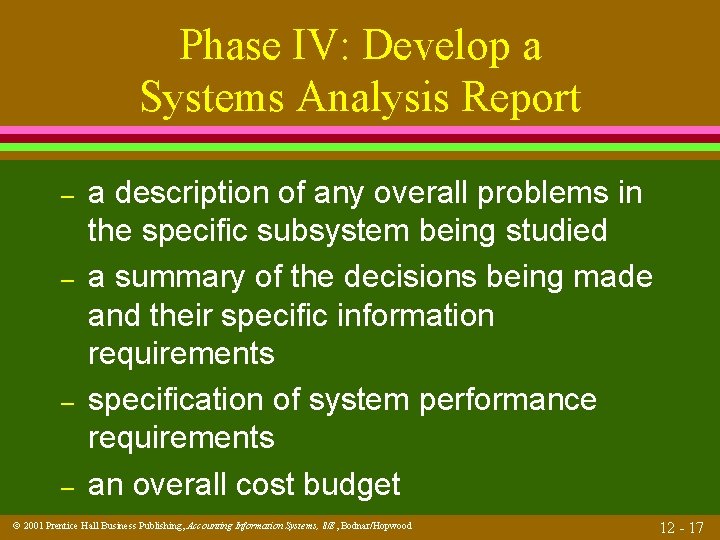
Phase IV: Develop a Systems Analysis Report The final output of the systems analysis project is a report. l What are key elements of this report? – a summary of the scope and purpose of the analysis project – a reiteration of the relationship of the project to the overall strategic information systems plan l 2001 Prentice Hall Business Publishing, Accounting Information Systems, 8/E, Bodnar/Hopwood 12 - 16
Phase IV: Develop a Systems Analysis Report – – a description of any overall problems in the specific subsystem being studied a summary of the decisions being made and their specific information requirements specification of system performance requirements an overall cost budget 2001 Prentice Hall Business Publishing, Accounting Information Systems, 8/E, Bodnar/Hopwood 12 - 17
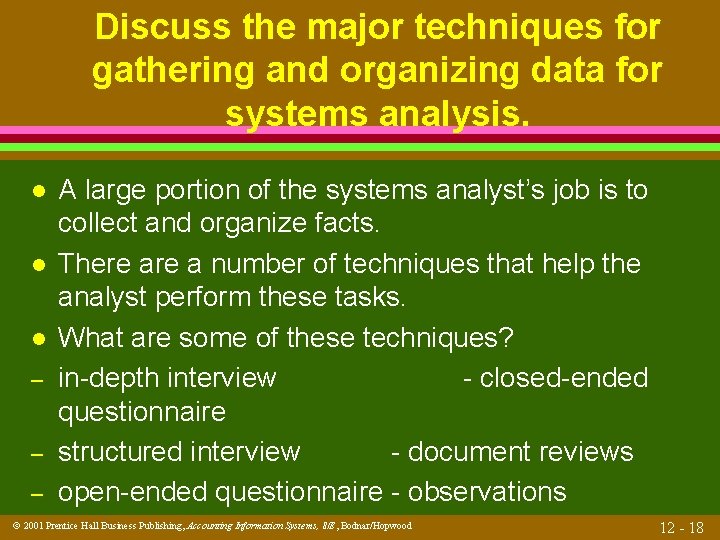
Discuss the major techniques for gathering and organizing data for systems analysis. l l l – – – A large portion of the systems analyst’s job is to collect and organize facts. There a number of techniques that help the analyst perform these tasks. What are some of these techniques? in-depth interview - closed-ended questionnaire structured interview - document reviews open-ended questionnaire - observations 2001 Prentice Hall Business Publishing, Accounting Information Systems, 8/E, Bodnar/Hopwood 12 - 18
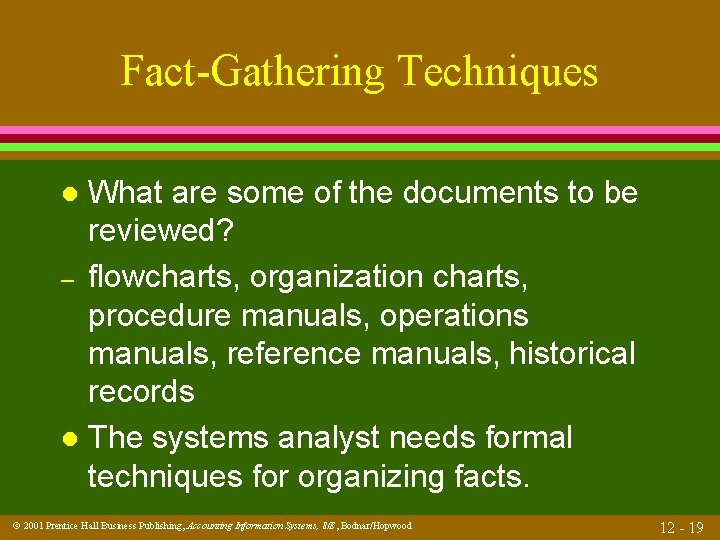
Fact-Gathering Techniques What are some of the documents to be reviewed? – flowcharts, organization charts, procedure manuals, operations manuals, reference manuals, historical records l The systems analyst needs formal techniques for organizing facts. l 2001 Prentice Hall Business Publishing, Accounting Information Systems, 8/E, Bodnar/Hopwood 12 - 19
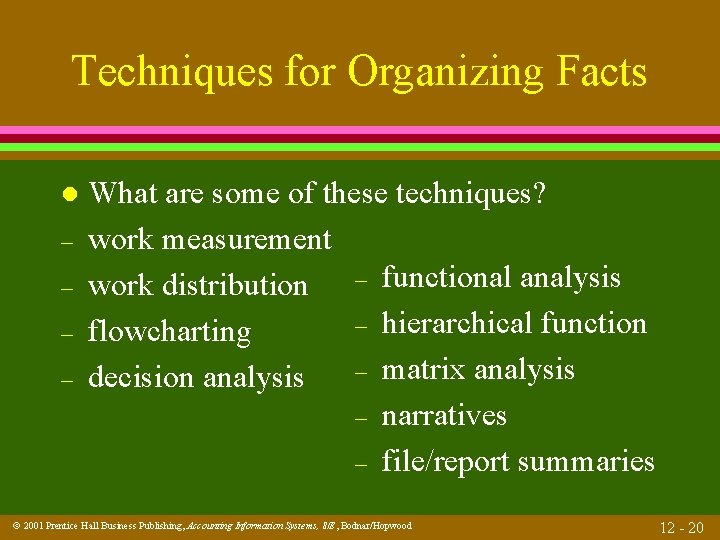
Techniques for Organizing Facts l – – What are some of these techniques? work measurement work distribution – functional analysis – hierarchical function flowcharting – matrix analysis decision analysis – narratives – file/report summaries 2001 Prentice Hall Business Publishing, Accounting Information Systems, 8/E, Bodnar/Hopwood 12 - 20
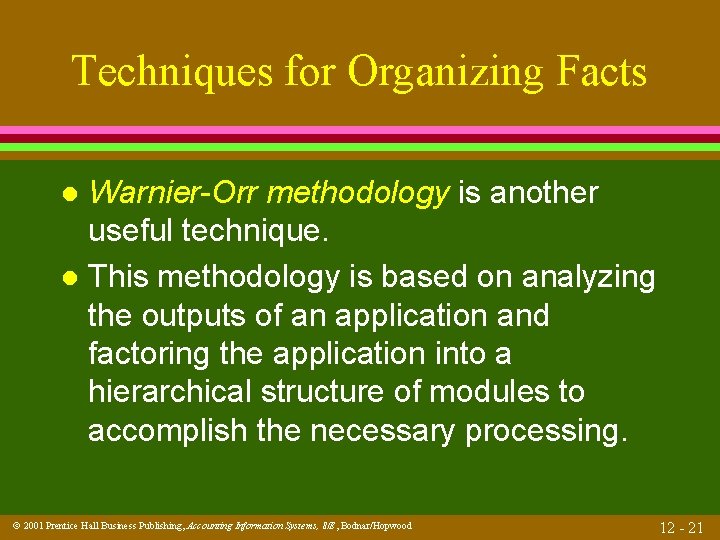
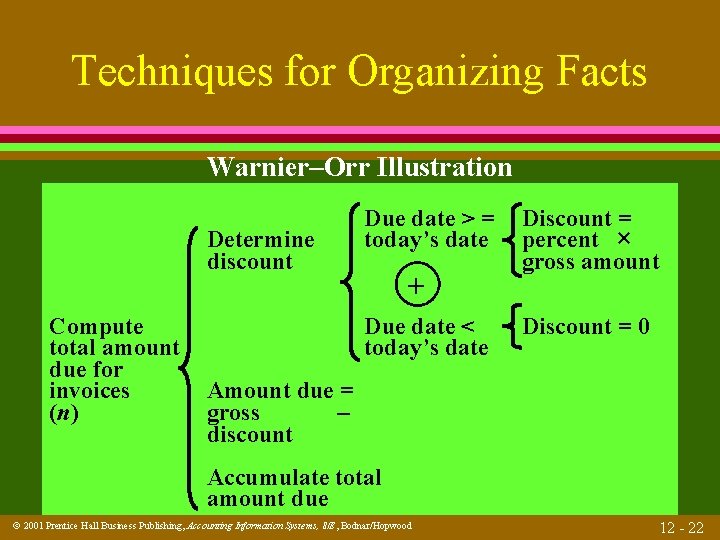
Techniques for Organizing Facts Warnier-Orr methodology is another useful technique. l This methodology is based on analyzing the outputs of an application and factoring the application into a hierarchical structure of modules to accomplish the necessary processing. l 2001 Prentice Hall Business Publishing, Accounting Information Systems, 8/E, Bodnar/Hopwood 12 - 21
Techniques for Organizing Facts Warnier–Orr Illustration Determine discount Compute total amount due for invoices (n) Due date > = today’s date + Due date < today’s date Discount = percent × gross amount Discount = 0 Amount due = gross – discount Accumulate total amount due 2001 Prentice Hall Business Publishing, Accounting Information Systems, 8/E, Bodnar/Hopwood 12 - 22
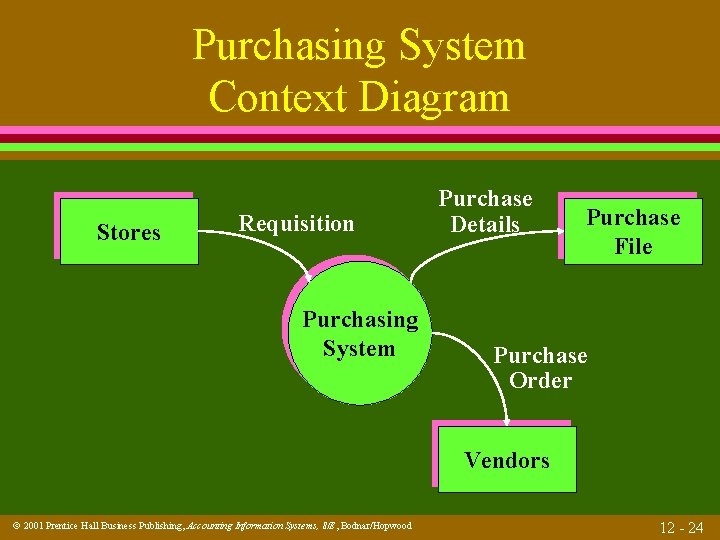
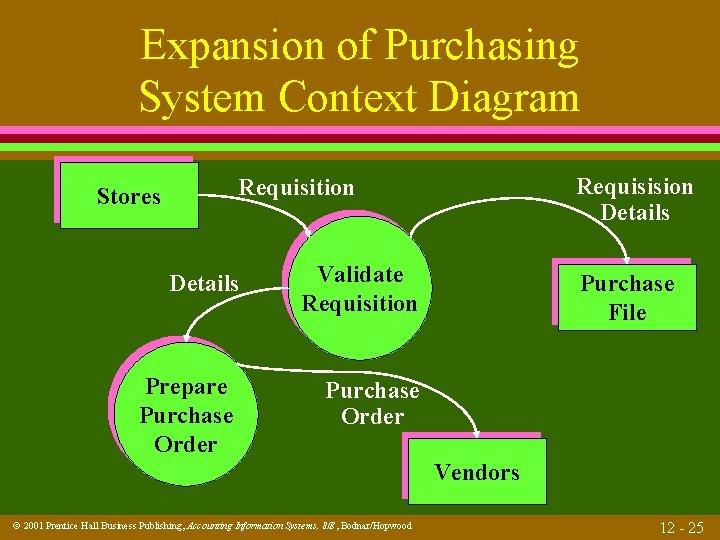
Structured Systems Analysis Structured systems analysis begins with a general logical data flow diagram. l This diagram is supported with detailed data flow diagrams, data dictionaries, access method descriptions, and specifics on process logic. l 2001 Prentice Hall Business Publishing, Accounting Information Systems, 8/E, Bodnar/Hopwood 12 - 23
Purchasing System Context Diagram Stores Requisition Purchasing System Purchase Details Purchase File Purchase Order Vendors 2001 Prentice Hall Business Publishing, Accounting Information Systems, 8/E, Bodnar/Hopwood 12 - 24
Expansion of Purchasing System Context Diagram Requisision Details Requisition Stores Details Validate Requisition Prepare Purchase Order Purchase File Vendors 2001 Prentice Hall Business Publishing, Accounting Information Systems, 8/E, Bodnar/Hopwood 12 - 25
steps involved in specifying systems design alternatives. Systems design is an orderly process that begins at a very general level with the setting of objectives for a particular system. l The process then proceeds to the more detailed level with the specification of file structures, processing operation, and form design. l 2001 Prentice Hall Business Publishing, Accounting Information Systems, 8/E, Bodnar/Hopwood 12 - 26
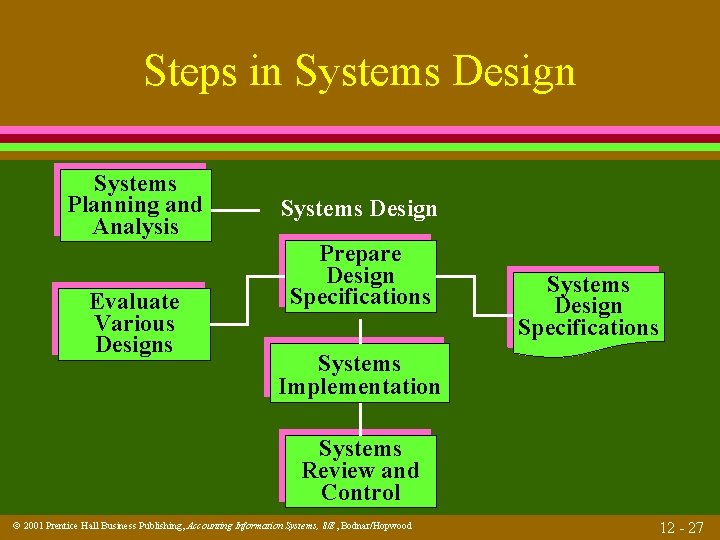
Steps in Systems Design Systems Planning and Analysis Evaluate Various Designs Systems Design Prepare Design Specifications Systems Implementation Systems Review and Control 2001 Prentice Hall Business Publishing, Accounting Information Systems, 8/E, Bodnar/Hopwood 12 - 27
Step I: Evaluating Design Alternatives In every case, the systems design project arises out of a specific need as determined by the systems planning and analysis phase of the development cycle. l What are some aspect of systems design? – enumeration of design alternatives – describing the alternatives l 2001 Prentice Hall Business Publishing, Accounting Information Systems, 8/E, Bodnar/Hopwood 12 - 28
Step II: Preparing Design Specifications The primary role in developing design specifications is that the designer should work backward from outputs to inputs. l The designer should design all management reports and operational output documents as a first step in the process. l 2001 Prentice Hall Business Publishing, Accounting Information Systems, 8/E, Bodnar/Hopwood 12 - 29
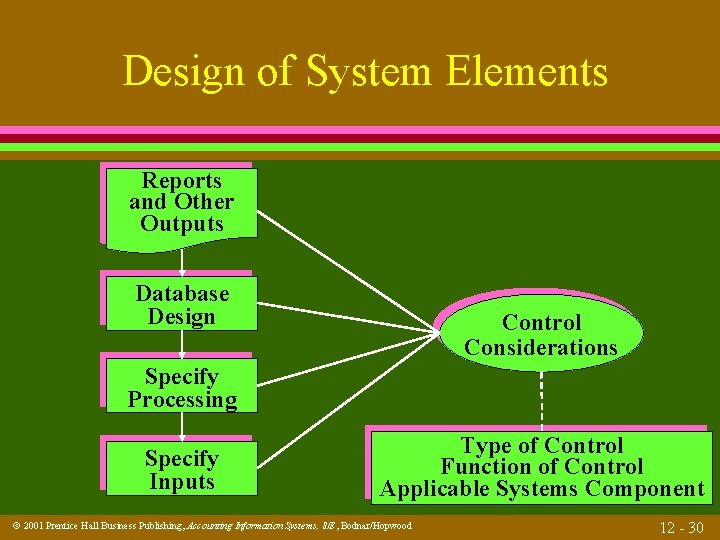
Design of System Elements Reports and Other Outputs Database Design Control Considerations Specify Processing Specify Inputs Type of Control Function of Control Applicable Systems Component 2001 Prentice Hall Business Publishing, Accounting Information Systems, 8/E, Bodnar/Hopwood 12 - 30
Step III: Preparing and Submitting Specifications l l l – – – The completed design specification should take the form of a proposal. The detailed design proposal should include everything necessary to actually implement the design project. What should the proposal include? specific timetables for completion Budget description of personnel requirements flowcharts other diagrams that describe the system to be 12 - 31 2001 Prentice Hall Business Publishing, Accounting Information Systems, 8/E, Bodnar/Hopwood
Step III: Preparing and Submitting Specifications l l A copy of all proposed system outputs would be incorporated as well as specifics on any databases to be created or modified. Details regarding hardware and software should be included. Specific details relating to the input of data in the system should be provided. Specific volume and cost information should also be provided. 2001 Prentice Hall Business Publishing, Accounting Information Systems, 8/E, Bodnar/Hopwood 12 - 32
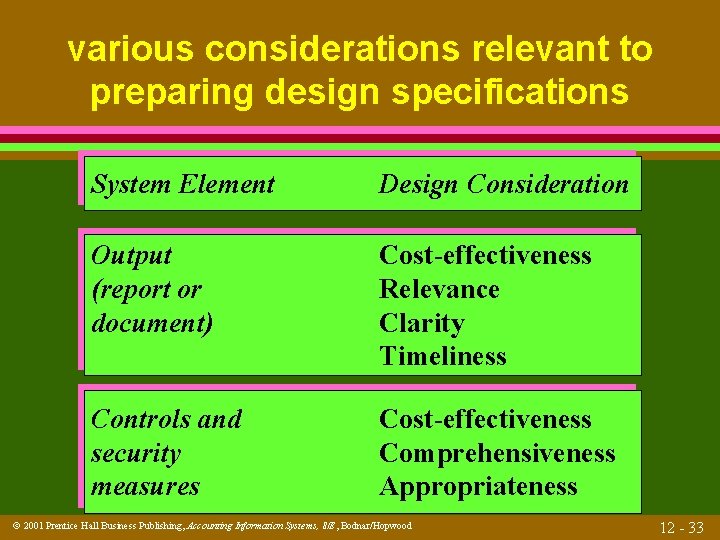
various considerations relevant to preparing design specifications System Element Design Consideration Output (report or document) Cost-effectiveness Relevance Clarity Timeliness Controls and security measures Cost-effectiveness Comprehensiveness Appropriateness 2001 Prentice Hall Business Publishing, Accounting Information Systems, 8/E, Bodnar/Hopwood 12 - 33
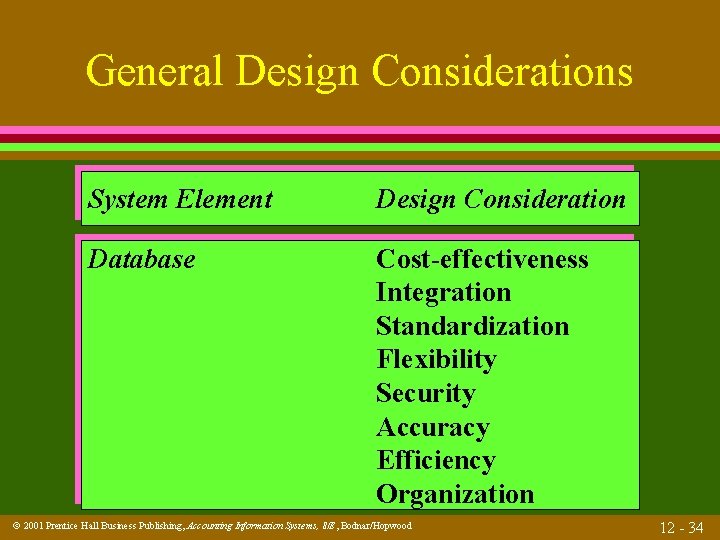
General Design Considerations System Element Design Consideration Database Cost-effectiveness Integration Standardization Flexibility Security Accuracy Efficiency Organization 2001 Prentice Hall Business Publishing, Accounting Information Systems, 8/E, Bodnar/Hopwood 12 - 34
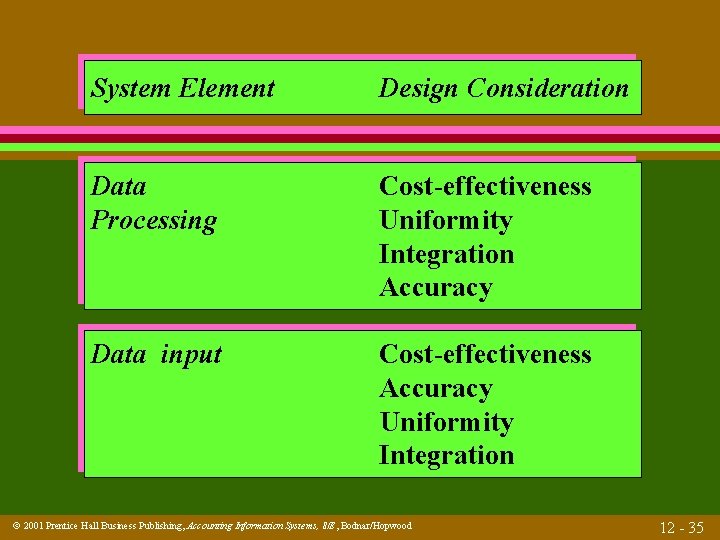
System Element Design Consideration Data Processing Cost-effectiveness Uniformity Integration Accuracy Data input Cost-effectiveness Accuracy Uniformity Integration 2001 Prentice Hall Business Publishing, Accounting Information Systems, 8/E, Bodnar/Hopwood 12 - 35
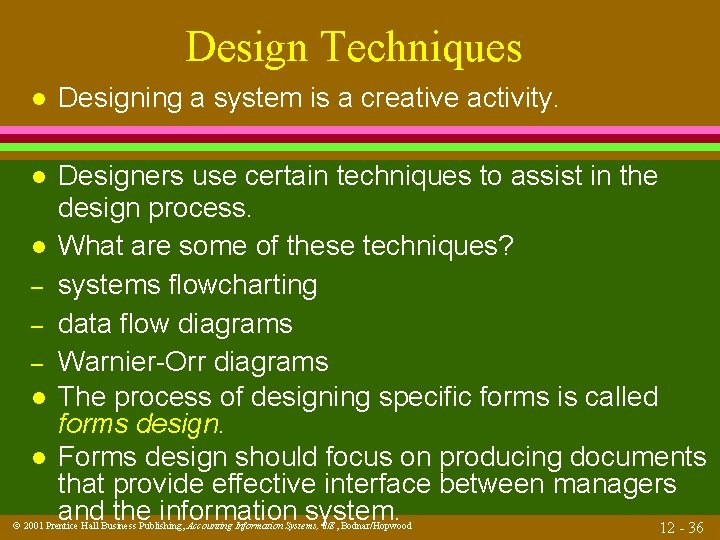
Design Techniques l Designing a system is a creative activity. l Designers use certain techniques to assist in the design process. What are some of these techniques? systems flowcharting data flow diagrams Warnier-Orr diagrams The process of designing specific forms is called forms design. Forms design should focus on producing documents that provide effective interface between managers and the information system. 12 - 36 l – – – l l 2001 Prentice Hall Business Publishing, Accounting Information Systems, 8/E, Bodnar/Hopwood
Design Techniques There a number of techniques for designing databases. l What are some of these techniques? – data structure diagrams – record layouts – file analysis sheets – file related matrices l 2001 Prentice Hall Business Publishing, Accounting Information Systems, 8/E, Bodnar/Hopwood 12 - 37
Systems Design Packages l l l A number of prepackaged design methodologies are available to assist in the systems development cycle. CASE (computer-aided software engineering) can produce data flow diagrams, narrative documentation, screen and report prototypes, and data dictionary descriptions. The decision must be made as to whether the computer software is to be built from scratch or purchased. 2001 Prentice Hall Business Publishing, Accounting Information Systems, 8/E, Bodnar/Hopwood 12 - 38
Choosing Software and Hardware l – – – l – What are some advantages of purchased software packages? less costly already debugged trials of the product prior to investing a great deal of money What is the main disadvantage of purchased software packages? rarely exactly meets a company’s needs 2001 Prentice Hall Business Publishing, Accounting Information Systems, 8/E, Bodnar/Hopwood 12 - 39