
Systems of linear and quadratic equations 1 of
- Slides: 11
Systems of linear and quadratic equations 1 of 16 © Boardworks 2012
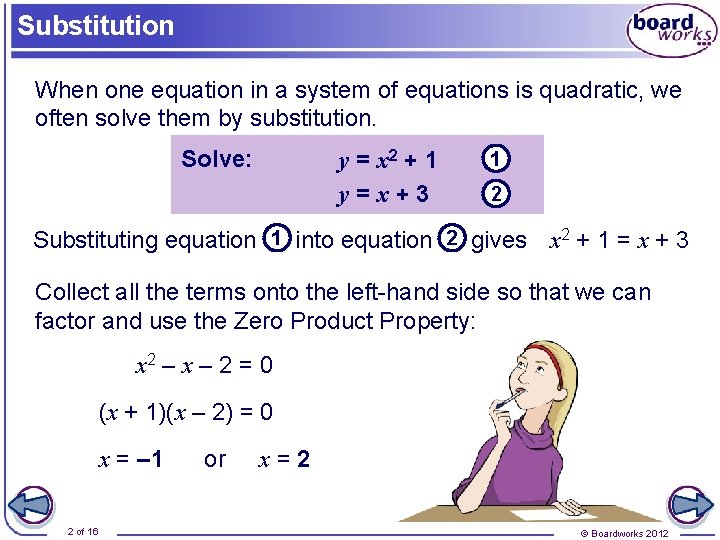
Substitution When one equation in a system of equations is quadratic, we often solve them by substitution. Solve: y = x 2 + 1 y=x+3 1 2 Substituting equation 1 into equation 2 gives x 2 + 1 = x + 3 Collect all the terms onto the left-hand side so that we can factor and use the Zero Product Property: x 2 – x – 2 = 0 (x + 1)(x – 2) = 0 x = – 1 2 of 16 or x=2 © Boardworks 2012
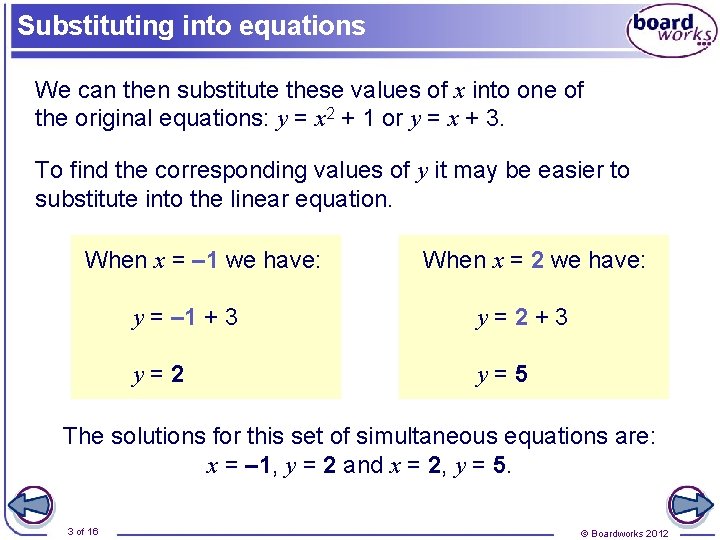
Substituting into equations We can then substitute these values of x into one of the original equations: y = x 2 + 1 or y = x + 3. To find the corresponding values of y it may be easier to substitute into the linear equation. When x = – 1 we have: When x = 2 we have: y = – 1 + 3 y=2+3 y=2 y=5 The solutions for this set of simultaneous equations are: x = – 1, y = 2 and x = 2, y = 5. 3 of 16 © Boardworks 2012
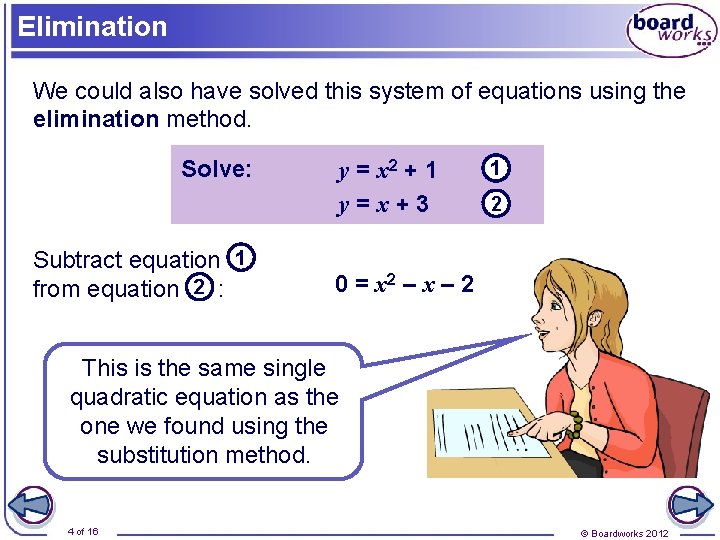
Elimination We could also have solved this system of equations using the elimination method. Solve: Subtract equation 1 from equation 2 : y = x 2 + 1 y=x+3 1 2 0 = x 2 – x – 2 This is the same single quadratic equation as the one we found using the substitution method. 4 of 16 © Boardworks 2012
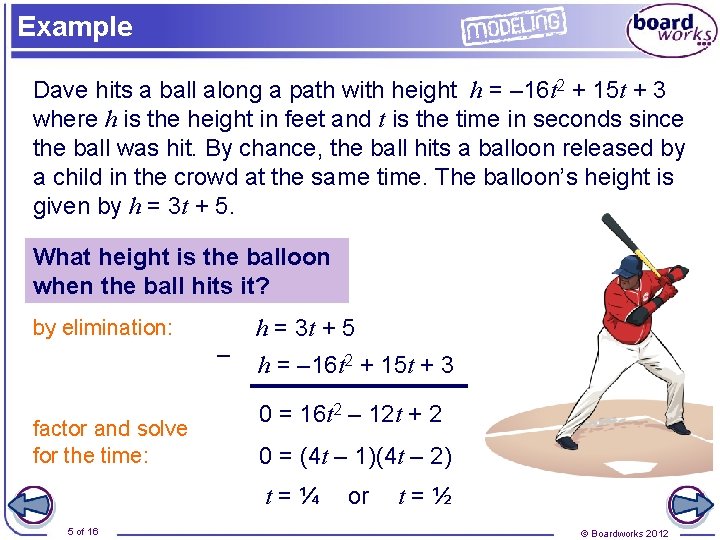
Example Dave hits a ball along a path with height h = – 16 t 2 + 15 t + 3 where h is the height in feet and t is the time in seconds since the ball was hit. By chance, the ball hits a balloon released by a child in the crowd at the same time. The balloon’s height is given by h = 3 t + 5. What height is the balloon when the ball hits it? by elimination: – factor and solve for the time: h = 3 t + 5 h = – 16 t 2 + 15 t + 3 0 = 16 t 2 – 12 t + 2 0 = (4 t – 1)(4 t – 2) t=¼ 5 of 16 or t=½ © Boardworks 2012
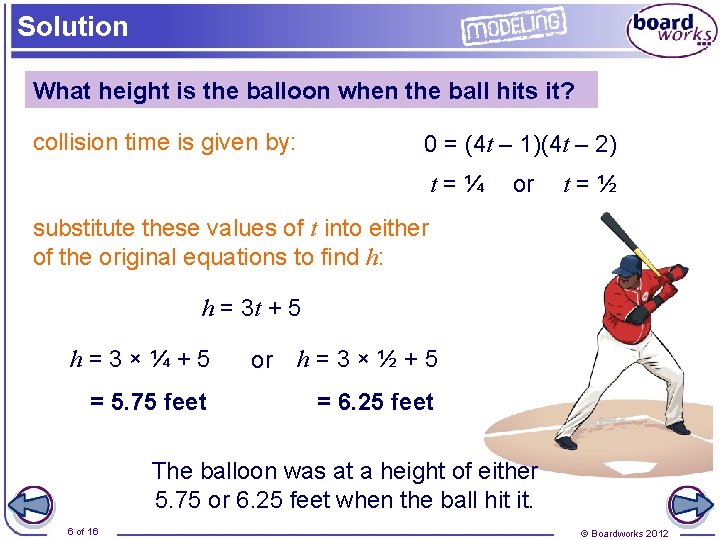
Solution What height is the balloon when the ball hits it? collision time is given by: 0 = (4 t – 1)(4 t – 2) t=¼ or t=½ substitute these values of t into either of the original equations to find h: h = 3 t + 5 h=3×¼+5 = 5. 75 feet or h=3×½+5 = 6. 25 feet The balloon was at a height of either 5. 75 or 6. 25 feet when the ball hit it. 6 of 16 © Boardworks 2012
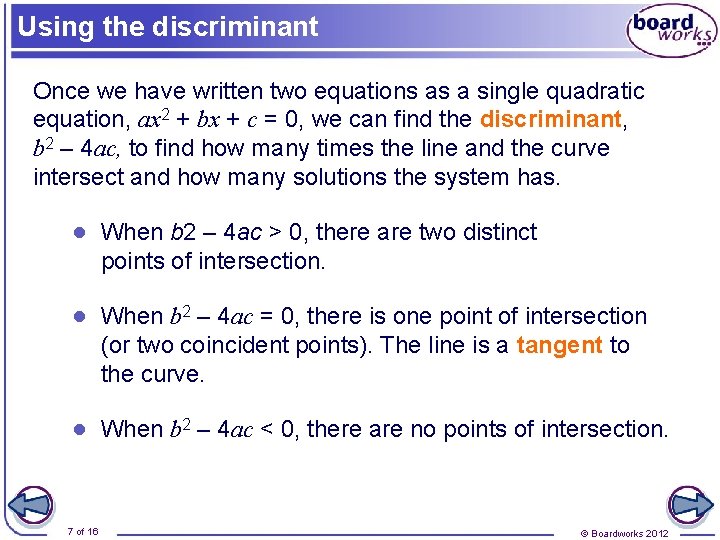
Using the discriminant Once we have written two equations as a single quadratic equation, ax 2 + bx + c = 0, we can find the discriminant, b 2 – 4 ac, to find how many times the line and the curve intersect and how many solutions the system has. ● When b 2 – 4 ac > 0, there are two distinct points of intersection. ● When b 2 – 4 ac = 0, there is one point of intersection (or two coincident points). The line is a tangent to the curve. ● When b 2 – 4 ac < 0, there are no points of intersection. 7 of 16 © Boardworks 2012
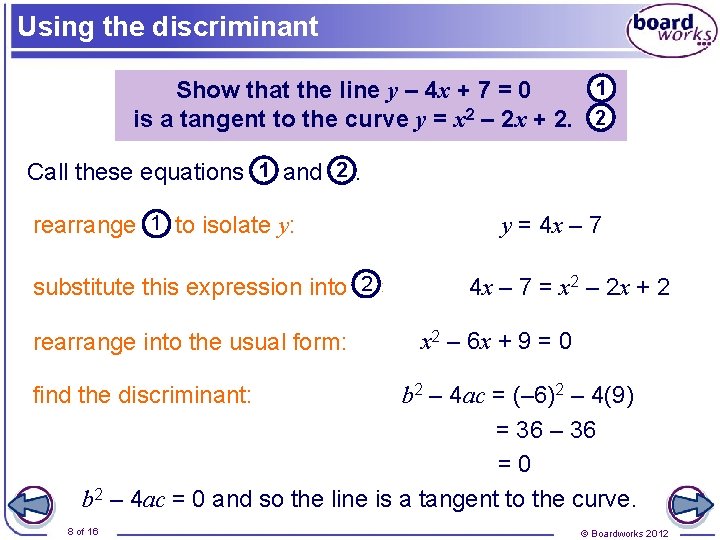
Using the discriminant 1 Show that the line y – 4 x + 7 = 0 is a tangent to the curve y = x 2 – 2 x + 2. 2 Call these equations 1 and 2. rearrange 1 to isolate y: substitute this expression into 2 rearrange into the usual form: y = 4 x – 7 : 4 x – 7 = x 2 – 2 x + 2 x 2 – 6 x + 9 = 0 b 2 – 4 ac = (– 6)2 – 4(9) = 36 – 36 =0 b 2 – 4 ac = 0 and so the line is a tangent to the curve. find the discriminant: 8 of 16 © Boardworks 2012
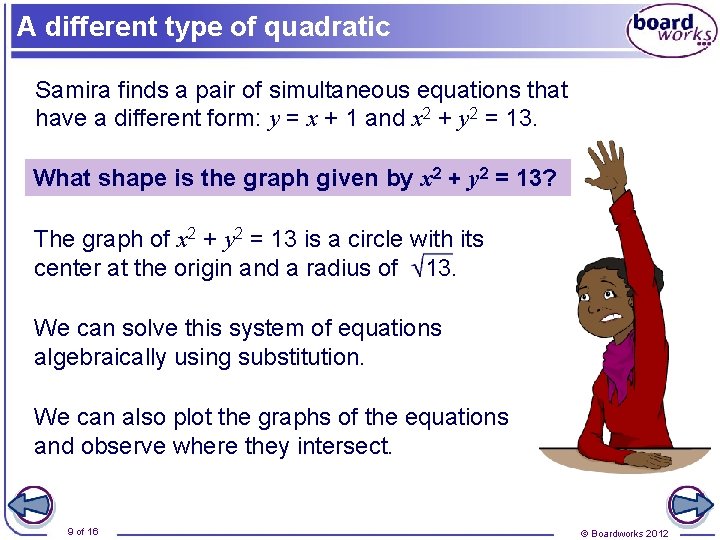
A different type of quadratic Samira finds a pair of simultaneous equations that have a different form: y = x + 1 and x 2 + y 2 = 13. What shape is the graph given by x 2 + y 2 = 13? The graph of x 2 + y 2 = 13 is a circle with its center at the origin and a radius of 13. We can solve this system of equations algebraically using substitution. We can also plot the graphs of the equations and observe where they intersect. 9 of 16 © Boardworks 2012
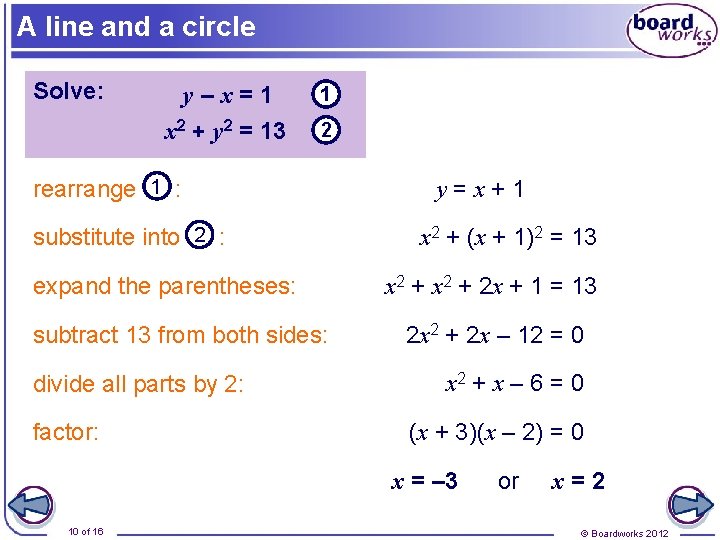
A line and a circle Solve: y–x=1 x 2 + y 2 = 13 1 2 rearrange 1 : substitute into 2 : expand the parentheses: subtract 13 from both sides: divide all parts by 2: factor: y=x+1 x 2 + (x + 1)2 = 13 x 2 + 2 x + 1 = 13 2 x 2 + 2 x – 12 = 0 x 2 + x – 6 = 0 (x + 3)(x – 2) = 0 x = – 3 10 of 16 or x=2 © Boardworks 2012
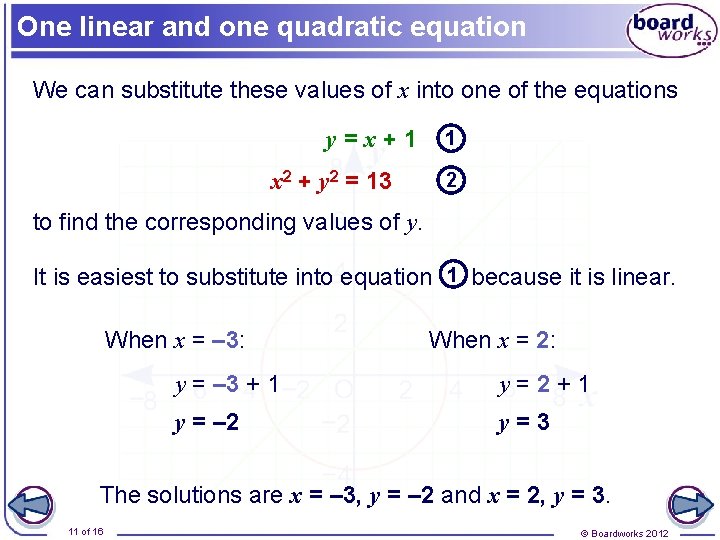
One linear and one quadratic equation We can substitute these values of x into one of the equations y=x+1 x 2 + y 2 = 13 1 2 to find the corresponding values of y. It is easiest to substitute into equation 1 because it is linear. When x = – 3: When x = 2: y = – 3 + 1 y=2+1 y = – 2 y=3 The solutions are x = – 3, y = – 2 and x = 2, y = 3. 11 of 16 © Boardworks 2012