
Systems of Government Types of Governments There are
- Slides: 17
Systems of Government
Types of Governments • There are many different forms of government but really just nine apply to us today. 1) Absolute Monarchy (absolutism) 2) Limited Monarchy (Constitutional Monarchy) 3) Representative Democracy 4) Direct democracy 5) Communism 6) Dictatorship 7) Totalitarianism 8) Oligarchy 9) Theocracy 4 MAIN GOVERNMENT SYSTEMS ARE: 1. Monarchy 2. Democracy 3. Communism 4. Dictatorship *The other types of governments are not as widespread and sometimes can be considered a sub-type of government for one of the 4 main systems.
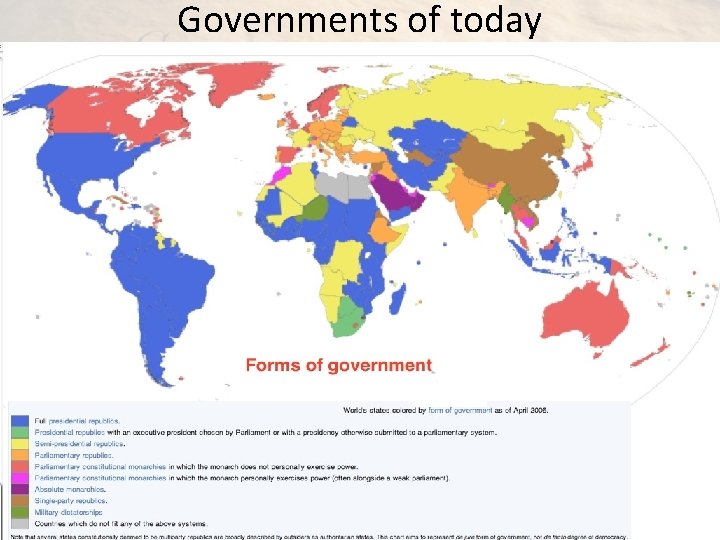
Governments of today
Monarchy • A system of government where power belongs to a ruling family. • Power is obtained by heredity (birthright) • Power is justified by Divine Right- God has given this family the authority to rule. • Monarchs are often called King/Queen, Emperor, Empress. • The two types of monarchies are absolutists and limited monarchs.
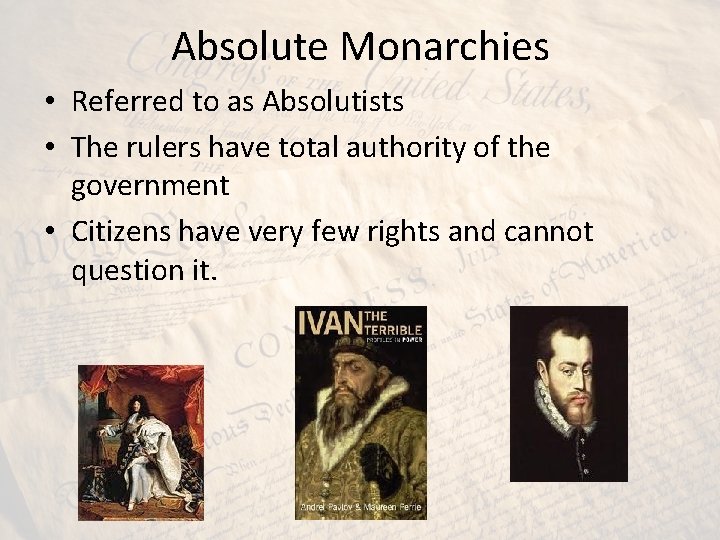
Absolute Monarchies • Referred to as Absolutists • The rulers have total authority of the government • Citizens have very few rights and cannot question it.
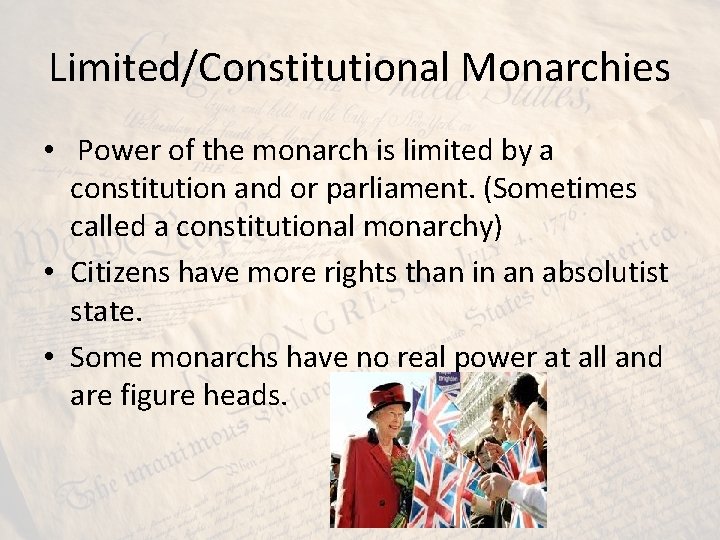
Limited/Constitutional Monarchies • Power of the monarch is limited by a constitution and or parliament. (Sometimes called a constitutional monarchy) • Citizens have more rights than in an absolutist state. • Some monarchs have no real power at all and are figure heads.
Democracy • Originated in ancient Greece • A system of government where power comes from the people. • Two types of democracy are Representative Democracy and Direct Democracy. • Power is usually taken through peaceful means in the form of voting by the people.
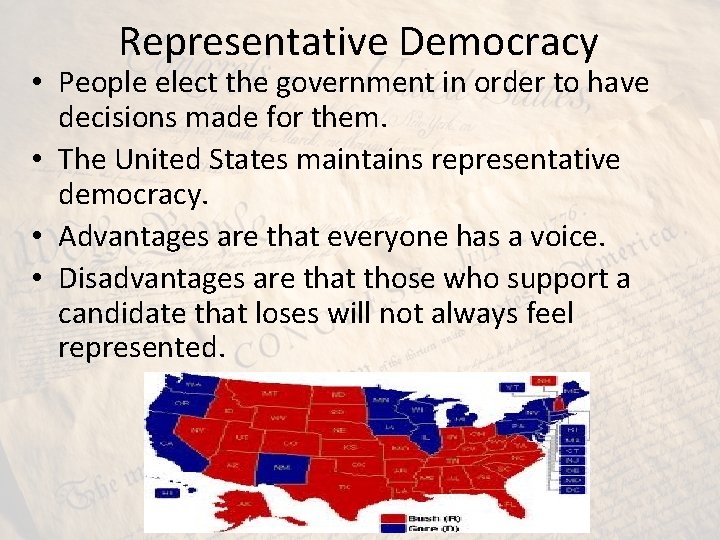
Representative Democracy • People elect the government in order to have decisions made for them. • The United States maintains representative democracy. • Advantages are that everyone has a voice. • Disadvantages are that those who support a candidate that loses will not always feel represented.
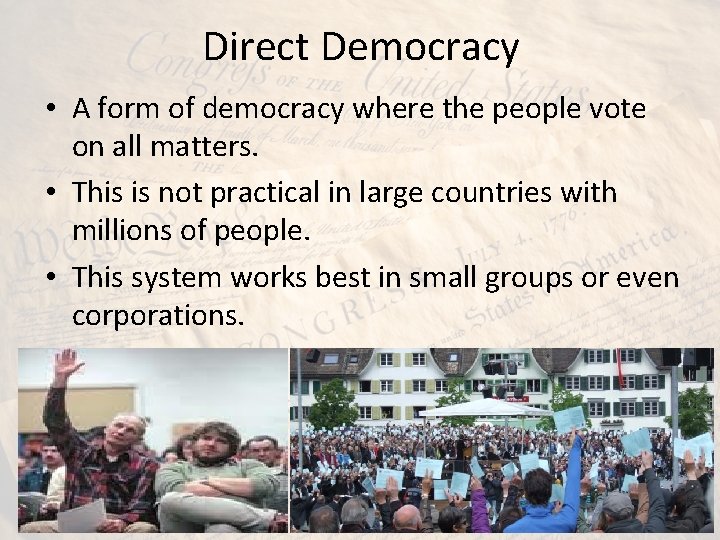
Direct Democracy • A form of democracy where the people vote on all matters. • This is not practical in large countries with millions of people. • This system works best in small groups or even corporations.
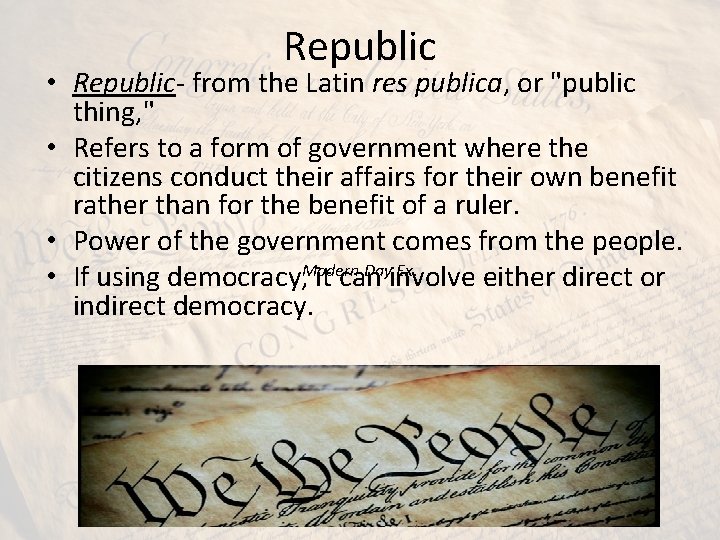
Republic • Republic- from the Latin res publica, or "public thing, " • Refers to a form of government where the citizens conduct their affairs for their own benefit rather than for the benefit of a ruler. • Power of the government comes from the people. Day Ex. • If using democracy, Modern it can involve either direct or indirect democracy.
Communism • The word “Communism” comes from the Latin word “Communis” which means common or belonging to all. • Communism - a government where people shared work fairly and were paid equally. • The type of government in which the society without different social classes exists • “Everyone” controls and owns the methods of production, and everyone has to work to get what they need • Usually have elected leaders, but government heavily controls every aspect of life. Including who gets what is earned
Communism Continued • Advantages: Efficient distribution of resources, Equality, Establishment of stronger communities, Every citizen has a job, Internally stable economic syatem, No competition • Disadvantages: Central state authority holds all means of production, Ever changing principles, No individual freedom, Relying on violence and terror, Workers treated like machines – “Rich get richer and the poor get poorer “
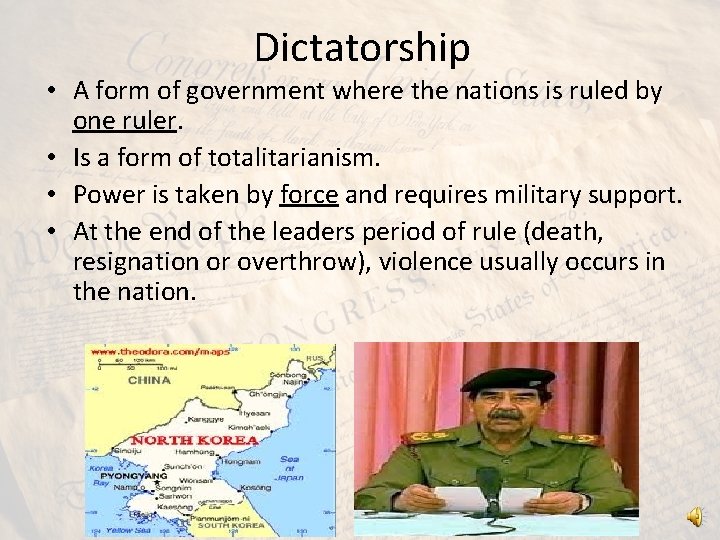
Dictatorship • A form of government where the nations is ruled by one ruler. • Is a form of totalitarianism. • Power is taken by force and requires military support. • At the end of the leaders period of rule (death, resignation or overthrow), violence usually occurs in the nation.
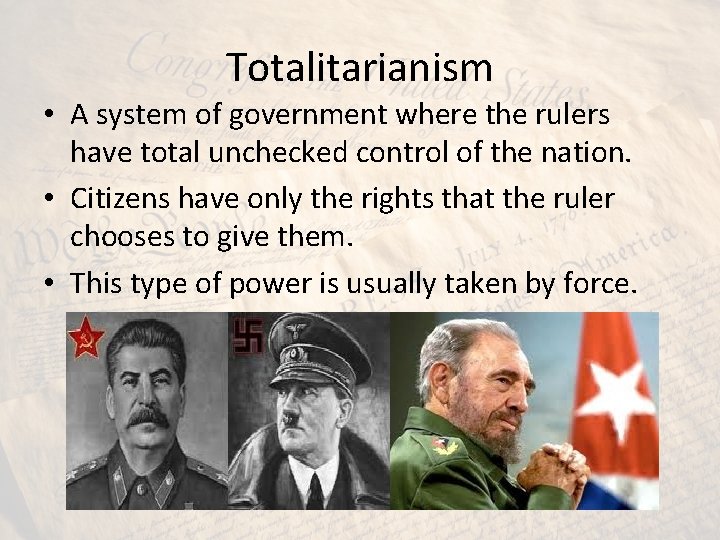
Totalitarianism • A system of government where the rulers have total unchecked control of the nation. • Citizens have only the rights that the ruler chooses to give them. • This type of power is usually taken by force.
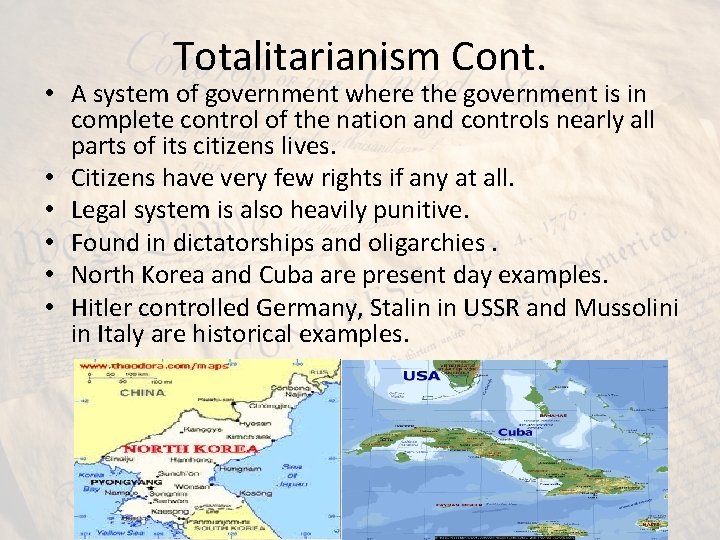
Totalitarianism Cont. • A system of government where the government is in complete control of the nation and controls nearly all parts of its citizens lives. • Citizens have very few rights if any at all. • Legal system is also heavily punitive. • Found in dictatorships and oligarchies. • North Korea and Cuba are present day examples. • Hitler controlled Germany, Stalin in USSR and Mussolini in Italy are historical examples.
Oligarchy • A system of government where a group of people rule and have power to serve their own interests. • Power could be identified by royalty, wealth, family ties, education, corporate, race or military control • Power is usually passed from generation to generation. • South Africa was an example with apartheid (white Africans 10% controlled all of the nation)
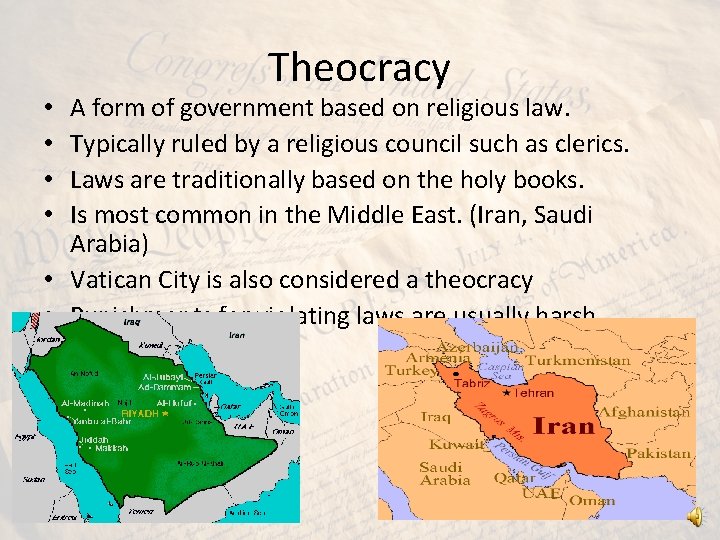
Theocracy A form of government based on religious law. Typically ruled by a religious council such as clerics. Laws are traditionally based on the holy books. Is most common in the Middle East. (Iran, Saudi Arabia) • Vatican City is also considered a theocracy • Punishments for violating laws are usually harsh. • •