
SYSTEMS Identification Ali Karimpour Assistant Professor Ferdowsi University
- Slides: 21
SYSTEMS Identification Ali Karimpour Assistant Professor Ferdowsi University of Mashhad Reference: “System Identification Theory For The User” Lennart Ljung(1999) “Practical Issues of System Identification” Lennart Ljung (2007) “Perspectives on System Identification” Lennart Ljung (2009)
lecture 1 Lecture 1 Perspective on System Identification Topics to be covered include: v System Identification. v Place System Identification on the global map. Who are our neighbors in this part of universe? v Discuss some open areas in System Identification. 2 Ali Karimpour Sep 2010
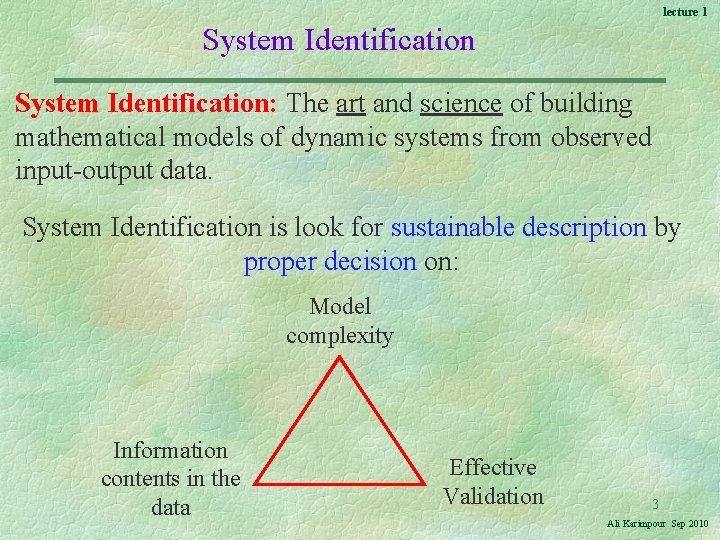
lecture 1 System Identification: The art and science of building mathematical models of dynamic systems from observed input-output data. System Identification is look for sustainable description by proper decision on: Model complexity Information contents in the data Effective Validation 3 Ali Karimpour Sep 2010
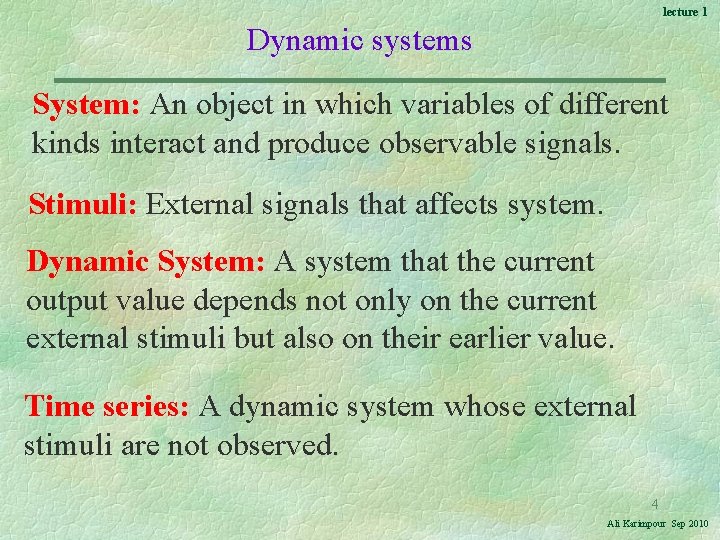
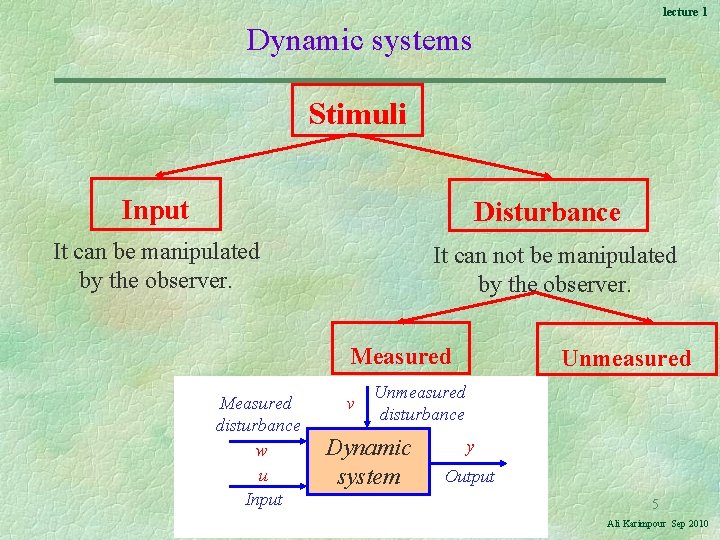
lecture 1 Dynamic systems System: An object in which variables of different kinds interact and produce observable signals. Stimuli: External signals that affects system. Dynamic System: A system that the current output value depends not only on the current external stimuli but also on their earlier value. Time series: A dynamic system whose external stimuli are not observed. 4 Ali Karimpour Sep 2010
lecture 1 Dynamic systems Stimuli Input Disturbance It can be manipulated by the observer. It can not be manipulated by the observer. Measured disturbance w u Input v Unmeasured disturbance Dynamic system y Output 5 Ali Karimpour Sep 2010
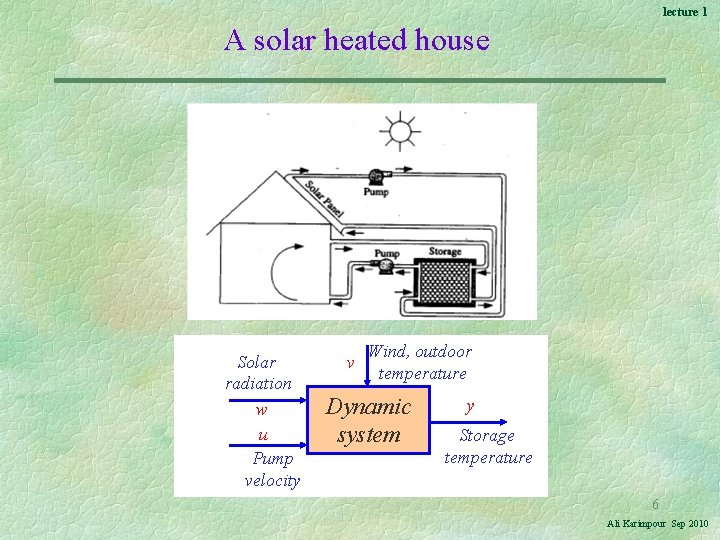
lecture 1 A solar heated house Solar radiation w u Pump velocity v Wind, outdoor temperature Dynamic system y Storage temperature 6 Ali Karimpour Sep 2010
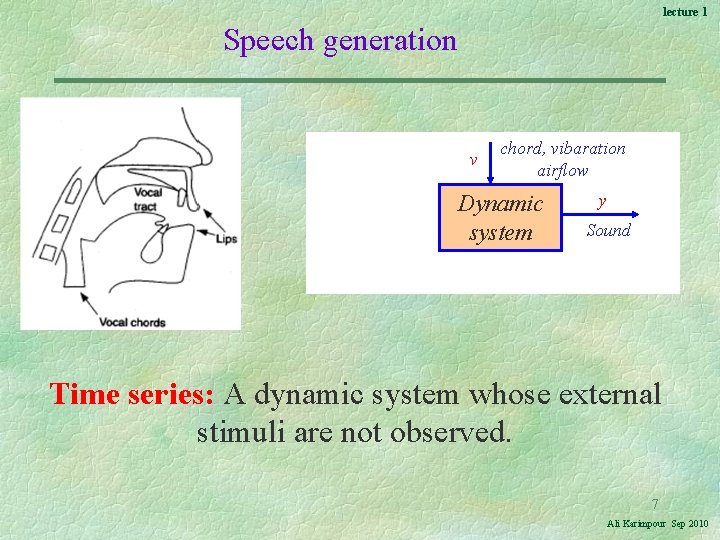
lecture 1 Speech generation v chord, vibaration airflow Dynamic system y Sound Time series: A dynamic system whose external stimuli are not observed. 7 Ali Karimpour Sep 2010
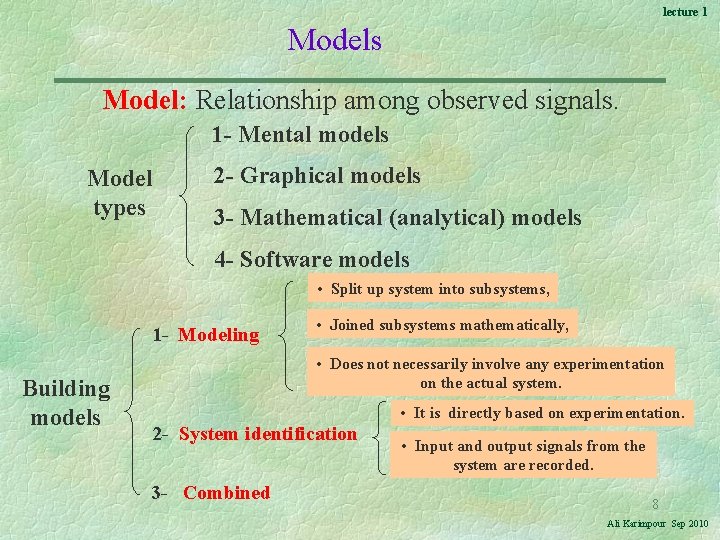
lecture 1 Models Model: Relationship among observed signals. 1 - Mental models Model types 2 - Graphical models 3 - Mathematical (analytical) models 4 - Software models • Split up system into subsystems, 1 - Modeling Building models • Joined subsystems mathematically, • Does not necessarily involve any experimentation on the actual system. • It is directly based on experimentation. 2 - System identification 3 - Combined • Input and output signals from the system are recorded. 8 Ali Karimpour Sep 2010
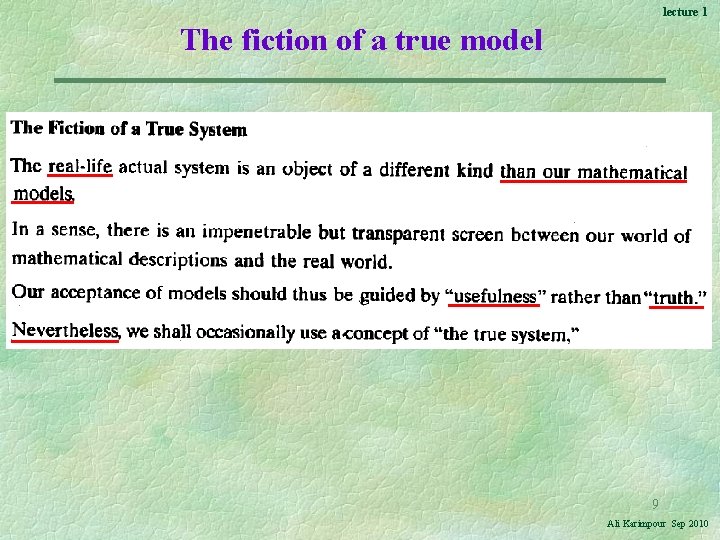
lecture 1 The fiction of a true model 9 Ali Karimpour Sep 2010
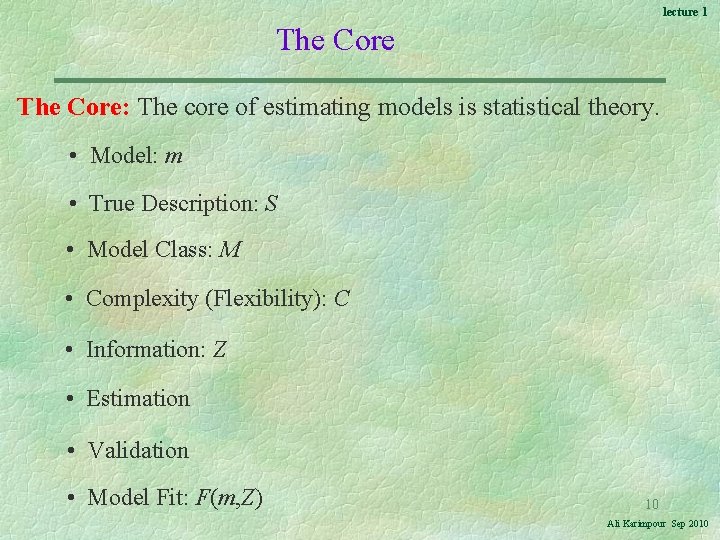
lecture 1 The Core: The core of estimating models is statistical theory. • Model: m • True Description: S • Model Class: M • Complexity (Flexibility): C • Information: Z • Estimation • Validation • Model Fit: F(m, Z) 10 Ali Karimpour Sep 2010
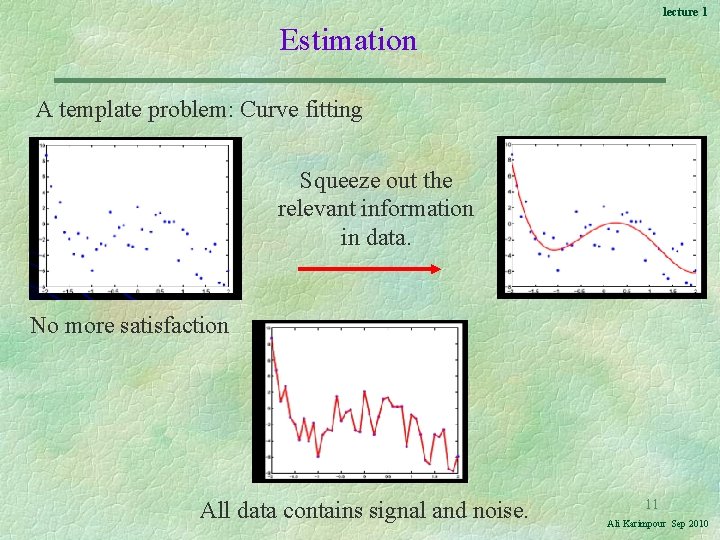
lecture 1 Estimation A template problem: Curve fitting Squeeze out the relevant information in data. No more satisfaction All data contains signal and noise. 11 Ali Karimpour Sep 2010
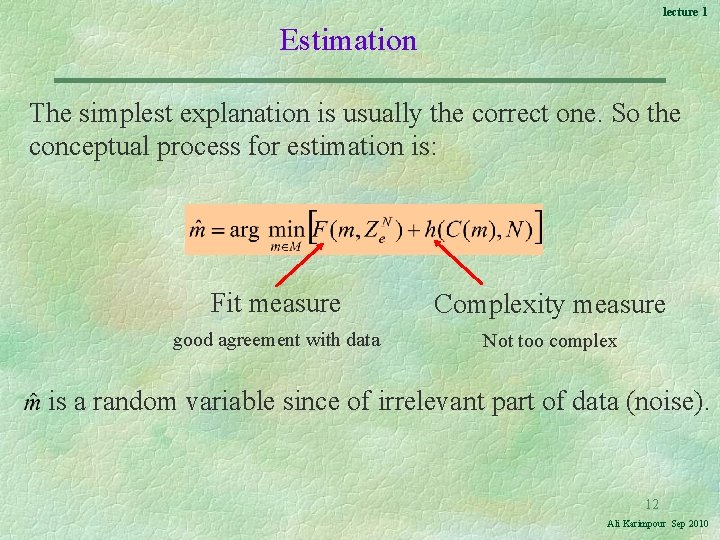
lecture 1 Estimation The simplest explanation is usually the correct one. So the conceptual process for estimation is: Fit measure Complexity measure good agreement with data Not too complex is a random variable since of irrelevant part of data (noise). 12 Ali Karimpour Sep 2010
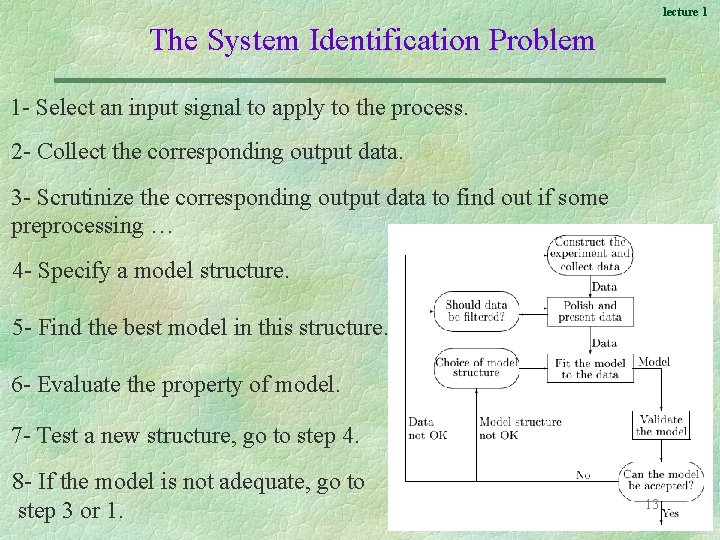
lecture 1 The System Identification Problem 1 - Select an input signal to apply to the process. 2 - Collect the corresponding output data. 3 - Scrutinize the corresponding output data to find out if some preprocessing … 4 - Specify a model structure. 5 - Find the best model in this structure. 6 - Evaluate the property of model. 7 - Test a new structure, go to step 4. 8 - If the model is not adequate, go to step 3 or 1. 13 Ali Karimpour Sep 2010
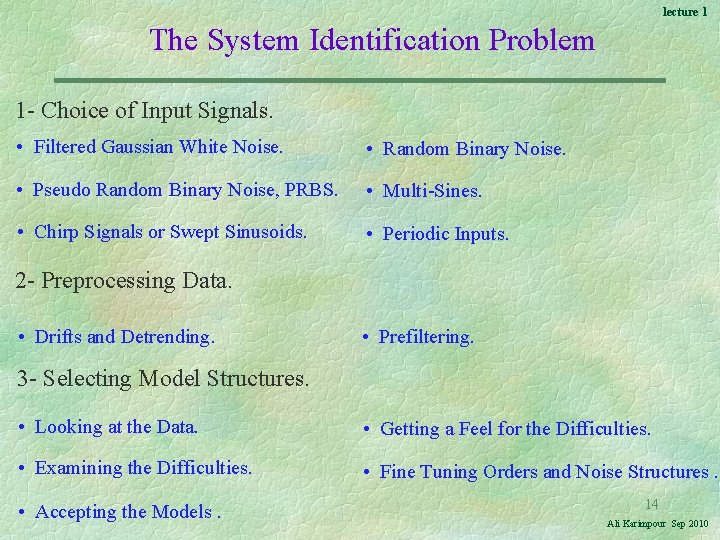
lecture 1 The System Identification Problem 1 - Choice of Input Signals. • Filtered Gaussian White Noise. • Random Binary Noise. • Pseudo Random Binary Noise, PRBS. • Multi-Sines. • Chirp Signals or Swept Sinusoids. • Periodic Inputs. 2 - Preprocessing Data. • Drifts and Detrending. • Prefiltering. 3 - Selecting Model Structures. • Looking at the Data. • Getting a Feel for the Difficulties. • Examining the Difficulties. • Fine Tuning Orders and Noise Structures. • Accepting the Models. 14 Ali Karimpour Sep 2010
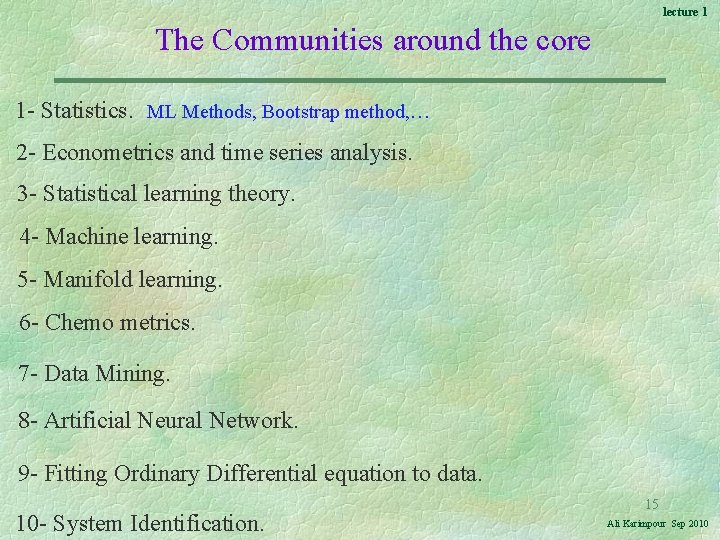
lecture 1 The Communities around the core 1 - Statistics. ML Methods, Bootstrap method, … 2 - Econometrics and time series analysis. 3 - Statistical learning theory. 4 - Machine learning. 5 - Manifold learning. 6 - Chemo metrics. 7 - Data Mining. 8 - Artificial Neural Network. 9 - Fitting Ordinary Differential equation to data. 10 - System Identification. 15 Ali Karimpour Sep 2010
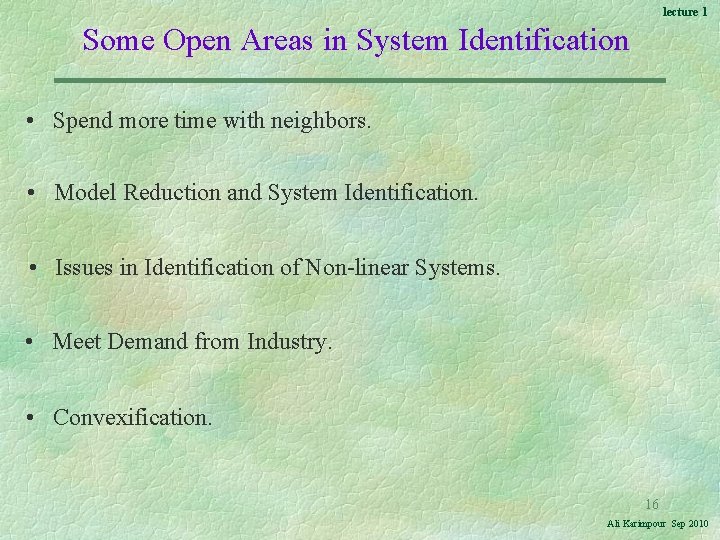
lecture 1 Some Open Areas in System Identification • Spend more time with neighbors. • Model Reduction and System Identification. • Issues in Identification of Non-linear Systems. • Meet Demand from Industry. • Convexification. 16 Ali Karimpour Sep 2010
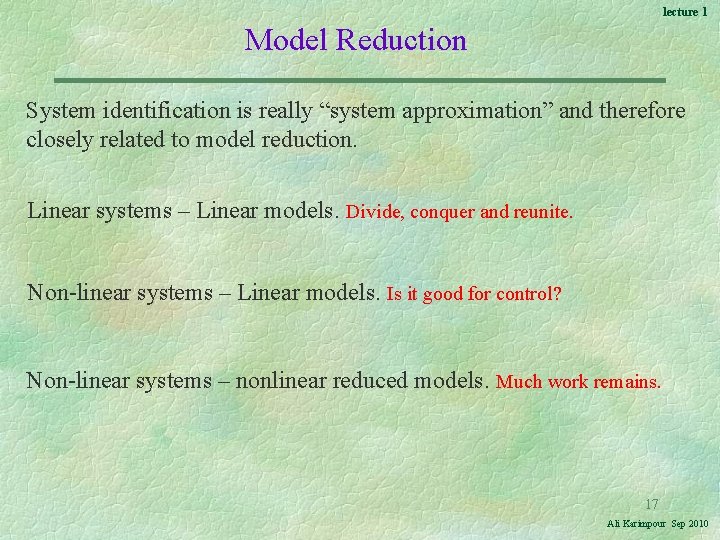
lecture 1 Model Reduction System identification is really “system approximation” and therefore closely related to model reduction. Linear systems – Linear models. Divide, conquer and reunite. Non-linear systems – Linear models. Is it good for control? Non-linear systems – nonlinear reduced models. Much work remains. 17 Ali Karimpour Sep 2010
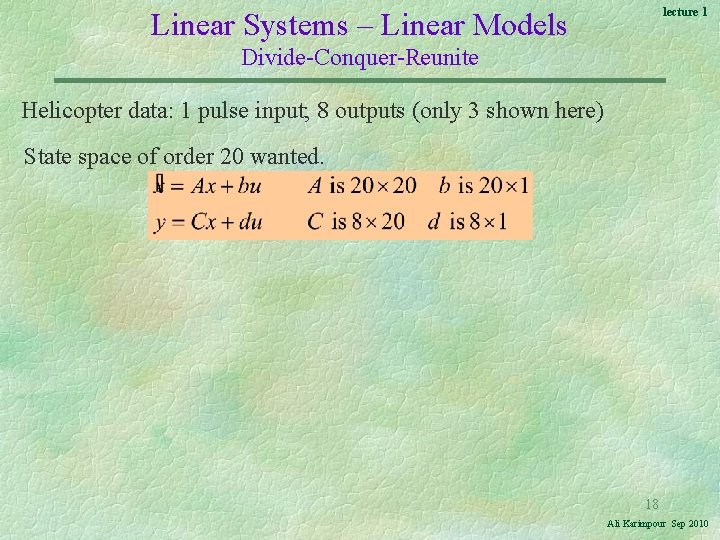
lecture 1 Linear Systems – Linear Models Divide-Conquer-Reunite Helicopter data: 1 pulse input; 8 outputs (only 3 shown here) State space of order 20 wanted. 18 Ali Karimpour Sep 2010
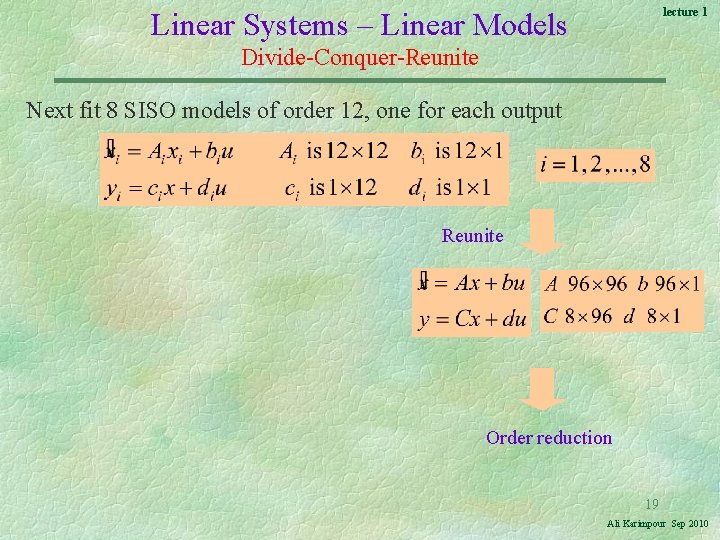
lecture 1 Linear Systems – Linear Models Divide-Conquer-Reunite Next fit 8 SISO models of order 12, one for each output Reunite Order reduction 19 Ali Karimpour Sep 2010
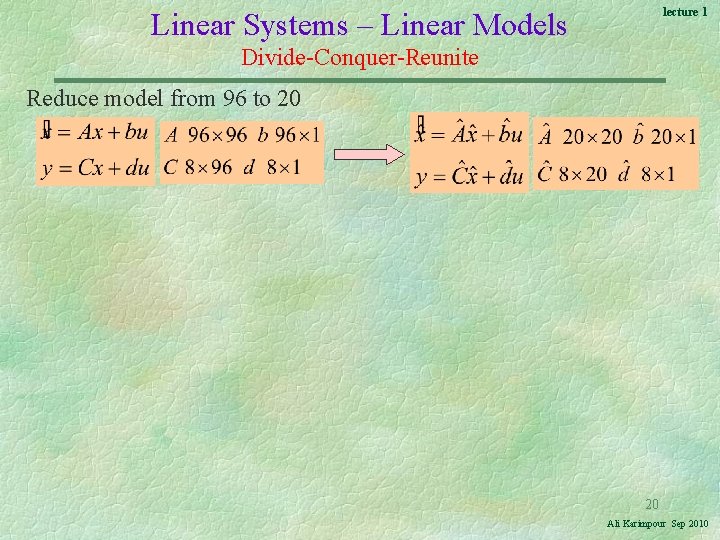
lecture 1 Linear Systems – Linear Models Divide-Conquer-Reunite Reduce model from 96 to 20 20 Ali Karimpour Sep 2010
lecture 1 Convexification 21 Ali Karimpour Sep 2010