
Systems Genetic Approaches for Studying Complex Traits Steve

- Slides: 33
Systems Genetic Approaches for Studying Complex Traits Steve Horvath Human Genetics, Biostatistics University of California, Los Angeles
Contents • Using genetic markers to orient the edges in quantitative trait networks: the NEO software. – Aten JE, Fuller TF, Lusis AJ, et al (2008) BMC Systems Biology 2008, 2: 34. April 15. – Chapter 11 in Springer book “Weighted Network Analysis. Applications in Genomics and Systems Biology” • Application – Plaisier et al (2009) A Systems Genetics Approach Implicates USF 1, FADS 3, and Other Causal Candidate Genes for Familial Combined Hyperlipidemia. Plo. S Genetics 2009; 5(9)
Using genetic markers to orient the edges in quantitative trait networks: the NEO software Aten JE, Fuller TF, Lusis AJ, et al (2008) Using genetic markers to orient the edges in quantitative trait networks: the NEO software. BMC Systems Biology 2008, 2: 34. April 15.
Using SNPs for learning directed networks • Question: Can genetic markers help us to dissect causal relationships between gene expression- and clinical traits? • Answer: yes, many authors have addressed this question both in genetics and in genetic epidemiology. – Vast literature->google search
Fundamental paradigm of biology can be used for inferring causal information • Sequence variation->gene expression (messenger RNA)->protein->clinical traits • SNPs are “causal anchors” SNP -> gene expression – Schadt et al 2005.
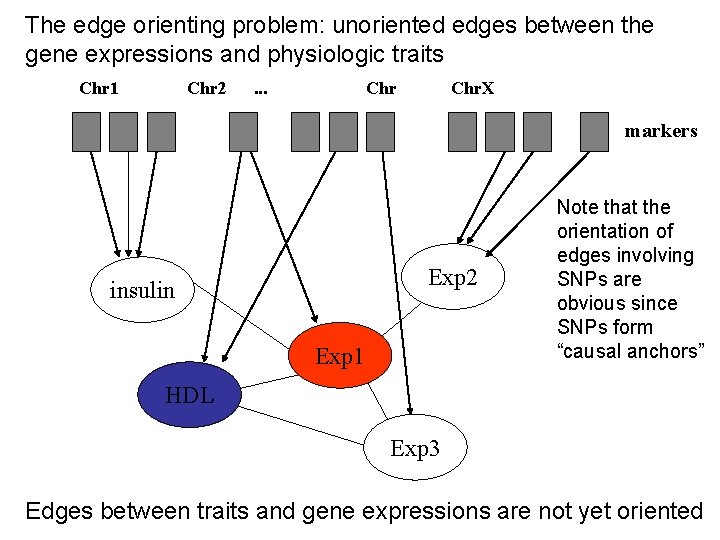
The edge orienting problem: unoriented edges between the gene expressions and physiologic traits Chr 1 Chr 2 . . . Chr. X markers Exp 2 insulin Exp 1 Note that the orientation of edges involving SNPs are obvious since SNPs form “causal anchors” HDL Exp 3 Edges between traits and gene expressions are not yet oriented
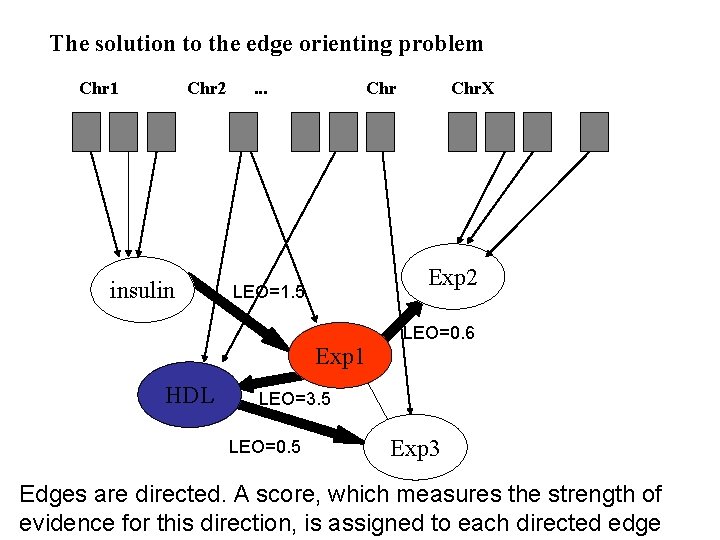
The solution to the edge orienting problem Chr 1 Chr 2 insulin . . . Chr Exp 2 LEO=1. 5 Exp 1 HDL Chr. X LEO=0. 6 LEO=3. 5 LEO=0. 5 Exp 3 Edges are directed. A score, which measures the strength of evidence for this direction, is assigned to each directed edge
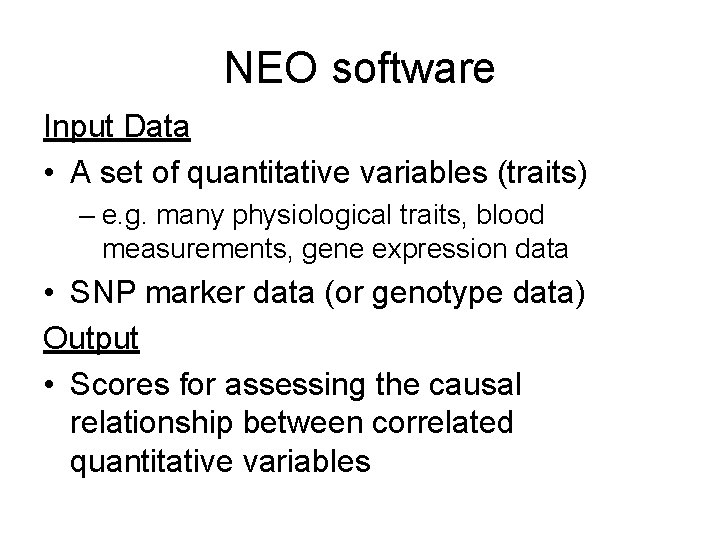
NEO software Input Data • A set of quantitative variables (traits) – e. g. many physiological traits, blood measurements, gene expression data • SNP marker data (or genotype data) Output • Scores for assessing the causal relationship between correlated quantitative variables
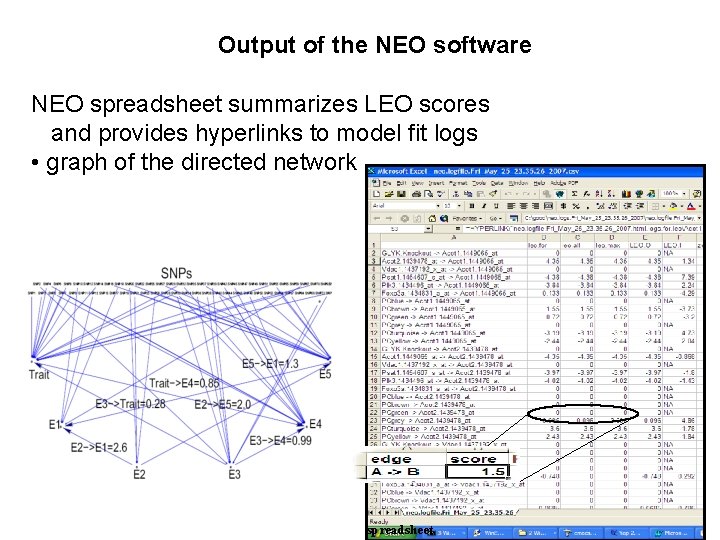
Output of the NEO software NEO spreadsheet summarizes LEO scores and provides hyperlinks to model fit logs • graph of the directed network spreadsheet
NEO Network Edge Orienting is a set of algorithms, implemented in R software functions, which compute scores for causal edge strength • LEO - compares local structural equation models; the more positive the score, the stronger the evidence
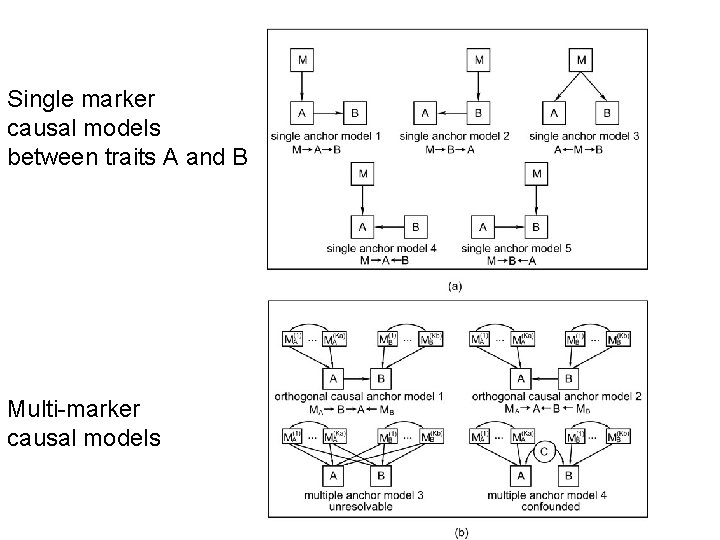
Single marker causal models between traits A and B Multi-marker causal models
Computing the model chi-square test p-value for assessing the fit
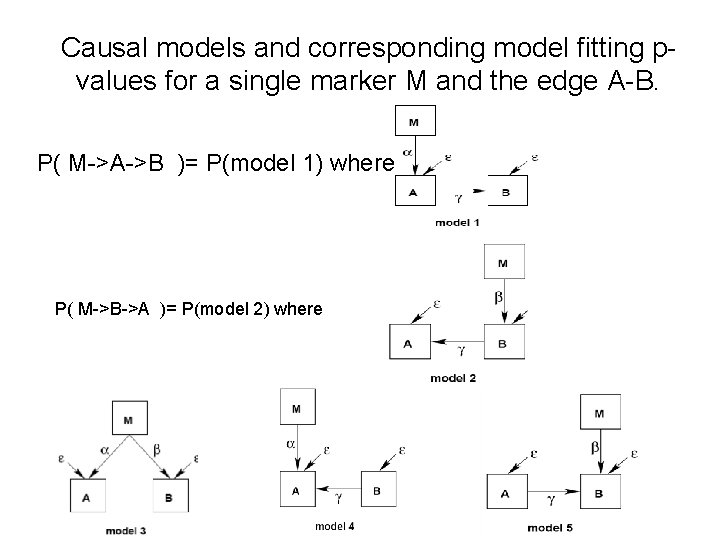
Causal models and corresponding model fitting pvalues for a single marker M and the edge A-B. P( M->A->B )= P(model 1) where P( M->B->A )= P(model 2) where
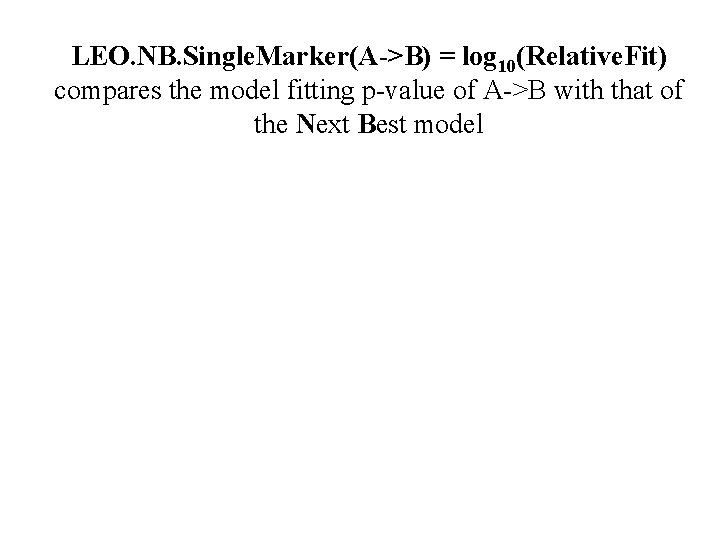
LEO. NB. Single. Marker(A->B) = log 10(Relative. Fit) compares the model fitting p-value of A->B with that of the Next Best model
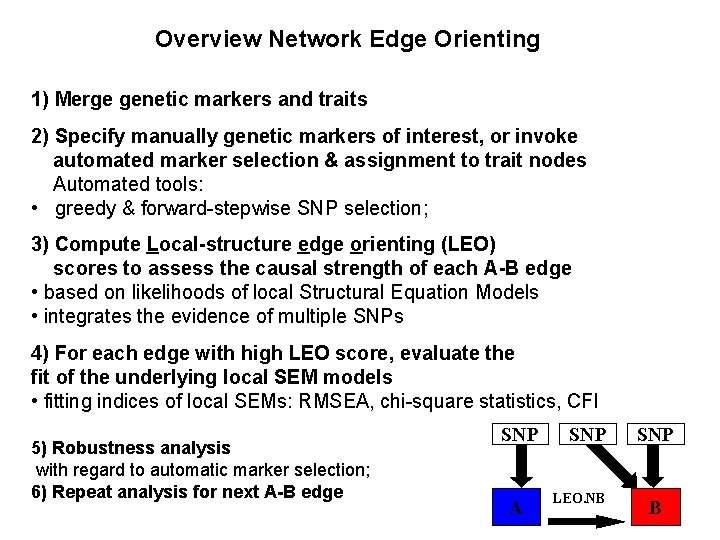
Overview Network Edge Orienting 1) Merge genetic markers and traits 2) Specify manually genetic markers of interest, or invoke automated marker selection & assignment to trait nodes Automated tools: • greedy & forward-stepwise SNP selection; 3) Compute Local-structure edge orienting (LEO) scores to assess the causal strength of each A-B edge • based on likelihoods of local Structural Equation Models • integrates the evidence of multiple SNPs 4) For each edge with high LEO score, evaluate the fit of the underlying local SEM models • fitting indices of local SEMs: RMSEA, chi-square statistics, CFI 5) Robustness analysis with regard to automatic marker selection; 6) Repeat analysis for next A-B edge SNP A SNP LEO. NB SNP B
A Systems Genetics Approach Implicates USF 1, FADS 3, and Other Causal Candidate Genes for Familial Combined Hyperlipidemia Chris Plaisier, …Paivi Pajukante. Plo. S Genetics 2009; 5(9)
Familial combined hyperlipidemia • FCHL is a common atherogenic dyslipidemia conferring nearly two-fold greater risk for coronary heart disease. • FCHL is characterized by familial segregation of elevated fasting plasma triglycerides (TGs), total cholesterol (TC), or both • Another common characteristic of FCHL is elevated levels of fasting plasma apolipoprotein B (Apo. B)
SNP rs 3737787 in LD with USF 1 • Linkage analysis and allelic association studies identified association within the region of chromosome 1 q 21 -q 23 consistently linked to FCHL with the associated linkage disequilibrium (LD) bin containing variants in upstream transcription factor 1 (USF 1) • A SNP (SNP rs 3737787 residing in the 3′ UTR of USF 1 captures the disease-associated signal • Previous studies involving direct sequencing, extensive genotyping and gene expression analyses of the USF 1 region have not identified any SNPs in the rs 3737787 LD bin altering the coding sequence or the expression of USF 1 itself in fat or lymphoblasts • It has, however, been demonstrated that genes known to be regulated by USF 1 were differentially expressed between rs 3737787 genotype groups in Finnish fat biopsies. • The direct targets of USF 1 were previously identified using chromatin immunoprecipitation and high-resolution promoter microarrays (Ch. IPChip).
Mexican FCHL Families • Originally, 872 individuals from 74 Mexican FCHL families were collected. • 70 extremely discordant individuals – The 90 th age-sex specific Mexican population percentiles for TGs and TC were used to determine the affection status • Gene expression data: Affymetrix U 133 Plus 2 • Our sample size of 70 extremely discordant individuals provided 80% power to detect a significant association (p-value≤ 0. 05) with correlation coefficient = 0. 33
Effect of rs 3737787 on FCHL is mediated through the transcription factor USF 1 • We observed 972 genes (gene expression profiles) significantly correlated with rs 3737787 genotypes using an additive model. • The rs 3737787 correlated genes had significant overlap both with – i) the set of USF 1 regulated genes identified in our USF 1 overexpression experiment (n = 277; p-value = 3. 0× 10− 5; foldenrichment = 1. 22) – and ii) the previously published genes identified by Ch. IP-Chip which are directly regulated by USF 1 (n = 117; p-value = 0. 0051; fold-enrichment = 1. 23). – Furthermore, we also observed significant overlap between the rs 3737787 correlated genes and the 2, 189 genes differentially expressed between FCHL cases and normolipidemic controls (n = 245; p-value = 0. 0030; fold-enrichment = 1. 16) supporting a link from rs 3737787 to FCHL etiology. • Taken together, the overlap between rs 3737787 correlated genes and genes regulated by USF 1 suggest that the effect of rs 3737787 on FCHL is mediated through the transcription factor USF 1.
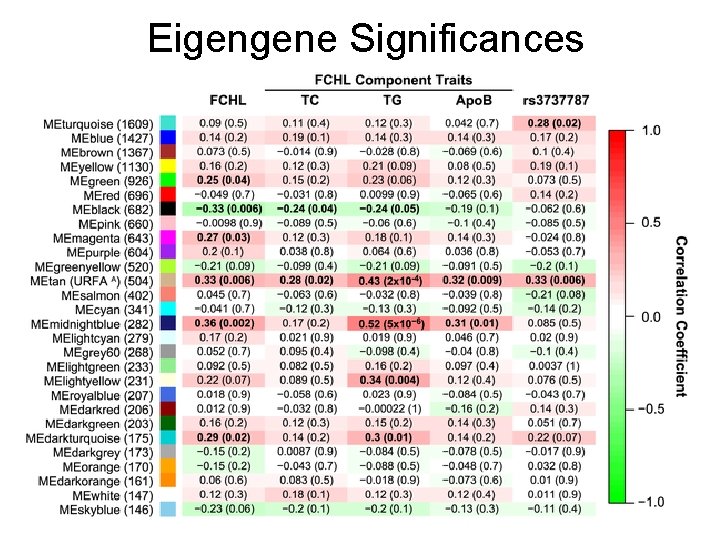
WGCNA analysis leads to 28 modules and 2*28 multiple tests • Using blockwise module detection, WGCNA method clustered the 14, 942 gene expression probes on the Mexican FCHL case/control microarrays into 28 gene co-expression modules. • The module eigengene (ME) of each module was correlated with the quantitative FCHL component traits: TC, TG and Apo. B. • Regarding Bonferroni correction: Given the high level of correlation between the FCHL component traits (correlation TC & TG = 0. 57; correlation TC & Apo. B = 0. 90; correlation TG & Apo. B = 0. 59), we approximate the total number of independent tests to be 2. Therefore, a Bonferroni correction would have to account for a total of 56 multiple comparisons (28 modules× 2 independent tests). • This highlights a major statistical advantage of our module based analyses over conventional differential expression analyses which have to account for tens of thousands of multiple comparisons.
Eigengene Significances
USF 1 -Regulated FCHL-Associated (URFA) Module Characterization • Tan module (504 genes) was renamed URFA module • The fact that the URFA ME was associated with rs 3737787 reflects the fact that most module genes are at least partially regulated by this SNP • Gene ontology enrichment – Cellular Lipid Metabolic Processes (p-values = 1. 0× 10− 5) and Lipid Metabolic Processes (9. 3× 10− 6) • The URFA ME accounts for 10% of the variation of FCHL, 6% of TC, 17% of TG, and 9% of Apo. B
NEO analysis • To evaluate whether the module causally affects FCHL component traits, we utilized the Network Edge Orienting (NEO) R software package • Since we are only considering a single SNP (rs 3737787) we computed LEO. NB. Single. Marker scores for the causal orientation of a ME→trait. • The LEO. NB. Single. Marker score is a relative model fitting index for the causal model rs 3737787→ME→trait relative to alternative causal models • We required that the causal model fit at least two times better than the next best alternative model, which equates to a LEO. NB. Single. Marker score of 0. 3
NEO analysis indicates that the URFA eigengene is upstream of TG levels • We found sufficient evidence to infer a causal relationship between the URFA ME and fasting plasma TG levels (LEO. NB. Single. Marker score = 0. 31), the key component trait of FCHL. • The LEO. NB. Single. Marker score for the URFA ME to FCHL was 0. 25.
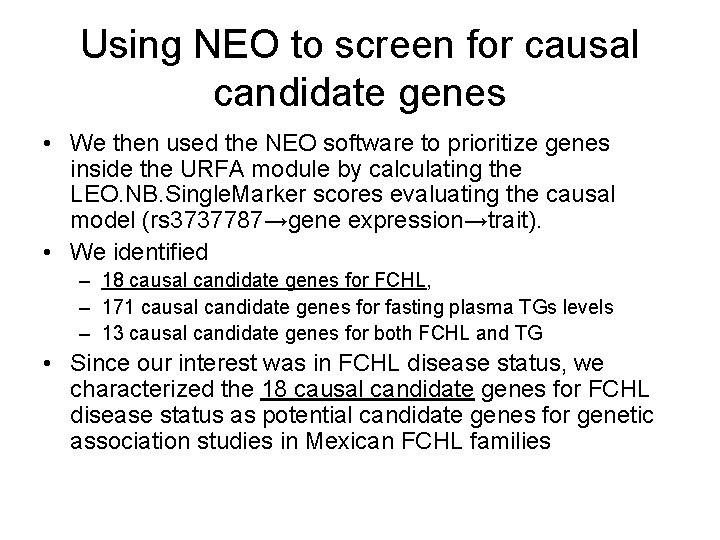
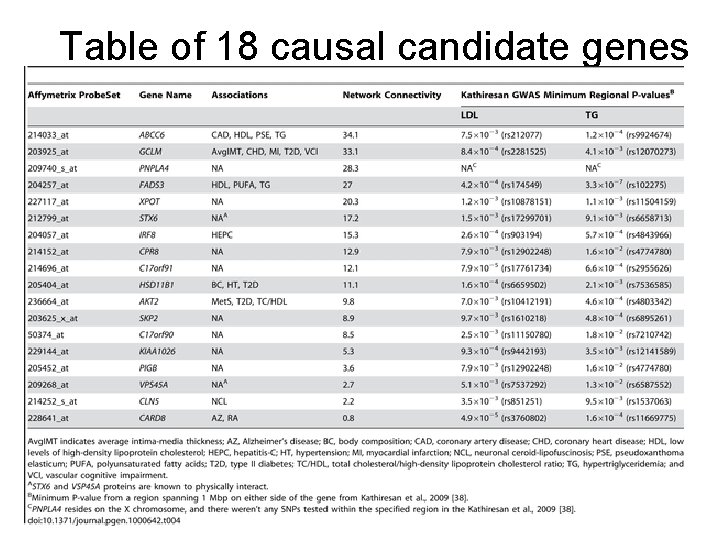
Using NEO to screen for causal candidate genes • We then used the NEO software to prioritize genes inside the URFA module by calculating the LEO. NB. Single. Marker scores evaluating the causal model (rs 3737787→gene expression→trait). • We identified – 18 causal candidate genes for FCHL, – 171 causal candidate genes for fasting plasma TGs levels – 13 causal candidate genes for both FCHL and TG • Since our interest was in FCHL disease status, we characterized the 18 causal candidate genes for FCHL disease status as potential candidate genes for genetic association studies in Mexican FCHL families
Table of 18 causal candidate genes
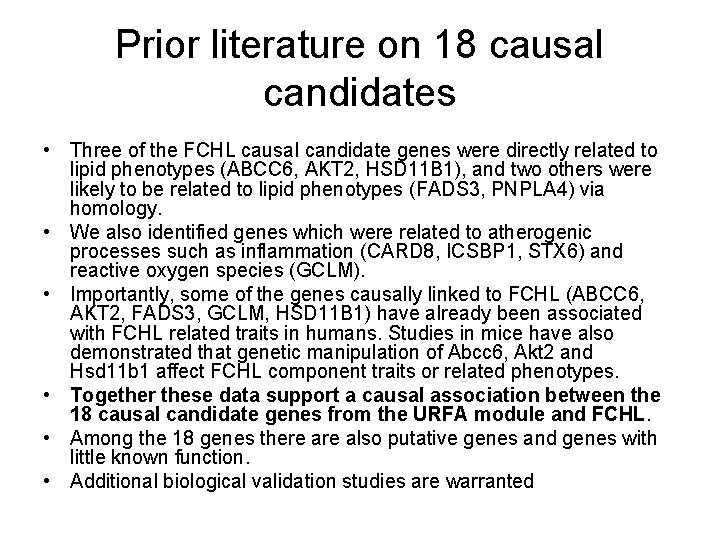
Prior literature on 18 causal candidates • Three of the FCHL causal candidate genes were directly related to lipid phenotypes (ABCC 6, AKT 2, HSD 11 B 1), and two others were likely to be related to lipid phenotypes (FADS 3, PNPLA 4) via homology. • We also identified genes which were related to atherogenic processes such as inflammation (CARD 8, ICSBP 1, STX 6) and reactive oxygen species (GCLM). • Importantly, some of the genes causally linked to FCHL (ABCC 6, AKT 2, FADS 3, GCLM, HSD 11 B 1) have already been associated with FCHL related traits in humans. Studies in mice have also demonstrated that genetic manipulation of Abcc 6, Akt 2 and Hsd 11 b 1 affect FCHL component traits or related phenotypes. • Together these data support a causal association between the 18 causal candidate genes from the URFA module and FCHL. • Among the 18 genes there also putative genes and genes with little known function. • Additional biological validation studies are warranted
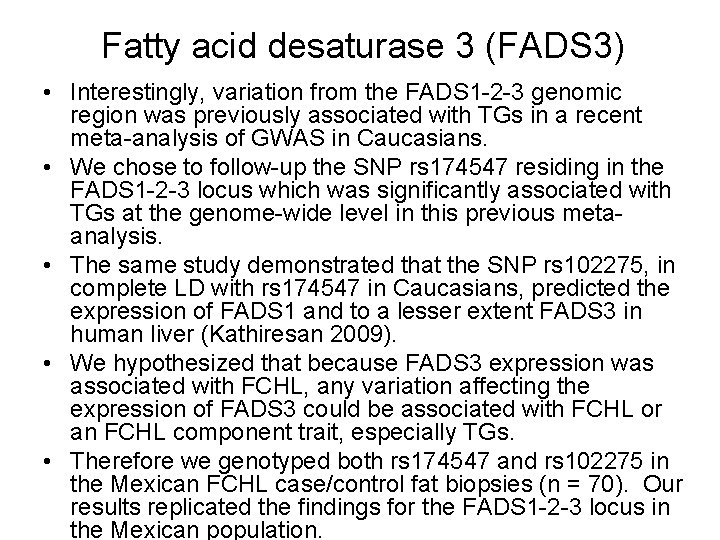
Fatty acid desaturase 3 (FADS 3) • Interestingly, variation from the FADS 1 -2 -3 genomic region was previously associated with TGs in a recent meta-analysis of GWAS in Caucasians. • We chose to follow-up the SNP rs 174547 residing in the FADS 1 -2 -3 locus which was significantly associated with TGs at the genome-wide level in this previous metaanalysis. • The same study demonstrated that the SNP rs 102275, in complete LD with rs 174547 in Caucasians, predicted the expression of FADS 1 and to a lesser extent FADS 3 in human liver (Kathiresan 2009). • We hypothesized that because FADS 3 expression was associated with FCHL, any variation affecting the expression of FADS 3 could be associated with FCHL or an FCHL component trait, especially TGs. • Therefore we genotyped both rs 174547 and rs 102275 in the Mexican FCHL case/control fat biopsies (n = 70). Our results replicated the findings for the FADS 1 -2 -3 locus in the Mexican population.
Why did we use WGCNA? • • • First, co-expression modules may be comprised of sets of genes that are likely to be co-regulated by similar factors (e. g. shared transcription factors, genetic variants or environmental effects). Second, modules (and corresponding module eigengenes) represent a biologically motivated data reduction method which greatly alleviates the multiple comparison problem inherent in genomic data analysis. Third, k. ME (intramodular connectivity) can be used to provide annotation tables for module membership e. g. to the URFA module
Conclusion • • By integrating a genetic polymorphism with genome-wide gene expression levels, we were able to attribute function to a genetic polymorphism in the USF 1 gene. We demonstrate that this genetic polymorphism in USF 1 contributes to FCHL disease risk by modulating the expression of a group of genes functionally related to lipid metabolism, and that this modulation is mediated by USF 1. Our unbiased module detection analysis identified a module (the URFA module) that was associated with rs 3737787 genotypes, fasting plasma TG levels, FCHL disease status, and contained genes that are causal drivers of TG levels. Our approach provides insight to how the SNP rs 3737787 confers increased risk for FCHL, by demonstrating that it regulates the URFA module eigengene which in turn contributes to increased TG levels, a key component trait of FCHL. One of the genes whose expression is modulated by USF 1 is FADS 3, which was also implicated in a recent genome-wide association study for lipid traits. We demonstrated that a genetic polymorphism from the FADS 3 region, which was associated with triglycerides in a GWAS study of Caucasians, was also associated with triglycerides in Mexican FCHL families. Our analysis provides novel insight into the gene expression profile contributing to FCHL disease risk, and identifies FADS 3 as a new gene for FCHL in Mexicans.
Software and Data Availability • For R code see “Corrected Tutorial for Chapter 12” at the following webpage: – http: //www. genetics. ucla. edu/labs/horvath/Coexpressi on. Network/Book/ • Or the original NEO webpage: • www. genetics. ucla. edu/labs/horvath/aten/NEO/
Acknowledgement • (Former) students and Postdocs: • Peter Langfelder, Jun Dong, Tova Fuller, Mike Oldham, Ai Li, Wen Lin, Jeremy Miller, Chris Plaisier, Anja Presson, Bin Zhang, Wei Zhao, Jason Aten, Lin Song • Colleagues/Collaborators • Jake Lusis, Paivi Pajukante, • Dan Geschwind, Giovanni Coppola