
Systems Engineering Lecture 4 Requirements Definition Dr Msury


- Slides: 25
Systems Engineering Lecture 4 Requirements Definition Dr. Msury Mahunnah https: //mahunnah. wordpress. com/ msury. mahunnah@ifm. ac. tz
How we should specify “exactly” what is expected before we start designing something
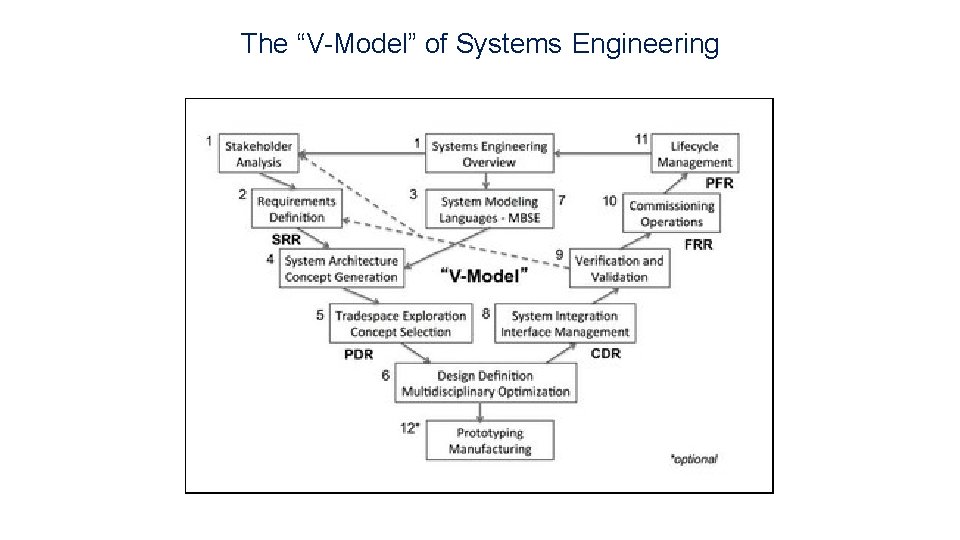
The “V-Model” of Systems Engineering
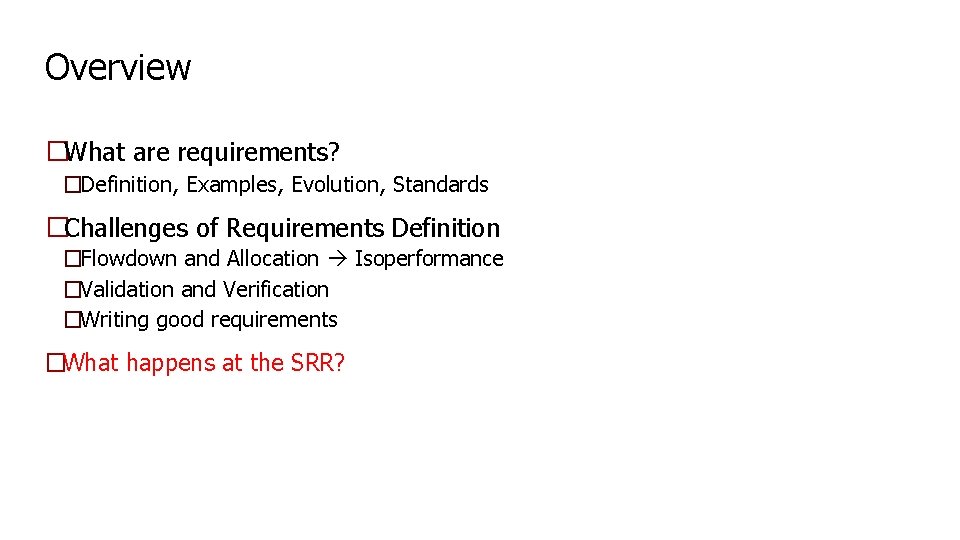
Overview �What are requirements? �Definition, Examples, Evolution, Standards �Challenges of Requirements Definition �Flowdown and Allocation Isoperformance �Validation and Verification �Writing good requirements �What happens at the SRR?
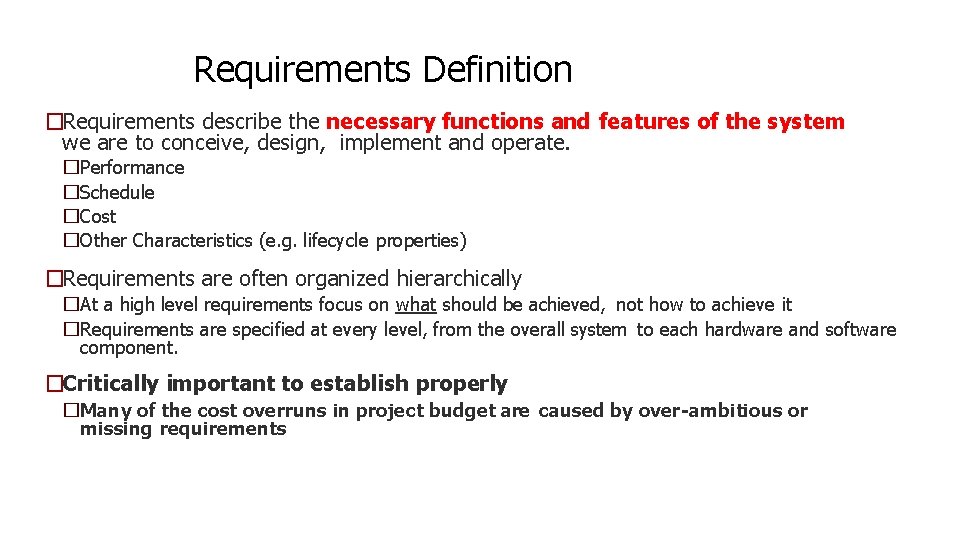
Requirements Definition �Requirements describe the necessary functions and features of the system we are to conceive, design, implement and operate. �Performance �Schedule �Cost �Other Characteristics (e. g. lifecycle properties) �Requirements are often organized hierarchically �At a high level requirements focus on what should be achieved, not how to achieve it �Requirements are specified at every level, from the overall system to each hardware and software component. �Critically important to establish properly �Many of the cost overruns in project budget are caused by over-ambitious or missing requirements
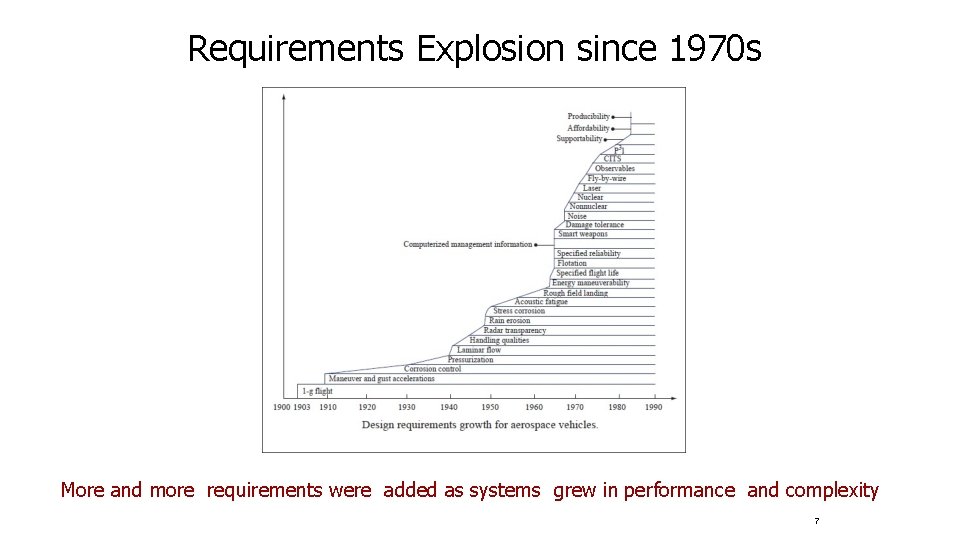
Requirements Explosion since 1970 s More and more requirements were added as systems grew in performance and complexity 7
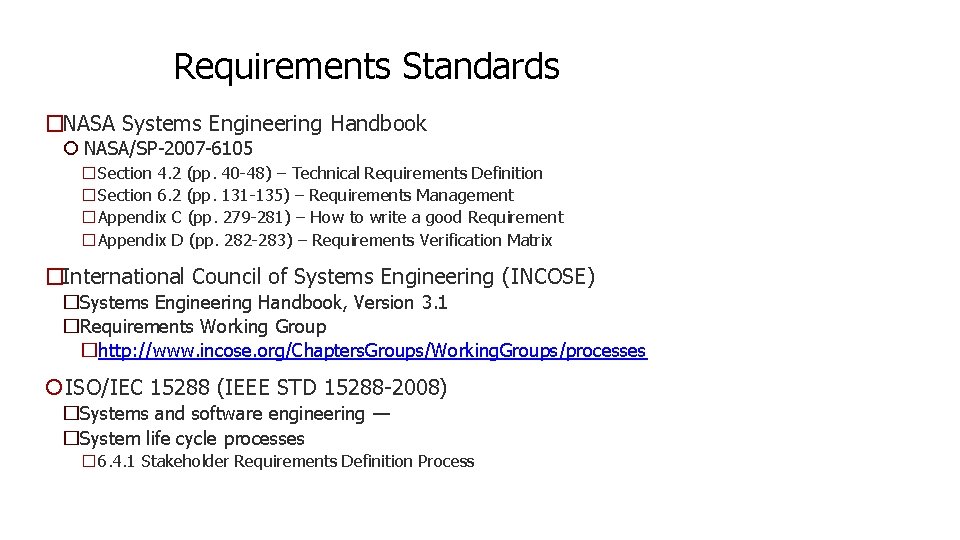
Requirements Standards �NASA Systems Engineering Handbook NASA/SP-2007 -6105 �Section 4. 2 (pp. 40 -48) – Technical Requirements Definition �Section 6. 2 (pp. 131 -135) – Requirements Management �Appendix C (pp. 279 -281) – How to write a good Requirement �Appendix D (pp. 282 -283) – Requirements Verification Matrix �International Council of Systems Engineering (INCOSE) �Systems Engineering Handbook, Version 3. 1 �Requirements Working Group �http: //www. incose. org/Chapters. Groups/Working. Groups/processes ISO/IEC 15288 (IEEE STD 15288 -2008) �Systems and software engineering — �System life cycle processes � 6. 4. 1 Stakeholder Requirements Definition Process
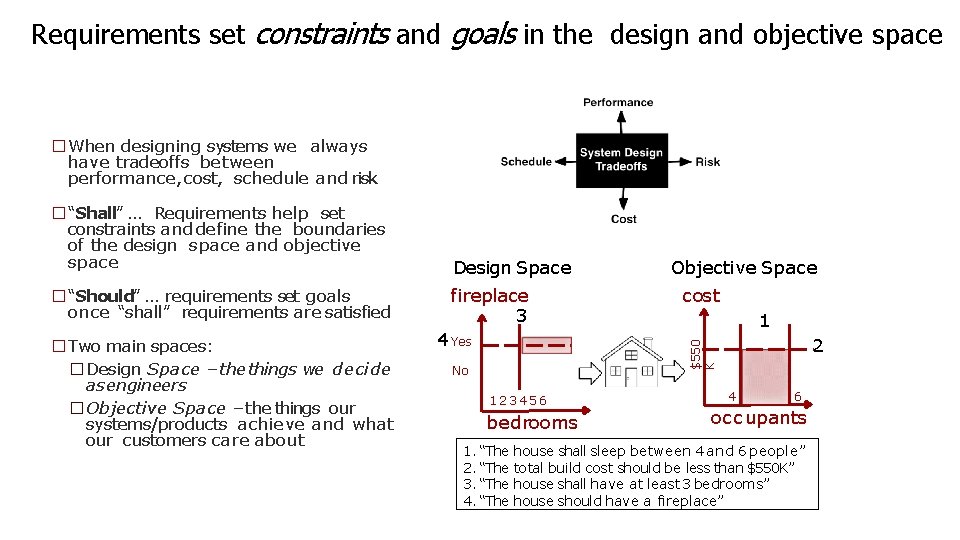
Requirements set constraints and goals in the design and objective space �When designing systems we always have tradeoffs between performance, cost, schedule and risk �“Shall” … Requirements help set constraints and define the boundaries of the design space and objective space Design Space �“Should” … requirements set goals once “shall” requirements are satisfied fireplace 3 4 Yes cost 1 2 $550 K �Two main spaces: � Design Space – the things we decide as engineers �Objective Space – the things our systems/products achieve and what our customers care about Objective Space No 123456 bedrooms 4 6 oc c upants 1. “The house shall sleep between 4 and 6 people” 2. “The total build cost should be less than $550 K” 3. “The house shall have at least 3 bedrooms” 4. “The house should have a fireplace”
Concept Question � Is there any difference in meaning between the words “Requirements” and “Specifications”? �No, they are essentially the same. �Yes, requirements are the input to the design process, while specifications are the output. �Yes, specifications include the requirements, but also contain other things such as blueprints etc… �I am not sure.
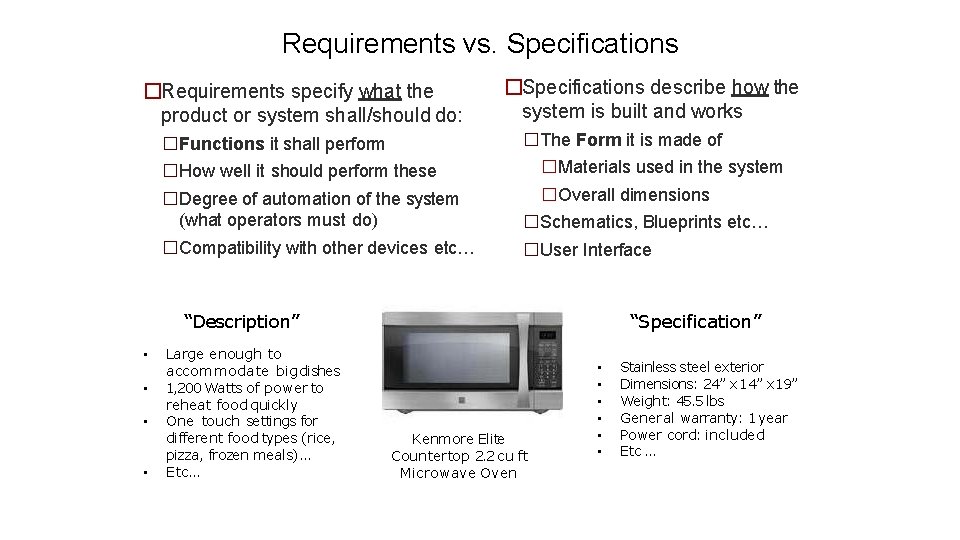
Requirements vs. Specifications �Requirements specify what the product or system shall/should do: �Functions it shall perform �How well it should perform these �Degree of automation of the system (what operators must do) �Compatibility with other devices etc… �Specifications describe how the system is built and works �The Form it is made of �Materials used in the system �Overall dimensions �Schematics, Blueprints etc… �User Interface “Description” • • Large enough to accommodate big dishes 1, 200 Watts of power to reheat food quickly One touch settings for different food types (rice, pizza, frozen meals) … Etc… “Specification” Kenmore Elite Countertop 2. 2 cu ft Microwave Oven • • • Stainless steel exterior Dimensions: 24” x 19” Weight: 45. 5 lbs General warranty: 1 year Power cord: included Etc …
Overview �What are requirements? �Definition, Examples, Evolution, Standards �Challenges of Requirements Definition �Flowdown and Allocation Isoperformance �Validation and Verification �Writing good requirements �What happens at the SRR?
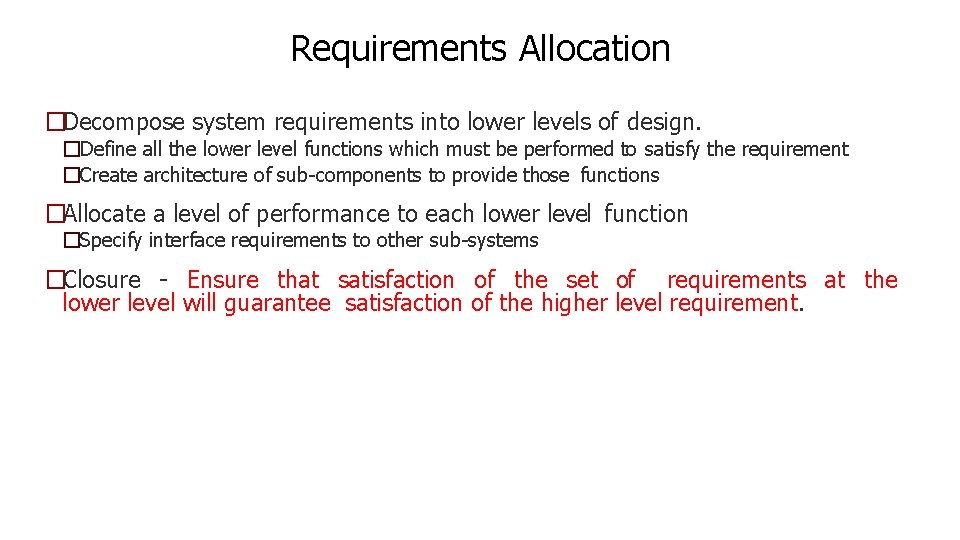
Requirements Allocation �Decompose system requirements into lower levels of design. �Define all the lower level functions which must be performed to satisfy the requirement �Create architecture of sub-components to provide those functions �Allocate a level of performance to each lower level function �Specify interface requirements to other sub-systems �Closure - Ensure that satisfaction of the set of requirements at the lower level will guarantee satisfaction of the higher level requirement.
Requirements Allocation Process Stakeholder Requirements 1 st Application System 2 Application System • System boundary • Applicable life cycle • Implementation Plan - top level • Preliminary concept (function to form) • Major chunks function 1 function 2 function 3 3 rd Application subsys 1 comp 1 subsys 2 comp 2 subsys 3 comp 3 System subsys 4 • System key performance parameters • Subsystems defined • Notional components Difficult to decompose reqts to lower levels while staying solution neutral
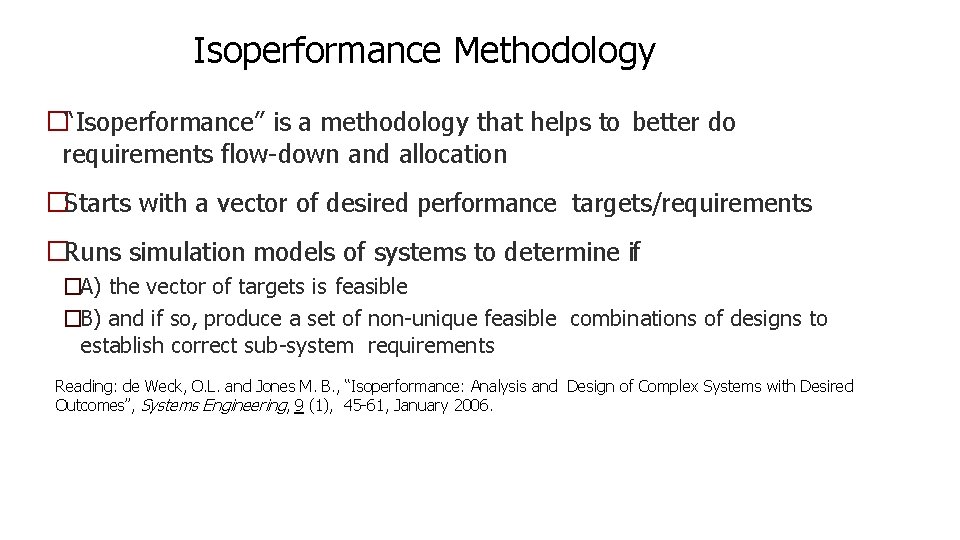
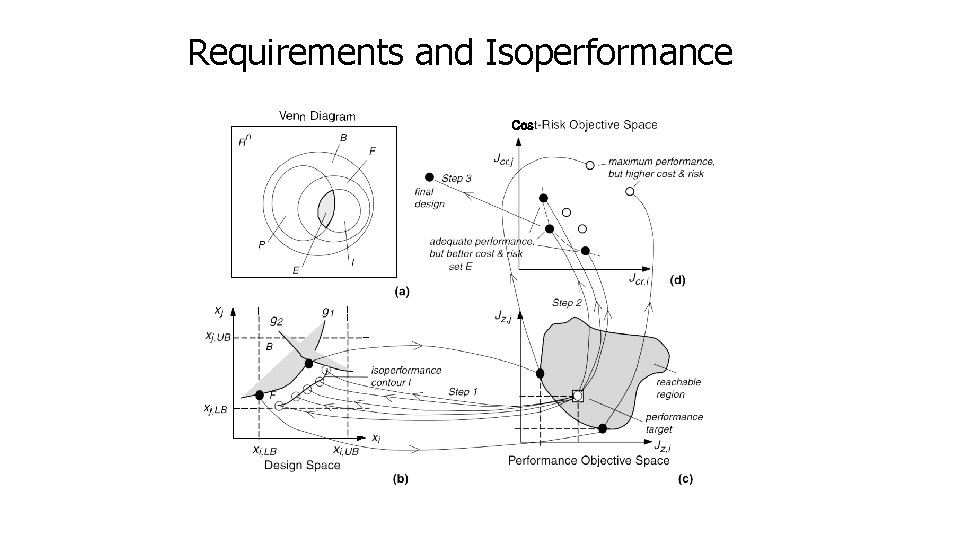
Isoperformance Methodology �“Isoperformance” is a methodology that helps to better do requirements flow-down and allocation �Starts with a vector of desired performance targets/requirements �Runs simulation models of systems to determine if �A) the vector of targets is feasible �B) and if so, produce a set of non-unique feasible combinations of designs to establish correct sub-system requirements Reading: de Weck, O. L. and Jones M. B. , “Isoperformance: Analysis and Design of Complex Systems with Desired Outcomes”, Systems Engineering, 9 (1), 45 -61, January 2006.
Requirements and Isoperformance
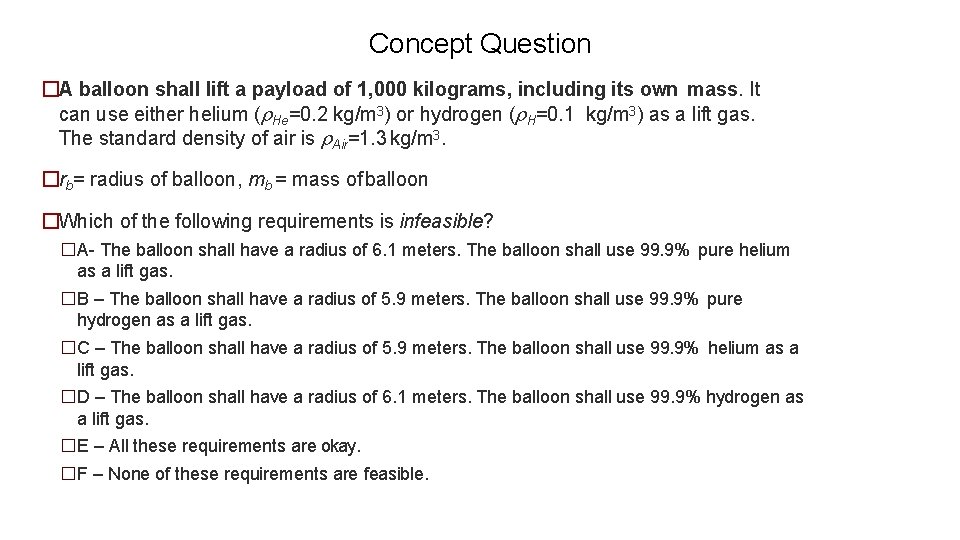
Concept Question �A balloon shall lift a payload of 1, 000 kilograms, including its own mass. It can use either helium ( He=0. 2 kg/m 3) or hydrogen ( H=0. 1 kg/m 3) as a lift gas. The standard density of air is Air=1. 3 kg/m 3. �rb= radius of balloon, mb = mass of balloon �Which of the following requirements is infeasible? �A- The balloon shall have a radius of 6. 1 meters. The balloon shall use 99. 9% pure helium as a lift gas. �B – The balloon shall have a radius of 5. 9 meters. The balloon shall use 99. 9% pure hydrogen as a lift gas. �C – The balloon shall have a radius of 5. 9 meters. The balloon shall use 99. 9% helium as a lift gas. �D – The balloon shall have a radius of 6. 1 meters. The balloon shall use 99. 9% hydrogen as a lift gas. �E – All these requirements are okay. �F – None of these requirements are feasible.
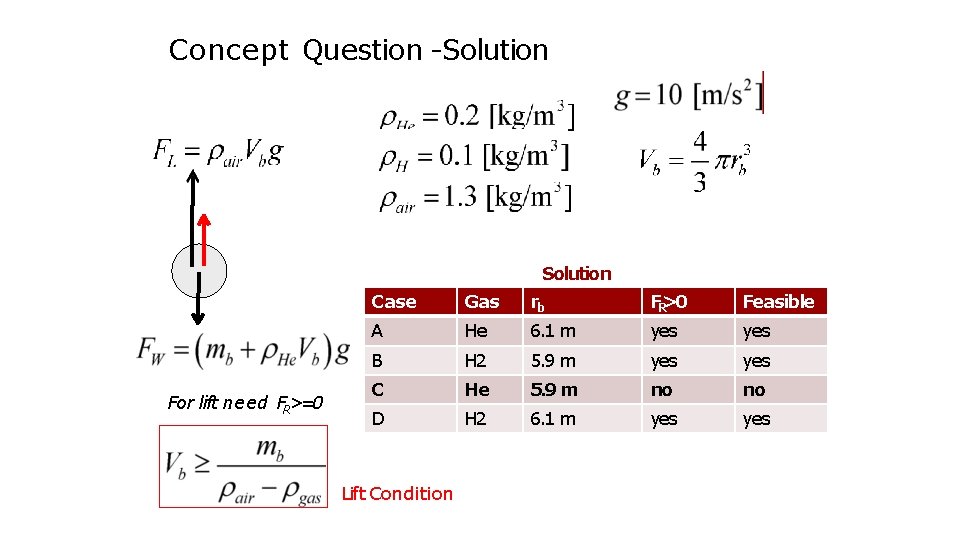
Concept Question -Solution For lift need FR>=0 Case Gas rb FR>0 Feasible A He 6. 1 m yes B H 2 5. 9 m yes C He 5. 9 m no no D H 2 6. 1 m yes Lift Condition
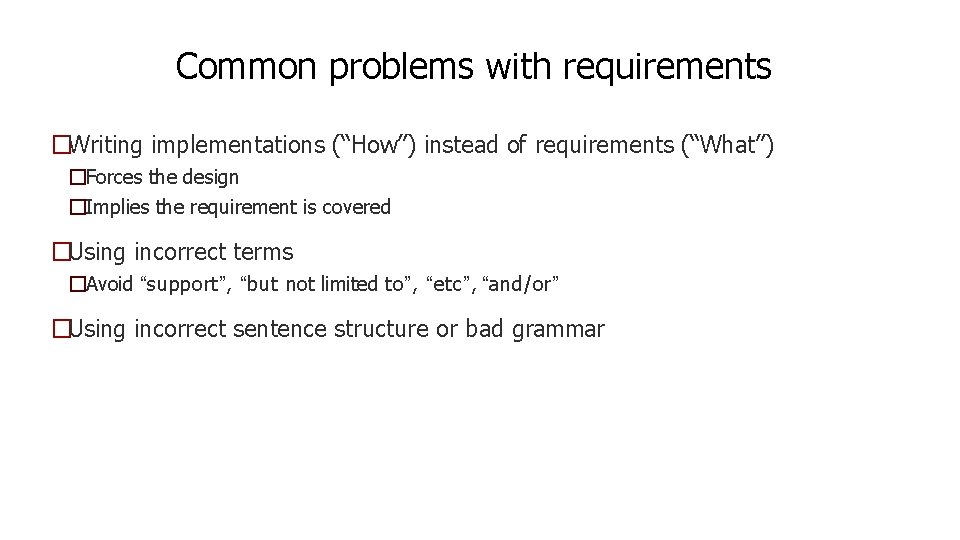
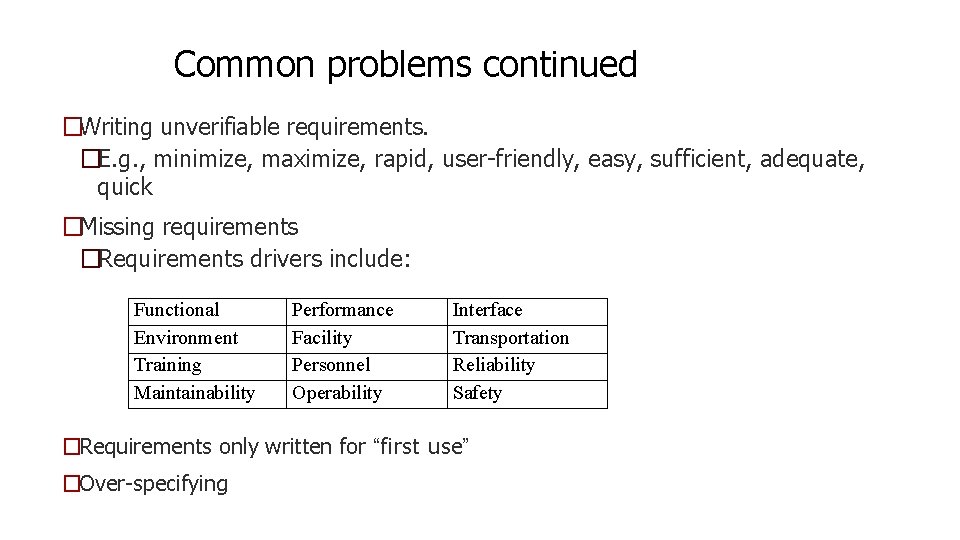
Common problems with requirements �Writing implementations (“How”) instead of requirements (“What”) �Forces the design �Implies the requirement is covered �Using incorrect terms �Avoid “support”, “but not limited to”, “etc”, “and/or” �Using incorrect sentence structure or bad grammar
Common problems continued �Writing unverifiable requirements. �E. g. , minimize, maximize, rapid, user-friendly, easy, sufficient, adequate, quick �Missing requirements �Requirements drivers include: Functional Environment Training Maintainability Performance Facility Personnel Operability Interface Transportation Reliability Safety �Requirements only written for “first use” �Over-specifying
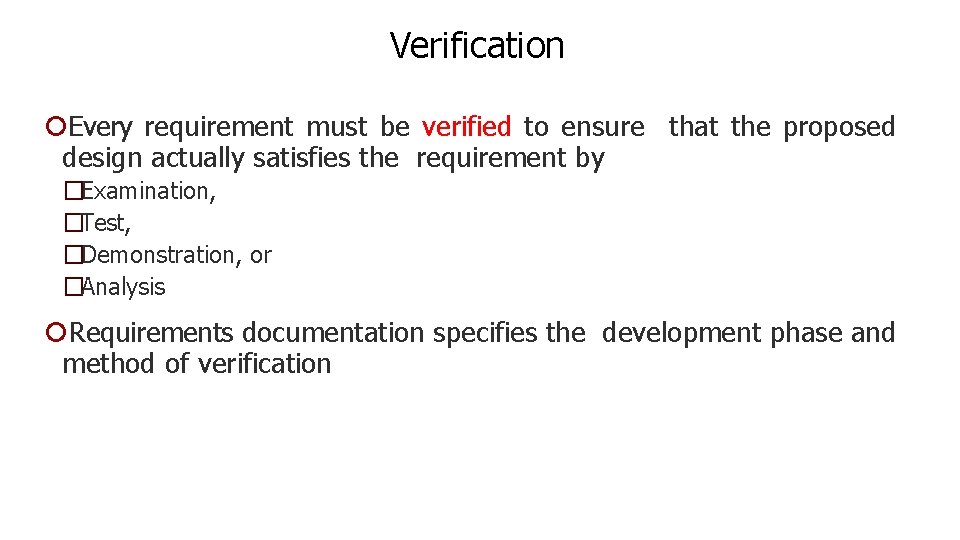
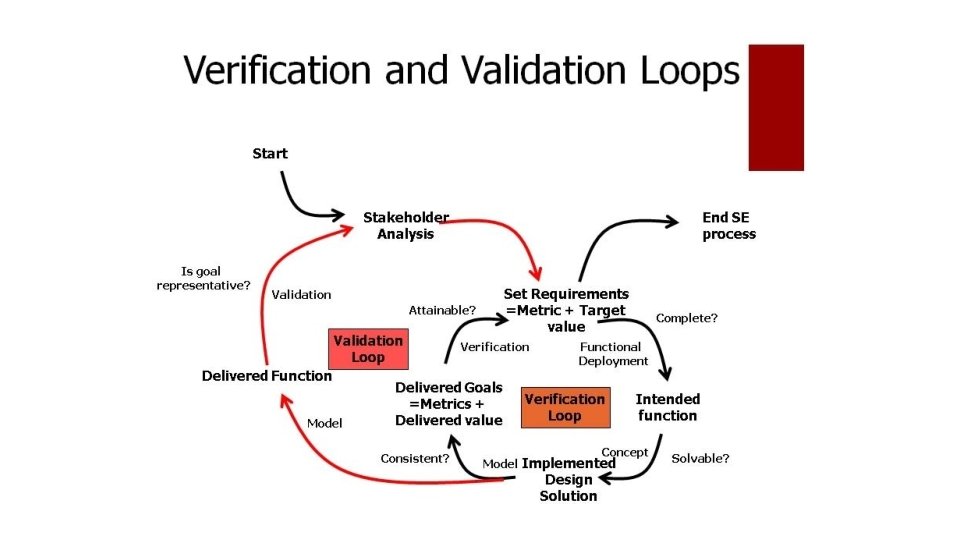
Verification Every requirement must be verified to ensure that the proposed design actually satisfies the requirement by �Examination, �Test, �Demonstration, or �Analysis Requirements documentation specifies the development phase and method of verification
Overview �What are requirements? �Definition, Examples, Evolution, Standards �Challenges of Requirements Definition �Flowdown and Allocation Isoperformance �Validation and Verification �Writing good requirements �What happens at the SRR?
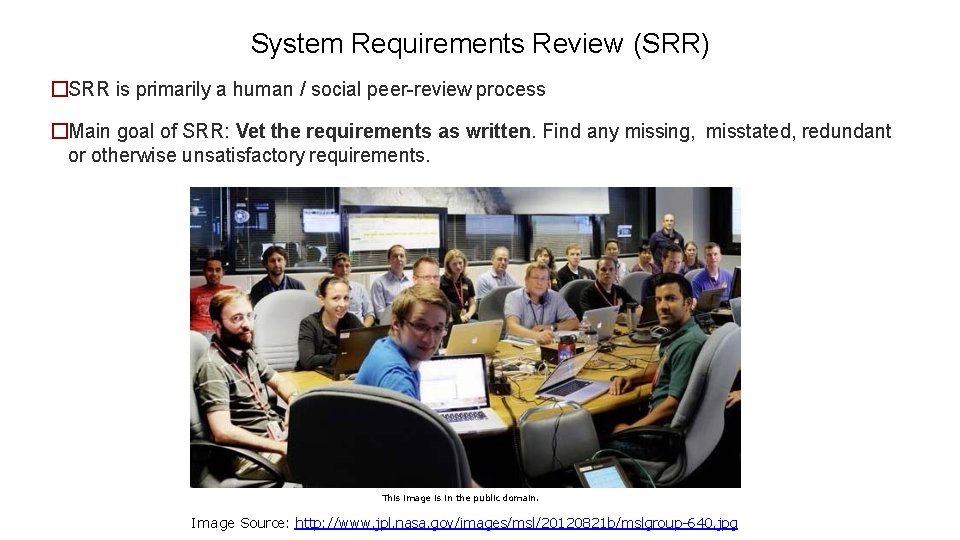
System Requirements Review (SRR) �SRR is primarily a human / social peer-review process �Main goal of SRR: Vet the requirements as written. Find any missing, misstated, redundant or otherwise unsatisfactory requirements. This image is in the public domain. Image Source: http: //www. jpl. nasa. gov/images/msl/20120821 b/mslgroup-640. jpg
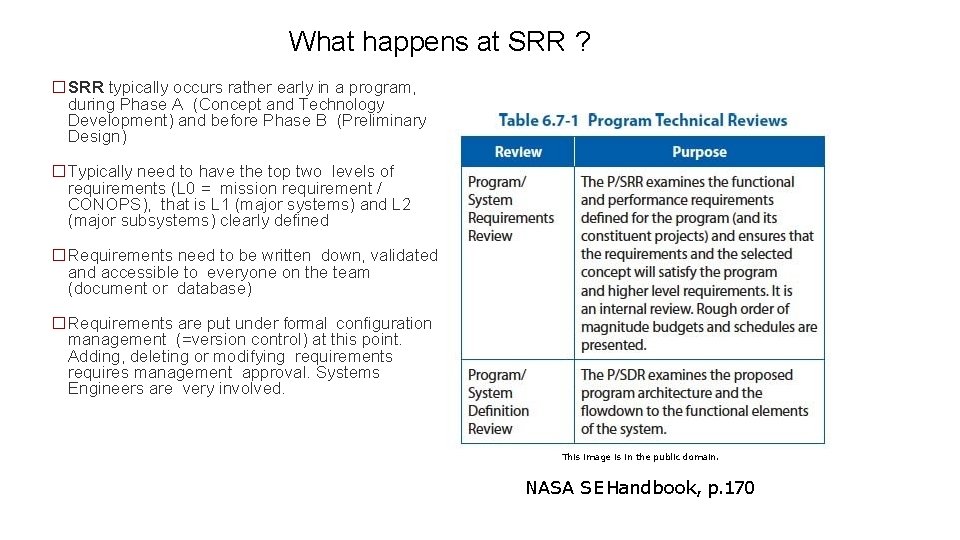
What happens at SRR ? � SRR typically occurs rather early in a program, during Phase A (Concept and Technology Development) and before Phase B (Preliminary Design) �Typically need to have the top two levels of requirements (L 0 = mission requirement / CONOPS), that is L 1 (major systems) and L 2 (major subsystems) clearly defined �Requirements need to be written down, validated and accessible to everyone on the team (document or database) �Requirements are put under formal configuration management (=version control) at this point. Adding, deleting or modifying requirements requires management approval. Systems Engineers are very involved. This image is in the public domain. NASA S E Handbook, p. 170
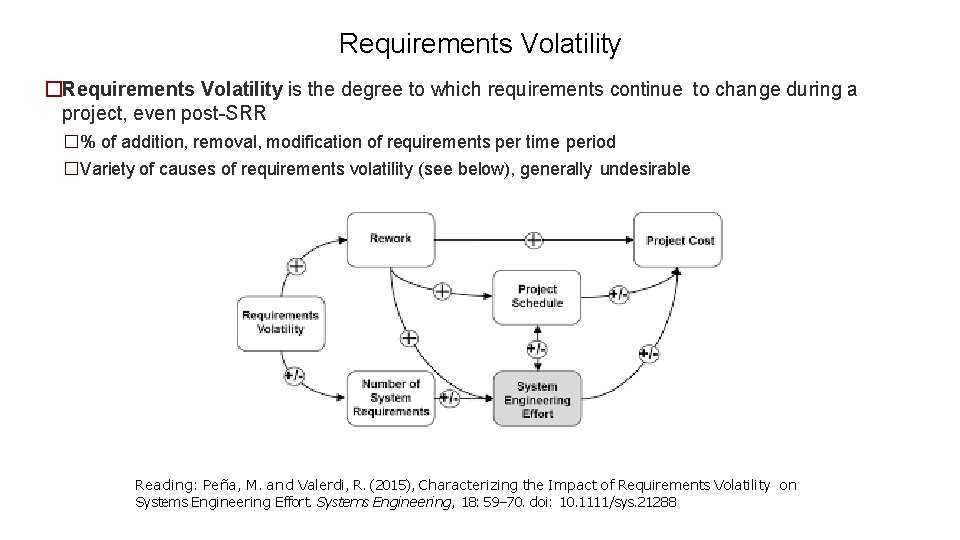
Requirements Volatility �Requirements Volatility is the degree to which requirements continue to change during a project, even post-SRR �% of addition, removal, modification of requirements per time period �Variety of causes of requirements volatility (see below), generally undesirable Reading: Peña, M. and Valerdi, R. (2015), Characterizing the Impact of Requirements Volatility on Systems Engineering Effort. Systems Engineering, 18: 59– 70. doi: 10. 1111/sys. 21288