
Systems Engineering Leadership Development Program Behavior Study October
Systems Engineering Leadership Development Program & Behavior Study October 16, 2008 Christine Williams SELDP Program Director
SELDP
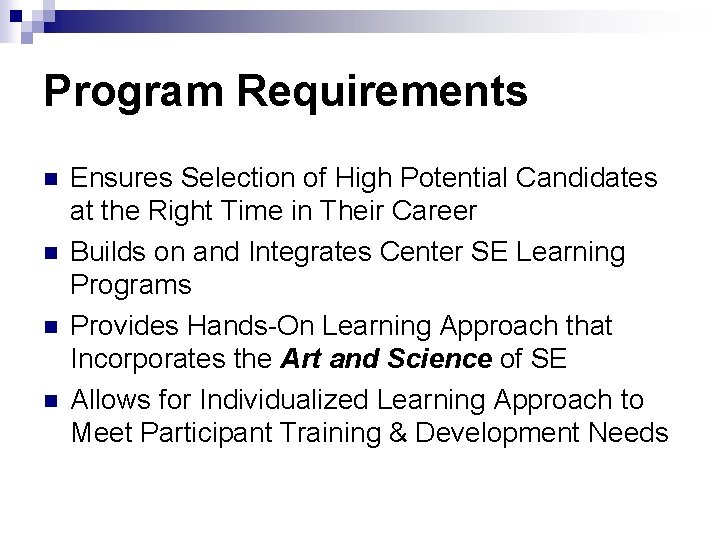
Program Requirements n n Ensures Selection of High Potential Candidates at the Right Time in Their Career Builds on and Integrates Center SE Learning Programs Provides Hands-On Learning Approach that Incorporates the Art and Science of SE Allows for Individualized Learning Approach to Meet Participant Training & Development Needs
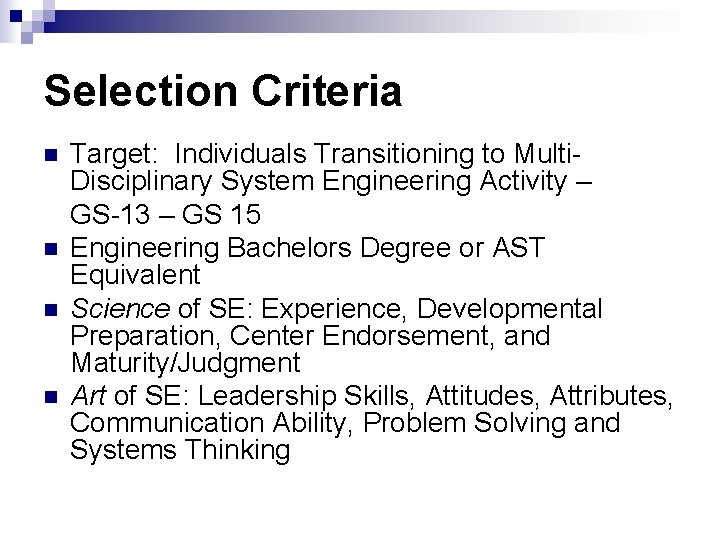
Selection Criteria n n Target: Individuals Transitioning to Multi. Disciplinary System Engineering Activity – GS-13 – GS 15 Engineering Bachelors Degree or AST Equivalent Science of SE: Experience, Developmental Preparation, Center Endorsement, and Maturity/Judgment Art of SE: Leadership Skills, Attitudes, Attributes, Communication Ability, Problem Solving and Systems Thinking
Program Elements n Developmental Assignments: Hands-On at Centers ¨ ¨ n Leadership Development: Models and Experiential Learning ¨ ¨ ¨ n n Assessment Instruments: Leadership Self Awareness Leadership Coaching: Personalized Development Leadership Training: Leadership Courses/Teambuilding Benchmarking: With Leading SE Organizations ¨ ¨ n Mentoring: Home & Assignment Job Shadowing: Top SE Leaders Center Visits: Greater Understanding Across Agency Industry Benchmarking: Cutting Edge Organizations Technical Training: Gap Analysis Agency SE Holds Themselves Accountable ¨ ¨ SE Selection and Participation Center Advocate Role Home Visits Tag Ups Reentry – Next Challenging Assignment
NASA SE Leadership Holds Themselves Accountable for SELDP Success n n n n n Nominate and Endorse Candidates Identify Potential SELDP Developmental Assignments Appoint a Center Mentor Advocate Rate Candidate Applications Interview and Select Highly Qualified Candidates Provide Guidance on Matching Participant with Developmental Assignment Participate in Program Activities Including Mid and Final Participant Briefings Ensure Participants are Placed in “Right Next Challenge” Upon Completion of the Program Provide Ongoing Support, Guidance & Learning Opportunities for SELDP Graduates
2008 -2009 Pilot Program 17 Participants Competitively Selected from Across NASA n Development Assignments Matched to Participants Learning Needs by SELDP Advocates n On-Going Feedback Being Used to Iterate the Final Design of the Program n
SE Behavior Study
Systems Engineering Behavior Study n n NASA studied 37 of the most highly regarded systems engineers from across the Agency to identify the characteristics or behaviors that set them apart. Data from this study will be used to design or update systems engineering training, development, coaching and mentoring programs to develop these behaviors in systems engineers across the agency.
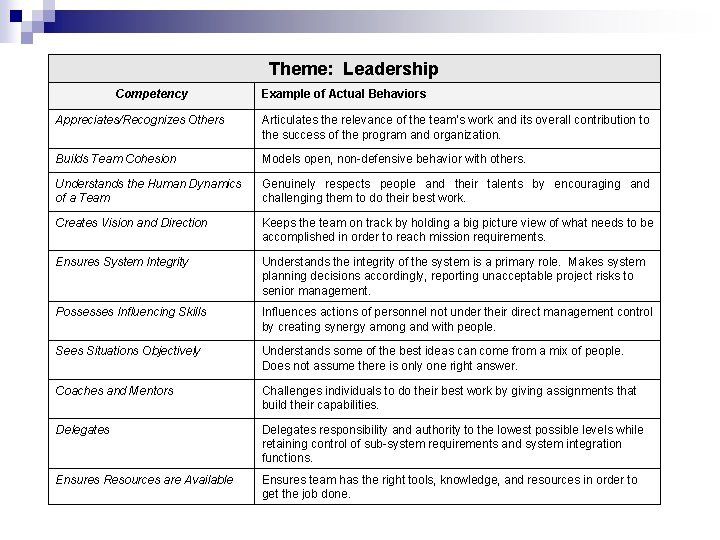
Theme: Leadership Competency Example of Actual Behaviors Appreciates/Recognizes Others Articulates the relevance of the team’s work and its overall contribution to the success of the program and organization. Builds Team Cohesion Models open, non-defensive behavior with others. Understands the Human Dynamics of a Team Genuinely respects people and their talents by encouraging and challenging them to do their best work. Creates Vision and Direction Keeps the team on track by holding a big picture view of what needs to be accomplished in order to reach mission requirements. Ensures System Integrity Understands the integrity of the system is a primary role. Makes system planning decisions accordingly, reporting unacceptable project risks to senior management. Possesses Influencing Skills Influences actions of personnel not under their direct management control by creating synergy among and with people. Sees Situations Objectively Understands some of the best ideas can come from a mix of people. Does not assume there is only one right answer. Coaches and Mentors Challenges individuals to do their best work by giving assignments that build their capabilities. Delegates responsibility and authority to the lowest possible levels while retaining control of sub-system requirements and system integration functions. Ensures Resources are Available Ensures team has the right tools, knowledge, and resources in order to get the job done.

Theme: Attitudes and Attributes Competency Example of Actual Behaviors Remains Inquisitive and Curious Is naturally inquisitive and curious, and is largely driven by that curiosity. Is fearless and has an authentic and persistent desire to understand how everything works and how it relates to everything else. Seeks Information and Uses the Art of Questioning Asks questions artfully. Uses a series of questions that build upon each other to help identify the root of a problem or solutions. Advances Ideas Engages the team by explaining how the solution or approach was reached. Gains Respect Credibility, and Trust Demonstrates understanding and appreciation of the challenges others face. Possesses Self-Confidence Willing to speak up, regardless of who is present to ensure the most technically sound decision is made for the good of the overall system. Has a Comprehensive View Takes responsibility for the whole life cycle, the whole system and all its parts. Understands the whole job and that it is never done. Possesses a Positive Attitude and Dedication to Mission Success Encourages a success oriented environment by displaying passion, excitement and enthusiasm about the work and the challenges faced by the system Is Aware of Personal Limitations Seeks guidance from experts. Knows what they know and what they don’t know and seeks others to fill in missing data. Adapts to Change and Uncertainty Understands that change is inevitable and takes appropriate actions quickly. May assemble other technical experts to brainstorm various avenues and approaches to support the change. Uses Intuition/ Sensing Uses both intuition and sensing when evaluating a problem or making a decision. Does not rely solely on data. May use "gut feeling" if data is inconclusive. Is Able to Deal with Politics, Financial Issues, and Customer Needs Shares and uses knowledge and expertise that shapes the political and financial environment in positive ways.
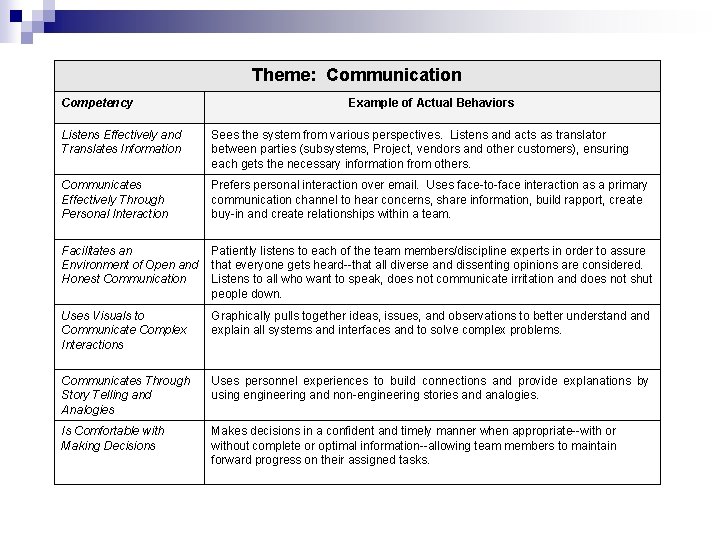
Theme: Communication Competency Example of Actual Behaviors Listens Effectively and Translates Information Sees the system from various perspectives. Listens and acts as translator between parties (subsystems, Project, vendors and other customers), ensuring each gets the necessary information from others. Communicates Effectively Through Personal Interaction Prefers personal interaction over email. Uses face-to-face interaction as a primary communication channel to hear concerns, share information, build rapport, create buy-in and create relationships within a team. Facilitates an Environment of Open and Honest Communication Patiently listens to each of the team members/discipline experts in order to assure that everyone gets heard--that all diverse and dissenting opinions are considered. Listens to all who want to speak, does not communicate irritation and does not shut people down. Uses Visuals to Communicate Complex Interactions Graphically pulls together ideas, issues, and observations to better understand explain all systems and interfaces and to solve complex problems. Communicates Through Story Telling and Analogies Uses personnel experiences to build connections and provide explanations by using engineering and non-engineering stories and analogies. Is Comfortable with Making Decisions Makes decisions in a confident and timely manner when appropriate--with or without complete or optimal information--allowing team members to maintain forward progress on their assigned tasks.
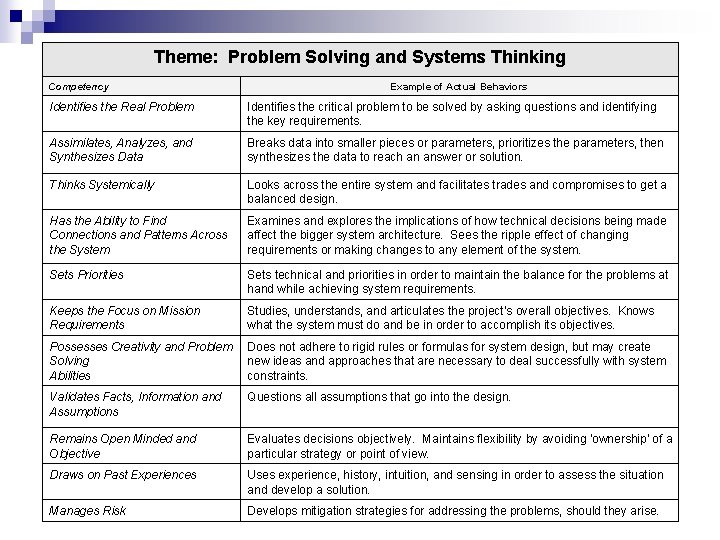
Theme: Problem Solving and Systems Thinking Competency Example of Actual Behaviors Identifies the Real Problem Identifies the critical problem to be solved by asking questions and identifying the key requirements. Assimilates, Analyzes, and Synthesizes Data Breaks data into smaller pieces or parameters, prioritizes the parameters, then synthesizes the data to reach an answer or solution. Thinks Systemically Looks across the entire system and facilitates trades and compromises to get a balanced design. Has the Ability to Find Connections and Patterns Across the System Examines and explores the implications of how technical decisions being made affect the bigger system architecture. Sees the ripple effect of changing requirements or making changes to any element of the system. Sets Priorities Sets technical and priorities in order to maintain the balance for the problems at hand while achieving system requirements. Keeps the Focus on Mission Requirements Studies, understands, and articulates the project’s overall objectives. Knows what the system must do and be in order to accomplish its objectives. Possesses Creativity and Problem Solving Abilities Does not adhere to rigid rules or formulas for system design, but may create new ideas and approaches that are necessary to deal successfully with system constraints. Validates Facts, Information and Assumptions Questions all assumptions that go into the design. Remains Open Minded and Objective Evaluates decisions objectively. Maintains flexibility by avoiding 'ownership' of a particular strategy or point of view. Draws on Past Experiences Uses experience, history, intuition, and sensing in order to assess the situation and develop a solution. Manages Risk Develops mitigation strategies for addressing the problems, should they arise.
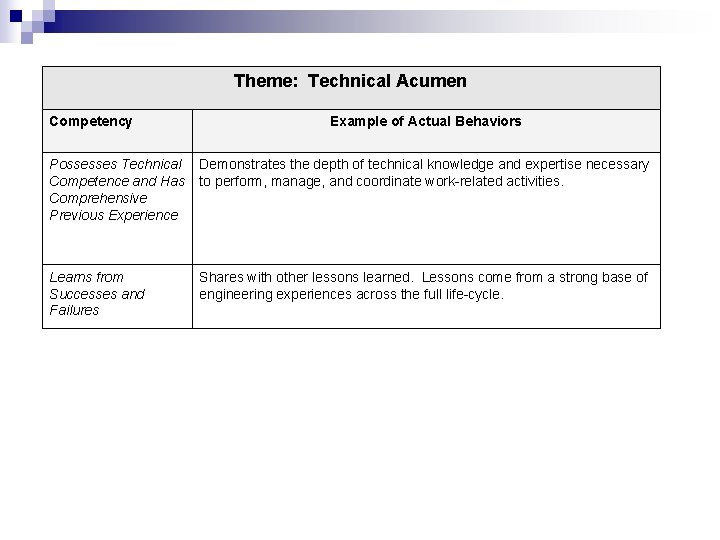
Theme: Technical Acumen Competency Example of Actual Behaviors Possesses Technical Competence and Has Comprehensive Previous Experience Demonstrates the depth of technical knowledge and expertise necessary to perform, manage, and coordinate work-related activities. Learns from Successes and Failures Shares with other lessons learned. Lessons come from a strong base of engineering experiences across the full life-cycle.
- Slides: 14