
Systems Engineering based Strategy Development Paul Am Rhein
Systems Engineering based Strategy Development Paul Am. Rhein Strategy Bridge International December 31, 2021
Not Nirvana, But Close § What if you could …. . • Maximize ROI – Align project portfolio with organizational objectives • Increase Decision Visibility – Document and examine implicit assumptions – Track, audit and improve decision-making over time. • Create Decision Traceability – Final decision authorities can see how decisions were achieved – Adjust strategy to changing market conditions with dynamic sensitivity analysis • Save Time
Agenda § Strategic Planning 101 § Why Use Systems Engineering precepts? § The Process
Strategic Planning 101 • What is the Core Purpose of the organization? • Where do we see ourselves in 3 -5 years? • What are the strategic challenges we must address? • How will we address shifts in technology, markets, products, the competition, and the economy? • How do we identify possible blind spots? • How will we plan for long-term sustainability?
Strategic Planning Methods § There a number of approaches to strategic planning • MBA approach – focus on cost and/or savings • Zappos approach – love your customers, pay your employees to leave • BOGGSAT – optimized for inefficiency
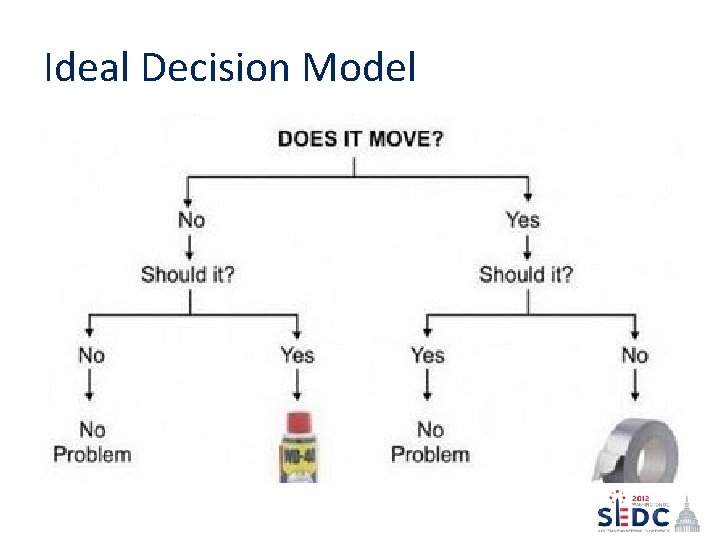
Ideal Decision Model
Agenda § Strategic Planning 101 § Why Use Systems Engineering precepts? § The Process
Why Systems Engineering? § The practices that systems engineers utilize in project definition and execution -- work • NDIA SE Effectiveness survey showed that planning and executing trade studies well had a very high correlation to overall program success • By applying a basic Analytical Hierarchy Process to the plan options, a justifiable, traceable decision can be identified • The process eliminates personalities, pet projects and ambiguity
Key Strategic Planning Elements § Understand the “problem” you are trying to solve § Take a systems view of the enterprise • Consider work systems, support processes, and interrelationships within the organization • Assign someone to have the voice of the customer § Worry about the inputs as much as the outputs § Individuals must take a systems view as well • Many of us suspend our systems thinking skills when it comes to our own initiatives
What is a Decision? § Decision is a response to a situation in which: • there is more than one possible course of action • the decision-maker can form expectations about the outcomes following each possible course of action • each outcome has an associated consequence that can be evaluated Hammond, K. R. (2000). Judgments Under Stress
What Doesn’t Change § Still using intuition • The proper decision frame opens up the spectrum, allowing truly creative possibilities to emerge. § Need the representative team to participate • The price of additional perspectives and enhanced “buy-in” is time and effort • Collaborative decision meetings must be carefully planned and facilitated
Agenda § Strategic Planning 101 § Why Use Systems Engineering precepts? § The Process
The Process § Strategic Planning follows a trade study process • • • Framing the decision to be made Generating alternatives Modelling-evaluating the trade study Choosing an alternative Conducting sensitivity analysis Implementing the selected alternative
Decision Process Flow
Why The Proper Frame is Critical § Typical decision-making tends to focus on point solutions (the way we’ve always done things) vice taking the time to examine the underlying goal(s) of the decision. § Better to ask the question “Why? ” • Allows a decision-maker to see alternatives and options that are not readily apparent if the chosen frame is constrained to answering the question “what’s wrong? ”
Proper Framing
Evaluation Criteria § The techniques rely on carefully selected decision criteria by which the alternatives are judged. • Should be few in number, reasonably independent of one another, and like requirements, should be clearly and unambiguously defined. • If the decision criteria do not have a common definition, the team results should be questioned, since team members may have evaluated the alternatives differently. • Too many criteria (more than nine) often prevent a conclusion due to insufficient discrimination among competing alternatives.
Sensitivity Analysis § Once the initial analysis is completed, it’s important to confirm that small changes to criteria do not significantly impact the results. § In addition to confirming that “what ifs” don’t impact results, sensitivity analysis can be used to demonstrate thoroughness of the decision analysis to stakeholders.
Implement and Repeat § Once a decision has been made, review checkpoints to confirm that progress is tracking as expected. § Depending upon how proactive your organization is, strategy development can be done at any time.
Summary § System Engineering is not just for complex project execution. § Decision Making techniques provide a reliable and repeatable process to make justifiable, traceable resource allocation decisions. § Though structure is added, vision and collaboration remain paramount.
Need More Info? Paul Am. Rhein pamrhein@strategybridge. com 571 -265 -2230 (c) 540 -723 -4242 (o)
- Slides: 21