
Systems Design JobOrder Costing Chapter 3 2010 The
Systems Design: Job-Order Costing Chapter 3 © 2010 The Mc. Graw-Hill Companies, Inc.
Learning Objective 1 Distinguish between process costing and joborder costing and identify companies that would use each costing method. Mc. Graw-Hill/Irwin Slide 2
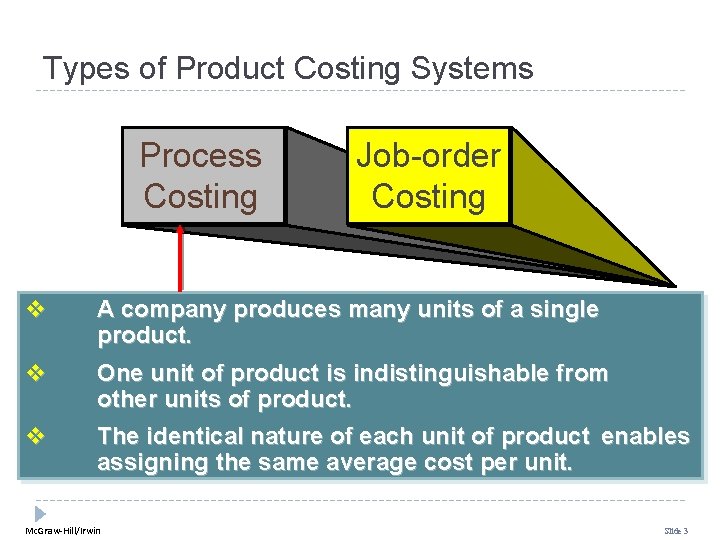
Types of Product Costing Systems Process Costing Job-order Costing v A company produces many units of a single product. v One unit of product is indistinguishable from other units of product. v The identical nature of each unit of product enables assigning the same average cost per unit. Mc. Graw-Hill/Irwin Slide 3
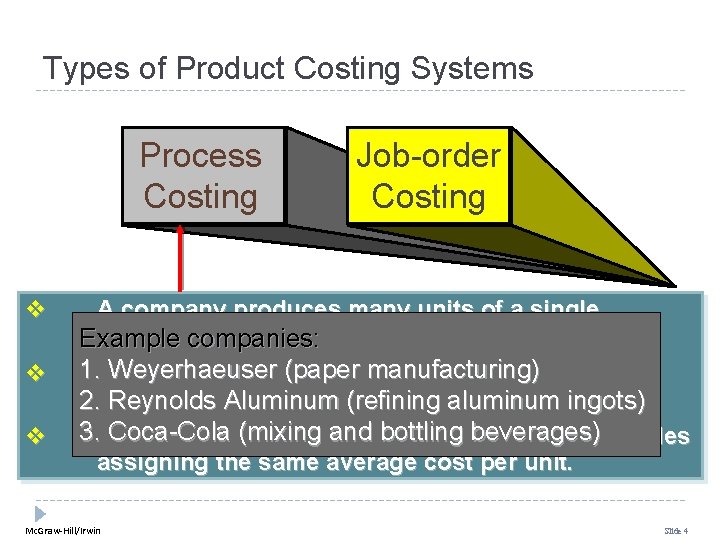
Types of Product Costing Systems Process Costing Job-order Costing v A company produces many units of a single product. companies: Example v 1. One Weyerhaeuser (paper manufacturing) from unit of product is indistinguishable units Aluminum of product. (refining aluminum ingots) 2. other Reynolds 3. The Coca-Cola bottling identical(mixing nature and of each unit beverages) of product enables v assigning the same average cost per unit. Mc. Graw-Hill/Irwin Slide 4
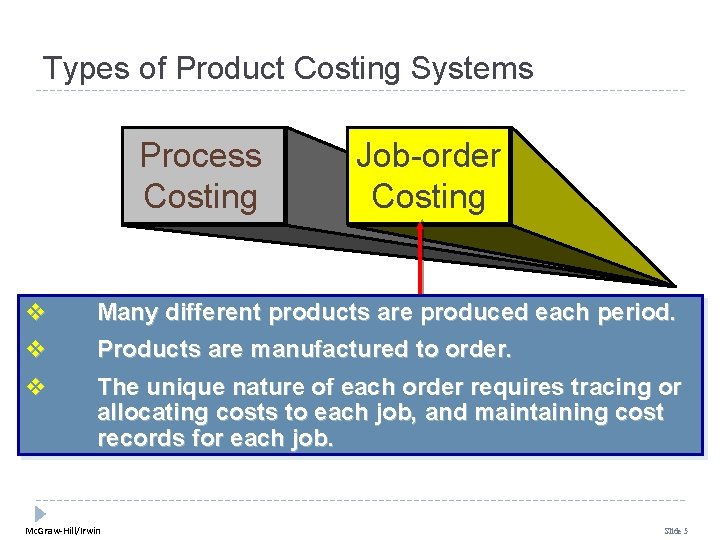
Types of Product Costing Systems Process Costing Job-order Costing v v Many different products are produced each period. v The unique nature of each order requires tracing or allocating costs to each job, and maintaining cost records for each job. Products are manufactured to order. Mc. Graw-Hill/Irwin Slide 5
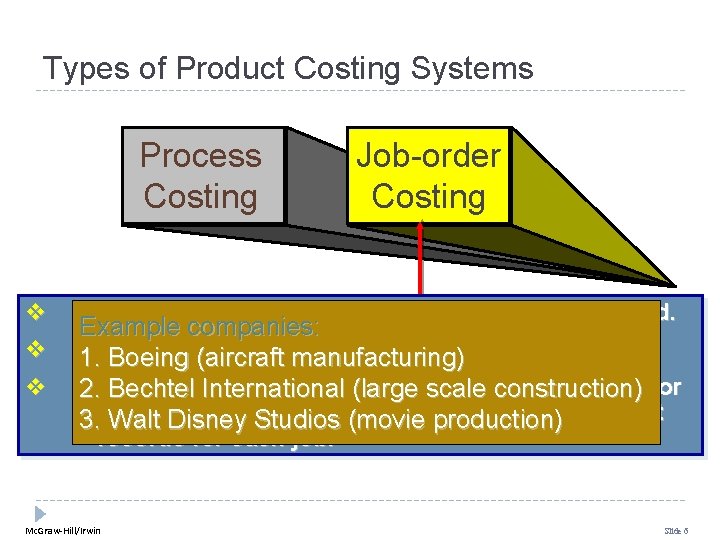
Types of Product Costing Systems Process Costing v v v Job-order Costing Many different products are produced each period. Example companies: are manufactured to order. 1. Products Boeing (aircraft manufacturing) unique nature of each order requires tracing or 2. The Bechtel International (large scale construction) costs to each job, and maintaining cost 3. allocating Walt Disney Studios (movie production) records for each job. Mc. Graw-Hill/Irwin Slide 6
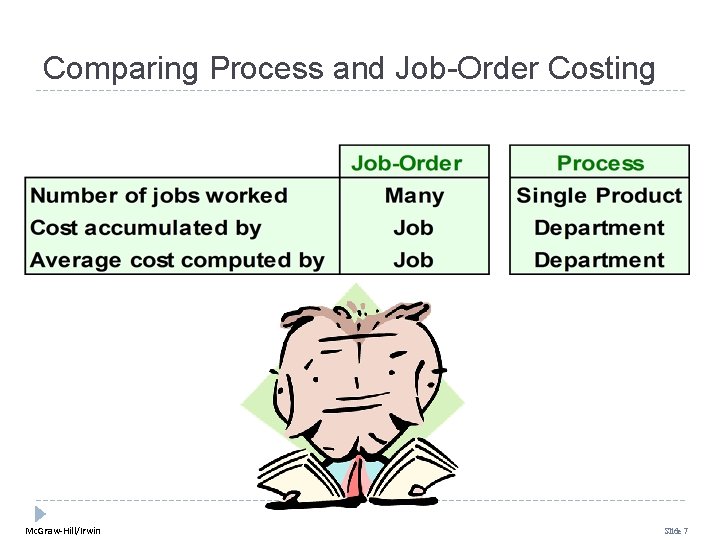
Comparing Process and Job-Order Costing Mc. Graw-Hill/Irwin Slide 7
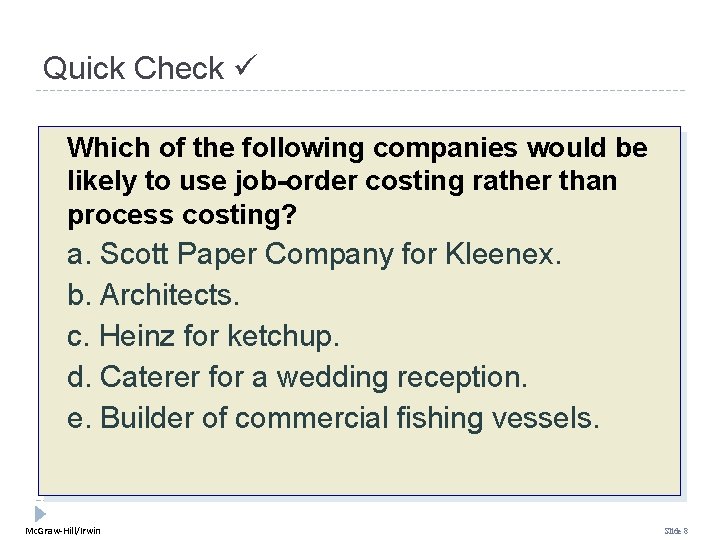
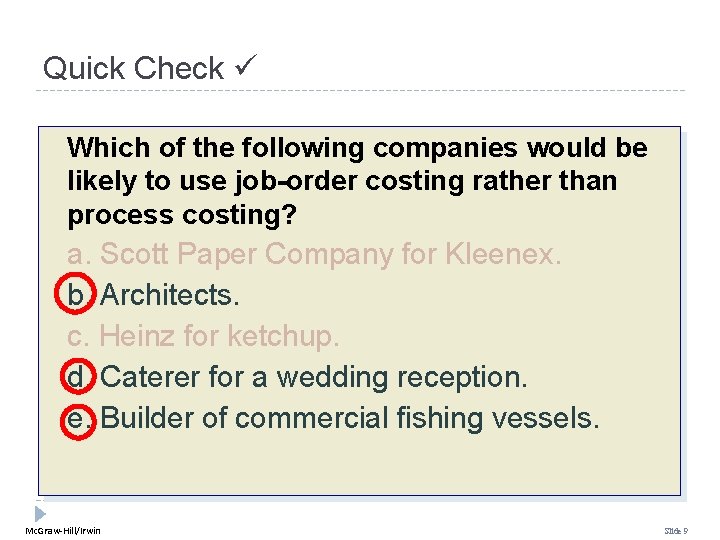
Quick Check Which of the following companies would be likely to use job-order costing rather than process costing? a. Scott Paper Company for Kleenex. b. Architects. c. Heinz for ketchup. d. Caterer for a wedding reception. e. Builder of commercial fishing vessels. Mc. Graw-Hill/Irwin Slide 8
Quick Check Which of the following companies would be likely to use job-order costing rather than process costing? a. Scott Paper Company for Kleenex. b. Architects. c. Heinz for ketchup. d. Caterer for a wedding reception. e. Builder of commercial fishing vessels. Mc. Graw-Hill/Irwin Slide 9
Learning Objective 2 Identify the documents used in a job-order costing system. Mc. Graw-Hill/Irwin Slide 10
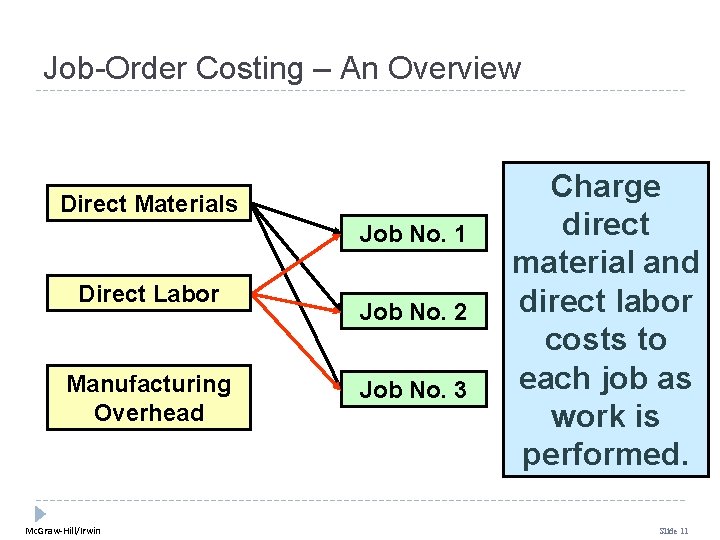
Job-Order Costing – An Overview Direct Materials Job No. 1 Direct Labor Manufacturing Overhead Mc. Graw-Hill/Irwin Job No. 2 Job No. 3 Charge direct material and direct labor costs to each job as work is performed. Slide 11
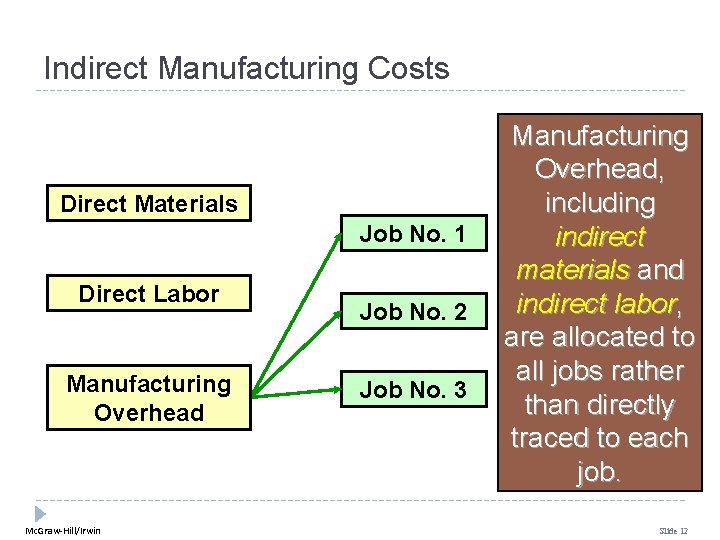
Indirect Manufacturing Costs Direct Materials Job No. 1 Direct Labor Manufacturing Overhead Mc. Graw-Hill/Irwin Job No. 2 Job No. 3 Manufacturing Overhead, including indirect materials and indirect labor, are allocated to all jobs rather than directly traced to each job. Slide 12
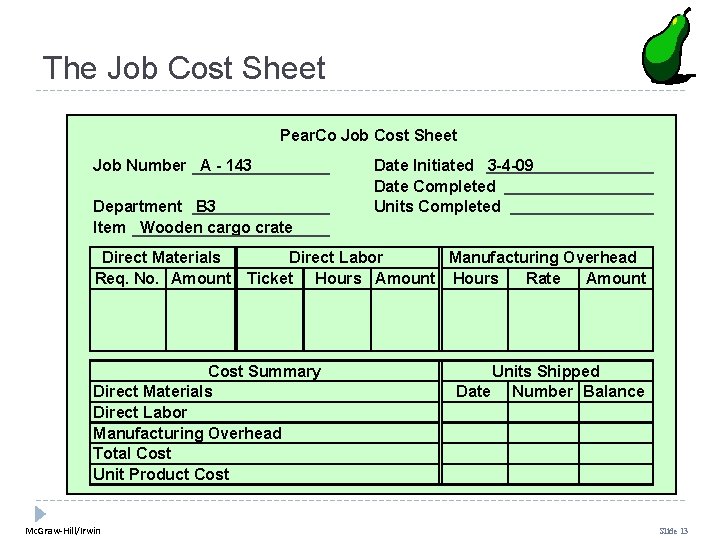
The Job Cost Sheet Pear. Co Job Cost Sheet Job Number A - 143 Department B 3 Item Wooden cargo crate Date Initiated 3 -4 -09 Date Completed Units Completed Direct Materials Direct Labor Manufacturing Overhead Req. No. Amount Ticket Hours Amount Hours Rate Amount Cost Summary Direct Materials Direct Labor Manufacturing Overhead Total Cost Unit Product Cost Mc. Graw-Hill/Irwin Units Shipped Date Number Balance Slide 13
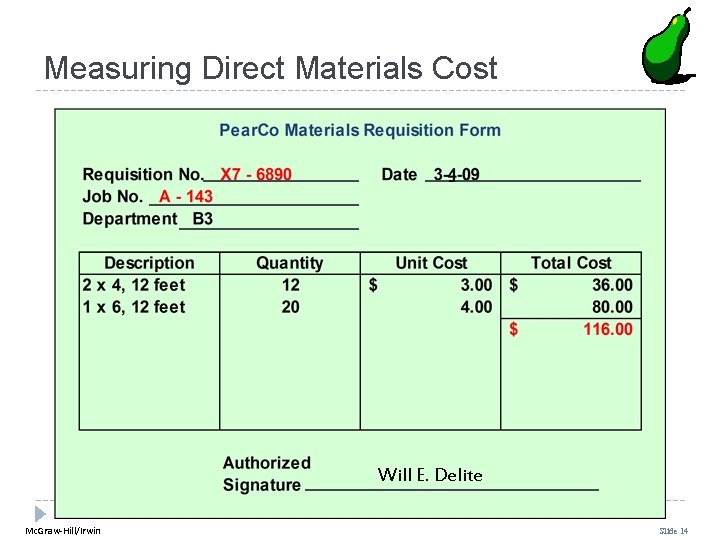
Measuring Direct Materials Cost Will E. Delite Mc. Graw-Hill/Irwin Slide 14
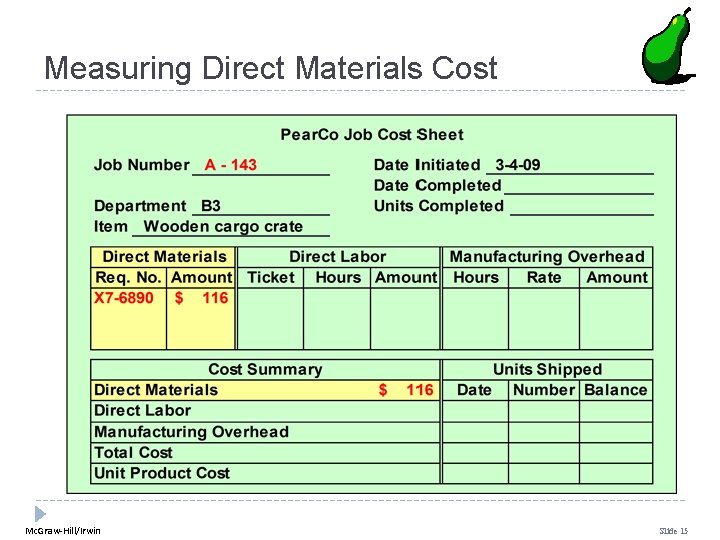
Measuring Direct Materials Cost Mc. Graw-Hill/Irwin Slide 15
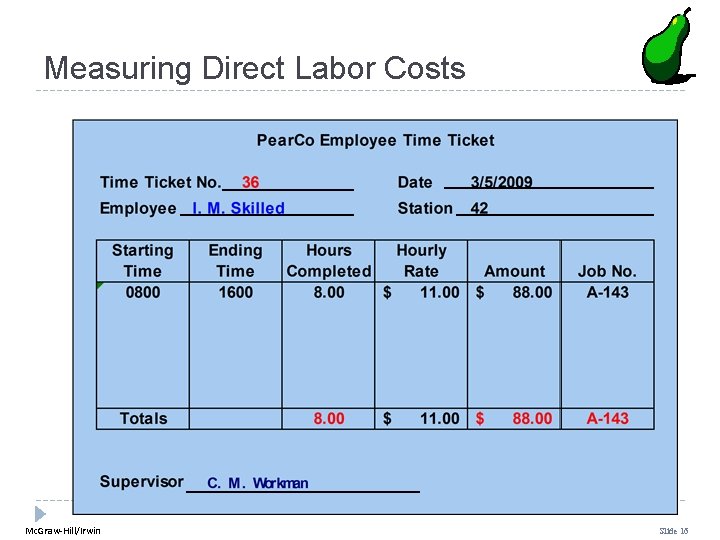
Measuring Direct Labor Costs Mc. Graw-Hill/Irwin Slide 16
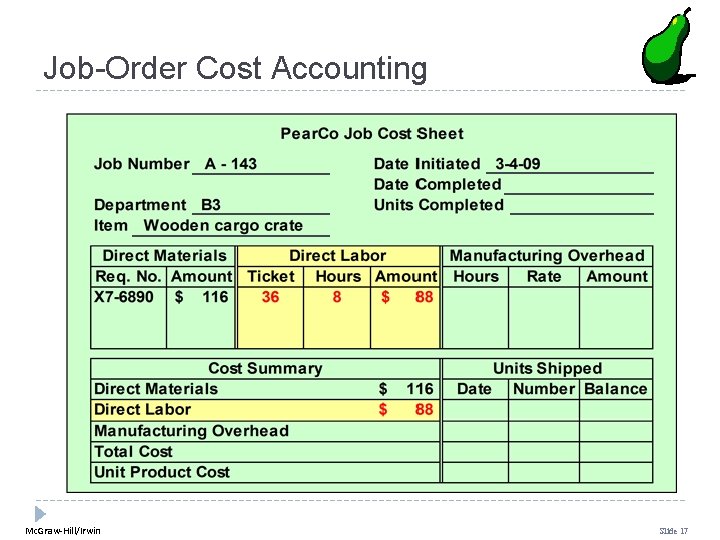
Job-Order Cost Accounting Mc. Graw-Hill/Irwin Slide 17
Learning Objective 3 Compute predetermined overhead rates and explain why estimated overhead costs (rather than actual overhead costs) are used in the costing process. Mc. Graw-Hill/Irwin Slide 18
Why Use an Allocation Base? Manufacturing overhead is applied to jobs that are in process. An allocation base, such as direct labor hours, direct labor dollars, or machine hours, is used to assign manufacturing overhead to individual jobs. We use an allocation base because: 1. It is impossible or difficult to trace overhead costs to particular jobs. 2. Manufacturing overhead consists of many different items ranging from the grease used in machines to production manager’s salary. 3. Many types of manufacturing overhead costs are fixed even though output fluctuates during the period. Mc. Graw-Hill/Irwin Slide 19
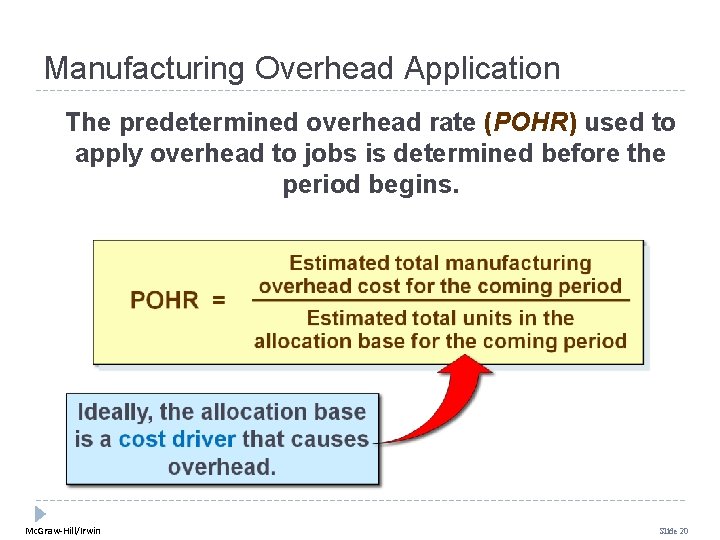
Manufacturing Overhead Application The predetermined overhead rate (POHR) used to apply overhead to jobs is determined before the period begins. Mc. Graw-Hill/Irwin Slide 20
The Need for a POHR Using a predetermined rate makes it possible to estimate total job costs sooner. Actual overhead for the period is not known until the end of the period. Mc. Graw-Hill/Irwin Slide 21
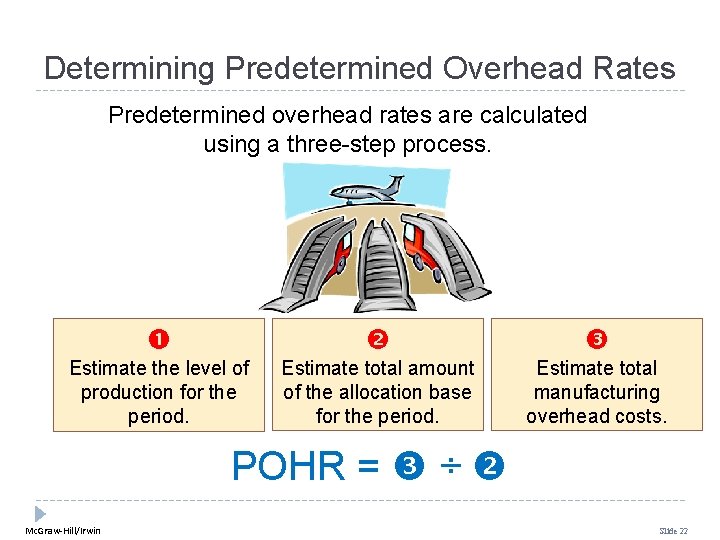
Determining Predetermined Overhead Rates Predetermined overhead rates are calculated using a three-step process. Estimate the level of production for the period. Estimate total amount of the allocation base for the period. Estimate total manufacturing overhead costs. POHR = ÷ Mc. Graw-Hill/Irwin Slide 22
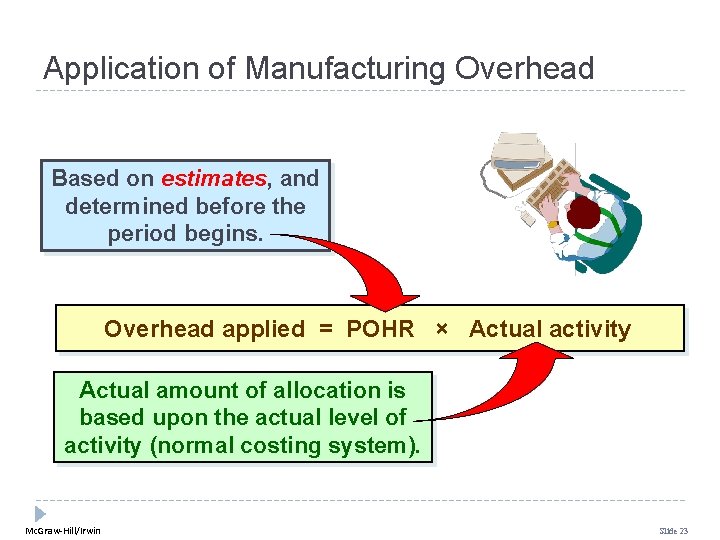
Application of Manufacturing Overhead Based on estimates, and determined before the period begins. Overhead applied = POHR × Actual activity Actual amount of allocation is based upon the actual level of activity (normal costing system). Mc. Graw-Hill/Irwin Slide 23
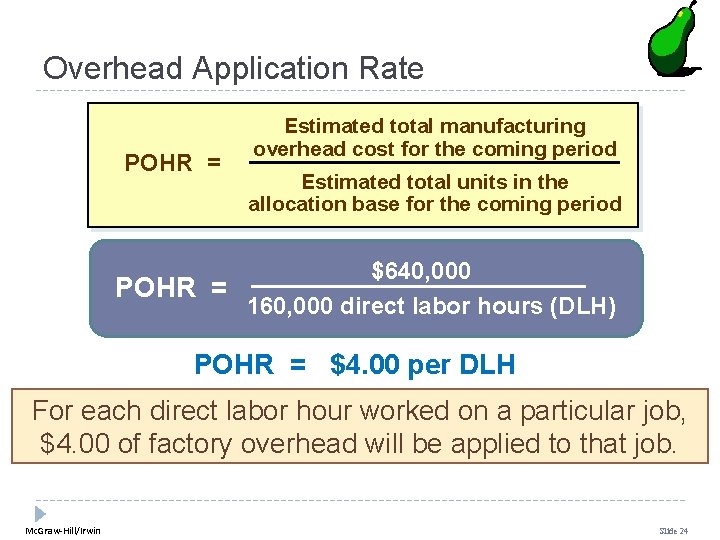
Overhead Application Rate POHR = Estimated total manufacturing overhead cost for the coming period Estimated total units in the allocation base for the coming period $640, 000 POHR = 160, 000 direct labor hours (DLH) POHR = $4. 00 per DLH For each direct labor hour worked on a particular job, $4. 00 of factory overhead will be applied to that job. Mc. Graw-Hill/Irwin Slide 24
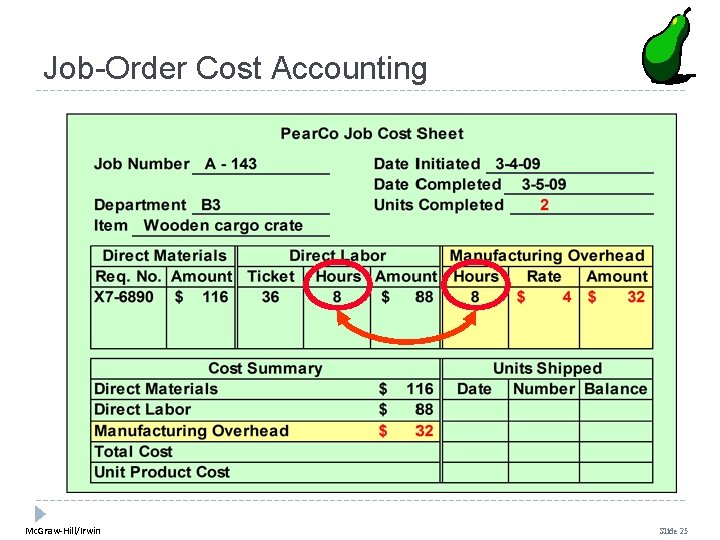
Job-Order Cost Accounting Mc. Graw-Hill/Irwin Slide 25
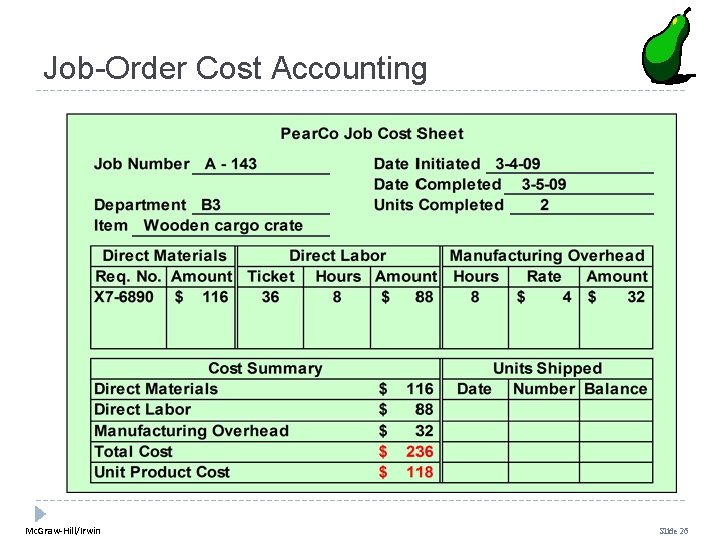
Job-Order Cost Accounting Mc. Graw-Hill/Irwin Slide 26
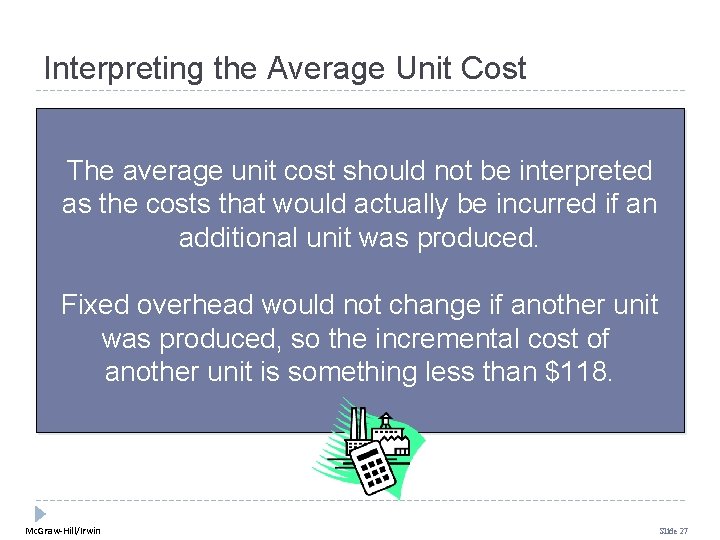
Interpreting the Average Unit Cost The average unit cost should not be interpreted as the costs that would actually be incurred if an additional unit was produced. Fixed overhead would not change if another unit was produced, so the incremental cost of another unit is something less than $118. Mc. Graw-Hill/Irwin Slide 27
Quick Check Job WR 53 at NW Fab, Inc. required $200 of direct materials and 10 direct labor hours at $15 per hour. Estimated total overhead for the year was $760, 000 and estimated direct labor hours were 20, 000. What would be recorded as the cost of job WR 53? a. $200. b. $350. c. $380. d. $730. Mc. Graw-Hill/Irwin Slide 28
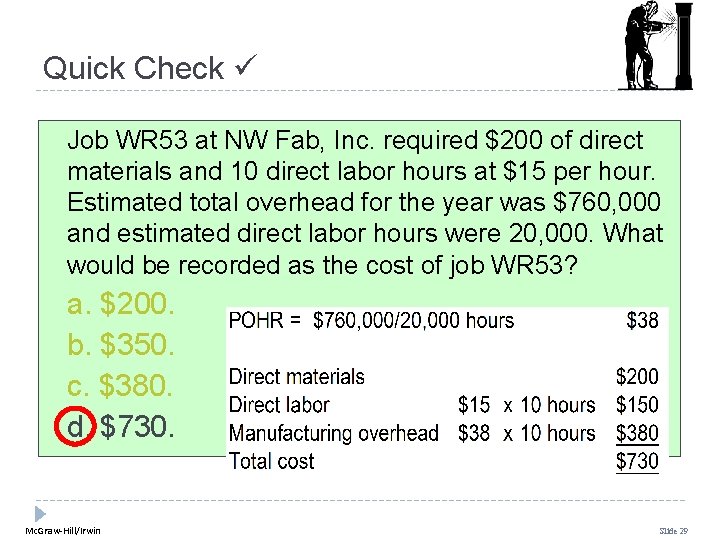
Quick Check Job WR 53 at NW Fab, Inc. required $200 of direct materials and 10 direct labor hours at $15 per hour. Estimated total overhead for the year was $760, 000 and estimated direct labor hours were 20, 000. What would be recorded as the cost of job WR 53? a. $200. b. $350. c. $380. d. $730. Mc. Graw-Hill/Irwin Slide 29
Learning Objective 4 Understand the flow of costs in a job-order costing system and prepare appropriate journal entries to record costs. Mc. Graw-Hill/Irwin Slide 30
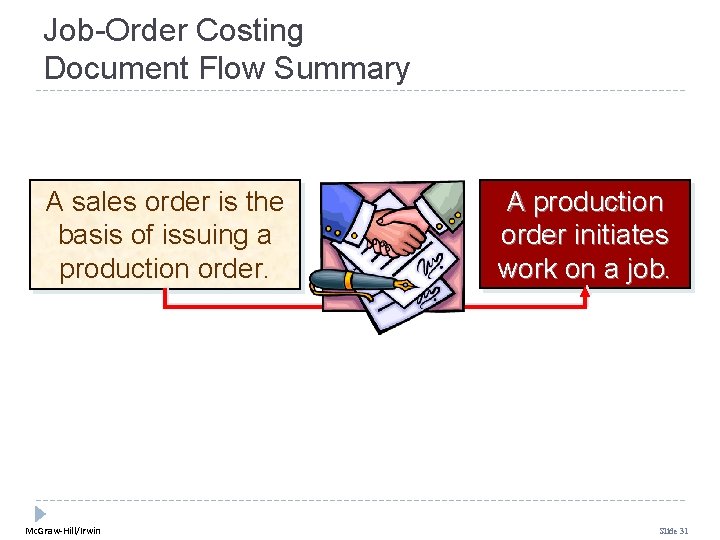
Job-Order Costing Document Flow Summary A sales order is the basis of issuing a production order. Mc. Graw-Hill/Irwin A production order initiates work on a job. Slide 31
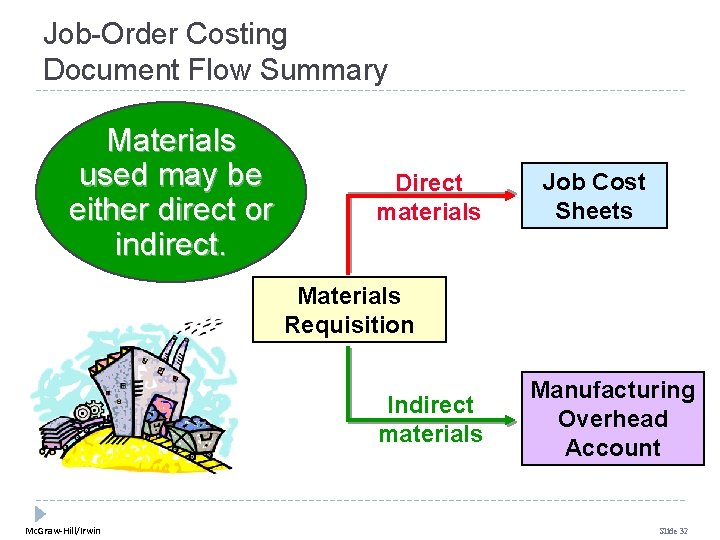
Job-Order Costing Document Flow Summary Materials used may be either direct or indirect. Direct materials Job Cost Sheets Materials Requisition Indirect materials Mc. Graw-Hill/Irwin Manufacturing Overhead Account Slide 32
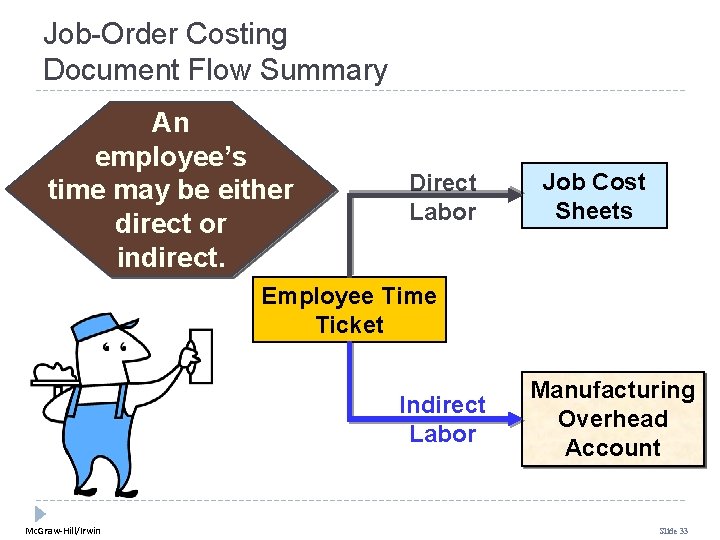
Job-Order Costing Document Flow Summary An employee’s time may be either direct or indirect. Direct Labor Job Cost Sheets Employee Time Ticket Indirect Labor Mc. Graw-Hill/Irwin Manufacturing Overhead Account Slide 33
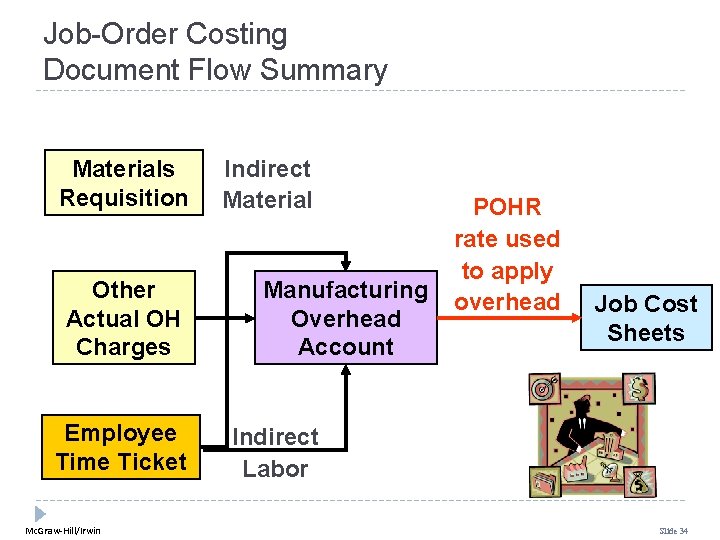
Job-Order Costing Document Flow Summary Materials Requisition Other Actual OH Charges Employee Time Ticket Mc. Graw-Hill/Irwin Indirect Material Manufacturing Overhead Account POHR rate used to apply overhead Job Cost Sheets Indirect Labor Slide 34
Learning Objectives 4 and 7 Understand the flow of costs in a joborder costing system and prepare appropriate journal entries to record costs. Use T-accounts to show the flow of costs in a job-order costing system. Mc. Graw-Hill/Irwin Slide 35
Job-Order Costing: The Flow of Costs The transactions (in Taccount and journal entry form) that capture the flow of costs in a job -order costing system are illustrated on the following slides. Mc. Graw-Hill/Irwin Slide 36
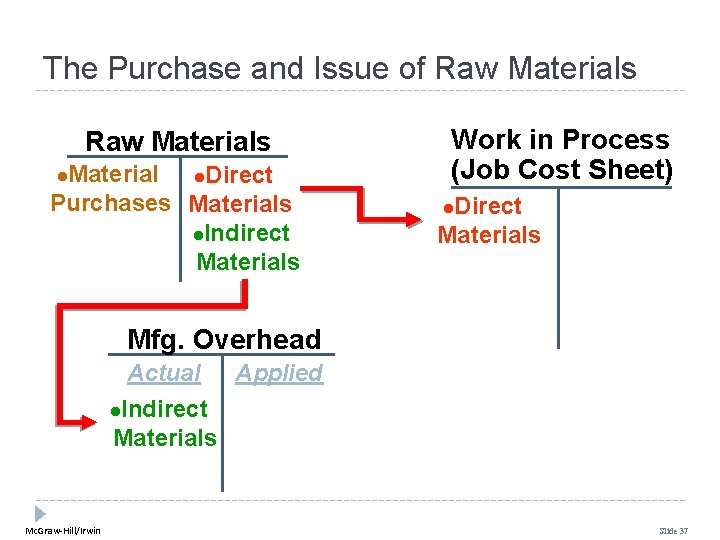
The Purchase and Issue of Raw Materials Material l. Direct Purchases Materials l. Indirect Materials l Work in Process (Job Cost Sheet) Direct Materials l Mfg. Overhead Actual Applied l. Indirect Materials Mc. Graw-Hill/Irwin Slide 37
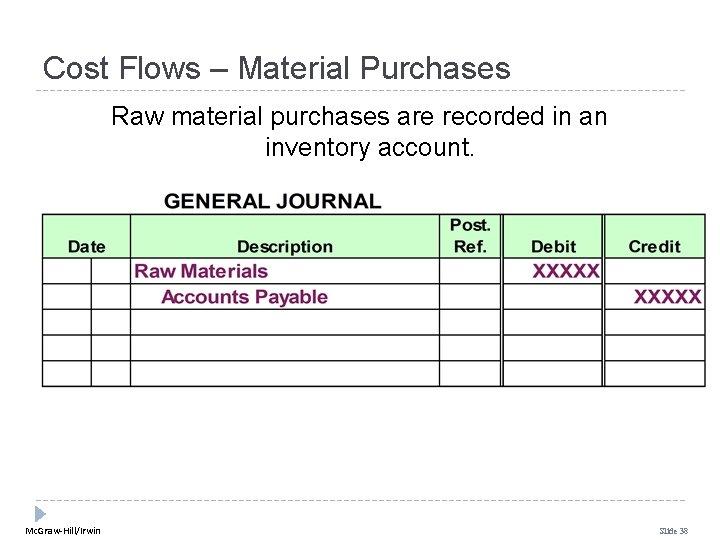
Cost Flows – Material Purchases Raw material purchases are recorded in an inventory account. Mc. Graw-Hill/Irwin Slide 38
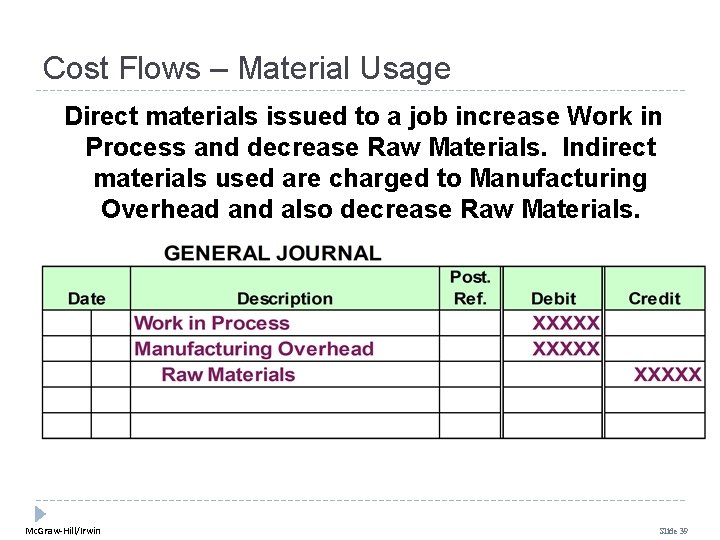
Cost Flows – Material Usage Direct materials issued to a job increase Work in Process and decrease Raw Materials. Indirect materials used are charged to Manufacturing Overhead and also decrease Raw Materials. Mc. Graw-Hill/Irwin Slide 39
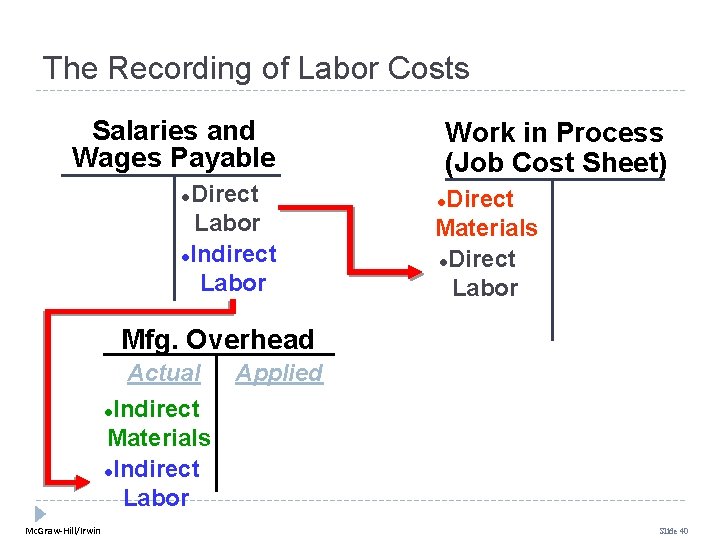
The Recording of Labor Costs Salaries and Wages Payable Direct Labor l. Indirect Labor l Work in Process (Job Cost Sheet) Direct Materials l. Direct Labor l Mfg. Overhead Actual l. Indirect Materials l. Indirect Labor Mc. Graw-Hill/Irwin Applied Slide 40
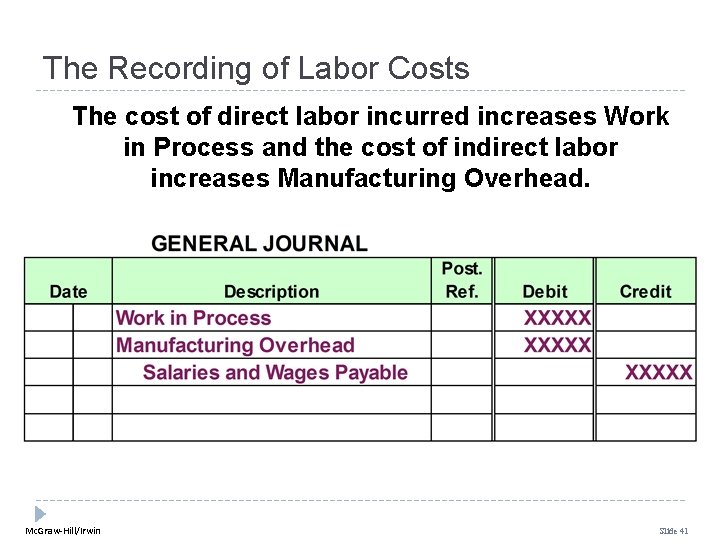
The Recording of Labor Costs The cost of direct labor incurred increases Work in Process and the cost of indirect labor increases Manufacturing Overhead. Mc. Graw-Hill/Irwin Slide 41
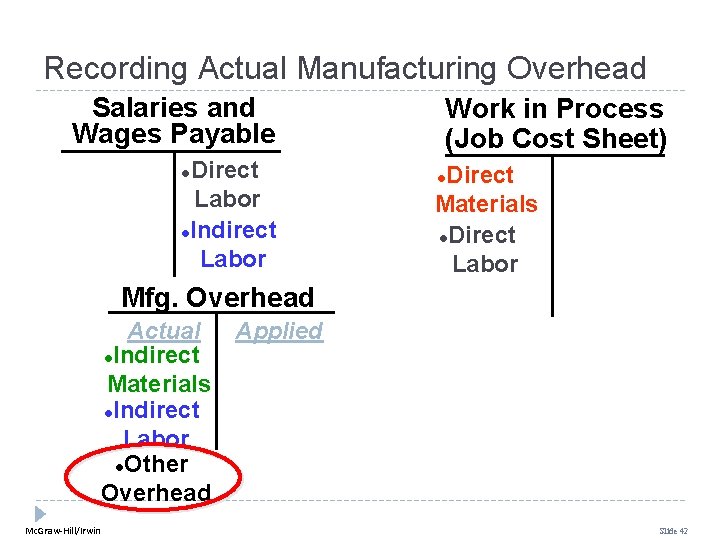
Recording Actual Manufacturing Overhead Salaries and Wages Payable Direct Labor l. Indirect Labor l Work in Process (Job Cost Sheet) Direct Materials l. Direct Labor l Mfg. Overhead Actual l. Indirect Materials l. Indirect Labor l. Other Overhead Mc. Graw-Hill/Irwin Applied Slide 42
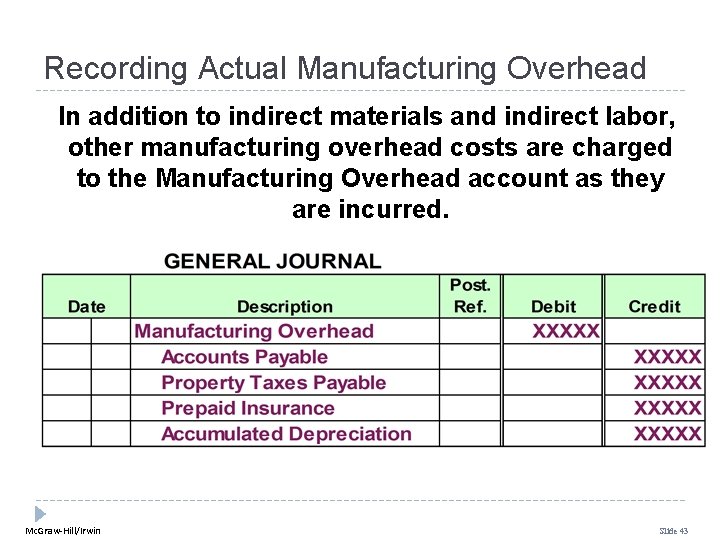
Recording Actual Manufacturing Overhead In addition to indirect materials and indirect labor, other manufacturing overhead costs are charged to the Manufacturing Overhead account as they are incurred. Mc. Graw-Hill/Irwin Slide 43
Learning Objective 5 Apply overhead cost to Work in Process using a predetermined overhead rate. Mc. Graw-Hill/Irwin Slide 44
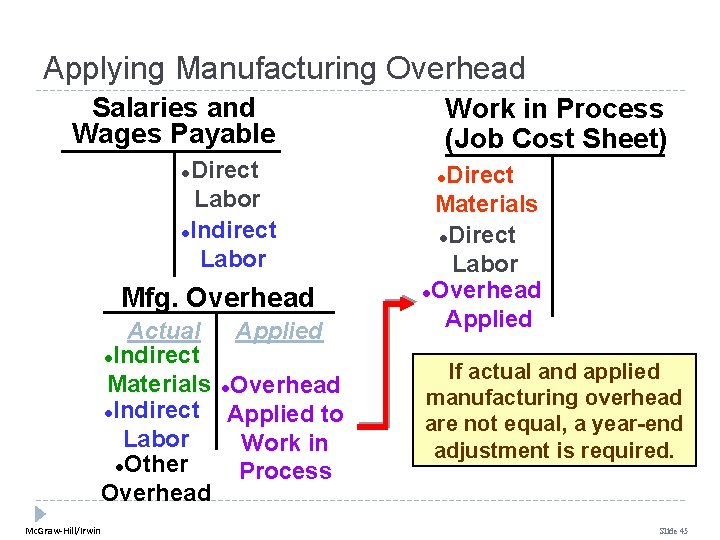
Applying Manufacturing Overhead Salaries and Wages Payable Direct Labor l. Indirect Labor l Mfg. Overhead Actual Applied l. Indirect Materials l. Overhead l. Indirect Applied to Labor Work in l. Other Process Overhead Mc. Graw-Hill/Irwin Work in Process (Job Cost Sheet) Direct Materials l. Direct Labor l. Overhead Applied l If actual and applied manufacturing overhead are not equal, a year-end adjustment is required. Slide 45
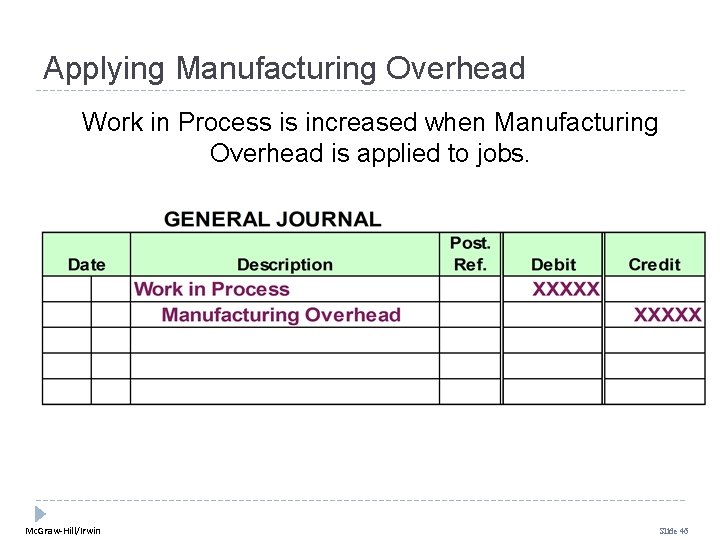
Applying Manufacturing Overhead Work in Process is increased when Manufacturing Overhead is applied to jobs. Mc. Graw-Hill/Irwin Slide 46
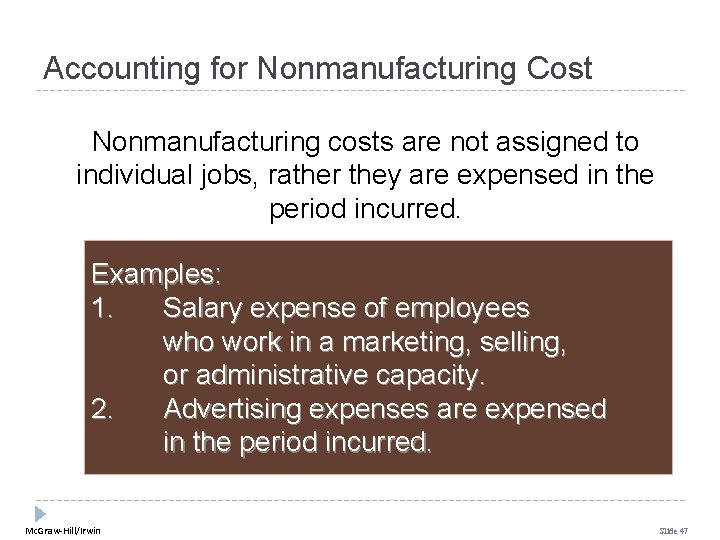
Accounting for Nonmanufacturing Cost Nonmanufacturing costs are not assigned to individual jobs, rather they are expensed in the period incurred. Examples: 1. Salary expense of employees who work in a marketing, selling, or administrative capacity. 2. Advertising expenses are expensed in the period incurred. Mc. Graw-Hill/Irwin Slide 47
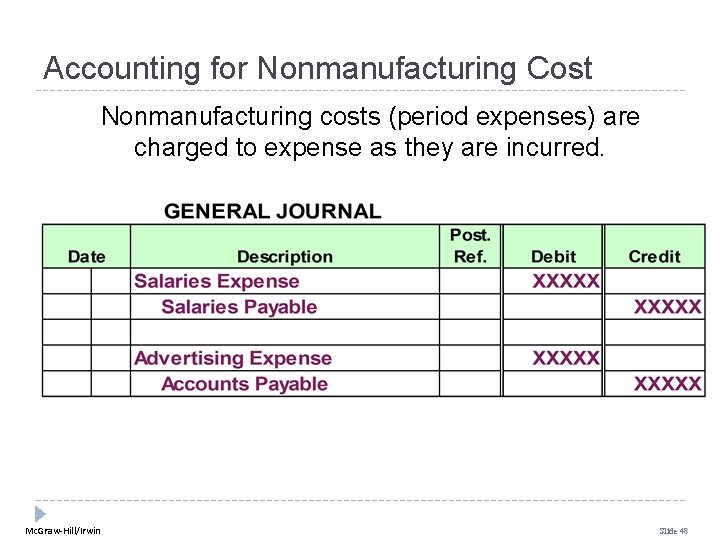
Accounting for Nonmanufacturing Cost Nonmanufacturing costs (period expenses) are charged to expense as they are incurred. Mc. Graw-Hill/Irwin Slide 48
Learning Objective 6 Prepare schedules of cost of goods manufactured and cost of goods sold. Mc. Graw-Hill/Irwin Slide 49
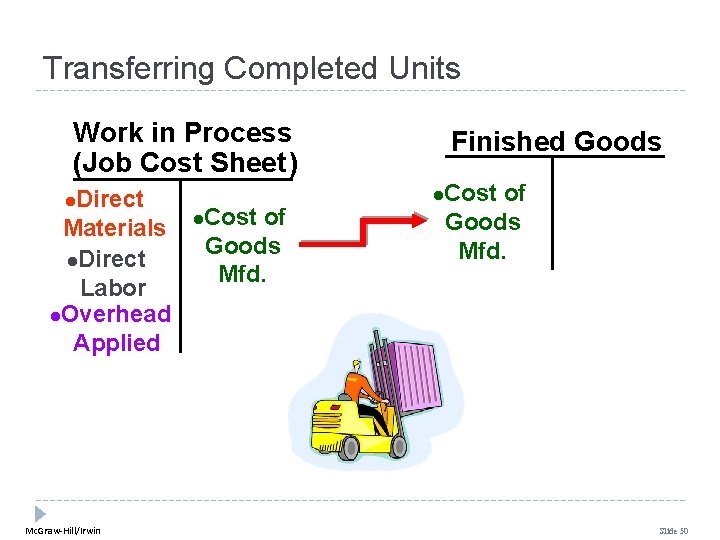
Transferring Completed Units Work in Process (Job Cost Sheet ) Direct Materials l. Direct Labor l. Overhead Applied l Mc. Graw-Hill/Irwin l Cost of Goods Mfd. Finished Goods l Cost of Goods Mfd. Slide 50
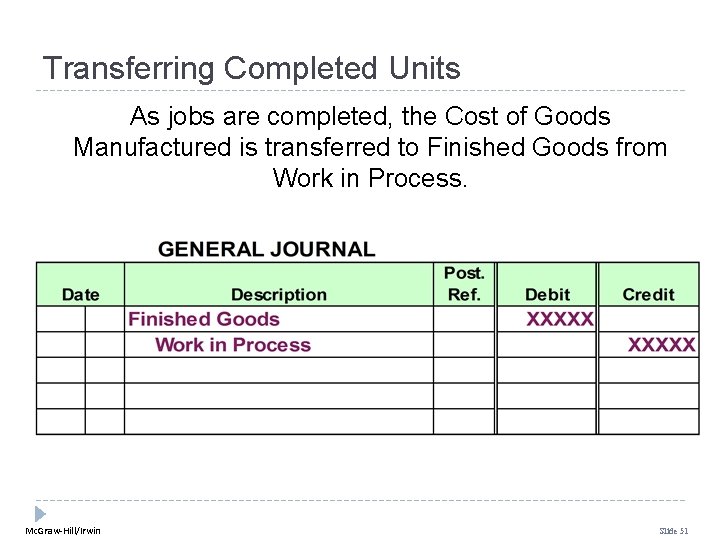
Transferring Completed Units As jobs are completed, the Cost of Goods Manufactured is transferred to Finished Goods from Work in Process. Mc. Graw-Hill/Irwin Slide 51
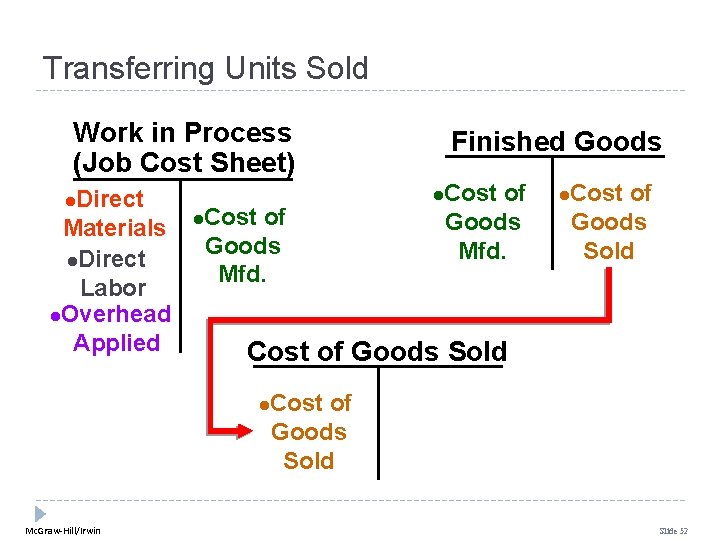
Transferring Units Sold Work in Process (Job Cost Sheet) Direct Materials l. Direct Labor l. Overhead Applied l l Cost of Goods Mfd. l Cost of Goods Sold l Mc. Graw-Hill/Irwin Finished Goods Cost of Goods Sold Slide 52
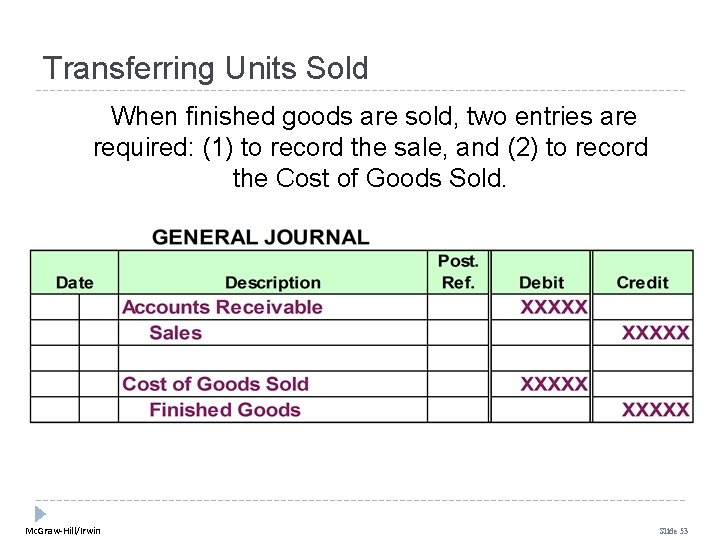
Transferring Units Sold When finished goods are sold, two entries are required: (1) to record the sale, and (2) to record the Cost of Goods Sold. Mc. Graw-Hill/Irwin Slide 53
Learning Objective 8 Compute underapplied or overapplied overhead cost and prepare the journal entry to close the balance in Manufacturing Overhead to the appropriate accounts. Mc. Graw-Hill/Irwin Slide 54
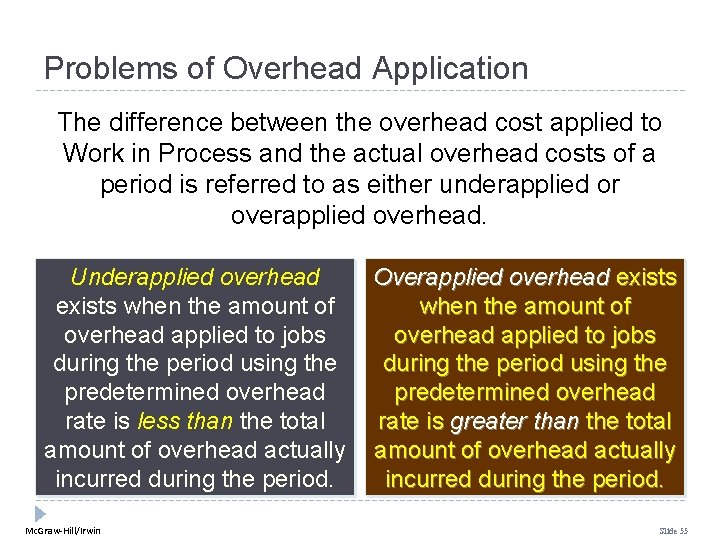
Problems of Overhead Application The difference between the overhead cost applied to Work in Process and the actual overhead costs of a period is referred to as either underapplied or overapplied overhead. Underapplied overhead exists when the amount of overhead applied to jobs during the period using the predetermined overhead rate is less than the total amount of overhead actually incurred during the period. Mc. Graw-Hill/Irwin Overapplied overhead exists when the amount of overhead applied to jobs during the period using the predetermined overhead rate is greater than the total amount of overhead actually incurred during the period. Slide 55
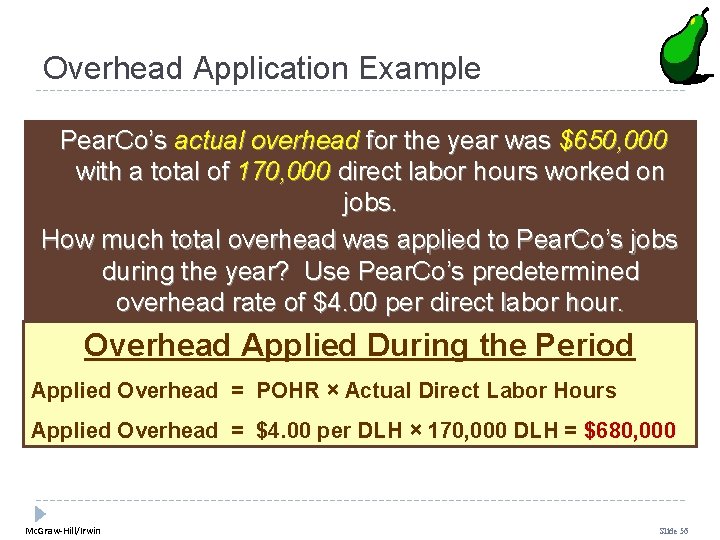
Overhead Application Example Pear. Co’s actual overhead for the year was $650, 000 with a total of 170, 000 direct labor hours worked on jobs. How much total overhead was applied to Pear. Co’s jobs during the year? Use Pear. Co’s predetermined overhead rate of $4. 00 per direct labor hour. Overhead Applied During the Period Applied Overhead = POHR × Actual Direct Labor Hours Applied Overhead = $4. 00 per DLH × 170, 000 DLH = $680, 000 Mc. Graw-Hill/Irwin Slide 56
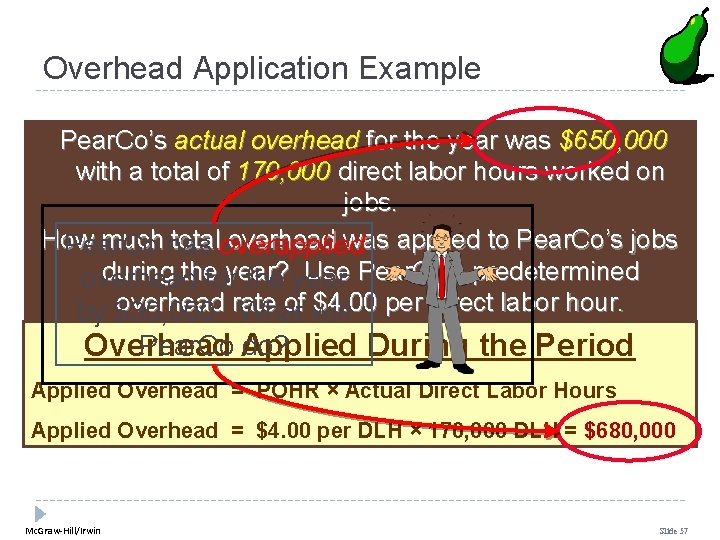
Overhead Application Example Pear. Co’s actual overhead for the year was $650, 000 with a total of 170, 000 direct labor hours worked on jobs. How much has totaloverapplied overhead was applied to Pear. Co’s jobs Pear. Co during thefor year? Use Pear. Co’s predetermined overhead the year overhead rate of will $4. 00 per direct labor hour. by $30, 000. What Pear. Co Applied do? Overhead During the Period Applied Overhead = POHR × Actual Direct Labor Hours Applied Overhead = $4. 00 per DLH × 170, 000 DLH = $680, 000 Mc. Graw-Hill/Irwin Slide 57
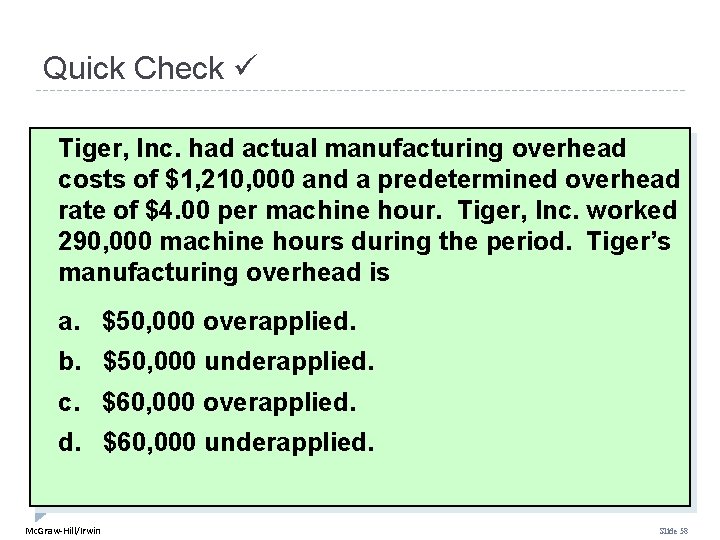
Quick Check Tiger, Inc. had actual manufacturing overhead costs of $1, 210, 000 and a predetermined overhead rate of $4. 00 per machine hour. Tiger, Inc. worked 290, 000 machine hours during the period. Tiger’s manufacturing overhead is a. $50, 000 overapplied. b. $50, 000 underapplied. c. $60, 000 overapplied. d. $60, 000 underapplied. Mc. Graw-Hill/Irwin Slide 58
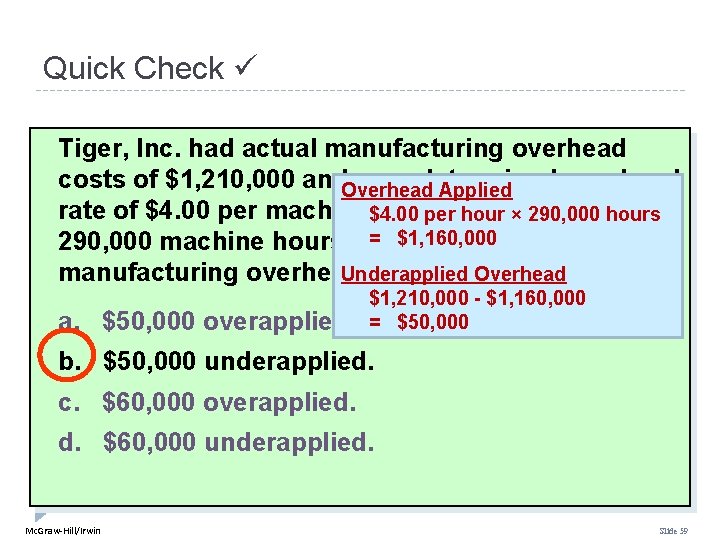
Quick Check Tiger, Inc. had actual manufacturing overhead costs of $1, 210, 000 and. Overhead a predetermined overhead Applied rate of $4. 00 per machine$4. 00 hour. Inc. worked per Tiger, hour × 290, 000 hours = $1, 160, 000 290, 000 machine hours during the period. Tiger’s Underapplied Overhead manufacturing overhead is a. $50, 000 overapplied. $1, 210, 000 - $1, 160, 000 = $50, 000 b. $50, 000 underapplied. c. $60, 000 overapplied. d. $60, 000 underapplied. Mc. Graw-Hill/Irwin Slide 59
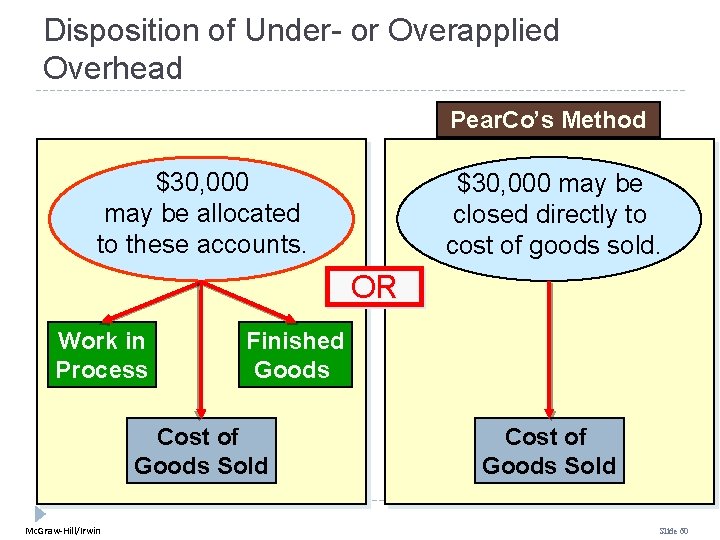
Disposition of Under- or Overapplied Overhead Pear. Co’s Method $30, 000 may be allocated to these accounts. $30, 000 may be closed directly to cost of goods sold. OR Work in Process Finished Goods Cost of Goods Sold Mc. Graw-Hill/Irwin Cost of Goods Sold Slide 60
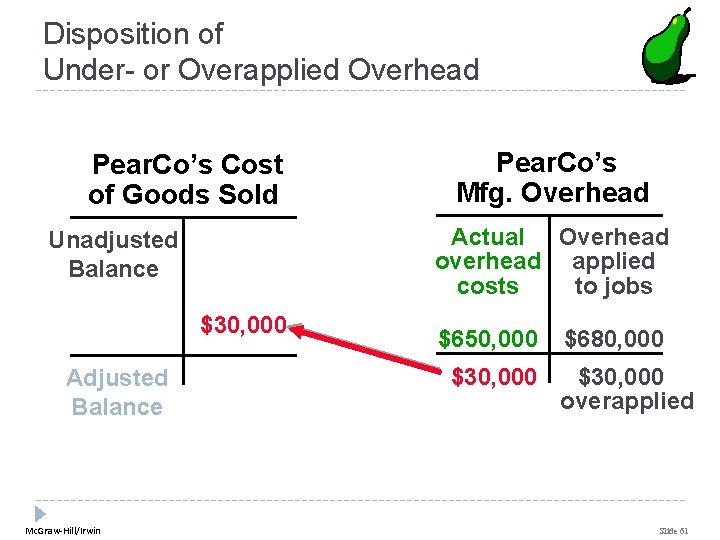
Disposition of Under- or Overapplied Overhead Pear. Co’s Cost of Goods Sold Actual Overhead overhead applied costs to jobs Unadjusted Balance $30, 000 Adjusted Balance Mc. Graw-Hill/Irwin Pear. Co’s Mfg. Overhead $650, 000 $30, 000 $680, 000 $30, 000 overapplied Slide 61
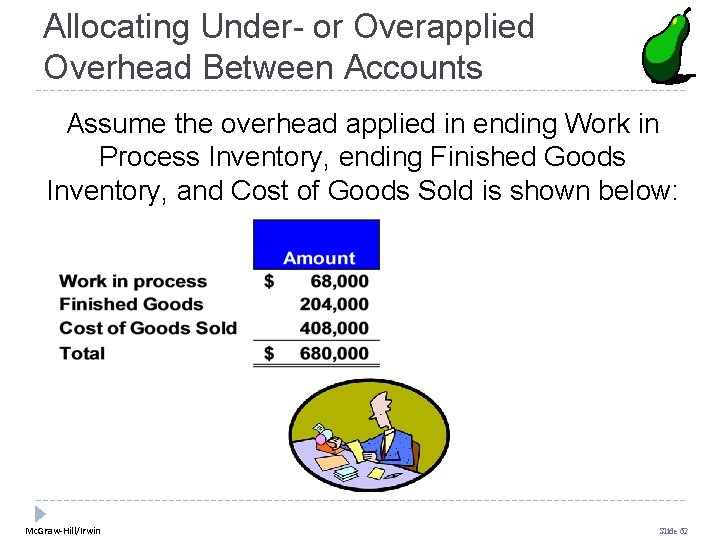
Allocating Under- or Overapplied Overhead Between Accounts Assume the overhead applied in ending Work in Process Inventory, ending Finished Goods Inventory, and Cost of Goods Sold is shown below: Mc. Graw-Hill/Irwin Slide 62
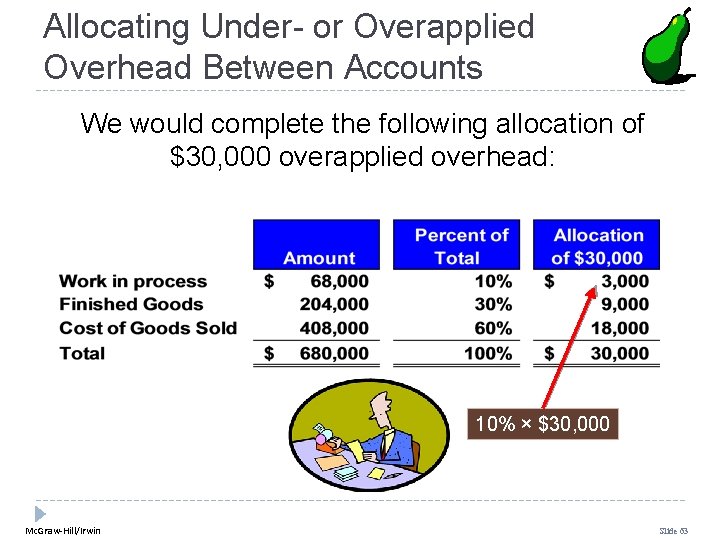
Allocating Under- or Overapplied Overhead Between Accounts We would complete the following allocation of $30, 000 overapplied overhead: 10% × $30, 000 Mc. Graw-Hill/Irwin Slide 63
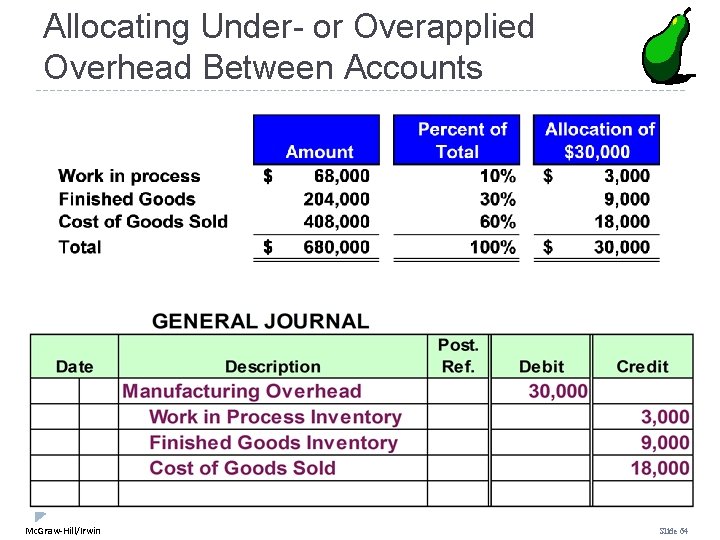
Allocating Under- or Overapplied Overhead Between Accounts Mc. Graw-Hill/Irwin Slide 64
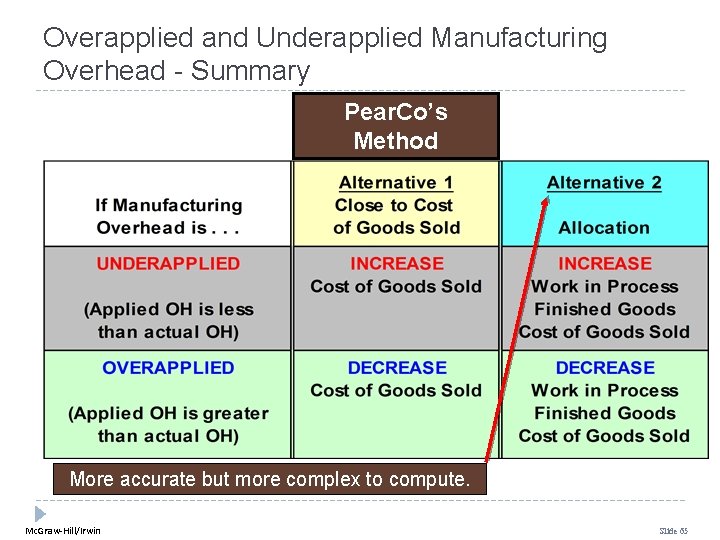
Overapplied and Underapplied Manufacturing Overhead - Summary Pear. Co’s Method More accurate but more complex to compute. Mc. Graw-Hill/Irwin Slide 65
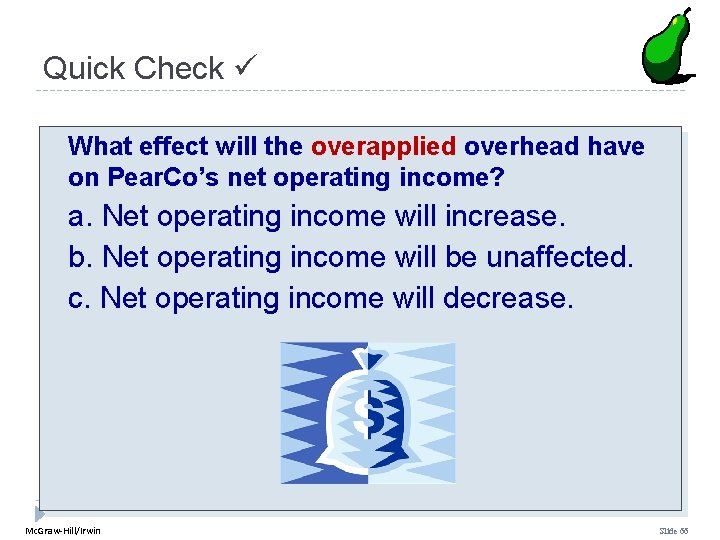
Quick Check What effect will the overapplied overhead have on Pear. Co’s net operating income? a. Net operating income will increase. b. Net operating income will be unaffected. c. Net operating income will decrease. Mc. Graw-Hill/Irwin Slide 66
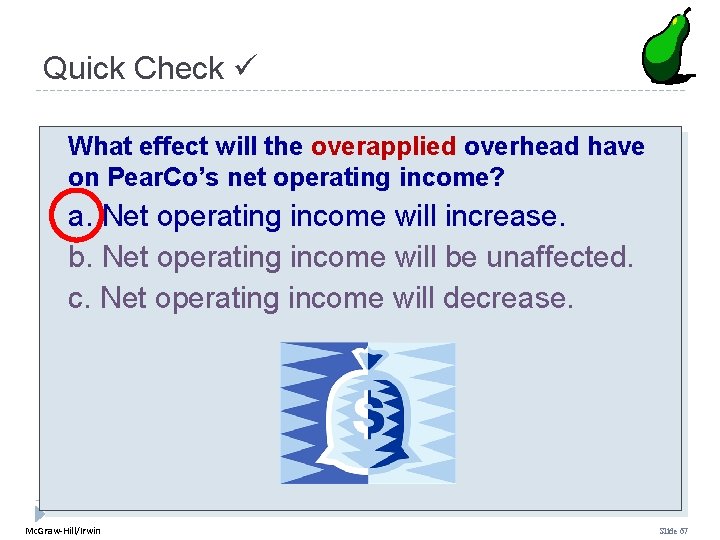
Quick Check What effect will the overapplied overhead have on Pear. Co’s net operating income? a. Net operating income will increase. b. Net operating income will be unaffected. c. Net operating income will decrease. Mc. Graw-Hill/Irwin Slide 67
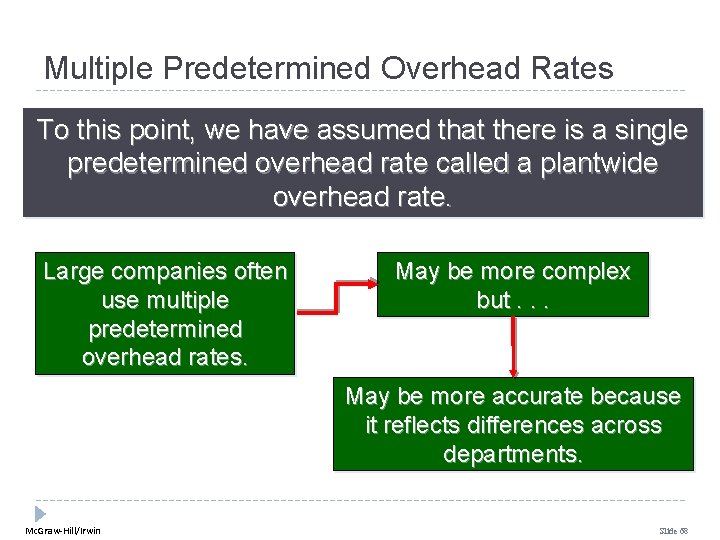
Multiple Predetermined Overhead Rates To this point, we have assumed that there is a single predetermined overhead rate called a plantwide overhead rate. Large companies often use multiple predetermined overhead rates. May be more complex but. . . May be more accurate because it reflects differences across departments. Mc. Graw-Hill/Irwin Slide 68
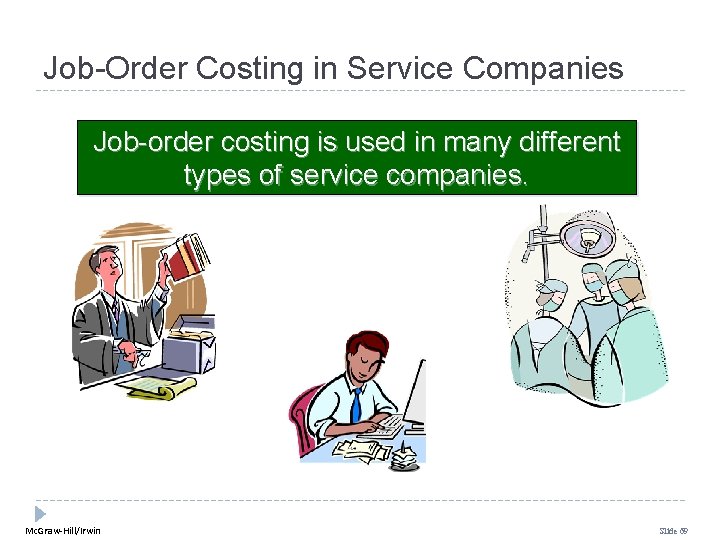
Job-Order Costing in Service Companies Job-order costing is used in many different types of service companies. Mc. Graw-Hill/Irwin Slide 69
The Use of Information Technology plays an important part in many job-order cost systems. When combined with Electronic Data Interchange (EDI) or a web-based programming language called Extensible Markup Language (XML), bar coding eliminates the inefficiencies and inaccuracies associated with manual clerical processes. Mc. Graw-Hill/Irwin Slide 70
The Predetermined Overhead Rate and Capacity Appendix 3 A © 2010 The Mc. Graw-Hill Companies, Inc.

Learning Objective 9 (Appendix 3 A) Understand the implications of basing the predetermined overhead rate on activity at capacity rather than on estimated activity for the period. Mc. Graw-Hill/Irwin Slide 72
Predetermined Overhead Rate and Capacity Calculating predetermined overhead rates using an estimated, or budgeted amount of the allocation base has been criticized because: 1. Basing the predetermined overhead rate upon budgeted activity results in product costs that fluctuate depending upon the activity level. 2. Calculating predetermined rates based upon budgeted activity charges products for costs that they do not use. Mc. Graw-Hill/Irwin Slide 73
Capacity-Based Overhead Rates Criticisms can be overcome by using estimated total units in the allocation base at capacity in the denominator of the predetermined overhead rate calculation. Let’s look at the difference! Mc. Graw-Hill/Irwin Slide 74
An Example Equipment is leased for $100, 000 per year. Running at full capacity, 50, 000 units may be produced. The company estimates that 40, 000 units will be produced and sold next year. What is the predetermined overhead rate? Mc. Graw-Hill/Irwin Slide 75
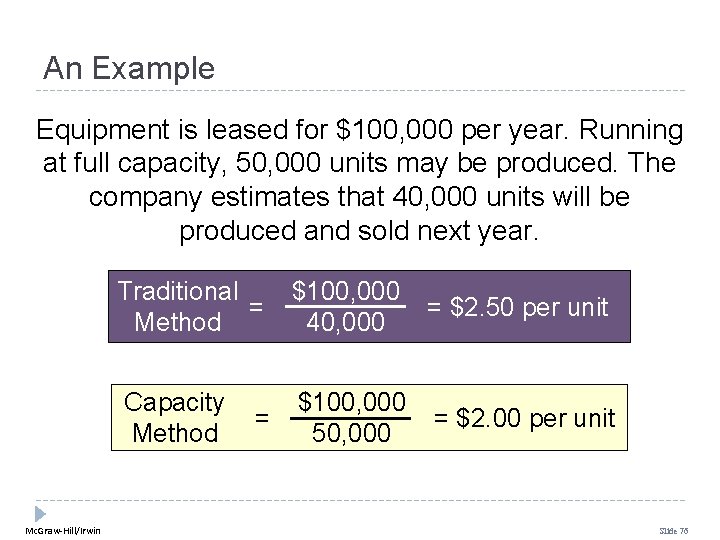
An Example Equipment is leased for $100, 000 per year. Running at full capacity, 50, 000 units may be produced. The company estimates that 40, 000 units will be produced and sold next year. Mc. Graw-Hill/Irwin Traditional = Method $100, 000 40, 000 = $2. 50 per unit Capacity Method $100, 000 50, 000 = $2. 00 per unit = Slide 76
Quick Check Crest Winery in Woodinville leases an automatic corking machine for $100, 000 per year. At full capacity, it can cork 50, 000 cases of wine per year. The company estimates 40, 000 cases of wine will be produced and sold next year. What is the predetermined overhead rate based on the estimated number of cases of wine? a. $2. 00 per case. b. $2. 50 per case. c. $4. 00 per case. Mc. Graw-Hill/Irwin Slide 77
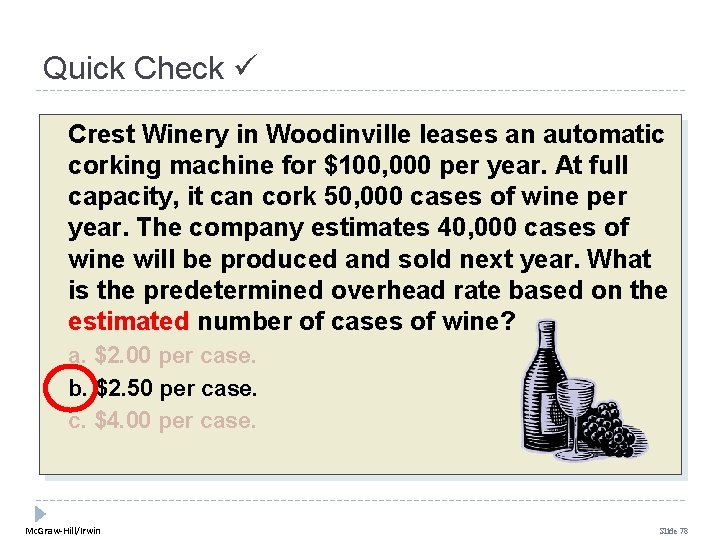
Quick Check Crest Winery in Woodinville leases an automatic corking machine for $100, 000 per year. At full capacity, it can cork 50, 000 cases of wine per year. The company estimates 40, 000 cases of wine will be produced and sold next year. What is the predetermined overhead rate based on the estimated number of cases of wine? a. $2. 00 per case. b. $2. 50 per case. c. $4. 00 per case. Mc. Graw-Hill/Irwin Slide 78
Quick Check Crest Winery in Woodinville leases an automatic corking machine for $100, 000 per year. At full capacity, it can cork 50, 000 cases of wine per year. The company estimates 40, 000 cases of wine will be produced and sold next year. What is the predetermined overhead rate based on the number of cases of wine at capacity? a. $2. 00 per case. b. $2. 50 per case. c. $4. 00 per case. Mc. Graw-Hill/Irwin Slide 79
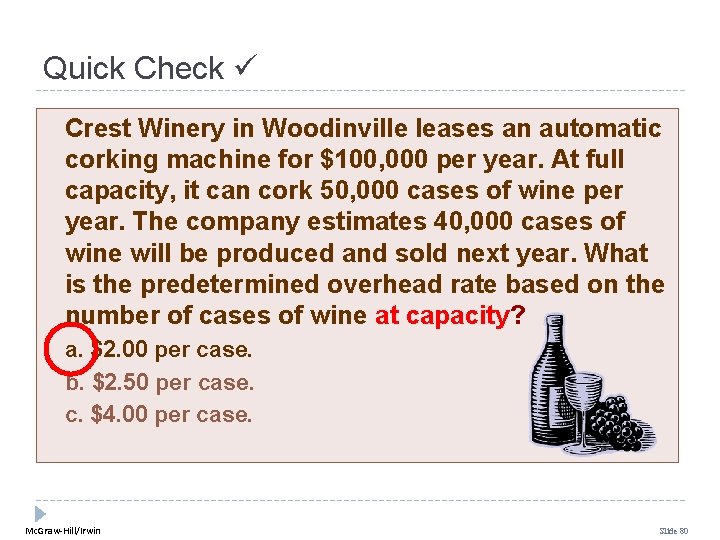
Quick Check Crest Winery in Woodinville leases an automatic corking machine for $100, 000 per year. At full capacity, it can cork 50, 000 cases of wine per year. The company estimates 40, 000 cases of wine will be produced and sold next year. What is the predetermined overhead rate based on the number of cases of wine at capacity? a. $2. 00 per case. b. $2. 50 per case. c. $4. 00 per case. Mc. Graw-Hill/Irwin Slide 80
Quick Check When capacity is used in the denominator of the predetermined rate, what happens to the predetermined overhead rate as estimated activity decreases? a. The predetermined overhead rate goes up when activity goes down. b. The predetermined overhead rate stays the same because it is not affected by changes in activity. c. The predetermined overhead rate goes down when activity goes down. Mc. Graw-Hill/Irwin Slide 81
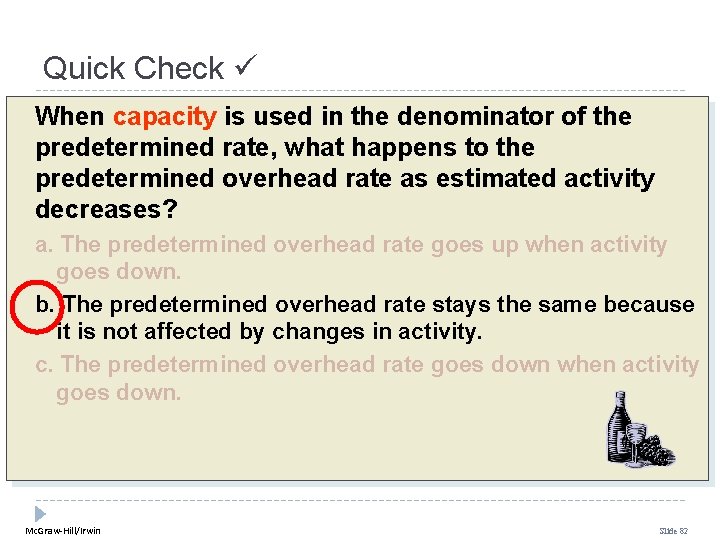
Quick Check When capacity is used in the denominator of the predetermined rate, what happens to the predetermined overhead rate as estimated activity decreases? a. The predetermined overhead rate goes up when activity goes down. b. The predetermined overhead rate stays the same because it is not affected by changes in activity. c. The predetermined overhead rate goes down when activity goes down. Mc. Graw-Hill/Irwin Slide 82
Quick Check When estimated activity is used in the denominator of the predetermined rate, what happens to the predetermined overhead rate as estimated activity decreases? a. The predetermined overhead rate goes up when activity goes down. b. The predetermined overhead rate stays the same because it is not affected by changes in activity. c. The predetermined overhead rate goes down when activity goes down. Mc. Graw-Hill/Irwin Slide 83
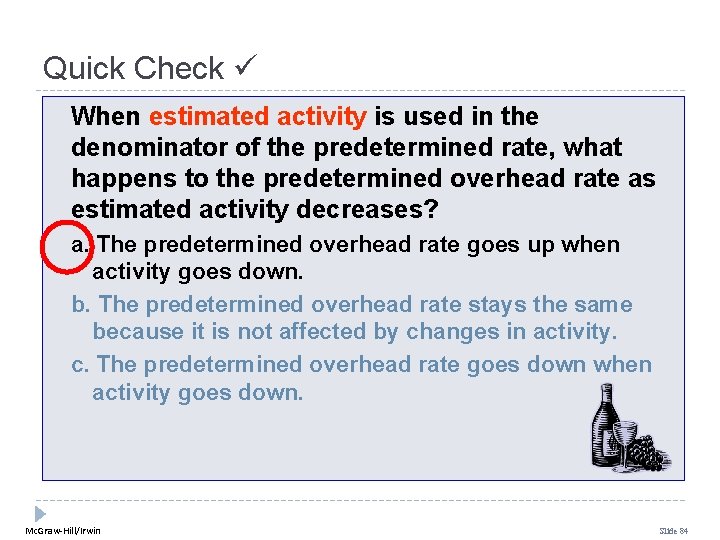
Quick Check When estimated activity is used in the denominator of the predetermined rate, what happens to the predetermined overhead rate as estimated activity decreases? a. The predetermined overhead rate goes up when activity goes down. b. The predetermined overhead rate stays the same because it is not affected by changes in activity. c. The predetermined overhead rate goes down when activity goes down. Mc. Graw-Hill/Irwin Slide 84
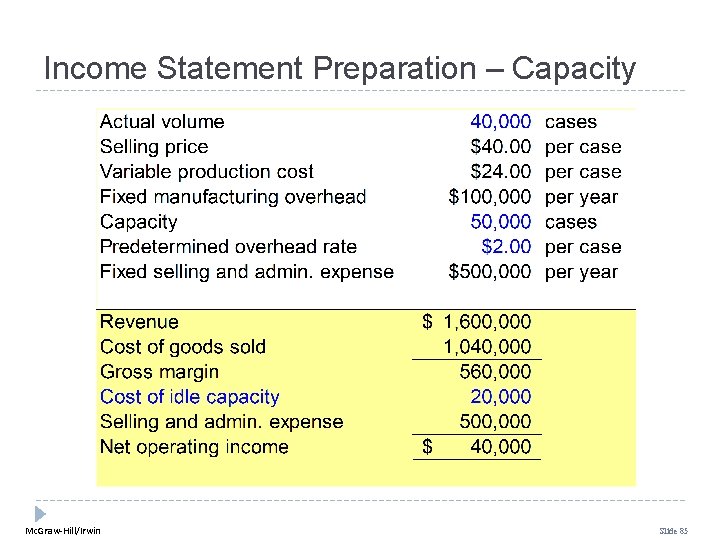
Income Statement Preparation – Capacity Mc. Graw-Hill/Irwin Slide 85
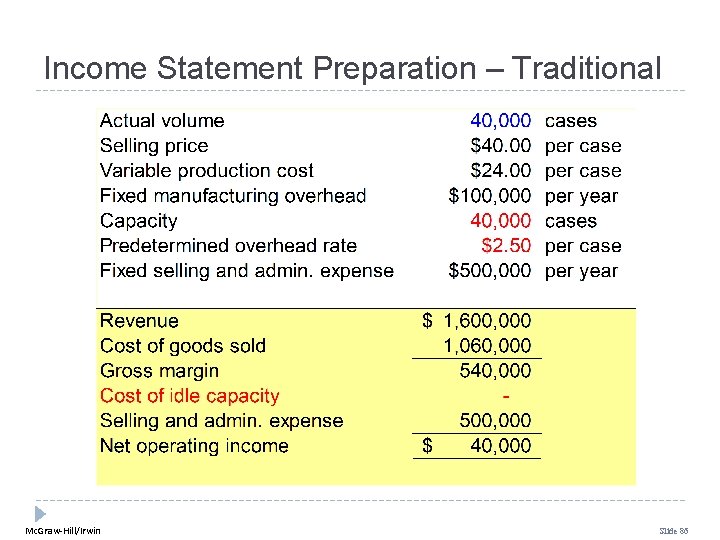
Income Statement Preparation – Traditional Mc. Graw-Hill/Irwin Slide 86
End of Chapter 3 Mc. Graw-Hill/Irwin Slide 87
- Slides: 87