
Systems Biology Haixu Tang School of Informatics Two
Systems Biology Haixu Tang School of Informatics
Two ways of looking a problem • Top down or bottom up – Either look at the whole organism and abstract large portions of it – Or try to understand each small piece and then after understanding every small piece assemble into the whole – Both are used, valid and complement each other

Bottom up (or reductionism) is traditional approach – You would study a biological process in details not worrying about how that process might interact with other elements in the cell. – You would strive to understand a gene or process in great detail, eventually you might extend this knowledge to other organisms and compare.

Systems Biology: a top-down approach? • Challenge: put the pieces back together • Attempts to create predictive models of cells, organs, biochemical processes and complete organisms – Data combined with computational, mathematical and engineering disciplines – Model <-> simulations <-> experiment
Definitions (Leroy Hood) • Systems biology – As global a view as possible – Fundamentally quantitative – Different scales integrated
Common “themes” • Cross disciplinary: – Systems biology = biology + CS/informatics + engineering +… • Massive data/information/knowledge • Concepts of networks for abstract portrayal of many interaction types. • Model development – Predictive models – Models to drive experimentation – Models to understand processes
What is a pathway? • A series of interconnected steps linked by the production of intermediates that are used in the next step • A series of consecutive reactions that lead to the ultimate goal.
Requires a higher level of understanding • Heterogeneous information “feed” into this understanding – – – Microarrays Homology tools (BLAST, alignments COGS) Biochemical literature Genomic sequence Specialized databases
A complex problem: human cells – 35, 000 genes either on or off (huge simplification!) would have 2^35, 000 solutions – Things can be simplified by grouping and finding key genes which regulate many other genes and genes which may only interact with one other gene – In reality there are lots of subtle interactions and non-binary states.
Some real numbers from E. coli • 630 transcription units controlled by 97 transcription factors. • 100 enzymes that catalyse more than one biochemical reaction. • 68 cases where the same reaction is catalysed by more than one enzyme. • 99 cases where one reaction participates in multiple pathways. • The regulatory network is at most 3 nodes deep. • 50 of 85 studied transcription factors do not regulate other transcription factors, lots of negative auto-regulation
An example – Bacterial Chemotaxis • Bacteria are able to sense temporal gradients of chemical ligands in their vicinity. • Their movement is composed of: – Smooth runs – Tumbling – in which a new direction is chosen randomly. • By modifying tumbling frequency a bacterium is able to direct its motion towards/away from attractants/repellents.
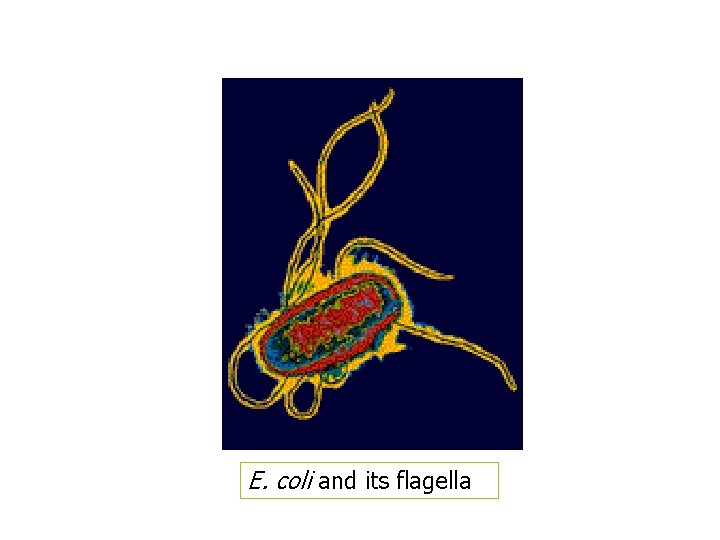
E. coli and its flagella
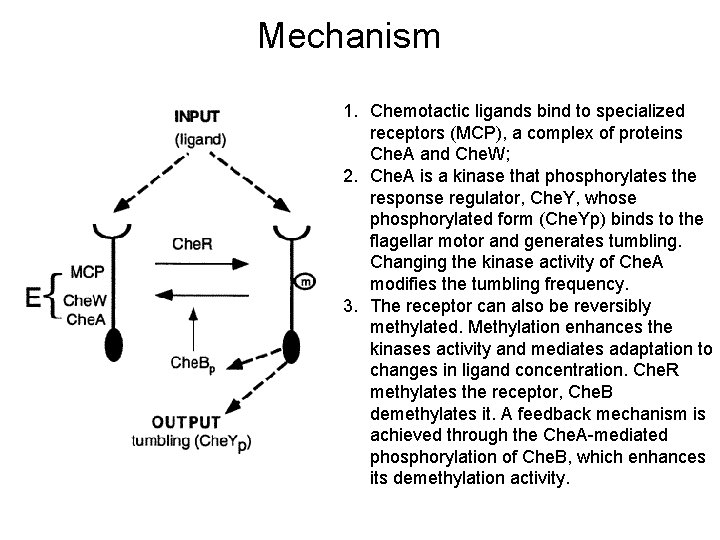
Mechanism 1. Chemotactic ligands bind to specialized receptors (MCP), a complex of proteins Che. A and Che. W; 2. Che. A is a kinase that phosphorylates the response regulator, Che. Y, whose phosphorylated form (Che. Yp) binds to the flagellar motor and generates tumbling. Changing the kinase activity of Che. A modifies the tumbling frequency. 3. The receptor can also be reversibly methylated. Methylation enhances the kinases activity and mediates adaptation to changes in ligand concentration. Che. R methylates the receptor, Che. B demethylates it. A feedback mechanism is achieved through the Che. A-mediated phosphorylation of Che. B, which enhances its demethylation activity.
Adaptation Property • The steady state tumbling frequency in a homogenous ligand environment is insensitive to the ligand concentration. • Allows bacteria to maintain sensitivity to chemical gradient over a wide range of ligand concentrations.
A Simple Two-State Model • Receptor complex (E) has two states: Active, inactive. • Active receptor has kinase activity, which induces tumbling. • Receptor activity is probabilistic, depending on – methylation level, m (feedback from E) – ligand occupancy, U or O – Activity probabilities um for Eu m, om for Eo m
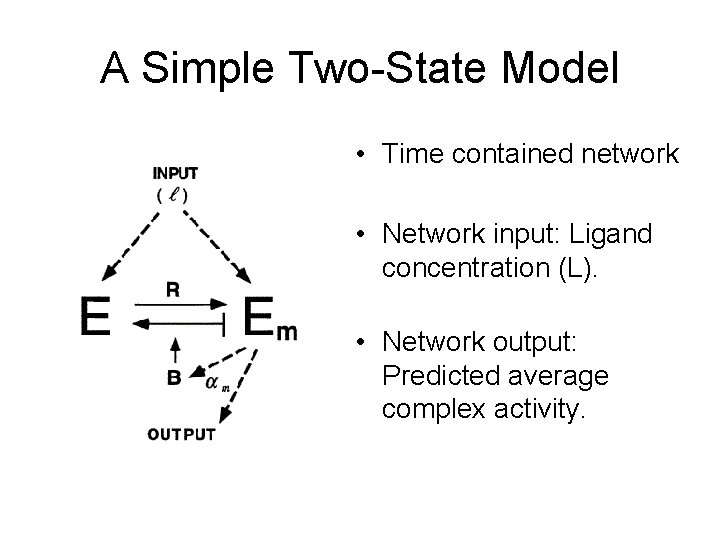
A Simple Two-State Model • Time contained network • Network input: Ligand concentration (L). • Network output: Predicted average complex activity.
Model Simulations • Obtain biochemical parameters by experiments • Solve differential equations using numerical methods (~ 1 min) • Variations in these biochemical parameters would occur naturally in a population —polymorphisms. • Model robustness comes from the feedback mechanism.
Importance of robustness • Genetic polymorphism may change network biochemical parameters. • Enzyme concentrations are low and therefore subject to considerable variations. • Robust mechanism allows bacteria to tolerate both.
Networks: the “system” of systems biology • Building network structure • Learning parameters • Simulation predicting behaviors • Dynamics
- Slides: 20