
SYSTEMS AND DYNAMICS FUNDAMENTAL FORCES NEWTONS LAWS FREE
- Slides: 39
SYSTEMS AND DYNAMICS FUNDAMENTAL FORCES NEWTON’S LAWS FREE BODY DIAGRAMS MASS VERSUS WEIGHT MOMENTUM AND IMPULSE SYSTEMS AND DYNAMICS
FORCE Any influence that causes an object to change in its motion or direction.
SYSTEMS All the objects involved in the problem • Usually only two objects • Two objects hit, and then one of those objects hits another.
DYNAMICS The study of the effects of forces on matter in a system
INTERNAL VERSUS EXTERNAL FORCES INTERNAL FORCES EXTERNAL FORCES • Forces which originate within the system. • Objects exert the forces on each other • Cannot change the total momentum of a system • Forces which originate outside the system. • Can change the total momentum of a system • Example: the objects pushing against each other • Example: gravity pulling the objects down (unless gravity is part of they system) An isolated system has no net external force acting on it, like wind, friction, or resistance
SYSTEMS AND DYNAMICS FUNDAMENTAL FORCES NEWTON’S LAWS FREE BODY DIAGRAMS MASS VERSUS WEIGHT MOMENTUM AND IMPULSE FUNDAMENTAL FORCES
FOUR FUNDAMENTAL FORCES OF THE UNIVERSE Gravitational Electromagnetic Strong Nuclear Weak Nuclear
GRAVITATIONAL Definition: Force of attraction between masses • Weakest of the 4 types • Long range • One of the most observable forces
ELECTROMAGNETIC Definition: Forces between charged particles • Much stronger than gravitation • Shorter (but still long) range. • One of the most observable
STRONG NUCLEAR Definition: Force that holds the nucleus of an atom together • Strongest force, overcoming strong repulsive forces in the nucleus, • Short range • Not easily observable
WEAK NUCLEAR Definition: Force that holds individual protons and neutrons together. (quarks) • • Involved in radioactive β decay One of the strongest forces Very short range Very difficult to observe
• Divide paper into 4 sections. • Each section should include 1 force. • Each force should include: • Name • Definition • Picture • A brief (but specific) explanation of what would happen if the force did not exist. Please be neat and colorful.
SYSTEMS AND DYNAMICS FUNDAMENTAL FORCES NEWTON’S LAWS FREE BODY DIAGRAMS MASS VERSUS WEIGHT MOMENTUM AND IMPULSE NEWTON’S LAWS
WHO WAS ISAAC NEWTON? 1642 - 1727 One of the greatest scientists of all time In 1665, wrote Philosophiae Naturalis Principia Mathematica • Mathematical Principles of Natural Philosophy Constructed three laws of motion: • The Law of Inertia • The Law of Unbalanced Force • The Law of Action and Reaction
NEWTON’S 1 ST LAW The Law of Inertia - The Tendency to Resist Change in Motion • An object at rest stays at rest, and object in motion stays in motion unless acted on by an outside, unbalanced force. • Objects keep on doing what they’re doing. • Example: • Fill up a baking dish with water. It would spill under the following circumstances: • the container was at rest and you attempted to move it • The container was in motion and you attempted to stop it • The container was moving in one direction and you attempted to change its direction
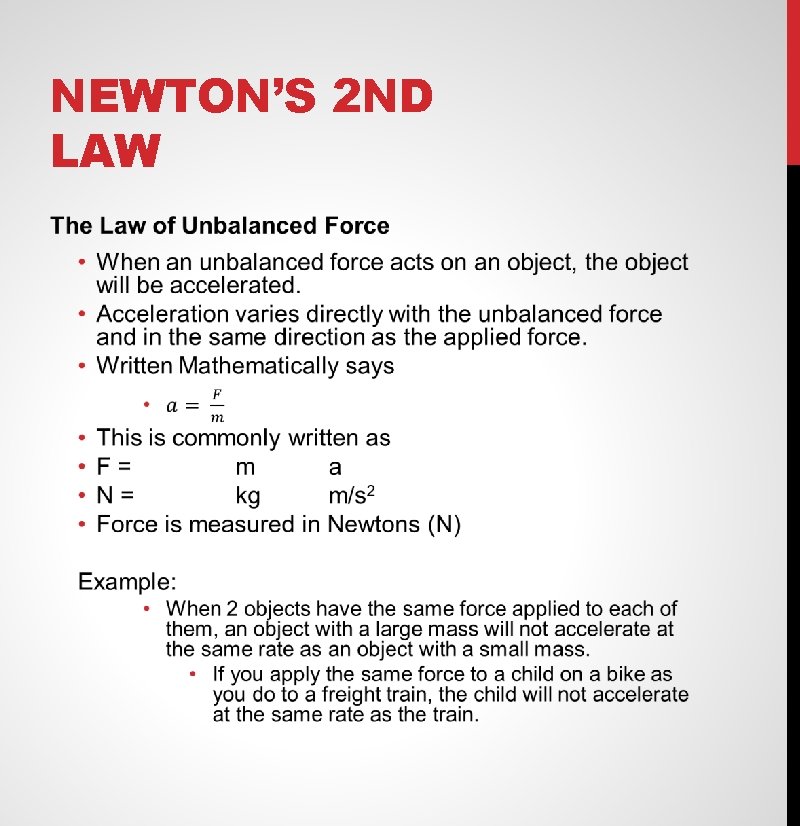
NEWTON’S 2 ND LAW
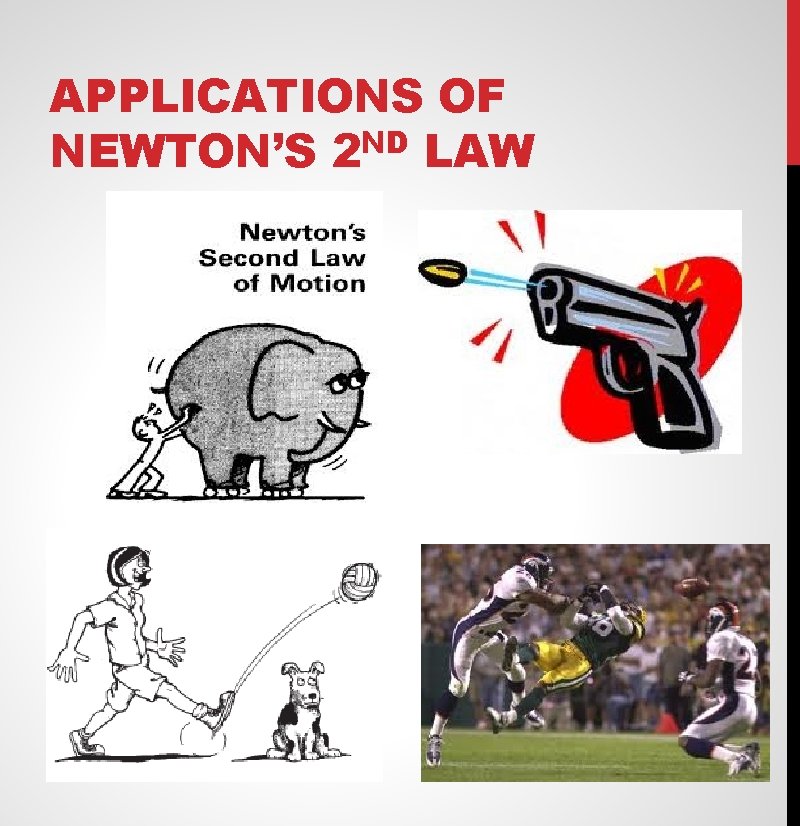
APPLICATIONS OF NEWTON’S 2 ND LAW
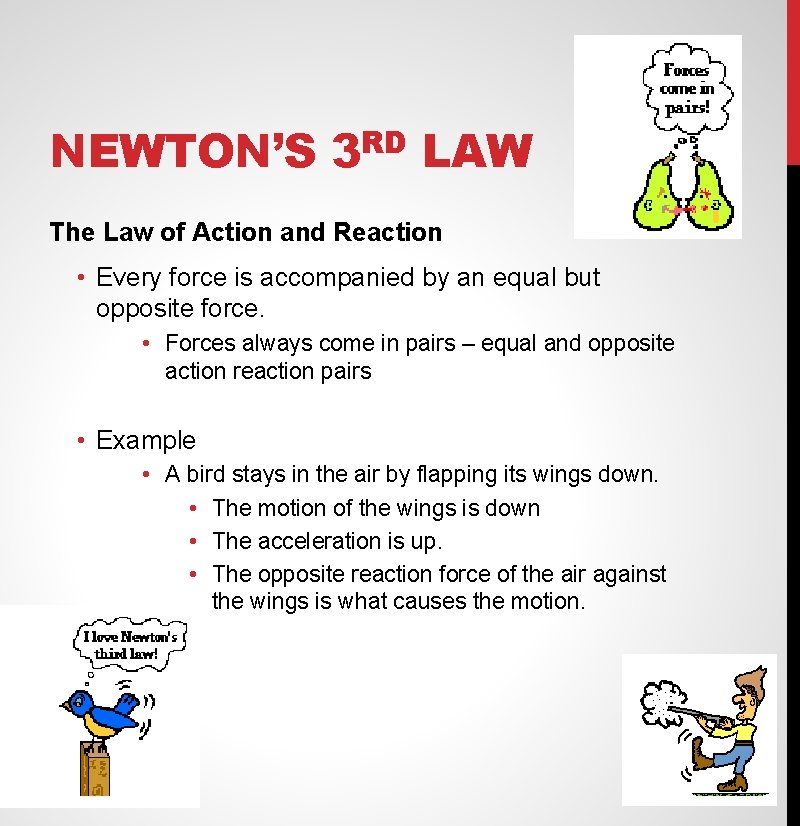
NEWTON’S 3 RD LAW The Law of Action and Reaction • Every force is accompanied by an equal but opposite force. • Forces always come in pairs – equal and opposite action reaction pairs • Example • A bird stays in the air by flapping its wings down. • The motion of the wings is down • The acceleration is up. • The opposite reaction force of the air against the wings is what causes the motion.
SYSTEMS AND DYNAMICS FUNDAMENTAL FORCES NEWTON’S LAWS FREE BODY DIAGRAMS MASS VERSUS WEIGHT MOMENTUM AND IMPULSE FREE BODY DIAGRAMS
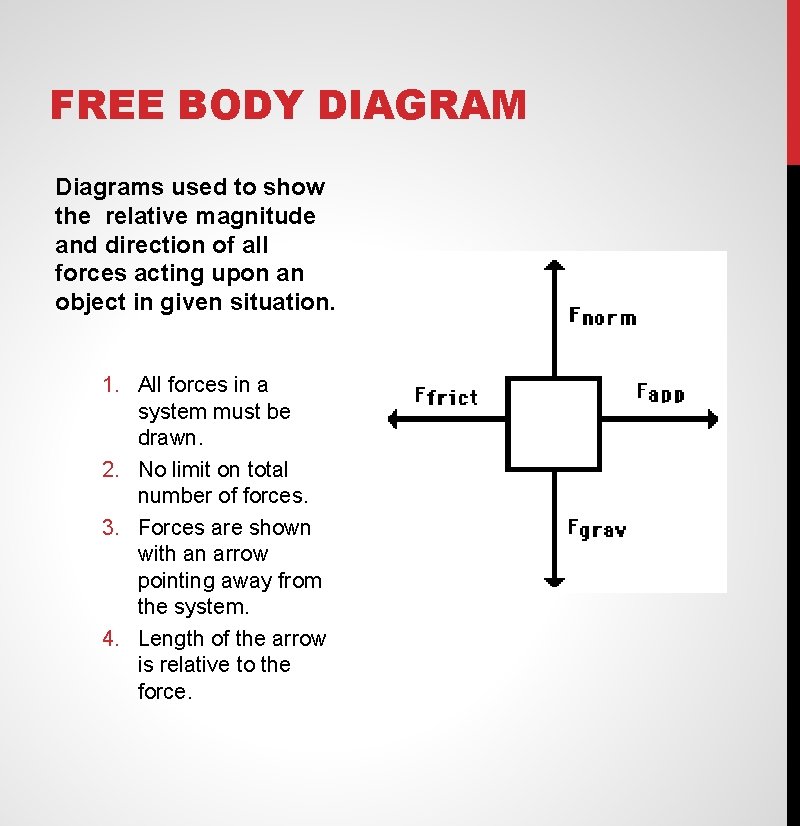
FREE BODY DIAGRAM Diagrams used to show the relative magnitude and direction of all forces acting upon an object in given situation. 1. All forces in a system must be drawn. 2. No limit on total number of forces. 3. Forces are shown with an arrow pointing away from the system. 4. Length of the arrow is relative to the force.
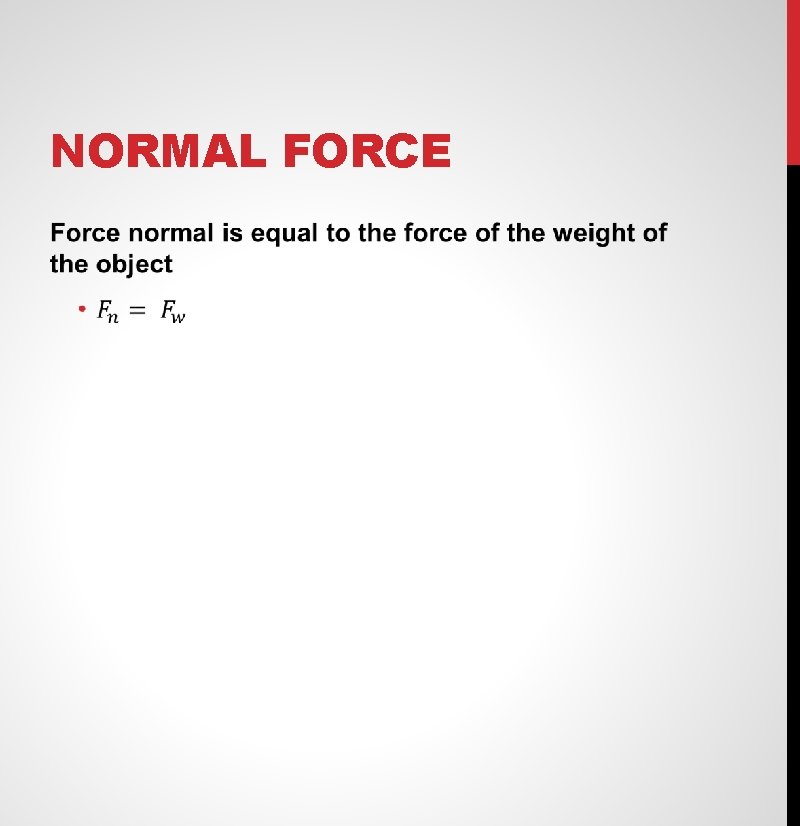
NORMAL FORCE
APPLIED FORCE A force applied to an object. It may be balanced or unbalanced by other forces.
FRICTION FORCE The resistance to motion between 2 objects in contact • Kinetic friction • The friction between objects moving with respect to one another. • Static friction • Friction between objects that are not moving with respect to one another. • Static friction is greater than kinetic friction Friction is an electromagnetic force Bill Nye and Friction- its slick!
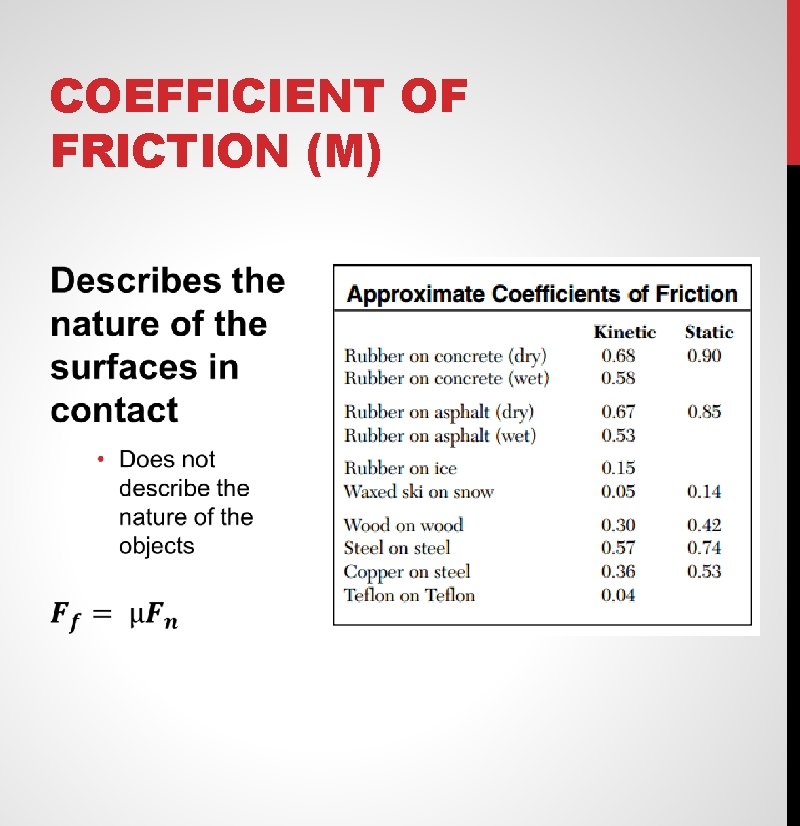
COEFFICIENT OF FRICTION (Μ)
AIR RESISTANCE The frictional force between air molecules and the surface of a falling object.
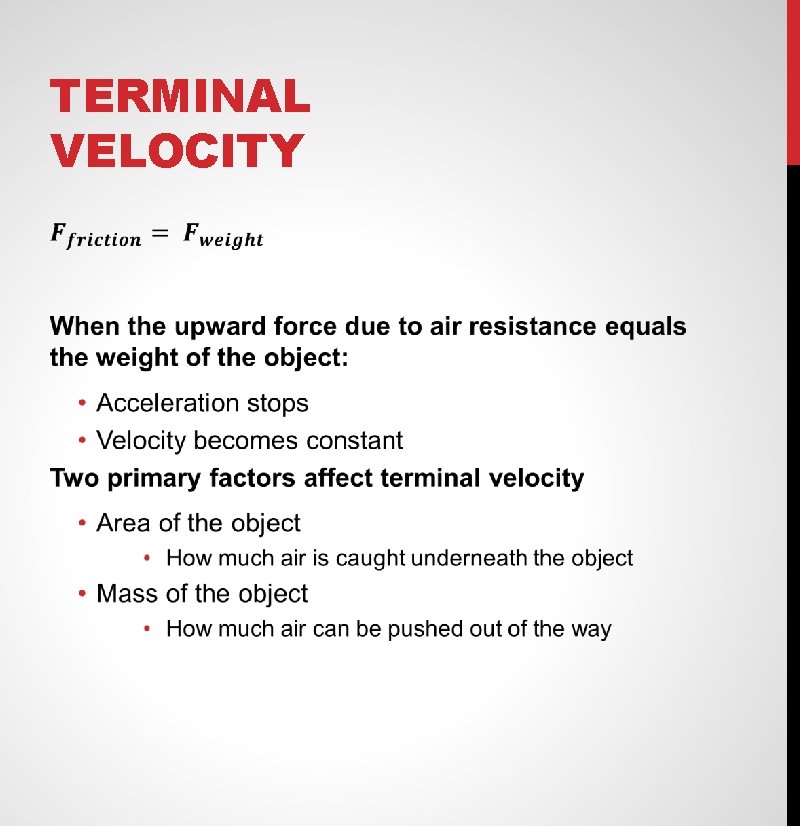
TERMINAL VELOCITY
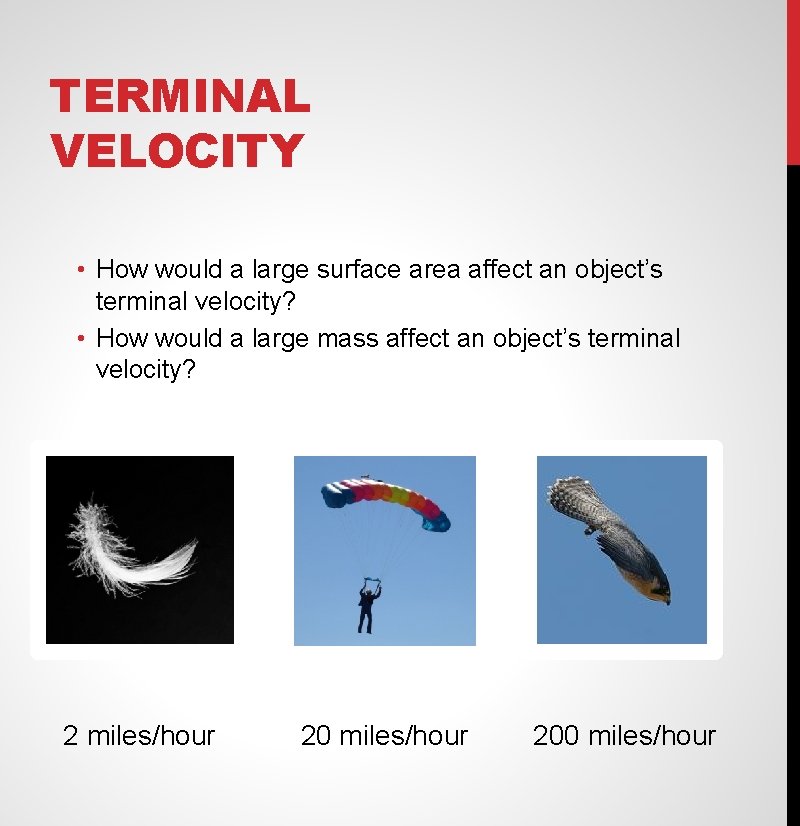
TERMINAL VELOCITY • How would a large surface area affect an object’s terminal velocity? • How would a large mass affect an object’s terminal velocity? 2 miles/hour 200 miles/hour
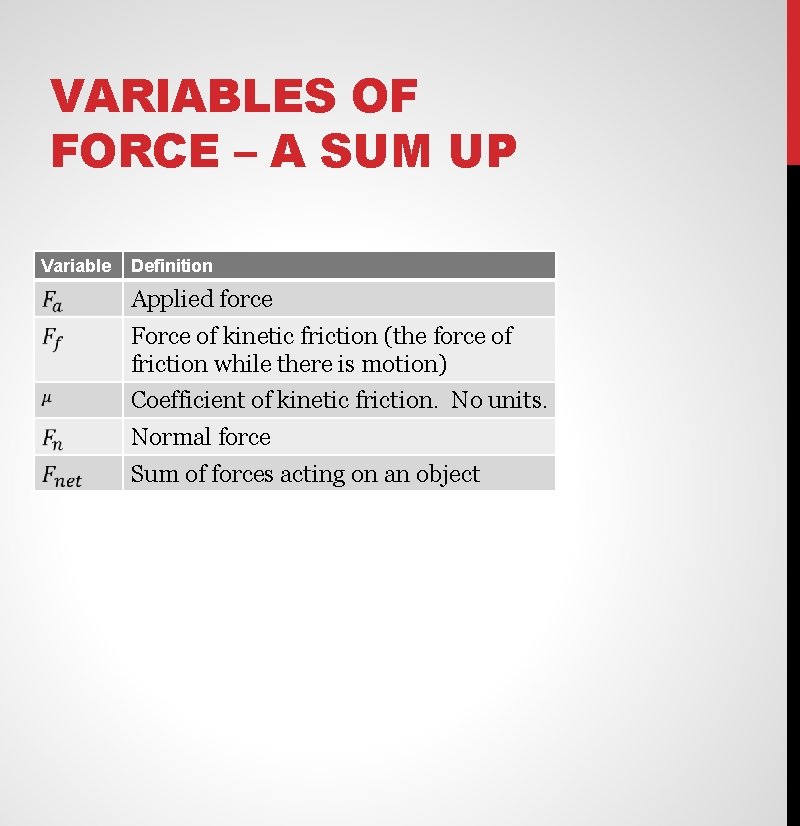
VARIABLES OF FORCE – A SUM UP Variable Definition Applied force Force of kinetic friction (the force of friction while there is motion) Coefficient of kinetic friction. No units. Normal force Sum of forces acting on an object
PRACTICE Draw a free body diagram for a Willard the donkey being shoved by Farmer Joe because Willard won’t move.
SYSTEMS AND DYNAMICS FUNDAMENTAL FORCES NEWTON’S LAWS FREE BODY DIAGRAMS MASS VERSUS WEIGHT MOMENTUM AND IMPULSE MASS VERSUS WEIGHT
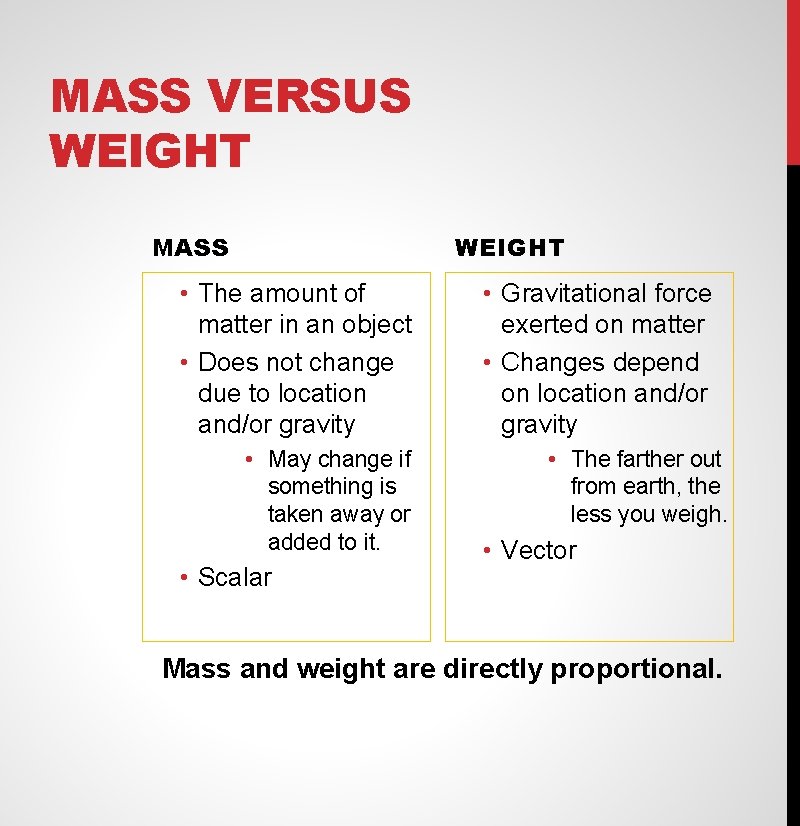
MASS VERSUS WEIGHT MASS WEIGHT • The amount of matter in an object • Does not change due to location and/or gravity • May change if something is taken away or added to it. • Scalar • Gravitational force exerted on matter • Changes depend on location and/or gravity • The farther out from earth, the less you weigh. • Vector Mass and weight are directly proportional.
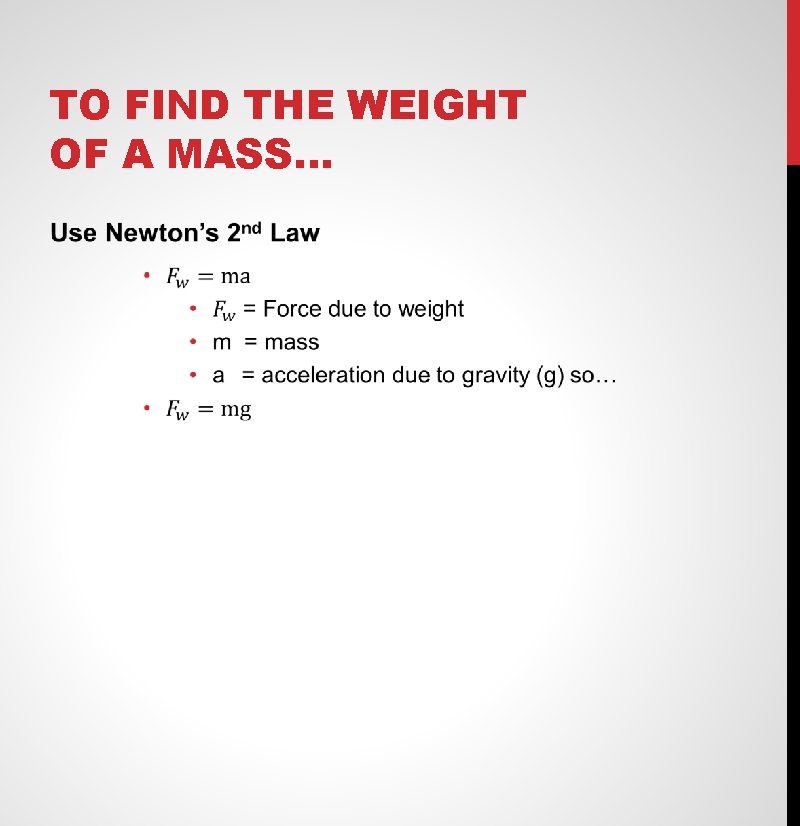
TO FIND THE WEIGHT OF A MASS…
SYSTEMS AND DYNAMICS FUNDAMENTAL FORCES NEWTON’S LAWS FREE BODY DIAGRAMS MASS VERSUS WEIGHT MOMENTUM AND IMPULSE
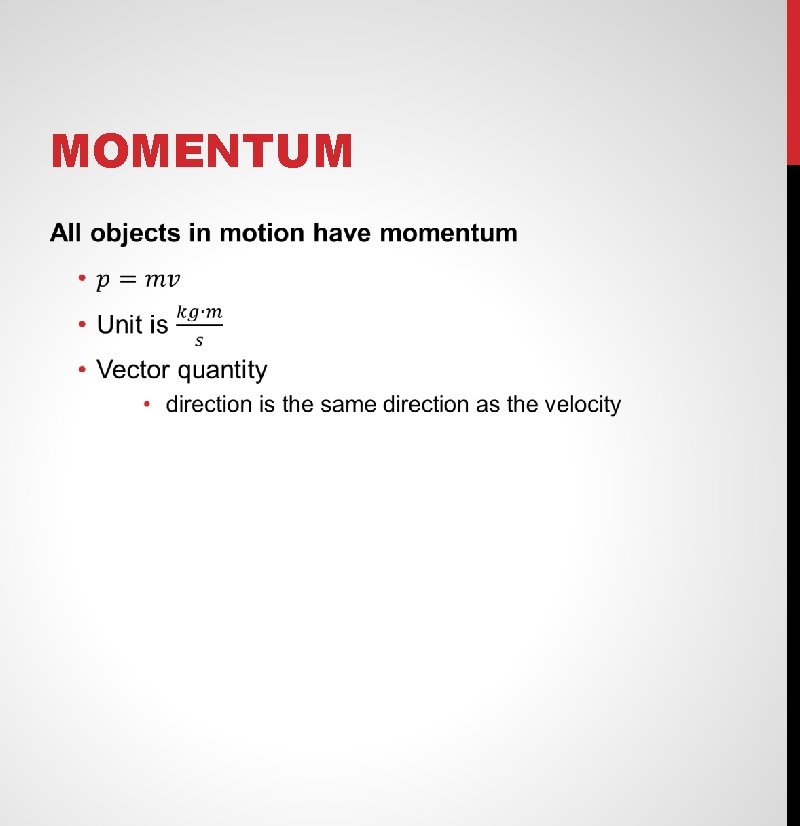
MOMENTUM
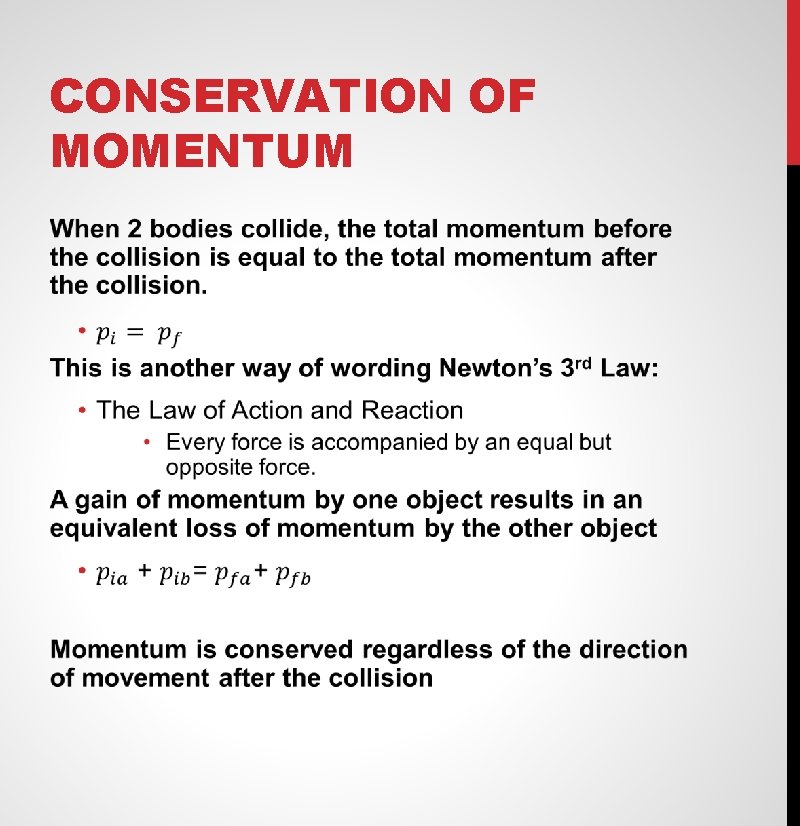
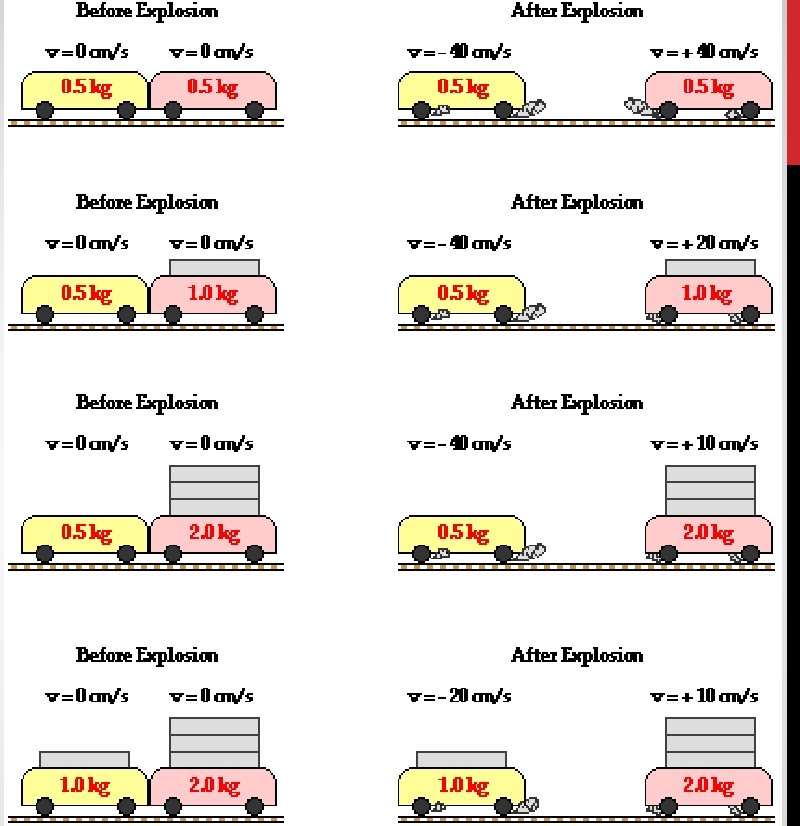
CONSERVATION OF MOMENTUM
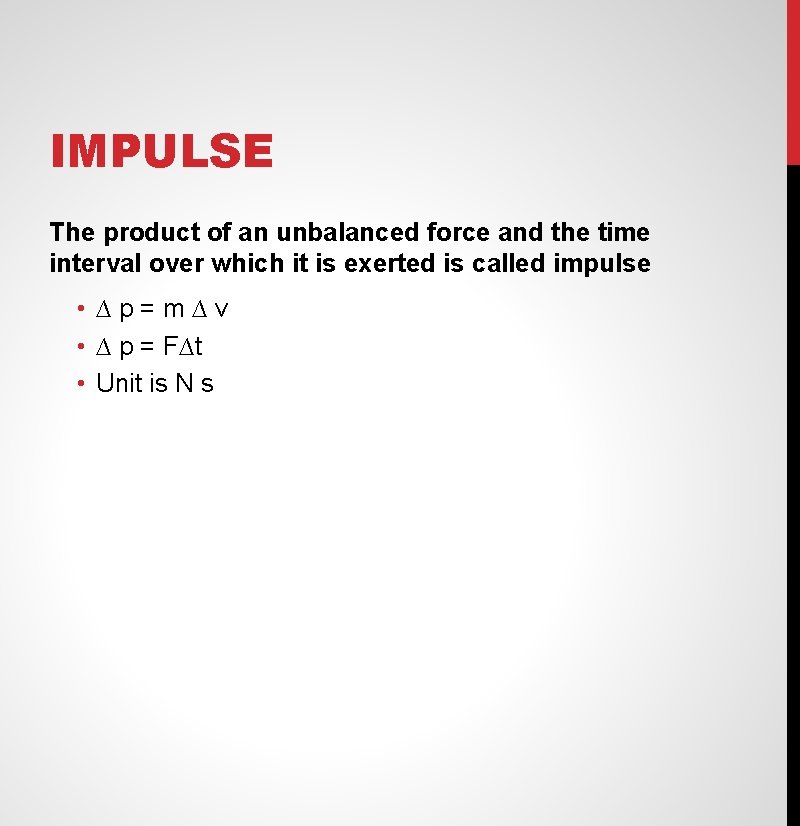
IMPULSE The product of an unbalanced force and the time interval over which it is exerted is called impulse • ∆p=m∆v • ∆ p = F∆t • Unit is N s
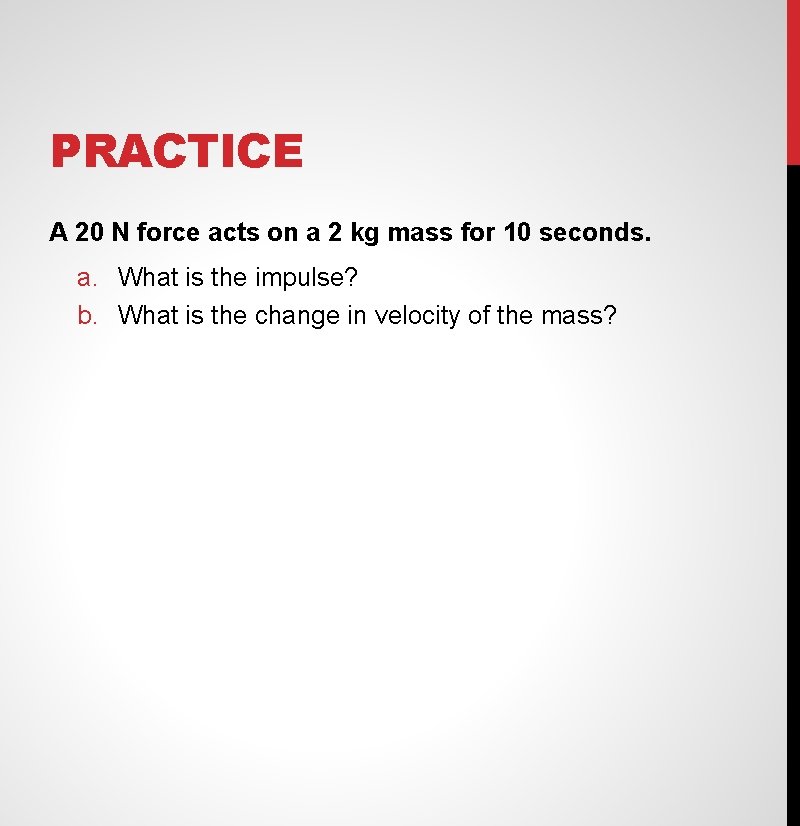
PRACTICE A 20 N force acts on a 2 kg mass for 10 seconds. a. What is the impulse? b. What is the change in velocity of the mass?