
SYSTEMS ANALYSIS DESIGN PHASE 5 SYSTEMS OPERATION SUPPORT

- Slides: 37
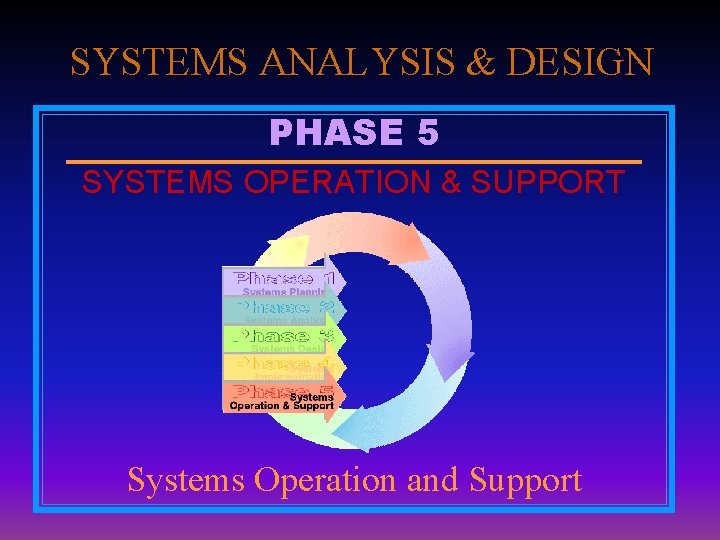
SYSTEMS ANALYSIS & DESIGN PHASE 5 SYSTEMS OPERATION & SUPPORT Systems Operation and Support
SDLC Phases PHASE 5 2 Phase 5: Systems Operation and Support Objectives à Provide maintenance and improvements for the new information system à Support users and help them obtain the most value from the new system SYSTEMS ANALYSIS & DESIGN 3 E
Chapter 12 Systems Operation and Support SYSTEMS ANALYSIS & DESIGN 3 E PHASE 5 3
Objectives PHASE 5 4 à Explain how the systems operation and support phase relates to the rest of the SDLC à Describe the information center concept and how it supports user needs à Discuss the three main categories of systems maintenance à Describe standard maintenance procedures SYSTEMS ANALYSIS & DESIGN 3 E
Objectives PHASE 5 5 à Discuss the role of configuration management in systems operation à Describe the process of capacity planning, including workload and performance measurements à Recognize the signs of system obsolescence SYSTEMS ANALYSIS & DESIGN 3 E
Introduction PHASE 5 6 à The new system must meet user expectations and provide support for business objectives à Systems analysts perform maintenance, and also act as internal consultants to help users obtain the greatest value from the system à The more a system is used, the more features and enhancements are requested, and the more maintenance is required SYSTEMS ANALYSIS & DESIGN 3 E
Introduction PHASE 5 7 à Chapter topics à Three types of maintenance: corrective, adaptive, and perfective à Support techniques include maintenance teams, configuration management, and maintenance releases à System performance issues à CASE maintenance tools à Recognizing system obsolescence SYSTEMS ANALYSIS & DESIGN 3 E
Overview of Systems Support and Maintenance Activities PHASE 5 8 à The systems operation and support phase begins when the system becomes operational and ends when the system is replaced SYSTEMS ANALYSIS & DESIGN 3 E
Overview of Systems Support and Maintenance Activities PHASE 5 9 à After delivering the system, the analyst must perform two tasks à Provide guidance and user training à Formal training sessions à Technical support à Creation of a centralized information center à Perform necessary maintenance à Keep the system operating properly à Increase its value to users SYSTEMS ANALYSIS & DESIGN 3 E
Support Activities PHASE 5 10 à User training and assistance à Current employees are trained when the new system is introduced à New employees typically are trained by user departments, rather than IS staff à If significant changes take place, the IS group might develop a user training package à Special Help via e-mail or company intranet à Revisions to the user guide à Training manual supplements à Formal training sessions SYSTEMS ANALYSIS & DESIGN 3 E Click to see Figure 12 -1
Support Activities PHASE 5 11 à Information centers à An information center has three main objectives à To help people use system resources more effectively à To provide answers to technical or operational questions à To make users more productive by teaching them how to meet their own information needs à An information center also is called a help desk SYSTEMS ANALYSIS & DESIGN 3 E Click to see Figure 12 -2
Support Activities PHASE 5 12 à Information centers à Typical information center tasks à Show a user how to create a data query or report à Demonstrate an advanced system feature à Help a user recover damaged data à Offer tips for better operation à Explain an undocumented software feature à Show a user how to write a macro à Explain how to access the company’s intranet or the Internet SYSTEMS ANALYSIS & DESIGN 3 E
Support Activities PHASE 5 13 à Typical information centers tasks à Assist a user in developing a simple database à Answer questions about software licensing and upgrades à Provide information about system specifications à Recommend a system solution that integrates data from different locations à An information center also monitors performance and provides support SYSTEMS ANALYSIS & DESIGN 3 E Click to see Figure 12 -3
PHASE 5 14 Maintenance Activities à The overall cost of a system includes the systems operation and support phase à Costs include fixed operational costs and maintenance activities à Operational costs are relatively constant, while maintenance costs vary over time à High costs when system is implemented à Relatively low costs during system’s useful life à High costs near end of system’s useful life Click to see Figure 12 -4 SYSTEMS ANALYSIS & DESIGN 3 E Click to see Figure 12 -5
Maintenance Activities PHASE 5 15 à Operational costs à Supplies à Equipment rentals à Software leases à Maintenance activities à Changing programs, procedures, or documentation to ensure correct performance à Adapting the system to changing requirements à Making the system operate more efficiently SYSTEMS ANALYSIS & DESIGN 3 E
Maintenance Activities PHASE 5 16 à Three types of maintenance à Corrective maintenance à To fix errors à Adaptive maintenance à To add new capability and enhancements à Perfective maintenance à To improve efficiency SYSTEMS ANALYSIS & DESIGN 3 E
Maintenance Activities PHASE 5 17 à Corrective maintenance à Diagnoses and corrects errors in the system à Investigation, analysis, design, and testing are necessary before a solution is implemented à Typically, a user submits a systems request form with supporting evidence, if necessary à Response depends on the priority of the request à All maintenance is logged SYSTEMS ANALYSIS & DESIGN 3 E Click to see Figure 12 -6
Maintenance Activities PHASE 5 18 à Adaptive maintenance à Adds enhancements to the system à An enhancement is a new feature or capability à Adaptive maintenance often is required in a dynamic business environment à An adaptive maintenance project is like a mini. SDLC, with similar phases and tasks à Can be more difficult than new systems development, because of the constraints of an existing system SYSTEMS ANALYSIS & DESIGN 3 E
Maintenance Activities PHASE 5 19 à Perfective maintenance à Involves changing an operational system to make it more efficient, reliable, or maintainable à Requests for corrective and adaptive maintenance typically come from users, while requests for perfective maintenance typically come from the IS department à Techniques à Reverse engineering tools aid design analysis à Reengineering tools can be used interactively to correct errors SYSTEMS ANALYSIS & DESIGN 3 E Click to see Figure 12 -7
Managing Systems Operation and Support à Systems operation requires effective management techniques à Maintenance team à Configuration management à Maintenance releases SYSTEMS ANALYSIS & DESIGN 3 E PHASE 5 20
Managing Systems Operation and Support PHASE 5 21 à Maintenance team à Consists of systems analysts and programmers à Systems analysts on maintenance work need à Solid background in information technology à Strong analytical abilities à Solid understanding of business operations à Effective interpersonal and communication skills à Analysis: studying the whole to understand the individual elements à Synthesis: studying the individual elements to understand the overall system SYSTEMS ANALYSIS & DESIGN 3 E
Managing Systems Operation and Support PHASE 5 22 à Configuration management à Process for controlling changes in system requirements à Usually involves three steps 1. The maintenance request 2. Initial action on the request 3. Final disposition of the request à Objectives of configuration management à Manage different versions of the system à Organize and handle documentation SYSTEMS ANALYSIS & DESIGN 3 E
TRADEOFF PHASE 5 23 à Should a systems review committee evaluate maintenance and new systems requests separately, or together? à Some say “let the dollars go where they will do the most good, regardless of project type” à Others feel that separate allocations are needed to protect maintenance projects à All projects draw from the same resource pool, but IS groups often are organized into separate teams, and can handle separate projects better SYSTEMS ANALYSIS & DESIGN 3 E
A KEY QUESTION PHASE 5 24 à At Brightside Insurance Company, you organized the IS group into two units — one for new systems, one for maintenance à Now one of your best people might quit if he is assigned to the maintenance team à Should you adopt a different policy and allow voluntary assignments? à If you must make the assignments, what criteria should you use? SYSTEMS ANALYSIS & DESIGN 3 E
Managing Systems Operation and Support PHASE 5 25 à Maintenance releases à With a maintenance release methodology, all noncritical changes are held until they can be implemented at one time à Each new system version is called a release à Numbering systems à Whole number = significant change à After decimal = relatively minor changes or fixes à There are pros and cons to this approach SYSTEMS ANALYSIS & DESIGN 3 E
Managing System Performance PHASE 5 26 à System performance directly affects users à Centralized operations are easier to measure than complex networks and client/server systems à Various statistics can be used to assess system performance à Capacity planning uses operational data to forecast system capability and future needs SYSTEMS ANALYSIS & DESIGN 3 E
Managing System Performance PHASE 5 27 à Performance and workload measurement à Response time à Turnaround time à Throughput SYSTEMS ANALYSIS & DESIGN 3 E
Managing System Performance PHASE 5 28 à Response time is the overall time between a request for system activity and the delivery of the response à Response time includes three elements à The time necessary to transmit or deliver the request to the system à The time the system needs to process the results à The time it takes to transmit or deliver the results back to the user à Response time is critical for user satisfaction SYSTEMS ANALYSIS & DESIGN 3 E
Managing System Performance PHASE 5 29 à Turnaround time measures the efficiency of centralized computer operations, which still are used for certain tasks, such as credit card processing à Turnaround time is the amount of time between the arrival of a request at a computer center and the availability of the output for delivery or transmission SYSTEMS ANALYSIS & DESIGN 3 E
Managing System Performance PHASE 5 30 à Throughput measures the efficiency of the computer itself à Throughput is the time from the input of a request to the central processor until the output is delivered to the system SYSTEMS ANALYSIS & DESIGN 3 E
Managing System Performance PHASE 5 31 à Capacity planning à Monitors current activity and performance levels à Anticipates future activity à Forecasts the resources needed to provide desired levels of service à In capacity planning you can use a technique called what-if analysis, where you vary one or more elements in a model to see the effect on other elements Click to see Figure 12 -8 a SYSTEMS ANALYSIS & DESIGN 3 E Click to see Figure 12 -8 b
PHASE 5 32 CASE Tools for System Maintenance à A CASE toolkit provides valuable tools for system evaluation and maintenance, such as à A performance monitor à A program analyzer à An interactive debugging analyzer à A restructuring or reengineering tool à Automated documentation tools à Network activity monitors à Workload forecasting software SYSTEMS ANALYSIS & DESIGN 3 E
System Obsolescence PHASE 5 33 à A system becomes obsolete when its functions are no longer required by users or when the platform becomes outmoded à Typical signs of obsolescence à Adaptive and corrective maintenance is increasing steadily à Operational costs or execution times are increasing rapidly, and routine perfective maintenance does not reverse the trend SYSTEMS ANALYSIS & DESIGN 3 E
PHASE 5 34 System Obsolescence à Typical signs of obsolescence à A software package is available that provides the same or additional services faster, better, and less expensively à New technology offers a way to perform the same or additional functions more efficiently à Maintenance changes or additions are difficult and expensive to perform à Users request significant new features to support business requirements Click to see Figure 12 -9 SYSTEMS ANALYSIS & DESIGN 3 E Click to see Figure 12 -10
SOFTWEAR, LIMITED PHASE 5 35 à Status report: in mid-December 1999, the payroll package and the ESIP system both are operating successfully and SWL users are satisfied à Corrective maintenance has been performed à Printing and alignment problems were resolved à Adaptive maintenance has been requested à Human resources department wants to develop an annual employee benefits statement, and additional ESIP deduction choices SYSTEMS ANALYSIS & DESIGN 3 E
SOFTWEAR, LIMITED PHASE 5 36 à New developments à Pacific Software announced the latest version of its payroll package, which supports integration of payroll and human resources functions à SWL decides to investigate the possibility of a human resources information system (HRIS) à After a preliminary investigation, IS staff recommends that SWL upgrade to the new payroll package and study the development of a company-wide human resources system SYSTEMS ANALYSIS & DESIGN 3 E
SOFTWEAR, LIMITED PHASE 5 37 à The future à The business environment is changing rapidly à SWL must investigate new information management technology constantly à At this point, the systems development life cycle for SWL begins again SYSTEMS ANALYSIS & DESIGN 3 E