
SYSTEMS ANALYSIS AND DESIGN METHODS 6 th Edition
- Slides: 43
SYSTEMS ANALYSIS AND DESIGN METHODS 6 th Edition Whitten Bentley Dittman C H A P T E R 18 Irwin/Mc. Graw-Hill OBJECTORIENTED DESIGN AND MODELING USING THE UML Copyright © 2004 The Mc. Graw-Hill Companies. All Rights reserved
SYSTEMS ANALYSIS AND DESIGN METHODS 6 th Edition Chapter 18 • • • • Whitten Bentley Dittman Object-Oriented Design & Modeling Using the UML Differentiate between entity, interface, and control objects. Understand the concept of a dependency relationship and the circumstances under which it is used. Describe association navigability and explain why it is used. Define visibility and explain its three levels. Explain the difference between a behavior and a method. Understand the basic concept object responsibility and how it is related to message sending between object types. Explain the importance of considering object reuse during systems design. Differentiate between design patterns, object frameworks, and components. Describe three activities involved in completing object design. Differentiate between a design use-case narrative an an analysis use-case narrative. Construct an object robustness diagram. Describe CRC card modeling. Construct statechart and sequence diagrams. Construct a class diagram that reflects design specifics. Construct component and deployment diagrams. Irwin/Mc. Graw-Hill Copyright © 2004 The Mc. Graw-Hill Companies. All Rights reserved
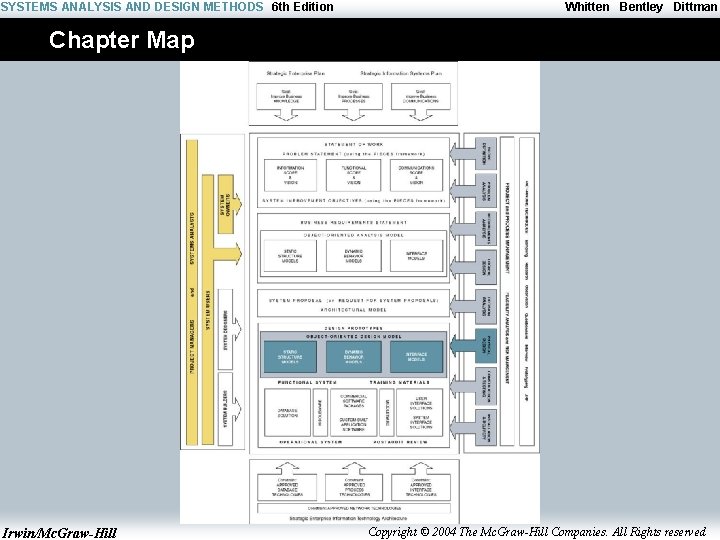
SYSTEMS ANALYSIS AND DESIGN METHODS 6 th Edition Whitten Bentley Dittman Chapter Map Irwin/Mc. Graw-Hill Copyright © 2004 The Mc. Graw-Hill Companies. All Rights reserved
SYSTEMS ANALYSIS AND DESIGN METHODS 6 th Edition Whitten Bentley Dittman Object-Oriented Design Object-oriented design (OOD) – an approach used to specify the software solution in terms of collaborating objects, their attributes, and their methods. – Continuation of object-oriented analysis Irwin/Mc. Graw-Hill Copyright © 2004 The Mc. Graw-Hill Companies. All Rights reserved
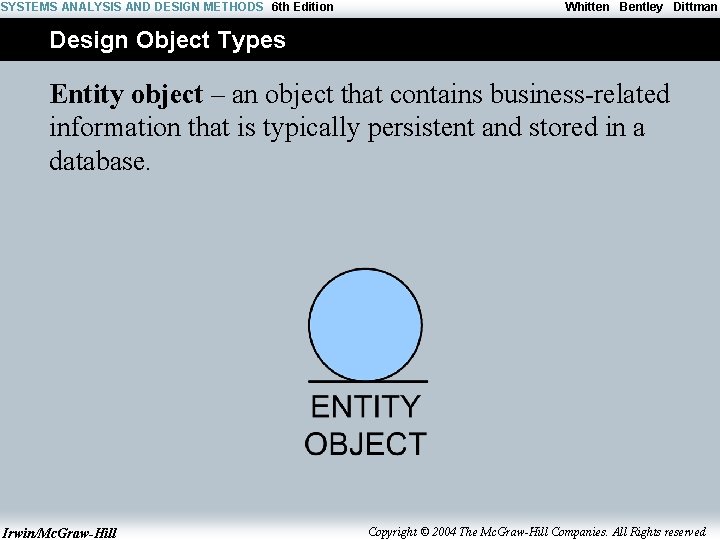
SYSTEMS ANALYSIS AND DESIGN METHODS 6 th Edition Whitten Bentley Dittman Design Object Types Entity object – an object that contains business-related information that is typically persistent and stored in a database. Irwin/Mc. Graw-Hill Copyright © 2004 The Mc. Graw-Hill Companies. All Rights reserved
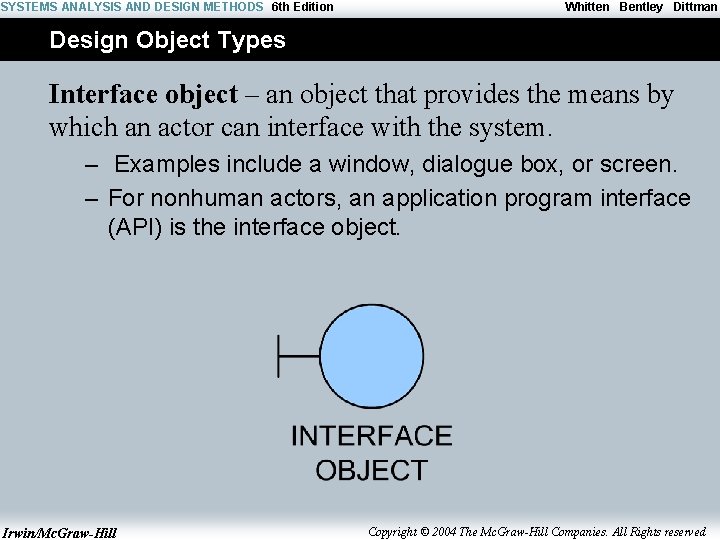
SYSTEMS ANALYSIS AND DESIGN METHODS 6 th Edition Whitten Bentley Dittman Design Object Types Interface object – an object that provides the means by which an actor can interface with the system. – Examples include a window, dialogue box, or screen. – For nonhuman actors, an application program interface (API) is the interface object. Irwin/Mc. Graw-Hill Copyright © 2004 The Mc. Graw-Hill Companies. All Rights reserved
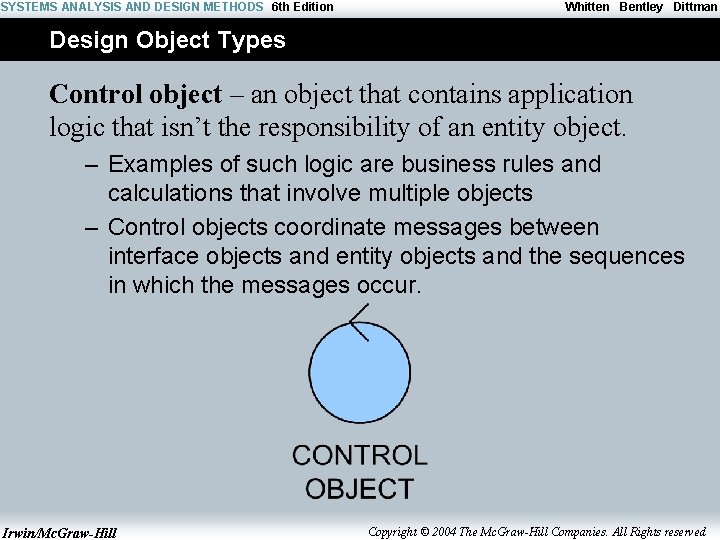
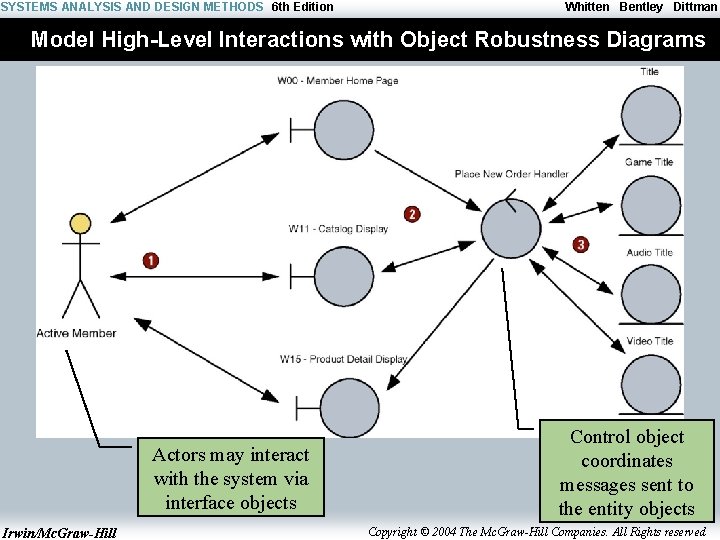
SYSTEMS ANALYSIS AND DESIGN METHODS 6 th Edition Whitten Bentley Dittman Design Object Types Control object – an object that contains application logic that isn’t the responsibility of an entity object. – Examples of such logic are business rules and calculations that involve multiple objects – Control objects coordinate messages between interface objects and entity objects and the sequences in which the messages occur. Irwin/Mc. Graw-Hill Copyright © 2004 The Mc. Graw-Hill Companies. All Rights reserved
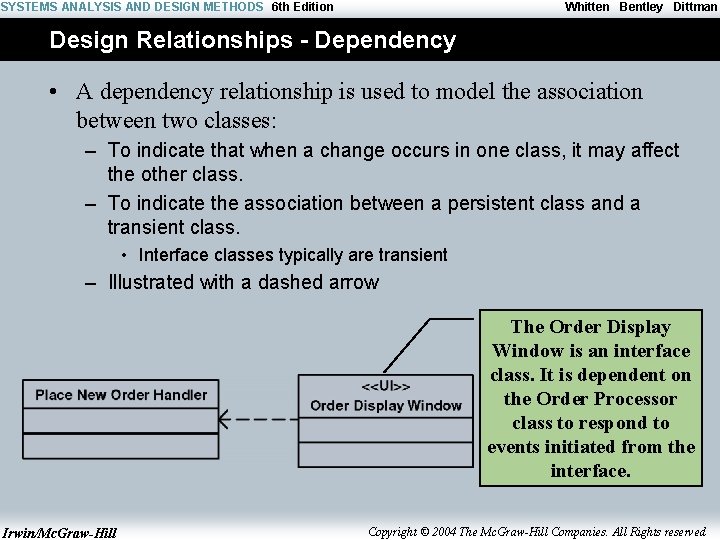
SYSTEMS ANALYSIS AND DESIGN METHODS 6 th Edition Whitten Bentley Dittman Design Relationships - Dependency • A dependency relationship is used to model the association between two classes: – To indicate that when a change occurs in one class, it may affect the other class. – To indicate the association between a persistent class and a transient class. • Interface classes typically are transient – Illustrated with a dashed arrow The Order Display Window is an interface class. It is dependent on the Order Processor class to respond to events initiated from the interface. Irwin/Mc. Graw-Hill Copyright © 2004 The Mc. Graw-Hill Companies. All Rights reserved
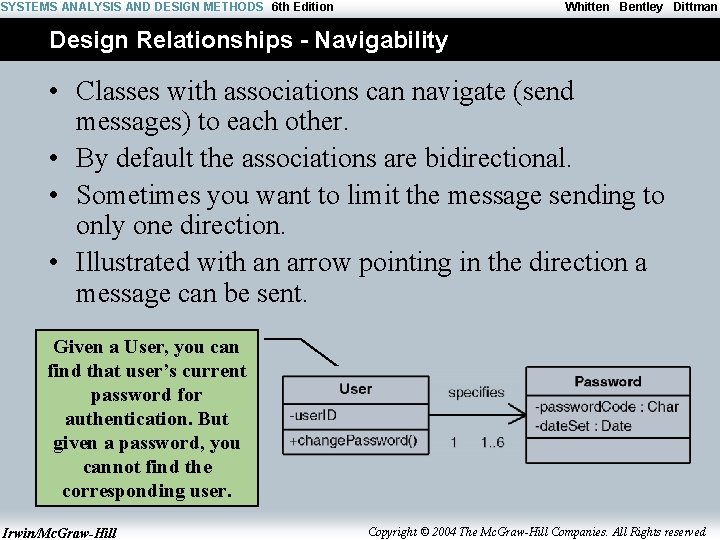
SYSTEMS ANALYSIS AND DESIGN METHODS 6 th Edition Whitten Bentley Dittman Design Relationships - Navigability • Classes with associations can navigate (send messages) to each other. • By default the associations are bidirectional. • Sometimes you want to limit the message sending to only one direction. • Illustrated with an arrow pointing in the direction a message can be sent. Given a User, you can find that user’s current password for authentication. But given a password, you cannot find the corresponding user. Irwin/Mc. Graw-Hill Copyright © 2004 The Mc. Graw-Hill Companies. All Rights reserved
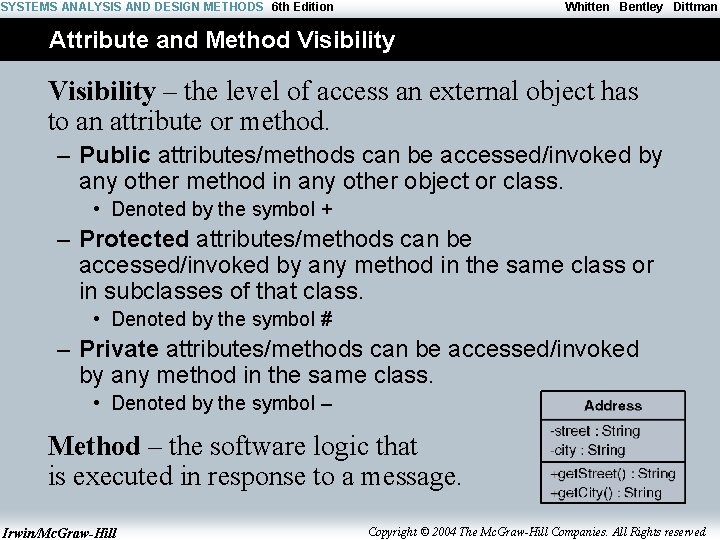
SYSTEMS ANALYSIS AND DESIGN METHODS 6 th Edition Whitten Bentley Dittman Attribute and Method Visibility – the level of access an external object has to an attribute or method. – Public attributes/methods can be accessed/invoked by any other method in any other object or class. • Denoted by the symbol + – Protected attributes/methods can be accessed/invoked by any method in the same class or in subclasses of that class. • Denoted by the symbol # – Private attributes/methods can be accessed/invoked by any method in the same class. • Denoted by the symbol – Method – the software logic that is executed in response to a message. Irwin/Mc. Graw-Hill Copyright © 2004 The Mc. Graw-Hill Companies. All Rights reserved
SYSTEMS ANALYSIS AND DESIGN METHODS 6 th Edition Whitten Bentley Dittman Object Responsibilities Object responsibility – the obligation that an object has to provide a service when requested and thus collaborate with other objects to satisfy the request if required. – An object responsibility is implemented by the creation of methods that may have to collaborate with other objects and methods. Irwin/Mc. Graw-Hill Copyright © 2004 The Mc. Graw-Hill Companies. All Rights reserved
SYSTEMS ANALYSIS AND DESIGN METHODS 6 th Edition Whitten Bentley Dittman Object Responsibility Irwin/Mc. Graw-Hill Copyright © 2004 The Mc. Graw-Hill Companies. All Rights reserved
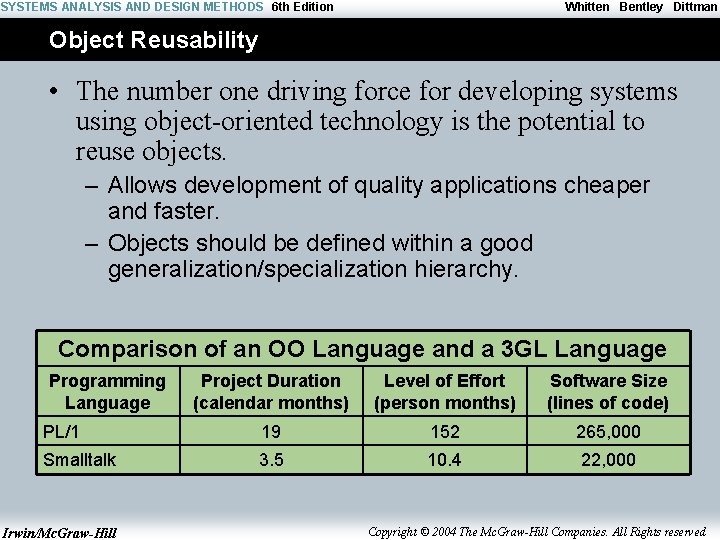
SYSTEMS ANALYSIS AND DESIGN METHODS 6 th Edition Whitten Bentley Dittman Object Reusability • The number one driving force for developing systems using object-oriented technology is the potential to reuse objects. – Allows development of quality applications cheaper and faster. – Objects should be defined within a good generalization/specialization hierarchy. Comparison of an OO Language and a 3 GL Language Programming Language Project Duration (calendar months) Level of Effort (person months) Software Size (lines of code) PL/1 19 152 265, 000 Smalltalk 3. 5 10. 4 22, 000 Irwin/Mc. Graw-Hill Copyright © 2004 The Mc. Graw-Hill Companies. All Rights reserved
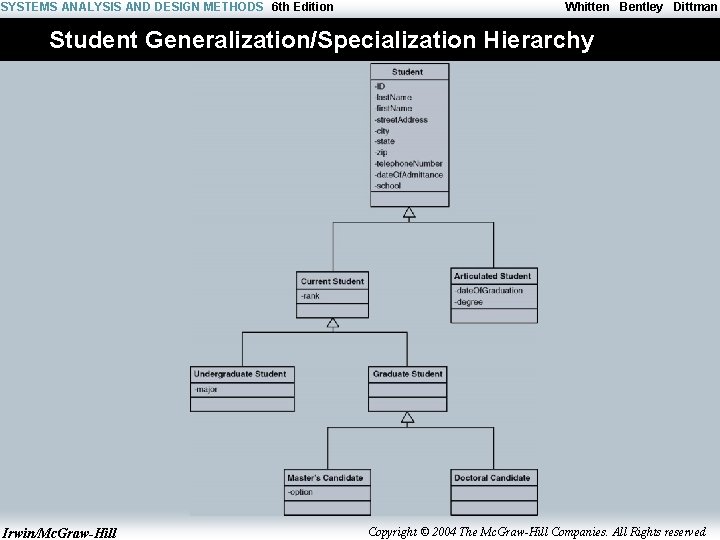
SYSTEMS ANALYSIS AND DESIGN METHODS 6 th Edition Whitten Bentley Dittman Student Generalization/Specialization Hierarchy Irwin/Mc. Graw-Hill Copyright © 2004 The Mc. Graw-Hill Companies. All Rights reserved
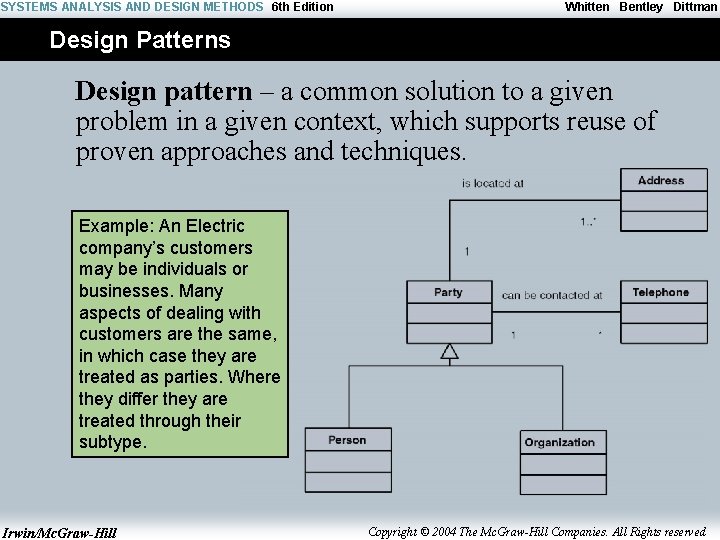
SYSTEMS ANALYSIS AND DESIGN METHODS 6 th Edition Whitten Bentley Dittman Design Patterns Design pattern – a common solution to a given problem in a given context, which supports reuse of proven approaches and techniques. Example: An Electric company’s customers may be individuals or businesses. Many aspects of dealing with customers are the same, in which case they are treated as parties. Where they differ they are treated through their subtype. Irwin/Mc. Graw-Hill Copyright © 2004 The Mc. Graw-Hill Companies. All Rights reserved
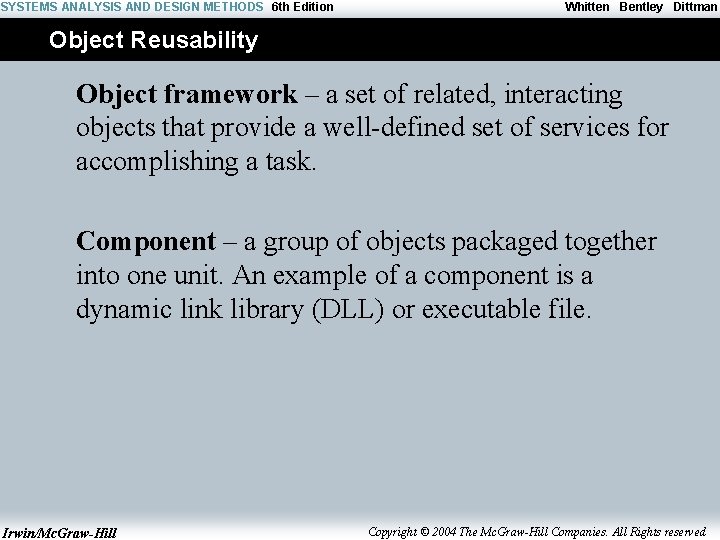
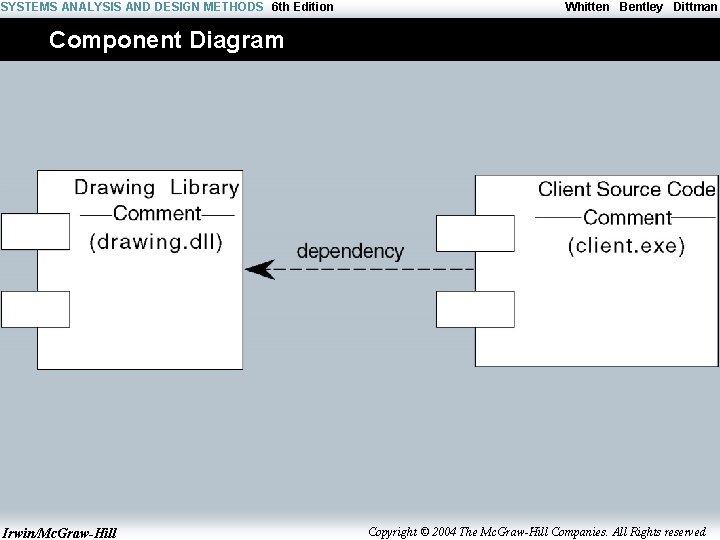
SYSTEMS ANALYSIS AND DESIGN METHODS 6 th Edition Whitten Bentley Dittman Object Reusability Object framework – a set of related, interacting objects that provide a well-defined set of services for accomplishing a task. Component – a group of objects packaged together into one unit. An example of a component is a dynamic link library (DLL) or executable file. Irwin/Mc. Graw-Hill Copyright © 2004 The Mc. Graw-Hill Companies. All Rights reserved
SYSTEMS ANALYSIS AND DESIGN METHODS 6 th Edition Whitten Bentley Dittman The Process of Object-Oriented Design • Refining the use case model to reflect the implementation environment. • Modeling object interactions and behavior that support the use case scenario. • Updating the object model to reflect the implementation environment. Irwin/Mc. Graw-Hill Copyright © 2004 The Mc. Graw-Hill Companies. All Rights reserved
SYSTEMS ANALYSIS AND DESIGN METHODS 6 th Edition Whitten Bentley Dittman Refining The Use Case Model Step 1: Transforming the “Analysis” Use Cases to “Design” Use Cases Step 2: Updating the Use Case Model Diagram and Other Documentation to Reflect any New Use Cases Irwin/Mc. Graw-Hill Copyright © 2004 The Mc. Graw-Hill Companies. All Rights reserved
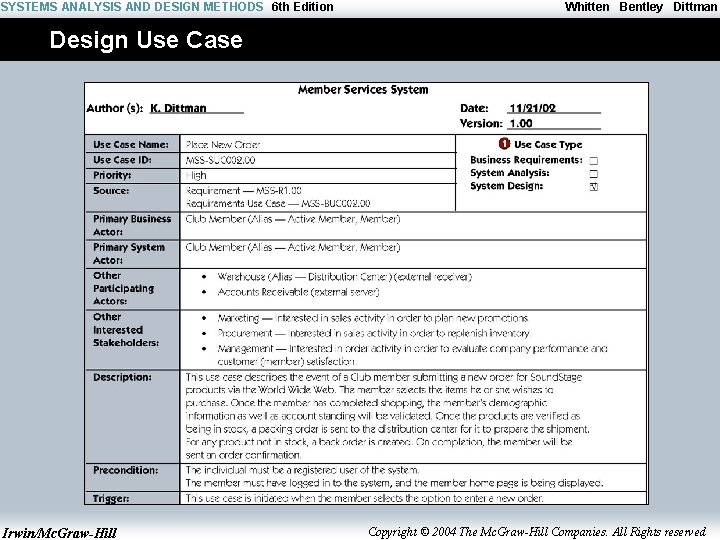
SYSTEMS ANALYSIS AND DESIGN METHODS 6 th Edition Whitten Bentley Dittman Design Use Case Irwin/Mc. Graw-Hill Copyright © 2004 The Mc. Graw-Hill Companies. All Rights reserved
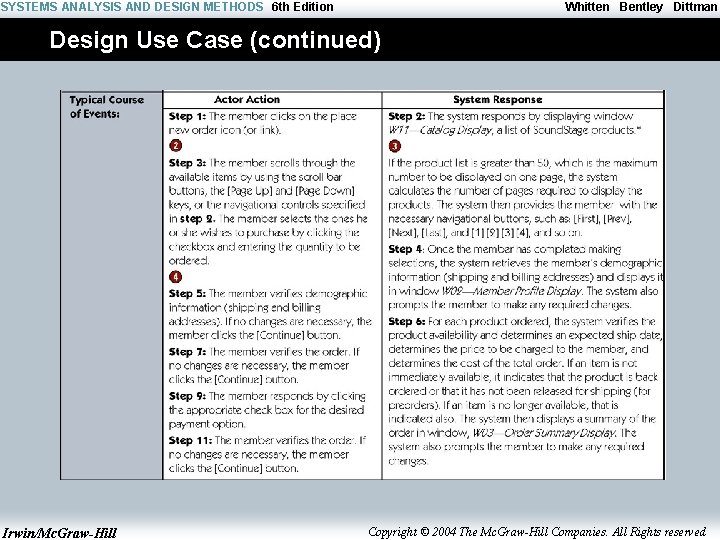
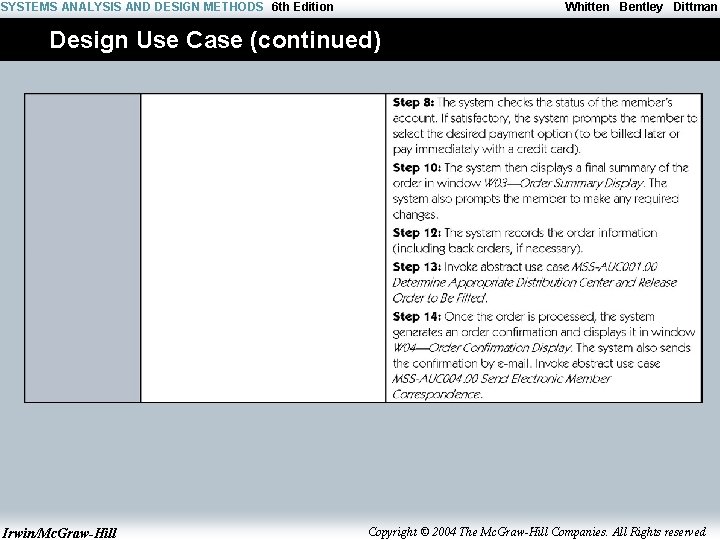
SYSTEMS ANALYSIS AND DESIGN METHODS 6 th Edition Whitten Bentley Dittman Design Use Case (continued) Irwin/Mc. Graw-Hill Copyright © 2004 The Mc. Graw-Hill Companies. All Rights reserved
SYSTEMS ANALYSIS AND DESIGN METHODS 6 th Edition Whitten Bentley Dittman Design Use Case (continued) Irwin/Mc. Graw-Hill Copyright © 2004 The Mc. Graw-Hill Companies. All Rights reserved
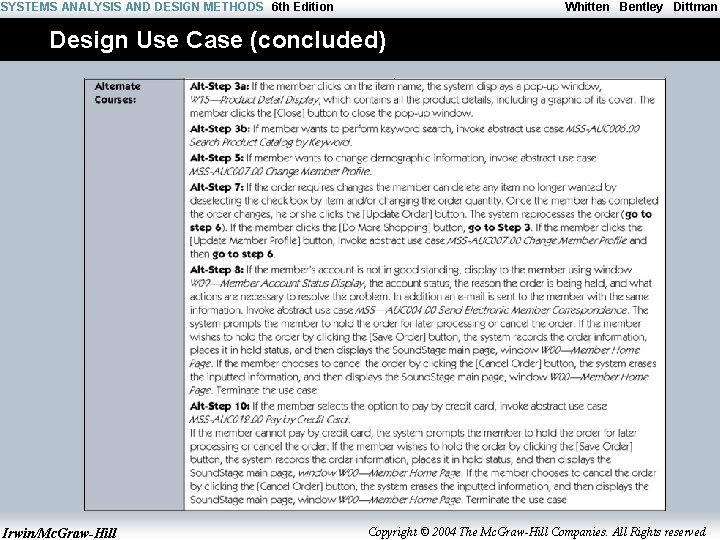
SYSTEMS ANALYSIS AND DESIGN METHODS 6 th Edition Whitten Bentley Dittman Design Use Case (concluded) Irwin/Mc. Graw-Hill Copyright © 2004 The Mc. Graw-Hill Companies. All Rights reserved
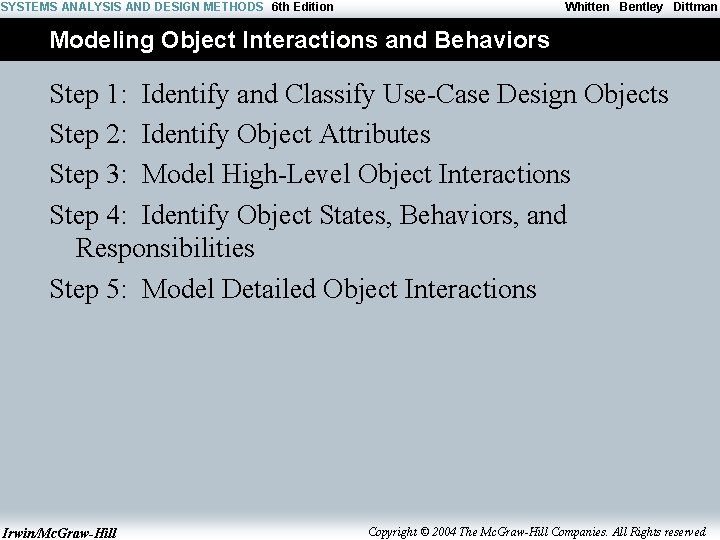
SYSTEMS ANALYSIS AND DESIGN METHODS 6 th Edition Whitten Bentley Dittman Modeling Object Interactions and Behaviors Step 1: Identify and Classify Use-Case Design Objects Step 2: Identify Object Attributes Step 3: Model High-Level Object Interactions Step 4: Identify Object States, Behaviors, and Responsibilities Step 5: Model Detailed Object Interactions Irwin/Mc. Graw-Hill Copyright © 2004 The Mc. Graw-Hill Companies. All Rights reserved
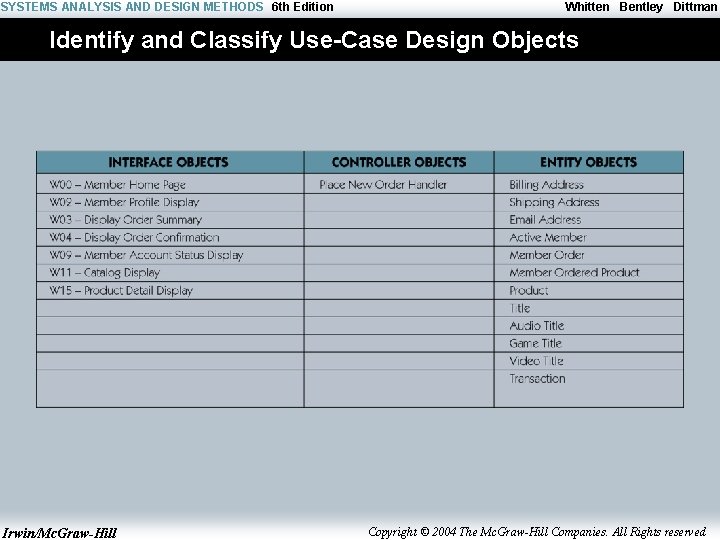
SYSTEMS ANALYSIS AND DESIGN METHODS 6 th Edition Whitten Bentley Dittman Identify and Classify Use-Case Design Objects Irwin/Mc. Graw-Hill Copyright © 2004 The Mc. Graw-Hill Companies. All Rights reserved
SYSTEMS ANALYSIS AND DESIGN METHODS 6 th Edition Whitten Bentley Dittman Model High-Level Interactions with Object Robustness Diagrams Actors may interact with the system via interface objects Irwin/Mc. Graw-Hill Control object coordinates messages sent to the entity objects Copyright © 2004 The Mc. Graw-Hill Companies. All Rights reserved
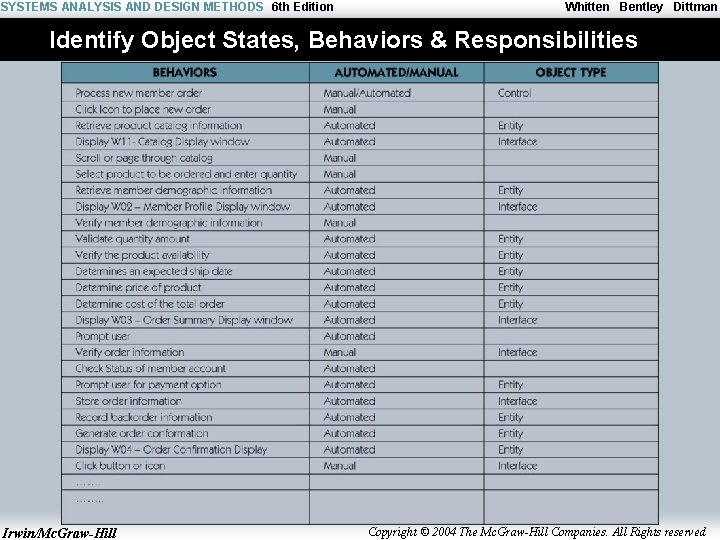
SYSTEMS ANALYSIS AND DESIGN METHODS 6 th Edition Whitten Bentley Dittman Identify Object States, Behaviors & Responsibilities • Analyze the use cases to identify required system behaviors • Associate behaviors and responsibilities with objects • Examine object model for additional behaviors • Verify classifications Irwin/Mc. Graw-Hill Copyright © 2004 The Mc. Graw-Hill Companies. All Rights reserved
SYSTEMS ANALYSIS AND DESIGN METHODS 6 th Edition Whitten Bentley Dittman Identify Object States, Behaviors & Responsibilities Irwin/Mc. Graw-Hill Copyright © 2004 The Mc. Graw-Hill Companies. All Rights reserved
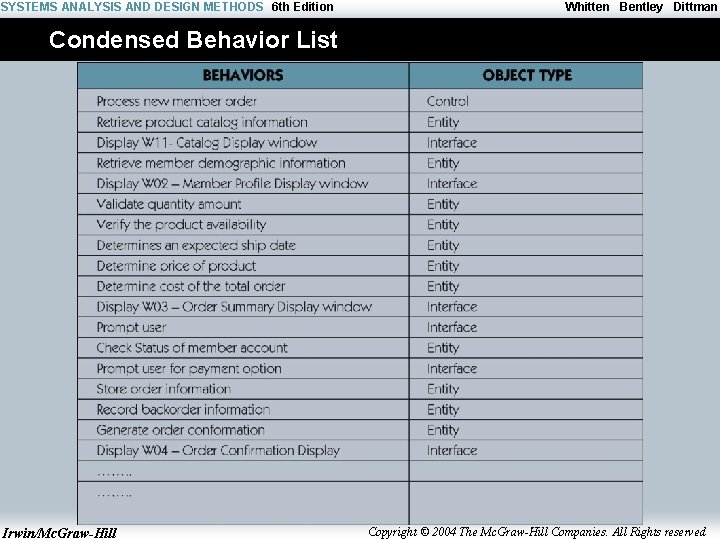
SYSTEMS ANALYSIS AND DESIGN METHODS 6 th Edition Whitten Bentley Dittman Condensed Behavior List Irwin/Mc. Graw-Hill Copyright © 2004 The Mc. Graw-Hill Companies. All Rights reserved
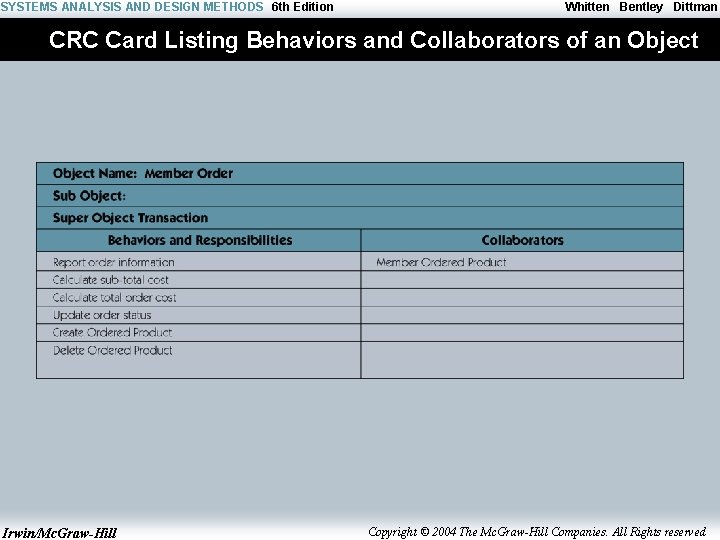
SYSTEMS ANALYSIS AND DESIGN METHODS 6 th Edition Whitten Bentley Dittman CRC Card Listing Behaviors and Collaborators of an Object Irwin/Mc. Graw-Hill Copyright © 2004 The Mc. Graw-Hill Companies. All Rights reserved
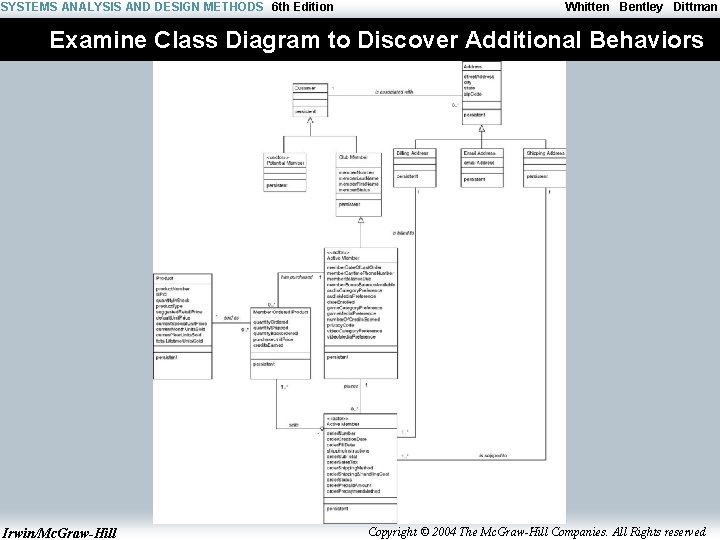
SYSTEMS ANALYSIS AND DESIGN METHODS 6 th Edition Whitten Bentley Dittman Examine Class Diagram to Discover Additional Behaviors Irwin/Mc. Graw-Hill Copyright © 2004 The Mc. Graw-Hill Companies. All Rights reserved
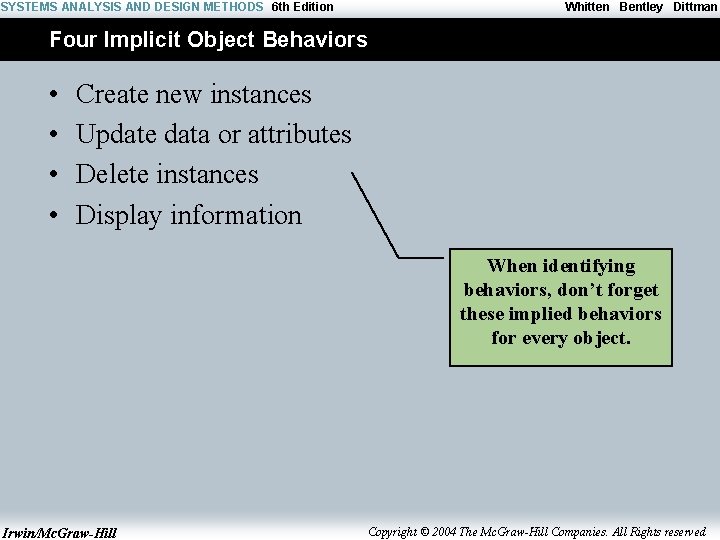
SYSTEMS ANALYSIS AND DESIGN METHODS 6 th Edition Whitten Bentley Dittman Four Implicit Object Behaviors • • Create new instances Update data or attributes Delete instances Display information When identifying behaviors, don’t forget these implied behaviors for every object. Irwin/Mc. Graw-Hill Copyright © 2004 The Mc. Graw-Hill Companies. All Rights reserved
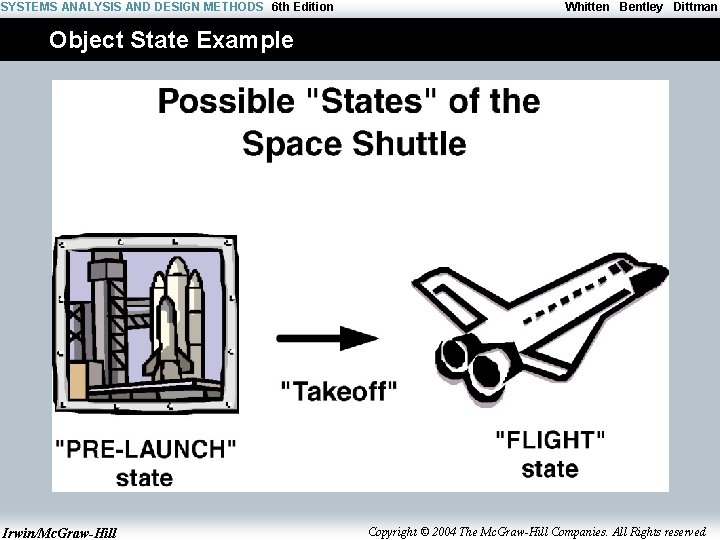
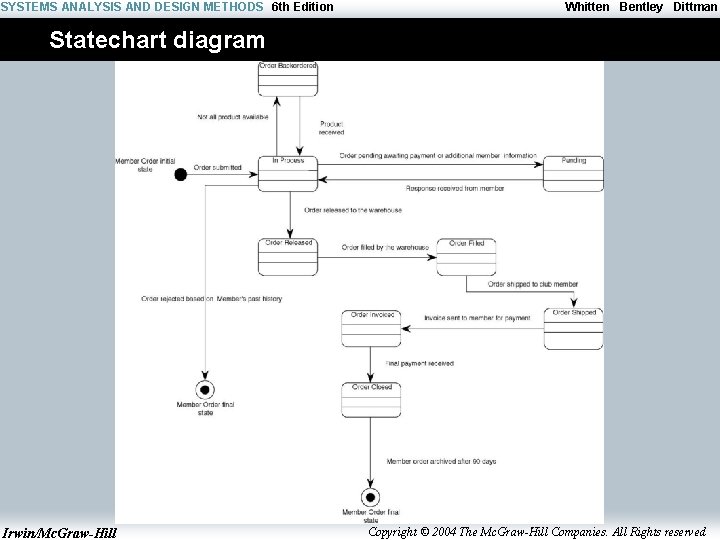
SYSTEMS ANALYSIS AND DESIGN METHODS 6 th Edition Whitten Bentley Dittman State and Diagramming State • Object state – a condition of the object at one point in its lifetime. • State transition event – an occurrence that triggers a change in an object’s state through the updating of one or more of its attribute values. • Statechart diagram – a UML diagram that depicts – the combination of states that an object can assume during its lifetime, – the events that trigger transitions between states, – the rules governing the from and to states an object may transition. Irwin/Mc. Graw-Hill Copyright © 2004 The Mc. Graw-Hill Companies. All Rights reserved
SYSTEMS ANALYSIS AND DESIGN METHODS 6 th Edition Whitten Bentley Dittman Object State Example Irwin/Mc. Graw-Hill Copyright © 2004 The Mc. Graw-Hill Companies. All Rights reserved
SYSTEMS ANALYSIS AND DESIGN METHODS 6 th Edition Whitten Bentley Dittman Statechart diagram Irwin/Mc. Graw-Hill Copyright © 2004 The Mc. Graw-Hill Companies. All Rights reserved
SYSTEMS ANALYSIS AND DESIGN METHODS 6 th Edition Whitten Bentley Dittman Verifying Object Behavior and Collaboration Role playing – the act of simulating object behavior and collaboration by acting out an object’s behaviors and responsibilities. – Participants may assume the role of an actor on an object type – Message sending is simulated by using an item such as a ball that is passed between the participants. – Useful for discovering missing objects and behaviors. Irwin/Mc. Graw-Hill Copyright © 2004 The Mc. Graw-Hill Companies. All Rights reserved
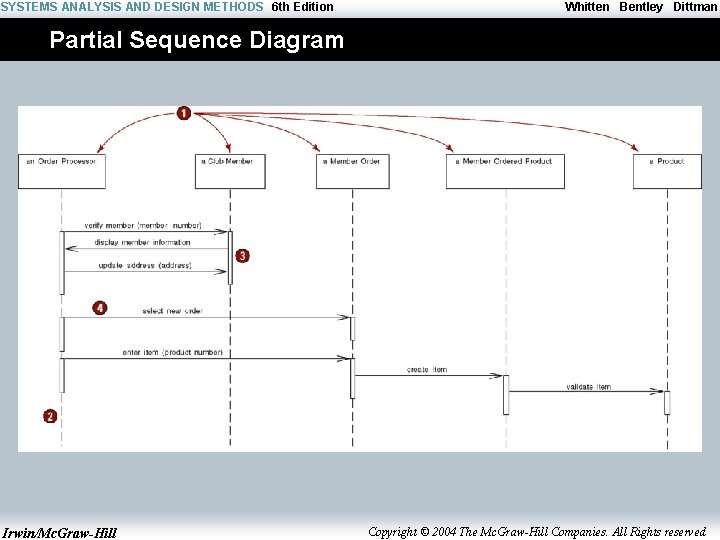
SYSTEMS ANALYSIS AND DESIGN METHODS 6 th Edition Whitten Bentley Dittman Modeling Object Interactions for a Use Case Sequence Diagram – a UML diagram that models the logic of a use case by depicting the interaction of messages between objects in time sequence. Collaboration Diagram – a UML diagram that models the logic of a use case by depicting the flows of messages between objects in message sequence. Irwin/Mc. Graw-Hill Copyright © 2004 The Mc. Graw-Hill Companies. All Rights reserved
SYSTEMS ANALYSIS AND DESIGN METHODS 6 th Edition Whitten Bentley Dittman Partial Sequence Diagram Irwin/Mc. Graw-Hill Copyright © 2004 The Mc. Graw-Hill Companies. All Rights reserved
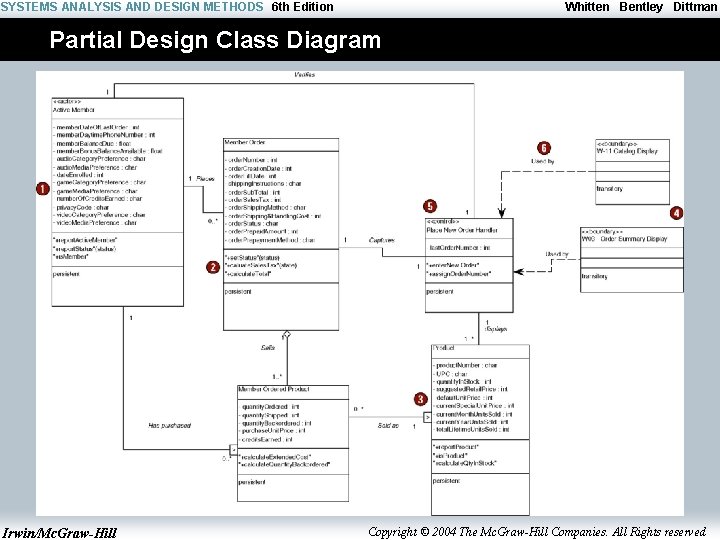
SYSTEMS ANALYSIS AND DESIGN METHODS 6 th Edition Whitten Bentley Dittman Updating Object Model to Reflect Implementation Environment Design class diagram – a diagram that depicts classes that correspond to software components that are used to build the software application. Includes: – Classes – Associations and gen/spec and aggregation relationships – Attributes and attribute-type information – Methods with parameters – Navigability – Dependencies Irwin/Mc. Graw-Hill Copyright © 2004 The Mc. Graw-Hill Companies. All Rights reserved
SYSTEMS ANALYSIS AND DESIGN METHODS 6 th Edition Whitten Bentley Dittman Transforming Analysis Class Diagram to Design Class Diagram • Add design objects to diagram • Add attributes and attribute-type information to design objects • Add attribute visibility • Add methods to design objects • Add method visibility • Add association navigability • Add dependency relationships Irwin/Mc. Graw-Hill Copyright © 2004 The Mc. Graw-Hill Companies. All Rights reserved
SYSTEMS ANALYSIS AND DESIGN METHODS 6 th Edition Whitten Bentley Dittman Partial Design Class Diagram Irwin/Mc. Graw-Hill Copyright © 2004 The Mc. Graw-Hill Companies. All Rights reserved
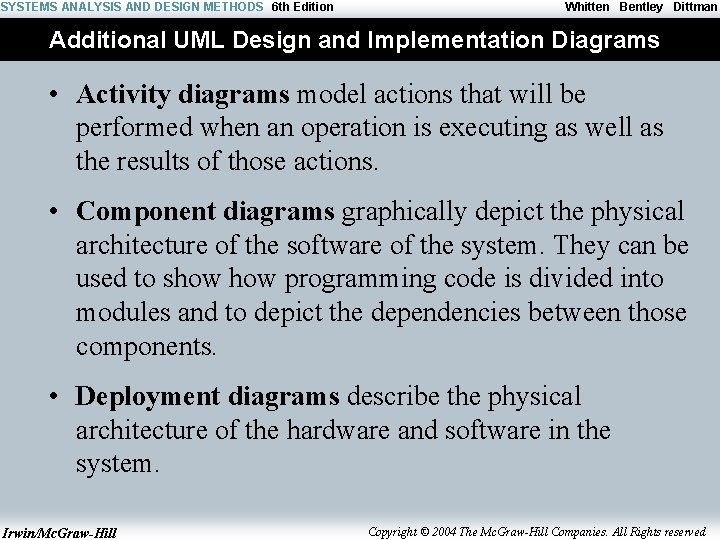
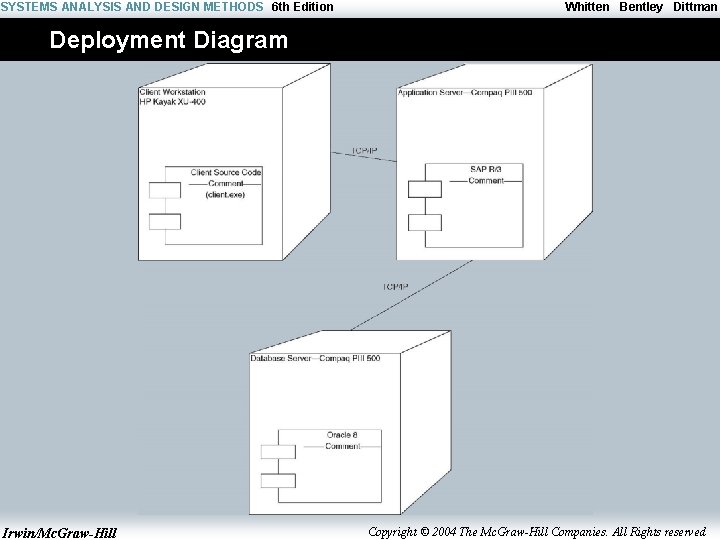
SYSTEMS ANALYSIS AND DESIGN METHODS 6 th Edition Whitten Bentley Dittman Additional UML Design and Implementation Diagrams • Activity diagrams model actions that will be performed when an operation is executing as well as the results of those actions. • Component diagrams graphically depict the physical architecture of the software of the system. They can be used to show programming code is divided into modules and to depict the dependencies between those components. • Deployment diagrams describe the physical architecture of the hardware and software in the system. Irwin/Mc. Graw-Hill Copyright © 2004 The Mc. Graw-Hill Companies. All Rights reserved
SYSTEMS ANALYSIS AND DESIGN METHODS 6 th Edition Whitten Bentley Dittman Component Diagram Irwin/Mc. Graw-Hill Copyright © 2004 The Mc. Graw-Hill Companies. All Rights reserved
SYSTEMS ANALYSIS AND DESIGN METHODS 6 th Edition Whitten Bentley Dittman Deployment Diagram Irwin/Mc. Graw-Hill Copyright © 2004 The Mc. Graw-Hill Companies. All Rights reserved