
Systems Analysis and Design Fourth Edition Alan Dennis


- Slides: 60
Systems Analysis and Design Fourth Edition Alan Dennis, Barbara Haley Wixom, and Roberta Roth John Wiley & Sons, Inc. Slides by Candace S. Garrod Red Rocks Community College 1 -1 Power. Point Presentation for Dennis, Wixom & Roth Systems Analysis and Design, 4 th Edition Copyright 2009 © John Wiley & Sons, Inc. All rights reserved.
The Systems Analyst and Information Systems Development Chapter 1 1 -2 Power. Point Presentation for Dennis, Wixom & Roth Systems Analysis and Design, 4 th Edition Copyright 2009 © John Wiley & Sons, Inc. All rights reserved.
The Systems Analyst The systems analyst assists and guides the project team so the team develops the right system in an effective way. Systems analysts must understand how to apply technology in order to solve problems. 1 -3 Power. Point Presentation for Dennis, Wixom, & Roth Systems Analysis and Design, 4 th Edition Copyright 2009 © John Wiley & Sons, Inc. All rights reserved.
Systems analysts may also serve as change agents who identify the organization improvements needed, design systems to implement those changes, and train/motivate others to use the systems. 1 -4 Power. Point Presentation for Dennis, Wixom, & Roth Systems Analysis and Design, 4 th Edition Copyright 2009 © John Wiley & Sons, Inc. All rights reserved.
Systems Analyst Skills Introduces change to the organization and people Leads a successful organization change effort Understands what to change and knows how to change it 1 -5 Power. Point Presentation for Dennis, Wixom, & Roth Systems Analysis and Design, 4 th Edition Copyright 2009 © John Wiley & Sons, Inc. All rights reserved.
Must have technical skills, as well as, business skills Communicate effectively and give presentations Must be able to deal fairly, honestly, and ethically with other project members, managers, and systems users 1 -6 Power. Point Presentation for Dennis, Wixom, & Roth Systems Analysis and Design, 4 th Edition Copyright 2009 © John Wiley & Sons, Inc. All rights reserved.
Project Team Specialization Business analyst Systems analyst Infrastructure analyst Change management analyst Project manager 1 -7 Power. Point Presentation for Dennis, Wixom, & Roth Systems Analysis and Design, 4 th Edition Copyright 2009 © John Wiley & Sons, Inc. All rights reserved.
Systems Analyst Specialization The systems analyst focuses on the IS issues surrounding the system. Develops ideas and suggestions for ways IT can improve business process, helps design new business processes, designs the new information system, and ensures that all IS standards are maintained. 1 -8 Power. Point Presentation for Dennis, Wixom, & Roth Systems Analysis and Design, 4 th Edition Copyright 2009 © John Wiley & Sons, Inc. All rights reserved.
Business Analyst Focuses on the business issues surrounding the system Identifies the business value that the system will create Develops ideas for improving the business processes Helps design new business processes and policies 1 -9 Power. Point Presentation for Dennis, Wixom, & Roth Systems Analysis and Design, 4 th Edition Copyright 2009 © John Wiley & Sons, Inc. All rights reserved.
Infrastructure Analyst Focuses on technical issues surrounding the ways the system will interact with the organization’s technical infrastructure Ensures that the new information system conforms to organization standards Identifies infrastructure changes 1 - 10 Power. Point Presentation for Dennis, Wixom, & Roth Systems Analysis and Design, 4 th Edition Copyright 2009 © John Wiley & Sons, Inc. All rights reserved.
Change Management Analyst Focuses on the people and management issues surrounding the system installation. Ensures that adequate documentation and support are available to users. Provides user training. Develops strategies to overcome resistance to change. 1 - 11 Power. Point Presentation for Dennis, Wixom, & Roth Systems Analysis and Design, 4 th Edition Copyright 2009 © John Wiley & Sons, Inc. All rights reserved.
Project Manager Highly experienced systems analyst. Ensures that the project is completed on time and within budget. Makes sure the system delivers the expected value to the organization. 1 - 12 Power. Point Presentation for Dennis, Wixom, & Roth Systems Analysis and Design, 4 th Edition Copyright 2009 © John Wiley & Sons, Inc. All rights reserved.
The Systems Development Life Cycle (SDLC) The SDLC is composed of four fundamental phases: Planning Analysis Design Implementation 1 - 13 Power. Point Presentation for Dennis, Wixom & Roth Systems Analysis and Design, 4 th Edition Copyright 2009 © John Wiley & Sons, Inc. All rights reserved.
Each of the phases include a set of steps, which rely on techniques that produce specific document files that provide understanding about the project. 1 - 14 Power. Point Presentation for Dennis, Wixom, & Roth Systems Analysis and Design, 4 th Edition Copyright 2009 © John Wiley & Sons, Inc. All rights reserved.
To Understand the SDLC: Each phase consists of steps that lead to specific deliverables The system evolves through gradual refinement 1 - 15 Power. Point Presentation for Dennis, Wixom, & Roth Systems Analysis and Design, 4 th Edition Copyright 2009 © John Wiley & Sons, Inc. All rights reserved.
Phase I: Planning This phase is the fundamental process of understanding why an information system should be built. The Planning phase will also determine how the project team will go about building the information system. The Planning phase is composed of two planning steps. 1 - 16 Power. Point Presentation for Dennis, Wixom, & Roth Systems Analysis and Design, 4 th Edition Copyright 2009 © John Wiley & Sons, Inc. All rights reserved.
Two Planning Steps 1. During project initiation, the system’s business value to the organization is identified (How will it lower costs or increase revenues? ) 2. During project management, the project manager creates a work plan, staffs the project, and puts techniques in place to help the project team control and direct the project through the entire SDLC. • 1 - 17 Deliverable is a project plan Power. Point Presentation for Dennis, Wixom, & Roth Systems Analysis and Design, 4 th Edition Copyright 2009 © John Wiley & Sons, Inc. All rights reserved.
Phase II: Analysis The analysis phase answers the questions of who will use the system, what the system will do, and where and when it will be used. During this phase the project team investigates any current system(s), identifies improvement opportunities, and develops a concept for the new system. This phase has three analysis steps. 1 - 18 Power. Point Presentation for Dennis, Wixom, & Roth Systems Analysis and Design, 4 th Edition Copyright 2009 © John Wiley & Sons, Inc. All rights reserved.
Three Analysis Steps 1. Analysis strategy: This is developed to guide the projects team’s efforts. This includes an analysis of the current system. 2. Requirements gathering: The analysis of this information leads to the development of a concept for a new system. This concept is used to build a set of analysis models. 3. System proposal: The proposal is presented to the project sponsor and other key individuals who decide whether the project should continue to move forward. 1 - 19 Power. Point Presentation for Dennis, Wixom, & Roth Systems Analysis and Design, 4 th Edition Copyright 2009 © John Wiley & Sons, Inc. All rights reserved.
The system proposal is the initial deliverable that describes what business requirements the new system should meet. The deliverable from this phase is both an analysis and a high-level initial design for the new system. 1 - 20 Power. Point Presentation for Dennis, Wixom, & Roth Systems Analysis and Design, 4 th Edition Copyright 2009 © John Wiley & Sons, Inc. All rights reserved.
Phase III: Design In this phases it is decided how the system will operate, in terms of the hardware, software, and network infrastructure; the user interface, forms, and reports that will be used; and the specific programs, databases, and files that will be needed. 1 - 21 Power. Point Presentation for Dennis, Wixom, & Roth Systems Analysis and Design, 4 th Edition Copyright 2009 © John Wiley & Sons, Inc. All rights reserved.
Four Design Steps 1. Design Strategy: This clarifies whether the system will be developed by the company or outside the company. 2. Architecture Design: This describes the hardware, software, and network infrastructure that will be used. 3. Database and File Specifications: These documents define what and where the data will be stored. 4. Program Design: Defines what programs need to be written and what they will do. 1 - 22 Power. Point Presentation for Dennis, Wixom, & Roth Systems Analysis and Design, 4 th Edition Copyright 2009 © John Wiley & Sons, Inc. All rights reserved.
Phase IV: Implementation During this phase, the system is either developed or purchased (in the case of packaged software). This phase is usually the longest and most expensive part of the process. The phase has three steps. 1 - 23 Power. Point Presentation for Dennis, Wixom, & Roth Systems Analysis and Design, 4 th Edition Copyright 2009 © John Wiley & Sons, Inc. All rights reserved.
Three Implementation Steps System Construction: The system is built and tested to make sure it performs as designed. Installation: Prepare to support the installed system (old system is turned off and new system is turned on). Support Plan: Includes a postimplementation review (major and minor changes needed for the system). 1 - 24 Power. Point Presentation for Dennis, Wixom, & Roth Systems Analysis and Design, 4 th Edition Copyright 2009 © John Wiley & Sons, Inc. All rights reserved.
Project Identification and Initiation A project is identified when someone in the organization (project sponsor) identifies a business need to build a system. A need may surface when an organization identifies unique and competitive ways of using IT. Emerging technologies. 1 - 25 Power. Point Presentation for Dennis, Wixom, & Roth Systems Analysis and Design, 4 th Edition Copyright 2009 © John Wiley & Sons, Inc. All rights reserved.
Both IT people and business people should work together to find way for technology to support business needs. The project sponsor is someone who recognizes the strong business need for a system. 1 - 26 Power. Point Presentation for Dennis, Wixom, & Roth Systems Analysis and Design, 4 th Edition Copyright 2009 © John Wiley & Sons, Inc. All rights reserved.
Project Sponsor This individual will work throughout the SDLC to make sure that the project is moving in the right direction from the perspective of the business. Serves as the primary point of contact for the system. Size and scope of the project is determined by the kind of sponsor that is needed. 1 - 27 Power. Point Presentation for Dennis, Wixom, & Roth Systems Analysis and Design, 4 th Edition Copyright 2009 © John Wiley & Sons, Inc. All rights reserved.
Business need drives the high-level business requirements for the system. Requirements are what the information system will do or what functionality it will contain. Business requirements are what features and capabilities the information system will have to include. 1 - 28 Power. Point Presentation for Dennis, Wixom, & Roth Systems Analysis and Design, 4 th Edition Copyright 2009 © John Wiley & Sons, Inc. All rights reserved.
The project sponsor also should have an idea of the business value to be gained from the system, in both tangible and intangible ways. Tangible value can be quantified and measured easily (reduction in operating costs). An intangible value is based on the belief that the system is important; however, benefits are hard to measure (improved customer service, a better competitive position). 1 - 29 Power. Point Presentation for Dennis, Wixom, & Roth Systems Analysis and Design, 4 th Edition Copyright 2009 © John Wiley & Sons, Inc. All rights reserved.
System Request The document that describes the business reasons for building a system and the value that system is expected to provide. The project sponsor usually completes this form as part of a formal system selection process within the organization. 1 - 30 Power. Point Presentation for Dennis, Wixom, & Roth Systems Analysis and Design, 4 th Edition Copyright 2009 © John Wiley & Sons, Inc. All rights reserved.
Most system requests includes 3 elements: The business requirements of the project refer to the business capabilities that the system will need to have. The business value describes the benefits that the organization should expect from the system. Special issues are included on the document as a catchall category for other information that should be considered in assessing the project (e. g. implementation issues). 1 - 31 Power. Point Presentation for Dennis, Wixom, & Roth Systems Analysis and Design, 4 th Edition Copyright 2009 © John Wiley & Sons, Inc. All rights reserved.
The completed system request is submitted to the approval committee for consideration. The committee reviews the system request and makes an initial determination, based on the information provided, of whether to investigate the proposed project or not. If so, the next step is to conduct a feasibility analysis. 1 - 32 Power. Point Presentation for Dennis, Wixom, & Roth Systems Analysis and Design, 4 th Edition Copyright 2009 © John Wiley & Sons, Inc. All rights reserved.
Feasibility Analysis Feasibility analysis guides the organization in determining whether to proceed with a project. Feasibility analysis also identifies the important risks associated with the project that must be addressed if the project is approved. 1 - 33 Power. Point Presentation for Dennis, Wixom, & Roth Systems Analysis and Design, 4 th Edition Copyright 2009 © John Wiley & Sons, Inc. All rights reserved.
As with the system request, each organization has its own process and format for the feasibility analysis. Most include techniques to assess three areas: Technical feasibility Economic feasibility Organizational feasibility The results of these techniques are combined into a feasibility study deliverable that is given to the approval committee at the end of the project initiation. 1 - 34 Power. Point Presentation for Dennis, Wixom, & Roth Systems Analysis and Design, 4 th Edition Copyright 2009 © John Wiley & Sons, Inc. All rights reserved.
Technical Feasibility Technical feasibility is the extent to which the system can be successfully designed, developed, and installed by the IT group. Essentially, a technical risk analysis strives to answer the question: “Can we build it? ” 1 - 35 Power. Point Presentation for Dennis, Wixom, & Roth Systems Analysis and Design, 4 th Edition Copyright 2009 © John Wiley & Sons, Inc. All rights reserved.
Risks can endanger the successful completion of a project. The following should be considered: Users’ and analysts’ should be familiar with the application. Familiarity with the technology Project size Compatibility of the new system with the technology that already exists 1 - 36 Power. Point Presentation for Dennis, Wixom, & Roth Systems Analysis and Design, 4 th Edition Copyright 2009 © John Wiley & Sons, Inc. All rights reserved.
Economic Feasibility Economic feasibility is also called a cost-benefit analysis, that identifies the financial risk associated with the project. This attempts to answer the question, “Should we build the system? ” 1 - 37 Power. Point Presentation for Dennis, Wixom, & Roth Systems Analysis and Design, 4 th Edition Copyright 2009 © John Wiley & Sons, Inc. All rights reserved.
Six Steps for Cost-benefit Analysis 1 - 38 Power. Point Presentation for Dennis, Wixom, & Roth Systems Analysis and Design, 4 th Edition Copyright 2009 © John Wiley & Sons, Inc. All rights reserved.
Step 1: Identify Costs and Benefits During this step it is important to identify the kinds of costs and benefits the system will have and list them along the left-hand column of a spreadsheet. 1 - 39 Power. Point Presentation for Dennis, Wixom, & Roth Systems Analysis and Design, 4 th Edition Copyright 2009 © John Wiley & Sons, Inc. All rights reserved.
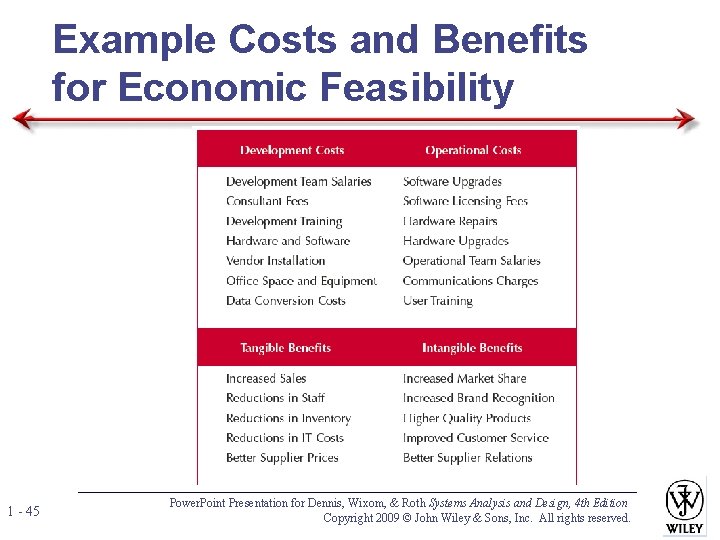
The costs and benefits and be broken down in to four categories: Development costs Operational costs Tangible benefits Intangibles 1 - 40 Power. Point Presentation for Dennis, Wixom, & Roth Systems Analysis and Design, 4 th Edition Copyright 2009 © John Wiley & Sons, Inc. All rights reserved.
Development Costs Tangible expenses that are incurred during the creation of the system (usually one-time costs) such as: Salaries Hardware and software expenses Consultant fees Training Office space and equipment 1 - 41 Power. Point Presentation for Dennis, Wixom, & Roth Systems Analysis and Design, 4 th Edition Copyright 2009 © John Wiley & Sons, Inc. All rights reserved.
Operational Costs Operational costs are those tangible costs that are required to operate the system and are considered ongoing cost. This will include: Salaries for operation staff Software licensing fees Equipment upgrades Communications charges 1 - 42 Power. Point Presentation for Dennis, Wixom, & Roth Systems Analysis and Design, 4 th Edition Copyright 2009 © John Wiley & Sons, Inc. All rights reserved.
Tangible Benefits This includes revenue that the system enables the organization to collect, such as increased sales. The system may enable the organization to avoid certain costs, which may lead to another type of tangible benefit such as, cost savings. 1 - 43 Power. Point Presentation for Dennis, Wixom, & Roth Systems Analysis and Design, 4 th Edition Copyright 2009 © John Wiley & Sons, Inc. All rights reserved.
Intangible Benefits Intangible costs and benefits are more difficult to incorporate into the economic feasibility analysis as they are based on intuition and belief rather that on “hard numbers. ” 1 - 44 Power. Point Presentation for Dennis, Wixom, & Roth Systems Analysis and Design, 4 th Edition Copyright 2009 © John Wiley & Sons, Inc. All rights reserved.
Example Costs and Benefits for Economic Feasibility 1 - 45 Power. Point Presentation for Dennis, Wixom, & Roth Systems Analysis and Design, 4 th Edition Copyright 2009 © John Wiley & Sons, Inc. All rights reserved.
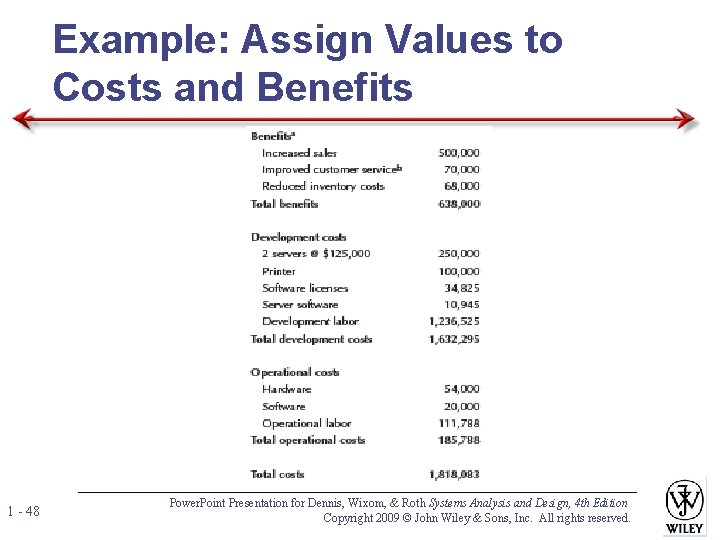
Step 2: Assign Values to Costs and Benefits Once the types of costs and benefits have been identified, you will need to assign specific dollar values to them. The most effective strategy for estimating costs and benefits is to rely on people who have the best understanding of them. If predicting a specific value for a cost or benefit proves difficult, it may be useful to estimate a range of values for the cost or benefit and then assign a probability estimate to each value. 1 - 46 Power. Point Presentation for Dennis, Wixom, & Roth Systems Analysis and Design, 4 th Edition Copyright 2009 © John Wiley & Sons, Inc. All rights reserved.
Sometimes it is acceptable to list intangible benefits, such as improved customer service, without assigning a dollar value. 1 - 47 Power. Point Presentation for Dennis, Wixom, & Roth Systems Analysis and Design, 4 th Edition Copyright 2009 © John Wiley & Sons, Inc. All rights reserved.
Example: Assign Values to Costs and Benefits 1 - 48 Power. Point Presentation for Dennis, Wixom, & Roth Systems Analysis and Design, 4 th Edition Copyright 2009 © John Wiley & Sons, Inc. All rights reserved.
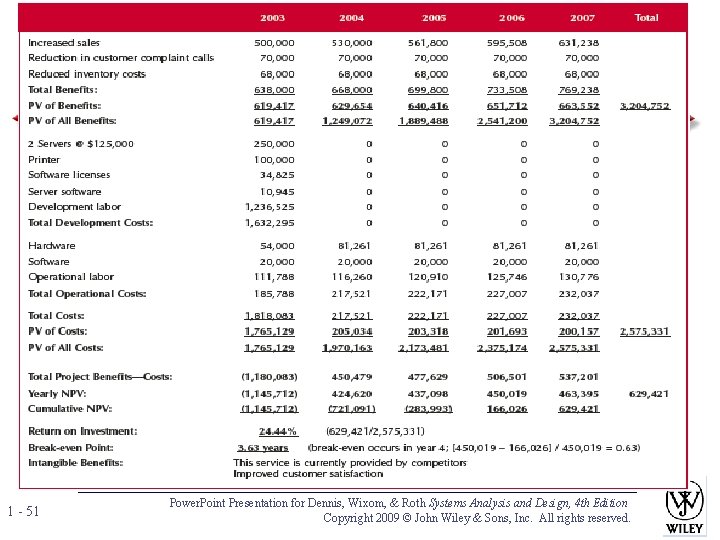
Step 3: Determine Cash Flow A formal cost-benefit analysis usually contains costs and benefits over a selected number or years (usually 3 -5 years) to show cash flow over time. With this cash flow method, the years are listed across the top of the spreadsheet to represent the period for analysis, and numeric values are entered in the appropriate cells with the spreadsheet’s body for all years. 1 - 49 Power. Point Presentation for Dennis, Wixom, & Roth Systems Analysis and Design, 4 th Edition Copyright 2009 © John Wiley & Sons, Inc. All rights reserved.
Often, amounts are augmented by some rate of growth to adjust for inflation or business improvements. Finally, totals are added to determine what the overall benefits will be, and the higher the overall total, the more feasible the solution becomes in terms of its economic feasibility. 1 - 50 Power. Point Presentation for Dennis, Wixom, & Roth Systems Analysis and Design, 4 th Edition Copyright 2009 © John Wiley & Sons, Inc. All rights reserved.
1 - 51 Power. Point Presentation for Dennis, Wixom, & Roth Systems Analysis and Design, 4 th Edition Copyright 2009 © John Wiley & Sons, Inc. All rights reserved.
Step 4: Assess Project’s Economic Value The three areas included in Assess Project’s Economic Value are: Determine Return on Investment Determine Break-Even Point Determine Net Present Value 1 - 52 Power. Point Presentation for Dennis, Wixom, & Roth Systems Analysis and Design, 4 th Edition Copyright 2009 © John Wiley & Sons, Inc. All rights reserved.
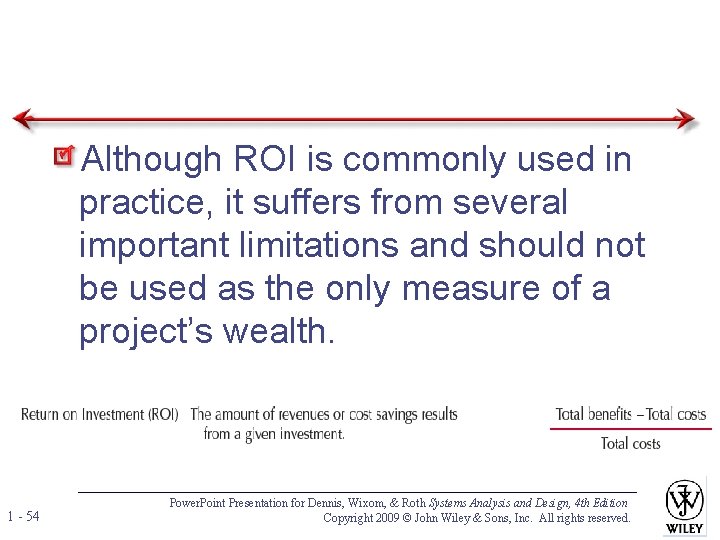
Determine Return on Investment The return on investment (ROI) is a calculation that measures the average rate of return on the money invested in the project. A high ROI suggests that the projects’ benefits far outweigh the project’s cost. ROI is a simple calculation that divides the project’s net benefits (total benefits – total costs) by the total costs. 1 - 53 Power. Point Presentation for Dennis, Wixom, & Roth Systems Analysis and Design, 4 th Edition Copyright 2009 © John Wiley & Sons, Inc. All rights reserved.
Although ROI is commonly used in practice, it suffers from several important limitations and should not be used as the only measure of a project’s wealth. 1 - 54 Power. Point Presentation for Dennis, Wixom, & Roth Systems Analysis and Design, 4 th Edition Copyright 2009 © John Wiley & Sons, Inc. All rights reserved.
Determine Break-Even Point Another common approach to measuring a project’s worth. Break-even point is sometimes referred to as the payback method. The payback method is defined as the number of years it takes a firm to recover its original investments in the project from net cash flows. The greater the time it takes to breakeven, the riskier the project 1 - 55 Power. Point Presentation for Dennis, Wixom, & Roth Systems Analysis and Design, 4 th Edition Copyright 2009 © John Wiley & Sons, Inc. All rights reserved.
The break-even point is easy to calculate and understand does give an indication of a project’s liquidity or the speed at which the project will generate cash returns. The break-even point does ignore cash flows that occur after the break-even point has been reached and therefore is biased against long-term projects. 1 - 56 Power. Point Presentation for Dennis, Wixom, & Roth Systems Analysis and Design, 4 th Edition Copyright 2009 © John Wiley & Sons, Inc. All rights reserved.
Determine Net Present Value Net present value (NPV) is used to compare the present value of all cash inflows and outflows for the project in today’s dollar terms. The NPV is simply the difference between the total present value of the benefits and the total present value of costs. As long as the NPV is greater than zero, the project is considered economically feasible. 1 - 57 Power. Point Presentation for Dennis, Wixom, & Roth Systems Analysis and Design, 4 th Edition Copyright 2009 © John Wiley & Sons, Inc. All rights reserved.
Organizational Feasibility Organizational feasibility of the system is how well the system ultimately will be accepted by its users and incorporated into the ongoing operations of the organization. There are many organizational factors that can have an impact on the project, and seasoned developers know that organizational feasibility can be the most difficult feasibility dimension to assess. An organizational feasibility analysis attempts to answer the question: “If we build it, will they come? ” 1 - 58 Power. Point Presentation for Dennis, Wixom, & Roth Systems Analysis and Design, 4 th Edition Copyright 2009 © John Wiley & Sons, Inc. All rights reserved.
Summary The Systems Analyst is the key person in the development of information systems. This individual helps to analyze the business situation, identify opportunities for the improvements, and design an information system that adds value to the organization. The Systems Development Lifecycle consists of four stages: Planning, Analysis, Design, and Implementation. Project Identification and Initiation allows recognition of a business need that can be satisfied through the use of information technology. The business value for an information system is identified and then described in a System Request. A Feasibility Analysis is used to provide more detail about the risks associated with the proposed system and includes, technical, economic, and organizational feasibilities. 1 - 59 Power. Point Presentation for Dennis, Wixom, & Roth Systems Analysis and Design, 4 th Edition Copyright 2009 © John Wiley & Sons, Inc. All rights reserved.
Copyright © 2009 John Wiley & Sons, Inc. All rights reserved. Reproduction or translation of this work beyond that permitted in Section 117 of the 1976 United States Copyright Act without the express written permission of the copyright owner is unlawful. Request for further information should be addressed to the Permissions Department, John Wiley & Sons, Inc. The purchaser may make back-up copies for his/her own use only and not for redistribution or resale. The Publisher assumes no responsibility for errors, omissions, or damages, caused by the use of these programs or from the use of the information contained herein. 1 - 60 Power. Point Presentation for Dennis, Wixom, & Roth Systems Analysis and Design, 4 th Edition Copyright 2009 © John Wiley & Sons, Inc. All rights reserved.