
Systems Analysis and Design Dr Ir Sumijan M
- Slides: 69
Systems Analysis and Design Dr. Ir. Sumijan, M. Sc soe@upiyptk. org sumijan@upiyptk. ac. id 1
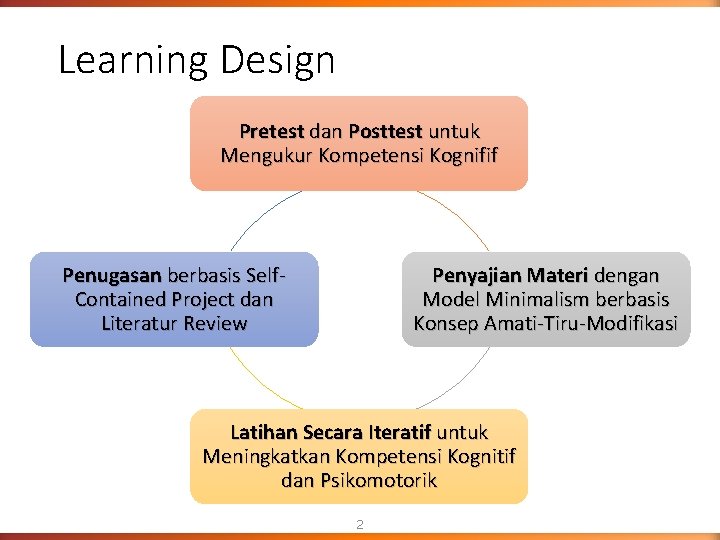
Learning Design Pretest dan Posttest untuk Mengukur Kompetensi Kognifif Penugasan berbasis Self. Contained Project dan Literatur Review Penyajian Materi dengan Model Minimalism berbasis Konsep Amati-Tiru-Modifikasi Latihan Secara Iteratif untuk Meningkatkan Kompetensi Kognitif dan Psikomotorik 2
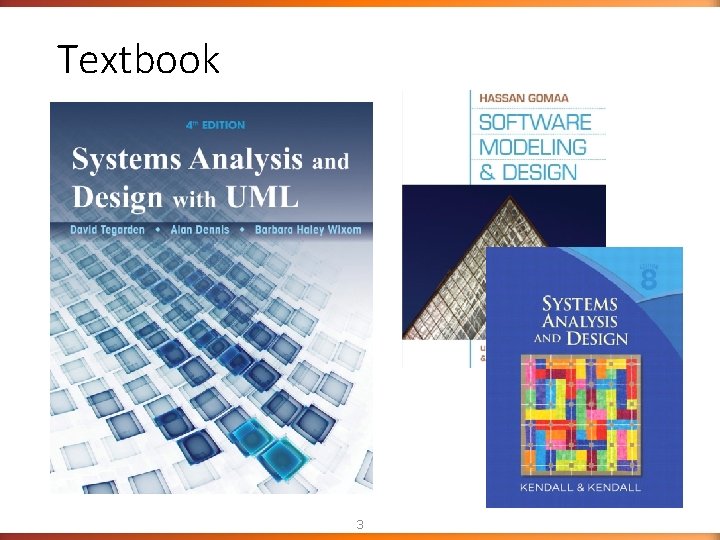
Textbook 3
References 1. Alan Dennis et al, Systems Analysis and Design with UML 4 th Edition, John Wiley and Sons, 2013 2. Kenneth E. Kendall and Julie E Kendall, Systems Analysis and Design 8 th Edition, Prentice Hall, 2010 3. Hassan Gomaa, Software Modeling and Design: UML, Use Cases, Patterns, and Software Architectures, Cambridge University Press, 2011 4. Gary B. Shelly and Harry J. Rosenblatt, Systems Analysis and Design 9 th Edition, Course Technology, 2011 5. Howard Podeswa, UML for the IT Business Analyst 2 nd Edition, Course Technology, 2009 6. Jeffrey A. Hoffer et al, Modern Systems Analysis and Design 6 th Edition, Prentice Hall, 2010 4
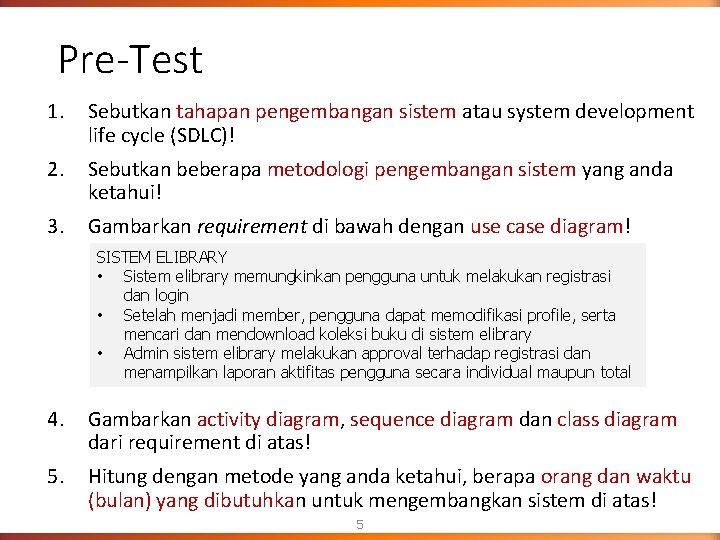
Pre-Test 1. Sebutkan tahapan pengembangan sistem atau system development life cycle (SDLC)! 2. Sebutkan beberapa metodologi pengembangan sistem yang anda ketahui! 3. Gambarkan requirement di bawah dengan use case diagram! SISTEM ELIBRARY • Sistem elibrary memungkinkan pengguna untuk melakukan registrasi dan login • Setelah menjadi member, pengguna dapat memodifikasi profile, serta mencari dan mendownload koleksi buku di sistem elibrary • Admin sistem elibrary melakukan approval terhadap registrasi dan menampilkan laporan aktifitas pengguna secara individual maupun total 4. Gambarkan activity diagram, sequence diagram dan class diagram dari requirement di atas! 5. Hitung dengan metode yang anda ketahui, berapa orang dan waktu (bulan) yang dibutuhkan untuk mengembangkan sistem di atas! 5
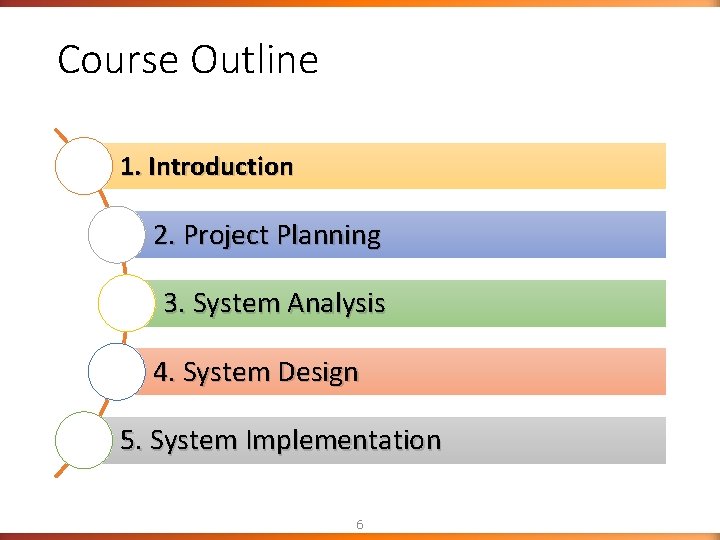
Course Outline 1. Introduction 2. Project Planning 3. System Analysis 4. System Design 5. System Implementation 6
1. Introduction 1. 1 Why We Learn Systems Analysis and Design 1. 2 Systems Analyst and Its Roles 1. 3 Systems Development Life Cycle 1. 4 Systems Development Methodology 1. 5 Methodology Selection Strategy 7
1. 1 Why We Learn Systems Analysis and Design 8
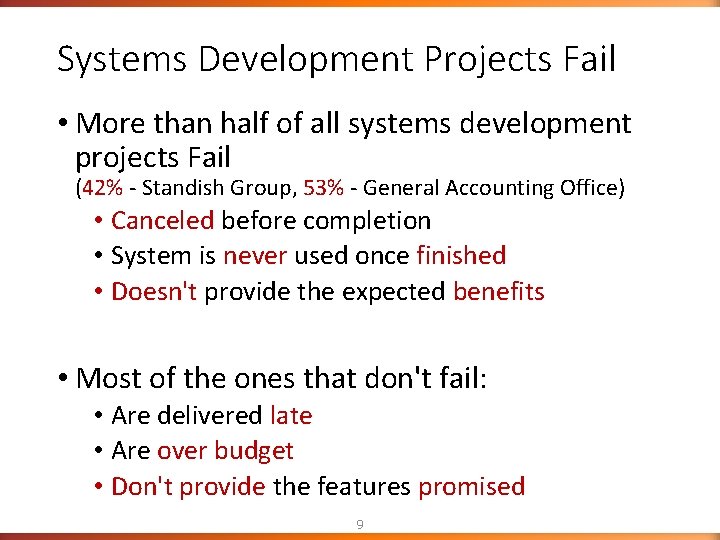
Systems Development Projects Fail • More than half of all systems development projects Fail (42% - Standish Group, 53% - General Accounting Office) • Canceled before completion • System is never used once finished • Doesn't provide the expected benefits • Most of the ones that don't fail: • Are delivered late • Are over budget • Don't provide the features promised 9
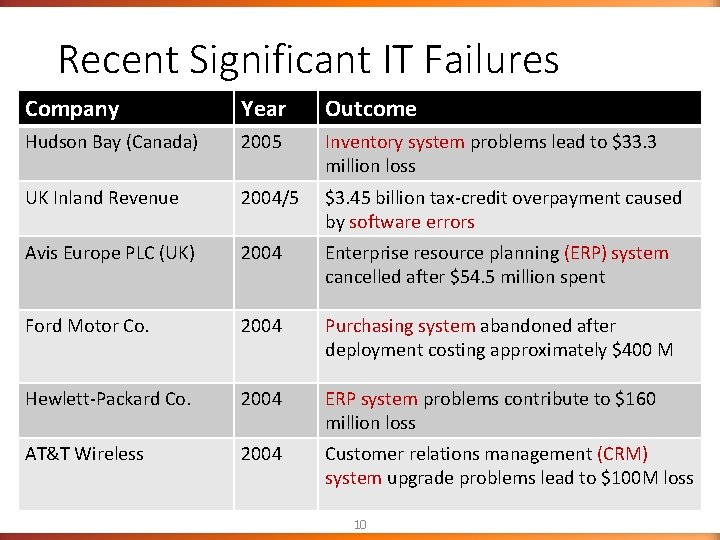
Recent Significant IT Failures Company Year Outcome Hudson Bay (Canada) 2005 Inventory system problems lead to $33. 3 million loss UK Inland Revenue 2004/5 $3. 45 billion tax-credit overpayment caused by software errors Avis Europe PLC (UK) 2004 Enterprise resource planning (ERP) system cancelled after $54. 5 million spent Ford Motor Co. 2004 Purchasing system abandoned after deployment costing approximately $400 M Hewlett-Packard Co. 2004 ERP system problems contribute to $160 million loss AT&T Wireless 2004 Customer relations management (CRM) system upgrade problems lead to $100 M loss 10
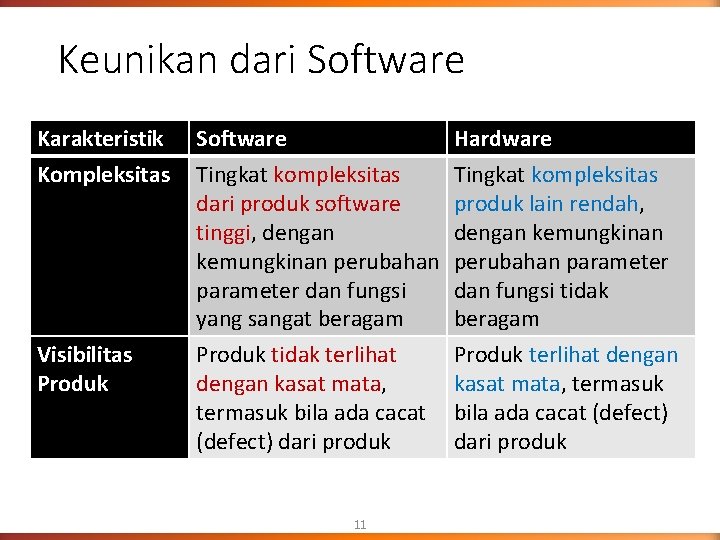
Keunikan dari Software Karakteristik Kompleksitas Visibilitas Produk Software Tingkat kompleksitas dari produk software tinggi, dengan kemungkinan perubahan parameter dan fungsi yang sangat beragam Produk tidak terlihat dengan kasat mata, termasuk bila ada cacat (defect) dari produk 11 Hardware Tingkat kompleksitas produk lain rendah, dengan kemungkinan perubahan parameter dan fungsi tidak beragam Produk terlihat dengan kasat mata, termasuk bila ada cacat (defect) dari produk
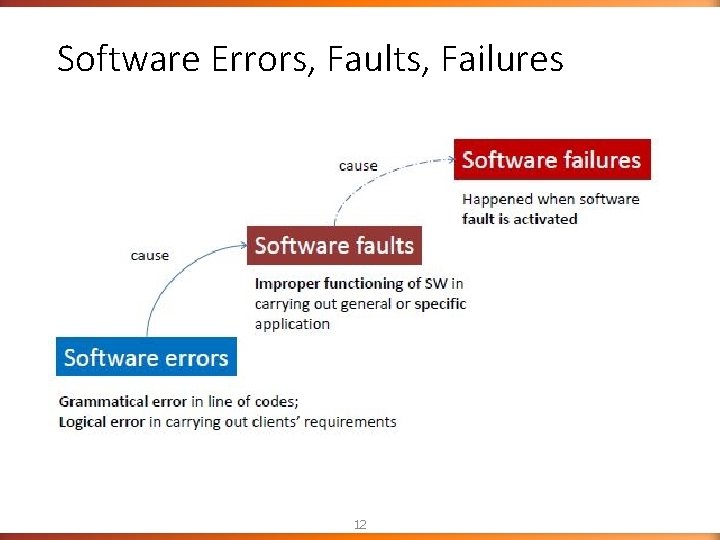
Software Errors, Faults, Failures 12
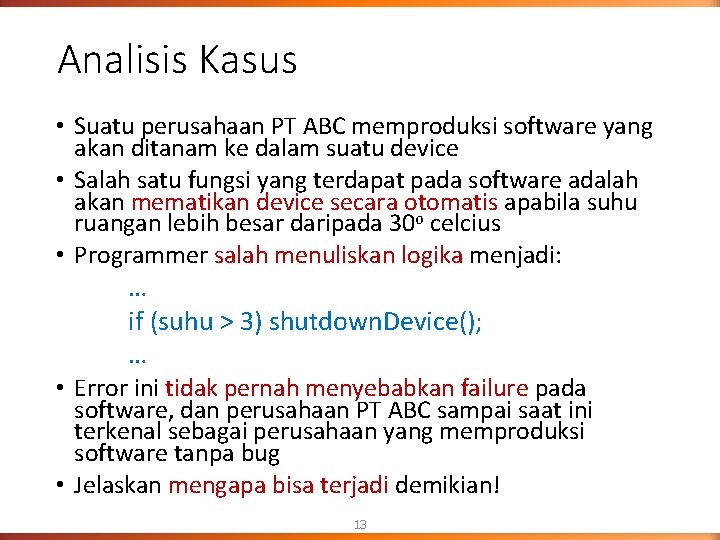
Analisis Kasus • Suatu perusahaan PT ABC memproduksi software yang akan ditanam ke dalam suatu device • Salah satu fungsi yang terdapat pada software adalah akan mematikan device secara otomatis apabila suhu ruangan lebih besar daripada 30 o celcius • Programmer salah menuliskan logika menjadi: … if (suhu > 3) shutdown. Device(); … • Error ini tidak pernah menyebabkan failure pada software, dan perusahaan PT ABC sampai saat ini terkenal sebagai perusahaan yang memproduksi software tanpa bug • Jelaskan mengapa bisa terjadi demikian! 13
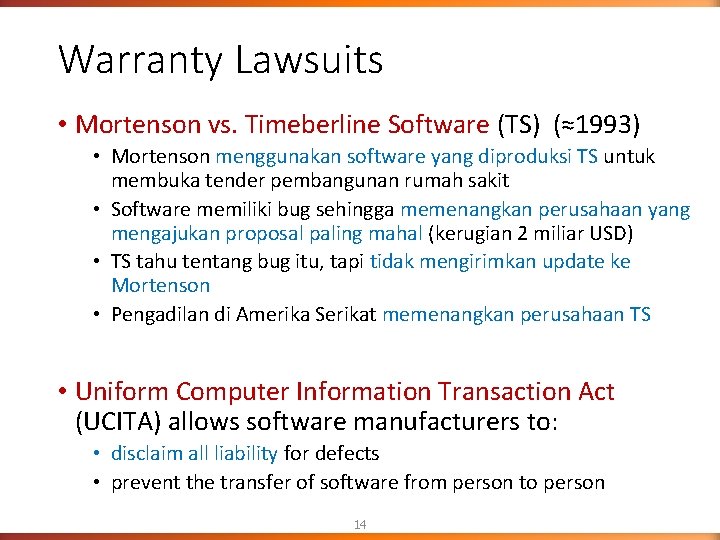
Warranty Lawsuits • Mortenson vs. Timeberline Software (TS) (≈1993) • Mortenson menggunakan software yang diproduksi TS untuk membuka tender pembangunan rumah sakit • Software memiliki bug sehingga memenangkan perusahaan yang mengajukan proposal paling mahal (kerugian 2 miliar USD) • TS tahu tentang bug itu, tapi tidak mengirimkan update ke Mortenson • Pengadilan di Amerika Serikat memenangkan perusahaan TS • Uniform Computer Information Transaction Act (UCITA) allows software manufacturers to: • disclaim all liability for defects • prevent the transfer of software from person to person 14
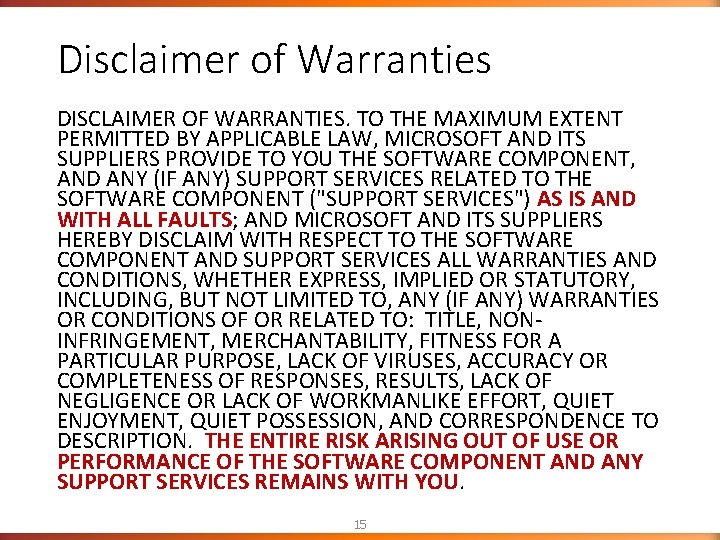
Disclaimer of Warranties DISCLAIMER OF WARRANTIES. TO THE MAXIMUM EXTENT PERMITTED BY APPLICABLE LAW, MICROSOFT AND ITS SUPPLIERS PROVIDE TO YOU THE SOFTWARE COMPONENT, AND ANY (IF ANY) SUPPORT SERVICES RELATED TO THE SOFTWARE COMPONENT ("SUPPORT SERVICES") AS IS AND WITH ALL FAULTS; AND MICROSOFT AND ITS SUPPLIERS HEREBY DISCLAIM WITH RESPECT TO THE SOFTWARE COMPONENT AND SUPPORT SERVICES ALL WARRANTIES AND CONDITIONS, WHETHER EXPRESS, IMPLIED OR STATUTORY, INCLUDING, BUT NOT LIMITED TO, ANY (IF ANY) WARRANTIES OR CONDITIONS OF OR RELATED TO: TITLE, NONINFRINGEMENT, MERCHANTABILITY, FITNESS FOR A PARTICULAR PURPOSE, LACK OF VIRUSES, ACCURACY OR COMPLETENESS OF RESPONSES, RESULTS, LACK OF NEGLIGENCE OR LACK OF WORKMANLIKE EFFORT, QUIET ENJOYMENT, QUIET POSSESSION, AND CORRESPONDENCE TO DESCRIPTION. THE ENTIRE RISK ARISING OUT OF USE OR PERFORMANCE OF THE SOFTWARE COMPONENT AND ANY SUPPORT SERVICES REMAINS WITH YOU. 15
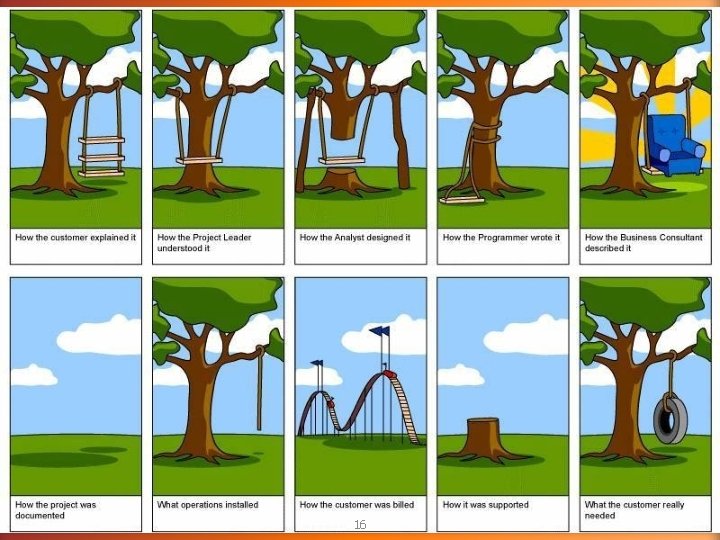
16
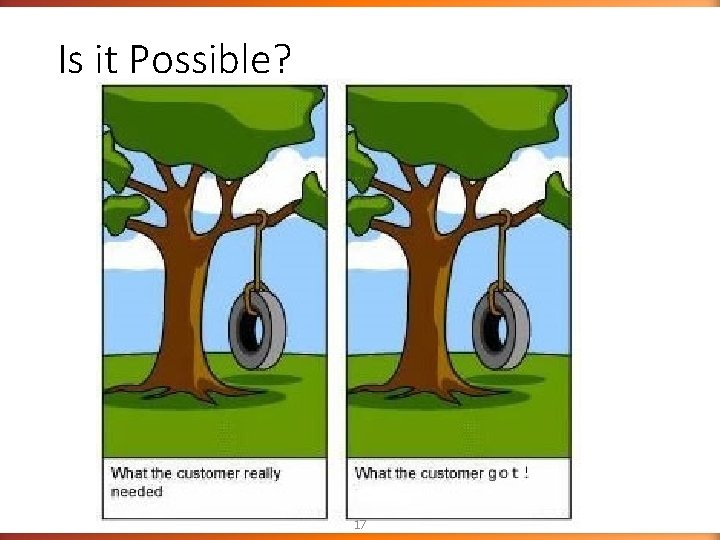
Is it Possible? 17
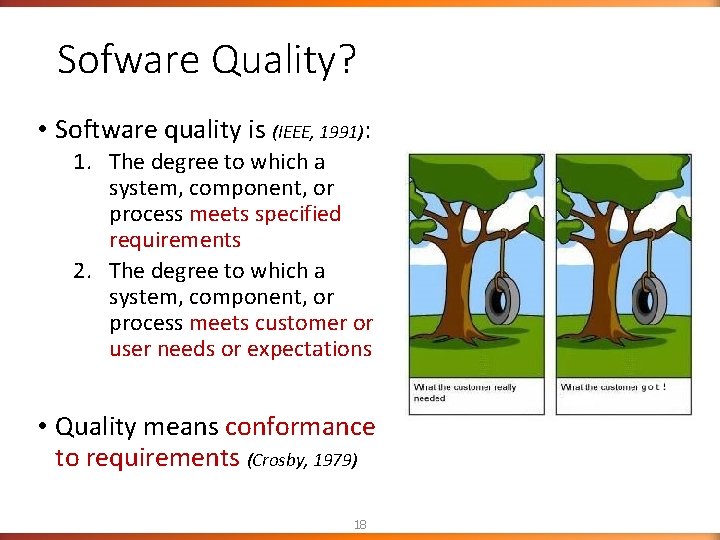
Sofware Quality? • Software quality is (IEEE, 1991): 1. The degree to which a system, component, or process meets specified requirements 2. The degree to which a system, component, or process meets customer or user needs or expectations • Quality means conformance to requirements (Crosby, 1979) 18
1. 2 Systems Analyst and Its Roles 19
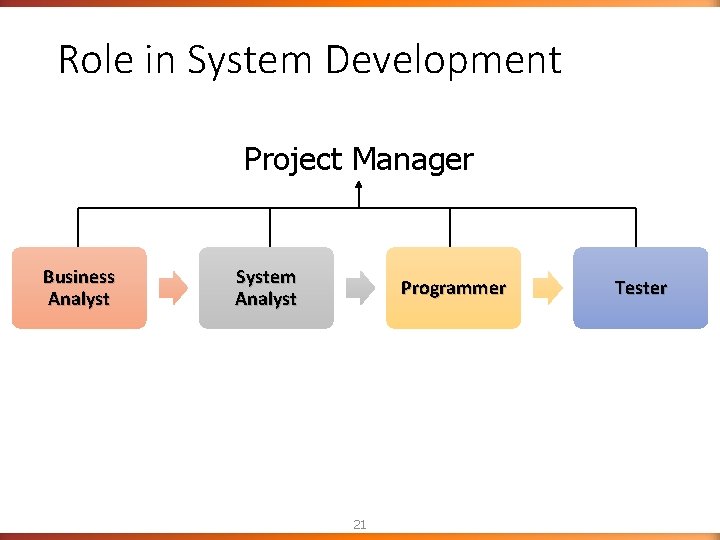
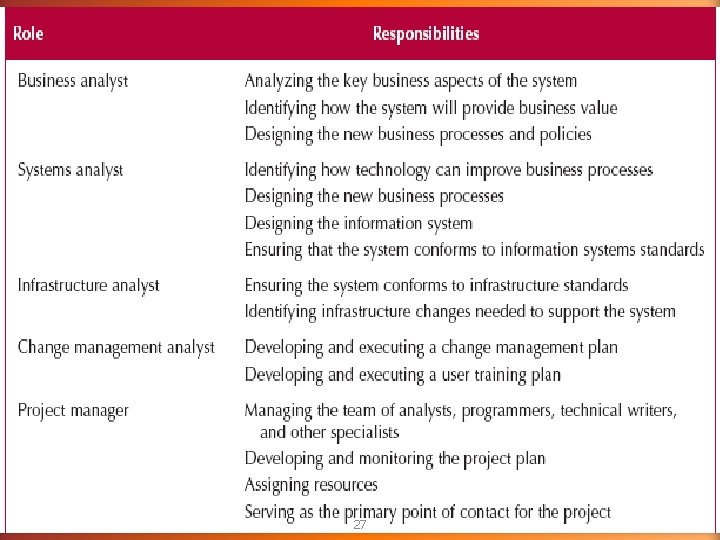
Analyst Related Role 1. 2. 3. 4. 5. Business analyst System analyst Infrastructure analyst Change management analyst Project manager 20
Role in System Development Project Manager Business Analyst System Analyst Programmer 21 Tester
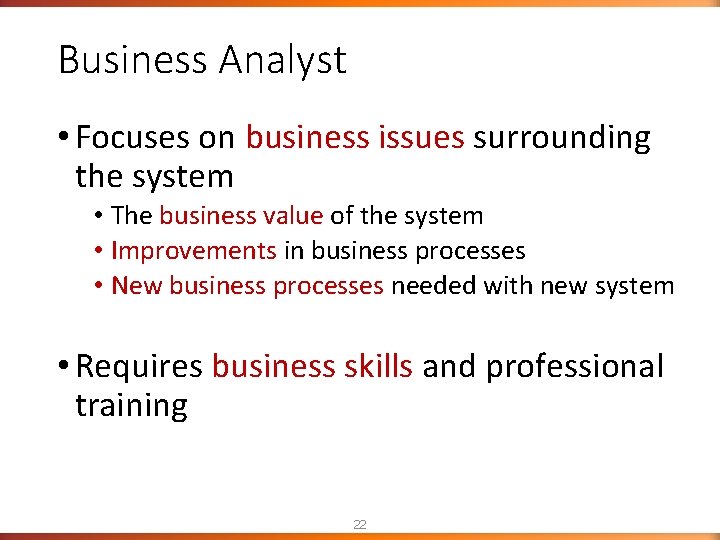
Business Analyst • Focuses on business issues surrounding the system • The business value of the system • Improvements in business processes • New business processes needed with new system • Requires business skills and professional training 22
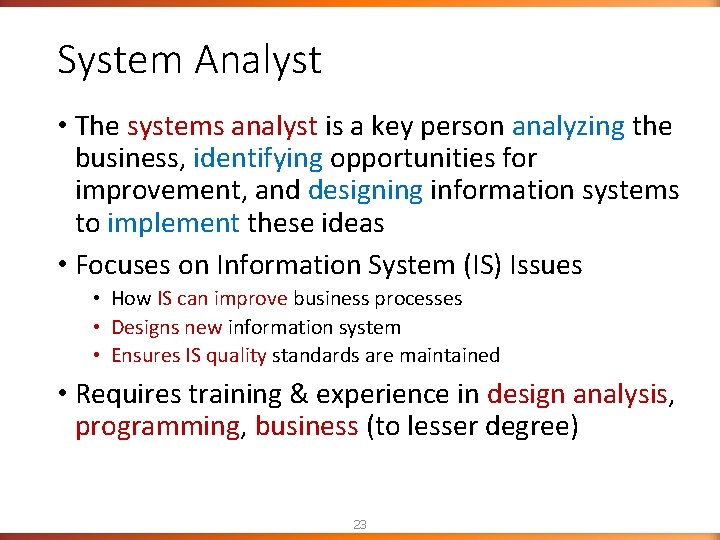
System Analyst • The systems analyst is a key person analyzing the business, identifying opportunities for improvement, and designing information systems to implement these ideas • Focuses on Information System (IS) Issues • How IS can improve business processes • Designs new information system • Ensures IS quality standards are maintained • Requires training & experience in design analysis, programming, business (to lesser degree) 23
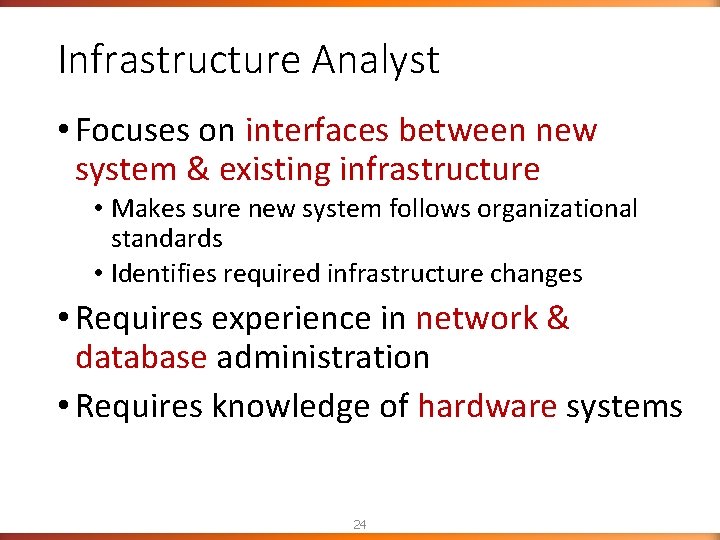
Infrastructure Analyst • Focuses on interfaces between new system & existing infrastructure • Makes sure new system follows organizational standards • Identifies required infrastructure changes • Requires experience in network & database administration • Requires knowledge of hardware systems 24
Change Management Analyst • Focuses on system installation • Documentation & support for users • Coordinate training of users • Strategies to overcome resistance • Requires experience in organizational behavior • Requires experience in change management 25
Project Manager • Responsible for schedule and budget • Ensures promised benefits are delivered • Manages team members • Responsible for project plan and reporting progress • Requires project management experience 26
27
1. 3 Systems Development Life Cycle 28
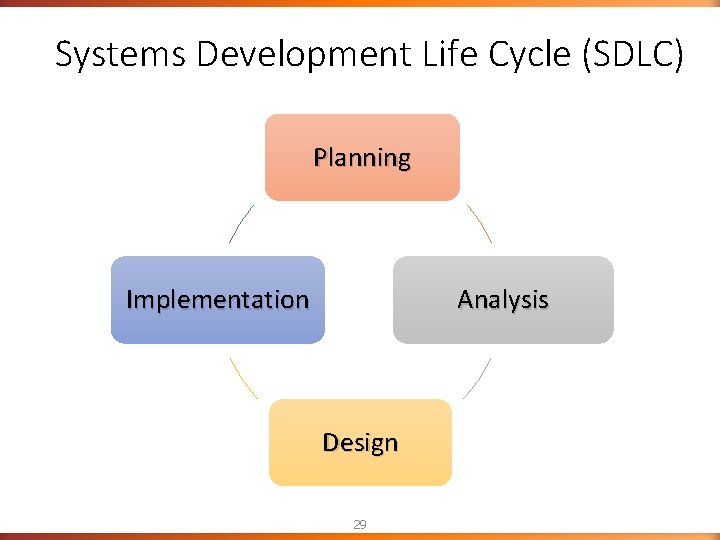
Systems Development Life Cycle (SDLC) Planning Implementation Analysis Design 29
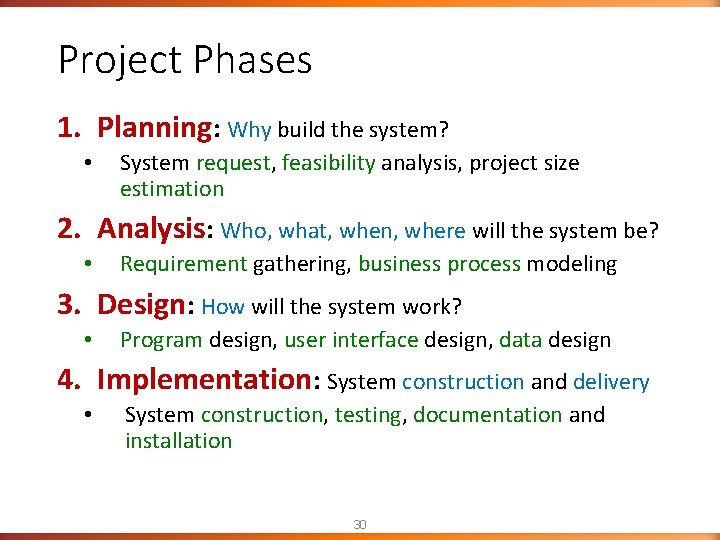
Project Phases 1. Planning: Why build the system? • System request, feasibility analysis, project size estimation 2. Analysis: Who, what, when, where will the system be? • Requirement gathering, business process modeling 3. Design: How will the system work? • Program design, user interface design, data design 4. Implementation: System construction and delivery • System construction, testing, documentation and installation 30
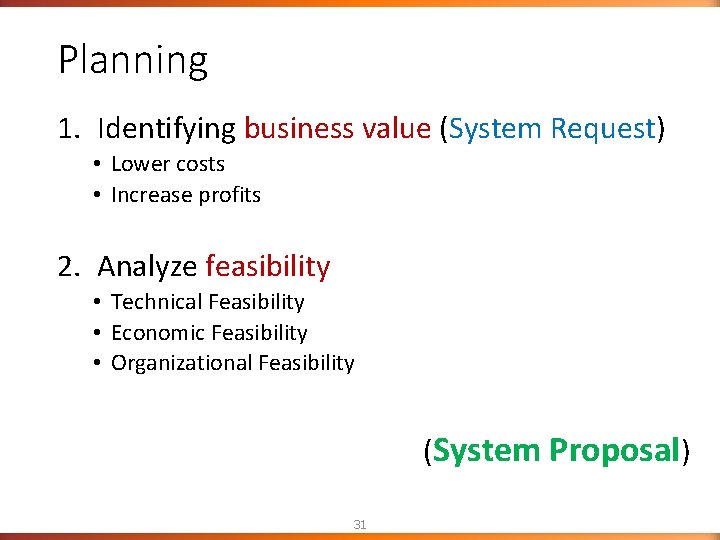
Planning 1. Identifying business value (System Request) • Lower costs • Increase profits 2. Analyze feasibility • Technical Feasibility • Economic Feasibility • Organizational Feasibility (System Proposal) 31
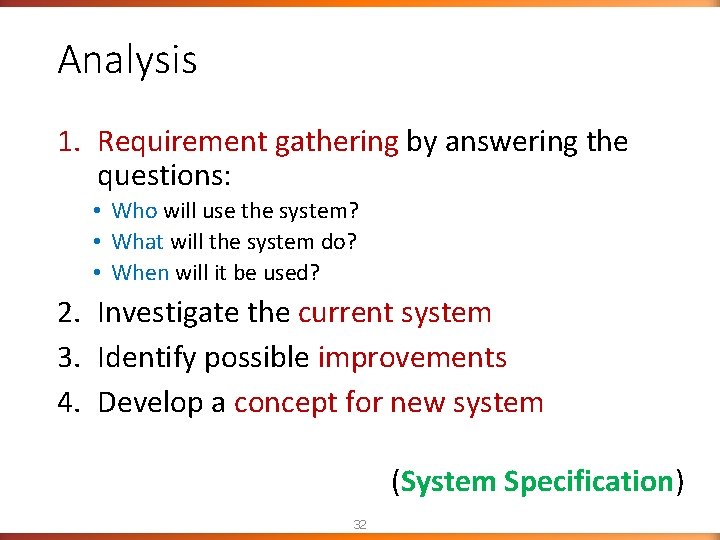
Analysis 1. Requirement gathering by answering the questions: • Who will use the system? • What will the system do? • When will it be used? 2. Investigate the current system 3. Identify possible improvements 4. Develop a concept for new system (System Specification) 32
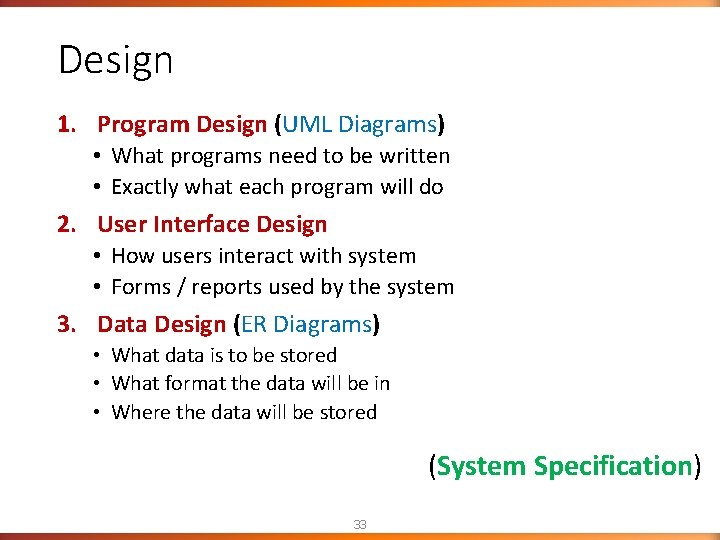
Design 1. Program Design (UML Diagrams) • What programs need to be written • Exactly what each program will do 2. User Interface Design • How users interact with system • Forms / reports used by the system 3. Data Design (ER Diagrams) • What data is to be stored • What format the data will be in • Where the data will be stored (System Specification) 33
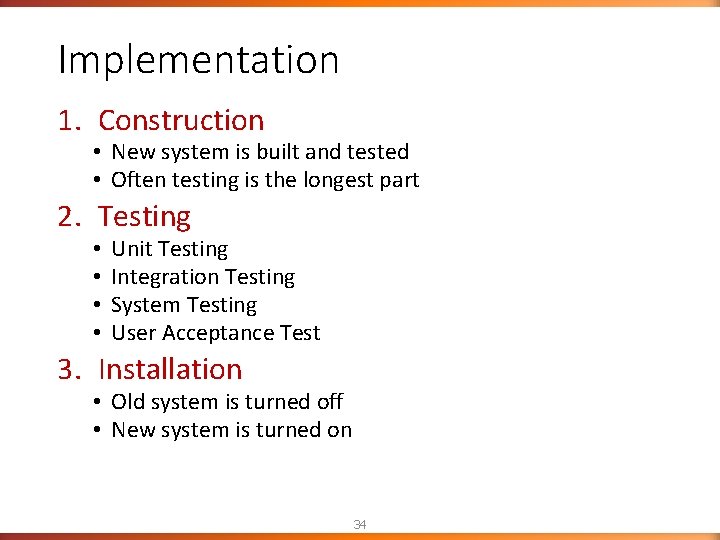
Implementation 1. Construction • New system is built and tested • Often testing is the longest part 2. Testing • • Unit Testing Integration Testing System Testing User Acceptance Test 3. Installation • Old system is turned off • New system is turned on 34
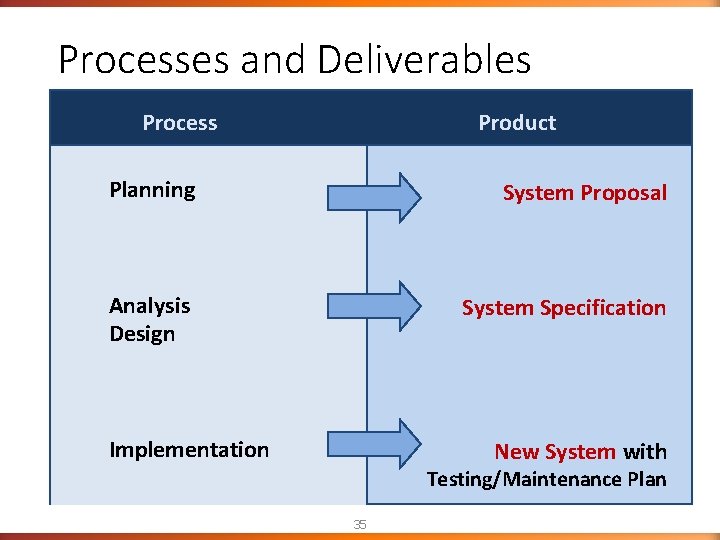
Processes and Deliverables Process Product Planning System Proposal Analysis Design System Specification Implementation New System with Testing/Maintenance Plan 35
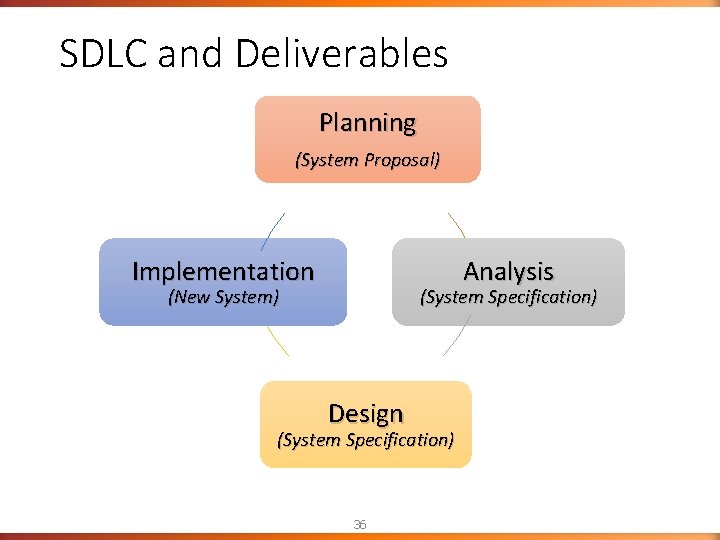
SDLC and Deliverables Planning (System Proposal) Implementation Analysis (New System) (System Specification) Design (System Specification) 36
1. 4 Systems Development Methodology (Model Process) 37
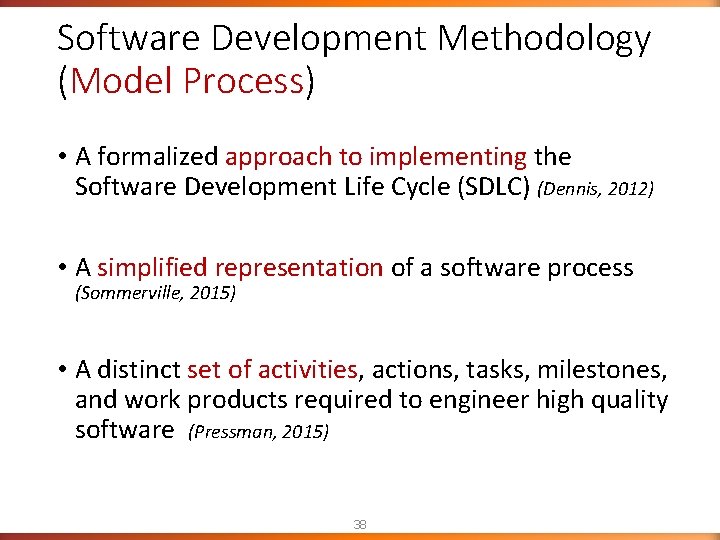
Software Development Methodology (Model Process) • A formalized approach to implementing the Software Development Life Cycle (SDLC) (Dennis, 2012) • A simplified representation of a software process (Sommerville, 2015) • A distinct set of activities, actions, tasks, milestones, and work products required to engineer high quality software (Pressman, 2015) 38
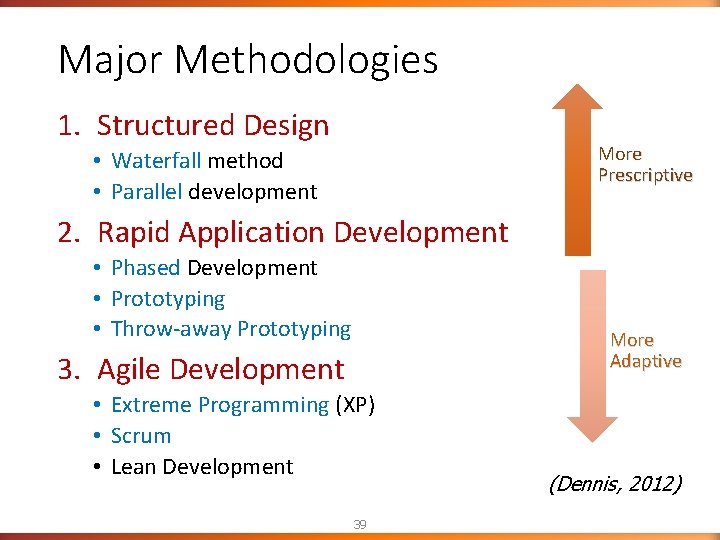
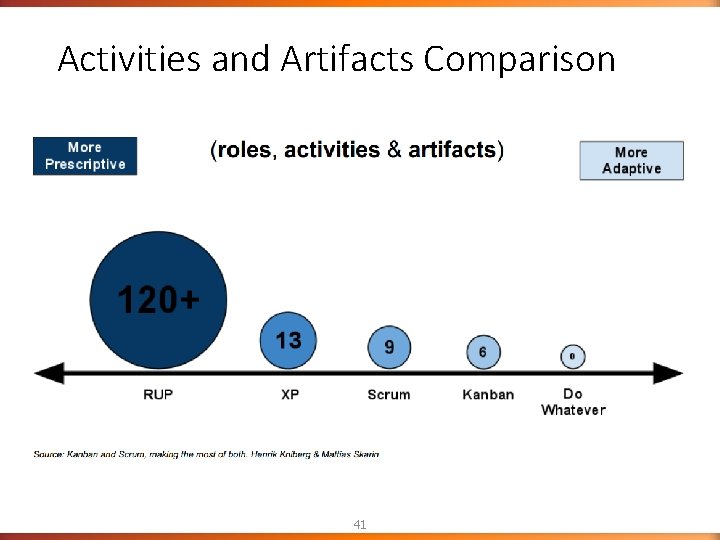
Major Methodologies 1. Structured Design More Prescriptive • Waterfall method • Parallel development 2. Rapid Application Development • Phased Development • Prototyping • Throw-away Prototyping More Adaptive 3. Agile Development • Extreme Programming (XP) • Scrum • Lean Development 39 (Dennis, 2012)
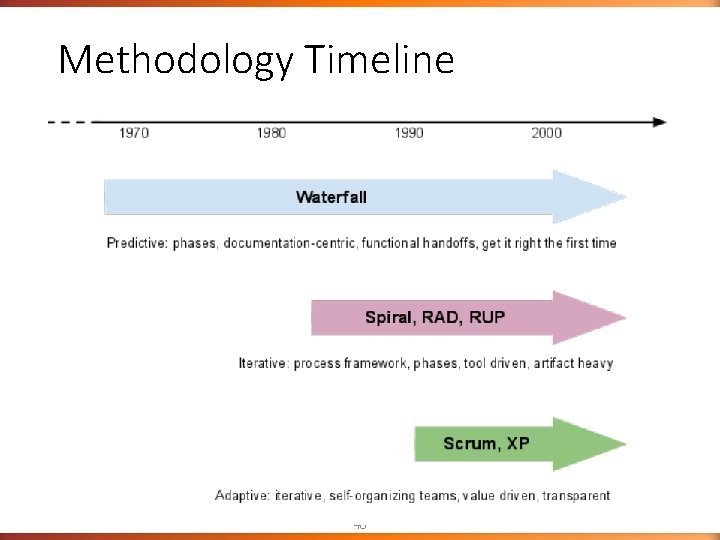
Methodology Timeline 40
Activities and Artifacts Comparison 41
1. 4. 1 Structured Design 42
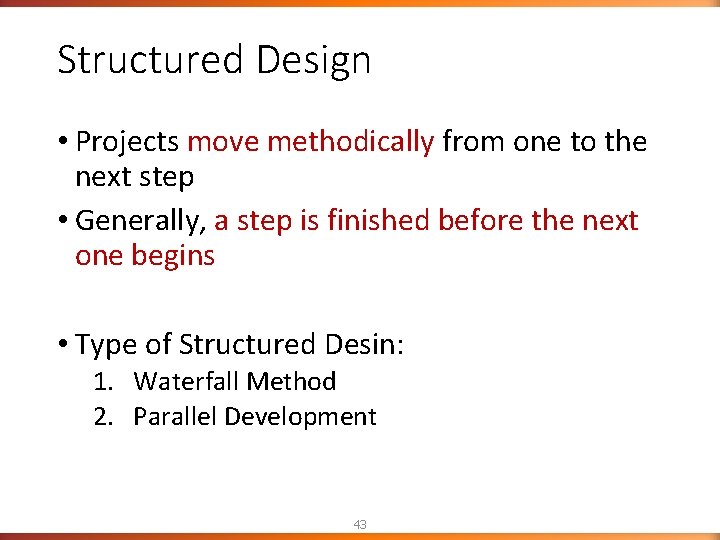
Structured Design • Projects move methodically from one to the next step • Generally, a step is finished before the next one begins • Type of Structured Desin: 1. Waterfall Method 2. Parallel Development 43
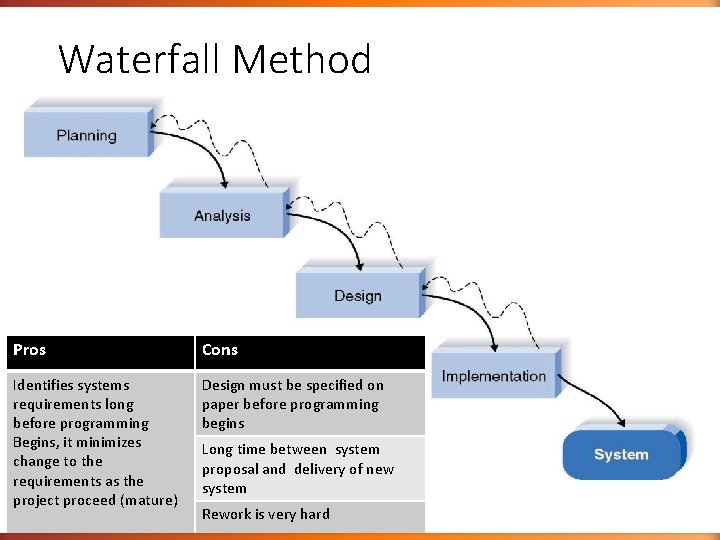
Waterfall Method Pros Cons Identifies systems requirements long before programming Begins, it minimizes change to the requirements as the project proceed (mature) Design must be specified on paper before programming begins Long time between system proposal and delivery of new system Rework is very hard 44
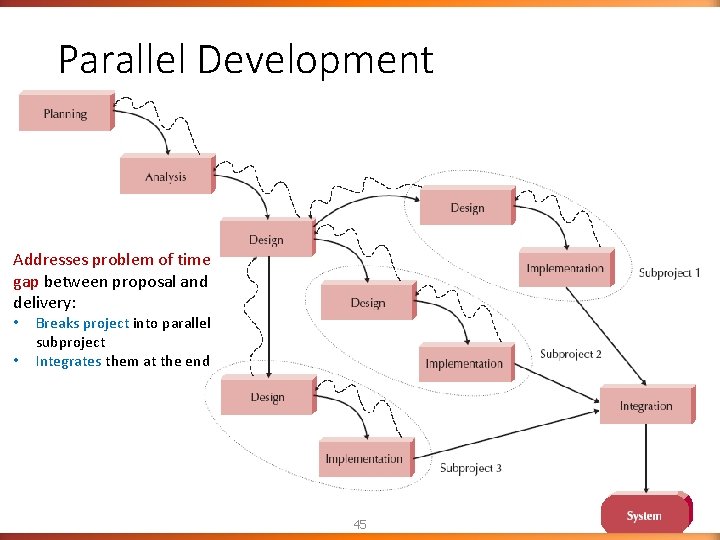
Parallel Development Addresses problem of time gap between proposal and delivery: • • Breaks project into parallel subproject Integrates them at the end 45
1. 4. 2 Rapid Application Development 46
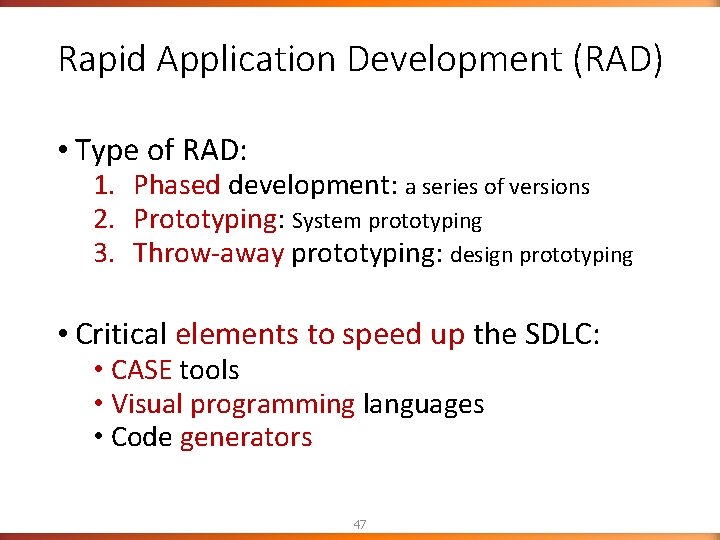
Rapid Application Development (RAD) • Type of RAD: 1. Phased development: a series of versions 2. Prototyping: System prototyping 3. Throw-away prototyping: design prototyping • Critical elements to speed up the SDLC: • CASE tools • Visual programming languages • Code generators 47
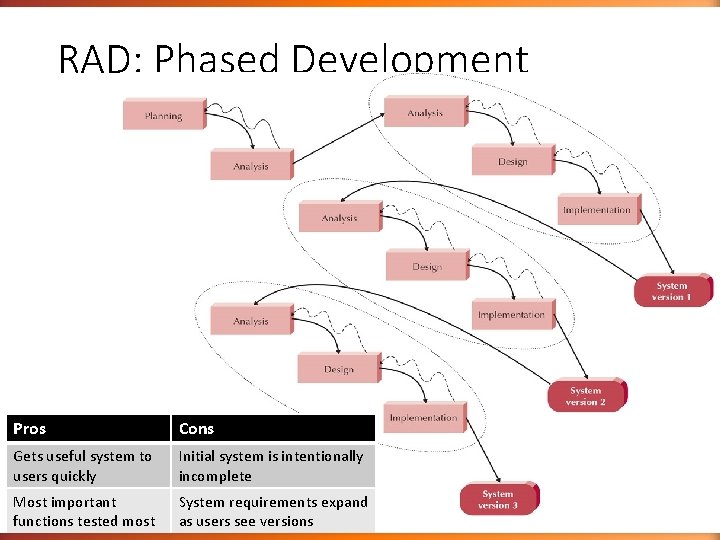
RAD: Phased Development Pros Cons Gets useful system to users quickly Initial system is intentionally incomplete Most important functions tested most System requirements expand as users see versions 48
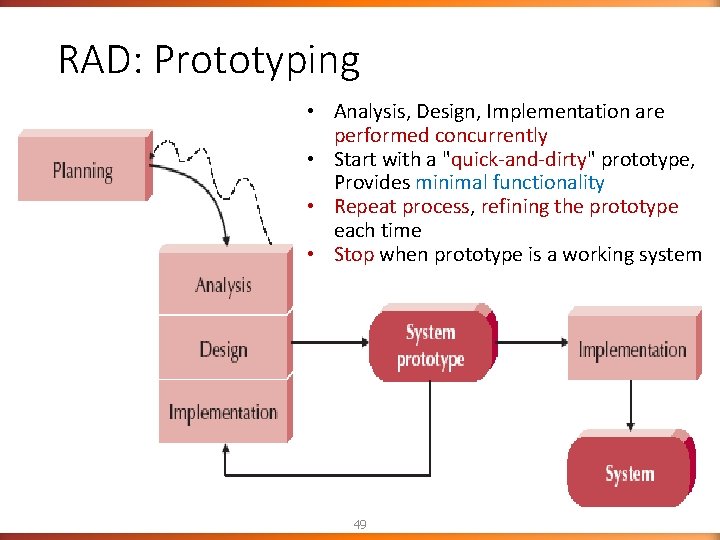
RAD: Prototyping • Analysis, Design, Implementation are performed concurrently • Start with a "quick-and-dirty" prototype, Provides minimal functionality • Repeat process, refining the prototype each time • Stop when prototype is a working system 49
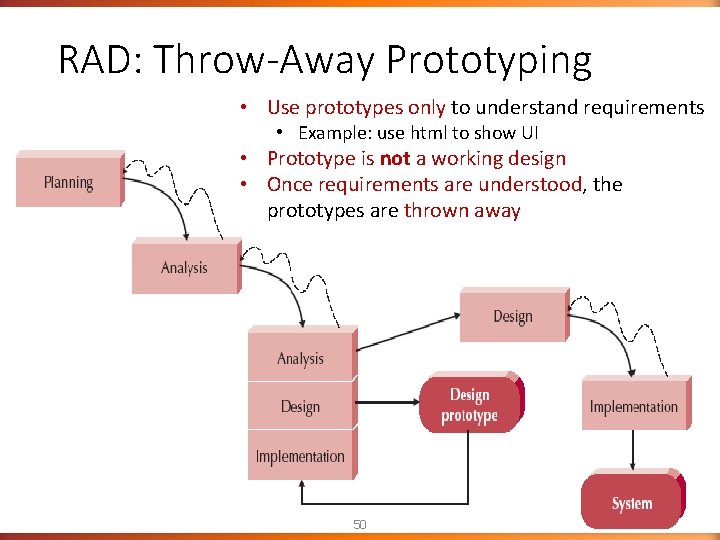
RAD: Throw-Away Prototyping • Use prototypes only to understand requirements • Example: use html to show UI • Prototype is not a working design • Once requirements are understood, the prototypes are thrown away 50
1. 4. 3 Agile Development 51
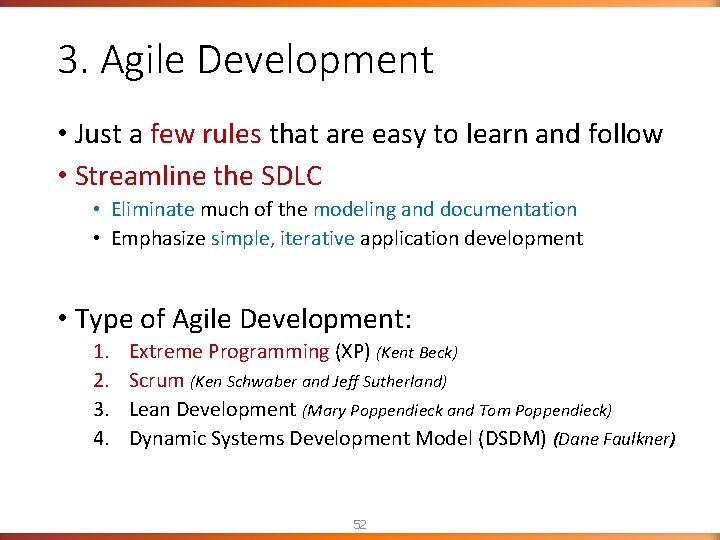
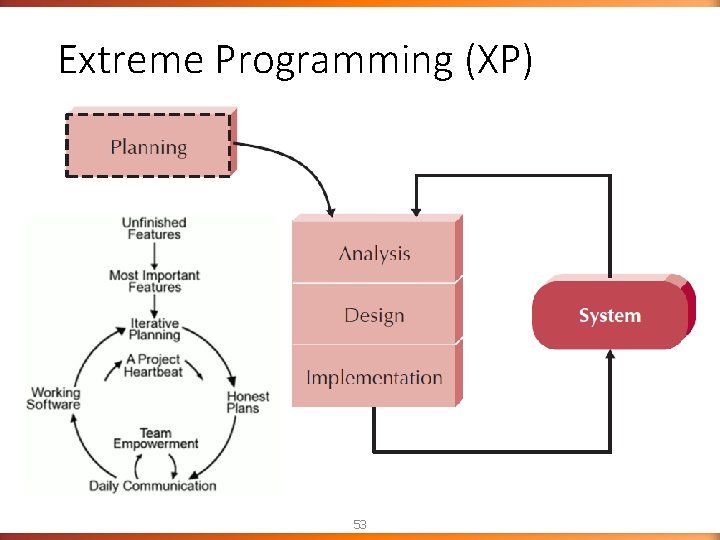
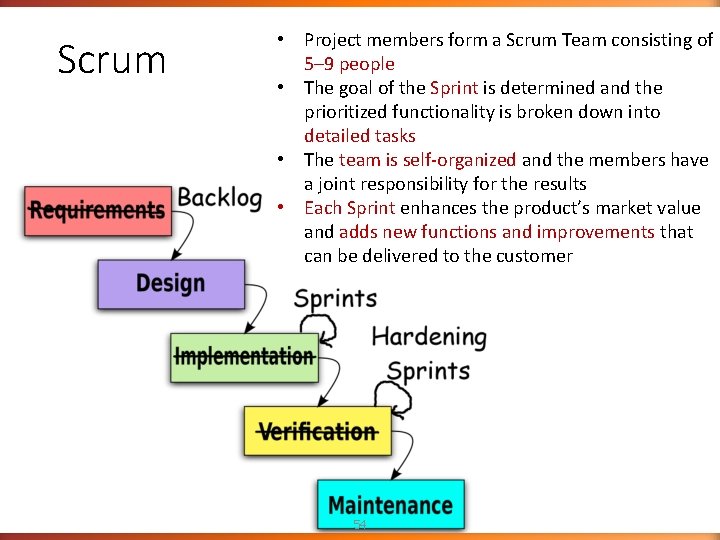
3. Agile Development • Just a few rules that are easy to learn and follow • Streamline the SDLC • Eliminate much of the modeling and documentation • Emphasize simple, iterative application development • Type of Agile Development: 1. 2. 3. 4. Extreme Programming (XP) (Kent Beck) Scrum (Ken Schwaber and Jeff Sutherland) Lean Development (Mary Poppendieck and Tom Poppendieck) Dynamic Systems Development Model (DSDM) (Dane Faulkner) 52
Extreme Programming (XP) 53
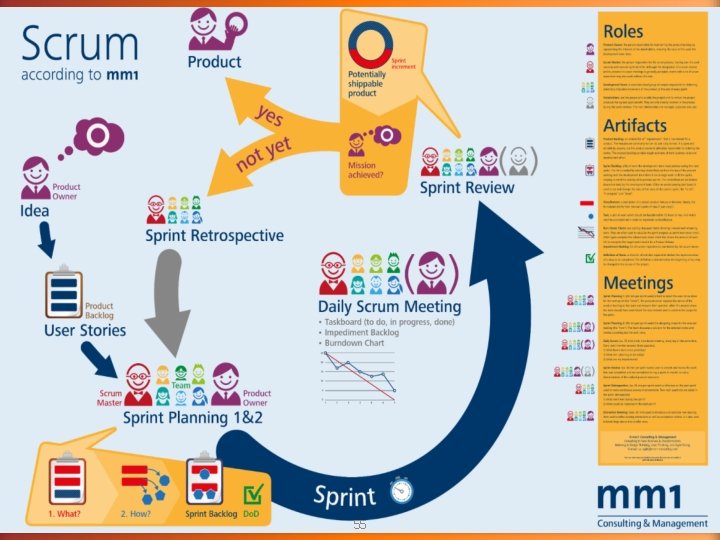
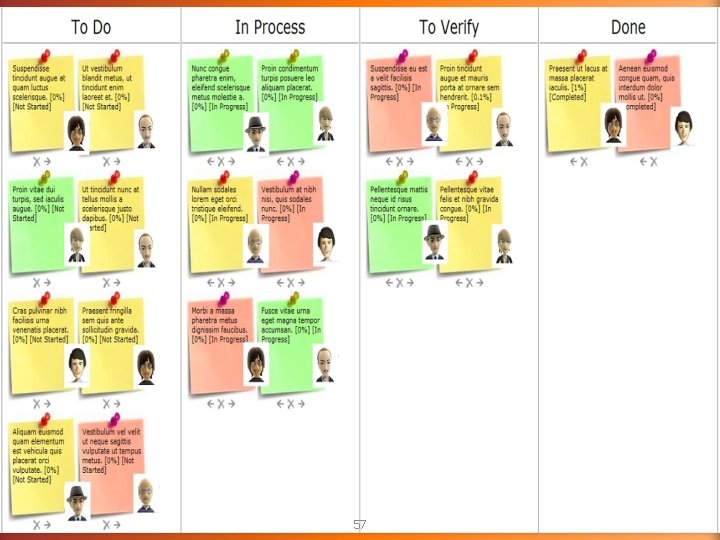
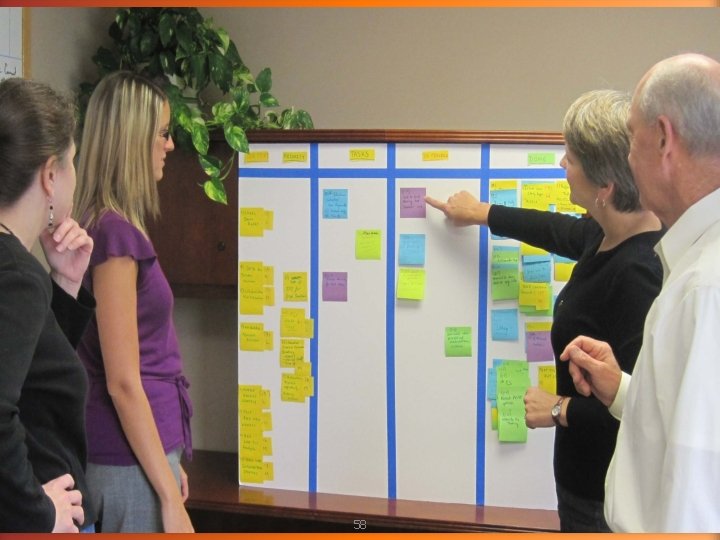
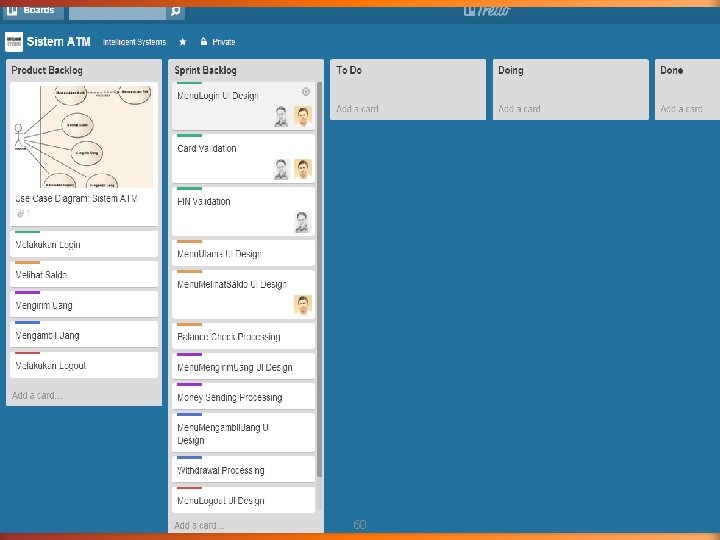
Scrum • Project members form a Scrum Team consisting of 5– 9 people • The goal of the Sprint is determined and the prioritized functionality is broken down into detailed tasks • The team is self-organized and the members have a joint responsibility for the results • Each Sprint enhances the product’s market value and adds new functions and improvements that can be delivered to the customer 54
Scrum 55
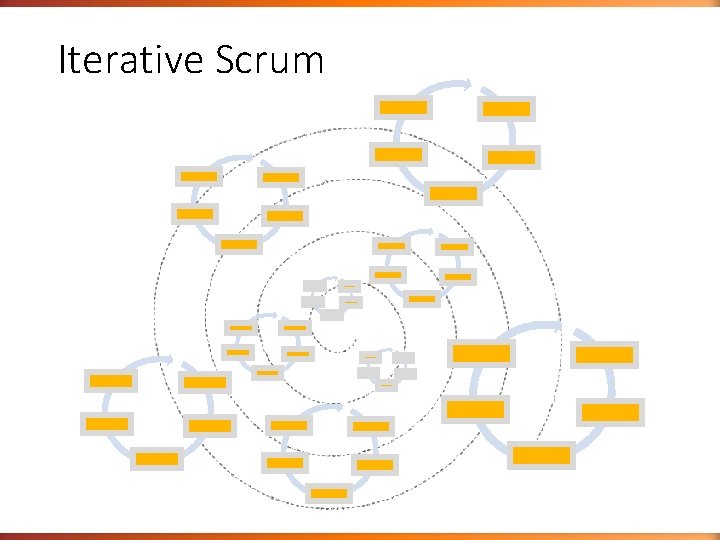
Iterative Scrum
Scrum 57
Scrum 58
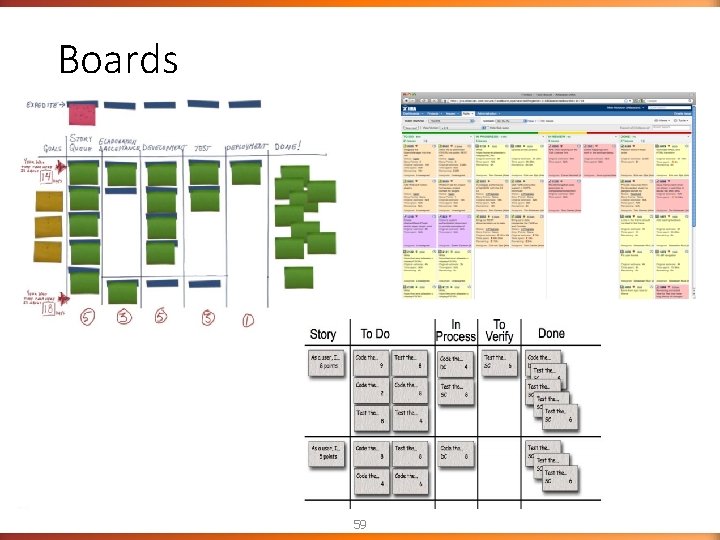
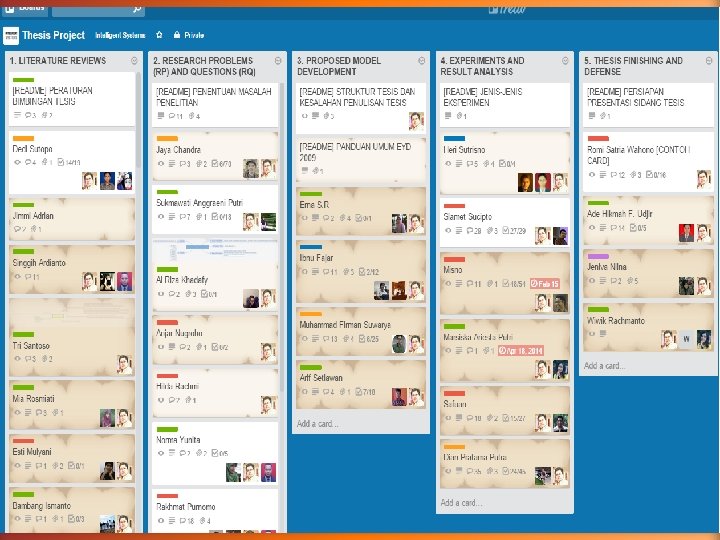
Boards 59
60
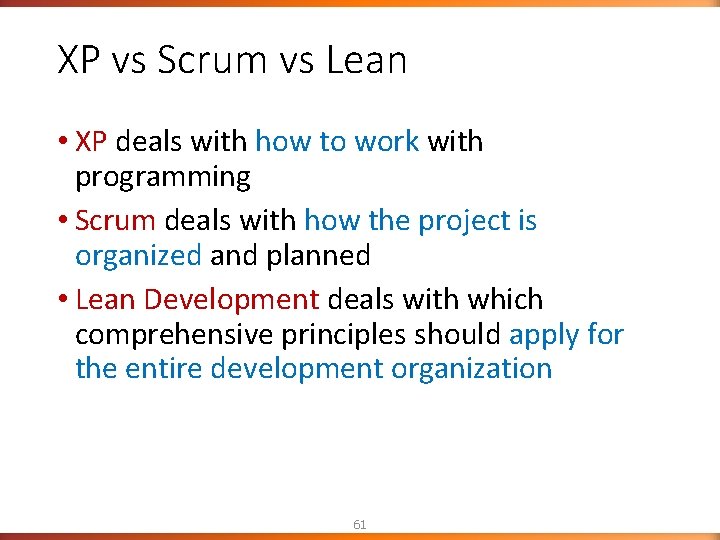
XP vs Scrum vs Lean • XP deals with how to work with programming • Scrum deals with how the project is organized and planned • Lean Development deals with which comprehensive principles should apply for the entire development organization 61
62
1. 5 Methodology Selection Strategy 63
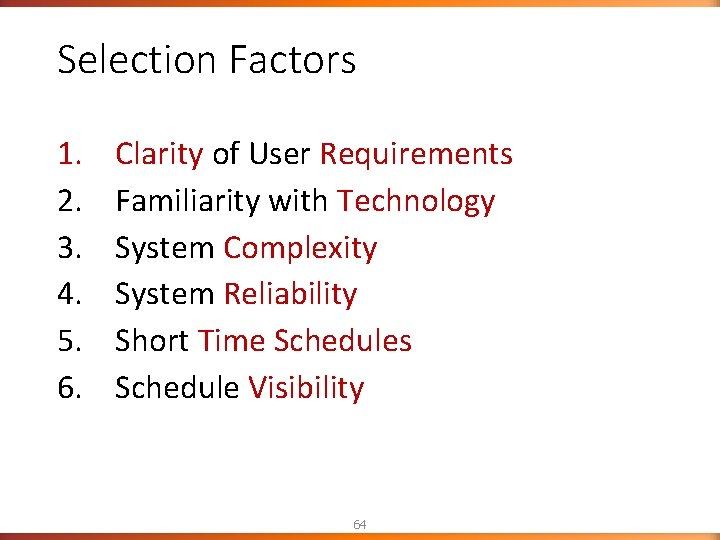
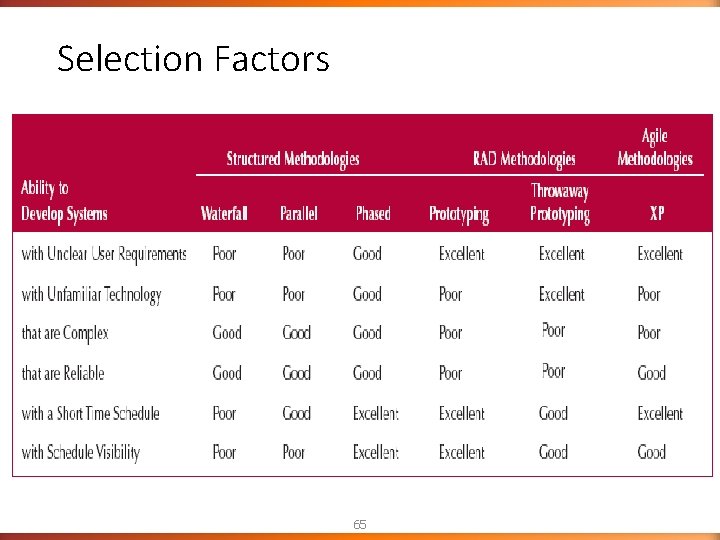
Selection Factors 1. 2. 3. 4. 5. 6. Clarity of User Requirements Familiarity with Technology System Complexity System Reliability Short Time Schedules Schedule Visibility 64
Selection Factors 65
Latihan Analisis Kasus: Memilih Metodologi yang Tepat • Seandainya, anda adalah seorang software engineer di perusahaan PT Black. Soft, sebuah perusahaan IT yang memiliki kantor cabang di berbagai tempat di dunia • PT Black. Soft ingin membangun sebuah sistem yang bisa menampilkan informasi tentang sumber daya manusia yang dimiliki, baik itu lokasi saat ini, latar belakang pendidikan, jadwal pekerjaan dan pengalaman kerja yang dimiliki • Asumsikan bahwa ini adalah ide baru yang belum pernah diimplementasikan di PT Black. Soft sebelumnya • PT Black. Soft memiliki jaringan internasional dimana kantor cabang di berbagai negara menggunakan hardware dan software yang berbeda • Manajemen ingin agar sistem dapat selesai dikerjakan dan mulai bisa berjalan dalam satu tahun 66
Summary -1 • The systems analyst is a key person analyzing the business, identifying opportunities for improvement, and designing information systems to implement these ideas • There are five major team roles: 1. 2. 3. 4. 5. Business analyst Systems analyst Infrastructure analyst Change management analyst Project manager 67
Summary -2 • The Systems Development Lifecycle consists of four stages: Planning, Analysis, Design, and Implementation • The major development methodologies: 1. Structured design • Waterfall method • Parallel development 2. RAD development • Phased Development • Prototyping • Throw-away Prototyping 3. Agile development • Extreme Programming • Scrum 68
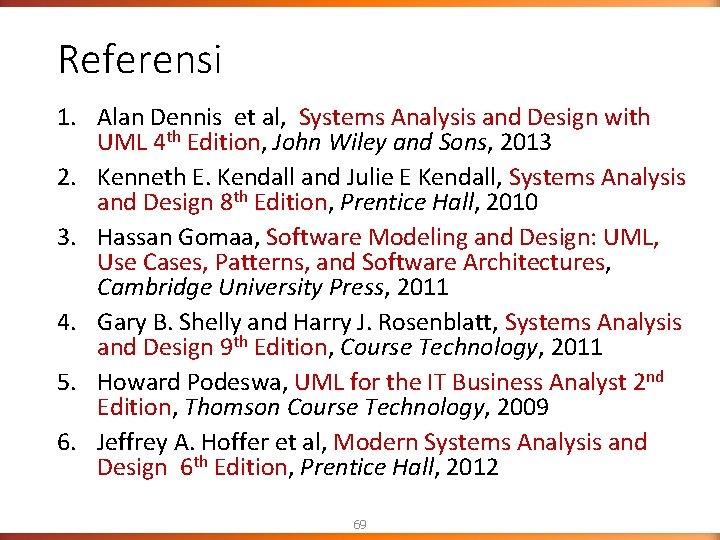
Referensi 1. Alan Dennis et al, Systems Analysis and Design with UML 4 th Edition, John Wiley and Sons, 2013 2. Kenneth E. Kendall and Julie E Kendall, Systems Analysis and Design 8 th Edition, Prentice Hall, 2010 3. Hassan Gomaa, Software Modeling and Design: UML, Use Cases, Patterns, and Software Architectures, Cambridge University Press, 2011 4. Gary B. Shelly and Harry J. Rosenblatt, Systems Analysis and Design 9 th Edition, Course Technology, 2011 5. Howard Podeswa, UML for the IT Business Analyst 2 nd Edition, Thomson Course Technology, 2009 6. Jeffrey A. Hoffer et al, Modern Systems Analysis and Design 6 th Edition, Prentice Hall, 2012 69