
SystemLevel Software Development 15 395 Gregory Kesden 1999
![Byte Ordering union { u_int 32_t addr; char c[4]; } un; /* 4 bytes](https://slidetodoc.com/presentation_image_h2/b99454d4a4c925b91e0a0d7d4af4a8e0/image-7.jpg "Byte Ordering union { u_int 32_t addr; char c[4]; } un; /* 4 bytes")
![Socket I/O: select() int fd, next=0; /* original socket */ int newfd[10]; /* new](https://slidetodoc.com/presentation_image_h2/b99454d4a4c925b91e0a0d7d4af4a8e0/image-22.jpg "Socket I/O: select() int fd, next=0; /* original socket */ int newfd[10]; /* new")
![Socket I/O: recvfrom() int fd; struct sockaddr_in srv; struct sockaddr_in cli; char buf[512]; int](https://slidetodoc.com/presentation_image_h2/b99454d4a4c925b91e0a0d7d4af4a8e0/image-29.jpg "Socket I/O: recvfrom() int fd; struct sockaddr_in srv; struct sockaddr_in cli; char buf[512]; int")
- Slides: 34
System-Level Software Development 15 -395 Gregory Kesden © 1999 Josh Brock. Minorly adapted at various times since then. 1 2/15/2022
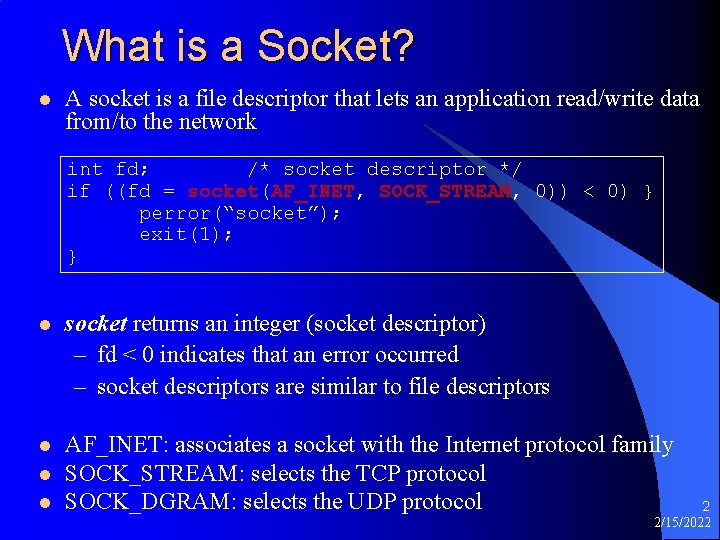
What is a Socket? l A socket is a file descriptor that lets an application read/write data from/to the network int fd; /* socket descriptor */ if ((fd = socket(AF_INET, SOCK_STREAM, 0)) < 0) } perror(“socket”); exit(1); } l socket returns an integer (socket descriptor) – fd < 0 indicates that an error occurred – socket descriptors are similar to file descriptors l AF_INET: associates a socket with the Internet protocol family SOCK_STREAM: selects the TCP protocol SOCK_DGRAM: selects the UDP protocol l l 2 2/15/2022
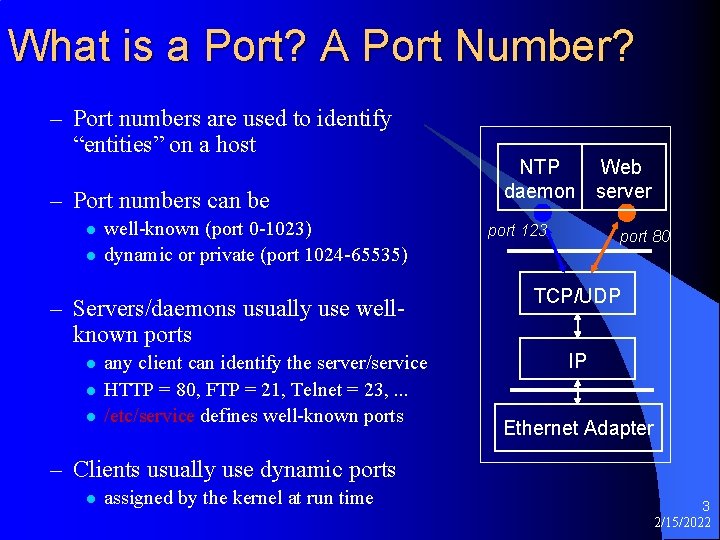
What is a Port? A Port Number? – Port numbers are used to identify “entities” on a host – Port numbers can be l l well-known (port 0 -1023) dynamic or private (port 1024 -65535) – Servers/daemons usually use wellknown ports l l l any client can identify the server/service HTTP = 80, FTP = 21, Telnet = 23, . . . /etc/service defines well-known ports NTP daemon port 123 Web server port 80 TCP/UDP IP Ethernet Adapter – Clients usually use dynamic ports l assigned by the kernel at run time 3 2/15/2022
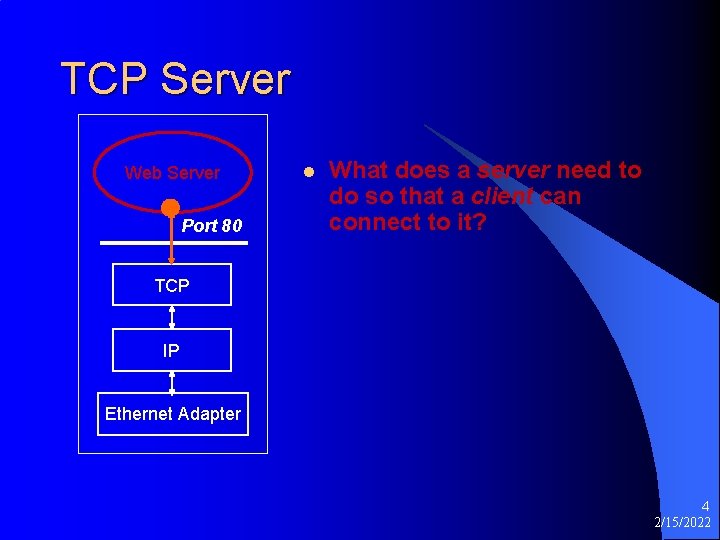
TCP Server Web Server Port 80 l What does a server need to do so that a client can connect to it? TCP IP Ethernet Adapter 4 2/15/2022
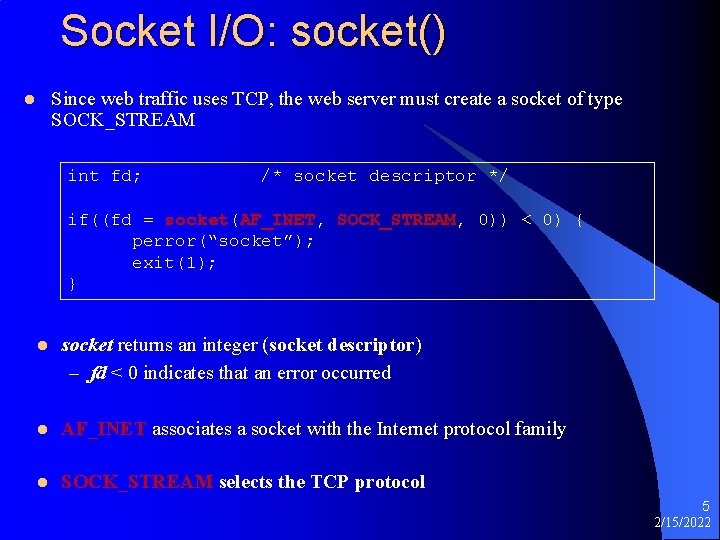
Socket I/O: socket() Since web traffic uses TCP, the web server must create a socket of type SOCK_STREAM l int fd; /* socket descriptor */ if((fd = socket(AF_INET, SOCK_STREAM, 0)) < 0) { perror(“socket”); exit(1); } l socket returns an integer (socket descriptor) – fd < 0 indicates that an error occurred l AF_INET associates a socket with the Internet protocol family l SOCK_STREAM selects the TCP protocol 5 2/15/2022
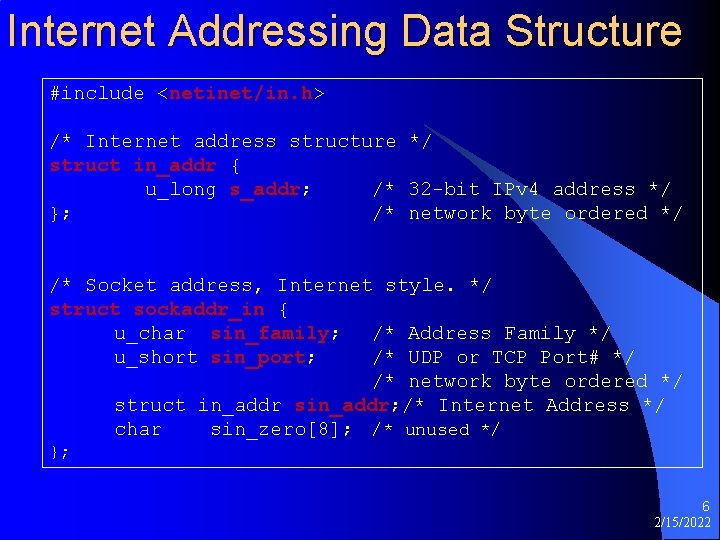
Internet Addressing Data Structure #include <netinet/in. h> /* Internet address structure */ struct in_addr { u_long s_addr; /* 32 -bit IPv 4 address */ }; /* network byte ordered */ /* Socket address, Internet style. */ struct sockaddr_in { u_char sin_family; /* Address Family */ u_short sin_port; /* UDP or TCP Port# */ /* network byte ordered */ struct in_addr sin_addr; /* Internet Address */ char sin_zero[8]; /* unused */ }; 6 2/15/2022
Byte Ordering union { u_int 32_t addr; char c[4]; } un; /* 4 bytes address */ /* 128. 2. 194. 95 */ un. addr = 0 x 8002 c 25 f; /* c[0] = ? */ c[0] c[1] c[2] c[3] l l l Big Endian – Sun Solaris, Power. PC, . . . Little Endian – i 386, alpha, . . . Network byte order = Big Endian 128 2 194 95 95 194 2 128 7 2/15/2022
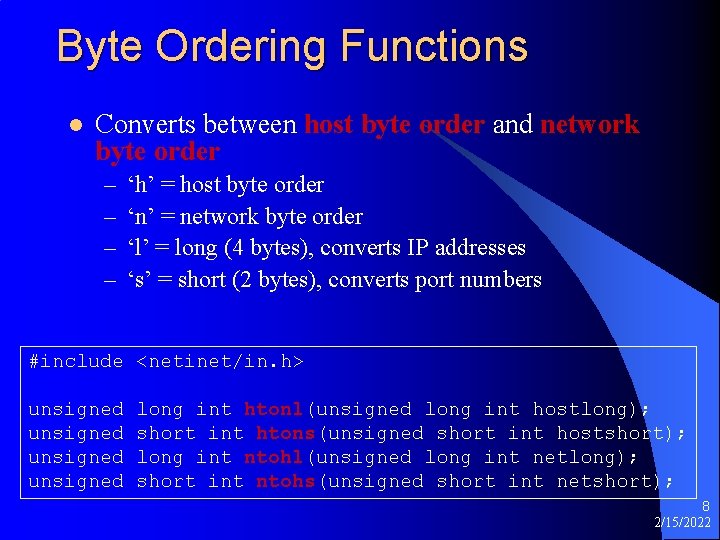
Byte Ordering Functions l Converts between host byte order and network byte order – – ‘h’ = host byte order ‘n’ = network byte order ‘l’ = long (4 bytes), converts IP addresses ‘s’ = short (2 bytes), converts port numbers #include <netinet/in. h> unsigned long int htonl(unsigned long int hostlong); short int htons(unsigned short int hostshort); long int ntohl(unsigned long int netlong); short int ntohs(unsigned short int netshort); 8 2/15/2022
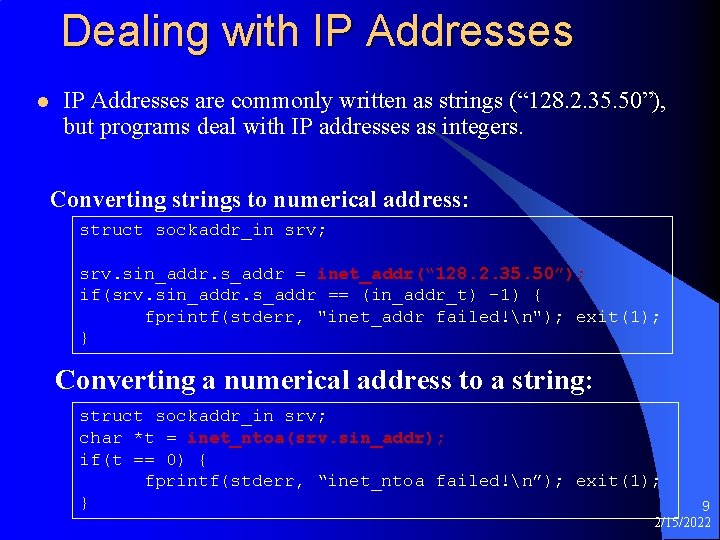
Dealing with IP Addresses l IP Addresses are commonly written as strings (“ 128. 2. 35. 50”), but programs deal with IP addresses as integers. Converting strings to numerical address: struct sockaddr_in srv; srv. sin_addr. s_addr = inet_addr(“ 128. 2. 35. 50”); if(srv. sin_addr. s_addr == (in_addr_t) -1) { fprintf(stderr, "inet_addr failed!n"); exit(1); } Converting a numerical address to a string: struct sockaddr_in srv; char *t = inet_ntoa(srv. sin_addr); if(t == 0) { fprintf(stderr, “inet_ntoa failed!n”); exit(1); } 9 2/15/2022
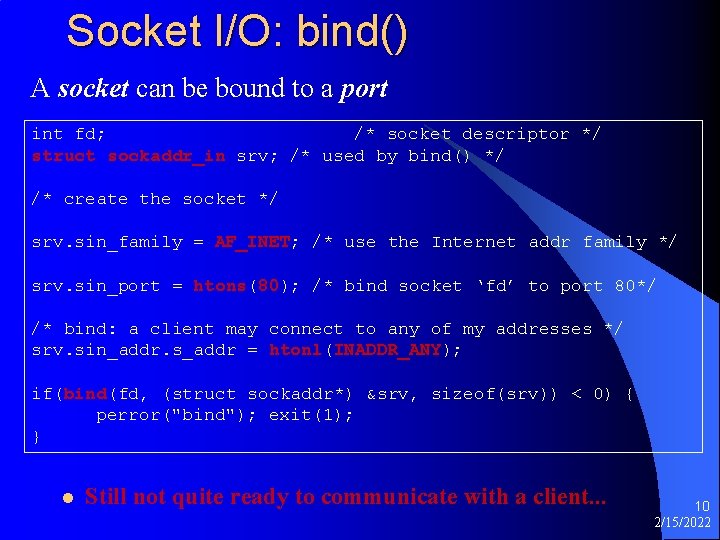
Socket I/O: bind() A socket can be bound to a port int fd; /* socket descriptor */ struct sockaddr_in srv; /* used by bind() */ /* create the socket */ srv. sin_family = AF_INET; /* use the Internet addr family */ srv. sin_port = htons(80); /* bind socket ‘fd’ to port 80*/ /* bind: a client may connect to any of my addresses */ srv. sin_addr. s_addr = htonl(INADDR_ANY); if(bind(fd, (struct sockaddr*) &srv, sizeof(srv)) < 0) { perror("bind"); exit(1); } l Still not quite ready to communicate with a client. . . 10 2/15/2022
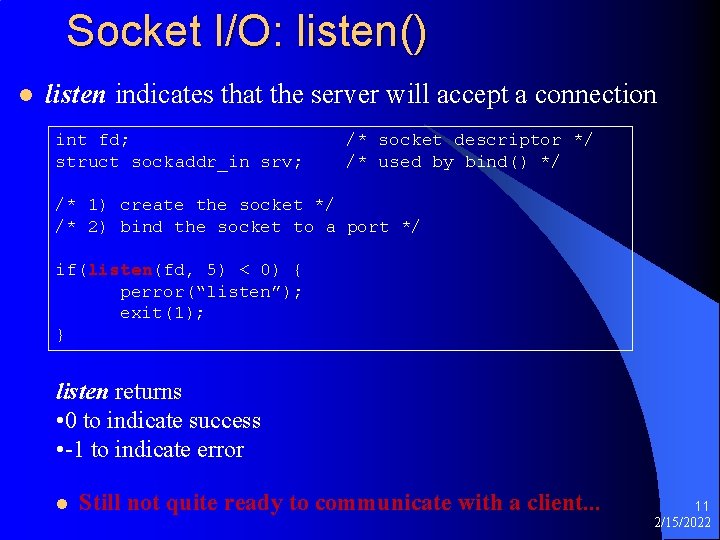
Socket I/O: listen() l listen indicates that the server will accept a connection int fd; struct sockaddr_in srv; /* socket descriptor */ /* used by bind() */ /* 1) create the socket */ /* 2) bind the socket to a port */ if(listen(fd, 5) < 0) { perror(“listen”); exit(1); } listen returns • 0 to indicate success • -1 to indicate error l Still not quite ready to communicate with a client. . . 11 2/15/2022
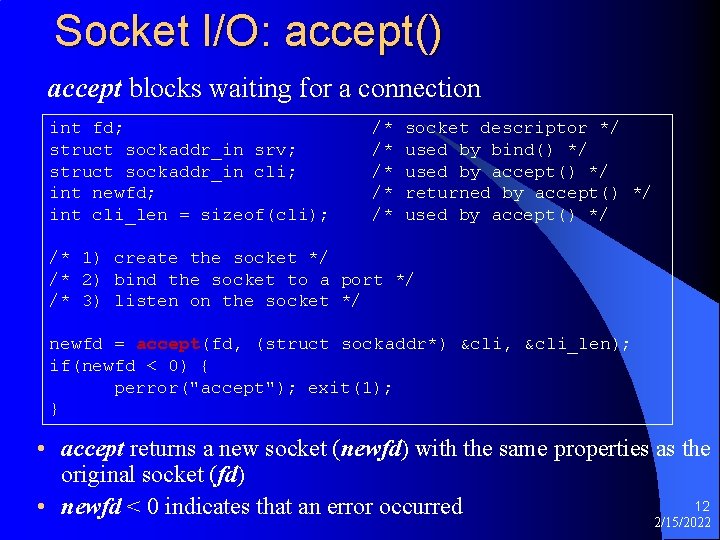
Socket I/O: accept() accept blocks waiting for a connection int fd; struct sockaddr_in srv; struct sockaddr_in cli; int newfd; int cli_len = sizeof(cli); /* /* /* socket descriptor */ used by bind() */ used by accept() */ returned by accept() */ used by accept() */ /* 1) create the socket */ /* 2) bind the socket to a port */ /* 3) listen on the socket */ newfd = accept(fd, (struct sockaddr*) &cli, &cli_len); if(newfd < 0) { perror("accept"); exit(1); } • accept returns a new socket (newfd) with the same properties as the original socket (fd) 12 • newfd < 0 indicates that an error occurred 2/15/2022
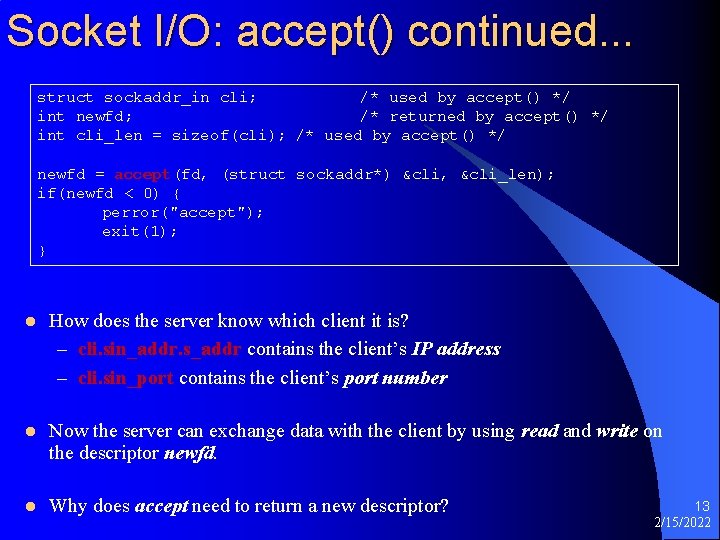
Socket I/O: accept() continued. . . struct sockaddr_in cli; /* used by accept() */ int newfd; /* returned by accept() */ int cli_len = sizeof(cli); /* used by accept() */ newfd = accept(fd, (struct sockaddr*) &cli, &cli_len); if(newfd < 0) { perror("accept"); exit(1); } l How does the server know which client it is? – cli. sin_addr. s_addr contains the client’s IP address – cli. sin_port contains the client’s port number l Now the server can exchange data with the client by using read and write on the descriptor newfd. l Why does accept need to return a new descriptor? 13 2/15/2022
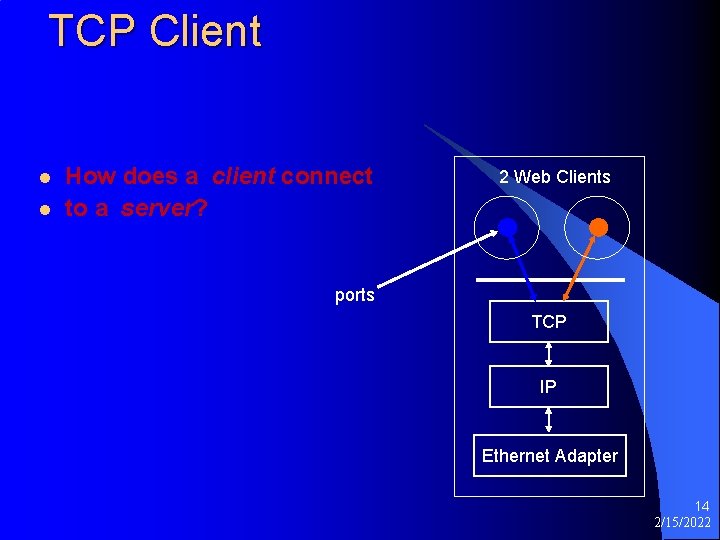
TCP Client l l How does a client connect to a server? 2 Web Clients ports TCP IP Ethernet Adapter 14 2/15/2022
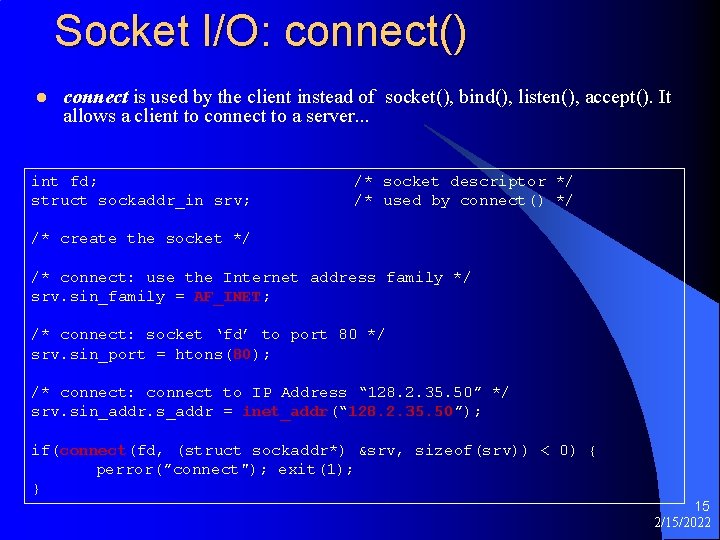
Socket I/O: connect() l connect is used by the client instead of socket(), bind(), listen(), accept(). It allows a client to connect to a server. . . int fd; struct sockaddr_in srv; /* socket descriptor */ /* used by connect() */ /* create the socket */ /* connect: use the Internet address family */ srv. sin_family = AF_INET; /* connect: socket ‘fd’ to port 80 */ srv. sin_port = htons(80); /* connect: connect to IP Address “ 128. 2. 35. 50” */ srv. sin_addr. s_addr = inet_addr(“ 128. 2. 35. 50”); if(connect(fd, (struct sockaddr*) &srv, sizeof(srv)) < 0) { perror(”connect"); exit(1); } 15 2/15/2022
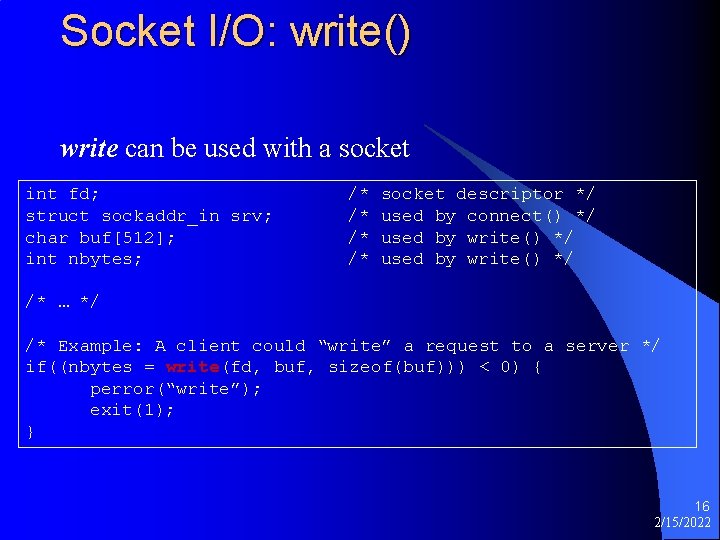
Socket I/O: write() write can be used with a socket int fd; struct sockaddr_in srv; char buf[512]; int nbytes; /* /* socket descriptor */ used by connect() */ used by write() */ /* … */ /* Example: A client could “write” a request to a server */ if((nbytes = write(fd, buf, sizeof(buf))) < 0) { perror(“write”); exit(1); } 16 2/15/2022
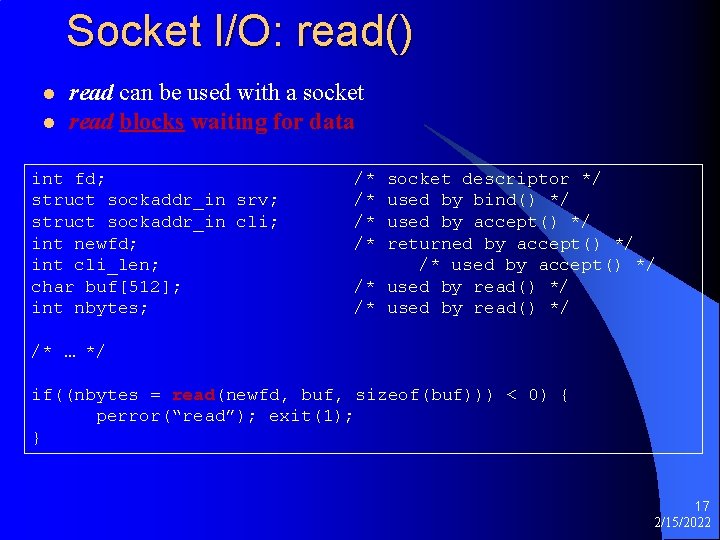
Socket I/O: read() l l read can be used with a socket read blocks waiting for data int fd; struct sockaddr_in srv; struct sockaddr_in cli; int newfd; int cli_len; char buf[512]; int nbytes; /* /* socket descriptor */ used by bind() */ used by accept() */ returned by accept() */ /* used by read() */ /* … */ if((nbytes = read(newfd, buf, sizeof(buf))) < 0) { perror(“read”); exit(1); } 17 2/15/2022
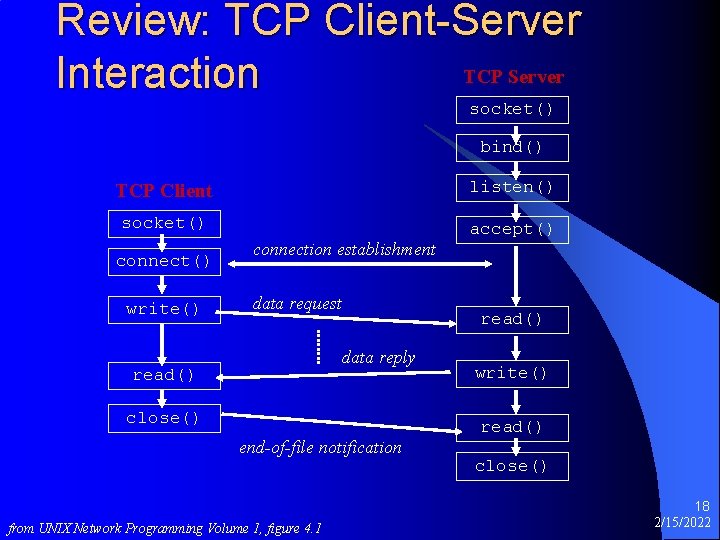
Review: TCP Client-Server TCP Server Interaction socket() bind() TCP Client listen() socket() accept() connect() write() connection establishment data request read() data reply read() close() end-of-file notification from UNIX Network Programming Volume 1, figure 4. 1 write() read() close() 18 2/15/2022
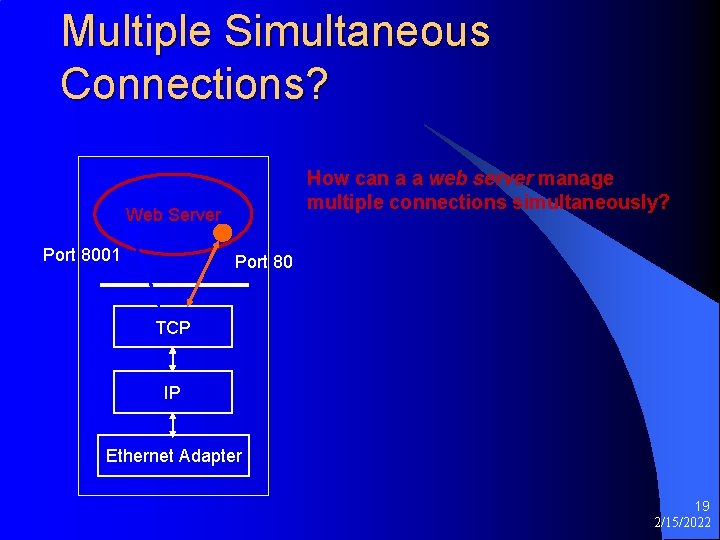
Multiple Simultaneous Connections? How can a a web server manage multiple connections simultaneously? Web Server Port 8001 Port 80 TCP IP Ethernet Adapter 19 2/15/2022
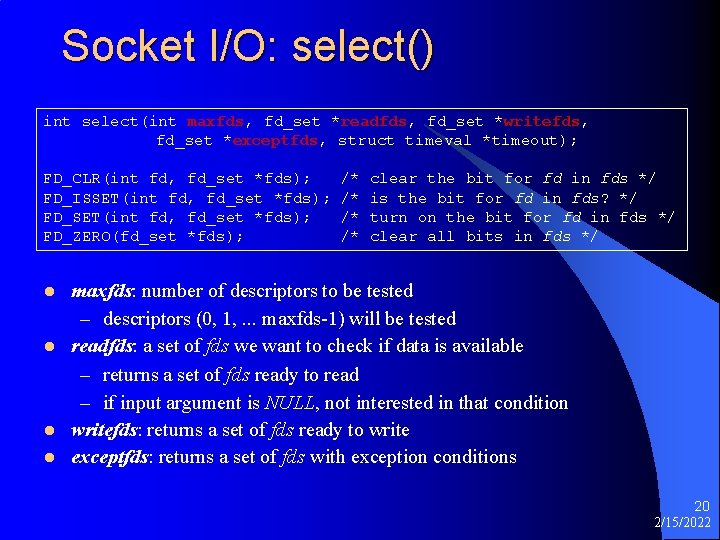
Socket I/O: select() int select(int maxfds, fd_set *readfds, fd_set *writefds, fd_set *exceptfds, struct timeval *timeout); FD_CLR(int fd, fd_set *fds); FD_ISSET(int fd, fd_set *fds); FD_ZERO(fd_set *fds); l l /* /* clear the bit for fd in fds */ is the bit for fd in fds? */ turn on the bit for fd in fds */ clear all bits in fds */ maxfds: number of descriptors to be tested – descriptors (0, 1, . . . maxfds-1) will be tested readfds: a set of fds we want to check if data is available – returns a set of fds ready to read – if input argument is NULL, not interested in that condition writefds: returns a set of fds ready to write exceptfds: returns a set of fds with exception conditions 20 2/15/2022
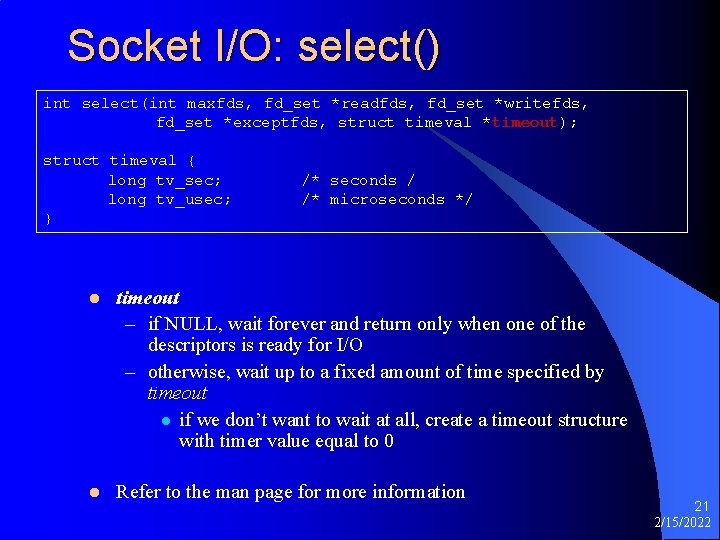
Socket I/O: select() int select(int maxfds, fd_set *readfds, fd_set *writefds, fd_set *exceptfds, struct timeval *timeout); struct timeval { long tv_sec; long tv_usec; } /* seconds / /* microseconds */ l timeout – if NULL, wait forever and return only when one of the descriptors is ready for I/O – otherwise, wait up to a fixed amount of time specified by timeout l if we don’t want to wait at all, create a timeout structure with timer value equal to 0 l Refer to the man page for more information 21 2/15/2022
Socket I/O: select() int fd, next=0; /* original socket */ int newfd[10]; /* new socket descriptors */ while(1) { fd_set readfds; FD_ZERO(&readfds); FD_SET(fd, &readfds); /* Now use FD_SET to initialize other newfd’s that have already been returned by accept() */ select(maxfd+1, &readfds, 0, 0, 0); if(FD_ISSET(fd, &readfds)) { newfd[next++] = accept(fd, . . . ); } /* do the following for each descriptor newfd[n] */ if(FD_ISSET(newfd[n], &readfds)) { read(newfd[n], buf, sizeof(buf)); /* process data */ } } l Now the TCP server can support multiple connections. . . 22 2/15/2022
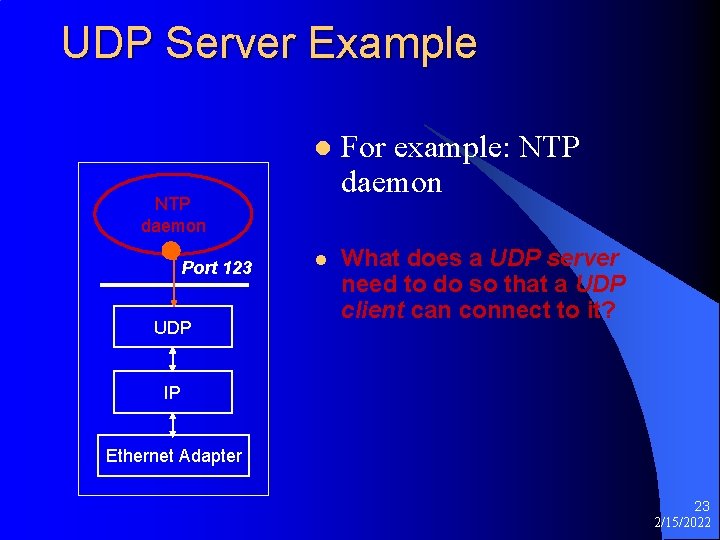
UDP Server Example l For example: NTP daemon l What does a UDP server need to do so that a UDP client can connect to it? NTP daemon Port 123 UDP IP Ethernet Adapter 23 2/15/2022
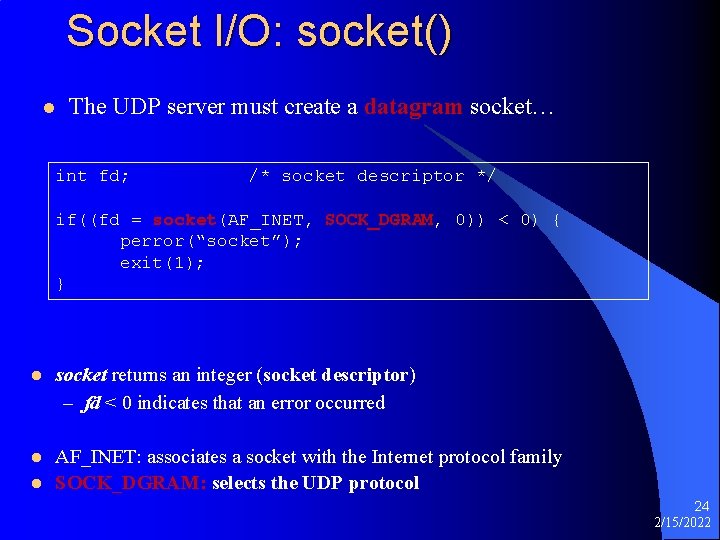
Socket I/O: socket() l The UDP server must create a datagram socket… int fd; /* socket descriptor */ if((fd = socket(AF_INET, SOCK_DGRAM, 0)) < 0) { perror(“socket”); exit(1); } l socket returns an integer (socket descriptor) – fd < 0 indicates that an error occurred l AF_INET: associates a socket with the Internet protocol family SOCK_DGRAM: selects the UDP protocol l 24 2/15/2022
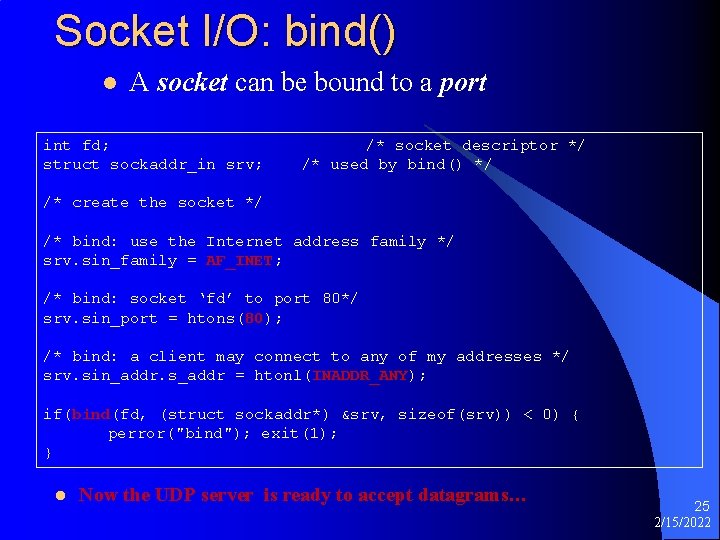
Socket I/O: bind() l A socket can be bound to a port int fd; struct sockaddr_in srv; /* socket descriptor */ /* used by bind() */ /* create the socket */ /* bind: use the Internet address family */ srv. sin_family = AF_INET; /* bind: socket ‘fd’ to port 80*/ srv. sin_port = htons(80); /* bind: a client may connect to any of my addresses */ srv. sin_addr. s_addr = htonl(INADDR_ANY); if(bind(fd, (struct sockaddr*) &srv, sizeof(srv)) < 0) { perror("bind"); exit(1); } l Now the UDP server is ready to accept datagrams… 25 2/15/2022
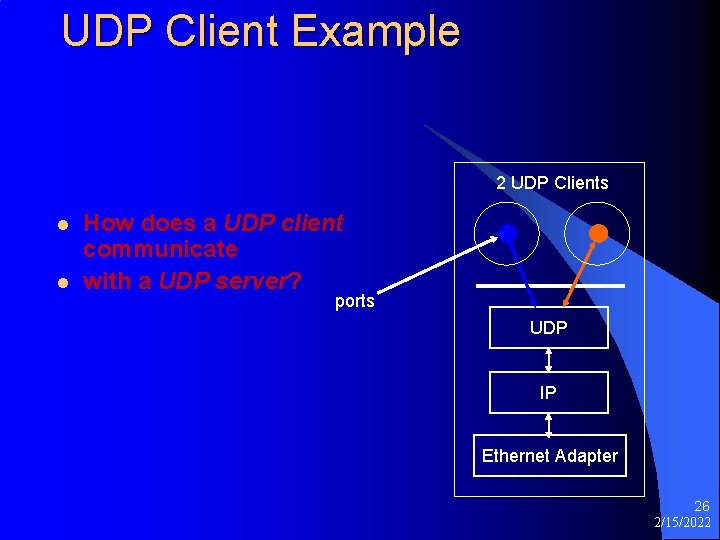
UDP Client Example 2 UDP Clients l l How does a UDP client communicate with a UDP server? ports UDP IP Ethernet Adapter 26 2/15/2022
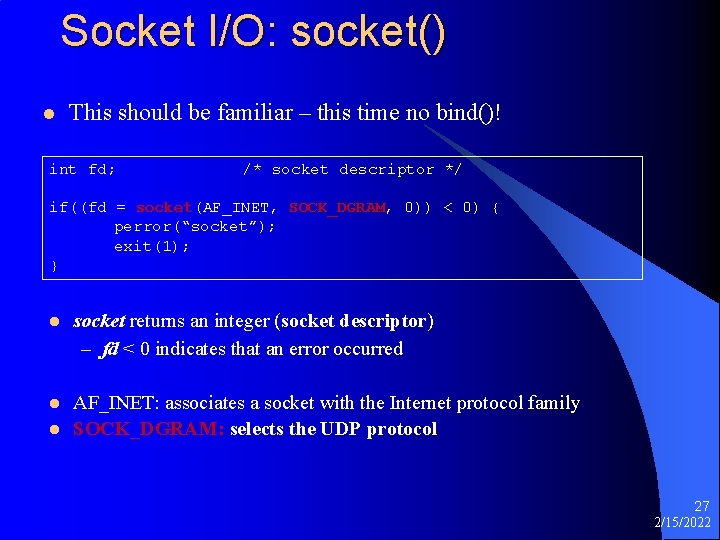
Socket I/O: socket() l This should be familiar – this time no bind()! int fd; /* socket descriptor */ if((fd = socket(AF_INET, SOCK_DGRAM, 0)) < 0) { perror(“socket”); exit(1); } l socket returns an integer (socket descriptor) – fd < 0 indicates that an error occurred l AF_INET: associates a socket with the Internet protocol family SOCK_DGRAM: selects the UDP protocol l 27 2/15/2022
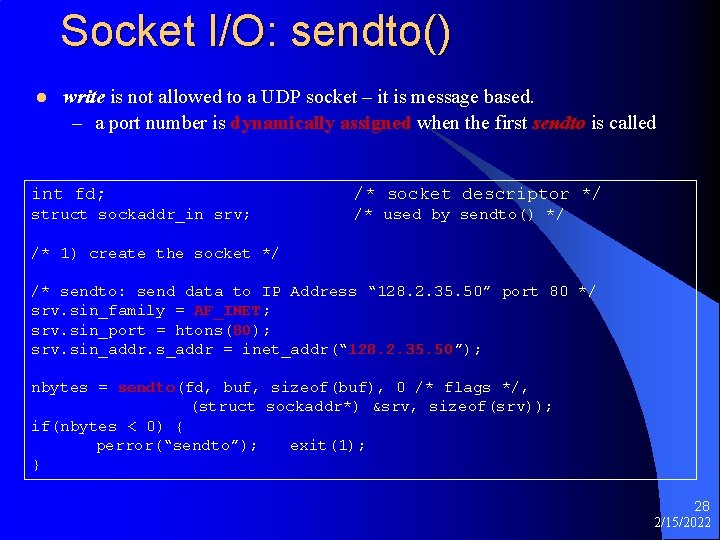
Socket I/O: sendto() l write is not allowed to a UDP socket – it is message based. – a port number is dynamically assigned when the first sendto is called int fd; /* socket descriptor */ struct sockaddr_in srv; /* used by sendto() */ /* 1) create the socket */ /* sendto: send data to IP Address “ 128. 2. 35. 50” port 80 */ srv. sin_family = AF_INET; srv. sin_port = htons(80); srv. sin_addr. s_addr = inet_addr(“ 128. 2. 35. 50”); nbytes = sendto(fd, buf, sizeof(buf), 0 /* flags */, (struct sockaddr*) &srv, sizeof(srv)); if(nbytes < 0) { perror(“sendto”); exit(1); } 28 2/15/2022
Socket I/O: recvfrom() int fd; struct sockaddr_in srv; struct sockaddr_in cli; char buf[512]; int cli_len = sizeof(cli); int nbytes; /* /* /* socket descriptor */ used by bind() */ used by recvfrom() */ /* 1) create the socket */ /* 2) bind to the socket */ nbytes = recvfrom(fd, buf, sizeof(buf), 0 /* flags */, (struct sockaddr*) &cli, &cli_len); if(nbytes < 0) { perror(“recvfrom”); exit(1); } 29 2/15/2022
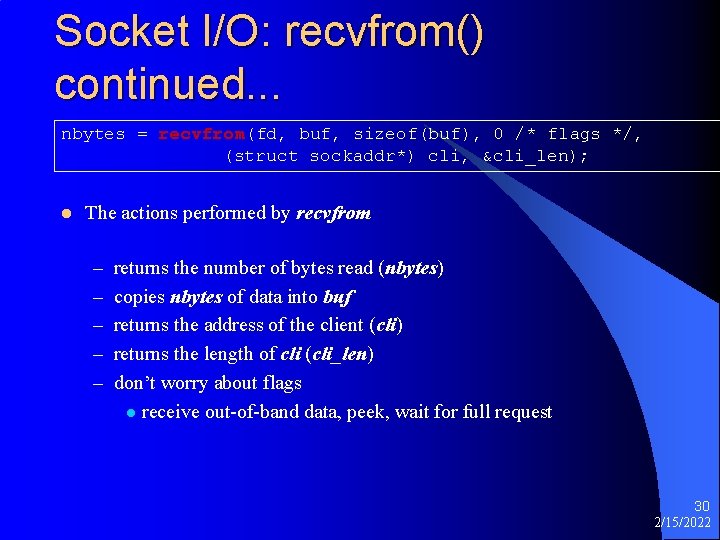
Socket I/O: recvfrom() continued. . . nbytes = recvfrom(fd, buf, sizeof(buf), 0 /* flags */, (struct sockaddr*) cli, &cli_len); l The actions performed by recvfrom – – – returns the number of bytes read (nbytes) copies nbytes of data into buf returns the address of the client (cli) returns the length of cli (cli_len) don’t worry about flags l receive out-of-band data, peek, wait for full request 30 2/15/2022
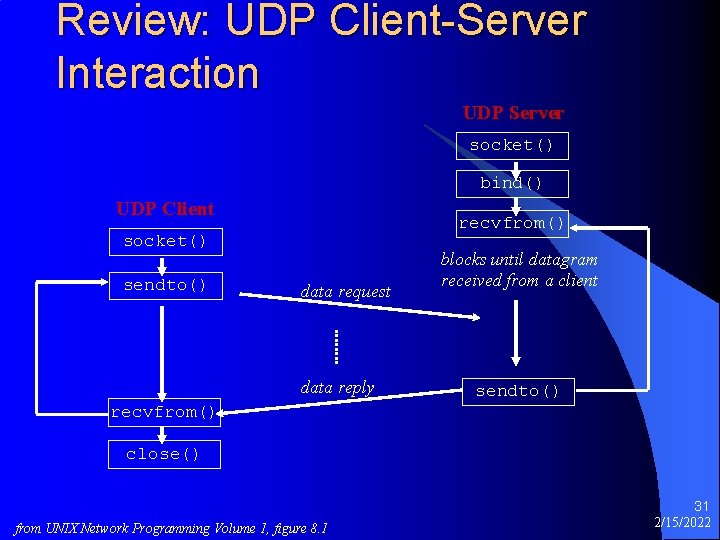
Review: UDP Client-Server Interaction UDP Server socket() bind() UDP Client recvfrom() socket() sendto() data request data reply blocks until datagram received from a client sendto() recvfrom() close() from UNIX Network Programming Volume 1, figure 8. 1 31 2/15/2022
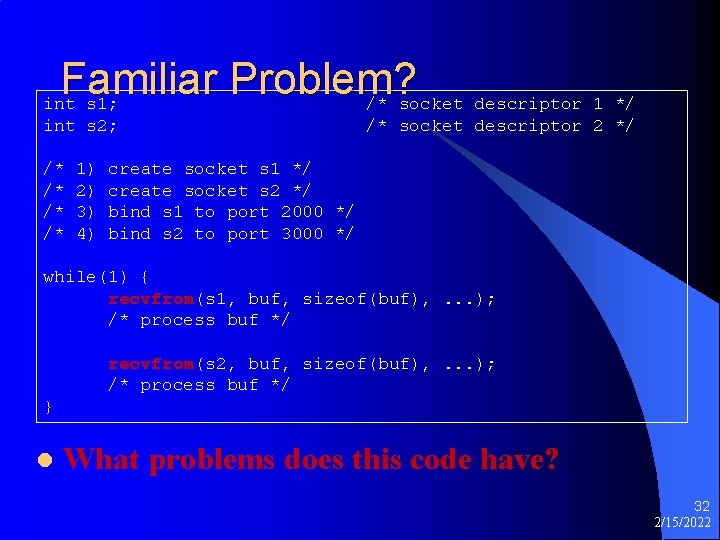
Familiar Problem? int s 1; /* socket descriptor 1 */ int s 2; /* /* 1) 2) 3) 4) /* socket descriptor 2 */ create socket s 1 */ create socket s 2 */ bind s 1 to port 2000 */ bind s 2 to port 3000 */ while(1) { recvfrom(s 1, buf, sizeof(buf), . . . ); /* process buf */ recvfrom(s 2, buf, sizeof(buf), . . . ); /* process buf */ } l What problems does this code have? 32 2/15/2022
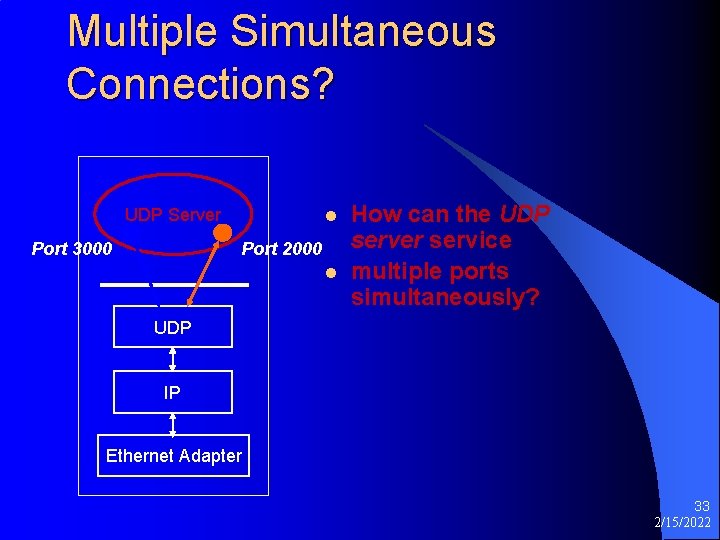
Multiple Simultaneous Connections? UDP Server Port 3000 l Port 2000 l How can the UDP server service multiple ports simultaneously? UDP IP Ethernet Adapter 33 2/15/2022
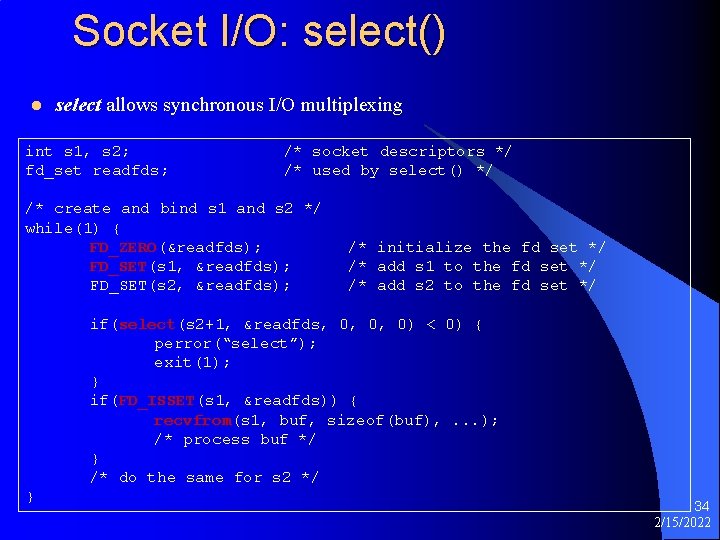
Socket I/O: select() l select allows synchronous I/O multiplexing int s 1, s 2; fd_set readfds; /* socket descriptors */ /* used by select() */ /* create and bind s 1 and s 2 */ while(1) { FD_ZERO(&readfds); FD_SET(s 1, &readfds); FD_SET(s 2, &readfds); /* initialize the fd set */ /* add s 1 to the fd set */ /* add s 2 to the fd set */ if(select(s 2+1, &readfds, 0, 0, 0) < 0) { perror(“select”); exit(1); } if(FD_ISSET(s 1, &readfds)) { recvfrom(s 1, buf, sizeof(buf), . . . ); /* process buf */ } /* do the same for s 2 */ } 34 2/15/2022