
SYSTEMIC HISTOLOGY III SERIES D Histology of Cerebral
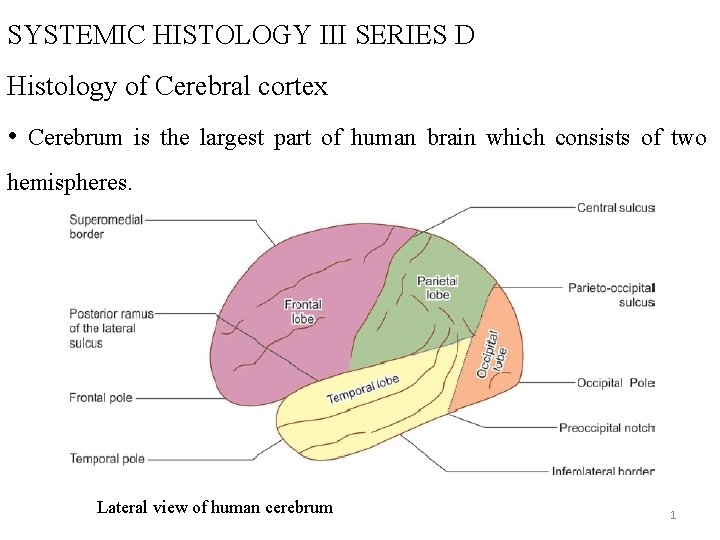
SYSTEMIC HISTOLOGY III SERIES D Histology of Cerebral cortex • Cerebrum is the largest part of human brain which consists of two hemispheres. Lateral view of human cerebrum 1
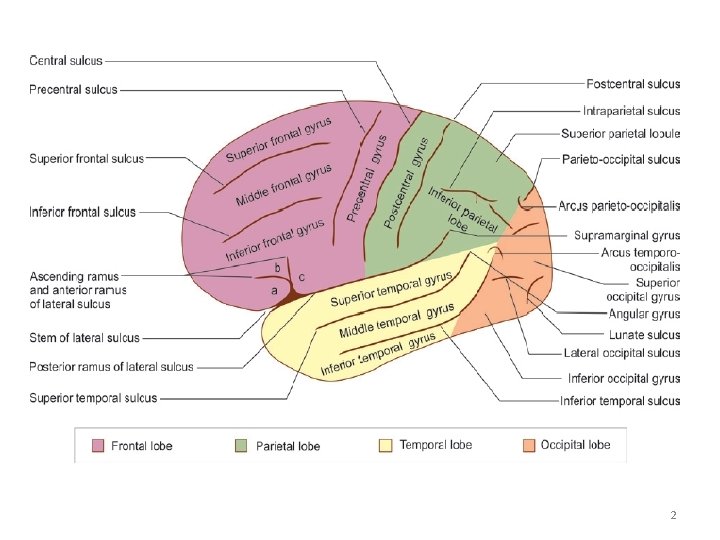
2
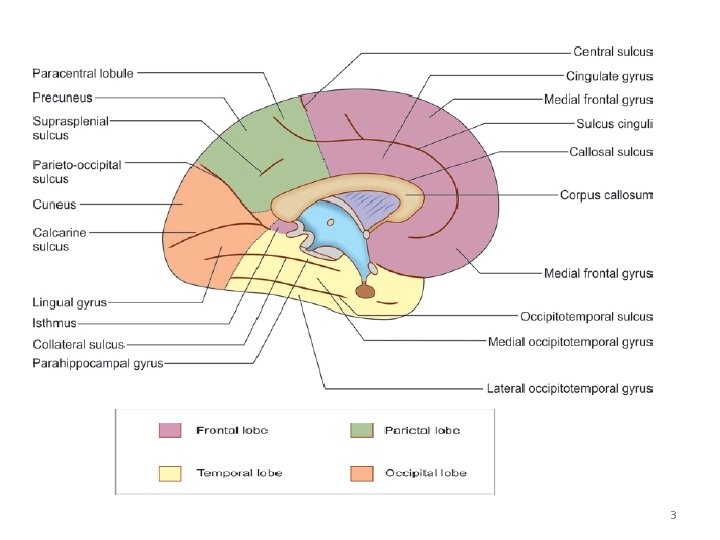
3
• Cerebrum has two components , which are the grey and white matter • the grey matter is the cerebral cortex (or pallium)which overlay the centrally located region of white matter • it is about 1 – 4 mm thick and composed of about 30 billion neurons, thinnest in primary cortex (grannular) and thick in motor (agrannular) and association cortices • motor cortex is the thickest, about 4. 5 mm. • the cortex is made of about 500 billion glial cells and 50 billion neurons 4
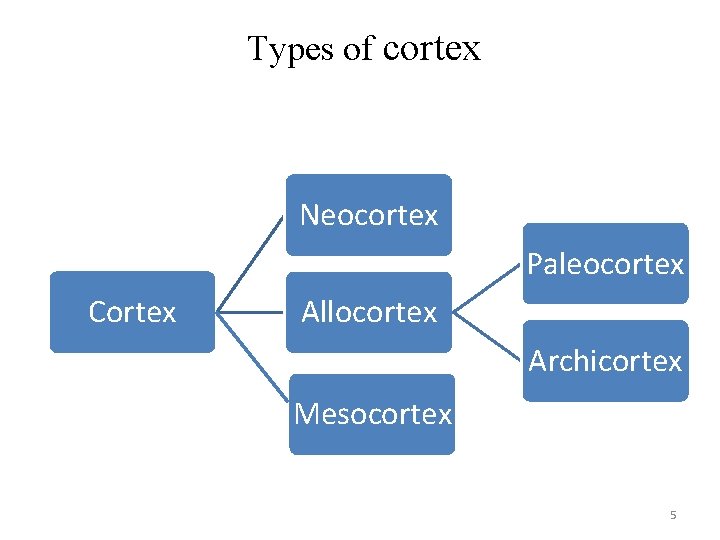
Types of cortex Neocortex Paleocortex Cortex Allocortex Archicortex Mesocortex 5
Neocortex • forms about 90% of the total cortex • also known as isocortex • it has six-layered structure • mostly homogenetic cortex (cortex showing the same 6 -laminar structure) • it is homotypical, where all 6 layers are distinct; e. g. primary sensory cortex • Heterotypical where some layers are obscure; e. g. motor and visual cortices 6
Allocortex • phylogenetically older • also known as heterogenetic cortex • 3 - layered structure • this could be; o Paleocortex. The oldest allocortex. e. g. rostral insular cortex, piriform cortex, and primary olfactory cortex o Archicortex. e. g. hippocampal formation • Mesocortex • can be called periallocortex or periarcjcortex • intermediate between neocortex and allocortex 7
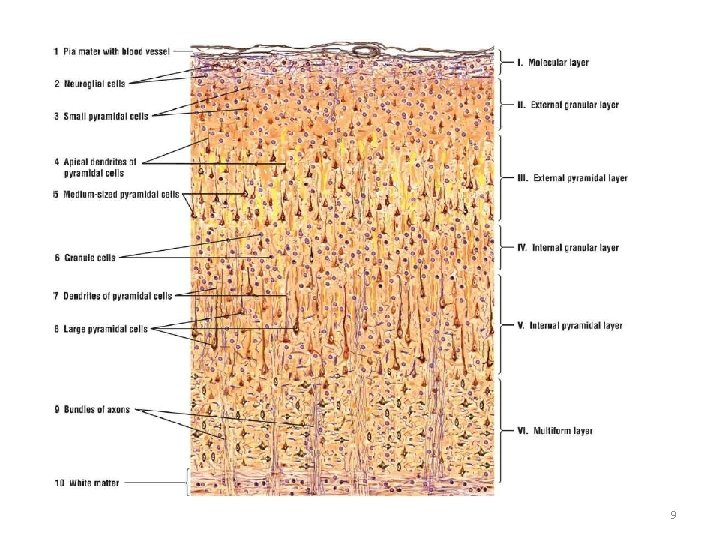
• 4 -layered structure • can be seen in cingulate gyrus, entorhinal, parahippocampal, and orbital cortices and anterior perforated substance. Neocortex has laminar arrangement. Cellular Laminae of the Neocortex • I- molecular or plexiform layer • II- external granular layer • III- external pyramidal layer • IV- internal granular layer • V- internal pyramidal or ganglionic layer • VI- multiform or fusiform or polymorphic layer 8
9

10
Descriptions of layers • Layer I consists of a dense network of nerve fibres with scattered interneurons (horizontal cells of Cajal) and neuroglia. The fibres in this layer comprise projection axons from extracortical sites as well as axons and dendrites of neurons in other cortical areas. It is essentially a synaptic area. • Layer II consists small pyramidal and stellate cells as well as axons and dendrites passing through this layer from deeper layers. • Layer III contains medium-sized pyramidal and stellate cells. It gives rise to association and commissural fibers and is the major source of corticocortical fibers. 11
• Layer IV. Most densely packed layer, containing granular and stellate cells. Stellate cells receives thalamocortical fibers from the thalamic nuclei (i. e. , ventral posterolateral, VPL and ventral posteromedial, VPM) stellate cells are specifically numerous in the primary somatic sensory cortex, primary visual cortex, and primary auditory cortex. They are described as granular cortex. But the primary motor cortex consists of few stellate cells in lamina IV and is termed agranular cortex. • Layer V. It contains few stellate cells, cells of martinotti and the giant pyramidal cells of Betz, which are found only in the motor cortex (Brodmann’s area 4). It gives rise to projection fibres to the corpus striatum, brainstem, and spinal cord as corticostriatal corticobulbar , and corticospinal fibers respectively. 12
• Layer VI. It is the major source of corticothalamic fibers. It gives rise to projection, commissural, and association fibers. Functionally, however, neocortex can be classified into three • Supragranular layer o layer III • Internal granular layer o layer IV • Infragranular layer o layer VI 13
• Supragranular layers are sites of intracortical connections e. g. Association and commisurral fibres • internal granular layer receives thalamocortical fibres. This layer is prominent in primary sensory cortex • Infragranular layers gives to projection fibres to subcortical structures. This layer is prominent in motor cortex Neuron Cell types 3 principal cell types can be found in neocortex ; • The pyramidal cells • The Stellate cells • The granular cells 14
Other cells are interneurons; • The cells of Martinotti • Fusiform cells • Horizontal cells of cajal Cerebral Cortical Cytoarchitecture • The most widely used reference map is developed by Brodmann. • In 1908 and 1909, he divided the cortex into 47 areas (Brodmann Area, BA) on the basis of cytoarchitectural differences. • These structural cortical areas correspond to the functional entities of the cortex. Central sulcus is used as reference point. 15
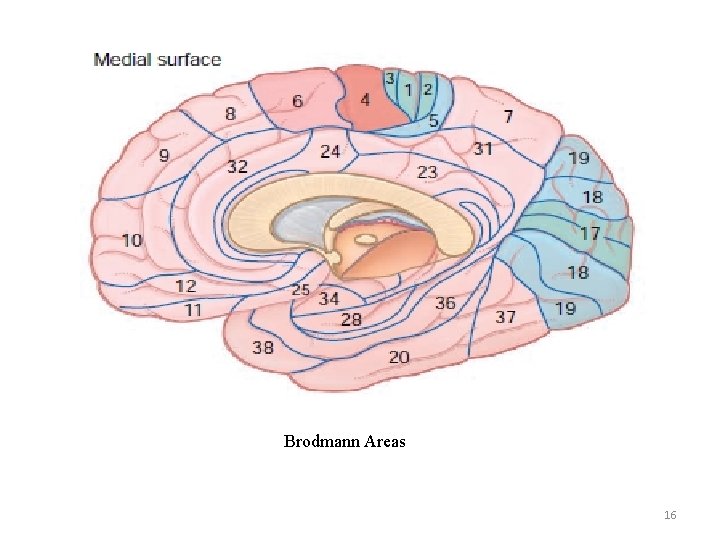
Brodmann Areas 16
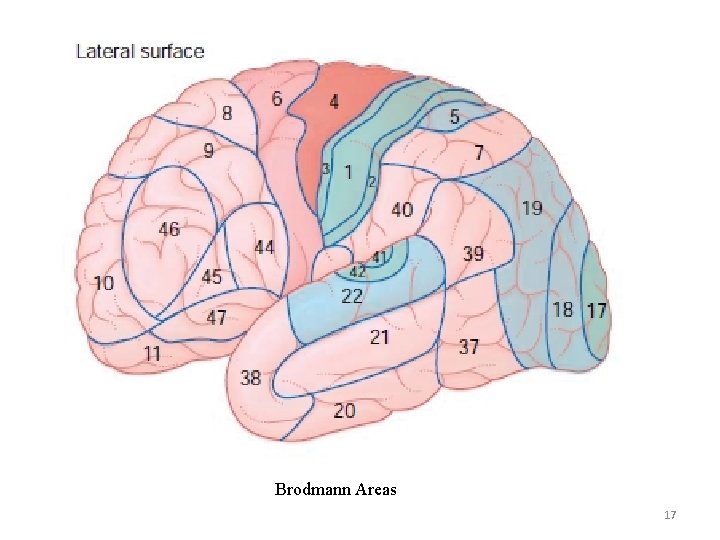
Brodmann Areas 17
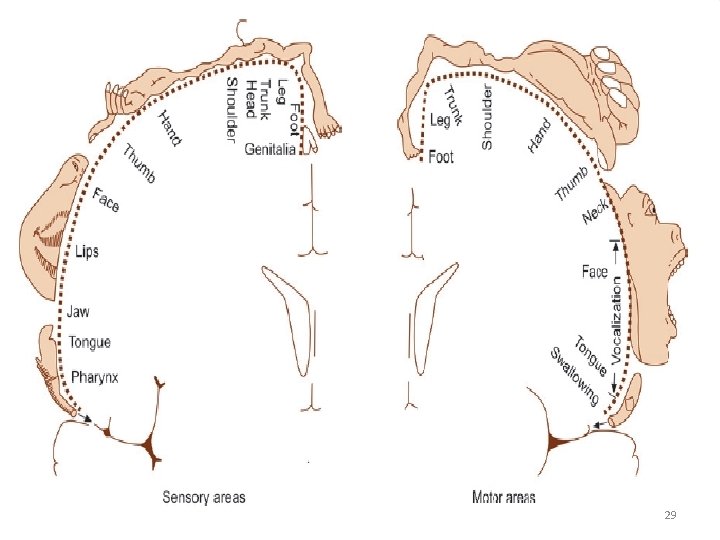
Functional Areas (Brodmann Areas) of Cerebral Cortex Sensory Areas Primary Somatosensory Cortex ( SI; areas 3, 1, and 2) • is located in the postcentral gyrus • actually four submaps, one each in area 3 a, 3 b, 1 and 2 • receives input from the VPL and VPM of the thalamus conveying impulses received via spinal, medial and trigeminal lemnisci • is somatotopically organized as the sensory homunculus which shows huge representations of sensitive areas like fingertips, lips, etc. • Stimulation results in contralateral numbness and tingling (paresthesia). • Destruction results in a contralateral loss of tactile discrimination (hypesthesia and astereognosis). 18
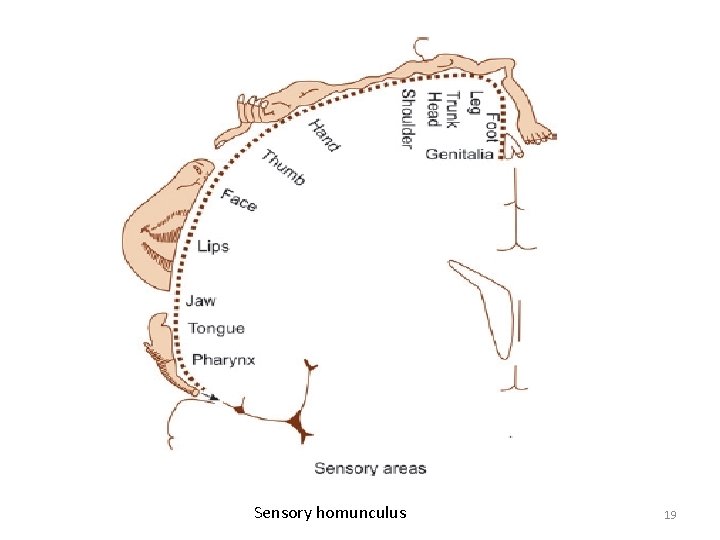
Sensory homunculus 19
Secondary Somatosensory Cortex (SII; Area 40) • lies is in the lower parietal lobe , ventral to the primary somatosensory area • receives inputs from the primary sensory cortex (SI) and less inputs from thalamus • responds to sensory stimuli bilaterally, although with much less precision than the primary cortex. • lesions to this area may impair some elements of sensory discrimination. Somatosensory Association Cortex (BA 5) • located at Superior parietal lobule 20
• receives input from primary and secondary somatosensory cortices. while posterior parietal cortex (BA 7) receives visual input from area 19, and also from auditory, vestibular cortices to achieve multimodal, higher-order sensorimotor intergrations. • Destruction results in contralateral losses of tactile discrimination, stereognosis (the ability to recognize form), and statognosis (the ability to recognize the position of body parts in space). • Destruction also leads to neglect of events occurring in the contralateral portion of the external world (more commonly seen with parietal damage on the right side- non- dominant hemisphere). 21
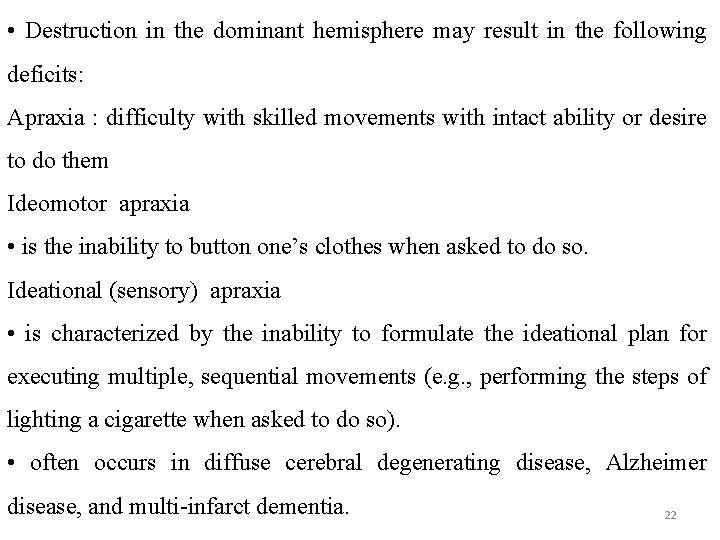
• Destruction in the dominant hemisphere may result in the following deficits: Apraxia : difficulty with skilled movements with intact ability or desire to do them Ideomotor apraxia • is the inability to button one’s clothes when asked to do so. Ideational (sensory) apraxia • is characterized by the inability to formulate the ideational plan for executing multiple, sequential movements (e. g. , performing the steps of lighting a cigarette when asked to do so). • often occurs in diffuse cerebral degenerating disease, Alzheimer disease, and multi-infarct dementia. 22
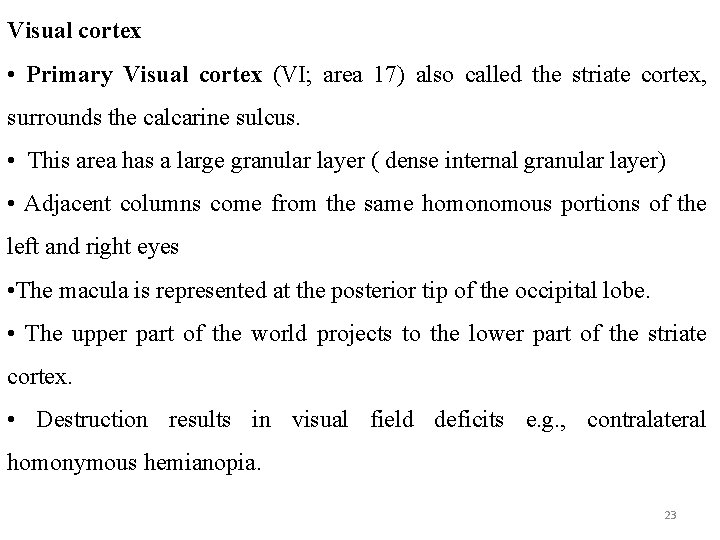
Visual cortex • Primary Visual cortex (VI; area 17) also called the striate cortex, surrounds the calcarine sulcus. • This area has a large granular layer ( dense internal granular layer) • Adjacent columns come from the same homonomous portions of the left and right eyes • The macula is represented at the posterior tip of the occipital lobe. • The upper part of the world projects to the lower part of the striate cortex. • Destruction results in visual field deficits e. g. , contralateral homonymous hemianopia. 23
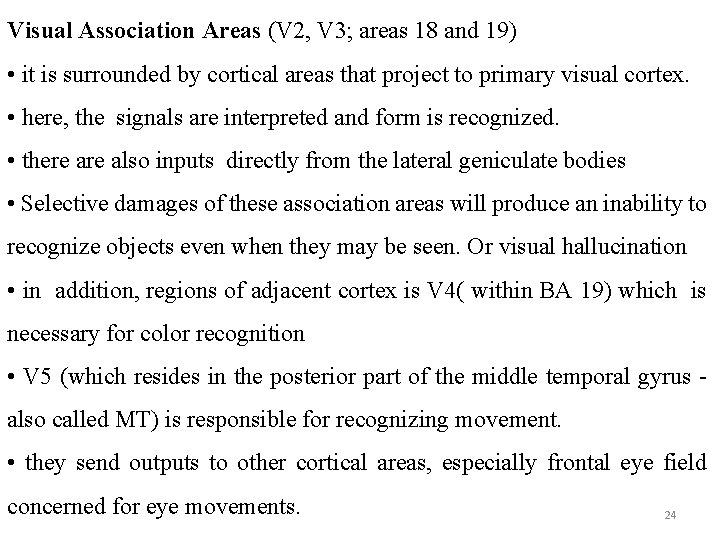
Visual Association Areas (V 2, V 3; areas 18 and 19) • it is surrounded by cortical areas that project to primary visual cortex. • here, the signals are interpreted and form is recognized. • there also inputs directly from the lateral geniculate bodies • Selective damages of these association areas will produce an inability to recognize objects even when they may be seen. Or visual hallucination • in addition, regions of adjacent cortex is V 4( within BA 19) which is necessary for color recognition • V 5 (which resides in the posterior part of the middle temporal gyrus also called MT) is responsible for recognizing movement. • they send outputs to other cortical areas, especially frontal eye field concerned for eye movements. 24
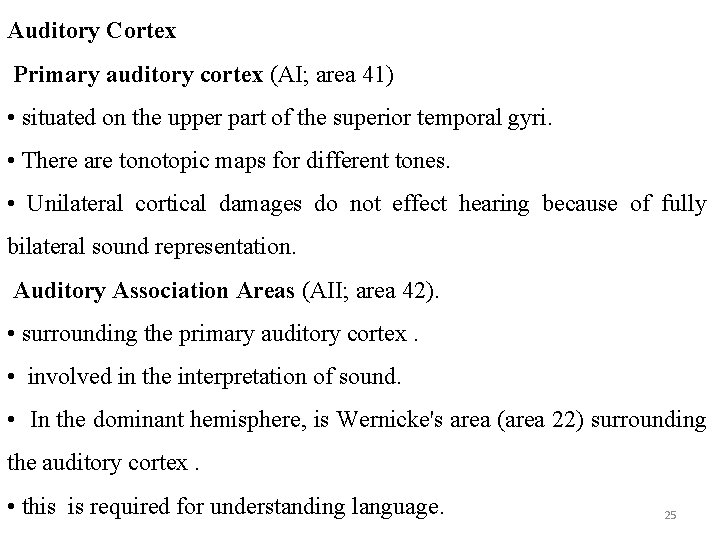
Auditory Cortex Primary auditory cortex (AI; area 41) • situated on the upper part of the superior temporal gyri. • There are tonotopic maps for different tones. • Unilateral cortical damages do not effect hearing because of fully bilateral sound representation. Auditory Association Areas (AII; area 42). • surrounding the primary auditory cortex. • involved in the interpretation of sound. • In the dominant hemisphere, is Wernicke's area (area 22) surrounding the auditory cortex. • this is required for understanding language. 25
• lesion to this area can produce inability to understand language, including written language. • however, in the nondominant hemisphere this may be involved in understanding the tone of voice. Primary Gustatory cortex (BA 43) • is located in the parietal operculum and parainsular cortex. • receives taste input from the VPM nucleus of the thalamus. Vestibular cortex (BA 2) • is located in the postcentral gyrus. • receives input from the ventral posteroinferior (VPI) and the VPL nuclei of the thalamus. . 26
Primary Motor Area (MI) • This area corresponds to the precentral gyrus ( BA 4) and functions as the primary motor cortex • it gives rise to corticospinal tract (pyramidal fibres) and corticobulbar fibres • Electrical stimulation results in contralateral movements of voluntary muscles, especially distal muscles of the limbs • it is is somatotopically organized as the motor homunculus • lesions here results in a contralateral upper motor neuron (UMN) lesion. 27
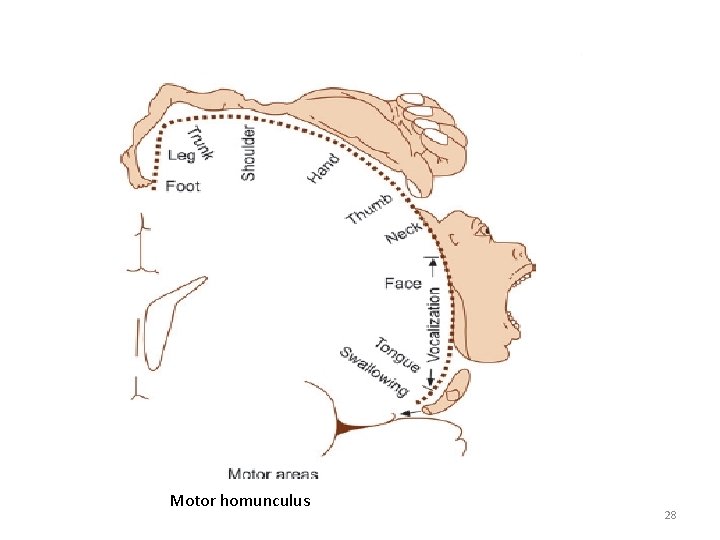
Motor homunculus 28
29
The Premotor Cortex (MII; area 6) • is anterior to the motor cortex and on the lateral surface • plays a role in the control of proximal and axial muscles; it prepares the motor cortex for specific movements in advance of their execution • It occupies the posterior parts of the superior, middle and inferior frontal gyri • has output to the primary motor cortex and input from sensory association cortex • Electrical stimulation of this area produces more complex movements than simple movements from MI • hence, Lesions here produce less severe weakness but greater spasticity than patients with isolated primary motor cortical lesions. 30
Supplementary Motor Area (MII, Area 6) • This lies on the medial surface of the cerebral hemisphere on the medial frontal gyrus • contributes to corticospinal tract • involved in planning complex motor sequences and coordinating bilateral movements • it regulates the somatosensory input into the motor cortex. • Stimulation results in vocalization with associated facial movements and coordinated movements of the limbs. • lesion can result in transient speech deficits or aphasias. • Bilateral lesions result in hypertonus of the flexor muscles but no paralysis. 31
Frontal eye field (area 8) • is located in the posterior part of the middle frontal gyrus. • projects via the corticotectobulbar tract to the contralateral gaze center of the pons (abducent nucleus). • Irritative stimulation results in conjugate deviation of the eyes to the opposite side. • however, destructive damage causes conjugate deviation of the eyes toward the side of the lesion. 32
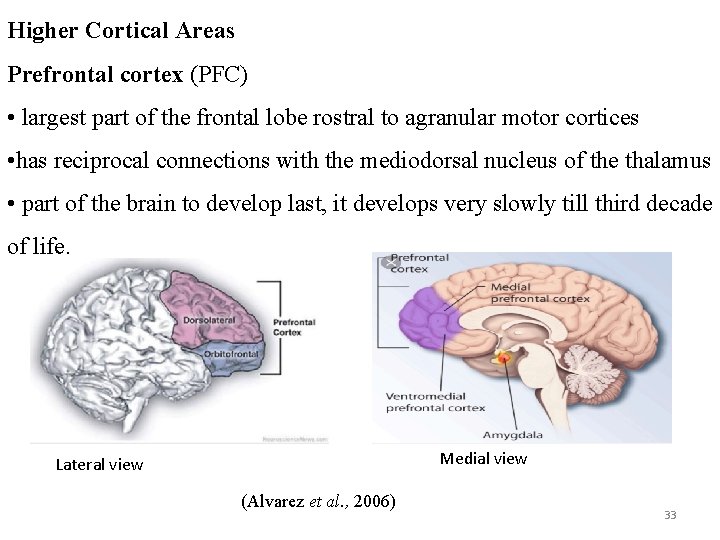
Higher Cortical Areas Prefrontal cortex (PFC) • largest part of the frontal lobe rostral to agranular motor cortices • has reciprocal connections with the mediodorsal nucleus of the thalamus • part of the brain to develop last, it develops very slowly till third decade of life. Medial view Lateral view (Alvarez et al. , 2006) 33
PFC is grossly related to • superior frontal gyrus • Medial frontal gyrus • Inferior frontal gyrus • anterior part of cingulate gyrus It corresponds to the following Brodmann Areas 8, 9, 10, 11, 12, 13, 14, 25, 32, 46, sometimes; 44, 45, 46, 47 It can be classified into • dorsolateral • orbitofrontal • medial 34
Functions of Dorsolateral PFC Executive functions; • working memory • judgment • planning • temporal organisation or sequencing of activity • abstract reasoning and top down regulation of attention Functions of Orbitofrontal / orbitomedial • impulse control, • personality • appropriate social behaviour • emotion or mood( especially anterior cingulate gyrus; BA 24, 25) 35
Multimodal association areas have reciprocal connections with PFC Clinical importance Dorsolateral • Schizophrenia • Autism Spectrum disorder • Attention Deficit Hypersensitive Disorder • Parkinson’s and Huntington’s Disorder Orbitofrontal or Orbitomedial • Bipolar Disorder • Major Depressive Disorder • frontal lobe syndrome (Phineas Gage syndrome) 36
Globally, • Traumatic brain injury • Alzheimer’s Disease Afferent and efferent fibers in the cerebral cortex Efferent fibres are usually • Projection fibres o corticospinal o corticobulbar o corticostriatal • Association fibres o intracortical – short association fibres 37
o corticocortical- long association fibres • commissural fibres o corpus callosum Afferent fibres • Projection fibres o Thalamocortical o Lemnisci- spinal, medial, trigeminal • association fibres o fibres running among the cortical layers • commissural fibres o fibres running in corpus callosum 38
- Slides: 38