
SYSTEMIC ASSESSMENT AS A VEHICLE TO ASSESS STUDENT
![INTRODUCTION -Systemic Assessment [SA] has been shown to be highly effective new vehicle in;](https://slidetodoc.com/presentation_image/4088c34b541fee3d8fff905ee220c0bc/image-2.jpg "INTRODUCTION -Systemic Assessment [SA] has been shown to be highly effective new vehicle in;")
![Why Systemic Assessment (SA) ? [1] It measures the cognitive structure from the cumulative](https://slidetodoc.com/presentation_image/4088c34b541fee3d8fff905ee220c0bc/image-3.jpg "Why Systemic Assessment (SA) ? [1] It measures the cognitive structure from the cumulative")
![[ 5 ] Assess the students in a wide range of Concepts in the](https://slidetodoc.com/presentation_image/4088c34b541fee3d8fff905ee220c0bc/image-4.jpg "[ 5 ] Assess the students in a wide range of Concepts in the")
![Types Systemic Assessment Questions: [SAQ, s] 1 - Systemic Multiple Choice Questions [SMCQ, s].](https://slidetodoc.com/presentation_image/4088c34b541fee3d8fff905ee220c0bc/image-6.jpg "Types Systemic Assessment Questions: [SAQ, s] 1 - Systemic Multiple Choice Questions [SMCQ, s].")
![Type-2: Systemic True False Questions [STFQ, s] STFQ, s are well suited for testing](https://slidetodoc.com/presentation_image/4088c34b541fee3d8fff905ee220c0bc/image-11.jpg "Type-2: Systemic True False Questions [STFQ, s] STFQ, s are well suited for testing")
![Type. 3 : SYSTEMIC MATCHING QUESTIONS: [SMQ, s] Measure the student's ability to find](https://slidetodoc.com/presentation_image/4088c34b541fee3d8fff905ee220c0bc/image-17.jpg "Type. 3 : SYSTEMIC MATCHING QUESTIONS: [SMQ, s] Measure the student's ability to find")
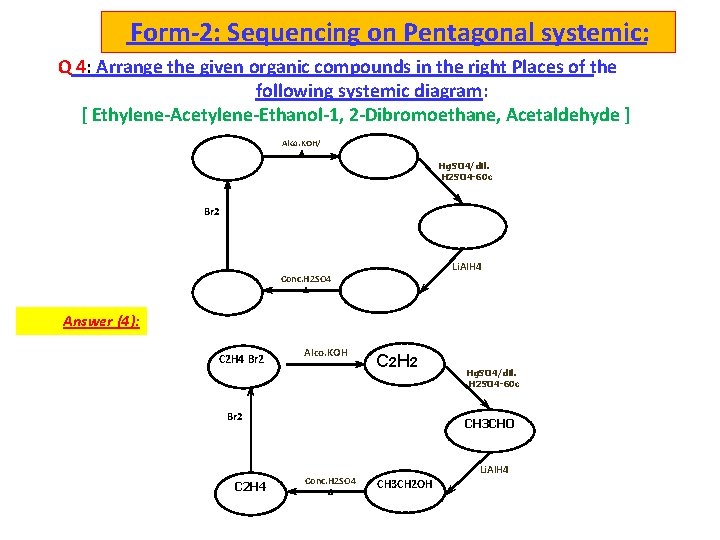
![Type-4: Systemic Sequencing Question [SSQ, s] Measure the student's ability to find the relationship](https://slidetodoc.com/presentation_image/4088c34b541fee3d8fff905ee220c0bc/image-23.jpg "Type-4: Systemic Sequencing Question [SSQ, s] Measure the student's ability to find the relationship")
![Type-5: Systemic Synthesis Questions [SSn. Q, s] SSQ, s means synthesize systemic relations between](https://slidetodoc.com/presentation_image/4088c34b541fee3d8fff905ee220c0bc/image-29.jpg "Type-5: Systemic Synthesis Questions [SSn. Q, s] SSQ, s means synthesize systemic relations between")
![Requierments for building [SSn. Q, s] 1 - The stem of the questions contains](https://slidetodoc.com/presentation_image/4088c34b541fee3d8fff905ee220c0bc/image-30.jpg "Requierments for building [SSn. Q, s] 1 - The stem of the questions contains")
![Type-6: Systemic Analysis Questions [SSAn. Q, s] Requires the Student to Analyze the given](https://slidetodoc.com/presentation_image/4088c34b541fee3d8fff905ee220c0bc/image-34.jpg "Type-6: Systemic Analysis Questions [SSAn. Q, s] Requires the Student to Analyze the given")

- Slides: 40
SYSTEMIC ASSESSMENT AS A VEHICLE TO ASSESS STUDENT ACHEIVEMENTS IN CHEMISTRY By Prof. A. F. M. FAHMY 1 st ACRICE –W-1 Dec. 3 -4. 2013
INTRODUCTION -Systemic Assessment [SA] has been shown to be highly effective new vehicle in; -Raising the level of students academic achievements. -Increasing equity of students learning outcomes. -Improving students’ ability to learn by enhancing the process of teaching and learning. -Involving the student as an active candidate in this process.
Why Systemic Assessment (SA) ? [1] It measures the cognitive structure from the cumulative (quantitative) to the interactive and tuned (qualitative). [2] Assess students higher-order thinking skills in which students are required to analyze, synthesize, and evaluate. [3] Measures the students’ ability to correlate between concepts. [4] Enables the students to discover new relation between concepts.
[ 5 ] Assess the students in a wide range of Concepts in the course unites. [ 6 ] Measures the systemic ILO, s, beside separate Linear ILO, s. [ 7 ] Develop the ability to think systemically, critically and creatively, and Solve problems. [ 8 ] Being objective, realistic and valid. [ 9 ] Very easily scored.
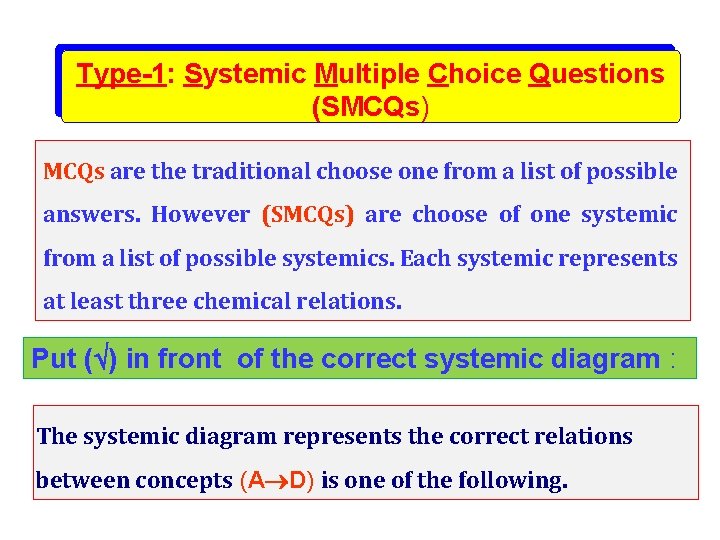
Goal of Systemic Assessment: - The main Goal of SA is to enhance, support and improve both teaching and learning processes via: 1] Enable students to make feedback and feed forward during their study of any course materials. [2]Help students in making maximum connections between Chemistry concepts, compounds, and reactions. [3] Enable students to achieve the highest standards they able. Help teachers to use evidence of student learning to assess student achievement against goals and standards of the courses and programs. .
Types Systemic Assessment Questions: [SAQ, s] 1 - Systemic Multiple Choice Questions [SMCQ, s]. 2 -Systemic True, False Questions [STFQ, s]. 3 -Systemic Matching Questions [SMQ, s]. 4 -Systemic Sequencing Questions [SSQ, s]. 5 -Systemic Synthesis Questions [SSn. Q, s]. 6 - Systemic Analysis Questions [SAn. Q, s].
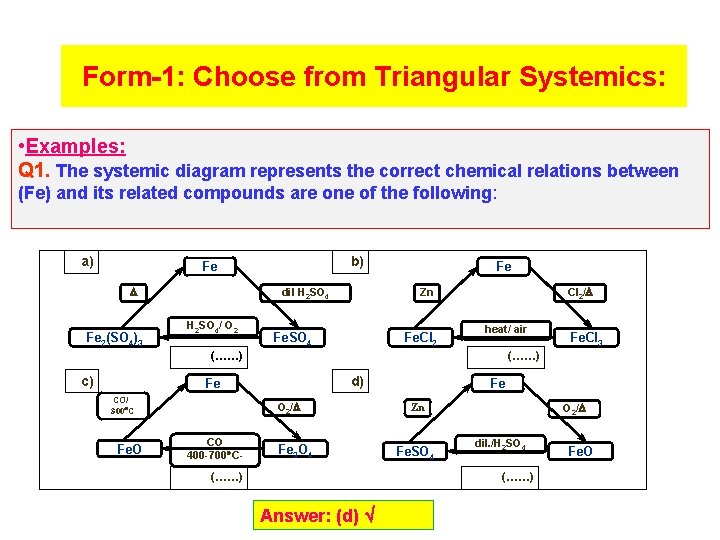
Type-1: Systemic Multiple Choice Questions (SMCQs) MCQs are the traditional choose one from a list of possible answers. However (SMCQs) are choose of one systemic from a list of possible systemics. Each systemic represents at least three chemical relations. Put ( ) in front of the correct systemic diagram : The systemic diagram represents the correct relations between concepts (A D) is one of the following.
Form-1: Choose from Triangular Systemics: • Examples: Q 1. The systemic diagram represents the correct chemical relations between (Fe) and its related compounds are one of the following: a) b) Fe 2(SO 4)3 dil H 2 SO 4/ O 2 Fe Cl 2/ Zn Fe. SO 4 Fe. Cl 2 heat/ air (……) c) (……) d) Fe CO/ 300 C Fe. O O 2/ CO 400 -700 C- Fe. Cl 3 Fe 3 O 4 Fe O 2/ Zn Fe. SO 4 dil. /H 2 SO 4 (……) Answer: (d) Fe. O
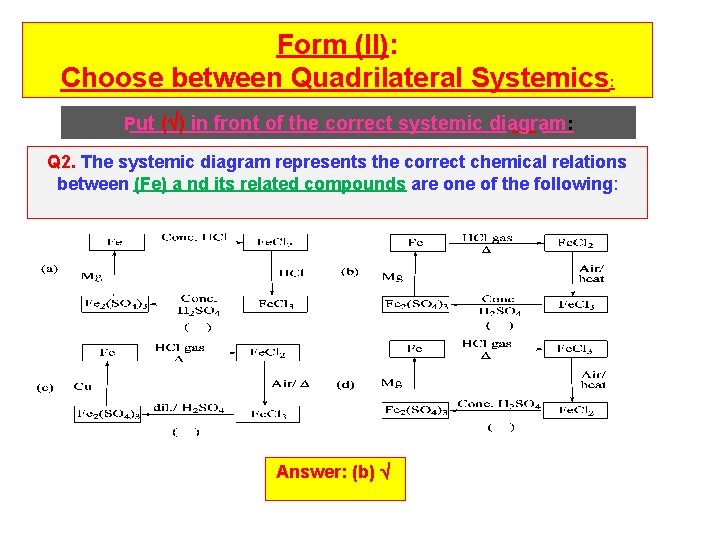
Form (II): Choose between Quadrilateral Systemics: Put ( ) in front of the correct systemic diagram: Q 2. The systemic diagram represents the correct chemical relations between (Fe) a nd its related compounds are one of the following: Answer: (b)
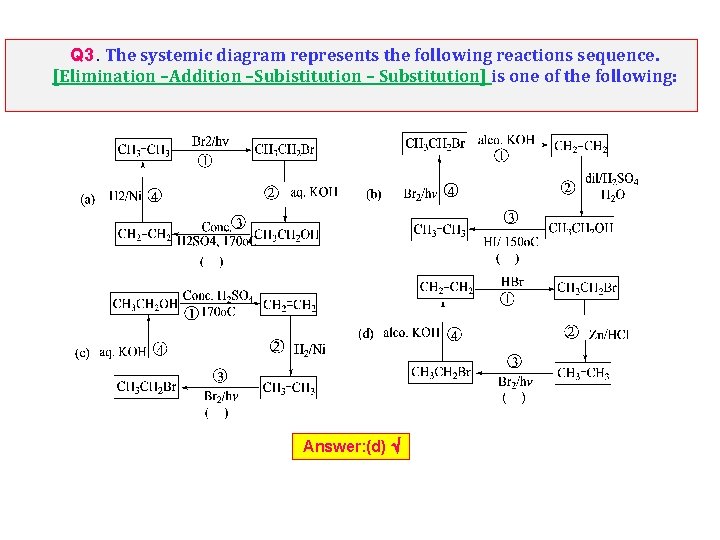
Q 3. The systemic diagram represents the following reactions sequence. [Elimination –Addition –Subistitution – Substitution] is one of the following: Answer: (d)
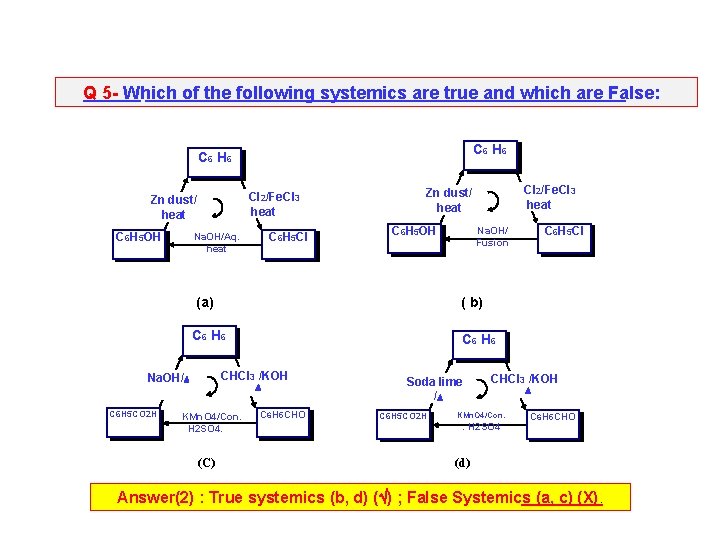
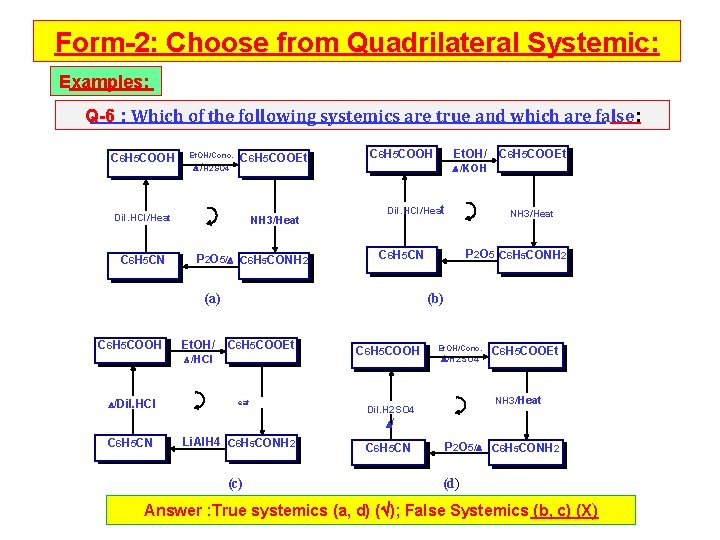
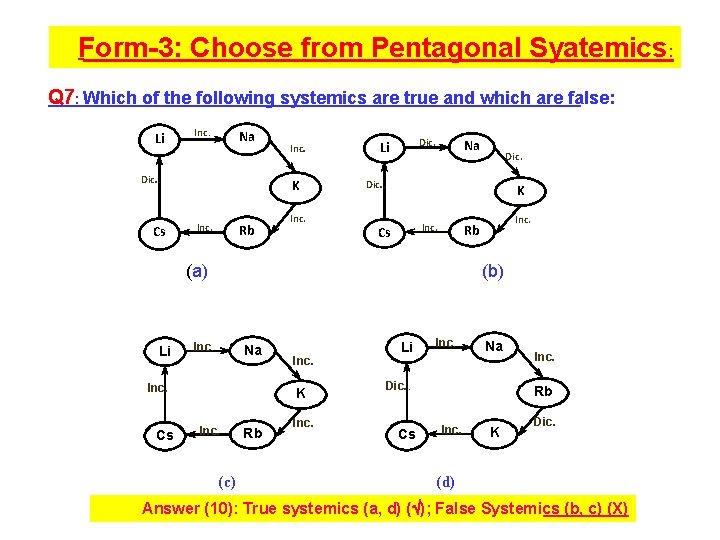
Type-2: Systemic True False Questions [STFQ, s] STFQ, s are well suited for testing student comprehension, synthesis and analysis, and require a student to assess whether the systemic is true or false. Advantages of [STFQ, S] 1 - Students can respond to many STFQ, s, covering a lot of concepts & facts and their relations in a short time. 2 -Can assess higher-order thinking skills in which students are able to analyze, synthesize, and evaluate. 3 -Scores are more reliable than for items that are partially dependent on the teacher's judgment. 4 - Teacher's can easily score STFQ, s.
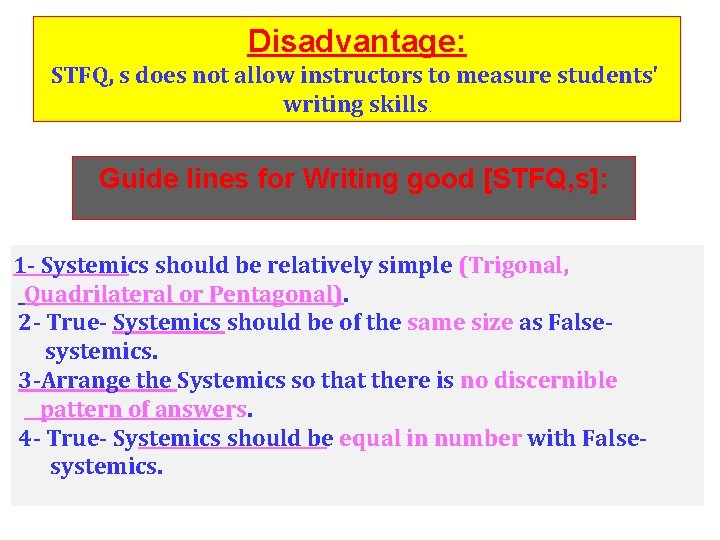
Disadvantage: STFQ, s does not allow instructors to measure students' writing skills. Guide lines for Writing good [STFQ, s]: 1 - Systemics should be relatively simple (Trigonal, Quadrilateral or Pentagonal). 2 - True- Systemics should be of the same size as Falsesystemics. 3 -Arrange the Systemics so that there is no discernible pattern of answers. 4 - True- Systemics should be equal in number with Falsesystemics.
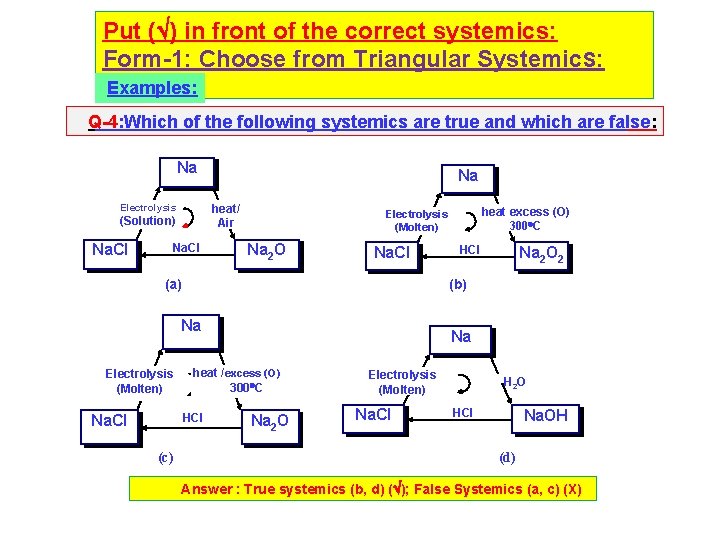
Put ( ) in front of the correct systemics: Form-1: Choose from Triangular Systemic. S: Examples: Q-4: Which of the following systemics are true and which are false: Na Electrolysis heat/ Air (Solution) Na. Cl Na 2 O Na. Cl (a) Na. Cl Na heat /excess (O) 300 C HCl (c) Na 2 O 2 HCl (b) Na Electrolysis (Molten) heat excess (O) 300 C Electrolysis (Molten) Na 2 O Electrolysis (Molten) Na. Cl H 2 O Na. OH HCl (d) Answer : True systemics (b, d) ( ); False Systemics (a, c) (X)
Q 5 - Which of the following systemics are true and which are False: C 6 H 6 Cl 2/Fe. Cl 3 heat Zn dust/ heat C 6 H 5 OH ( b) C 6 H 6 CHCl 3 /KOH KMn. O 4/Con. H 2 SO 4. (C) C 6 H 5 CHO Soda lime / C 6 H 5 CO 2 H C 6 H 5 Cl Na. OH/ Fusion (a) Na. OH/ C 6 H 5 CO 2 H C 6 H 5 Cl Na. OH/Aq. heat Cl 2/Fe. Cl 3 heat Zn dust/ heat CHCl 3 /KOH KMn. O 4/Con. . H 2 SO 4 C 6 H 5 CHO (d) Answer(2) : True systemics (b, d) ( ) ; False Systemics (a, c) (X).
Form-2: Choose from Quadrilateral Systemic: Examples: Q-6 : Which of the following systemics are true and which are false: C 6 H 5 COOH Et. OH/Conc. /H 2 SO 4 C 6 H 5 COOEt Dil. HCl/Heat C 6 H 5 CN NH 3/Heat P 2 O 5/ C 6 H 5 CONH 2 C 6 H 5 COOH Dil. HCl/Heat Et. OH/ P 2 O 5 C 6 H 5 CONH 2 (b) C 6 H 5 COOEt /HCl /Dil. HCl C 6 H 5 COOEt NH 3/Heat C 6 H 5 CN (a) C 6 H 5 COOH Et. OH/ /KOH eat C 6 H 5 COOH Et. OH/Conc. /H 2 SO 4 C 6 H 5 COOEt NH 3/Heat Dil. H 2 SO 4 / C 6 H 5 CN Li. Al. H 4 C 6 H 5 CONH 2 (c) C 6 H 5 CN P 2 O 5/ C 6 H 5 CONH 2 (d) ) Answer : True systemics (a, d) ( ); False Systemics (b, c) (X)
Form-3: Choose from Pentagonal Syatemics: Q 7: Which of the following systemics are true and which are false: Li Inc. Na Dic. . Cs Inc. K Inc. Rb Inc. Dic. Li Na Dic. . K Inc. Cs (b) Inc. Na Inc. Cs Inc. Rb (a) Li Dic. Inc. K Inc. (c) Rb Inc. Li Inc. Na Dic. . Cs Inc. Rb Inc. K Dic. (d) Answer (10): True systemics (a, d) ( ); False Systemics (b, c) (X)
Type. 3 : SYSTEMIC MATCHING QUESTIONS: [SMQ, s] Measure the student's ability to find the relationship between a set of similar items, each of which has two components. Guide lines for Writing [SMQ, s]: 1 -The items in the left (Column A) are usually called premises and assigned numbers (1, 2, 3, etc. ). 2 -The items in the right (Column B) are called responses and designated by capital letters (A, B, C etc).
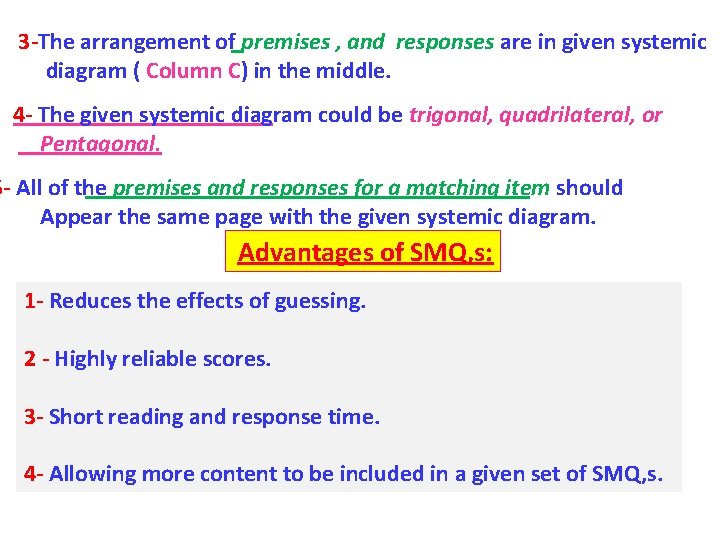
3 -The arrangement of premises , and responses are in given systemic diagram ( Column C) in the middle. 4 - The given systemic diagram could be trigonal, quadrilateral, or Pentagonal. 5 - All of the premises and responses for a matching item should Appear the same page with the given systemic diagram. Advantages of SMQ, s: 1 - Reduces the effects of guessing. 2 - Highly reliable scores. 3 - Short reading and response time. 4 - Allowing more content to be included in a given set of SMQ, s.
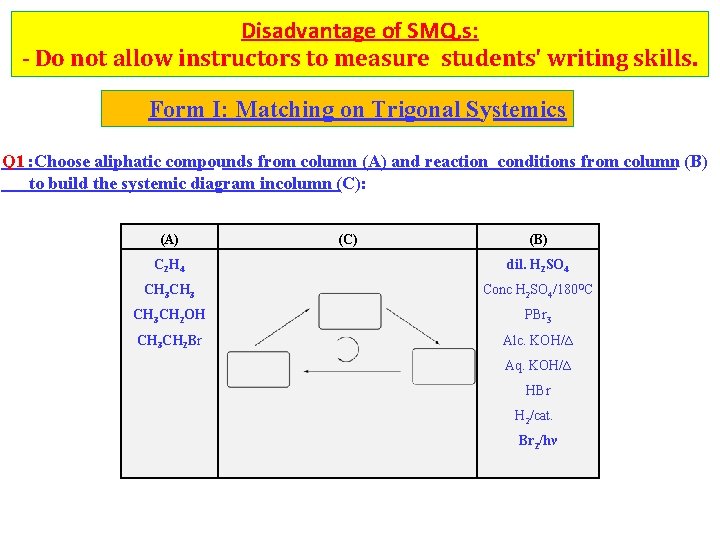
Disadvantage of SMQ, s: - Do not allow instructors to measure students' writing skills. Form I: Matching on Trigonal Systemics Q 1 : Choose aliphatic compounds from column (A) and reaction conditions from column (B) to build the systemic diagram incolumn (C): (A) (C) (B) C 2 H 4 dil. H 2 SO 4 CH 3 Conc H 2 SO 4/180 OC CH 3 CH 2 OH PBr 3 CH 3 CH 2 Br Alc. KOH/∆ Aq. KOH/∆ HBr H 2/cat. Br 2/hν
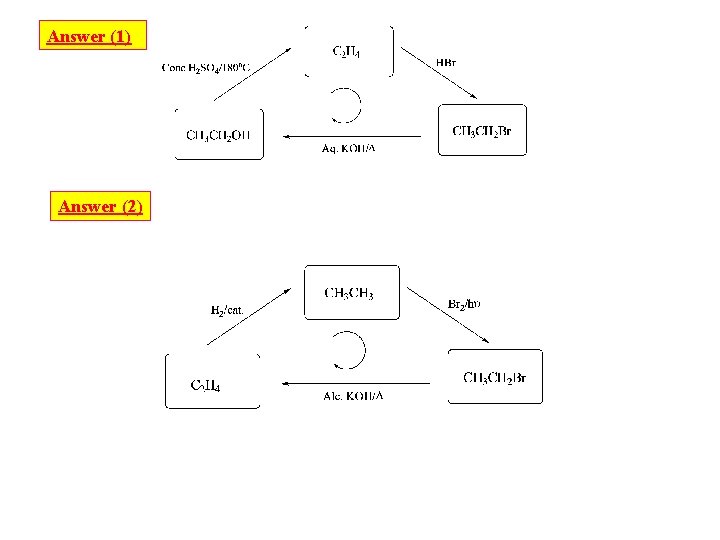
Answer (1) Answer (2)
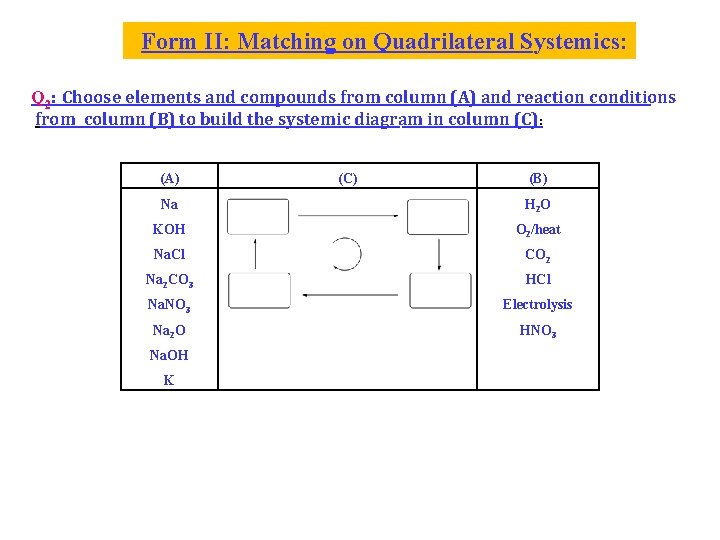
Form II: Matching on Quadrilateral Systemics: Q 2: Choose elements and compounds from column (A) and reaction conditions from column (B) to build the systemic diagram in column (C): (A) (C) (B) Na H 2 O KOH O 2/heat Na. Cl CO 2 Na 2 CO 3 HCl Na. NO 3 Electrolysis Na 2 O HNO 3 Na. OH K
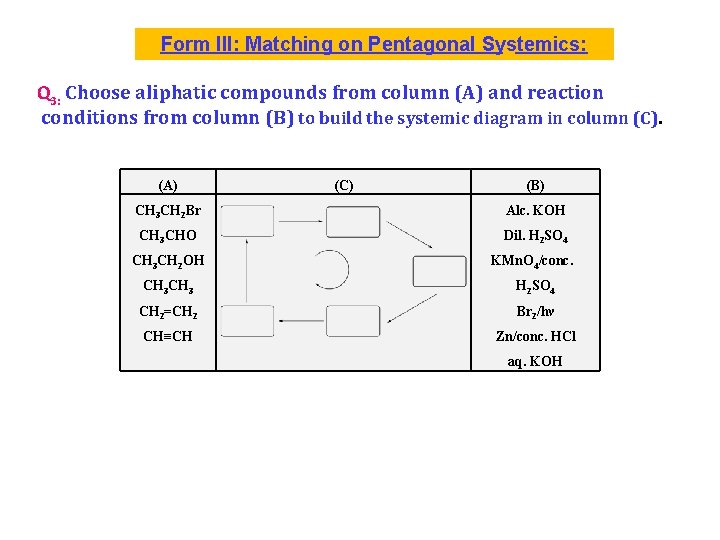
Form III: Matching on Pentagonal Systemics: Q 3: Choose aliphatic compounds from column (A) and reaction conditions from column (B) to build the systemic diagram in column (C). (A) (C) (B) CH 3 CH 2 Br Alc. KOH CH 3 CHO Dil. H 2 SO 4 CH 3 CH 2 OH KMn. O 4/conc. CH 3 H 2 SO 4 CH 2=CH 2 Br 2/hν CH≡CH Zn/conc. HCl aq. KOH
Type-4: Systemic Sequencing Question [SSQ, s] Measure the student's ability to find the relationship between a set of similar items, each of which has two components, and arrange them in a given systemic.
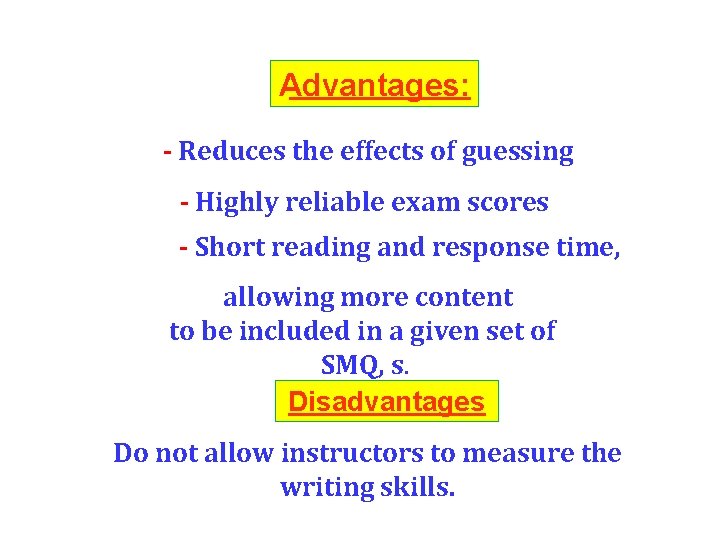
Advantages: - Reduces the effects of guessing - Highly reliable exam scores - Short reading and response time, allowing more content to be included in a given set of SMQ, s. Disadvantages Do not allow instructors to measure the writing skills.
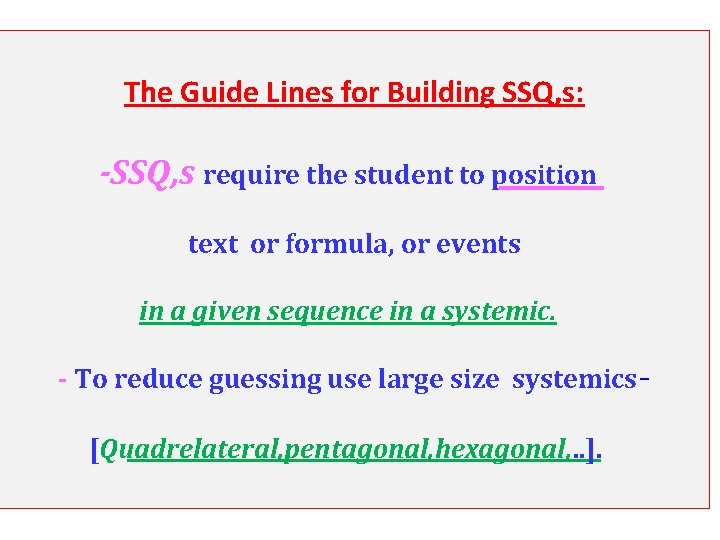
The Guide Lines for Building SSQ, s: -SSQ, s require the student to position text or formula, or events in a given sequence in a systemic. - To reduce guessing use large size systemics[Quadrelateral, pentagonal, hexagonal, . . ].
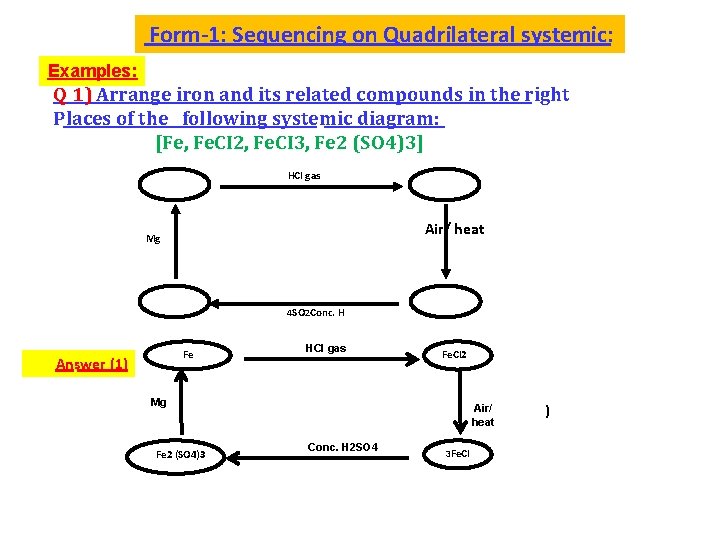
Form-1: Sequencing on Quadrilateral systemic: Examples: Q 1) Arrange iron and its related compounds in the right Places of the following systemic diagram: [Fe, Fe. CI 2, Fe. CI 3, Fe 2 (SO 4)3] HCl gas Air/ heat Mg 4 SO 2 Conc. H Fe Answer (1) HCl gas Fe. Cl 2 Mg Fe 2 (SO 4)3 Air/ heat Conc. H 2 SO 4 3 Fe. Cl )
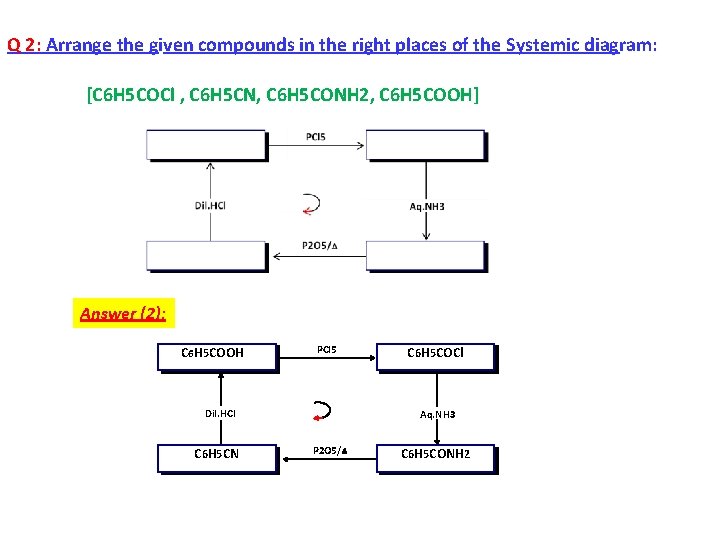
Q 2: Arrange the given compounds in the right places of the Systemic diagram: [C 6 H 5 COCl , C 6 H 5 CN, C 6 H 5 CONH 2, C 6 H 5 COOH] Answer (2): C 6 H 5 COOH PCl 5 Dil. HCl C 6 H 5 CN C 6 H 5 COCl Aq. NH 3 P 2 O 5/ C 6 H 5 CONH 2
Form-2: Sequencing on Pentagonal systemic: Q 4: Arrange the given organic compounds in the right Places of the following systemic diagram: [ Ethylene-Acetylene-Ethanol-1, 2 -Dibromoethane, Acetaldehyde ] Alco. KOH/ Hg. SO 4/dil. H 2 SO 4 -60 c Br 2 Li. Al. H 4 Conc. H 2 SO 4 Answer (4): C 2 H 4 Br 2 Alco. KOH C 2 H 2 Br 2 C 2 H 4 Hg. SO 4/dil. H 2 SO 4 -60 c CH 3 CHO Conc. H 2 SO 4 Li. Al. H 4 CH 3 CH 2 OH
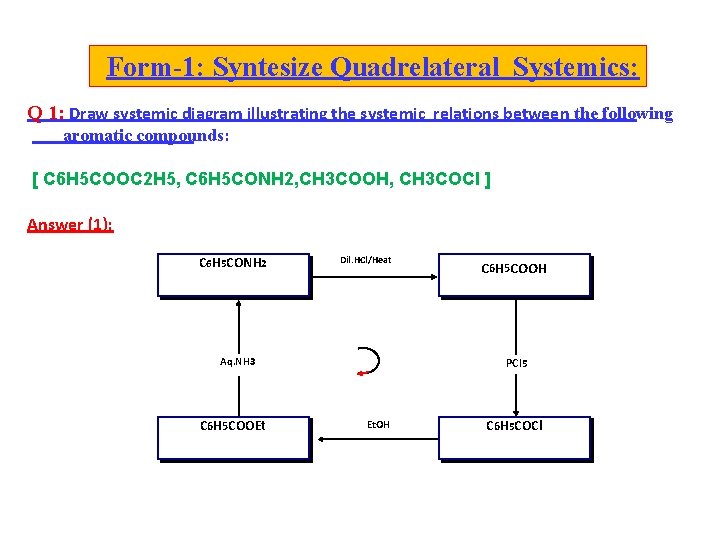
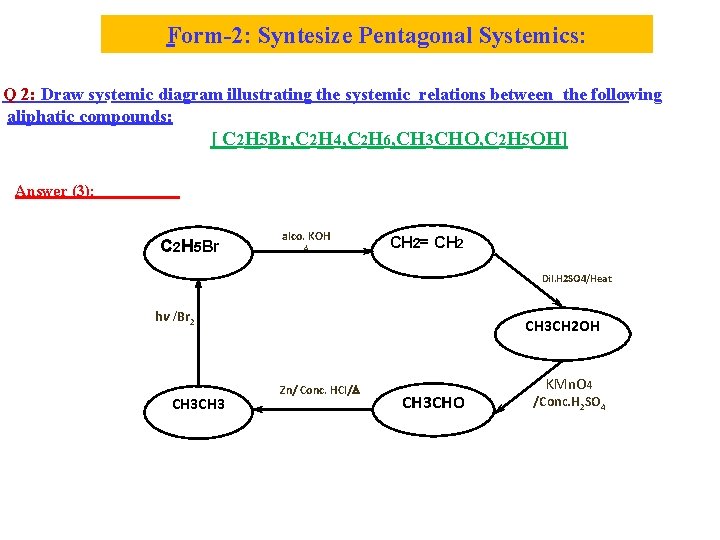
Type-5: Systemic Synthesis Questions [SSn. Q, s] SSQ, s means synthesize systemic relations between concepts, facts, issues, Requires the Student to Position concepts or formulas, or events or issues , numbers and their relations in a systemic diagram
Requierments for building [SSn. Q, s] 1 - The stem of the questions contains 4 -6 components. 2 - Components could be; Atoms, molecules, or both. Formulas. 3 -The components should be correlated in a systemic diagram. 4 -The size of the systemic diagram depends on the number of Components.
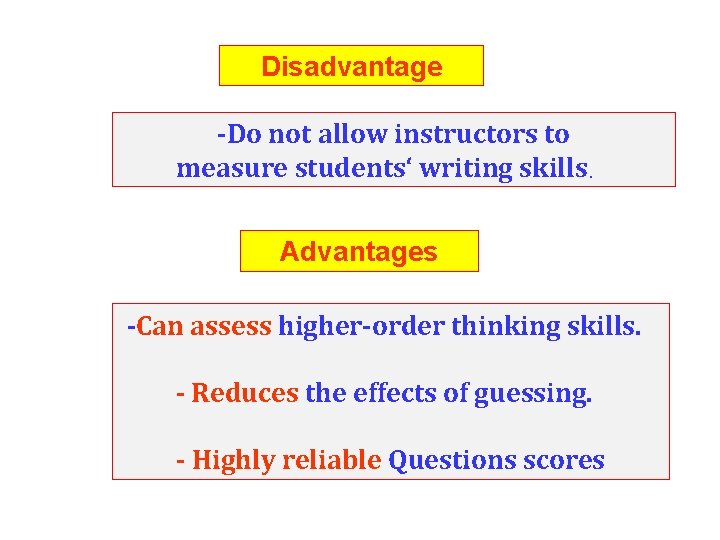
Disadvantage -Do not allow instructors to measure students‘ writing skills. Advantages -Can assess higher-order thinking skills. - Reduces the effects of guessing. - Highly reliable Questions scores
Form-1: Syntesize Quadrelateral Systemics: Q 1: Draw systemic diagram illustrating the systemic relations between the following aromatic compounds: [ C 6 H 5 COOC 2 H 5, C 6 H 5 CONH 2, CH 3 COOH, CH 3 COCl ] Answer (1): C 6 H 5 CONH 2 Dil. HCl/Heat Aq. NH 3 C 6 H 5 COOEt C 6 H 5 COOH PCl 5 Et. OH C 6 H 5 COCl
Form-2: Syntesize Pentagonal Systemics: Q 2: Draw systemic diagram illustrating the systemic relations between the following aliphatic compounds: [ C 2 H 5 Br, C 2 H 4, C 2 H 6, CH 3 CHO, C 2 H 5 OH] Answer (3): C 2 H 5 Br alco. KOH CH 2= CH 2 Dil. H 2 SO 4/Heat hv /Br 2 CH 3 CH 2 OH Zn/ Conc. HCl/ CH 3 CHO KMn. O 4 /Conc. H 2 SO 4
Type-6: Systemic Analysis Questions [SSAn. Q, s] Requires the Student to Analyze the given systemic diagram to its concepts or formula, numbers, or events with their relations.
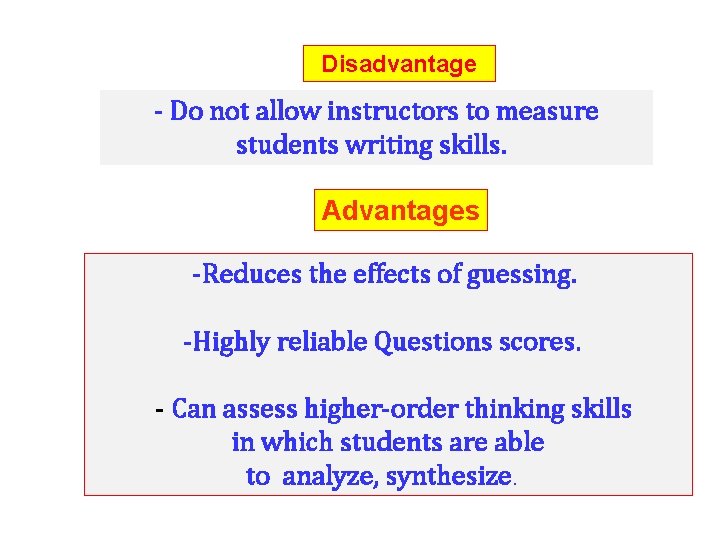
Disadvantage - Do not allow instructors to measure students writing skills. Advantages -Reduces the effects of guessing. -Highly reliable Questions scores. - Can assess higher-order thinking skills in which students are able to analyze, synthesize.
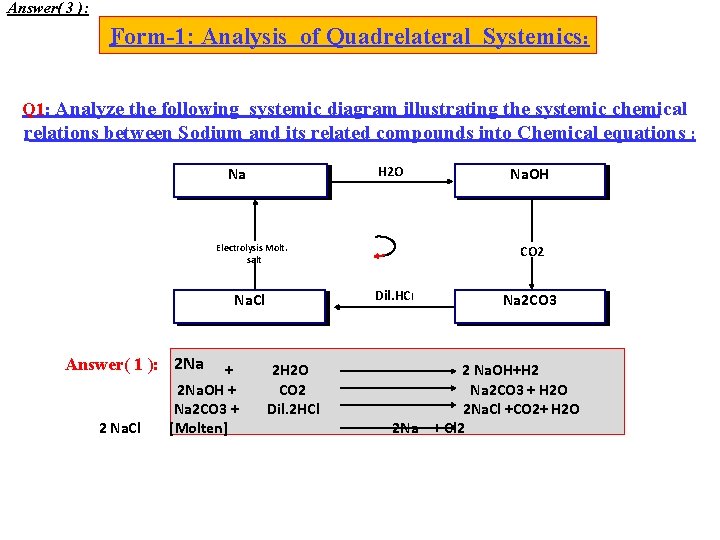
Answer( 3 ): Form-1: Analysis of Quadrelateral Systemics: Q 1: Analyze the following systemic diagram illustrating the systemic chemical relations between Sodium and its related compounds into Chemical equations : H 2 O Na Electrolysis Molt. salt Answer( 1 ): 2 Na 2 Na. Cl + 2 Na. OH + Na 2 CO 3 + [Molten] CO 2 Dil. HCl Na. Cl 2 H 2 O CO 2 Dil. 2 HCl Na. OH Na 2 CO 3 2 Na. OH+H 2 Na 2 CO 3 + H 2 O 2 Na. Cl +CO 2+ H 2 O 2 Na + Cl 2
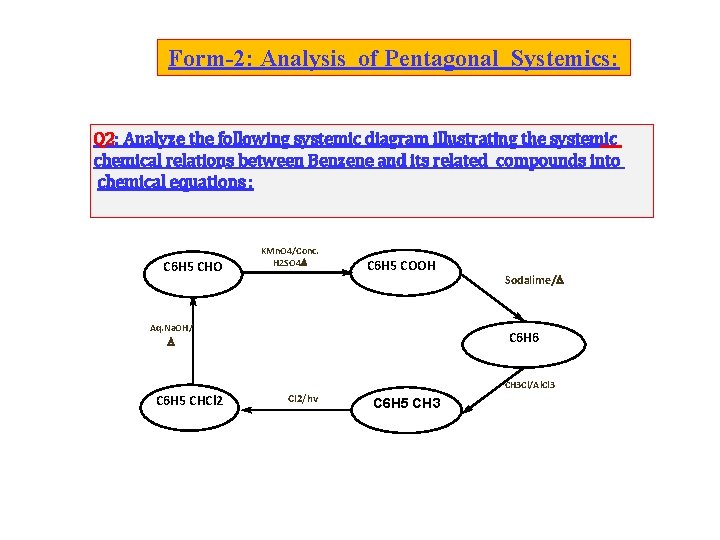
Form-2: Analysis of Pentagonal Systemics: Q 2: Analyze the following systemic diagram illustrating the systemic chemical relations between Benzene and its related compounds into chemical equations : C 6 H 5 CHO KMn. O 4/Conc. H 2 SO 4 C 6 H 5 COOH Aq. Na. OH/ Sodalime/ C 6 H 6 CH 3 Cl/Al. Cl 3 C 6 H 5 CHCl 2/hv C 6 H 5 CH 3
References: 1 -Fahmy, A. F. M. , Lagowski, J. J; Systemic Reform in Chemical Education , An International Perspective, J. Chem. Edu. , 2003, 80 (9), 1078. 2 -Fahmy, A. F. M. , Lagowski, J. J. , Using SATL Techniques to Assess Student Achievement, [18 th ICCE, Istanbul Turkey, 3 -8, August 2004]. 3 -ahmy, A. F. M. , Lagowski, J. J. , ” Systemic multiple choice questions (SMCQs) in Chemistry “[19 th ICCE, Seoul, South Korea, 12 -17 August 2006]. 4 -Fahmy, A. F. M. , Lagowski, J. J , “Systemic Problem solving [SPS] to Assess Student Achievement in Chemistry”[42 IUPAC Congress, 2 -7 Aug. 2009] 5 -Colleen M. and Bull, J. ; Workshop on designing objective test questions. CAA center (http: //caacenter. ac. uk/ university of luton, luton UK.
6 -Writing Multiple Choice Items which Require Comprehension by Russell A. Dewey, Ph. D http: //www. psychwww. com/selfquiz/aboutq. htm 7 -Mc. Millan, J. H. (2001). Classroom assessment Principles and practice for effective instruction. Boston: Allyn and Bacon. . 8 - http: //web. utk. edu/~mccay/apdm/match_b. htm