
Systemic Approaches to Counseling Students Experiencing Complex and

- Slides: 65
Systemic Approaches to Counseling Students Experiencing Complex and Specialized Problems CHAPTER 15
Introduction Youth at risk for academic failure and personal/social problems present a substantial dilemma for schools, families, and communities. Professional school counselors must become “coordinators of interdisciplinary resources” to collaborate and develop partnerships with community agencies and organizations providing overlapping services with school personnel. It is important that professional school counselors help educators support, rather than blame and punish, youth at risk.
The Changing Needs of Students and Families Rising levels of poverty, substance abuse, and domestic and community violence are a few of the major problems affecting mental health during the latter half of the 20 th century. 20% of all children and adolescents have significant emotional impairment requiring treatment, but only 1 out of 5 actually receive treatment. Half of all students with emotional problems drop out of school. Clinical depression afflicts 3 -6 million children, contributing to widespread social and emotional problems, including suicide.
The Changing Needs of Students and Families (cont. ) Suicide is the 3 rd leading cause of death among American adolescents. More than 2, 000 adolescents kill themselves each year. Approximately 10, 000 -20, 000 adolescents attempt suicide annually. 30 -50% of school-aged children referred to community mental health agencies experience conduct problems and behavior disorders. These problems have been compounded by government funding procedural changes and shortages of affordable community-based mental health services.
The Changing Needs of Students and Families (cont. ) U. S. reports continue to show increasing numbers of youth who are alienated and disconnected from the positive aspects and opportunities of society and have difficult and negative experiences in schools, communities, and families. Students with complex problems come from all socioeconomic classes, ethnic, and racial backgrounds. Anyone could be exposed to community, school and family violence, family dysfunction, drugs or alcohol, teenage suicide, or problems with peers. Through the growing numbers of these youth, it is clear that overall intervention and prevention strategies have been limited in their success.
Resiliency Risk factors are characteristics of students that place them at higher risk of developing mental disorders, academic problems, or personal-social difficulties. It is important to realize that a single risk factor leads to only a slight increase in risk, while multiple factors exponentially increase one’s risk status. Resilience factors are ordinarily more important to assess, because resilience involves characteristics that allow an individual to rebound from adversity, or maintain equilibrium of positive functioning when exposed to traumatic events or environmental stressors. Professional school counselors can help students develop increased resilience or protective factors by helping to build parent, peer and school support mechanisms.
Identifying and Categorizing Students With Complex Problems There is still ongoing debate and controversy over defining the population of youth at risk. There is no framework for one definition that is inclusive enough to consider all the parameters necessary for a culturally responsive approach to addressing the needs of children at-risk.
Guidelines Describing Youth At Risk Youth are considered at risk when they lack familial, community, cultural, institutional, and societal supports necessary to develop and grow in an environment that is safe, positive, healthy, and conducive to personal, social, cultural, intellectual, spiritual, economic, and physical development. Healthy growth and development for youth must include the context of family and other social networks, environment, health and nutrition, opportunities for spiritual development, and a positive interaction with the surrounding community, society, and culture within which one lives.
Problems Categorizing Youth At Risk Five potential problem areas have been identified. First, when using the term, at-risk, there is a danger of discounting resiliency. Secondly, the label, “at risk, ” has strong negative associations, which stigmatize youth. Thirdly, many youth are identified as being at risk during adolescence, leaving the prospect of being at risk no longer a question, but rather an assured fact. Fourth, the term at-risk has been used as a catch all phrase that does not differentiate the level of risk one is facing nor the conditions, causes, or problem behaviors associated with that risk.
Problems Categorizing Youth At Risk (cont. ) Fifth, there is not a sensitivity or awareness of cultural differences related to at risk behavior. These problems contribute to confusion in characterizing and identifying youth at risk and are reflected in the lack of effective programming to reduce problems.
Approaches to Working With Youth With Complex Problems Historically the definition of at-risk has been based on one of four approaches with each having it’s flaws. Predictive - emphasizes what is wrong or missing in the student. Descriptive - focuses on “after-the-fact” reporting. The unilateral technique states that all students are at risk by virtue of living in today’s society. School factors approach states that schools are solely accountable and responsible (Hixson & Tinszmann, 1990).
Working with All Youth Helping students with complex problems cuts across many disciplines including mental health, education, public health, substance abuse, business, social services, juvenile justice, and child and family services.
Working with All Youth (cont. ) Many professionals are disheartened with trying to reach youth at risk. The result of these attitudes is a growing trend toward containment, punishment, and banishment, rather than treatment and prevention. However, all children can be reached. Rather than reject and abandon youth who do not respond to our traditional programs, it is crucial that we develop new and innovative strategies for working with families, communities, and schools to reach those children now regarded as “unreachable. ”
Systems Failures: Who Is To Blame? There a large number of facilities in the U. S. that have the potential to effectively serve youth at risk. For many years youth at risk have been blamed for their problems, but by blaming children and adolescents who are already powerless, programs not only fail to protect our youth, but add to the existing problems faced by this population. We can no longer blame the youth but must undergo a critical selfexamination of intervention strategies and work to design successful interventions.
Systems Failures: Who Is To Blame? (cont. ) Programs that are narrow in focus and aim to address problems in isolation are failing the youth in need of services. It is important to adjust and adapt intervention strategies to the complex needs of the target population from the perspective of an interagency response that is not limited to only schools. Professional school counselors hold a pivotal position to lead these efforts, as school can be the focal point for all youth.
Why Haven’t Needs of Youth At Risk Youth Been Addressed? There are five major reasons for the lack of commitment to the needs of atrisk youth. First, funding priorities have not been focused on this population. Second, it is difficult to change systems. Third, the nation does not have a consensus moral commitment to working with this population. Fourth, there is a lack of societal, institutional and community commitment to address these problems for a disengaged and essentially powerless population. Finally, graduate level university training of professionals often lacks innovation and responsiveness when addressing these concerns as a part of the curriculum.
Responding to Crisis Situations Experiences of violence, disaster, and any form of trauma can leave students without sufficient resources needed to cope. Crises that may affect the school community: Suicide Loss Medical emergencies Family trauma School shootings Gang activities Abuse Natural disasters
Definition. A crisis of represents Crisisdanger because it initially is experienced as an intolerable difficulty that threatens to overwhelm the individual. Unless the person obtains relief, the crisis potentially can cause severe psychological, cognitive, physical, and behavioral consequences. A crisis also presents an opportunity because during times of crisis, individuals are usually more receptive to help. Prompt, skillful interventions increase an individual’s ability to adapt and function in the future. The timing and intensity of the crisis, as well as the number of other stressors the student is experiencing, can affect the complexity of the crisis situation.
Crisis Intervention Crisis intervention refers to the immediate action a professional school counselor takes to “provide the support and direction that the student in crisis requires for him or herself” (Steigerwald, 2010 a, p. 830 -831). Goals of crisis intervention: Help the student to defuse emotions Organize and interpret what has happened Integrate the traumatic event into his or her life story Interpret the event in a way that is meaningful Crisis intervention is time-limited and should not be confused with more long-term postcrisis counseling.
Guidelines to Follow in Crisis Counseling Respond immediately. Be directive at first. Listen actively and nonjudgmentally as students tell their stories. Follow a holistic approach. Begin work where the student is experiencing the greatest impairment. Get the facts surrounding the crisis. Sustain relationships and resources. Keep a multicultural awareness of the student’s expressions of emotions, perspectives, and behaviors. Do not offer false reassurance. Help students take action. Determine whether the effects are long-lasting and whether a referral for further assessment and counseling is needed. Do not work in isolation. Continue to develop knowledge and skills in crisis intervention.
Crisis Response Plans At times, a crisis affects a larger number of students, and a systemic response from the school is required. Crises that may dictate a systemic response: Homicide or suicide Unexpected death Natural disasters Professional school counselors often play leadership roles in helping schools develop and implement a systemic crisis plan that is comprehensive, well-planned, mobilizes resources, and operates quickly.
Crisis Response Plans (cont. ) Crisis response plans should exist on both a district and school level. The professional school counselor takes a leadership role in the prevention, intervention, and post-incident support of school responses by: Providing individual and group counseling Consulting with administrators, teachers, parents, and other professionals Coordinating services within the school and the community Professional school counselors can be instrumental in leading workshops in the school and community to communicate the school crisis plan to others.
Suicide Professional school counselors, especially at the high school level, need to be prepared to assess suicidal ideation, behaviors, and risk, as well as be ready to intervene decisively. While the student is in the school, it is common practice to be sure the student is in the company of an adult at all times and that contact is made with a parent or guardian as soon as possible. Professional school counselors can be valuable consultants to parents, facilitating transitions to treatment with mental health professionals, community agencies, or psychiatric inpatient facilities.
Assessing Suicidal Ideation and Behaviors Professional school counselors should pay close attention to student suicidal ideation and behaviors during an initial interview, and revisit the issue periodically during the course of treatment. Nearly all suicides are avoidable. Predicting who will attempt suicide is extremely difficult, which is why experienced professional school counselors take every client with suicidal ideation very seriously.
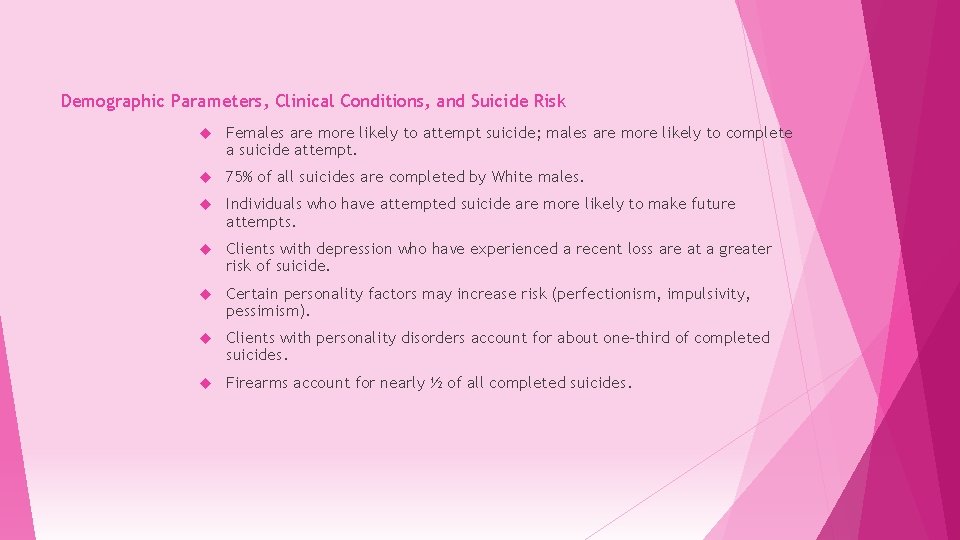
Demographic Parameters, Clinical Conditions, and Suicide Risk Females are more likely to attempt suicide; males are more likely to complete a suicide attempt. 75% of all suicides are completed by White males. Individuals who have attempted suicide are more likely to make future attempts. Clients with depression who have experienced a recent loss are at a greater risk of suicide. Certain personality factors may increase risk (perfectionism, impulsivity, pessimism). Clients with personality disorders account for about one-third of completed suicides. Firearms account for nearly ½ of all completed suicides.
Assessing Suicidal Ideation and Behaviors (cont. ) Professional school counselors should also assess for resiliency and protective factors, activities, or people in a student’s life that provide responsibilities, meaning, and hope for the student. When assessing suicidal risk it is essential to determine both the existence and intensity of suicidal thoughts and behaviors and respond quickly and decisively with a treatment plan.
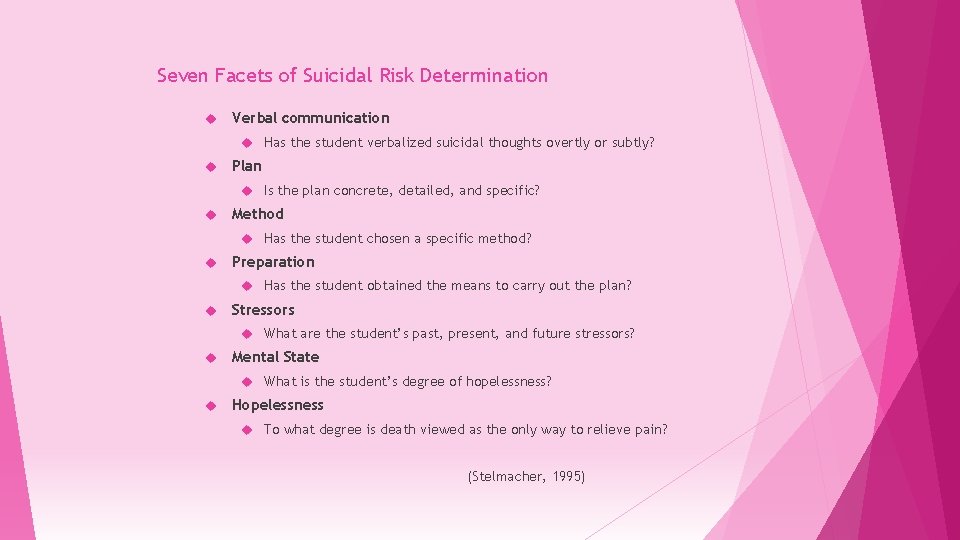
Seven Facets of Suicidal Risk Determination Verbal communication Has the student verbalized suicidal thoughts overtly or subtly? Plan Is the plan concrete, detailed, and specific? Method Has the student chosen a specific method? Preparation Has the student obtained the means to carry out the plan? Stressors What are the student’s past, present, and future stressors? Mental State What is the student’s degree of hopelessness? Hopelessness To what degree is death viewed as the only way to relieve pain? (Stelmacher, 1995)
Assessing Suicidal Ideation and Behaviors (cont. ) Several instruments useful to professional school counselors: Suicide Probability Scale (SPS) Beck Scale for Suicide Ideation (BSSI) Suicide Ideation Questionnaire (SIQ) At most, scores should be used as helpful guidelines; professional school counselors must use caution because of the potential for clients to underreport the severity of suicidal thoughts and behaviors.
Violence & Threat Assessment Several highly publicized school shootings over the past decade have heightened public interest and fears related to school safety. Although such instances are rare, students today are more likely to bring a weapon to school, fight on school grounds, and bully or harass other students.
Bullying, Harassment, Abuse, and Dating Violence At-risk status stems from isolation from societal, cultural, school, family, or peer interactions and institutions. Isolation may lead to victimization and perpetuation of violence in the forms of bullying and harassment, abuse and neglect, and suicide.
Bullying & Harassment Bullying and harassment are caused when an imbalance of power is created. Failure of adults and bystanders to act encourages perpetuation of reputations of abusers as strong individuals, and victims as weak. The quickest way to interrupt the cycle of bullying or harassment is for adults and peers to intervene. Teaching adults and peers the importance of intervening and how to effectively intervene is a critical role of the professional school counselor.
Bullying & Harassment (cont) Bullying and harassment have become so problematic in schools that many states now have legislation or regulations prohibiting these behaviors. This includes indirect forms of bullying and harassment such as relational aggression and cyberbullying.
Physical Abuse, Sexual Abuse, & Neglect Widespread physical and sexual abuse and neglect often result in devastating long-term emotional problems, including anxiety, depression, substance abuse, and other serious psychiatric disturbances. Emotional and social isolation is particularly problematic with individuals who have been abused or neglected, or are witnesses of abuse. Incidences of dating violence have risen over the past decade and affects many teenagers. Victims of dating violence displayed increased risks of suicidal thought and actions, substance use, depression, and risky sexual behavior.
Threat Assessment Violent acts committed on school property increased sharply during the 1980 s, but have been steadily declining since 1993. There is no foolproof profile of violent youth or list of risk factors that allows certain identification of youth as violent. Threat assessment, developmental programming, prevention, and intervention are all part of a comprehensive school safety program.
Threat Assessment (cont. ) Most violent students are not playful. Violent students often feel desperate and panic-stricken, fearing that others want to hurt them. In general, males aged 15 -24 have a higher risk of violence. Students from lower socio-economic status have higher associated risks. Students with thought disorders and disorders of impulse present with higher degrees of risk. Those with a history of violent acts are at greater risk for future violent acts. Environmental risk factors include: Unstable family and peer relationships Association with criminal or sexual predators Association with antisocial peers Educational problems Living in an urban environment
Threat Assessment (cont. ) In previous school shooting incidences, most times the attacker revealed his plan to at least one other person not involved in the attack, and most had access to guns and previous experiences using guns. FBI’s classification of threats: Indirect threats Veiled threats Conditional threats Direct threats FBI’s 4 -pronged Assessment Model Personality of the Student Family Dynamics School Dynamics Social Dynamics
Suggestions for Prevention of Violence and Intervening with Youth At Risk Increase the quality and frequency of peer contacts. Create a sense of hope and feelings of togetherness in the school and community. Teach and role-play interpersonal and social skills in real life situations. Establish a clear district-wide policy for dealing with violence, bullying, harassment, abuse, and neglect. Encourage participation in mentoring programs. Develop and train a threat assessment team in each school. Establish a peer mentoring program. Collaborate with law enforcement, faith leaders, and representatives of social service agencies. Create a school climate of trust between adults and students. Help parents, guardians, and other adults in the life of the child make systematic connections in the community. Provide supportive intervention services to potential offenders.
Protective Factors Commitment to school Intelligence Control over career choices Intolerance toward deviance Confidence in academic ability Positive social orientation Close relationship with a teacher Adult mentoring programs Academic/vocational planning initiated by the end of middle school Role models or mentors in careers of interest Parental influence through support
Substance Abuse Nearly one-third of youth aged 12 -20 years drank alcohol in the previous month. As many as 10% of youth in this age group abuse, or are dependent on alcohol. Professional school counselors may serve more as a referral source than providing actual treatment in the school context. Professional school counselors must at least become proficient in substance abuse assessment. Assessment of substance abuse is best conducted early in the counseling process.
Substance Abuse (cont. ) Since self-report of substance use is fairly reliable, professional school counselors often use a straightforward interviewing approach. A brief interview method designed for alcohol abuse screening is CAGE. Have you ever felt you need to Cut down on your drinking? Have people Annoyed you by criticizing your drinking? Have you ever felt bad or Guilty about drinking? Have you ever had a drink first thing in the morning to steady your nerves or get rid of a hangover (Eye opener)? Client responses can lead the professional counselor to suspect alcohol or other drug abuse and use more formalized or systematic data collection procedures.
Grief Work and Children from Changing Families Professional school counselors encounter children with grief reactions quite frequently for a variety of reasons. Most grief reactions share commonalities, and there are strategies and interventions professional school counselors can use with groups or individuals.
Understanding the Effects of Divorce Research shows that most children adjust well to divorce, although older children experience more negative outcomes. The majority of children from divorced families are emotionally well-adjusted, however a number of risk and resiliency factors play into the mix. When compared to nondivorced peers, adolescents from divorced families demonstrate: More depression Greater conflict with parents Poorer school performance Higher levels of aggression and disruptive behavior It is critical for professional school counselors to understand that 75 -80% of children and young adults from divorced families: Do not experience major psychological problems Aspire to and achieve career or higher educational goals Enjoy intimate relationships as adults
Understanding the Effects of Divorce (cont. ) Risk Factors Protective Factors Interparental cooperation and diminished conflict following the divorce Poor quality parenting Lack of contact with father Competent parenting from custodial parents Contact with, and competent parenting from, nonresidential parents Having a trusting relationship with a nonparental adult and peers Positive school experiences Interparental conflict Gender
A Primer. Griefon as a Grief development. Work process: Stage 1 : Shock and denial Stage 2: Anger Stage 3: Guilt Stage 4: Hopelessness/Depression Stage 5: Acceptance Many of the physical symptoms associated with grief reactions are similar to those of depression: Fatigue Loss or increase in appetite Loss of concentration Feelings of hopelessness and isolation Frequent sighing or breathlessness Aches and pains
A Primer on Grief (cont. ) The intensity of the Work grief experience is usually determined by: One’s personal relationship to the loss The intensity of or ambivalence to that relationship The dependency or security provided by that relationship How the loss occurred One’s personality History of dealing with grief experiences Individual characteristics Obstacles to effective grieving: Sudden loss Lack of finality or uncertain loss Lack of support The perception that grief is a weakness and should be avoided or denied
A Primer on Grief Work (cont. ) Professional school counselors should assess the situation to decide whether a referral should be made. In the context of developmental grief reactions, the professional school counselor should continuously remind the student that the symptoms and reactions are normal and life and emotional health will get better in time. Professional school counselors can help students resolve the 4 primary tasks of grieving Accept the reality of the loss. Experience (not avoid) the pain of the grief. Adjust to life without the lost object or condition. Emotionally relocate the loss and move on with life. Other suggestions for professional school counselors: Encourage them to find a way to resolve the loss Encourage social support Bibliotherapy Journal writing Help the student keep busy in meaningful activities and take care of their physical health Be alert for signs of complicated grief or other signs of trouble
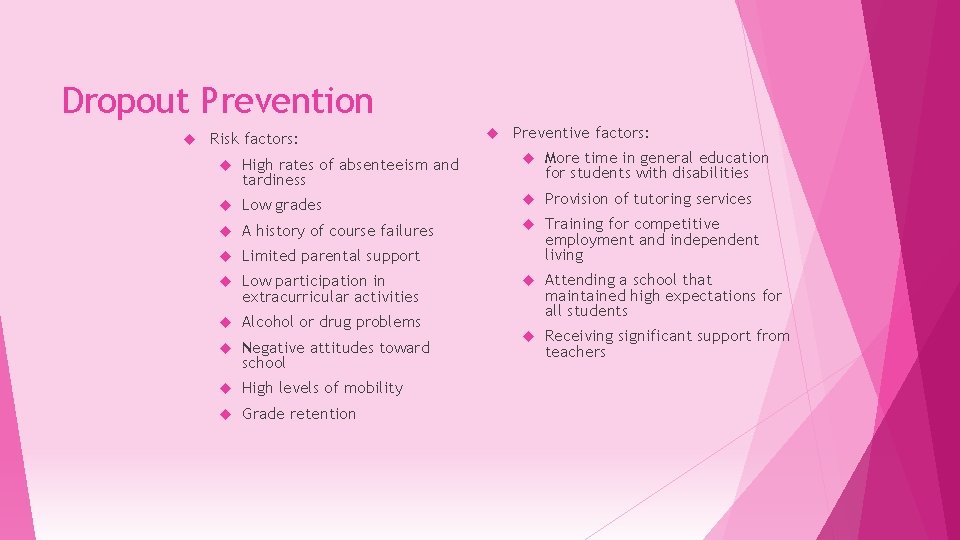
Dropout Prevention Risk factors: Preventive factors: High rates of absenteeism and tardiness More time in general education for students with disabilities Low grades Provision of tutoring services A history of course failures Limited parental support Training for competitive employment and independent living Low participation in extracurricular activities Alcohol or drug problems Attending a school that maintained high expectations for all students Negative attitudes toward school Receiving significant support from teachers High levels of mobility Grade retention
Dropout Prevention (cont. ) Most dropout interventions seek to: Enhance students’ sense of belonging in school Foster the development of relationships with teachers, administrators, and peers Improve academic success Address personal problems through counseling Provide skill-building opportunities in behavior and social skills Categories of dropout interventions Personal/affective Academic Family outreach School structure Work related
Dropout Prevention (cont. ) Professional school counselors can help develop and implement school -wide dropout prevention programs, using risk screenings to identify students at higher risk, and promoting some of the key components related to school completion. Key dropout preventions/interventions Environmental support Counseling support Enhancing relationships and affiliation Providing/supporting vocational programming Bolster outside influences
Conflict Resolution and Peer Mediation Program Development Most schools implement some systemic or developmental program to help students mediate and resolve conflict. The development of any conflict resolution or peer mediation program or intervention should reflect the unique contextual needs of the school or district to be served.
Program Development: Assessing Climate Necessary to understand the structure of competition in the school. Professional school counselors must work to understand the reasons for conflicts and types of conflict within the school climate.
Systemic Change Efforts to create a high level of personal and community awareness and participation in conflict resolution and peer mediation programs can stimulate collective power, and share information about similarities and differences useful in formulating solutions. Peer mediation and conflict resolution programs can change the community as a whole. Teacher and administrative support is vital.
Diversity Considerations Essential that peer mediators represent the multiple diversities of the school. Three factors are necessary: recruitment, selection, and training. Diverse populations of schools—differentiated by age, race or ethnicity, disability, socioeconomic status, and academic ability—need to be reflected in programming.
Recruitment Enlist the help of teachers. Only students likely to be selected should be encouraged. Empower students to be leaders and role models.
Selection Should reflect a cross-section of student population. Student characteristics should include leadership skills, maturity, communication skills, responsibility, perspective taking, empathy, and problem-solving skills. High academic achievement is not necessarily a prerequisite for selection.
Training Multicultural sensitivity should be integrated. Special attention to patterns of speech and issues specific to the special needs of non-English-speaking students or students for whom English is a second language must be considered.
Program Implementation Plans must be well documented to be linked with school-wide data. Cyclical process including: development of a mission statement, the collection of data used to set goals, the prioritizing of goals, training for skill development, an implementation schedule, evaluation, and follow-up. Enlist the input of all stakeholders.
Training for Program Coordinators Well trained coordinators can take a leadership role. Need for strategies and information that is practical, easy to use, and can be directly applied (King, Wagner, & Hedrick, 2001).
Student Access to Services Ensure that programs serve the entire school community. Administrative support is necessary. Sends a message of shared values and beliefs.
Program Evaluation As professional school counselors work to link school counseling programs to the mission of schools, evidence of concrete measures that contribute to creating a safe learning environment is essential. Regular program evaluation reports should be completed and presented to all school personnel.
Multicultural Implications To be truly effective, conflict resolution and violence prevention efforts must “adjust” to the diverse cultural, ethnic, and socioeconomic influences of society and involve every segment of society. Need to educate students in a global context. Must teach students how to manage and resolve conflicts through multiple contexts that move beyond merely tolerating diversity but to one that seeks out and celebrates the rich dimensions of multiple diversities.
Recommendations for Professional School Counselors: Generating Effective Programs 1. Develop authentic partnerships with community agencies. 2. Facilitate interdisciplinary collaboration by being the Coordinator of Interdisciplinary Services. 3. Maintain a strong multicultural focus. 4. Be a systems change agent to better serve the needs of youth at risk. 5. Empower clients by giving up power. 6. Look for short-term successes.
More Recommendations for Professional School Counselors: Generating Effective Programs 7. Become an advocate by fighting for services and funds for youth at risk. 8. Research and document outcomes by researching and documenting what interventions work and which do not. 9. Assume responsibility for successes and failures by discontinuing interventions when they do not work and then implementing effective intervention strategies.
Conclusion It is clear that the issues encountered by youth at-risk in the U. S. continue to present serious problems for schools, families, and communities. It is essential that professional school counselors design innovative service systems to effectively address the complex and multifaceted needs of the atrisk population. It is clear that many of the existing prevention and intervention programs are ineffective and unsuccessful, given the high numbers of disengaged and marginalized youth. Therefore, a new approach to working with this population is critical.