
SYSTEMATICS ON CHANDRA XRAY MASS ESTIMATES Lauro Moscardini

- Slides: 20
SYSTEMATICS ON CHANDRA X-RAY MASS ESTIMATES Lauro Moscardini Giuseppe Tormen Stefano Ettori Stefano Borgani Pasquale Mazzotta Klaus Dolag Massimo Meneghetti & Key-Project team Elena Rasia Dipartimento di Astronomia, Padova, Italy (rasia@pd. astro. it)
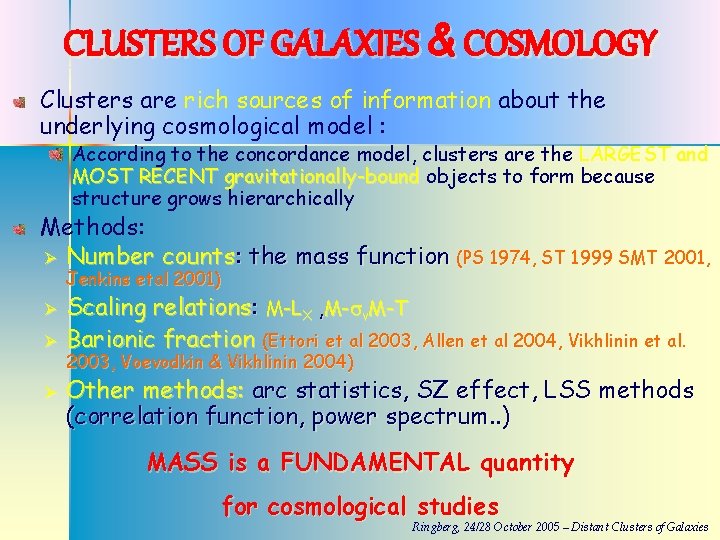
CLUSTERS OF GALAXIES & COSMOLOGY Clusters are rich sources of information about the underlying cosmological model : According to the concordance model, clusters are the LARGEST and MOST RECENT gravitationally-bound objects to form because structure grows hierarchically Methods: Ø Number counts: the mass function (PS 1974, ST 1999 SMT 2001, Jenkins etal 2001) Ø Ø Ø Scaling relations: M-LX , M- v. M-T Barionic fraction (Ettori et al 2003, Allen et al 2004, Vikhlinin et al. 2003, Voevodkin & Vikhlinin 2004) Other methods: arc statistics, SZ effect, LSS methods (correlation function, power spectrum. . ) MASS is a FUNDAMENTAL quantity for cosmological studies Ringberg, 24/28 October 2005 – Distant Clusters of Galaxies
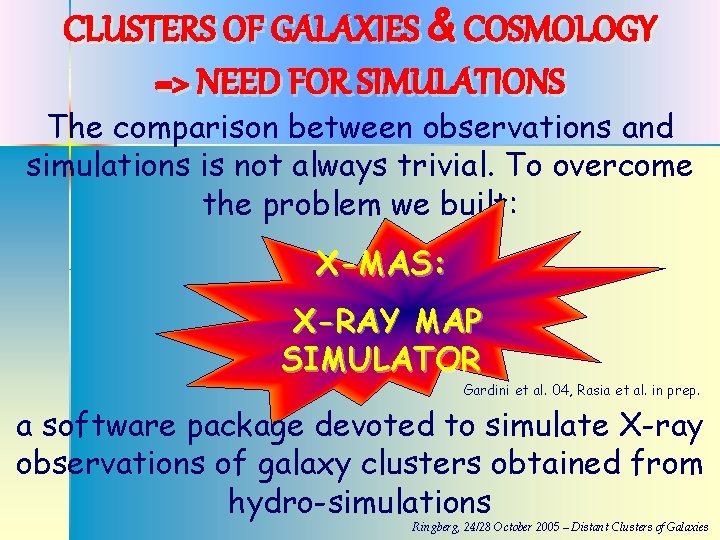
CLUSTERS OF GALAXIES & COSMOLOGY => NEED FOR SIMULATIONS The comparison between observations and simulations is not always trivial. To overcome the problem we built: X-MAS: X-RAY MAP SIMULATOR Gardini et al. 04, Rasia et al. in prep. a software package devoted to simulate X-ray observations of galaxy clusters obtained from hydro-simulations Ringberg, 24/28 October 2005 – Distant Clusters of Galaxies
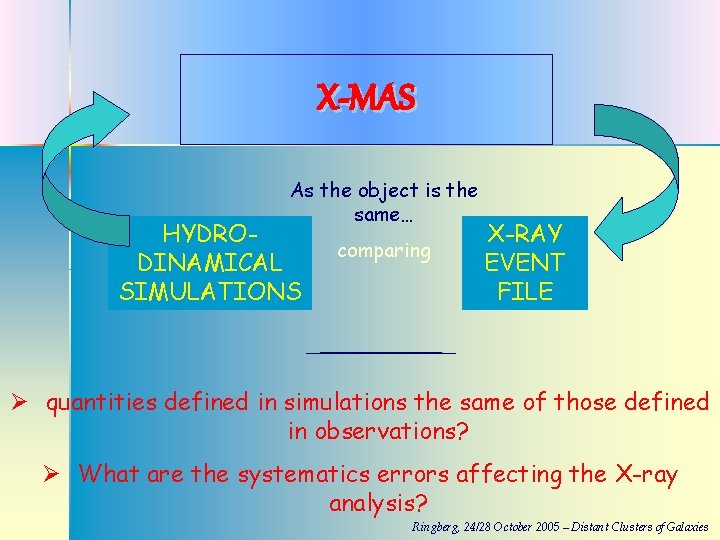
X-MAS As the object is the same… HYDRODINAMICAL SIMULATIONS comparing X-RAY EVENT FILE Ø quantities defined in simulations the same of those defined in observations? Ø What are the systematics errors affecting the X-ray analysis? Ringberg, 24/28 October 2005 – Distant Clusters of Galaxies
SYSTEMATICS ON X-RAY MASS ESTIMATE Ø Simulations: Rasia et al. ’ 05, submitted Øhigh resolution resimulations of clusters extracted from the cosmological box (4 at z=0. 175 + 1 at z=0. 28) ØPhysics: radiative cooling, the effect of a uniform time-dependet UV background, a sub-resolution model for star formation from a multiphase interstellar medium, as well as galactic winds powered by SN explosions (Springel & Hernquist 2003), suppressed Borgani et al. ’ 05, Dolag et al. in prep thermal conduction ØMock observation with X-MAS to produce long exposure Chandra-like observations ØNormal bkg & bkg/100 Ringberg, 24/28 October 2005 – Distant Clusters of Galaxies
STEP BY STEP Soft energy band images [0. 2 -2] ke. V: in order to recognize and exclude cold regions. Spatial analysis : the surface brightness , rc is extracted in the [0. 5 -5 ] ke. V energy band from concentric annuli Spectral analysis: spectra are extracted by using CIAO tools in the [0. 5 -8] ke. V band in PI channels and fitted within XSPEC package with a single thermal model using 2 statistic. Deprojection: ü the 3 D gas density and ü the 3 D temperature profiles. HE Ringberg, 24/28 October 2005 – Distant Clusters of Galaxies
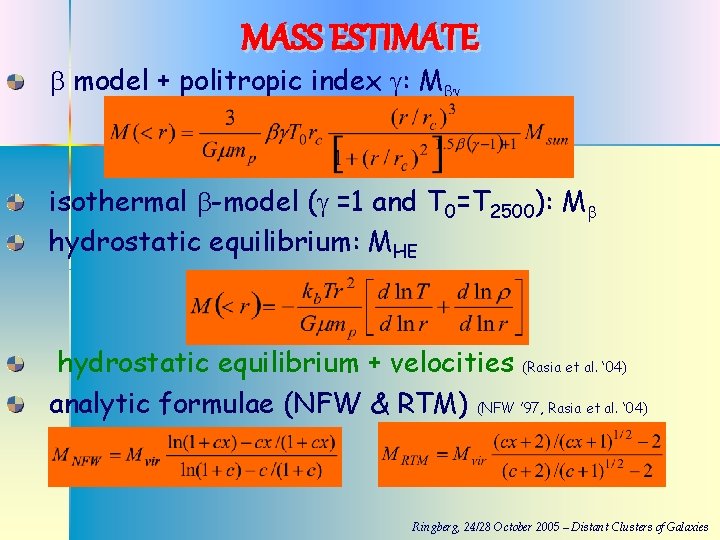
MASS ESTIMATE model + politropic index : M isothermal -model ( =1 and T 0=T 2500): M hydrostatic equilibrium: MHE hydrostatic equilibrium + velocities (Rasia et al. ‘ 04) analytic formulae (NFW & RTM) (NFW ’ 97, Rasia et al. ‘ 04) Ringberg, 24/28 October 2005 – Distant Clusters of Galaxies
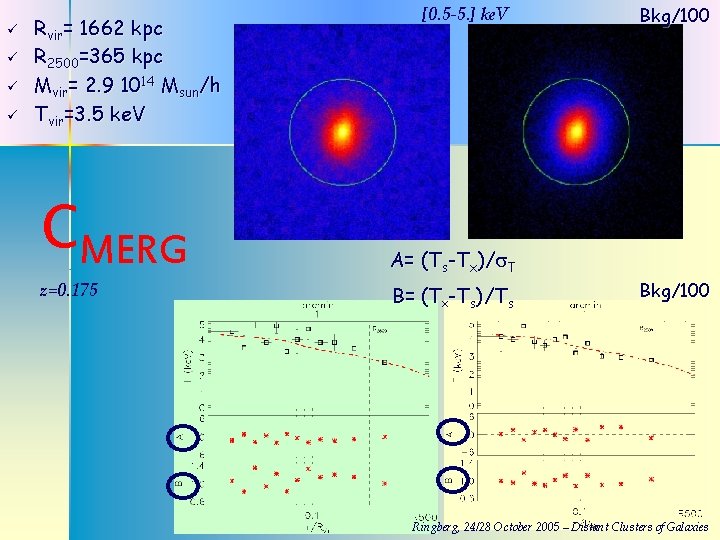
ü ü Rvir= 1662 kpc R 2500=365 kpc Mvir= 2. 9 1014 Msun/h Tvir=3. 5 ke. V CMERG z=0. 175 [0. 5 -5. ] ke. V Bkg/100 A= (Ts-Tx)/ T B= (Tx-Ts)/Ts Bkg/100 Ringberg, 24/28 October 2005 – Distant Clusters of Galaxies
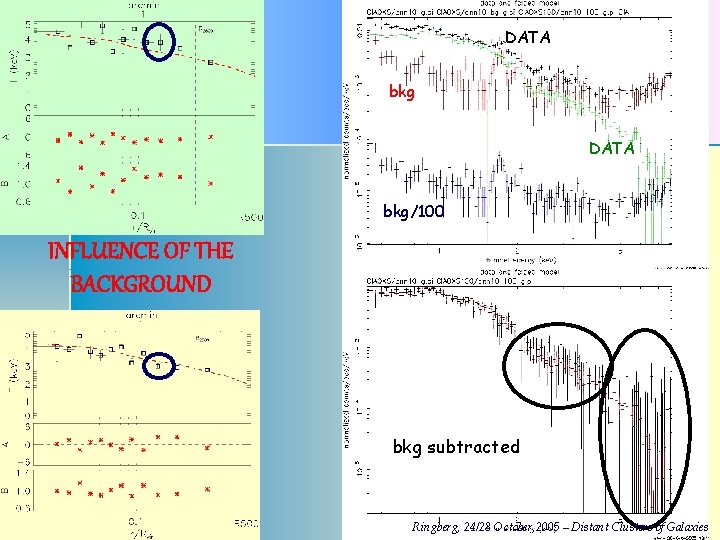
DATA bkg/100 INFLUENCE OF THE BACKGROUND bkg subtracted Ringberg, 24/28 October 2005 – Distant Clusters of Galaxies
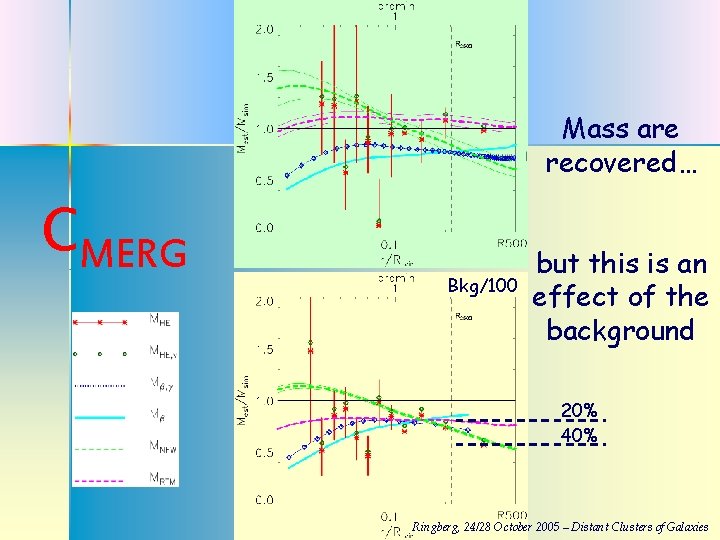
Mass are recovered… CMERG Bkg/100 but this is an effect of the background 20% 40% Ringberg, 24/28 October 2005 – Distant Clusters of Galaxies
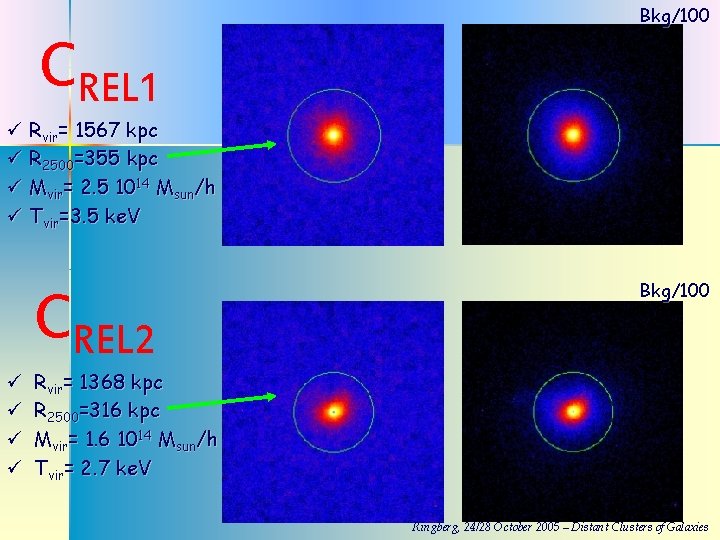
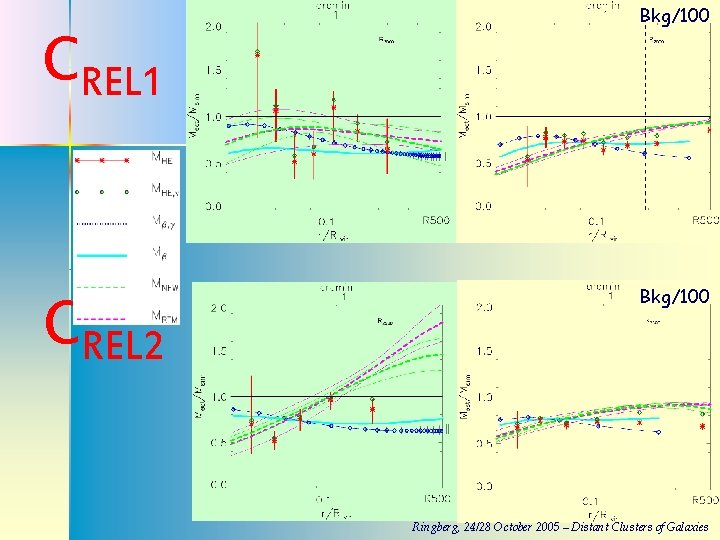
Bkg/100 CREL 1 ü Rvir= 1567 kpc ü R 2500=355 kpc ü Mvir= 2. 5 1014 Msun/h ü Tvir=3. 5 ke. V CREL 2 ü ü Bkg/100 Rvir= 1368 kpc R 2500=316 kpc Mvir= 1. 6 1014 Msun/h Tvir= 2. 7 ke. V Ringberg, 24/28 October 2005 – Distant Clusters of Galaxies
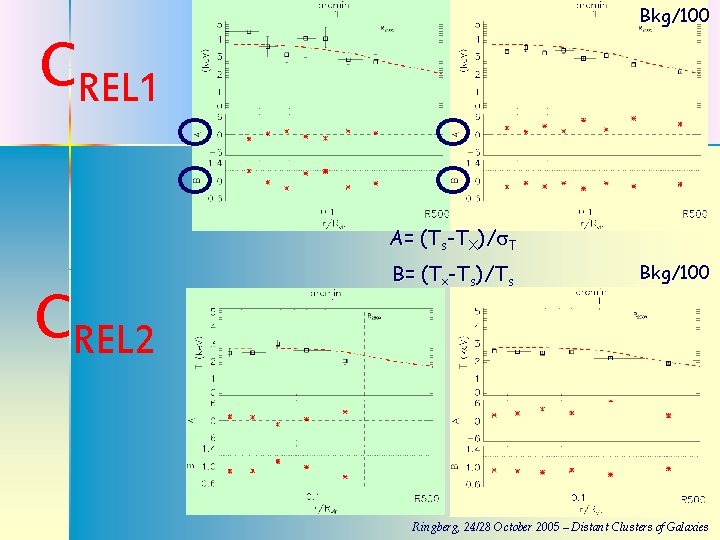
Bkg/100 CREL 1 A= (Ts-TX)/ T CREL 2 B= (Tx-Ts)/Ts Bkg/100 Ringberg, 24/28 October 2005 – Distant Clusters of Galaxies
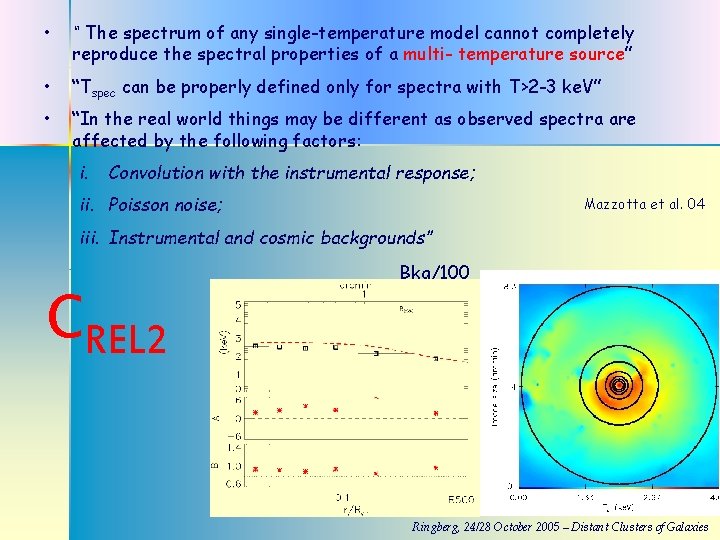
• “ The spectrum of any single-temperature model cannot completely reproduce the spectral properties of a multi- temperature source” • “Tspec can be properly defined only for spectra with T>2 -3 ke. V” • “In the real world things may be different as observed spectra are affected by the following factors: i. Convolution with the instrumental response; ii. Poisson noise; Mazzotta et al. 04 iii. Instrumental and cosmic backgrounds” CREL 2 Bkg/100 Ringberg, 24/28 October 2005 – Distant Clusters of Galaxies
CREL 1 CREL 2 Bkg/100 Ringberg, 24/28 October 2005 – Distant Clusters of Galaxies
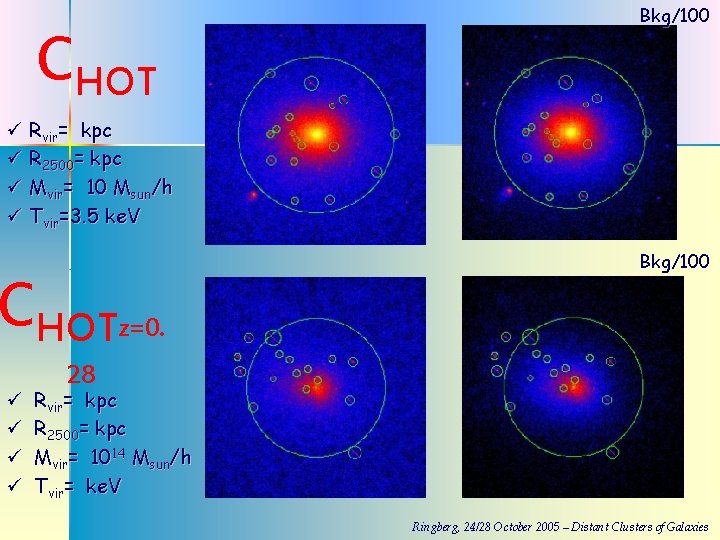
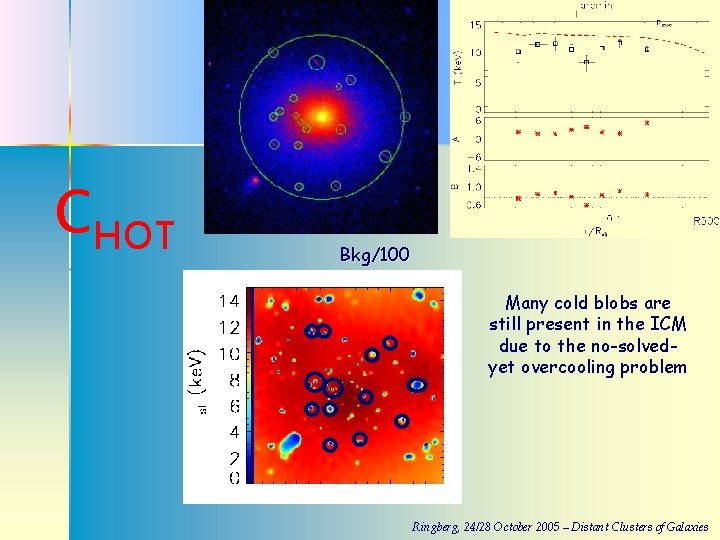
CHOT Bkg/100 ü Rvir= kpc ü R 2500= kpc ü Mvir= 10 Msun/h ü Tvir=3. 5 ke. V CHOTz=0. ü ü Bkg/100 28 Rvir= kpc R 2500= kpc Mvir= 1014 Msun/h Tvir= ke. V Ringberg, 24/28 October 2005 – Distant Clusters of Galaxies
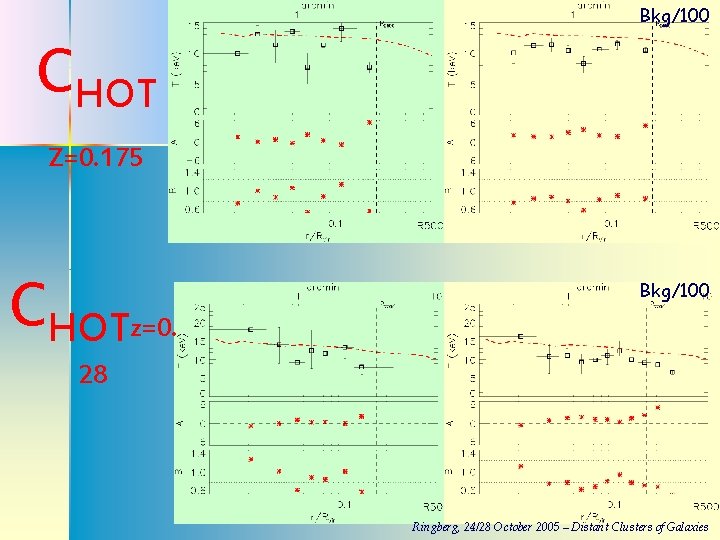
Bkg/100 CHOT Z=0. 175 CHOTz=0. Bkg/100 28 Ringberg, 24/28 October 2005 – Distant Clusters of Galaxies
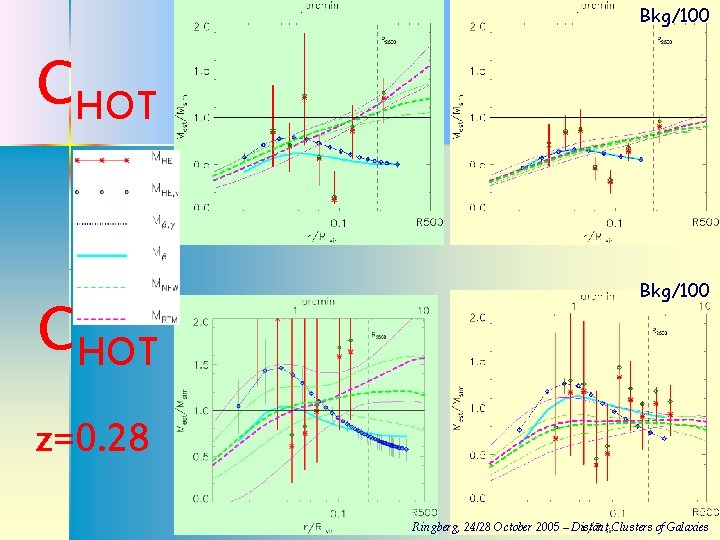
Bkg/100 CHOT Bkg/100 z=0. 28 Ringberg, 24/28 October 2005 – Distant Clusters of Galaxies
CHOT Bkg/100 Many cold blobs are still present in the ICM due to the no-solvedyet overcooling problem Ringberg, 24/28 October 2005 – Distant Clusters of Galaxies
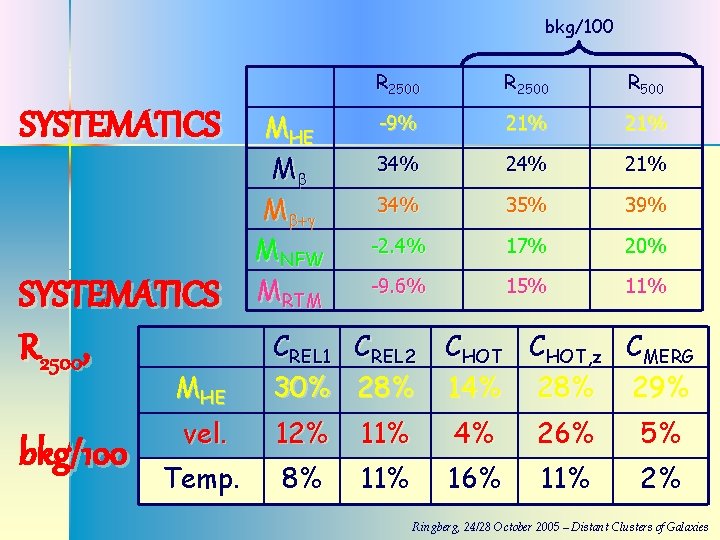
bkg/100 SYSTEMATICS R 2500, bkg/100 MHE M M MNFW MRTM R 2500 R 500 -9% 21% 34% 35% 39% -2. 4% 17% 20% -9. 6% 15% 11% MHE CREL 1 CREL 2 30% 28% CHOT, z CMERG 14% 28% 29% vel. 12% 11% 4% 26% 5% Temp. 8% 11% 16% 11% 2% Ringberg, 24/28 October 2005 – Distant Clusters of Galaxies
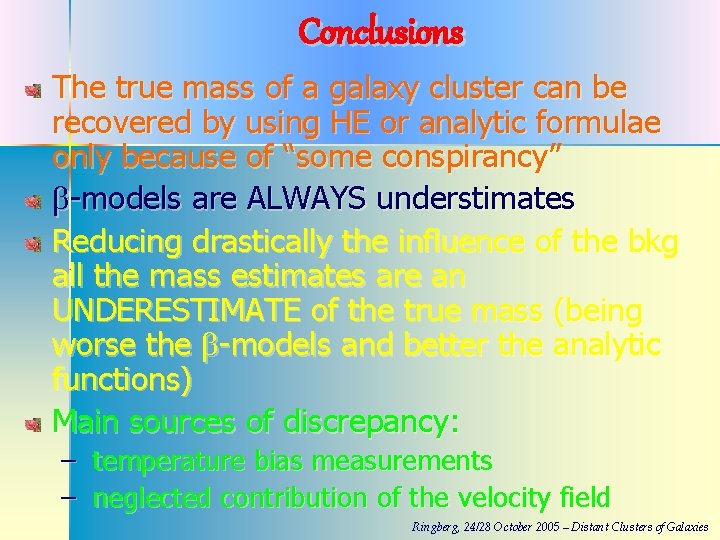
Conclusions The true mass of a galaxy cluster can be recovered by using HE or analytic formulae only because of “some conspirancy” -models are ALWAYS understimates Reducing drastically the influence of the bkg all the mass estimates are an UNDERESTIMATE of the true mass (being worse the -models and better the analytic functions) Main sources of discrepancy: – temperature bias measurements – neglected contribution of the velocity field Ringberg, 24/28 October 2005 – Distant Clusters of Galaxies