
Systematics and systematic exclusion examining conventions in scientific
- Slides: 1
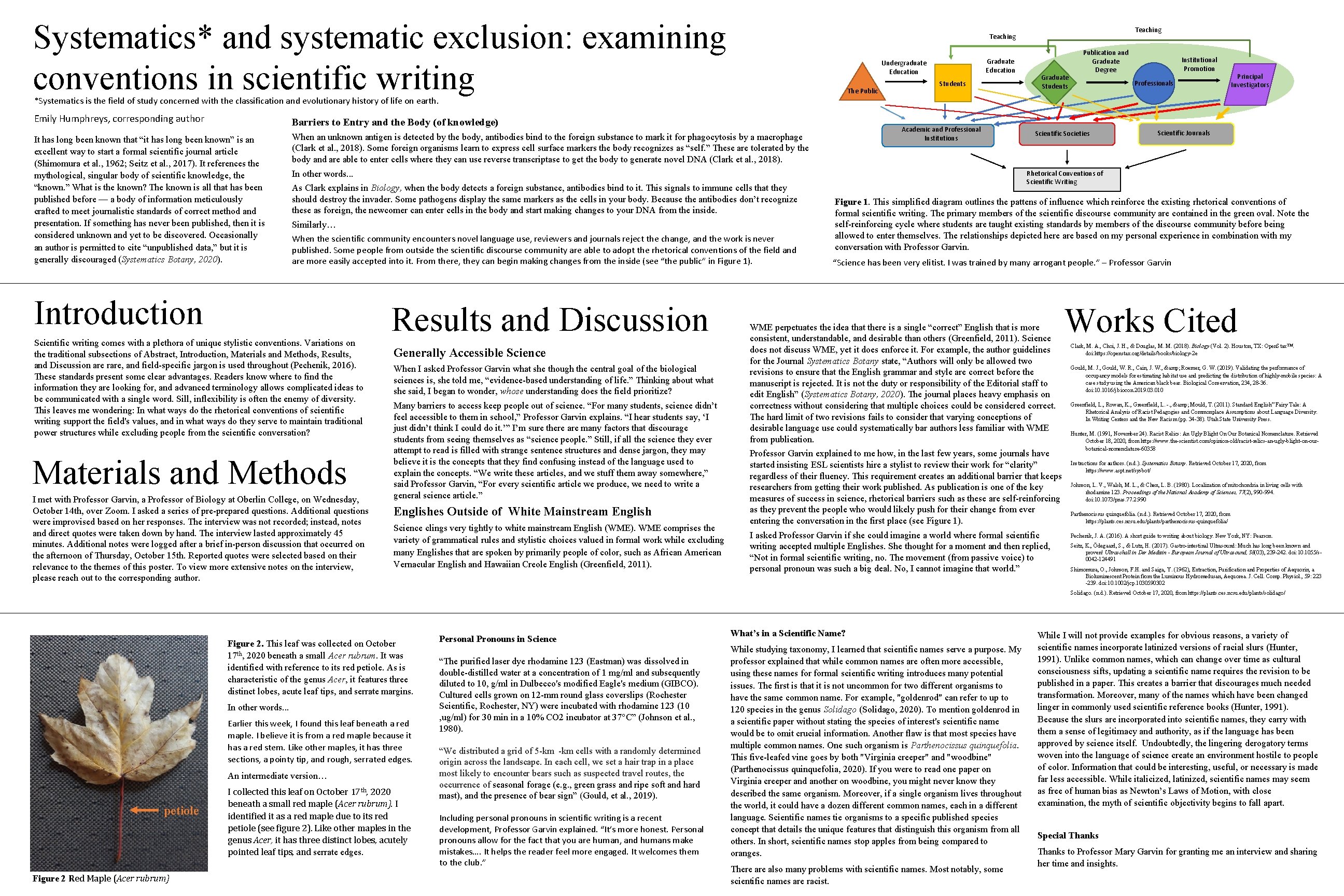
Systematics* and systematic exclusion: examining conventions in scientific writing Graduate Education Undergraduate Education The Public *Systematics is the field of study concerned with the classification and evolutionary history of life on earth. Emily Humphreys, corresponding author Barriers to Entry and the Body (of knowledge) It has long been known that “it has long been known” is an excellent way to start a formal scientific journal article (Shimomura et al. , 1962; Seitz et al. , 2017). It references the mythological, singular body of scientific knowledge, the “known. ” What is the known? The known is all that has been published before — a body of information meticulously crafted to meet journalistic standards of correct method and presentation. If something has never been published, then it is considered unknown and yet to be discovered. Occasionally an author is permitted to cite “unpublished data, ” but it is generally discouraged (Systematics Botany, 2020). When an unknown antigen is detected by the body, antibodies bind to the foreign substance to mark it for phagocytosis by a macrophage (Clark et al. , 2018). Some foreign organisms learn to express cell surface markers the body recognizes as “self. ” These are tolerated by the body and are able to enter cells where they can use reverse transcriptase to get the body to generate novel DNA (Clark et al. , 2018). Students Academic and Professional Institutions In other words. . . As Clark explains in Biology, when the body detects a foreign substance, antibodies bind to it. This signals to immune cells that they should destroy the invader. Some pathogens display the same markers as the cells in your body. Because the antibodies don’t recognize these as foreign, the newcomer can enter cells in the body and start making changes to your DNA from the inside. Similarly… When the scientific community encounters novel language use, reviewers and journals reject the change, and the work is never published. Some people from outside the scientific discourse community are able to adopt the rhetorical conventions of the field and are more easily accepted into it. From there, they can begin making changes from the inside (see “the public” in Figure 1). Introduction Scientific writing comes with a plethora of unique stylistic conventions. Variations on the traditional subsections of Abstract, Introduction, Materials and Methods, Results, and Discussion are rare, and field-specific jargon is used throughout (Pechenik, 2016). These standards present some clear advantages. Readers know where to find the information they are looking for, and advanced terminology allows complicated ideas to be communicated with a single word. Sill, inflexibility is often the enemy of diversity. This leaves me wondering: In what ways do the rhetorical conventions of scientific writing support the field's values, and in what ways do they serve to maintain traditional power structures while excluding people from the scientific conversation? Materials and Methods I met with Professor Garvin, a Professor of Biology at Oberlin College, on Wednesday, October 14 th, over Zoom. I asked a series of pre-prepared questions. Additional questions were improvised based on her responses. The interview was not recorded; instead, notes and direct quotes were taken down by hand. The interview lasted approximately 45 minutes. Additional notes were logged after a brief in-person discussion that occurred on the afternoon of Thursday, October 15 th. Reported quotes were selected based on their relevance to themes of this poster. To view more extensive notes on the interview, please reach out to the corresponding author. Results and Discussion Generally Accessible Science When I asked Professor Garvin what she though the central goal of the biological sciences is, she told me, “evidence-based understanding of life. ” Thinking about what she said, I began to wonder, whose understanding does the field prioritize? Many barriers to access keep people out of science. “For many students, science didn’t feel accessible to them in school, ” Professor Garvin explains. “I hear students say, ‘I just didn’t think I could do it. ’” I’m sure there are many factors that discourage students from seeing themselves as “science people. ” Still, if all the science they ever attempt to read is filled with strange sentence structures and dense jargon, they may believe it is the concepts that they find confusing instead of the language used to explain the concepts. “We write these articles, and we stuff them away somewhere, ” said Professor Garvin, “For every scientific article we produce, we need to write a general science article. ” Englishes Outside of White Mainstream English Science clings very tightly to white mainstream English (WME). WME comprises the variety of grammatical rules and stylistic choices valued in formal work while excluding many Englishes that are spoken by primarily people of color, such as African American Vernacular English and Hawaiian Creole English (Greenfield, 2011). Teaching Graduate Students Publication and Graduate Degree Institutional Promotion Professionals Scientific Societies Principal Investigators Scientific Journals Rhetorical Conventions of Scientific Writing Figure 1. This simplified diagram outlines the pattens of influence which reinforce the existing rhetorical conventions of formal scientific writing. The primary members of the scientific discourse community are contained in the green oval. Note the self-reinforcing cycle where students are taught existing standards by members of the discourse community before being allowed to enter themselves. The relationships depicted here are based on my personal experience in combination with my conversation with Professor Garvin. “Science has been very elitist. I was trained by many arrogant people. ” – Professor Garvin WME perpetuates the idea that there is a single “correct” English that is more consistent, understandable, and desirable than others (Greenfield, 2011). Science does not discuss WME, yet it does enforce it. For example, the author guidelines for the Journal Systematics Botany state, “Authors will only be allowed two revisions to ensure that the English grammar and style are correct before the manuscript is rejected. It is not the duty or responsibility of the Editorial staff to edit English” (Systematics Botany, 2020). The journal places heavy emphasis on correctness without considering that multiple choices could be considered correct. The hard limit of two revisions fails to consider that varying conceptions of desirable language use could systematically bar authors less familiar with WME from publication. Professor Garvin explained to me how, in the last few years, some journals have started insisting ESL scientists hire a stylist to review their work for “clarity” regardless of their fluency. This requirement creates an additional barrier that keeps researchers from getting their work published. As publication is one of the key measures of success in science, rhetorical barriers such as these are self-reinforcing as they prevent the people who would likely push for their change from ever entering the conversation in the first place (see Figure 1). I asked Professor Garvin if she could imagine a world where formal scientific writing accepted multiple Englishes. She thought for a moment and then replied, “Not in formal scientific writing, no. The movement (from passive voice) to personal pronoun was such a big deal. No, I cannot imagine that world. ” Works Cited Clark, M. A. , Choi, J. H. , & Douglas, M. M. (2018). Biology (Vol. 2). Houston, TX: Open. Stax™. doi: https: //openstax. org/details/books/biology-2 e Gould, M. J. , Gould, W. R. , Cain, J. W. , & Roemer, G. W. (2019). Validating the performance of occupancy models for estimating habitat use and predicting the distribution of highly-mobile species: A case study using the American black bear. Biological Conservation, 234, 28 -36. doi: 10. 1016/j. biocon. 2019. 03. 010 Greenfield, L. , Rowan, K. , Greenfield, L. -. , & Mould, T. (2011). Standard English” Fairy Tale: A Rhetorical Analysis of Racist Pedagogies and Commonplace Assumptions about Language Diversity. In Writing Centers and the New Racism (pp. 34 -38). Utah State University Press. Hunter, M. (1991, November 24). Racist Relics: An Ugly Blight On Our Botanical Nomenclature. Retrieved October 18, 2020, from https: //www. the-scientist. com/opinion-old/racist-relics-an-ugly-blight-on-ourbotanical-nomenclature-60358 Instructions for authors. (n. d. ). Systematics Botany. Retrieved October 17, 2020, from https: //www. aspt. net/sysbot/ Johnson, L. V. , Walsh, M. L. , & Chen, L. B. (1980). Localization of mitochondria in living cells with rhodamine 123. Proceedings of the National Academy of Sciences, 77(2), 990 -994. doi: 10. 1073/pnas. 77. 2. 990 Parthenocissus quinquefolia. (n. d. ). Retrieved October 17, 2020, from https: //plants. ces. ncsu. edu/plants/parthenocissus-quinquefolia/ Pechenik, J. A. (2016). A short guide to writing about biology. New York, NY: Pearson. Seitz, K. , Ödegaard, S. , & Lutz, H. (2017). Gastro-intestinal Ultrasound: Much has long been known and proven! Ultraschall in Der Medizin - European Journal of Ultrasound, 38(03), 239 -242. doi: 10. 1055/s 0042 -124491 Shimomura, O. , Johnson, F. H. and Saiga, Y. (1962), Extraction, Purification and Properties of Aequorin, a Bioluminescent Protein from the Luminous Hydromedusan, Aequorea. J. Cell. Comp. Physiol. , 59: 223 -239. doi: 10. 1002/jcp. 1030590302 Solidago. (n. d. ). Retrieved October 17, 2020, from https: //plants. ces. ncsu. edu/plants/solidago/ Figure 2. This leaf was collected on October 17 th, 2020 beneath a small Acer rubrum. It was identified with reference to its red petiole. As is characteristic of the genus Acer, it features three distinct lobes, acute leaf tips, and serrate margins. In other words. . . Earlier this week, I found this leaf beneath a red maple. I believe it is from a red maple because it has a red stem. Like other maples, it has three sections, a pointy tip, and rough, serrated edges. An intermediate version… petiole Figure 2 Red Maple (Acer rubrum) I collected this leaf on October 17 th, 2020 beneath a small red maple (Acer rubrum). I identified it as a red maple due to its red petiole (see figure 2). Like other maples in the genus Acer, it has three distinct lobes, acutely pointed leaf tips, and serrate edges. Personal Pronouns in Science “The purified laser dye rhodamine 123 (Eastman) was dissolved in double-distilled water at a concentration of 1 mg/ml and subsequently diluted to 10, g/ml in Dulbecco's modified Eagle's medium (GIBCO). Cultured cells grown on 12 -mm round glass coverslips (Rochester Scientific, Rochester, NY) were incubated with rhodamine 123 (10 , ug/ml) for 30 min in a 10% CO 2 incubator at 37°C” (Johnson et al. , 1980). “We distributed a grid of 5 -km cells with a randomly determined origin across the landscape. In each cell, we set a hair trap in a place most likely to encounter bears such as suspected travel routes, the occurrence of seasonal forage (e. g. , green grass and ripe soft and hard mast), and the presence of bear sign” (Gould, et al. , 2019). Including personal pronouns in scientific writing is a recent development, Professor Garvin explained. “It’s more honest. Personal pronouns allow for the fact that you are human, and humans make mistakes…. It helps the reader feel more engaged. It welcomes them to the club. ” What’s in a Scientific Name? While studying taxonomy, I learned that scientific names serve a purpose. My professor explained that while common names are often more accessible, using these names formal scientific writing introduces many potential issues. The first is that it is not uncommon for two different organisms to have the same common name. For example, "goldenrod" can refer to up to 120 species in the genus Solidago (Solidago, 2020). To mention goldenrod in a scientific paper without stating the species of interest's scientific name would be to omit crucial information. Another flaw is that most species have multiple common names. One such organism is Parthenocissus quinquefolia. This five-leafed vine goes by both "Virginia creeper" and "woodbine" (Parthenocissus quinquefolia, 2020). If you were to read one paper on Virginia creeper and another on woodbine, you might never know they described the same organism. Moreover, if a single organism lives throughout the world, it could have a dozen different common names, each in a different language. Scientific names tie organisms to a specific published species concept that details the unique features that distinguish this organism from all others. In short, scientific names stop apples from being compared to oranges. There also many problems with scientific names. Most notably, some scientific names are racist. While I will not provide examples for obvious reasons, a variety of scientific names incorporate latinized versions of racial slurs (Hunter, 1991). Unlike common names, which can change over time as cultural consciousness sifts, updating a scientific name requires the revision to be published in a paper. This creates a barrier that discourages much needed transformation. Moreover, many of the names which have been changed linger in commonly used scientific reference books (Hunter, 1991). Because the slurs are incorporated into scientific names, they carry with them a sense of legitimacy and authority, as if the language has been approved by science itself. Undoubtedly, the lingering derogatory terms woven into the language of science create an environment hostile to people of color. Information that could be interesting, useful, or necessary is made far less accessible. While italicized, latinized, scientific names may seem as free of human bias as Newton’s Laws of Motion, with close examination, the myth of scientific objectivity begins to fall apart. Special Thanks to Professor Mary Garvin for granting me an interview and sharing her time and insights.