
Systematical calculation on alpha decay of superheavy nuclei
- Slides: 45
Systematical calculation on alpha decay of superheavy nuclei l Zhongzhou Ren 1, 2 (任中洲), Chang Xu 1 (许昌 ) l 1 Department l 2 Center of Physics, Nanjing University, Nanjing, China of Theoretical Nuclear Physics, National Laboratory of Heavy-Ion Accelerator, Lanzhou, China
Outline l 1. Introduction l 2. Density-dependent cluster model l 3. Numeral results and discussions l 4. Summary
1. Introduction l Becquerel discovered a kind of unknown radiation from Uranium in 1896. l M. Curie and P. Curie identified two chemical elements (polonium and radium) by their strong radioactivity. l In 1908 Rutherford found that this unknown radiation consists of 4 He nuclei and named it as the alpha decay for convenience.
Gamow: Quantum 1928 l In 1910 s alpha scattering from natural radioactivity on target nuclei provided first information on the size of a nucleus and on the range of nuclear force. l In 1928 Gamow tried to apply quantum mechanics to alpha decay and explained it as a quantum tunnelling effect.
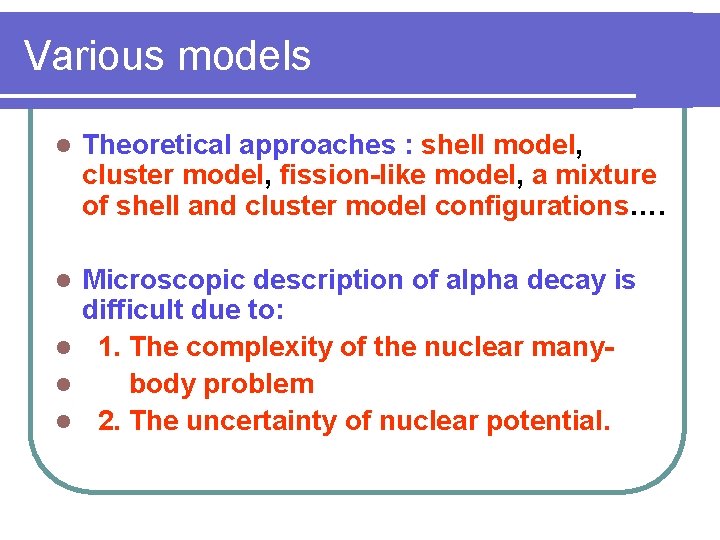
Various models l Theoretical approaches : shell model, cluster model, fission-like model, a mixture of shell and cluster model configurations…. Microscopic description of alpha decay is difficult due to: l 1. The complexity of the nuclear manyl body problem l 2. The uncertainty of nuclear potential. l
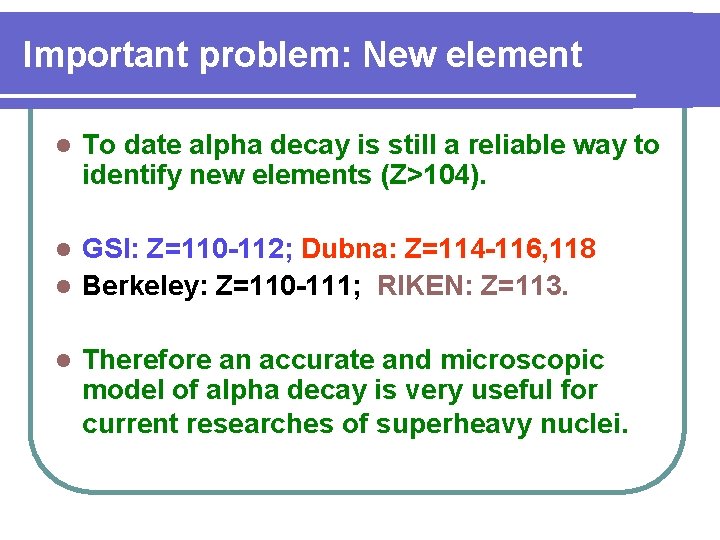
Important problem: New element l To date alpha decay is still a reliable way to identify new elements (Z>104). GSI: Z=110 -112; Dubna: Z=114 -116, 118 l Berkeley: Z=110 -111; RIKEN: Z=113. l l Therefore an accurate and microscopic model of alpha decay is very useful for current researches of superheavy nuclei.
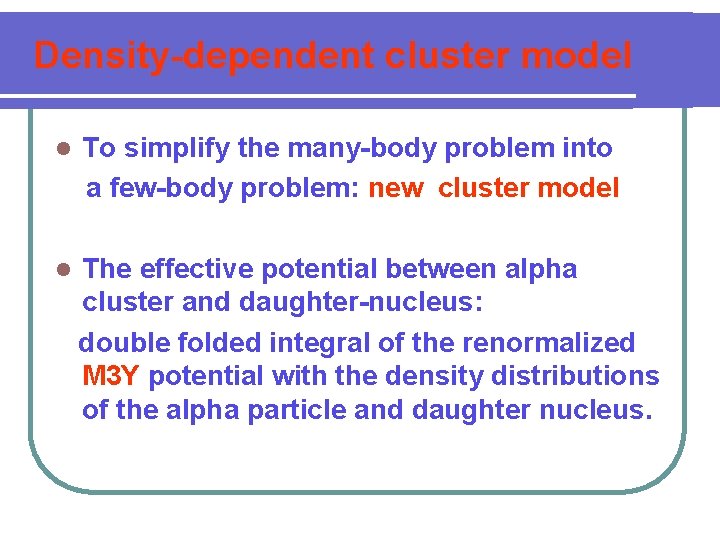
Density-dependent cluster model l To simplify the many-body problem into a few-body problem: new cluster model l The effective potential between alpha cluster and daughter-nucleus: double folded integral of the renormalized M 3 Y potential with the density distributions of the alpha particle and daughter nucleus.
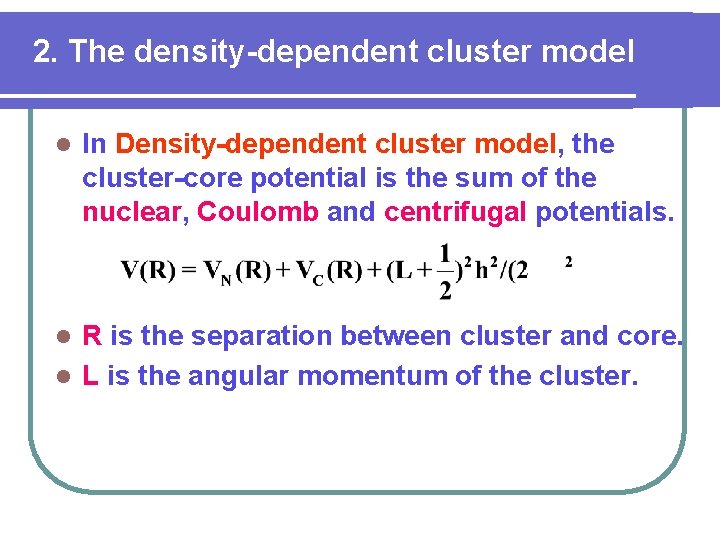
2. The density-dependent cluster model l In Density-dependent cluster model, the cluster-core potential is the sum of the nuclear, Coulomb and centrifugal potentials. R is the separation between cluster and core. l L is the angular momentum of the cluster. l
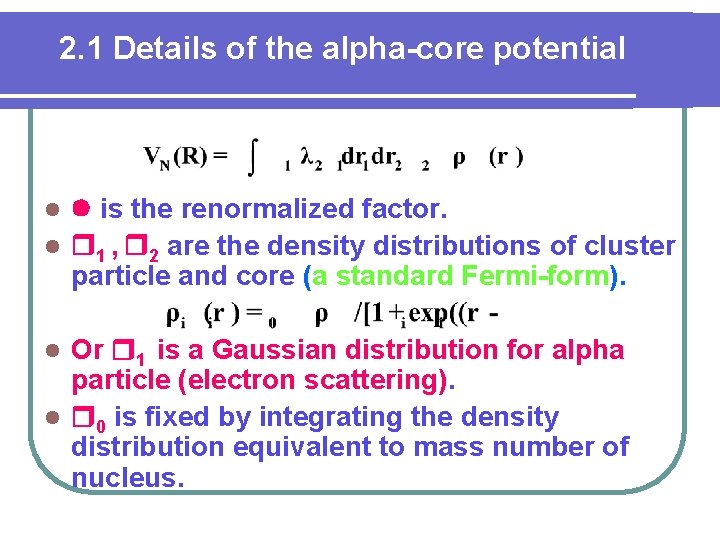
2. 1 Details of the alpha-core potential is the renormalized factor. l 1 , 2 are the density distributions of cluster particle and core (a standard Fermi-form). l Or 1 is a Gaussian distribution for alpha particle (electron scattering). l 0 is fixed by integrating the density distribution equivalent to mass number of nucleus. l
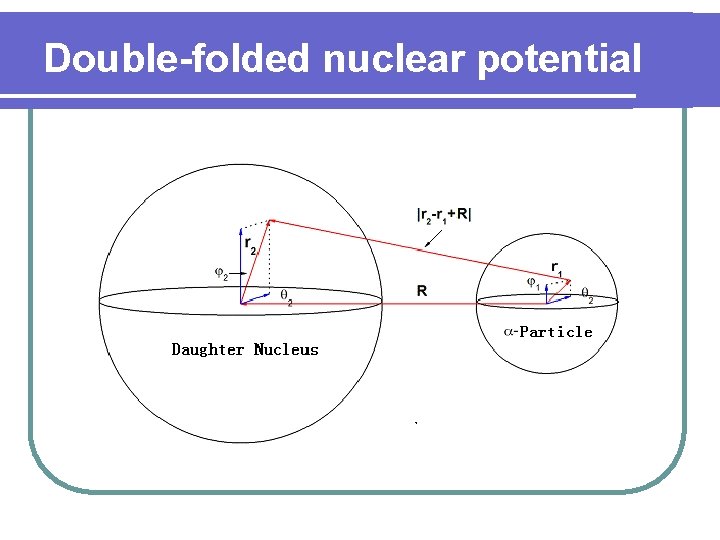
Double-folded nuclear potential
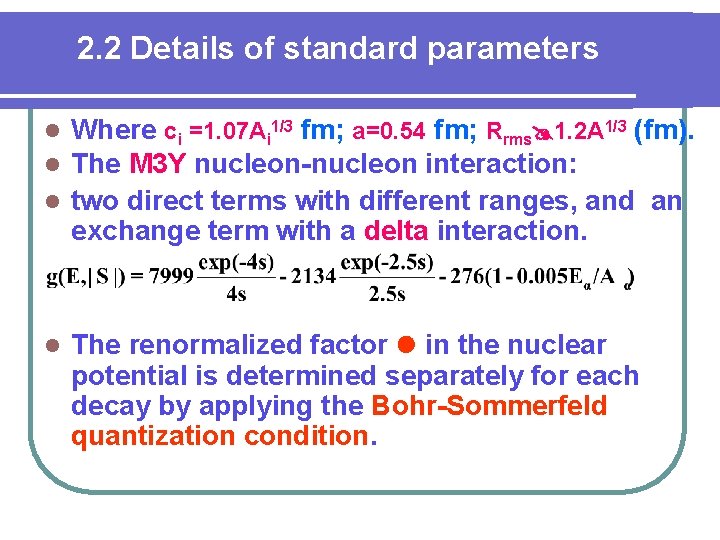
2. 2 Details of standard parameters Where ci =1. 07 Ai 1/3 fm; a=0. 54 fm; Rrms 1. 2 A 1/3 (fm). The M 3 Y nucleon-nucleon interaction: l two direct terms with different ranges, and an exchange term with a delta interaction. l l l The renormalized factor in the nuclear potential is determined separately for each decay by applying the Bohr-Sommerfeld quantization condition.
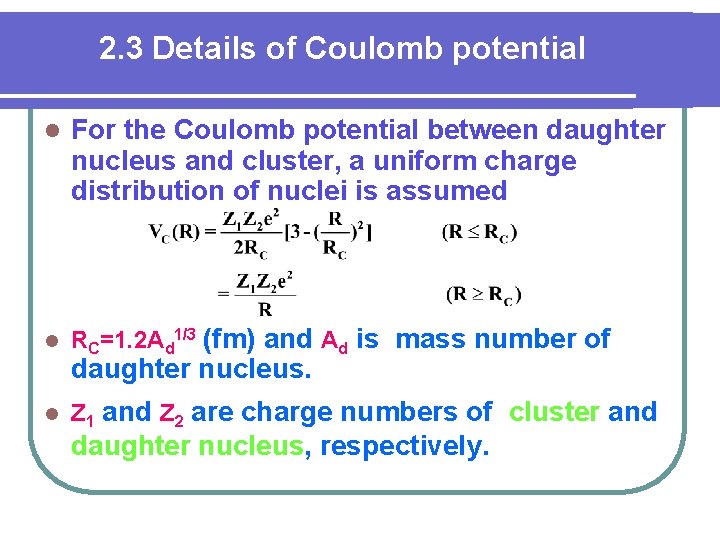
2. 3 Details of Coulomb potential l For the Coulomb potential between daughter nucleus and cluster, a uniform charge distribution of nuclei is assumed l RC=1. 2 Ad 1/3 (fm) and Ad is mass number of daughter nucleus. l Z 1 and Z 2 are charge numbers of cluster and daughter nucleus, respectively.
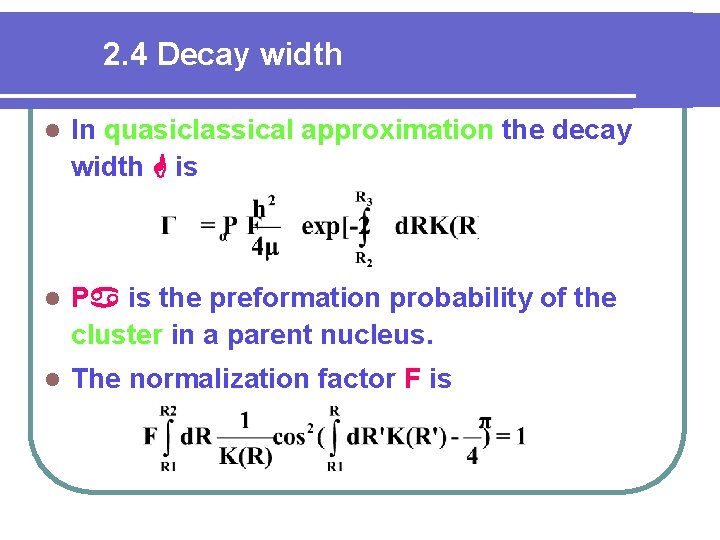
2. 4 Decay width l In quasiclassical approximation the decay width is l P is the preformation probability of the cluster in a parent nucleus. l The normalization factor F is
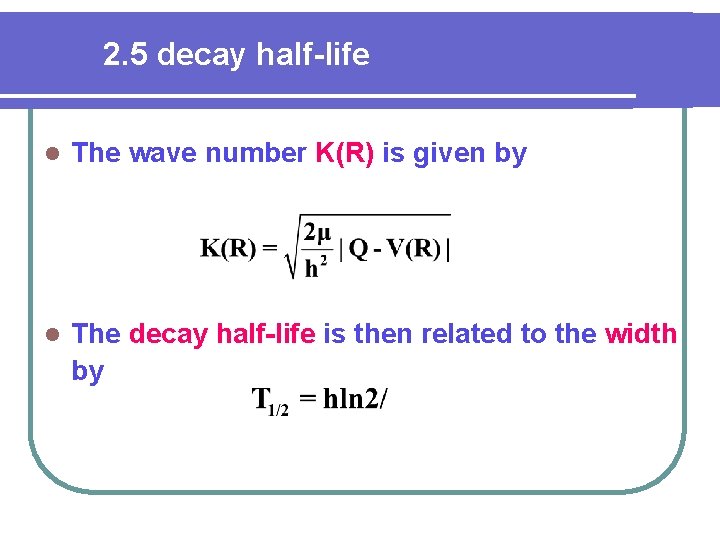
2. 5 decay half-life l The wave number K(R) is given by l The decay half-life is then related to the width by
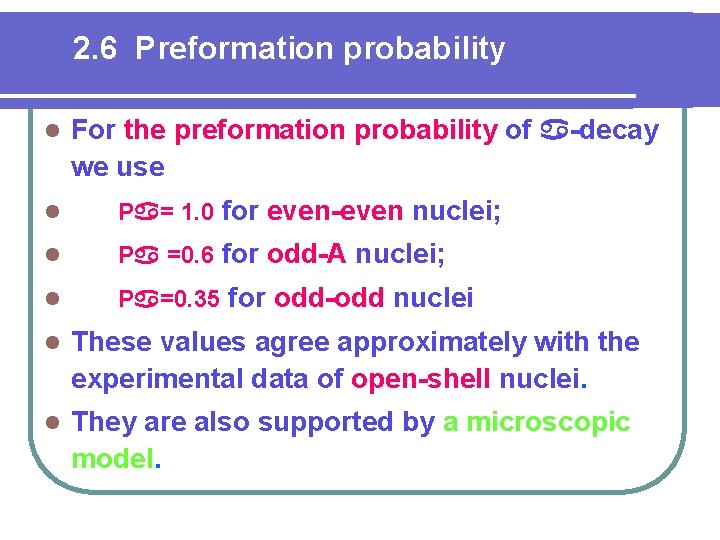
2. 6 Preformation probability l For the preformation probability of -decay we use l P = 1. 0 for even-even nuclei; l P =0. 6 for odd-A nuclei; l P =0. 35 for odd-odd nuclei l These values agree approximately with the experimental data of open-shell nuclei. l They are also supported by a microscopic model.
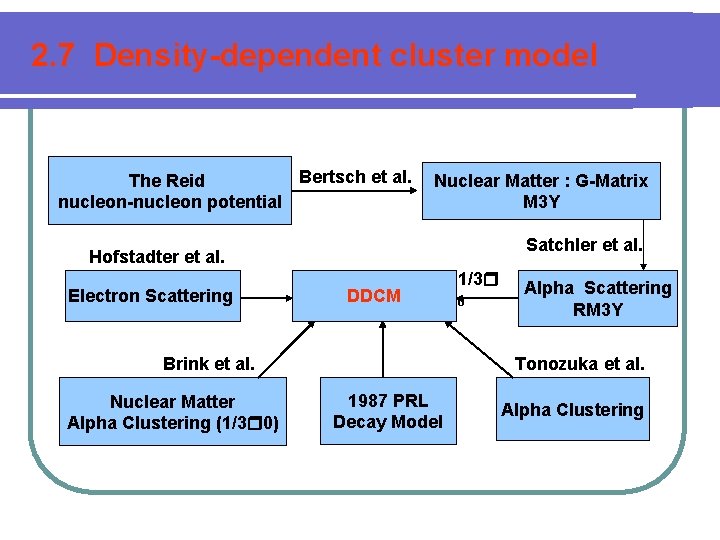
2. 7 Density-dependent cluster model Bertsch et al. The Reid nucleon-nucleon potential Nuclear Matter : G-Matrix M 3 Y Satchler et al. Hofstadter et al. Electron Scattering DDCM Brink et al. Nuclear Matter Alpha Clustering (1/3 0) 1/3 0 Alpha Scattering RM 3 Y Tonozuka et al. 1987 PRL Decay Model Alpha Clustering
3. Numeral results and discussions l 1. We discuss the details of realistic M 3 Y potential used in DDCM. l 2. We give theoretical half-lives of alpha decay for heavy and superheavy nuclei.
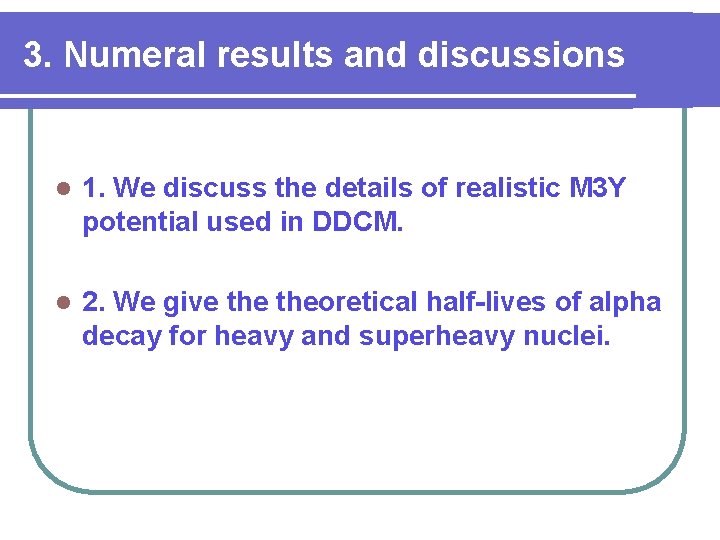
The variation of the nuclear alpha-core potential with distance R(fm) in the density-dependent cluster model and in Buck's model for 232 Th.
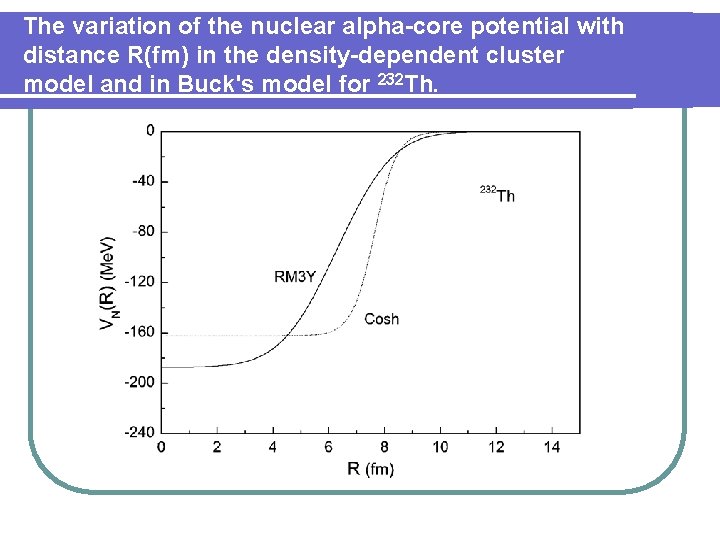
The variation of the sum of nuclear alpha-core and Coulomb potential with distance R (fm) in DDCM and in Buck's model for 232 Th.
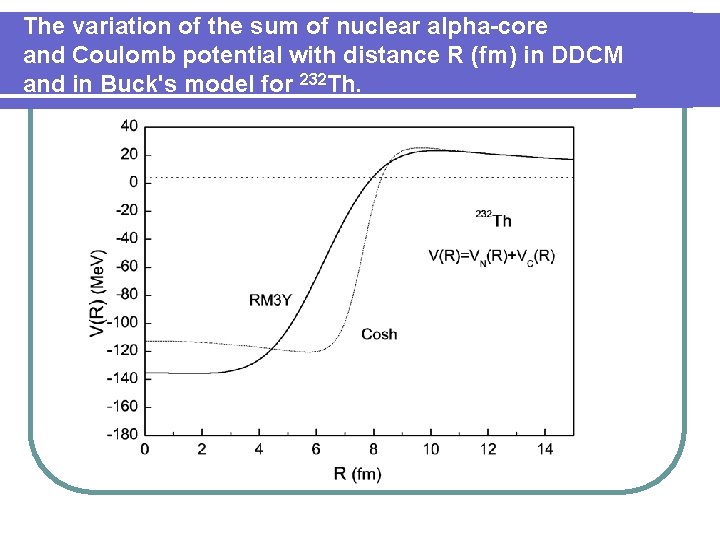
The variation of the hindrance factor for Z=70, 80, 90, 100, and 110 isotopes.
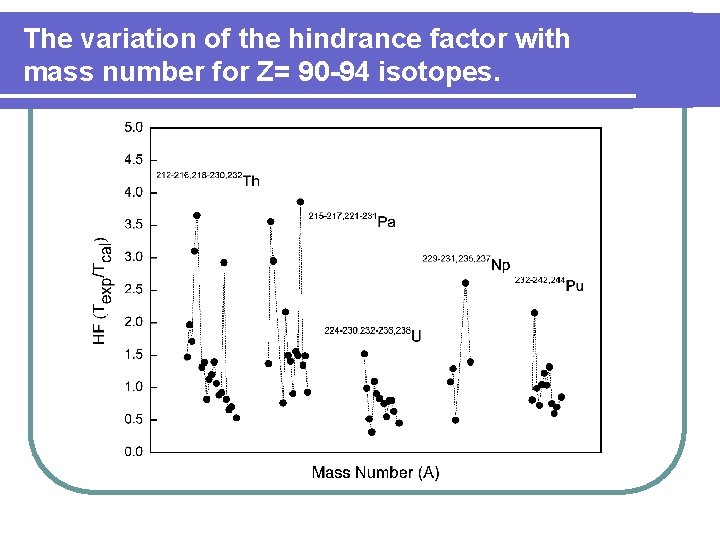
The variation of the hindrance factor with mass number for Z= 90 -94 isotopes.
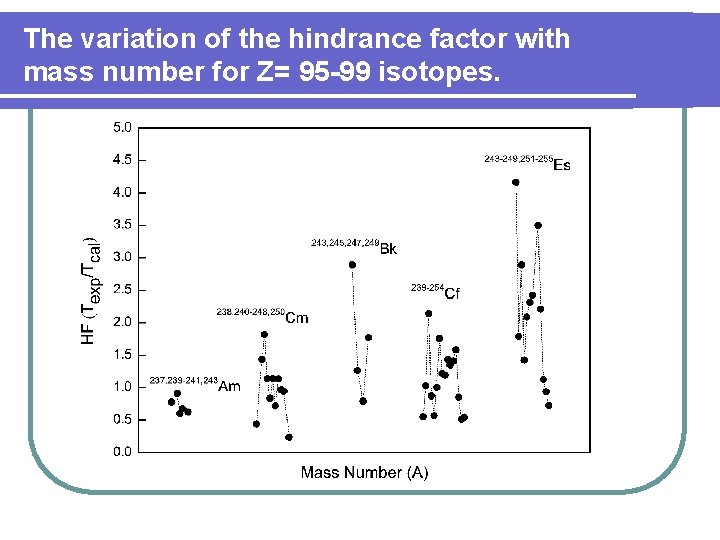
The variation of the hindrance factor with mass number for Z= 95 -99 isotopes.
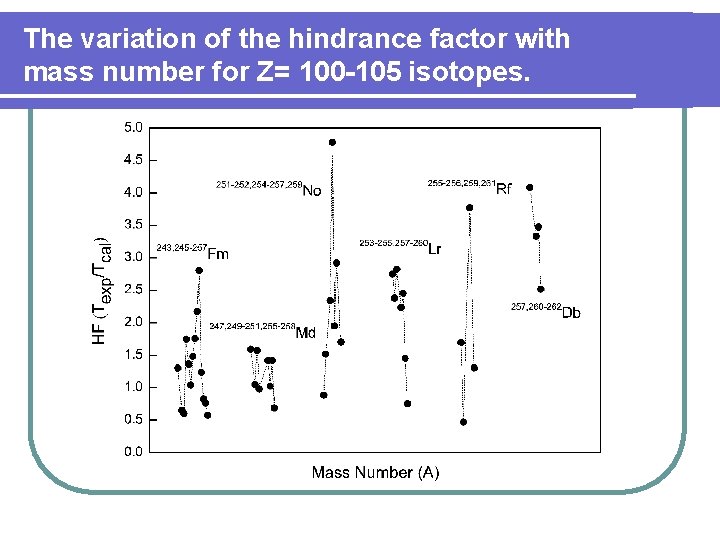
The variation of the hindrance factor with mass number for Z= 100 -105 isotopes.
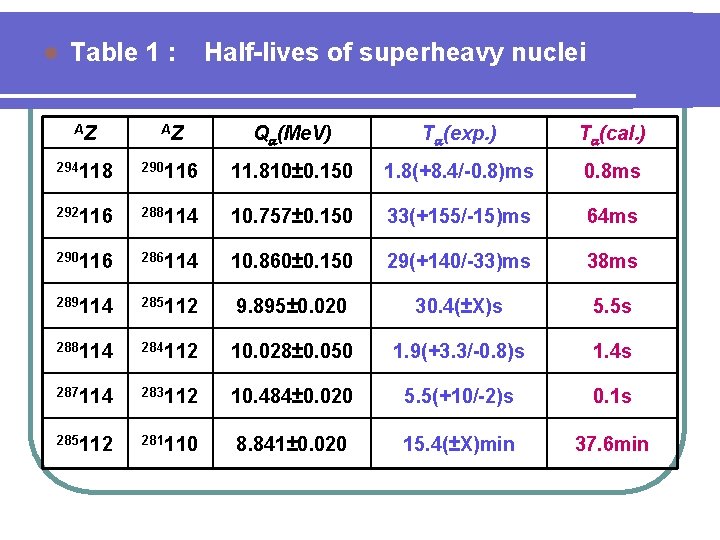
l Table 1 : Half-lives of superheavy nuclei AZ AZ Q (Me. V) T (exp. ) T (cal. ) 294118 290116 11. 810± 0. 150 1. 8(+8. 4/-0. 8)ms 0. 8 ms 292116 288114 10. 757± 0. 150 33(+155/-15)ms 64 ms 290116 286114 10. 860± 0. 150 29(+140/-33)ms 38 ms 289114 285112 9. 895± 0. 020 30. 4(±X)s 5. 5 s 288114 284112 10. 028± 0. 050 1. 9(+3. 3/-0. 8)s 1. 4 s 287114 283112 10. 484± 0. 020 5. 5(+10/-2)s 0. 1 s 285112 281110 8. 841± 0. 020 15. 4(±X)min 37. 6 min
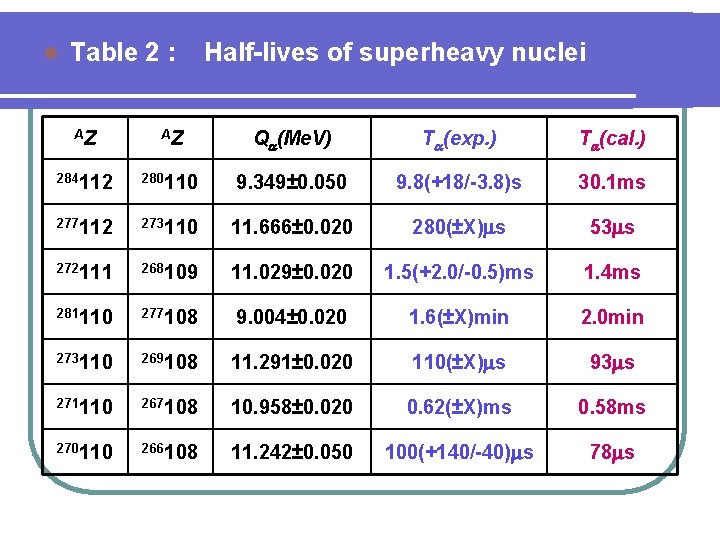
l Table 2 : Half-lives of superheavy nuclei AZ AZ Q (Me. V) T (exp. ) T (cal. ) 284112 280110 9. 349± 0. 050 9. 8(+18/-3. 8)s 30. 1 ms 277112 273110 11. 666± 0. 020 280(±X) s 53 s 272111 268109 11. 029± 0. 020 1. 5(+2. 0/-0. 5)ms 1. 4 ms 281110 277108 9. 004± 0. 020 1. 6(±X)min 2. 0 min 273110 269108 11. 291± 0. 020 110(±X) s 93 s 271110 267108 10. 958± 0. 020 0. 62(±X)ms 0. 58 ms 270110 266108 11. 242± 0. 050 100(+140/-40) s 78 s
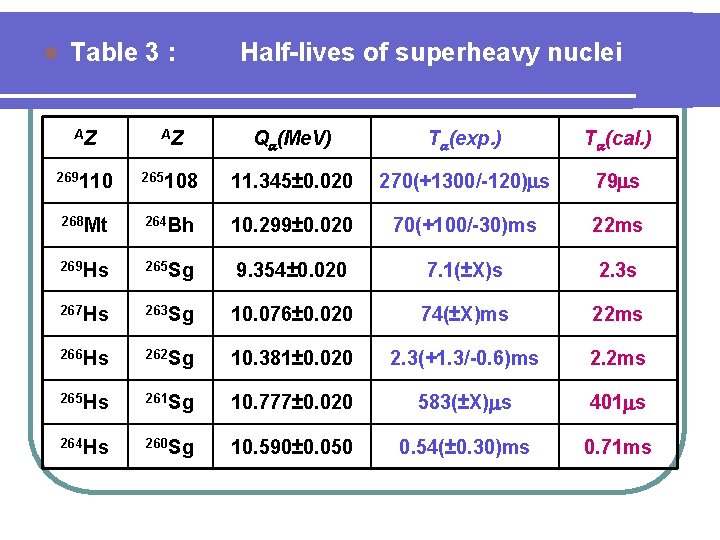
l Table 3 : Half-lives of superheavy nuclei AZ AZ Q (Me. V) T (exp. ) T (cal. ) 269110 265108 11. 345± 0. 020 270(+1300/-120) s 79 s 268 Mt 264 Bh 10. 299± 0. 020 70(+100/-30)ms 22 ms 269 Hs 265 Sg 9. 354± 0. 020 7. 1(±X)s 2. 3 s 267 Hs 263 Sg 10. 076± 0. 020 74(±X)ms 22 ms 266 Hs 262 Sg 10. 381± 0. 020 2. 3(+1. 3/-0. 6)ms 2. 2 ms 265 Hs 261 Sg 10. 777± 0. 020 583(±X) s 401 s 264 Hs 260 Sg 10. 590± 0. 050 0. 54(± 0. 30)ms 0. 71 ms
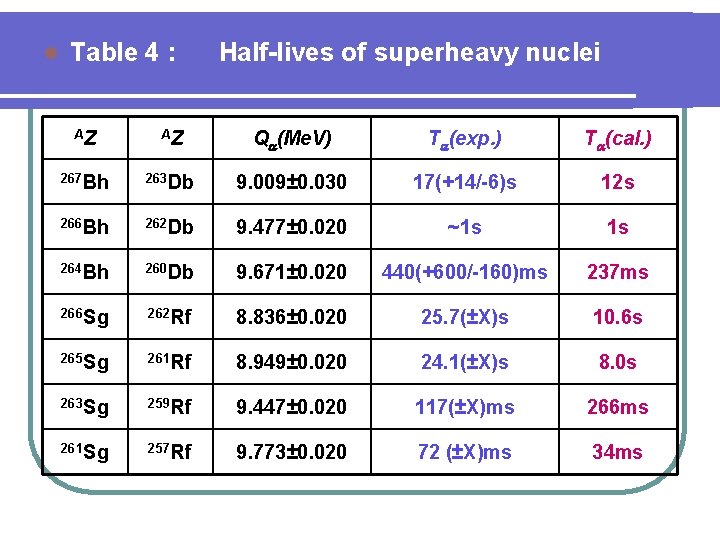
l Table 4 : Half-lives of superheavy nuclei AZ AZ Q (Me. V) T (exp. ) T (cal. ) 267 Bh 263 Db 9. 009± 0. 030 17(+14/-6)s 12 s 266 Bh 262 Db 9. 477± 0. 020 ~1 s 1 s 264 Bh 260 Db 9. 671± 0. 020 440(+600/-160)ms 237 ms 266 Sg 262 Rf 8. 836± 0. 020 25. 7(±X)s 10. 6 s 265 Sg 261 Rf 8. 949± 0. 020 24. 1(±X)s 8. 0 s 263 Sg 259 Rf 9. 447± 0. 020 117(±X)ms 266 ms 261 Sg 257 Rf 9. 773± 0. 020 72 (±X)ms 34 ms
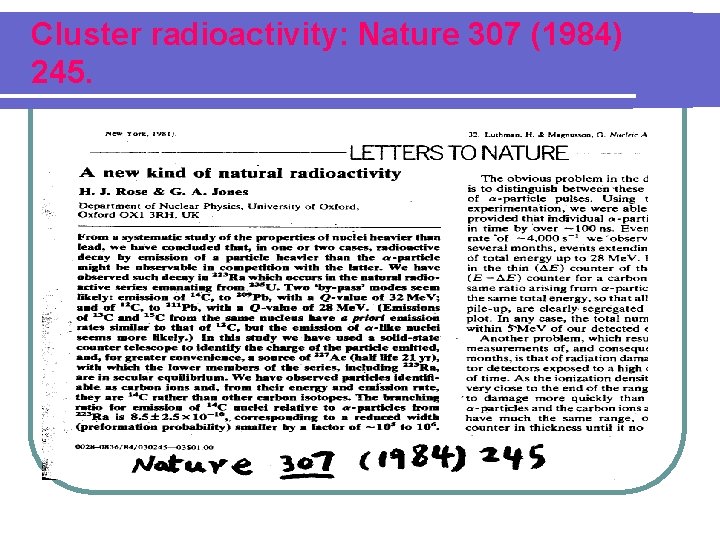
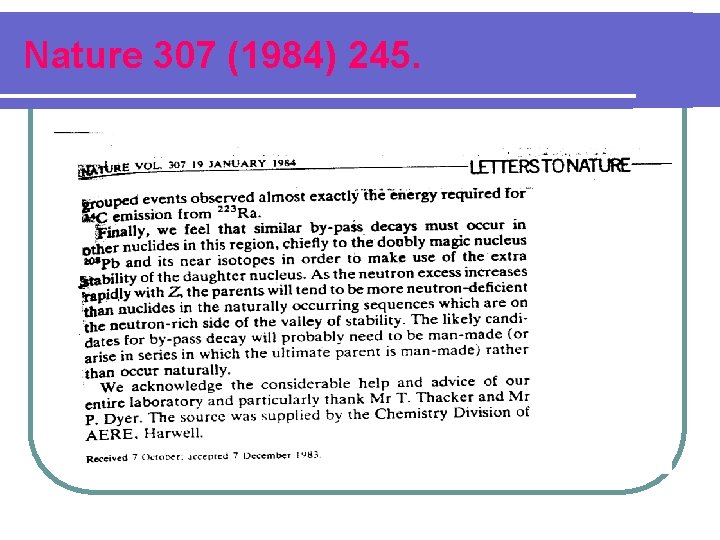
Cluster radioactivity: Nature 307 (1984) 245.
Nature 307 (1984) 245.
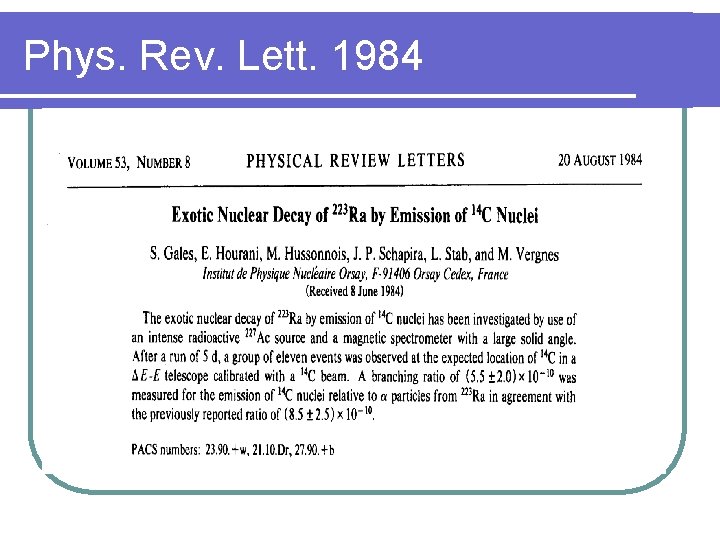
Phys. Rev. Lett. 1984
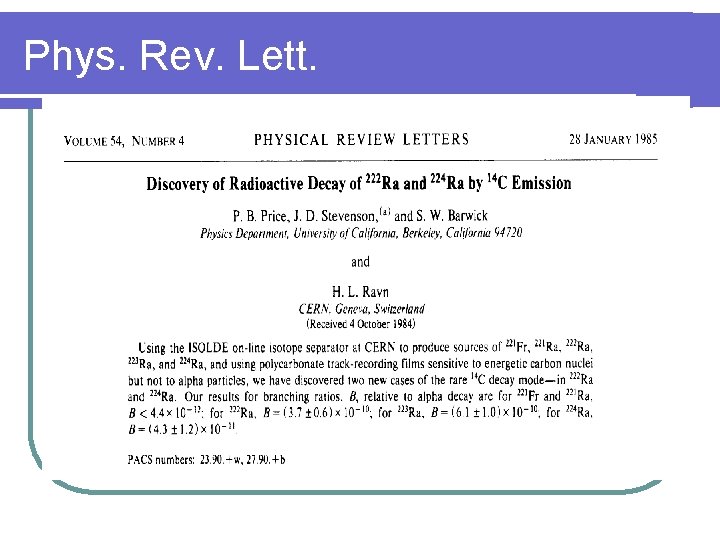
Phys. Rev. Lett.
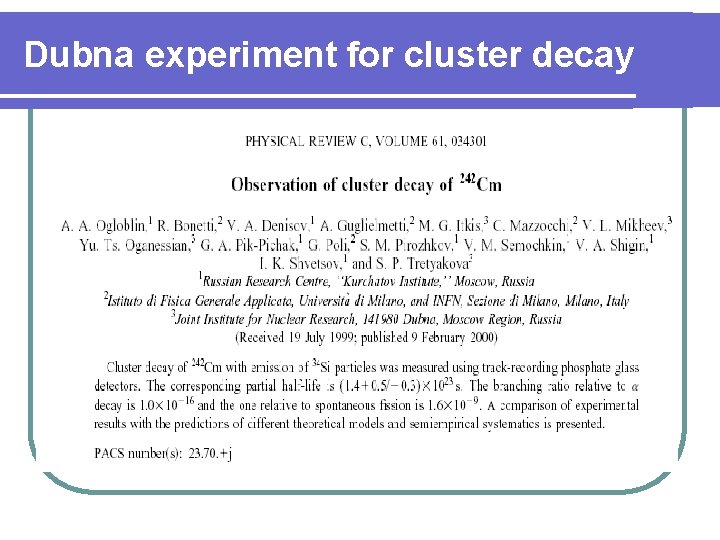
Dubna experiment for cluster decay
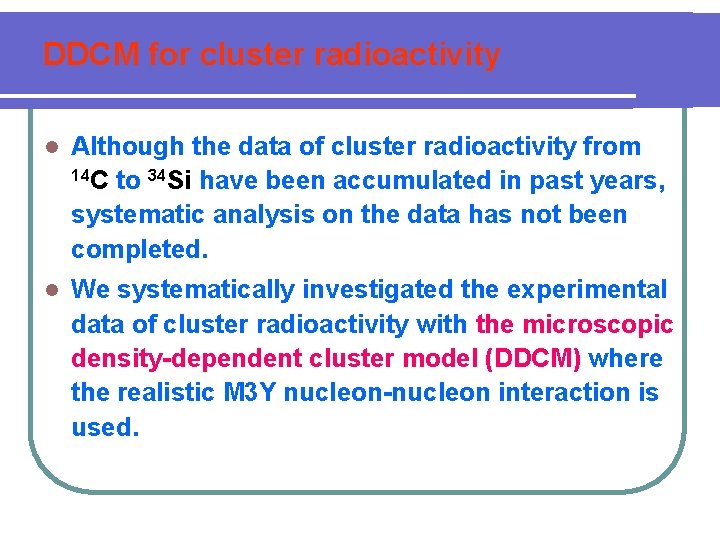
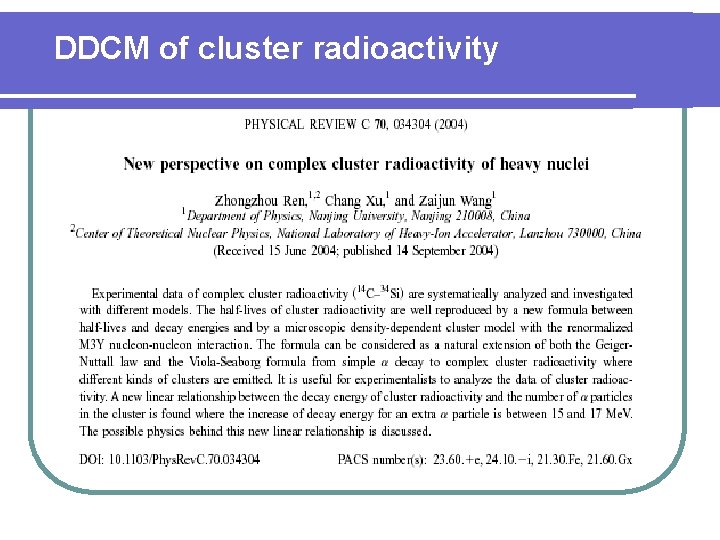
DDCM for cluster radioactivity l Although the data of cluster radioactivity from 14 C to 34 Si have been accumulated in past years, systematic analysis on the data has not been completed. l We systematically investigated the experimental data of cluster radioactivity with the microscopic density-dependent cluster model (DDCM) where the realistic M 3 Y nucleon-nucleon interaction is used.
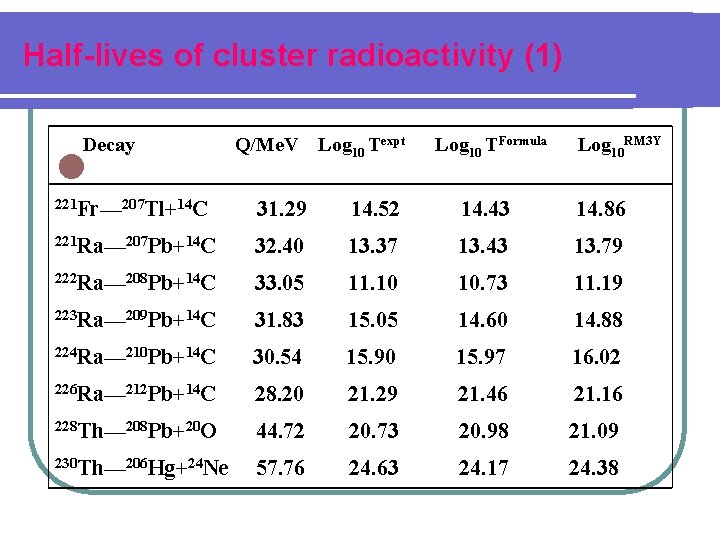
Half-lives of cluster radioactivity (1) Decay l Q/Me. V Log 10 Texpt Log 10 TFormula Log 10 RM 3 Y 221 Fr— 207 Tl+14 C 31. 29 14. 52 14. 43 14. 86 221 Ra— 207 Pb+14 C 32. 40 13. 37 13. 43 13. 79 222 Ra— 208 Pb+14 C 33. 05 11. 10 10. 73 11. 19 223 Ra— 209 Pb+14 C 31. 83 15. 05 14. 60 14. 88 224 Ra— 210 Pb+14 C 30. 54 15. 90 15. 97 16. 02 226 Ra— 212 Pb+14 C 28. 20 21. 29 21. 46 21. 16 228 Th— 208 Pb+20 O 44. 72 20. 73 20. 98 21. 09 230 Th— 206 Hg+24 Ne 57. 76 24. 63 24. 17 24. 38
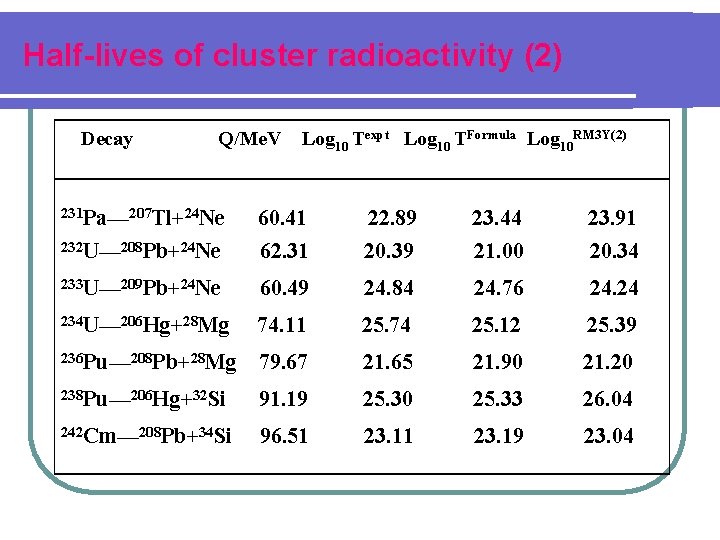
Half-lives of cluster radioactivity (2) Decay Q/Me. V Log 10 Texpt Log 10 TFormula Log 10 RM 3 Y(2) 231 Pa— 207 Tl+24 Ne 60. 41 22. 89 23. 44 23. 91 232 U— 208 Pb+24 Ne 62. 31 20. 39 21. 00 20. 34 233 U— 209 Pb+24 Ne 60. 49 24. 84 24. 76 24. 24 234 U— 206 Hg+28 Mg 74. 11 25. 74 25. 12 25. 39 236 Pu— 208 Pb+28 Mg 79. 67 21. 65 21. 90 21. 20 238 Pu— 206 Hg+32 Si 91. 19 25. 30 25. 33 26. 04 242 Cm— 208 Pb+34 Si 96. 51 23. 19 23. 04
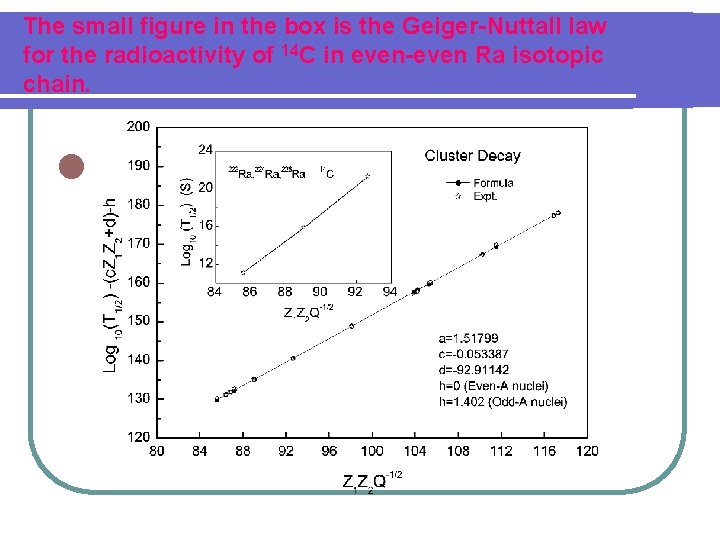
The small figure in the box is the Geiger-Nuttall law for the radioactivity of 14 C in even-even Ra isotopic chain. l
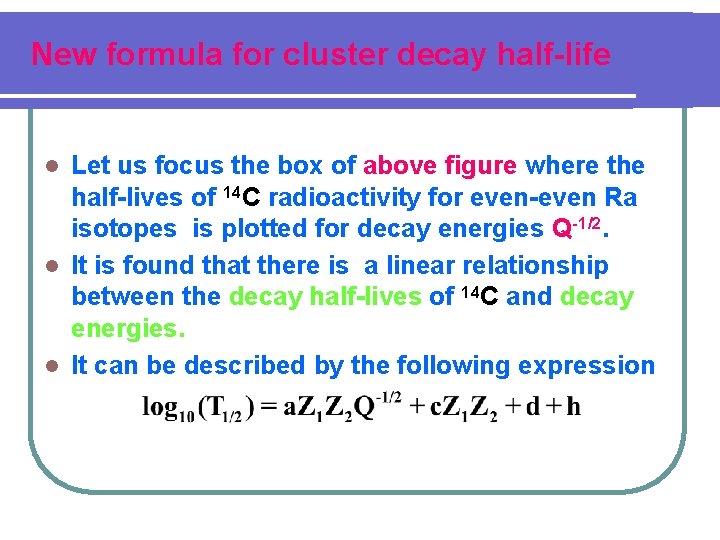
New formula for cluster decay half-life Let us focus the box of above figure where the half-lives of 14 C radioactivity for even-even Ra isotopes is plotted for decay energies Q-1/2. l It is found that there is a linear relationship between the decay half-lives of 14 C and decay energies. l It can be described by the following expression l
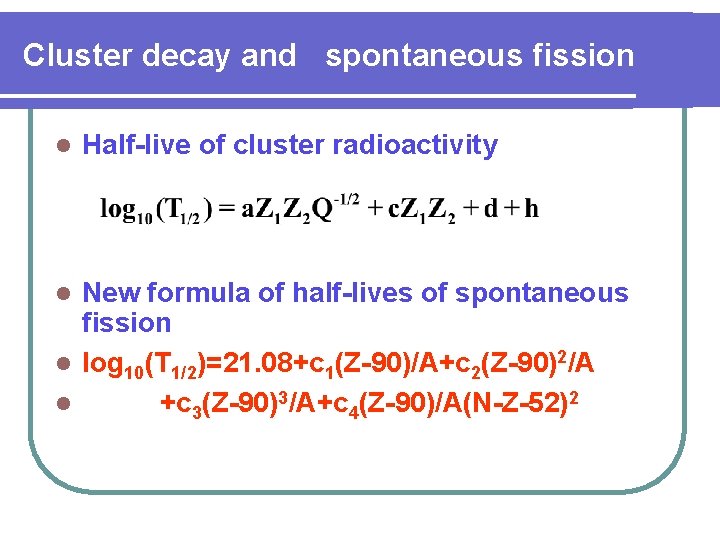
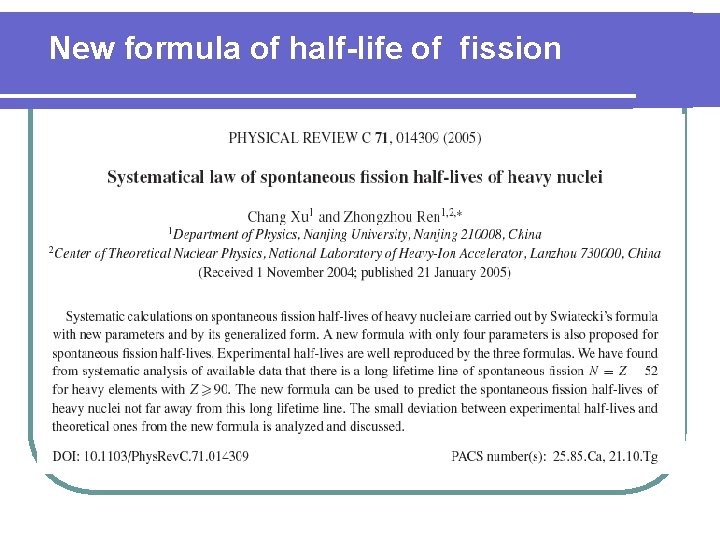
Cluster decay and spontaneous fission l Half-live of cluster radioactivity New formula of half-lives of spontaneous fission l log 10(T 1/2)=21. 08+c 1(Z-90)/A+c 2(Z-90)2/A l +c 3(Z-90)3/A+c 4(Z-90)/A(N-Z-52)2 l
DDCM for alpha decay
Further development of DDCM
DDCM of cluster radioactivity
New formula of half-life of fission
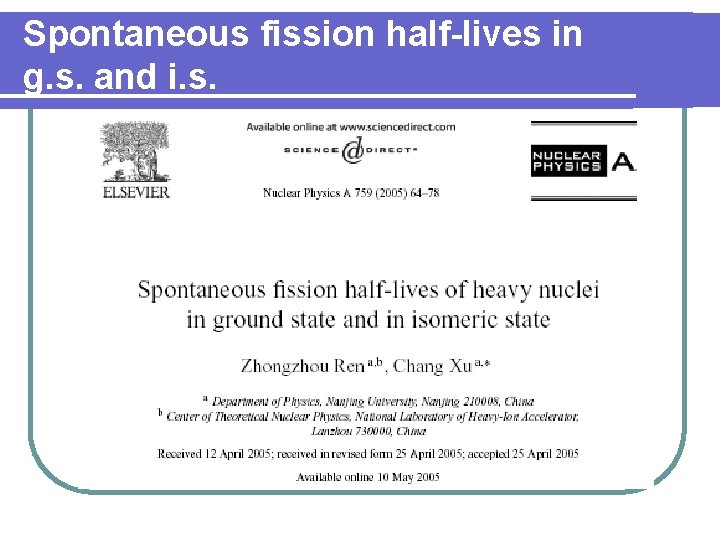
Spontaneous fission half-lives in g. s. and i. s.
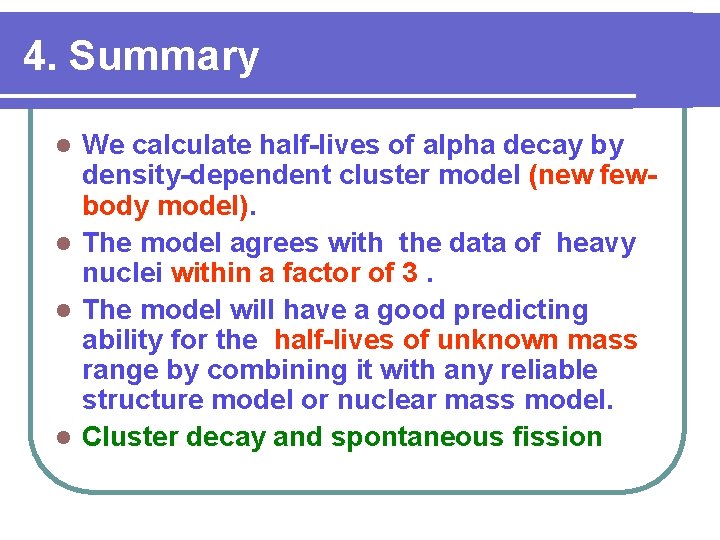
4. Summary We calculate half-lives of alpha decay by density-dependent cluster model (new fewbody model). l The model agrees with the data of heavy nuclei within a factor of 3. l The model will have a good predicting ability for the half-lives of unknown mass range by combining it with any reliable structure model or nuclear mass model. l Cluster decay and spontaneous fission l
Thanks l Thanks for the organizer of this conference