
Systematic Theology Lecture 4 The Incommunicable Attributes of
Systematic Theology Lecture 4 – The Incommunicable Attributes of God
God’s Attributes Communicable = able to be passed on to another, able to be communicated to another being. The Communicable Attributes: those that God passes on to us through the Holy Spirit and the work of redemption. These include things such as spirituality, eternal life, holiness, love, justice, goodness, self-control, righteousness, wisdom, truthfulness, knowledge and so on. The Incommunicable Attributes: those that God reserves for Himself and does not pass on to the redeemed. These include being all-powerful, all-knowing, outside of time, being present everywhere at all times, having infinite knowledge and being independent of all needs.
Overlap The communicable and incommunicable attributes have some overlap For instance God’s wisdom is communicated to us, so it is communicable, but His omniscience (having all wisdom, everywhere at all times) is not communicated to us and is thus incommunicable. God’s eternity is an incommunicable attribute but we will inherit eternal life and dwell with God in eternity, for eternity and will have some participation in His eternal nature though not completely, so this incommunicable attribute can, to some extent be communicated.
We Will Never Become God Christians become “sons of God” but they never become God Himself. The creation never becomes the Creator We are made to worship the One Creator God, not to be worshipped as gods ourselves The main Mormon doctrine: “As man is God once was, as God is man may become” is false. God is not a spiritual category, God is a singular, complex, organic, triune Being God is not embodied, created or finite. God is not subject to time or space God is only subject to His own divine character
Trick Questions…. http: //www. godandscience. org/apologetics/rock. html Can God create a spherical triangle? Can God make a rock so heavy that He cannot lift it? Can God think of a time when He was not omnipotent ? These trick questions rely on creation of illogical categories (spherical triangles) or asking God to do something that is against His character (failing to lift a very heavy rock) or which contradicts His nature (being non-omnipotent for a period of time). The word "omnipotent" is never used in the Bible, but has been inferred primarily by one of God's Hebrew titles, "Shadday, " which is most often translated "almighty. “ However, the Bible never claims that God can do all things. In fact, the Bible makes a point that there are things that God cannot do. The Bible says that God cannot commit sin. God cannot lie. Omnipotence means that God is All-Powerful in such a way that God can do whatever He sets out to do. An all-powerful being cannot fail. Therefore, God can create a rock of tremendous size, but, since He is all-powerful, He will always be able to lift it. The Bible makes it clear that God is able to do anything He wants to, and that nothing He wants to do is too difficult for Him to accomplish. This is the true meaning of omnipotence. Therefore, biblical omnipotence does not mean that God can do all things. God cannot do anything that is contrary to His holy character. However, God can do anything that He determines to do (such as lifting a very heavy rock). This is a true meaning of omnipotence - the ability to do anything that one sets out to do. (James 1: 13, Titus 1: 2, Genesis 18: 14, Jeremiah 32: 17, 27)

“Proving or Disproving” God Atheists try to use God’s incommunicable attributes to “disprove” that God exists. The Bible tells us that God cannot be proven or disproven like a proposition in logic or a hypothesis in science. God tells us that God is not proven but that He is discovered. For many years people did not know that America or Australia existed and they certainly had no idea of their shape, geography, animals and so on. No one could prove or disprove the existence of America, Australia or even of the platypus. Some people inferred they existed but no one could definitely prove they existed or describe them from logic alone. These lands, their nature and their animals could only be discovered.
God’s Independence (p. 160 Grudem) Also known as God’s self-existence or His aseity (Latin for “from Himself”) God is absolutely independent and self-sufficient. God is not just different from us in size and quantity but also in nature and quality. God exists in an infinitely better, stronger, more excellent way in a fundamentally different order of being and cannot “pass away” (Ps. 90, Dan 7: 14, Matt 24; 35) God necessarily exists, we exist contingently (are dependent on God’s existence for our existence) Acts 17: 24 -25, Job 41: 11, Psalm 50: 10 -12, John 17: 5, 24 Revelation 4: 11, John 1: 3, Romans 11: 35 -36, 1 Corinthians 8: 6 Psalm 90: 2, Exodus 3: 14
God’s Independence – 2 Definition: God does not need us or the rest of Creation for anything, yet we and the rest of Creation can glorify Him and bring Him joy. Very Rough Illustration: A person does not “need” an aquarium yet the aquarium can still bring that person joy. The entire Universe is God’s aquarium and the nations are but a “drop in the bucket”. God created us “for His pleasure” and not because He needs Creation in any way. Ephesians 1: 1 -14, Philippians 2: 13, Luke 12: 32 1 Corinthians 1: 21, 10: 5, 12: 18 Revelation 4: 11, Isaiah 62: 3 -5, Zephaniah 3: 17, 18
God’s Independence - 3 God does not need us but we need God! God does not need us to do anything for Him including Christian ministry, worship, sacrifices etc. No human individual is absolutely essential for God’s plans to work out (Esther 4: 13, 14) Thus there is no adequate justification for unethical behavior by Christians “in order to get people saved” etc. If God wants ministry done He wants it done righteously! You cannot say “unless I cut this corner God will not be able to achieve…” We obey God for our own good (to inherit eternal life and reward).
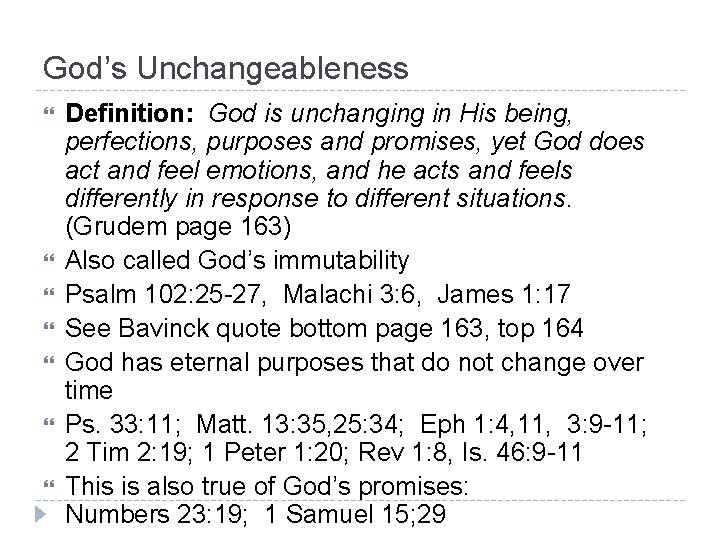
God’s Unchangeableness Definition: God is unchanging in His being, perfections, purposes and promises, yet God does act and feel emotions, and he acts and feels differently in response to different situations. (Grudem page 163) Also called God’s immutability Psalm 102: 25 -27, Malachi 3: 6, James 1: 17 See Bavinck quote bottom page 163, top 164 God has eternal purposes that do not change over time Ps. 33: 11; Matt. 13: 35, 25: 34; Eph 1: 4, 11, 3: 9 -11; 2 Tim 2: 19; 1 Peter 1: 20; Rev 1: 8, Is. 46: 9 -11 This is also true of God’s promises: Numbers 23: 19; 1 Samuel 15; 29
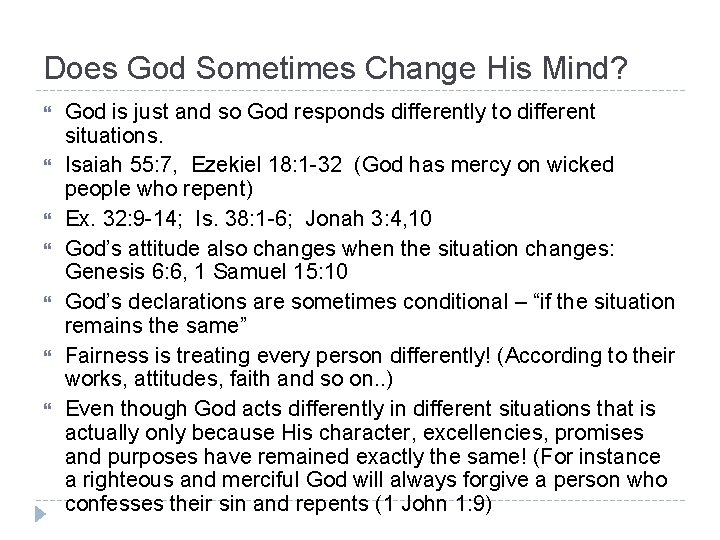
Does God Sometimes Change His Mind? God is just and so God responds differently to different situations. Isaiah 55: 7, Ezekiel 18: 1 -32 (God has mercy on wicked people who repent) Ex. 32: 9 -14; Is. 38: 1 -6; Jonah 3: 4, 10 God’s attitude also changes when the situation changes: Genesis 6: 6, 1 Samuel 15: 10 God’s declarations are sometimes conditional – “if the situation remains the same” Fairness is treating every person differently! (According to their works, attitudes, faith and so on. . ) Even though God acts differently in different situations that is actually only because His character, excellencies, promises and purposes have remained exactly the same! (For instance a righteous and merciful God will always forgive a person who confesses their sin and repents (1 John 1: 9)
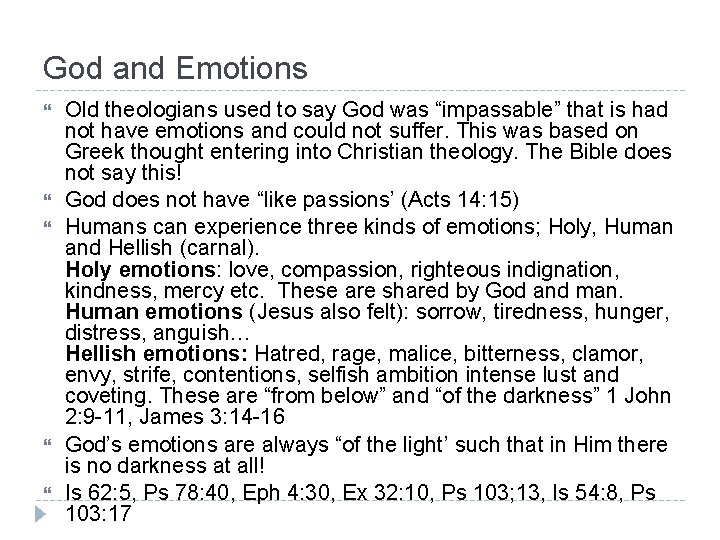
God and Emotions Old theologians used to say God was “impassable” that is had not have emotions and could not suffer. This was based on Greek thought entering into Christian theology. The Bible does not say this! God does not have “like passions’ (Acts 14: 15) Humans can experience three kinds of emotions; Holy, Human and Hellish (carnal). Holy emotions: love, compassion, righteous indignation, kindness, mercy etc. These are shared by God and man. Human emotions (Jesus also felt): sorrow, tiredness, hunger, distress, anguish… Hellish emotions: Hatred, rage, malice, bitterness, clamor, envy, strife, contentions, selfish ambition intense lust and coveting. These are “from below” and “of the darkness” 1 John 2: 9 -11, James 3: 14 -16 God’s emotions are always “of the light’ such that in Him there is no darkness at all! Is 62: 5, Ps 78: 40, Eph 4: 30, Ex 32: 10, Ps 103; 13, Is 54: 8, Ps 103: 17
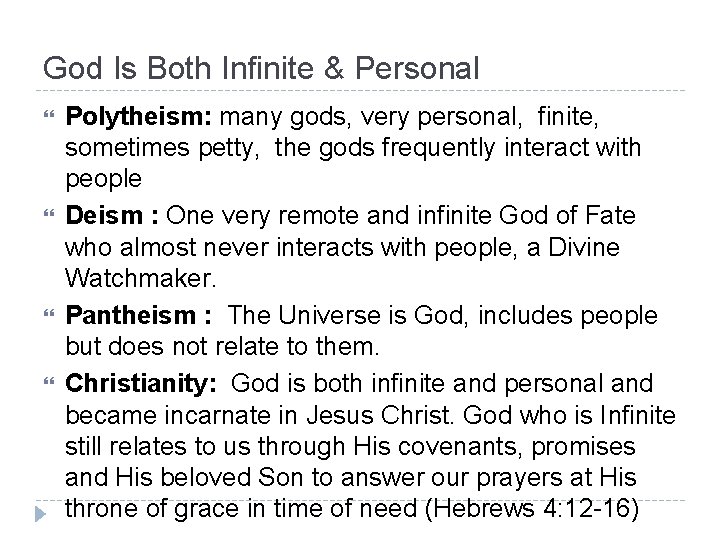
God Is Both Infinite & Personal Polytheism: many gods, very personal, finite, sometimes petty, the gods frequently interact with people Deism : One very remote and infinite God of Fate who almost never interacts with people, a Divine Watchmaker. Pantheism : The Universe is God, includes people but does not relate to them. Christianity: God is both infinite and personal and became incarnate in Jesus Christ. God who is Infinite still relates to us through His covenants, promises and His beloved Son to answer our prayers at His throne of grace in time of need (Hebrews 4: 12 -16)
The Importance of Unchangeableness We can trust in God because God stays good and does not ever become evil God’s promises never fail (1 Kings 8: 56, Lamentations 3: 22) God’s purposes always stand Prov. 19: 21; Is. 14; 24, 46: 10 God will not abandon us or forsake us (Hebrews 13: 5) Therefore we can always trust God because God is always the same in His being, perfections, purposes and promises. Because God is unchangeable Jesus is the same yesterday, today and forever (Hebrews 13: 8) Jesus is our High Priest “forever” – Hebrews 1: 8, 5: 6, 6: 20, 7: 15 -28, 10: 10 -14
God’s Eternity Definition: God has no beginning, end or succession of moments in His own being, and He sees all time, equally vividly, yet God sees events in time and acts in time. Very Rough Illustration: Imagine a very large football field full of one yard measuring sticks (rulers). The field has an observation tower in the middle. An accurate and perceptive observer in the tower can see all the measuring sticks (the various ages of time) at once and can read all the gradations on them and knows what is happening along the edge of each ruler but the observer in the tower is not judged or measured by the sticks, is far beyond them and is uninfluenced by them in any way. God sees what is going on in time, can measure time, knows the pace of events in time and acts in time but is Himself uninfluenced by time.
Aspects of God’s Eternity God is Timeless in His Own Being: Ps 90: 2, Job 36: 26, Rev 1: 8, 4: 8; John 8: 58; Ex. 3: 14; God is “before all things”: Gen 1: 1; John 1: 3; 1 Cor. 8: 6; Colossians 1: 15 -20; Hebrews 1: 1 -3 God sees all time equally vividly: Ps. 90: 4, 2 Peter 3: 8 Genesis 5 – 1, 500 years, Cross – 1 day. Sees future events Isaiah 45: 1, 46: 9 -10 God sees events in time and acts in time: Gal 4: 4 -5, Acts 17: 30, 31 We will always dwell in time: Rev 21: 23, 24, 25, 22: 2, 5 Types of Time: Clock time, Event time, Prophetic Time, Eternity, Heavenly Time (Ages), Times & Seasons, Historical Time: “Days” (in the day of king Such-and So , Epochs, Reigns), Astrological Time, Momentary Time (now, immediately).
Omnipresence - 1 Definition: God does not have size or spatial dimensions and is present in every point of space with His whole being, yet acts differently in different places. (Grudem p. 173) God is present everywhere: Jer. 23: 23 -24, Ps. 139: 7 -10, Acts 17: 28, Colossians 1: 17 God does not have spatial dimensions: 1 Kings 8: 27, Isa. 66; 1 -2, Acts 7: 48, God is completely beyond space and time which are His creations. Rough Analogy: God is present throughout the Creation but is bigger than creation like a vast ocean (God) is present throughout a small sponge.
Omnipresence - 2 God Can Be Present to Punish, To Sustain or to Bless: Amos 9: 1 -4; Colossians 1: 17, Hebrews 1: 3, Ps. 16: 11; I Samuel 4: 4, Exodus 25; 22 John 4: 20, Rev. 21: 3 When God is “present” some aspect of His character is being revealed (wrath, blessing, Creation, etc) God is most fully revealed in Heaven so is most present in heaven. Scripture reveals God so we say God is present in His Word. God is present fully in Christ – Colossians 2: 9, John 1: 1418, God is present in Spirit: 2 Cor. 3: 17, 18 Rom 8: 9 -10 Jn 14: 23 Separation from God (absence of his self-revelation) Prov. 15; 29, Is. 59: 2,
- Slides: 18