
Systematic study of a large sample of NLS
![Narrow Line Seyfert 1 galaxies n n n n narrow Balmer lines [OIII]/ Hβ](https://slidetodoc.com/presentation_image_h/167beea51a3a58371ab947097fdb1eb3/image-2.jpg "Narrow Line Seyfert 1 galaxies n n n n narrow Balmer lines [OIII]/ Hβ")
- Slides: 26
Systematic study of a large sample of NLS 1 galaxies from SDSS — first results Weimin Yuan Yunnan Observatory/NAOC, CAS, Kunming, China H. Zhou, T. -G. Wang, H. Lu, X. Dong J. Wang, Y. Lu University of Science & Technology of China Hefei H. Zhou, T. -G. Wang, W. Yuan, et al. 2006, Ap. JS, 166, 128
Narrow Line Seyfert 1 galaxies n n n n narrow Balmer lines [OIII]/ Hβ small (<3) FWHM(Hβ)<2000 km/s strong Fe. II soft X-ray: steep spectrum, rapid variability outflows ([OIII] and CIV)…) extreme region in the eigenvector 1 space small BH mass and high L/LEdd useful to constrain AGN models
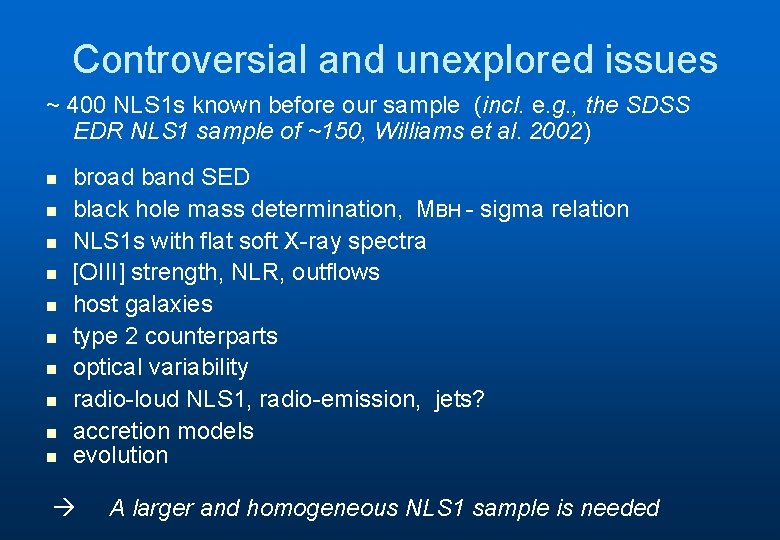
Controversial and unexplored issues ~ 400 NLS 1 s known before our sample (incl. e. g. , the SDSS EDR NLS 1 sample of ~150, Williams et al. 2002) n n n n n broad band SED black hole mass determination, MBH - sigma relation NLS 1 s with flat soft X-ray spectra [OIII] strength, NLR, outflows host galaxies type 2 counterparts optical variability radio-loud NLS 1, radio-emission, jets? accretion models evolution A larger and homogeneous NLS 1 sample is needed
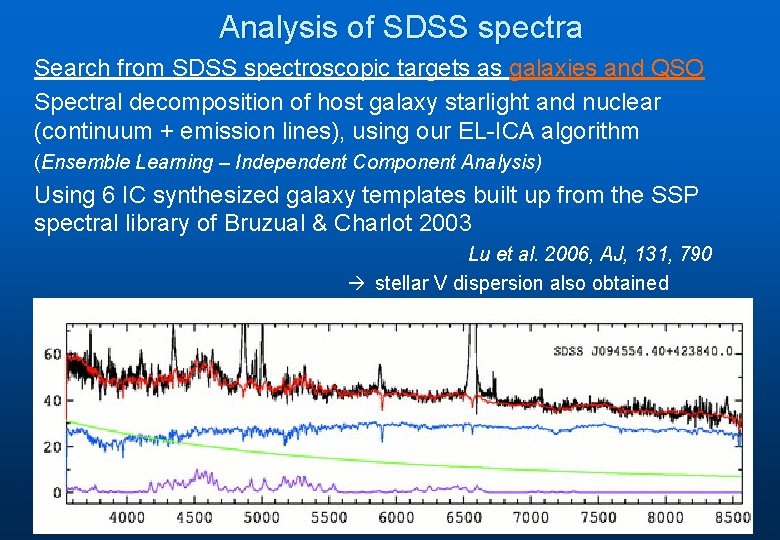
Analysis of SDSS spectra Search from SDSS spectroscopic targets as galaxies and QSO Spectral decomposition of host galaxy starlight and nuclear (continuum + emission lines), using our EL-ICA algorithm (Ensemble Learning – Independent Component Analysis) Using 6 IC synthesized galaxy templates built up from the SSP spectral library of Bruzual & Charlot 2003 Lu et al. 2006, AJ, 131, 790 stellar V dispersion also obtained
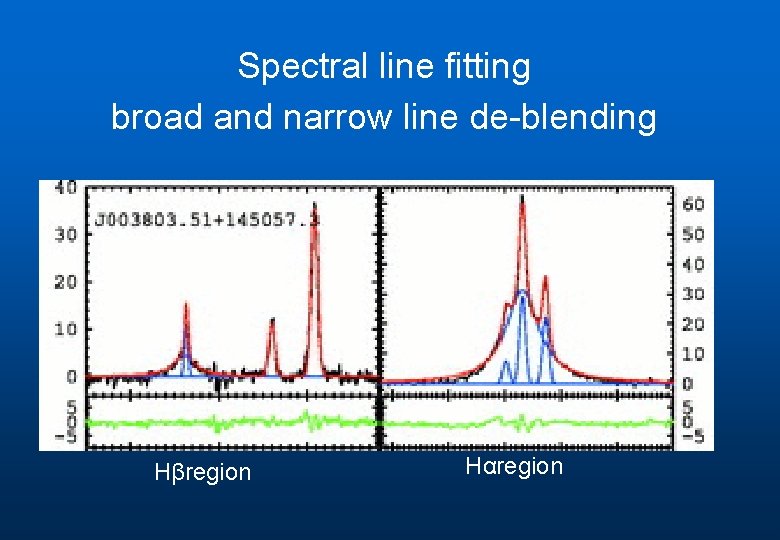
Spectral line fitting broad and narrow line de-blending Hβregion Hαregion
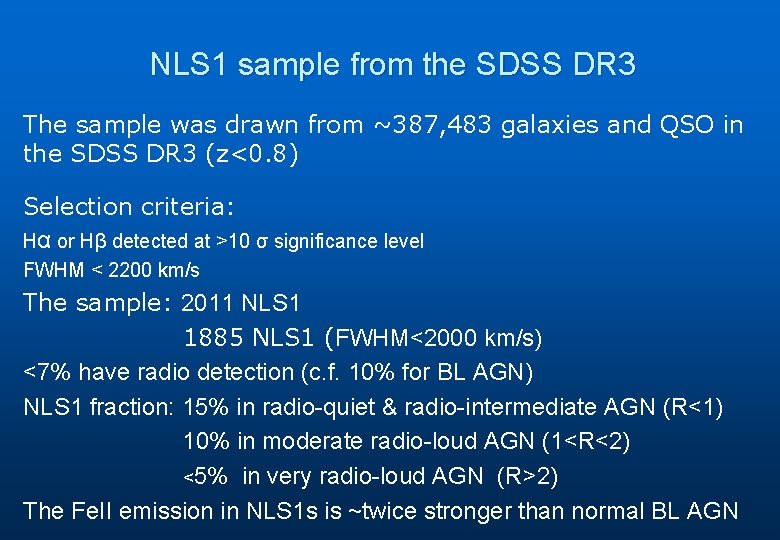
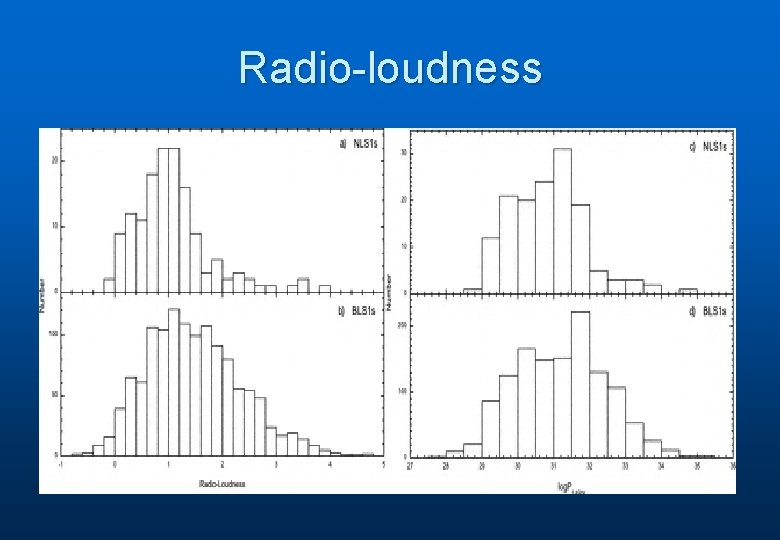
NLS 1 sample from the SDSS DR 3 The sample was drawn from ~387, 483 galaxies and QSO in the SDSS DR 3 (z<0. 8) Selection criteria: Hα or Hβ detected at >10 σ significance level FWHM < 2200 km/s The sample: 2011 NLS 1 1885 NLS 1 (FWHM<2000 km/s) <7% have radio detection (c. f. 10% for BL AGN) NLS 1 fraction: 15% in radio-quiet & radio-intermediate AGN (R<1) 10% in moderate radio-loud AGN (1<R<2) <5% in very radio-loud AGN (R>2) The Fe. II emission in NLS 1 s is ~twice stronger than normal BL AGN
note The conventional NLS 1 definition may include some AGNs with IMBH mass Objects with MBH <~ 106 M⊙ See poster # 268 for our IMBH (<~ 106 M⊙ ) AGN sample
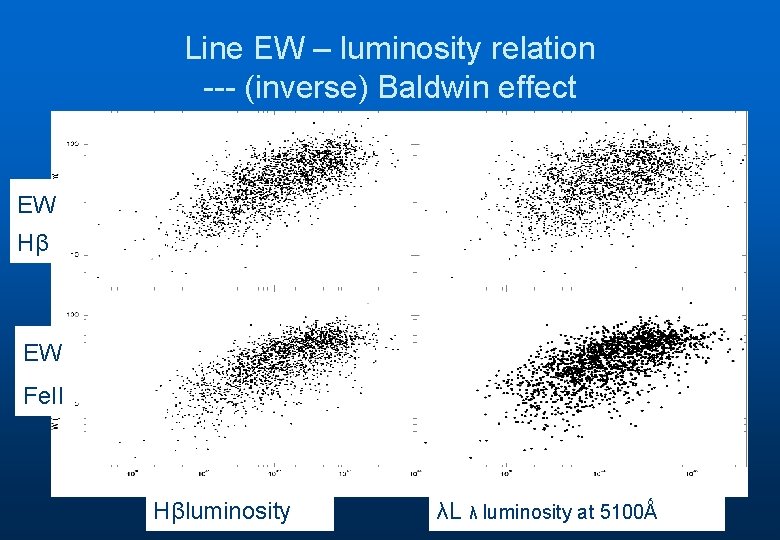
Line EW – luminosity relation --- (inverse) Baldwin effect EW Hβ EW Fe. II Hβluminosity λL λ luminosity at 5100Ǻ
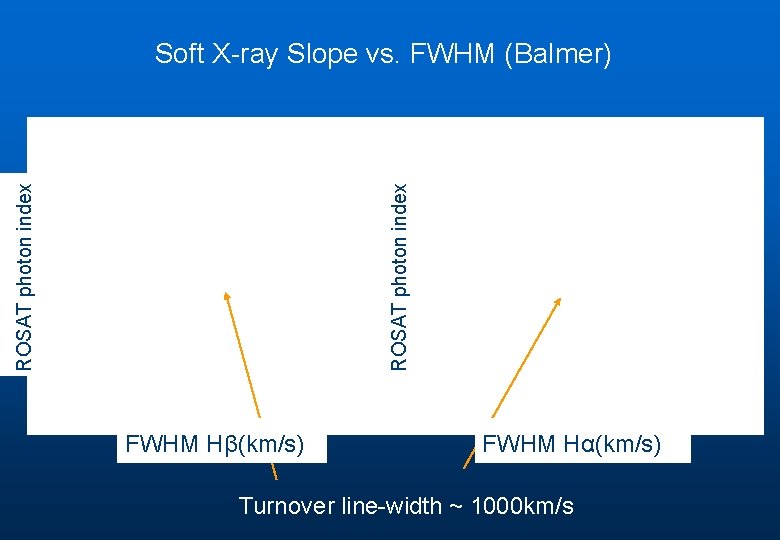
ROSAT photon index Soft X-ray Slope vs. FWHM (Balmer) FWHM Hβ(km/s) FWHM Hα(km/s) Turnover line-width ~ 1000 km/s
Narrow line region No difference between NLS 1 and normal BL AGN
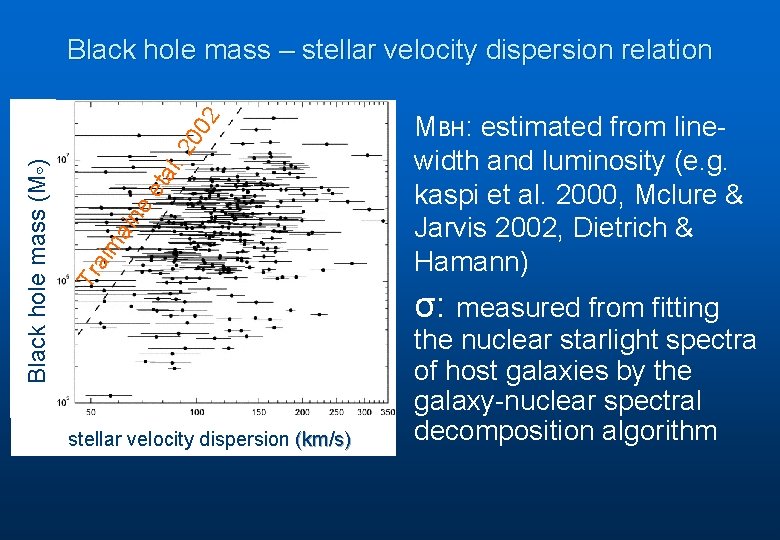
al. et e ain aim Tr Black hole mass (M⊙) 20 02 Black hole mass – stellar velocity dispersion relation stellar velocity dispersion (km/s) MBH: estimated from linewidth and luminosity (e. g. kaspi et al. 2000, Mclure & Jarvis 2002, Dietrich & Hamann) σ: measured from fitting the nuclear starlight spectra of host galaxies by the galaxy-nuclear spectral decomposition algorithm
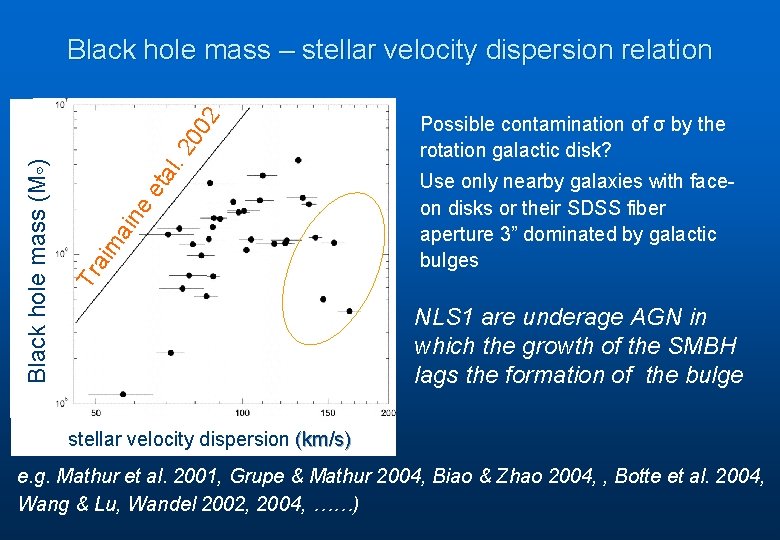
al. et e ain aim Tr Black hole mass (M⊙) 20 02 Black hole mass – stellar velocity dispersion relation Possible contamination of σ by the rotation galactic disk? Use only nearby galaxies with faceon disks or their SDSS fiber aperture 3” dominated by galactic bulges NLS 1 are underage AGN in which the growth of the SMBH lags the formation of the bulge stellar velocity dispersion (km/s) e. g. Mathur et al. 2001, Grupe & Mathur 2004, Biao & Zhao 2004, , Botte et al. 2004, Wang & Lu, Wandel 2002, 2004, ……)
summary n n n Providing to the AGN community with the largest NLS 1 sample The frequency of finding NLS 1 s depends strongly on optical luminosity and radio-loudness Turnover of the trend of soft X-ray Slope vs. FWHM (Balmer) Inverse Baldwin effect seen in Hbeta and Fe. II NLR in NLS 1 s is not different from that of BLS 1 s finding NLS 2 is challenging NLS 1 s are underage AGN in which the growth of the SMBH lags the formation of the bulge
Current work • Search for optical variability ~150 covered in the SDSS SN survey (preliminary results see poster #280 Y. Ai et al. ) n optical monitoring n • X-ray data analysis (XMM, ROSAT, etc. ) a sample of ~40 objects with XMM data
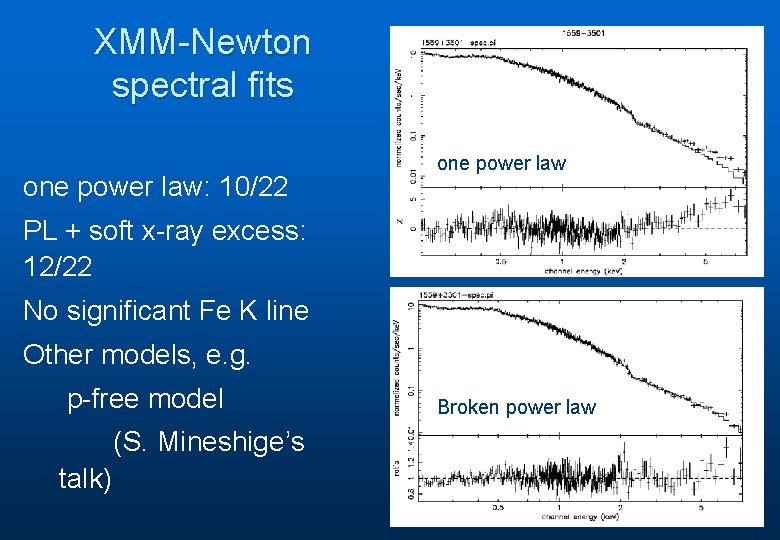
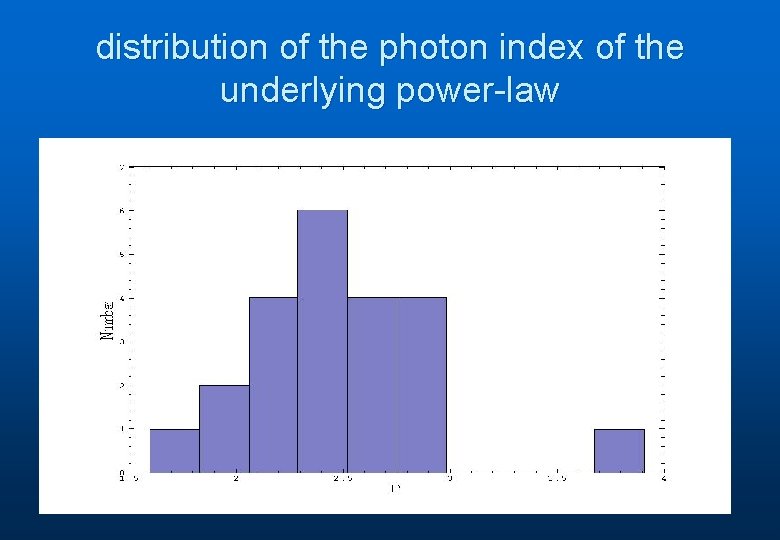
XMM-Newton spectral fits one power law: 10/22 one power law PL + soft x-ray excess: 12/22 No significant Fe K line Other models, e. g. p-free model (S. Mineshige’s talk) Broken power law
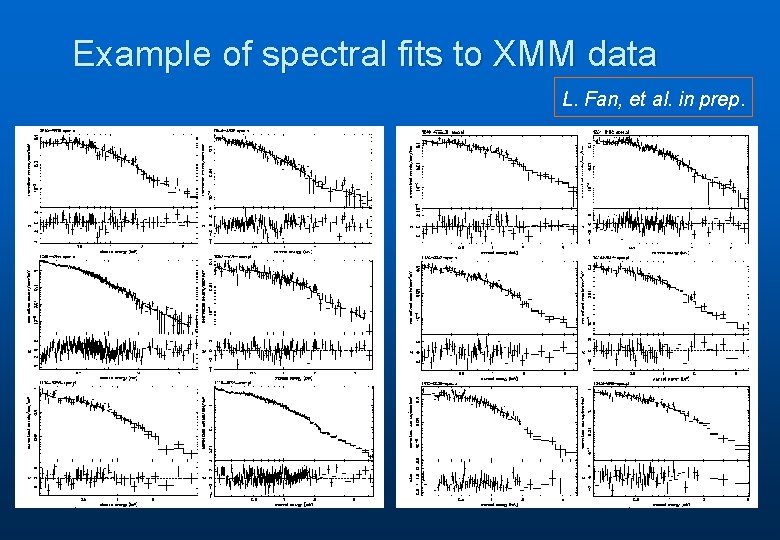
Example of spectral fits to XMM data L. Fan, et al. in prep.
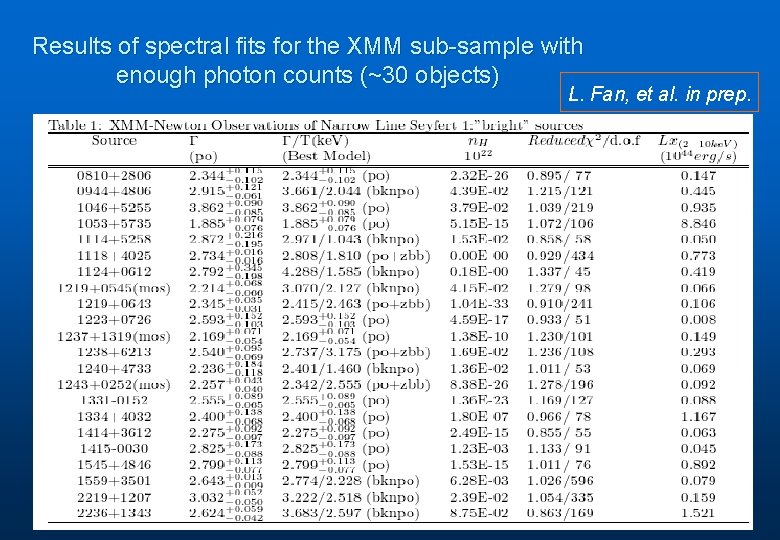
Results of spectral fits for the XMM sub-sample with enough photon counts (~30 objects) L. Fan, et al. in prep.
distribution of the photon index of the underlying power-law
Current work and future plan • much detailed statistical analysis Fraction of NLS 1 w. r. t. luminosity, z, etc. n …… n • broad band properties and SED n • • UV (Galex) Host galaxy morphology and stellar contents new radio/X-ray observations photometric/spectroscopic monitor, variability study possible black hole mass measurement by reverberation mapping • Cosmic evolution: NLS 1 sample at higher redshifts using the Mg. II line
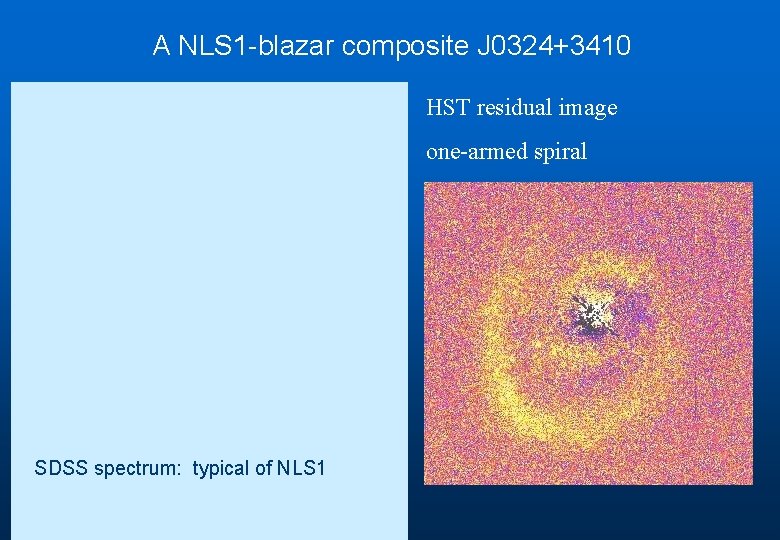
A NLS 1 -blazar composite J 0324+3410 HST residual image one-armed spiral SDSS spectrum: typical of NLS 1
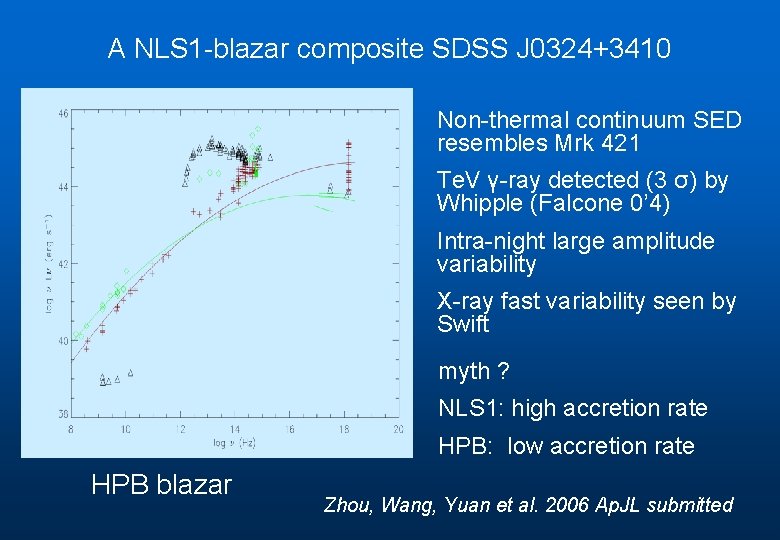
A NLS 1 -blazar composite SDSS J 0324+3410 Non-thermal continuum SED resembles Mrk 421 Te. V γ-ray detected (3 σ) by Whipple (Falcone 0’ 4) Intra-night large amplitude variability X-ray fast variability seen by Swift myth ? NLS 1: high accretion rate HPB: low accretion rate HPB blazar Zhou, Wang, Yuan et al. 2006 Ap. JL submitted
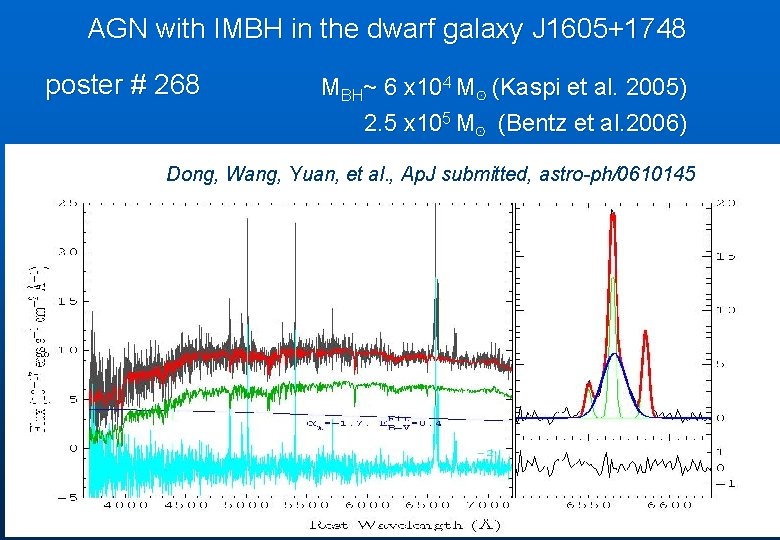
AGN with IMBH in the dwarf galaxy J 1605+1748 poster # 268 MBH~ 6 x 10⁴ M⊙ (Kaspi et al. 2005) 2. 5 x 10⁵ M⊙ (Bentz et al. 2006) Dong, Wang, Yuan, et al. , Ap. J submitted, astro-ph/0610145
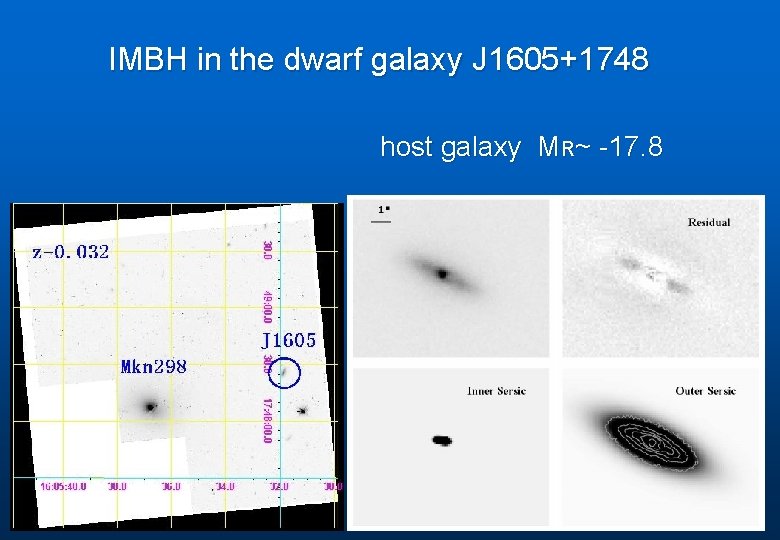
IMBH in the dwarf galaxy J 1605+1748 host galaxy MR~ -17. 8
NLS 1 s from SDSS (3) Frequency of finding NLS 1 s: strongly dependent on optical luminosity
The Fe II emission strength R 4570 = Fe II (λ 4434 -4684) / Hβ The Fe. II emission in NLS 1 s is ~twice stronger than normal BL AGN
Radio-loudness