
Systematic review of health state utility values in

- Slides: 10
Systematic review of health state utility values in patients with diabetic retinopathy and age-related macular oedema Reporting of utility studies Edith Poku, Sc. HARR Acknowledgements: John Brazier, Jill Carlton, Katy Cooper
Overview • Summarise the review • Consider the factors that influence measurements of utilities • Propose good practice in reporting of utility studies 1/17/2022 © The University of Sheffield
The Review What was it about: -Assessing the impact of visual acuity on health state utility values (HSUVs) Why it is important: -HSUVs are quantitative measures of preference of a health state/ health outcome - Utility measurements are important in NICE appraisals. 1/17/2022 © The University of Sheffield • Searches – August to October 2009 • Of 334 potentially relevant papers, 14 studies were included in the review. ‘Vision loss was found to have a marked impact on quality of life as indicated by the relationship between visual acuity and health state utility values. However, the relationship differed between conditions and methods of obtaining health. ’
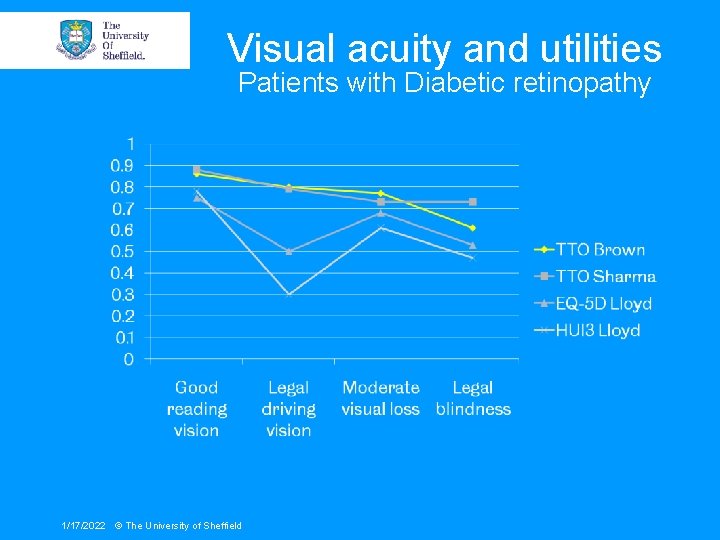
Visual acuity and utilities Patients with Diabetic retinopathy 1/17/2022 © The University of Sheffield
Health state utility value • Quantitative measure of an individual’s preference for a health outcome/ state • Range: 1 (perfect health) to 0 (death) • Reflects Ø Significance of health impairment Ø willingness to trade time for health Ø time preference Ø Risk attitude (standard gamble) 1/17/2022 © The University of Sheffield
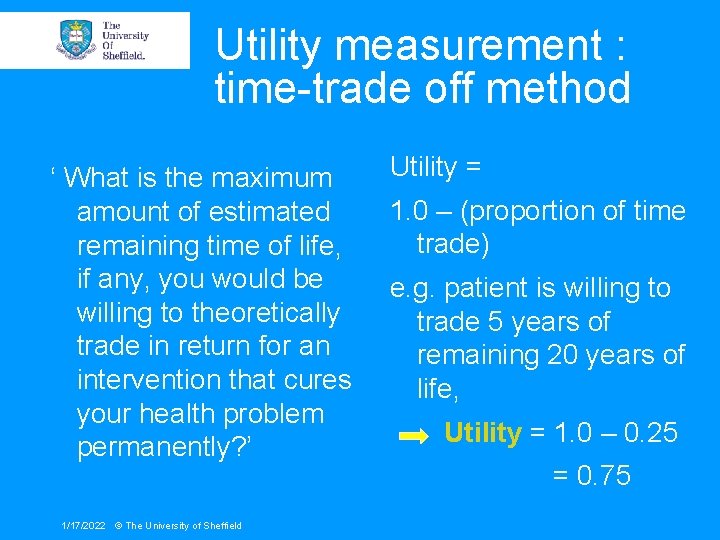
Utility measurement : time-trade off method ‘ What is the maximum amount of estimated remaining time of life, if any, you would be willing to theoretically trade in return for an intervention that cures your health problem permanently? ’ 1/17/2022 © The University of Sheffield Utility = 1. 0 – (proportion of time trade) e. g. patient is willing to trade 5 years of remaining 20 years of life, Utility = 1. 0 – 0. 25 = 0. 75
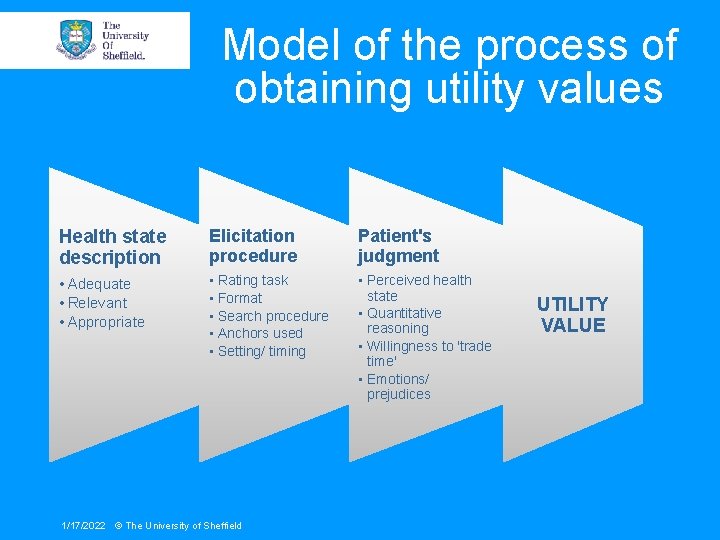
Model of the process of obtaining utility values Health state description Elicitation procedure Patient's judgment • Adequate • Relevant • Appropriate • Rating task • Format • Search procedure • Anchors used • Setting/ timing • Perceived health state • Quantitative reasoning • Willingness to 'trade time' • Emotions/ prejudices 1/17/2022 © The University of Sheffield UTILITY VALUE
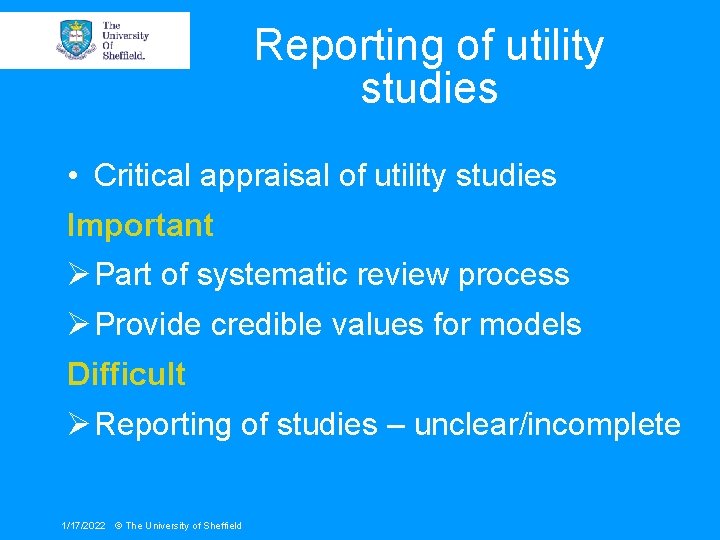
Reporting of utility studies • Critical appraisal of utility studies Important Ø Part of systematic review process Ø Provide credible values for models Difficult Ø Reporting of studies – unclear/incomplete 1/17/2022 © The University of Sheffield
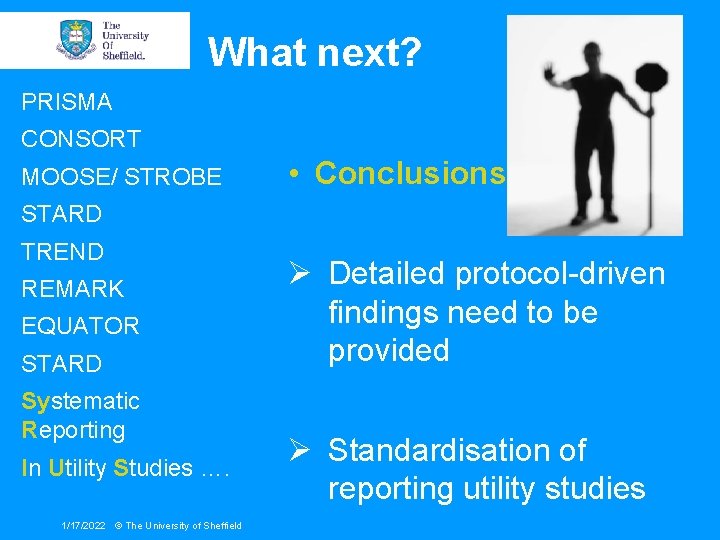
What next? PRISMA CONSORT MOOSE/ STROBE • Conclusions STARD TREND REMARK EQUATOR STARD Systematic Reporting In Utility Studies …. 1/17/2022 © The University of Sheffield Ø Detailed protocol-driven findings need to be provided Ø Standardisation of reporting utility studies
References • Brazier, J. (2007) National Institute for Health and Clinical Excellence: Brief Paper for methods review workshop on key issues in utility measurement. 1 -24. • Kymes, S. M. & Lee, B. S. (2007) Preference-based quality of life measures in people with visual impairment. [Review] [47 refs]. Optometry & Vision Science, 84, 809 -816. • Lenert, L. & Kaplan, R. (2000) Validity and interpretation of preference-based measures of health-related quality of life. Medical Care, 38(9 Suppl), 38 -50. 1/17/2022 © The University of Sheffield