
Systematic Fish Pathology Part 11 Pathology of circulatory
- Slides: 17
Systematic Fish Pathology Part 11. Pathology of circulatory / respiratory system – heart, vessels and gills Section A: Heart & Vessels Part I: Anatomy & microanatomy of the heart & vessels Prepared by Judith Handlinger With the support of The Fish Health Unit, Animal Health Laboratory, Department Of Primary Industries, Parks, Water and Environment, Tasmania, for The Australian Animal Pathology Standards (AAPSP) program
Course Outline A. Systematic Fish Pathology 1. Consider the Fish: An evolutionary perspective on comparative anatomy and physiology 2. Pathology of the kidney I – interstitial tissue Part A 3. Pathology of the kidney II – interstitial tissue Part B 4. Pathology of the kidney III – the nephron 5. Pathophysiology of the spleen 6. Fish haematology 7. Fish immunology – evolutionary & practical aspects 8. Pathology of the digestive system I – the oesophagus, stomach, & intestines. 9. Pathology of digestive system II – the liver and pancreas, swim bladder, peritoneum. 10. Pathology of fish skin 11. Pathology of circulatory / respiratory system – heart, vessels and gills. A: Heart & vessels (this presentation) B: Gills – general & non-infectious pathology C: Gills – infectious diseases 12. Pathology of the musculoskeletal system and nervous system 13. Pathology of gonads and fry
Acknowledgments & Introduction. • This is the eleventh module of the systematic examination of fish pathology, which aims to convey an approach to diagnosis and cover fish reactions of each organ system rather than to cover all fish diseases, and is based largely on representative pathology found in the diagnostic laboratory of the Tasmanian Department of Primary Industries, Parks, Water & Environment (DPIPWE). • It was funded by the Australian Animal Pathology Standards program with in-kind support of DIPWE as acknowledged previously. • Photos for this series, especially those of gross pathology, are generally also from DPIPWE archives and were generated by multiple contributors within DPIPWE Fish Health Unit. • Contributors of cases from other laboratories have been acknowledged wherever possible and specific material and photographs used with permission where the origin is known. Any inadvertent omissions in this regard are unintended. • References quoted are listed at the end of each presentation.
Anatomy & Microanatomy The major circulatory difference between fish and higher vertebrates is the single blood circuit of fish (2 chambered heart, to tissues via the gills), versus the double circuit of the 4 chambered heart of mammals (to lungs, back to heart, then to other tissues). This is considered to be driven by the relative inefficiency of mammals in extracting oxygen from air. The gills will therefore be considered with circulation, though they have both respiratory and excretory functions. The change from a water to air environment, and the further development of limbs as weight bearing organs often at considerable distance from the heart, also drove an increase in blood pressure, which in turn was one of the drivers for a subsequent increase in vascular thickness (see Part-1). Therefore fish vessels are in general thinner & more permeable than land mammals. (The most commonly encountered of the latter are also usually larger). Fish capillary pressures are considerably lower than mammals (5 – 15 mm Hg v 20 -30 mm. Hg), though the pressure in gill is higher than other tissues. Fish capillaries other than brain (which is enclosed in rigid bony vault) and the gill are also much more permeable to protein.
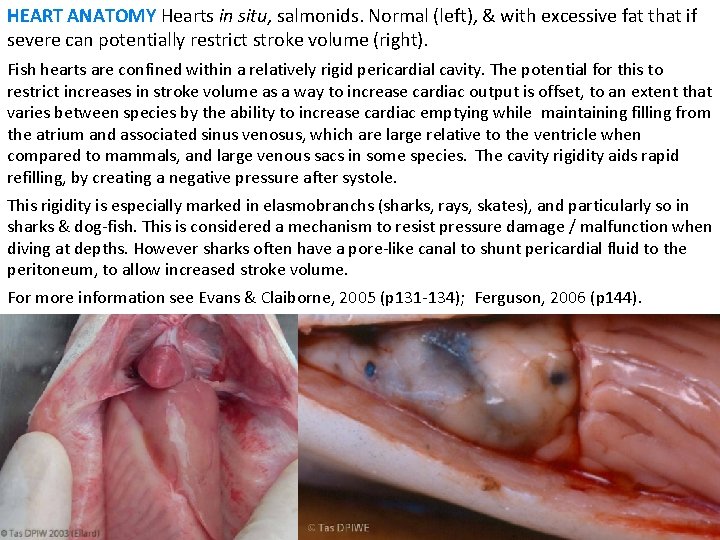
HEART ANATOMY Hearts in situ, salmonids. Normal (left), & with excessive fat that if severe can potentially restrict stroke volume (right). Fish hearts are confined within a relatively rigid pericardial cavity. The potential for this to restrict increases in stroke volume as a way to increase cardiac output is offset, to an extent that varies between species by the ability to increase cardiac emptying while maintaining filling from the atrium and associated sinus venosus, which are large relative to the ventricle when compared to mammals, and large venous sacs in some species. The cavity rigidity aids rapid refilling, by creating a negative pressure after systole. This rigidity is especially marked in elasmobranchs (sharks, rays, skates), and particularly so in sharks & dog-fish. This is considered a mechanism to resist pressure damage / malfunction when diving at depths. However sharks often have a pore-like canal to shunt pericardial fluid to the peritoneum, to allow increased stroke volume. For more information see Evans & Claiborne, 2005 (p 131 -134); Ferguson, 2006 (p 144).
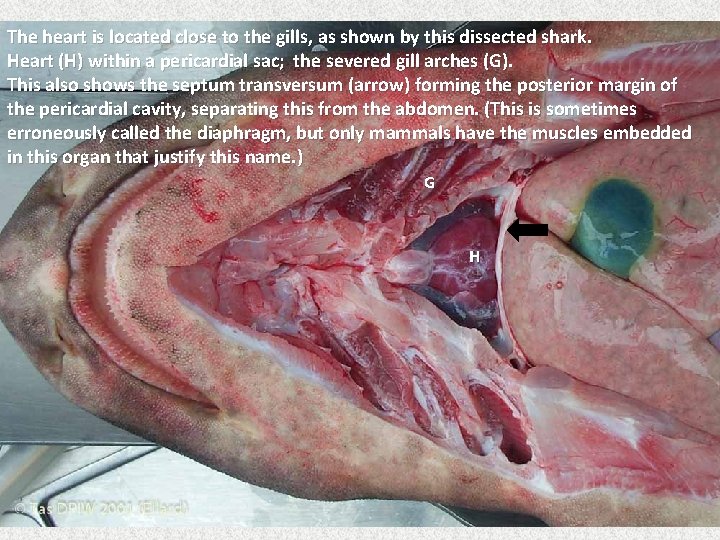
The heart is located close to the gills, as shown by this dissected shark. Heart (H) within a pericardial sac; the severed gill arches (G). This also shows the septum transversum (arrow) forming the posterior margin of the pericardial cavity, separating this from the abdomen. (This is sometimes erroneously called the diaphragm, but only mammals have the muscles embedded in this organ that justify this name. ) G H
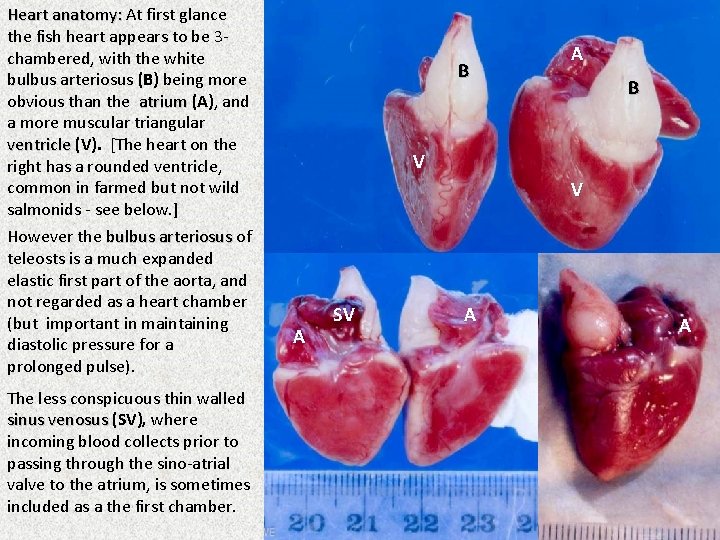
Heart anatomy: At first glance the fish heart appears to be 3 chambered, with the white bulbus arteriosus (B) being more obvious than the atrium (A), and a more muscular triangular ventricle (V). [The heart on the right has a rounded ventricle, common in farmed but not wild salmonids - see below. ] However the bulbus arteriosus of teleosts is a much expanded elastic first part of the aorta, and not regarded as a heart chamber (but important in maintaining diastolic pressure for a prolonged pulse). The less conspicuous thin walled sinus venosus (SV), where incoming blood collects prior to passing through the sino-atrial valve to the atrium, is sometimes included as a the first chamber. B A B V V A SV A A
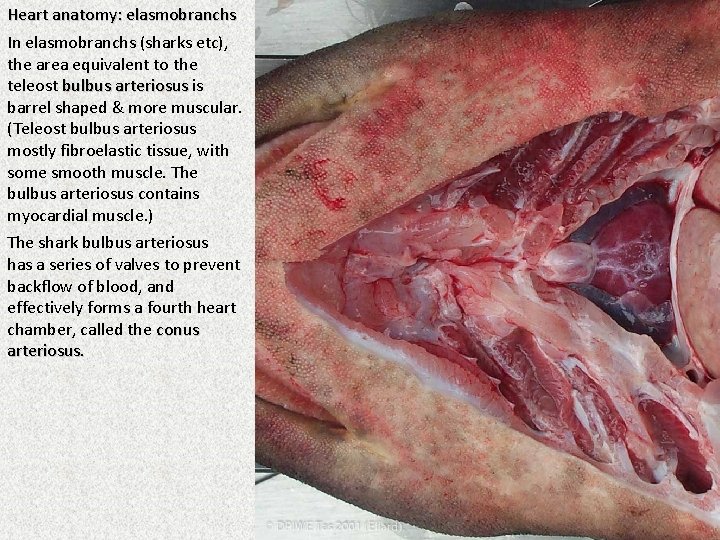
Heart anatomy: elasmobranchs In elasmobranchs (sharks etc), the area equivalent to the teleost bulbus arteriosus is barrel shaped & more muscular. (Teleost bulbus arteriosus mostly fibroelastic tissue, with some smooth muscle. The bulbus arteriosus contains myocardial muscle. ) The shark bulbus arteriosus has a series of valves to prevent backflow of blood, and effectively forms a fourth heart chamber, called the conus arteriosus.
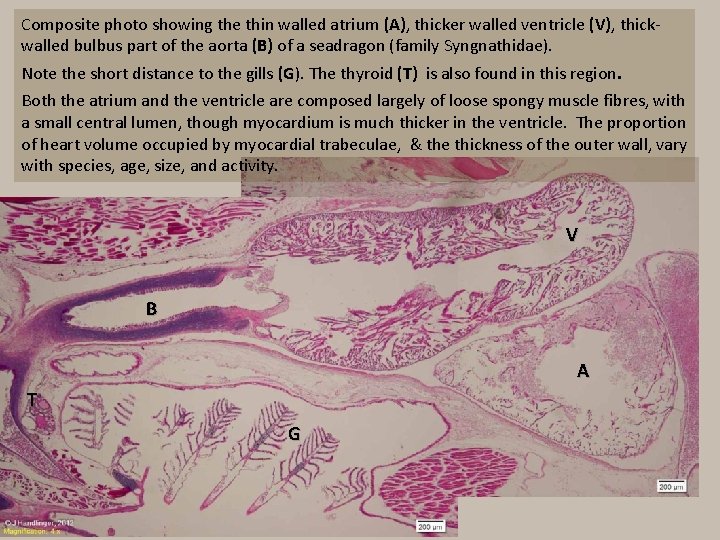
Composite photo showing the thin walled atrium (A), thicker walled ventricle (V), thickwalled bulbus part of the aorta (B) of a seadragon (family Syngnathidae). Note the short distance to the gills (G). The thyroid (T) is also found in this region. Both the atrium and the ventricle are composed largely of loose spongy muscle fibres, with a small central lumen, though myocardium is much thicker in the ventricle. The proportion of heart volume occupied by myocardial trabeculae, & the thickness of the outer wall, vary with species, age, size, and activity. V B A T G
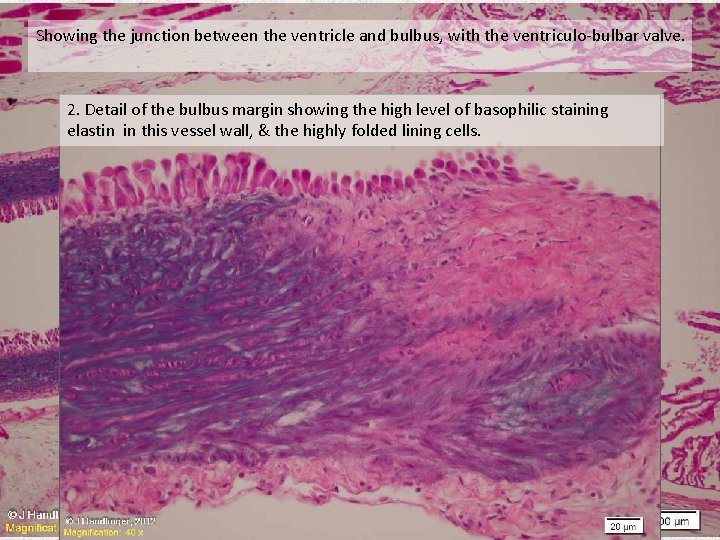
Showing the junction between the ventricle and bulbus, with the ventriculo-bulbar valve. 2. Detail of the bulbus margin showing the high level of basophilic staining elastin in this vessel wall, & the highly folded lining cells.
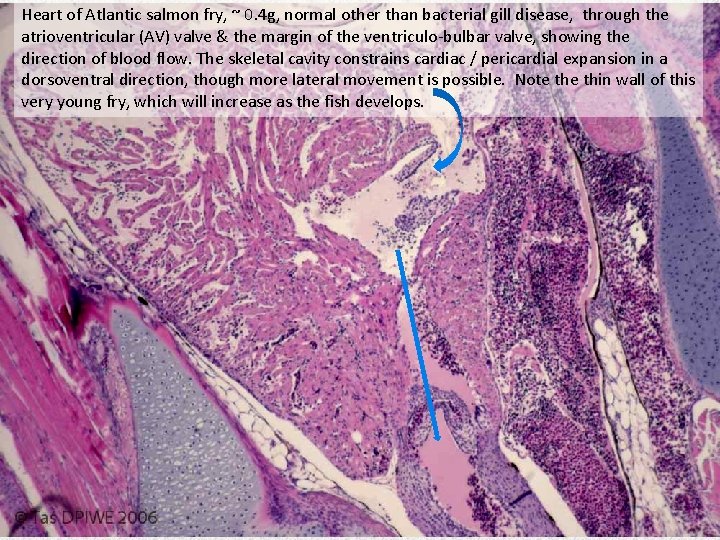
Heart of Atlantic salmon fry, ~ 0. 4 g, normal other than bacterial gill disease, through the atrioventricular (AV) valve & the margin of the ventriculo-bulbar valve, showing the direction of blood flow. The skeletal cavity constrains cardiac / pericardial expansion in a dorsoventral direction, though more lateral movement is possible. Note thin wall of this very young fry, which will increase as the fish develops.
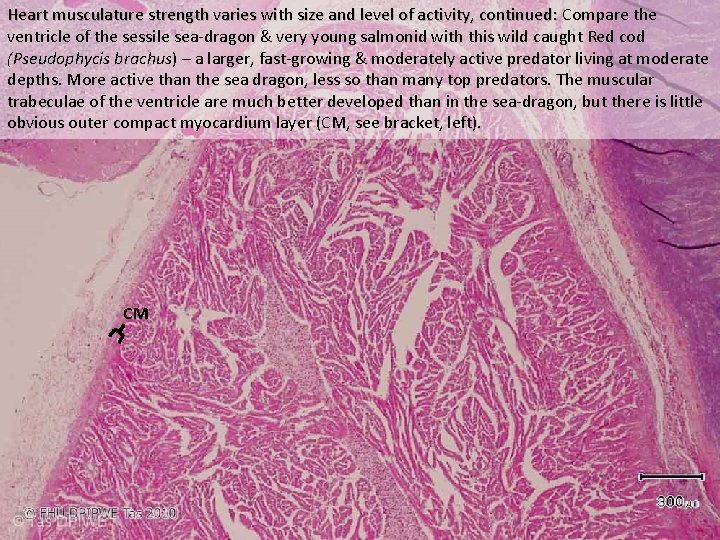
Heart musculature strength varies with size and level of activity, continued: Compare the ventricle of the sessile sea-dragon & very young salmonid with this wild caught Red cod (Pseudophycis brachus) – a larger, fast-growing & moderately active predator living at moderate depths. More active than the sea dragon, less so than many top predators. The muscular trabeculae of the ventricle are much better developed than in the sea-dragon, but there is little obvious outer compact myocardium layer (CM, see bracket, left). CM
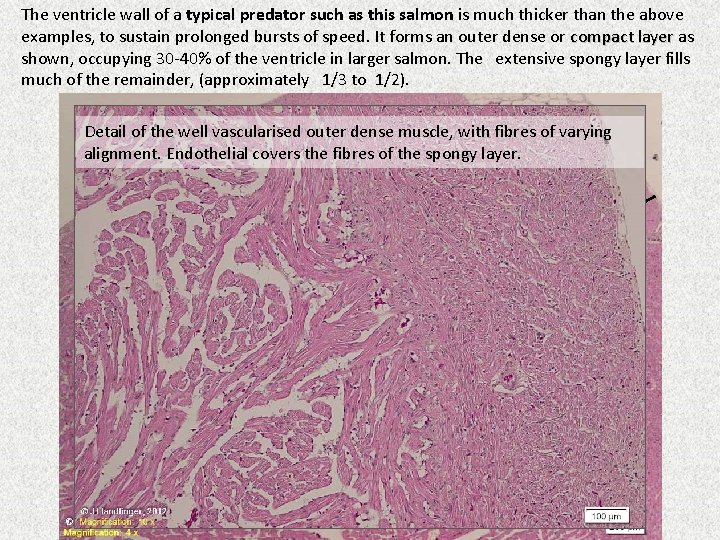
The ventricle wall of a typical predator such as this salmon is much thicker than the above examples, to sustain prolonged bursts of speed. It forms an outer dense or compact layer as shown, occupying 30 -40% of the ventricle in larger salmon. The extensive spongy layer fills much of the remainder, (approximately 1/3 to 1/2). Detail of the well vascularised outer dense muscle, with fibres of varying alignment. Endothelial covers the fibres of the spongy layer.
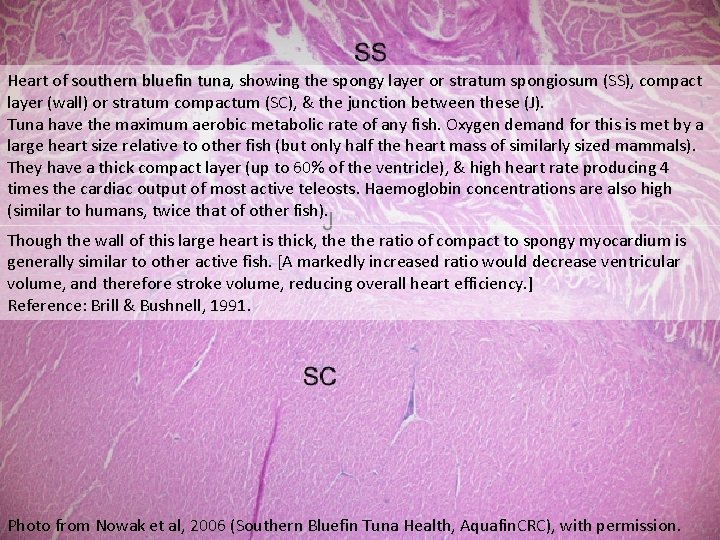
Heart of southern bluefin tuna, tuna showing the spongy layer or stratum spongiosum (SS), compact layer (wall) or stratum compactum (SC), & the junction between these (J). Tuna have the maximum aerobic metabolic rate of any fish. Oxygen demand for this is met by a large heart size relative to other fish (but only half the heart mass of similarly sized mammals). They have a thick compact layer (up to 60% of the ventricle), & high heart rate producing 4 times the cardiac output of most active teleosts. Haemoglobin concentrations are also high (similar to humans, twice that of other fish). Though the wall of this large heart is thick, the ratio of compact to spongy myocardium is generally similar to other active fish. [A markedly increased ratio would decrease ventricular volume, and therefore stroke volume, reducing overall heart efficiency. ] Reference: Brill & Bushnell, 1991. Photo from Nowak et al, 2006 (Southern Bluefin Tuna Health, Aquafin. CRC), with permission.
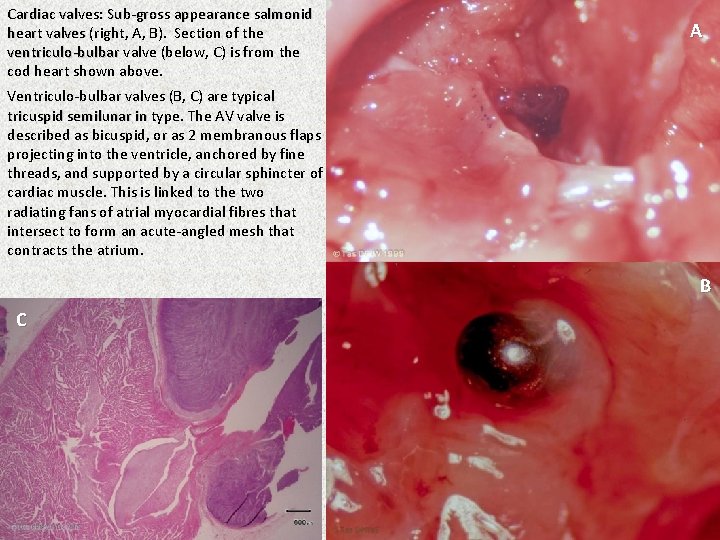
Cardiac valves: Sub-gross appearance salmonid heart valves (right, A, B). Section of the ventriculo-bulbar valve (below, C) is from the cod heart shown above. A Ventriculo-bulbar valves (B, C) are typical tricuspid semilunar in type. The AV valve is described as bicuspid, or as 2 membranous flaps projecting into the ventricle, anchored by fine threads, and supported by a circular sphincter of cardiac muscle. This is linked to the two radiating fans of atrial myocardial fibres that intersect to form an acute-angled mesh that contracts the atrium. B C
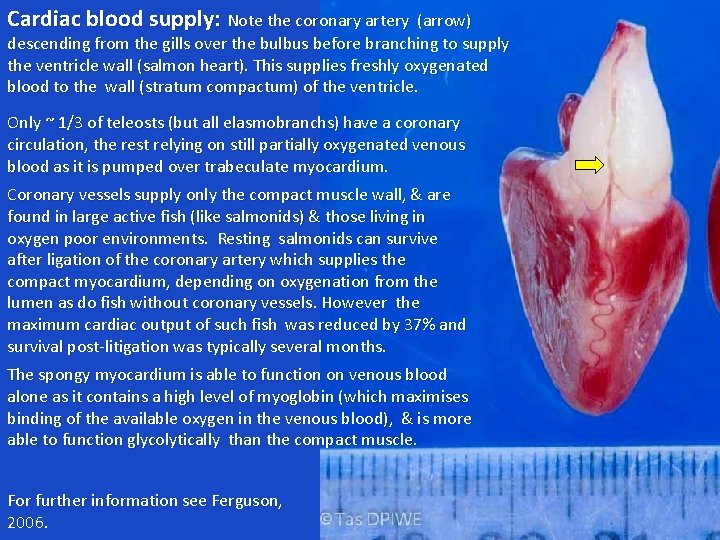
Cardiac blood supply: Note the coronary artery (arrow) descending from the gills over the bulbus before branching to supply the ventricle wall (salmon heart). This supplies freshly oxygenated blood to the wall (stratum compactum) of the ventricle. Only ~ 1/3 of teleosts (but all elasmobranchs) have a coronary circulation, the rest relying on still partially oxygenated venous blood as it is pumped over trabeculate myocardium. Coronary vessels supply only the compact muscle wall, & are found in large active fish (like salmonids) & those living in oxygen poor environments. Resting salmonids can survive after ligation of the coronary artery which supplies the compact myocardium, depending on oxygenation from the lumen as do fish without coronary vessels. However the maximum cardiac output of such fish was reduced by 37% and survival post-litigation was typically several months. The spongy myocardium is able to function on venous blood alone as it contains a high level of myoglobin (which maximises binding of the available oxygen in the venous blood), & is more able to function glycolytically than the compact muscle. For further information see Ferguson, 2006.
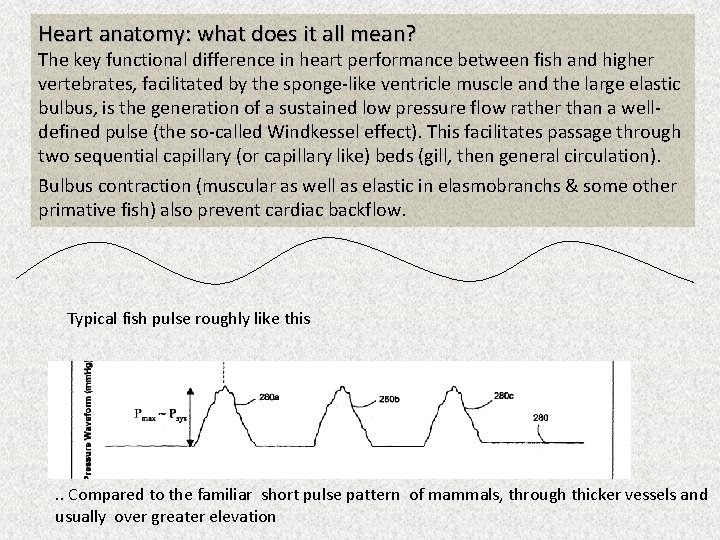
Heart anatomy: what does it all mean? The key functional difference in heart performance between fish and higher vertebrates, facilitated by the sponge-like ventricle muscle and the large elastic bulbus, is the generation of a sustained low pressure flow rather than a welldefined pulse (the so-called Windkessel effect). This facilitates passage through two sequential capillary (or capillary like) beds (gill, then general circulation). Bulbus contraction (muscular as well as elastic in elasmobranchs & some other primative fish) also prevent cardiac backflow. Typical fish pulse roughly like this . . Compared to the familiar short pulse pattern of mammals, through thicker vessels and usually over greater elevation