
Systematic Approaches to Literature Reviewing Presenter Maeve Gallagher
- Slides: 35
Systematic Approaches to Literature Reviewing Presenter: Maeve Gallagher Adapted from presentation by Dr. Derek Richards & Dr Mark Mathews
Workshop Overview ü Explain elements of the systematic review process
Challenges in Conducting Literature Reviews n Knowing where to start, (e. g. wide then narrow, or narrow then wide? ) n Knowing what to include n Knowing when to stop literature searching n Knowing how far to venture into the literature of associated domains
Literature Review What is a Systematic Literature Review?
Systematic Reviews A review of a clearly formulated question that uses systematic and explicit methods to identify, select and critically appraise relevant research. from www. sebc. bangor. ac. uk
Systematic Reviews Readers need to be able to judge whether all of the relevant literature is likely to have been found, and how the quality of studies was assessed.
Key features The systematic review process: n Explicit and transparent methods n A standard set of stages n Accountable, replicable and updateable
To summarise … You need: n 1. A clearly formulated question n 2. Systematic and explicit methods n 3. Critical appraisal of relevant research
1. Formulating a Problem A Research Question should be: - Specific - Focused - Clearly formulated - Well defined Ask questions of the question!
1. Formulating a Question - Discuss following questions in pairs/threes 1. Why are social networking sites harmful? 2. How are online users experiencing or addressing privacy issues on such social networking sites as My. Space and Facebook? 3. What is the effect on the environment from global warming? 4. How is glacial melting affecting penguins in Antarctica?
Research Question Examples Why are social networking sites harmful? q q q n Doesn’t specify which social networking sites What kind of harm the sites are causing. Assumes that this “harm” is proven and/or accepted. http: //writingcenter. gmu. edu/? p=307
Research Question Examples How are online users experiencing or addressing privacy issues on such social networking sites as My. Space and Facebook? q q q Specifies sites (My. Space and Facebook), Type of harm (privacy issues) Who the issue is harming (users). http: //writingcenter. gmu. edu/? p=307
n A strong research question should never leave room for ambiguity or interpretation.
Research Questions Examples What is the effect on the environment from global warming? So broad that it couldn’t be adequately answered in a book-length piece, let alone a standard college-level paper. http: //writingcenter. gmu. edu/? p=307
Research Question Examples How is glacial melting affecting penguins in Antarctica? q q q n narrows down to a specific cause (glacial melting), a specific place (Antarctica) a specific group that is affected (penguins). http: //writingcenter. gmu. edu/? p=307
n n When in doubt, make a research question as narrow and focused as possible http: //writingcenter. gmu. edu/? p=307
1. Formulating a Problem What is your research question? Take a few moments to write down your research question.
1. Formulating a Problem Is Your Research Question: - Specific? - Focused? - Clearly formulated? - Well defined? Ask questions of your question!
n Exercise to do in pairs: Take five minutes each to discuss your research topic. Ask your partner to interrogate your question to see if it meets all the criteria mentioned earlier Online students can take the time to objectively interrogate their own question.
1. Formulate question Computer-based psychological treatments for depression: A systematic review
2. Locating and Finding Studies
2. Locating and Finding Studies Phase 1 – Identifying the Research n Phase 2 - Selection n
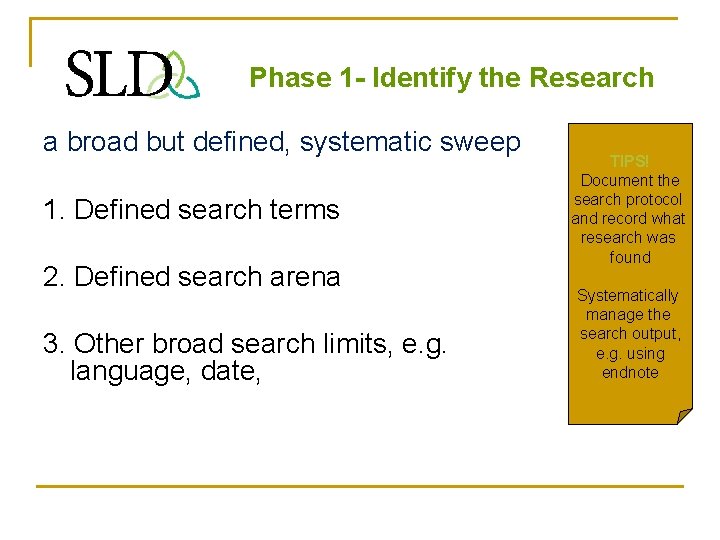
Phase 1 - Identify the Research a broad but defined, systematic sweep 1. Defined search terms 2. Defined search arena 3. Other broad search limits, e. g. language, date, TIPS! Document the search protocol and record what research was found Systematically manage the search output, e. g. using endnote
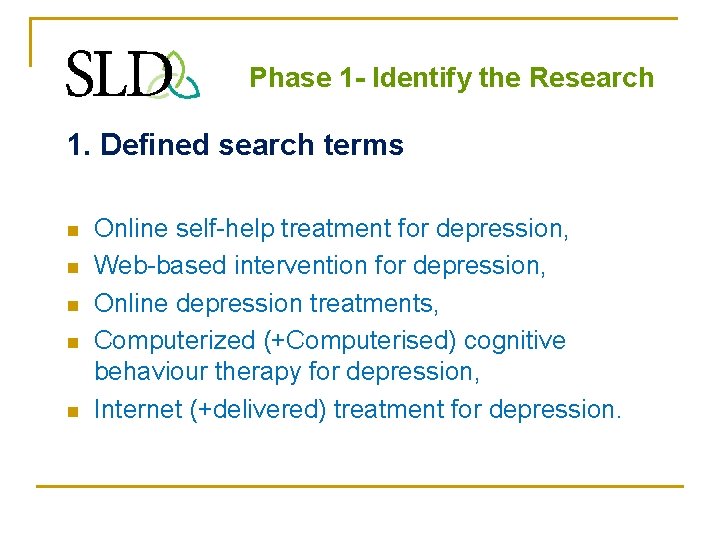
Phase 1 - Identify the Research 1. Defined search terms n n n Online self-help treatment for depression, Web-based intervention for depression, Online depression treatments, Computerized (+Computerised) cognitive behaviour therapy for depression, Internet (+delivered) treatment for depression.
Phase 1 - Identify the Research 2. Defined search arena v v v v n Databases citation indices reference lists from primary and review articles grey literature conference proceedings research registers the internet individual researchers/practitioners A search of three databases (EMBASE, Pub. Med, and Psych. INFO including Psych. ARTICLES)
Phase 1 - Identify the Research 3. Other broad search limits, e. g. language, date: § Studies published in English in peer-reviewed journals in the last 10 years (March 2001–March 2011) § The authors decided that the years represented a meaningful timeframe in terms of: §contemporary technologies §advances in multimedia §broadband developments
Phase 2 – Selection Inclusion and Exclusion Criteria - related to your research question Develop inclusion or exclusion statements, these might relate to study outcomes, research design, methods used, population worked with etc. e. g. n studies with a mixed population of men and women, n only random control trials, n maximum exposure time of 10 mins
Phase 2 – Selection Inclusion and Exclusion Criteria - related to your research question n Included studies using a variety of different computer-based technologies n Study participants had to be adults (18+years) with depression (selfreport or diagnosis), established using valid and reliable measures n Studies included were published in peer reviewed journals in English in the last 10 years n Participants could be from the general population or a clinical group so long as depression was specifically measured. n Preliminary research into recent developments in computerized paradigms for depression such as cognitive bias modification (CBM) based interventions were not considered for inclusion
3. Critical appraisal of studies “Assessing the quality of methodology is a critical part of the systematic review process” You will need to make decisions on all aspects of the review and simply justify what you decide, making sure its credible and meets the criteria, that it is transparent, replicable and updateable.
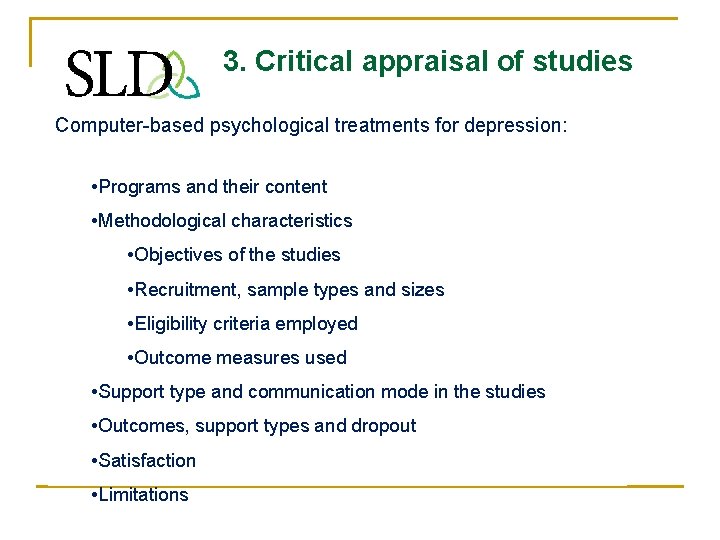
3. Critical appraisal of studies Computer-based psychological treatments for depression: • Programs and their content • Methodological characteristics • Objectives of the studies • Recruitment, sample types and sizes • Eligibility criteria employed • Outcome measures used • Support type and communication mode in the studies • Outcomes, support types and dropout • Satisfaction • Limitations
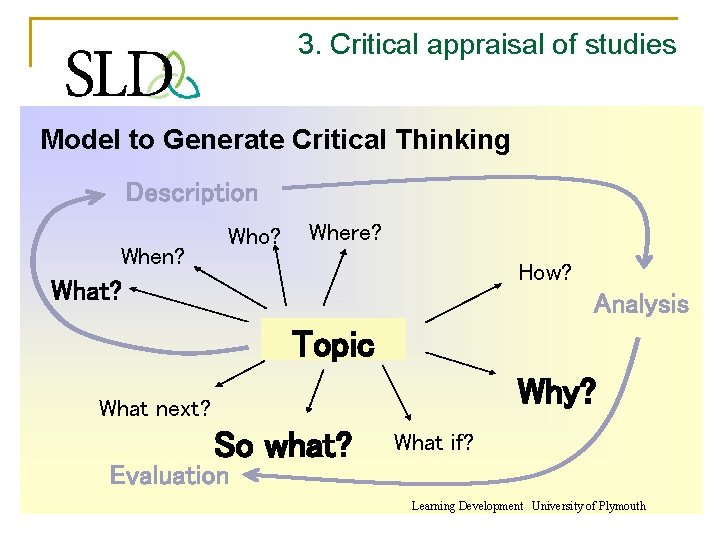
3. Critical appraisal of studies Model to Generate Critical Thinking Description When? Who? Where? How? What? Analysis Topic Why? What next? So what? What if? Evaluation Learning Development University of Plymouth
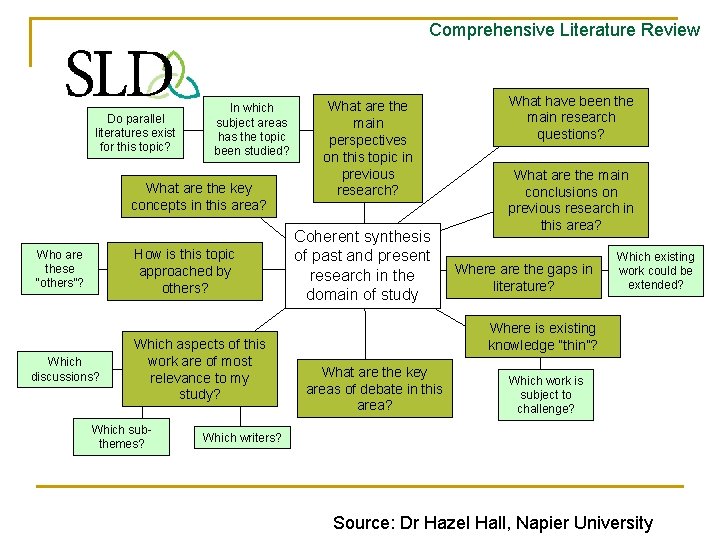
Comprehensive Literature Review Do parallel literatures exist for this topic? In which subject areas has the topic been studied? What are the key concepts in this area? How is this topic approached by others? Who are these “others”? Which discussions? Which aspects of this work are of most relevance to my study? Which subthemes? What are the main perspectives on this topic in previous research? Coherent synthesis of past and present research in the domain of study What have been the main research questions? What are the main conclusions on previous research in this area? Where are the gaps in literature? Which existing work could be extended? Where is existing knowledge “thin”? What are the key areas of debate in this area? Which work is subject to challenge? Which writers? Source: Dr Hazel Hall, Napier University
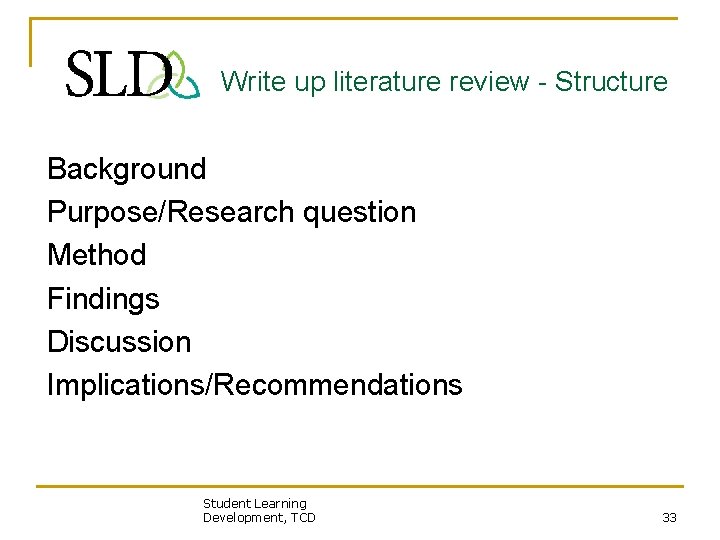
Write up literature review - Structure Background Purpose/Research question Method Findings Discussion Implications/Recommendations Student Learning Development, TCD 33
Other ideas and options Speed reading Endnote Databases in my area Data mining techniques Recording
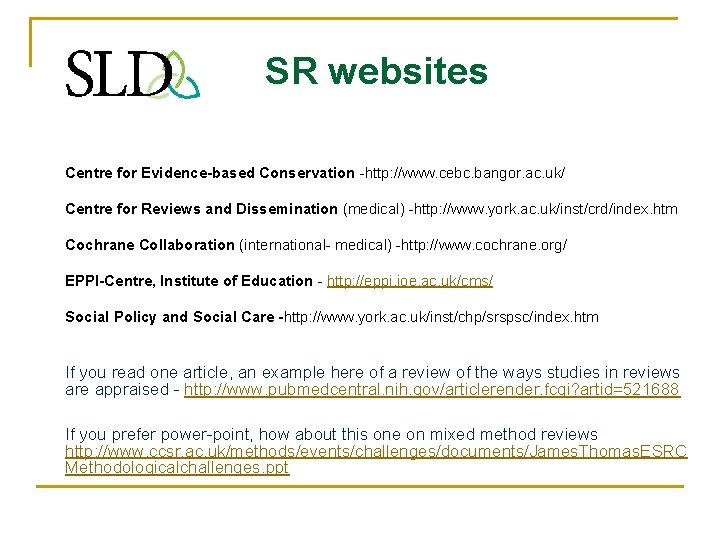
SR websites Centre for Evidence-based Conservation -http: //www. cebc. bangor. ac. uk/ Centre for Reviews and Dissemination (medical) -http: //www. york. ac. uk/inst/crd/index. htm Cochrane Collaboration (international- medical) -http: //www. cochrane. org/ EPPI-Centre, Institute of Education - http: //eppi. ioe. ac. uk/cms/ Social Policy and Social Care -http: //www. york. ac. uk/inst/chp/srspsc/index. htm If you read one article, an example here of a review of the ways studies in reviews are appraised - http: //www. pubmedcentral. nih. gov/articlerender. fcgi? artid=521688 If you prefer power-point, how about this one on mixed method reviews http: //www. ccsr. ac. uk/methods/events/challenges/documents/James. Thomas. ESRC Methodologicalchallenges. ppt