
Systematic Approach to Training Uttam Acharya NASC Preview








- Slides: 40
Systematic Approach to Training Uttam Acharya NASC
Preview of Session Training concept Philosophy of training Training Cycle Training methods Training evaluation Focus of training
Discussions Let us re-check our perception of what “training” and “learning” ?
Training: Some Concepts v v Training is a means of learning or making others learn. Training is concerned with gaining learning experience that leads to relatively permanent change in an individual’s ability to perform job. Training is a process of changing one’s habits in the form of re-shaping of ice-berg, i. e. , unfreezing, processing and re-freezing of the habits of trainees. Training is a systematic process of creating learning environment
Training and Education
Philosophy of Training is different from education q Training is concerned with action (doing) rather than knowledge (knowing) q Training is a learning process rather than teaching q Training is a means for introducing changes in organisation q Training is not a panacea for all ills q
What training can do?
What training can do? Improves one’s knowledge and skill levels q Helps to change one’s attitudes q Enhances job performance level q Links individual’s career goals with organization's development goals q Minimizes the cost of trial and error in learning q
What training can not do?
What training can not do? q Does not ensure increased job performance q Does not increase learning potentialities q Does not make anyone learn everything
How can we make training effective? v v Undertaking training as a process Adopting a learning-focused training strategy
Training cycle/process
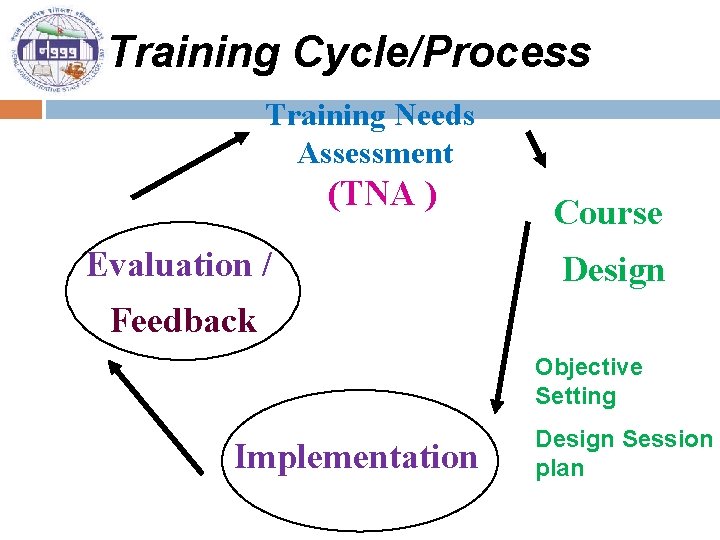
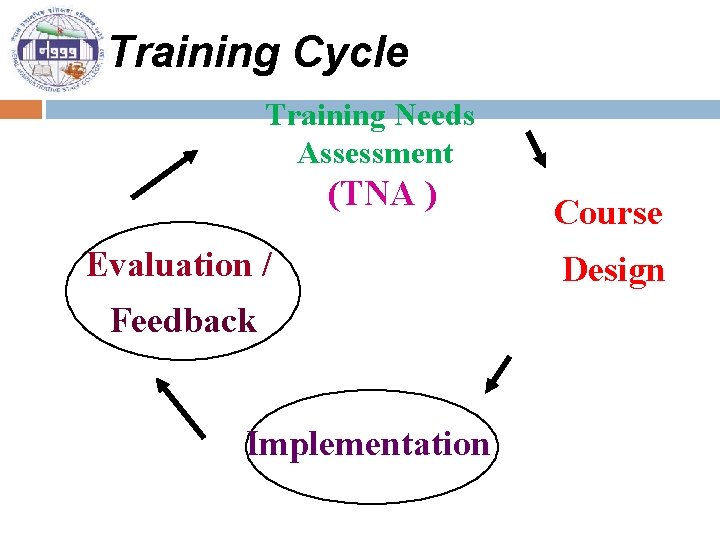
Training Cycle/Process Training Needs Assessment (TNA ) Evaluation / Course Design Feedback Objective Setting Implementation Design Session plan
Training Process: Training is systematic process to be followed.
Training phases 16 There are many activities to be done through before and after training Three main phases have different types of actors.
Training phases and actors ? Exercise Pre-training phase and actors ? During training and actors ? Post training phase and actors?
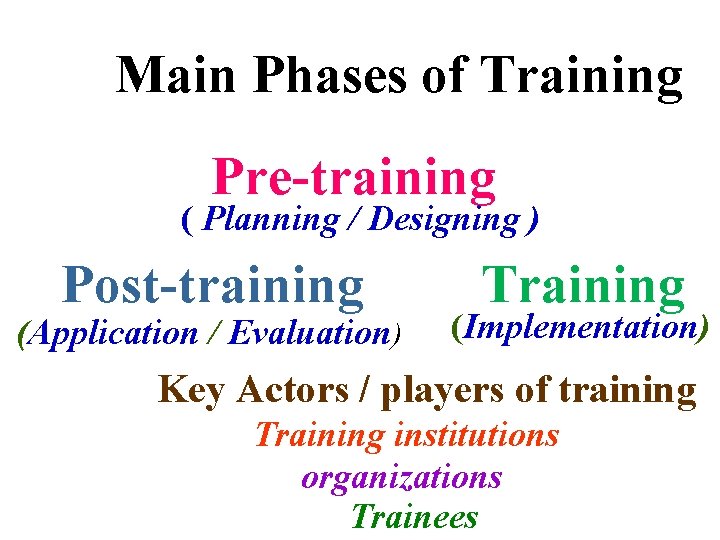
Phases: Pre-training (Planning / Designing) During Training (Implementation) Post-training (Application after training + Evaluation) Actors: Training institutions/centre/trainers Work organization / unit /employer Trainees
(I) Pre-training phase (Actors: training institution, work org. ) Identification of training needs: Design of training program - Setting training objectives - Designing curriculum - Choosing appropriate training methods - Selecting trainers - Designing trainee selection criteria - Planning and preparing training materials - Ensuring availability of physical facilities Selection of trainees as per set criteria
II) Training phase(Actors: training institution and trainees) Implementation of training course or program Ensuring active participation in training sessions Facilitating and maintaining learning environment
III) Post-training phase (Actors: trainees, work organisation and training institution) Placement of trainees on the jobs for which they are trained Providing support to the trained staff for utilisation of training on their jobs Follow up and evaluation of usefulness of training: (a) reaction evaluation (b) outcome evaluation
TNA /LNA ? LNA?
Training Needs Assessment : (TNA) What is Training Need? The training need a gap between the competency required by the job and the competency currently possessed by the job holder.
Steps in Training Needs Assessment : Step 1: Assess job requirements: (Expected KSA) Step 2: Assess existing performance of jobholders: (Existing KSA) Step 3: gap) Identify the need (i. e. , the
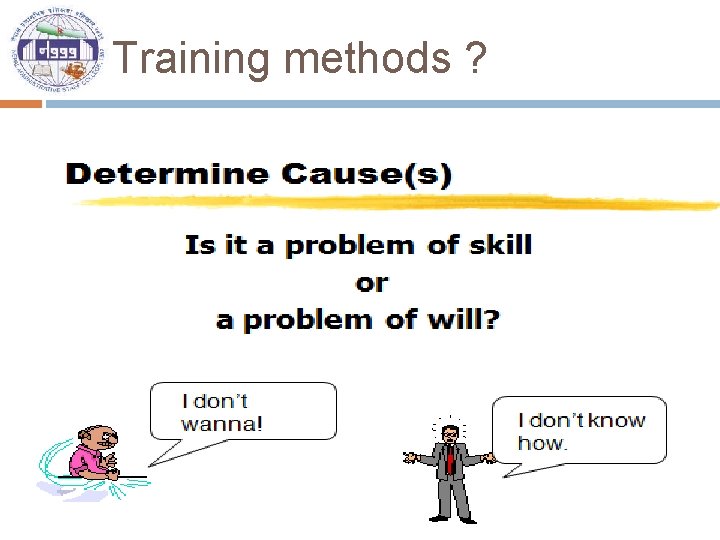
Training methods ?
Choice of Training Methods e. g. ring finger Each method is uniquely useful in a particular situation. The usefulness depends on: · Training objectives · Content (course) · Level of trainees · Availability of physical facilities and equipment · Time availability · Competency of trainer · Temporal needs of the situation
How do we evaluate training? Discussions
Training Evaluation: Levels of Evaluation: Reaction level Learning Level Behaviour Level Outcome/Impact Level
How we evaluate training? 29 NASC 2016
Approaches or methods for evaluating training · · · Observation method Test / re-test methods Pre-post performance method Experimental/ control group Trainee surveys Cost effectiveness analysis.
Focus of Training Creating an awareness, on the part of learner, of the need for change helping the learners to learn how to learn
Learning-focused Training Strategy Help trainees identifying progress Help trainees to move around a cycle of experiential learning
Experiential Learning Cycle Undergoing certain activity or concrete experience; Reflecting on experiences; Conceptualising from the reflection; and Applying learning in a new situation
Training sequencing Experiencing: engaging in one or more structured experiences, etc. Reflecting / processing Generalizing: inferring principles about the real work Applying
Training strategies based on focus Development of individuals Development of organization Learning of content Learning of process Strategies Individual development Organization development
Revisiting Systematic Training/( training process)
Training Cycle Training Needs Assessment (TNA ) Evaluation / Feedback Implementation Course Design
Main Phases of Training Pre-training ( Planning / Designing ) Post-training (Application / Evaluation) Training (Implementation) Key Actors / players of training Training institutions organizations Trainees
Thank you
Queries 40 Thank you