
Systematic analysis and visualisation of microarray studies Sander


- Slides: 17
Systematic analysis and visualisation of microarray studies Sander Claus Professional Bachelor Biomedical laboratory science Bioinformatics Tutor: Peter Ghazal Supervisor: Nigel Binns Belgian supervisor: Raphaël Kiekens 2012 - 2013
Overview 1. Aim and hypothesis 2. Sterol pathway 3. Microarrays 4. Datasets 5. Workflow 6. Processing and visualisation of the data 7. Hypothesis testing 8. Conclusion
Aim and hypothesis • Aim – Process microarray data using R – Generate graphs – Test hypothesis • Hypothesis – Is the sterol pathway perturbed in a broad range of pathogen studies? • Does this occur in cells other than macrophages? • Is this a common theme for other pathogens?
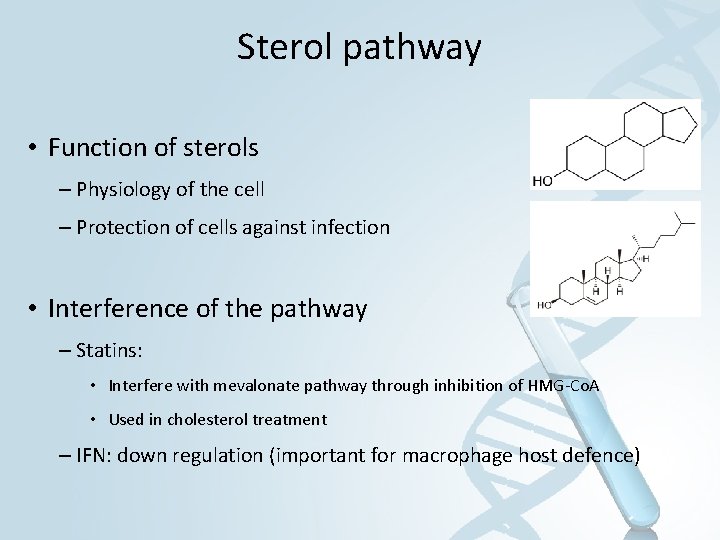
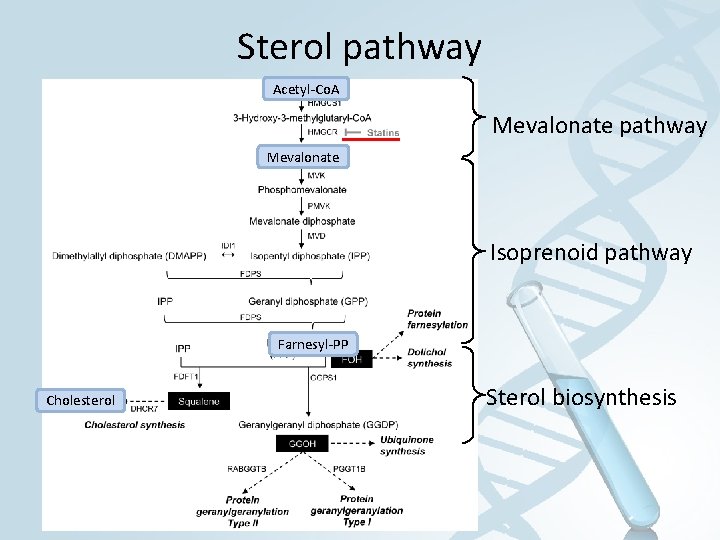
Sterol pathway • Function of sterols – Physiology of the cell – Protection of cells against infection • Interference of the pathway – Statins: • Interfere with mevalonate pathway through inhibition of HMG-Co. A • Used in cholesterol treatment – IFN: down regulation (important for macrophage host defence)
Sterol pathway Acetyl-Co. A Mevalonate pathway Mevalonate Isoprenoid pathway Farnesyl-PP Cholesterol Sterol biosynthesis
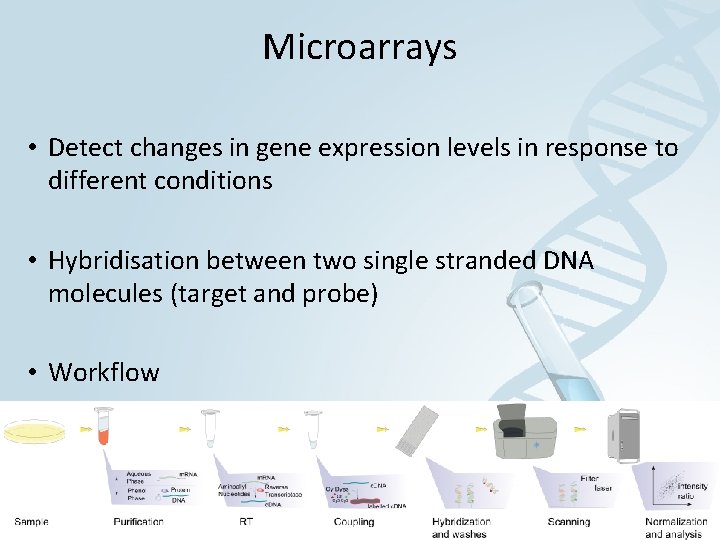
Microarrays • Detect changes in gene expression levels in response to different conditions • Hybridisation between two single stranded DNA molecules (target and probe) • Workflow
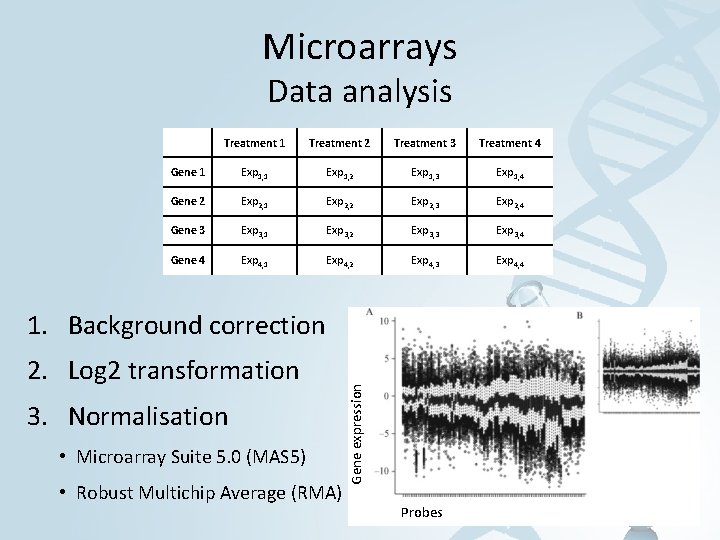
Microarrays Data analysis Treatment 1 Treatment 2 Treatment 3 Treatment 4 Gene 1 Exp 1, 2 Exp 1, 3 Exp 1, 4 Gene 2 Exp 2, 1 Exp 2, 2 Exp 2, 3 Exp 2, 4 Gene 3 Exp 3, 1 Exp 3, 2 Exp 3, 3 Exp 3, 4 Gene 4 Exp 4, 1 Exp 4, 2 Exp 4, 3 Exp 4, 4 2. Log 2 transformation 3. Normalisation • Microarray Suite 5. 0 (MAS 5) • Robust Multichip Average (RMA) Gene expression 1. Background correction Probes
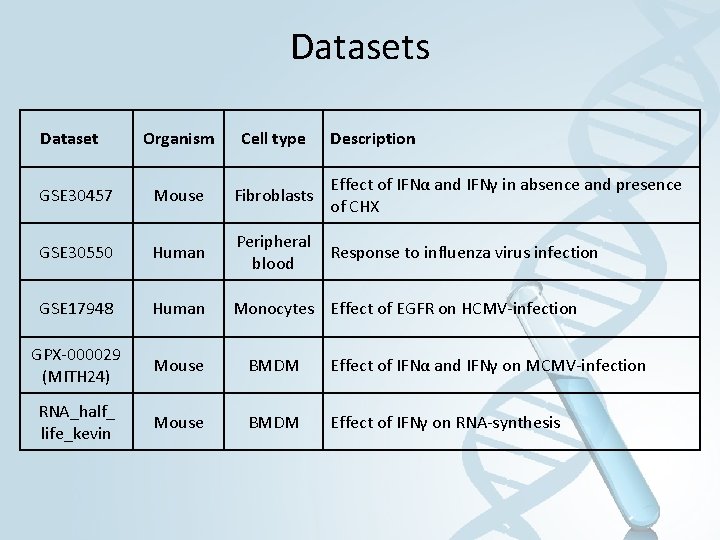
Datasets Dataset Organism Cell type Description GSE 30457 Mouse Fibroblasts Effect of IFNα and IFNγ in absence and presence of CHX GSE 30550 Human Peripheral blood Response to influenza virus infection GSE 17948 Human Monocytes Effect of EGFR on HCMV-infection GPX-000029 (MITH 24) Mouse BMDM Effect of IFNα and IFNγ on MCMV-infection RNA_half_ life_kevin Mouse BMDM Effect of IFNγ on RNA-synthesis
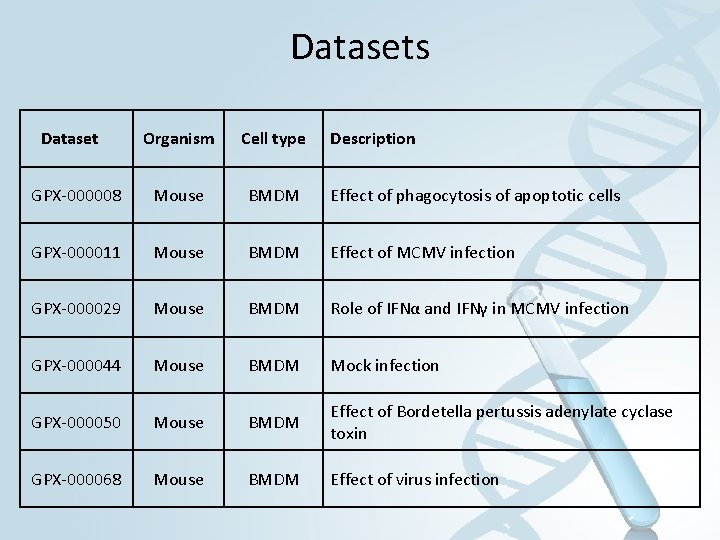
Datasets Dataset Organism Cell type Description GPX-000008 Mouse BMDM Effect of phagocytosis of apoptotic cells GPX-000011 Mouse BMDM Effect of MCMV infection GPX-000029 Mouse BMDM Role of IFNα and IFNγ in MCMV infection GPX-000044 Mouse BMDM Mock infection GPX-000050 Mouse BMDM Effect of Bordetella pertussis adenylate cyclase toxin GPX-000068 Mouse BMDM Effect of virus infection
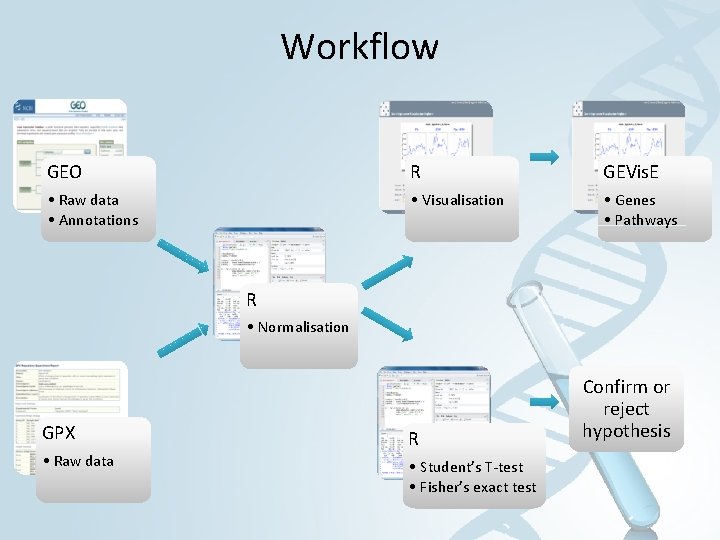
Workflow GEO R GEVis. E • Raw data • Annotations • Visualisation • Genes • Pathways R • Normalisation GPX • Raw data R • Student’s T-test • Fisher’s exact test Confirm or reject hypothesis
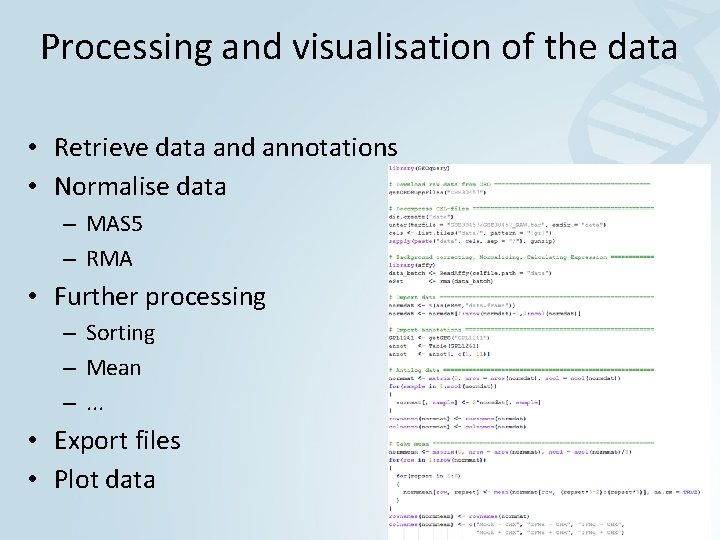
Processing and visualisation of the data • Retrieve data and annotations • Normalise data – MAS 5 – RMA • Further processing – Sorting – Mean –. . . • Export files • Plot data
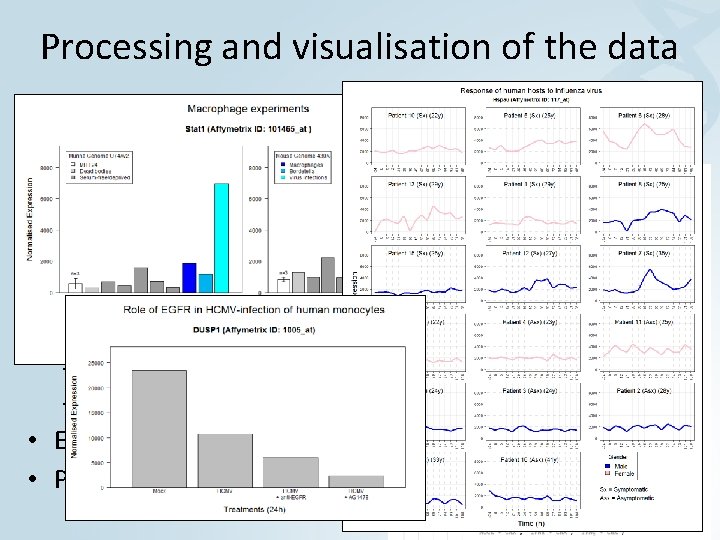
Processing and visualisation of the data • Retrieve data and annotations • Normalise data – MAS 5 – RMA • Further processing – Sorting – Mean –. . . • Export files • Plot data
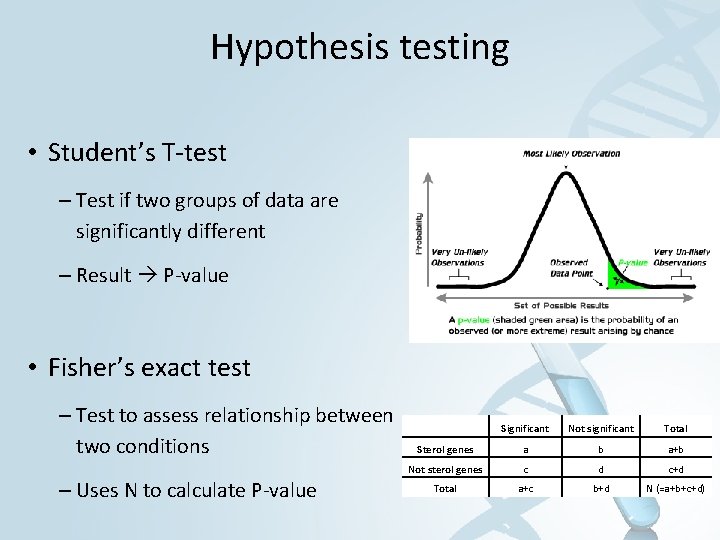
Hypothesis testing • Student’s T-test – Test if two groups of data are significantly different – Result P-value • Fisher’s exact test – Test to assess relationship between two conditions – Uses N to calculate P-value Significant Not significant Total Sterol genes a b a+b Not sterol genes c d c+d Total a+c b+d N (=a+b+c+d)
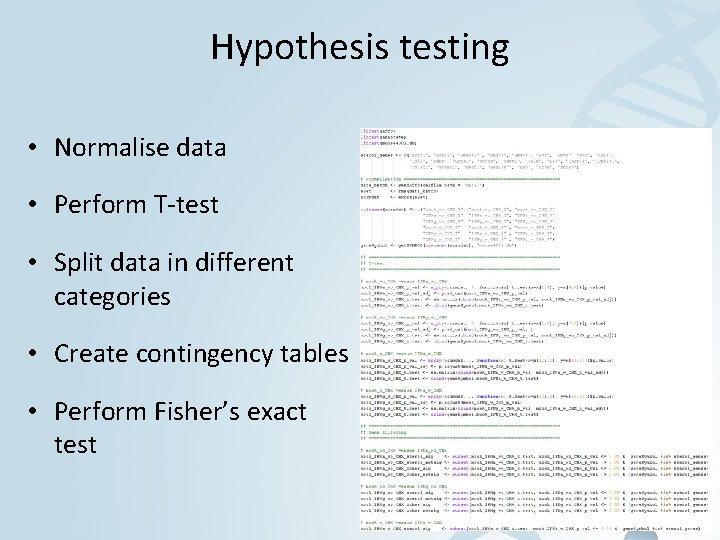
Hypothesis testing • Normalise data • Perform T-test • Split data in different categories • Create contingency tables • Perform Fisher’s exact test
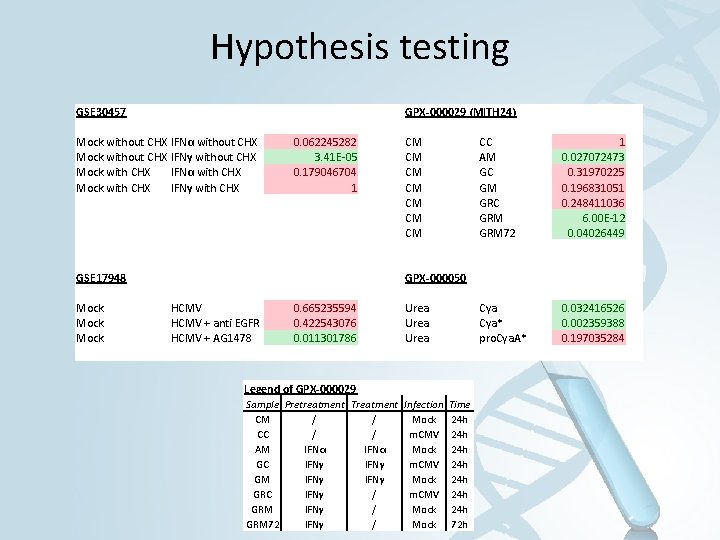
Hypothesis testing GSE 30457 GPX-000029 (MITH 24) Mock without CHX IFNα without CHX Mock without CHX IFNγ without CHX Mock with CHX IFNα with CHX Mock with CHX IFNγ with CHX 0. 062245282 3. 41 E-05 0. 179046704 1 GSE 17948 Mock CM CM CC AM GC GM GRC GRM 72 1 0. 027072473 0. 31970225 0. 196831051 0. 248411036 6. 00 E-12 0. 04026449 Cya* pro. Cya. A* 0. 032416526 0. 002359388 0. 197035284 GPX-000050 HCMV + anti EGFR HCMV + AG 1478 0. 665235594 0. 422543076 0. 011301786 Urea Legend of GPX-000029 Sample Pretreatment Treatment Infection CM / / Mock CC / / m. CMV AM IFNα Mock GC IFNγ m. CMV GM IFNγ Mock GRC IFNγ / m. CMV GRM IFNγ / Mock GRM 72 IFNγ / Mock Time 24 h 24 h 72 h
Conclusion • Processing microarray gene expression • Visualise data as graphs – Upload graphs to GEVis. E • Use data in Fisher’s exact test – Confirm/reject hypothesis – GSE 30457 future project
Systematic analysis and visualisation of microarray studies Sander Claus Professional Bachelor Biomedical laboratory science Bioinformatics Tutor: Peter Ghazal Supervisor: Nigel Binns Belgian supervisor: Raphaël Kiekens 2012 - 2013