
System Structures CSE 425 Industrial Process Control Lecture
- Slides: 16
System Structures CSE 425 Industrial Process Control Lecture 5 Copyright © Thomas Marlin 2013 1
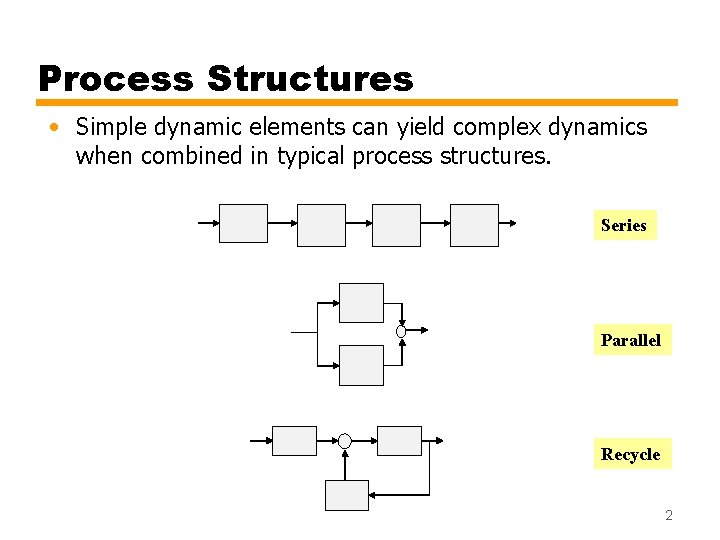
Process Structures • Simple dynamic elements can yield complex dynamics when combined in typical process structures. Series Parallel Recycle 2
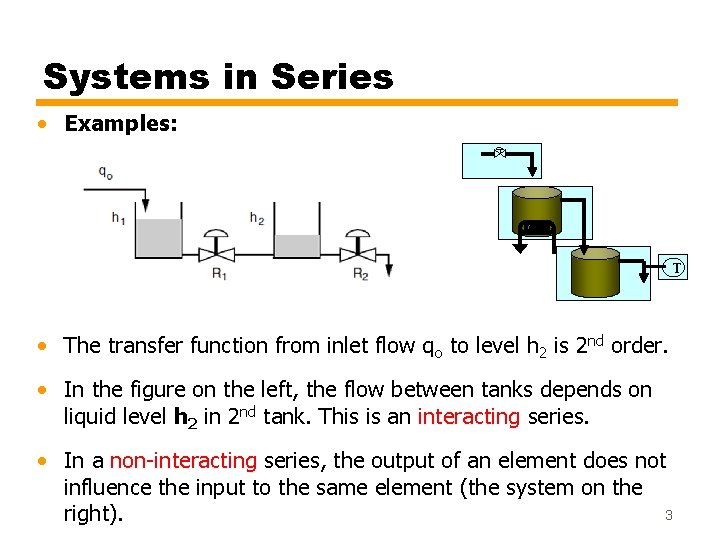
Systems in Series • Examples: T • The transfer function from inlet flow qo to level h 2 is 2 nd order. • In the figure on the left, the flow between tanks depends on liquid level h 2 in 2 nd tank. This is an interacting series. • In a non-interacting series, the output of an element does not influence the input to the same element (the system on the 3 right).
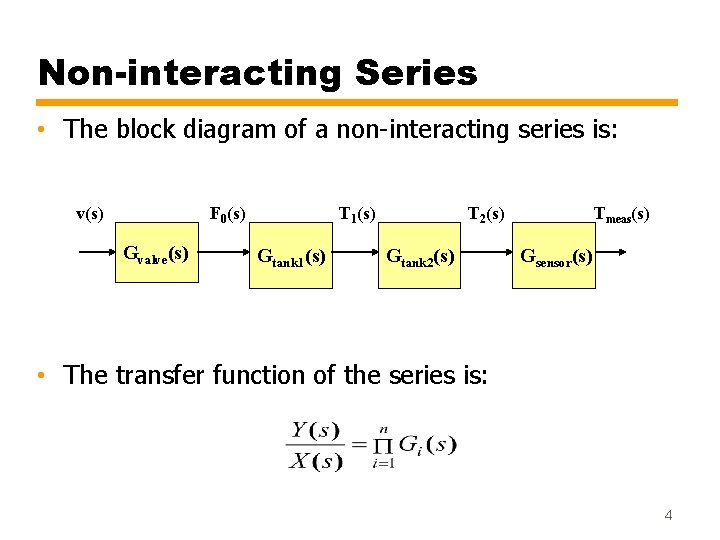
Non-interacting Series • The block diagram of a non-interacting series is: v(s) F 0(s) Gvalve(s) T 1(s) Gtank 1(s) T 2(s) Gtank 2(s) Tmeas(s) Gsensor(s) • The transfer function of the series is: 4
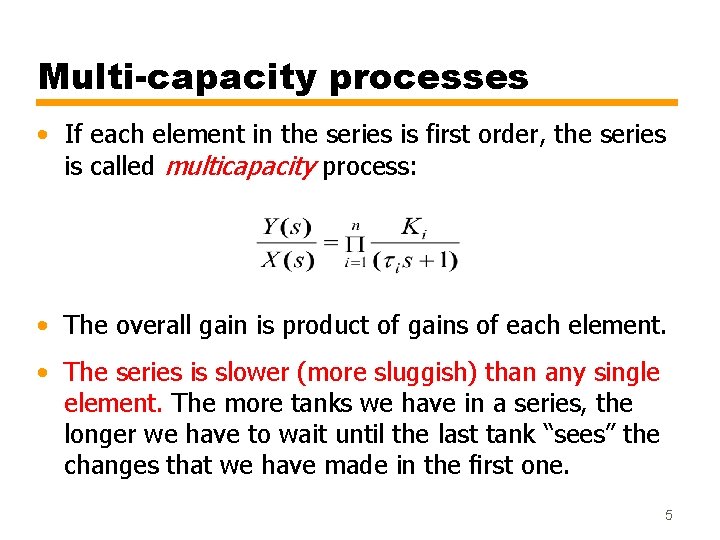
Multi-capacity processes • If each element in the series is first order, the series is called multicapacity process: • The overall gain is product of gains of each element. • The series is slower (more sluggish) than any single element. The more tanks we have in a series, the longer we have to wait until the last tank “sees” the changes that we have made in the first one. 5
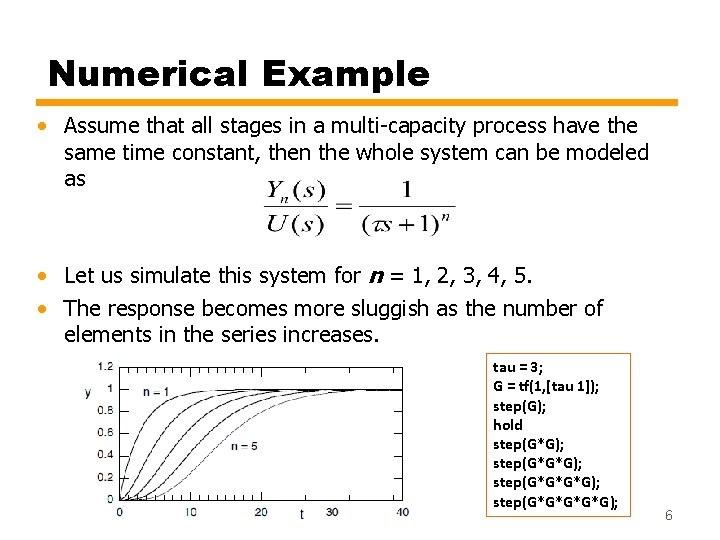
Numerical Example • Assume that all stages in a multi-capacity process have the same time constant, then the whole system can be modeled as • Let us simulate this system for n = 1, 2, 3, 4, 5. • The response becomes more sluggish as the number of elements in the series increases. tau = 3; G = tf(1, [tau 1]); step(G); hold step(G*G); step(G*G*G*G); step(G*G*G); 6
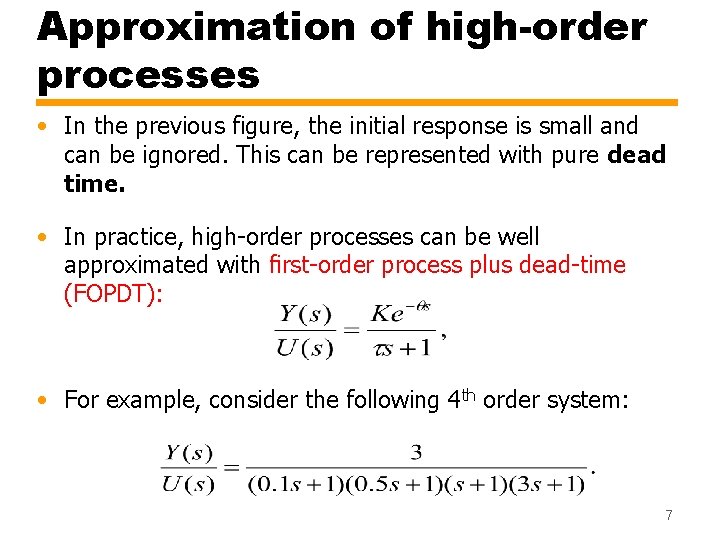
Approximation of high-order processes • In the previous figure, the initial response is small and can be ignored. This can be represented with pure dead time. • In practice, high-order processes can be well approximated with first-order process plus dead-time (FOPDT): • For example, consider the following 4 th order system: 7
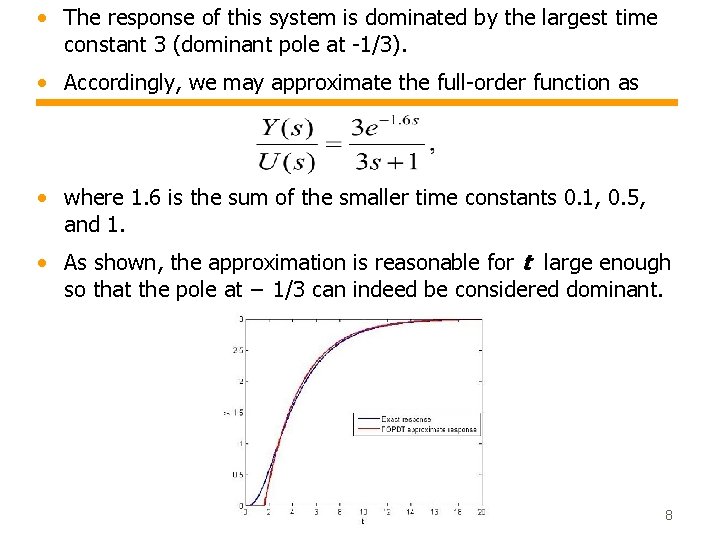
• The response of this system is dominated by the largest time constant 3 (dominant pole at -1/3). • Accordingly, we may approximate the full-order function as • where 1. 6 is the sum of the smaller time constants 0. 1, 0. 5, and 1. • As shown, the approximation is reasonable for t large enough so that the pole at − 1/3 can indeed be considered dominant. 8
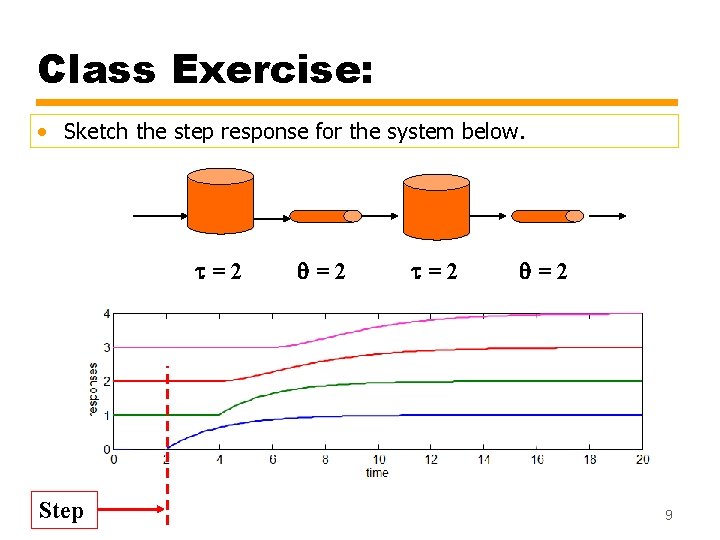
Class Exercise: • Sketch the step response for the system below. =2 Step =2 =2 9
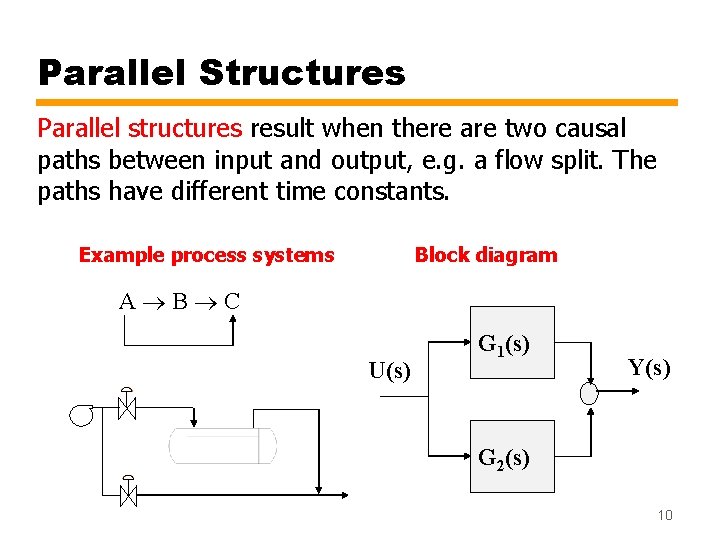
Parallel Structures Parallel structures result when there are two causal paths between input and output, e. g. a flow split. The paths have different time constants. Example process systems Block diagram A B C U(s) G 1(s) Y(s) G 2(s) 10
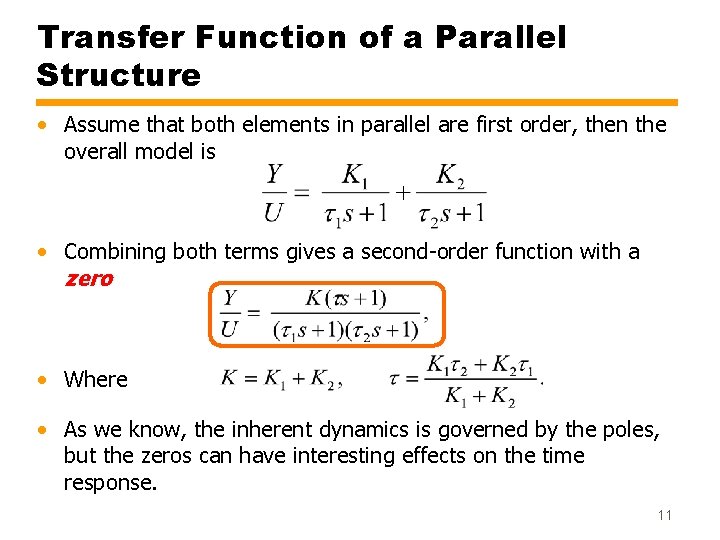
Transfer Function of a Parallel Structure • Assume that both elements in parallel are first order, then the overall model is • Combining both terms gives a second-order function with a zero • Where • As we know, the inherent dynamics is governed by the poles, but the zeros can have interesting effects on the time response. 11
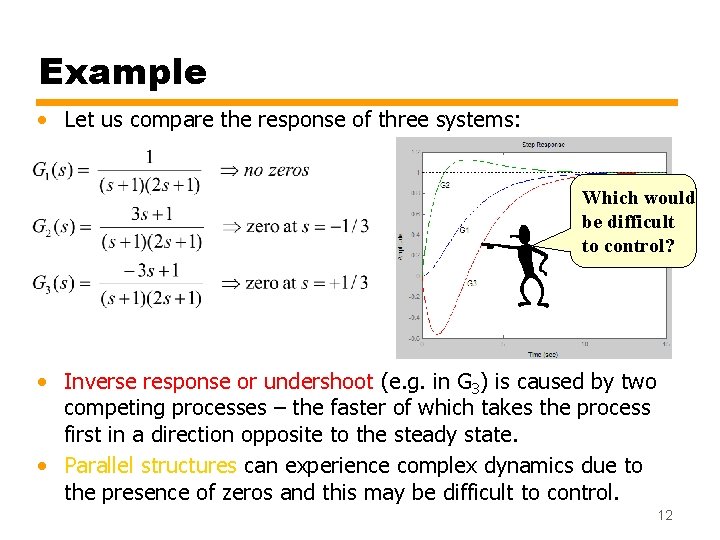
Example • Let us compare the response of three systems: Which would be difficult to control? • Inverse response or undershoot (e. g. in G 3) is caused by two competing processes – the faster of which takes the process first in a direction opposite to the steady state. • Parallel structures can experience complex dynamics due to the presence of zeros and this may be difficult to control. 12
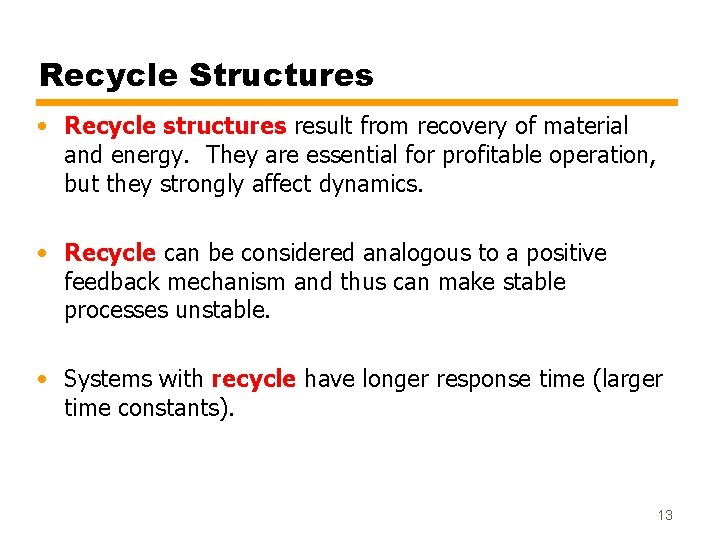
Recycle Structures • Recycle structures result from recovery of material and energy. They are essential for profitable operation, but they strongly affect dynamics. • Recycle can be considered analogous to a positive feedback mechanism and thus can make stable processes unstable. • Systems with recycle have longer response time (larger time constants). 13
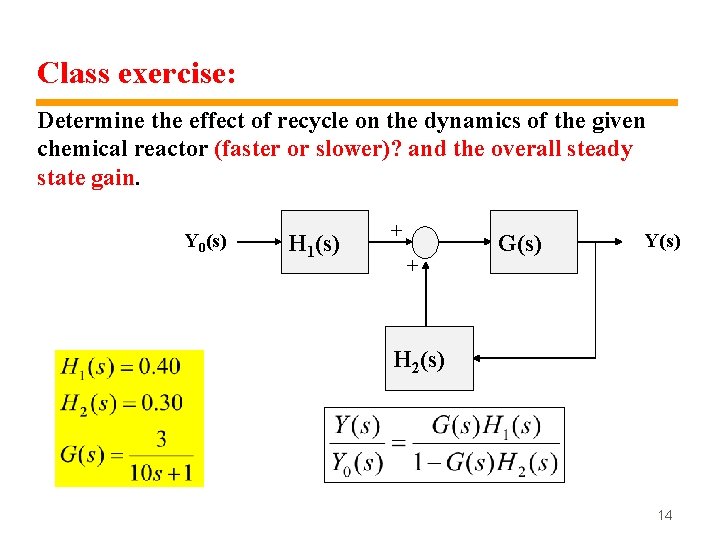
Class exercise: Determine the effect of recycle on the dynamics of the given chemical reactor (faster or slower)? and the overall steady state gain. Y 0(s) H 1(s) + + G(s) Y(s) H 2(s) 14
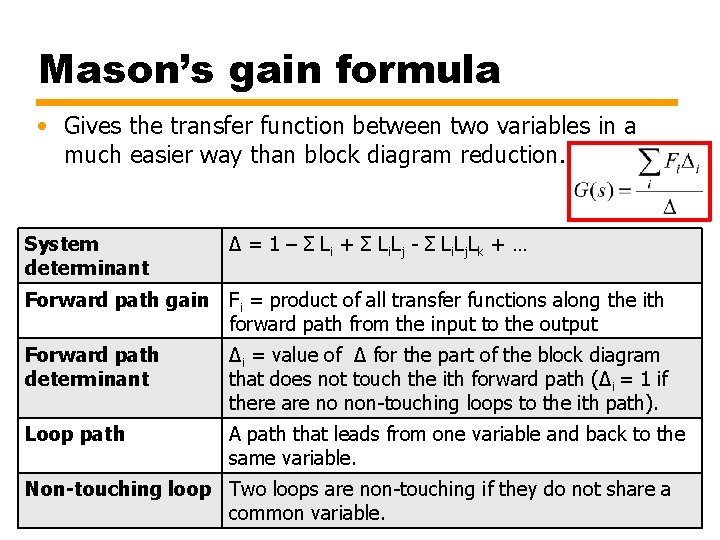
Mason’s gain formula • Gives the transfer function between two variables in a much easier way than block diagram reduction. System determinant Δ = 1 – Σ Li + Σ Li. Lj - Σ Li. Lj. Lk + … Forward path gain Fi = product of all transfer functions along the ith forward path from the input to the output Forward path determinant Δi = value of Δ for the part of the block diagram that does not touch the ith forward path (Δi = 1 if there are no non-touching loops to the ith path). Loop path A path that leads from one variable and back to the same variable. Non-touching loop Two loops are non-touching if they do not share a 15 common variable.
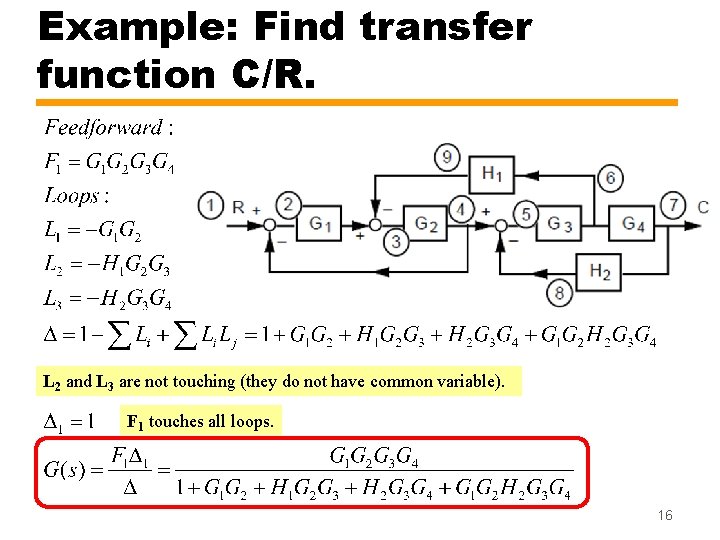
Example: Find transfer function C/R. L 2 and L 3 are not touching (they do not have common variable). F 1 touches all loops. 16