
System Responses Dr Holbert March 24 2008 Lect
System Responses Dr. Holbert March 24, 2008 Lect 16 EEE 202 1
Introduction • Today, we explore in greater depth the three cases for second-order systems – Real and unequal poles – Real and equal poles – Complex conjugate pair • This material is ripe with new terminology Lect 16 EEE 202 2
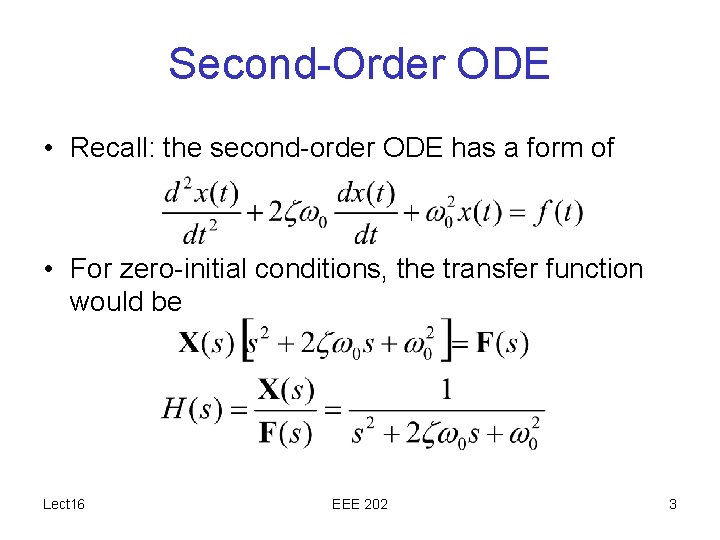
Second-Order ODE • Recall: the second-order ODE has a form of • For zero-initial conditions, the transfer function would be Lect 16 EEE 202 3
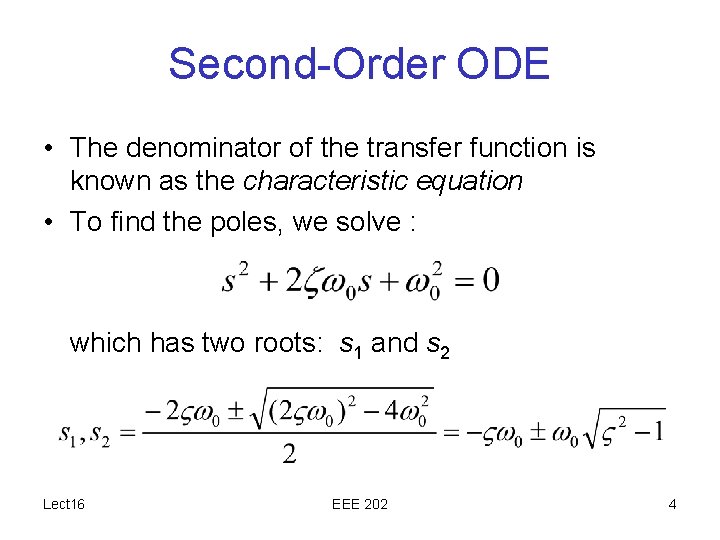
Second-Order ODE • The denominator of the transfer function is known as the characteristic equation • To find the poles, we solve : which has two roots: s 1 and s 2 Lect 16 EEE 202 4
Damping Ratio ( ) and Natural Frequency ( 0) • The damping ratio is ζ • The damping ratio determines what type of solution we will obtain: – Exponentially decreasing ( >1) – Exponentially decreasing sinusoid ( < 1) • The undamped natural frequency is 0 – Determines how fast sinusoids wiggle – Approximately equal to resonance frequency Lect 16 EEE 202 5

Characteristic Equation Roots The roots of the characteristic equation determine whether the complementary (natural) solution wiggles Lect 16 EEE 202 6
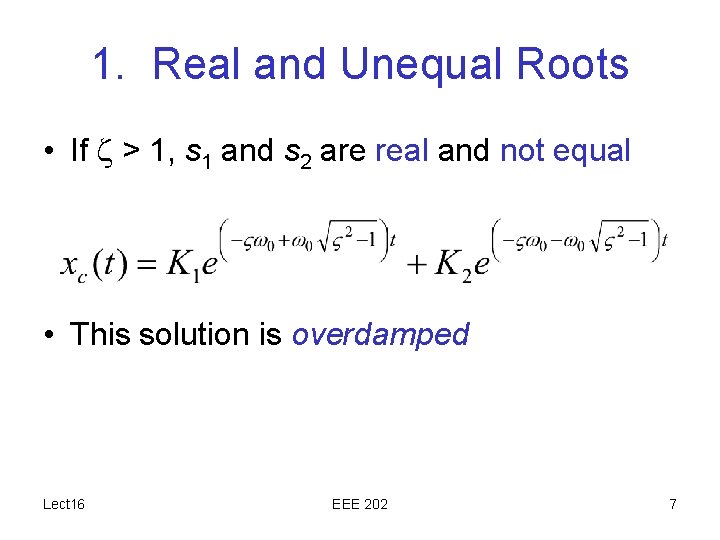
1. Real and Unequal Roots • If > 1, s 1 and s 2 are real and not equal • This solution is overdamped Lect 16 EEE 202 7
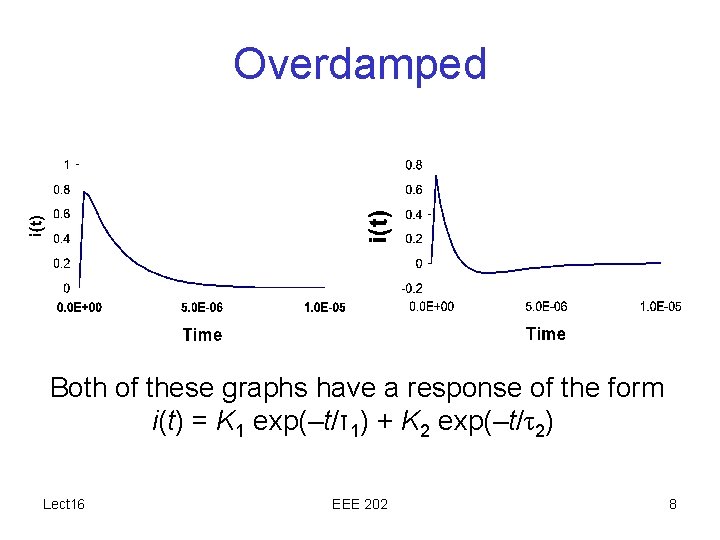
Overdamped Both of these graphs have a response of the form i(t) = K 1 exp(–t/τ1) + K 2 exp(–t/τ2) Lect 16 EEE 202 8
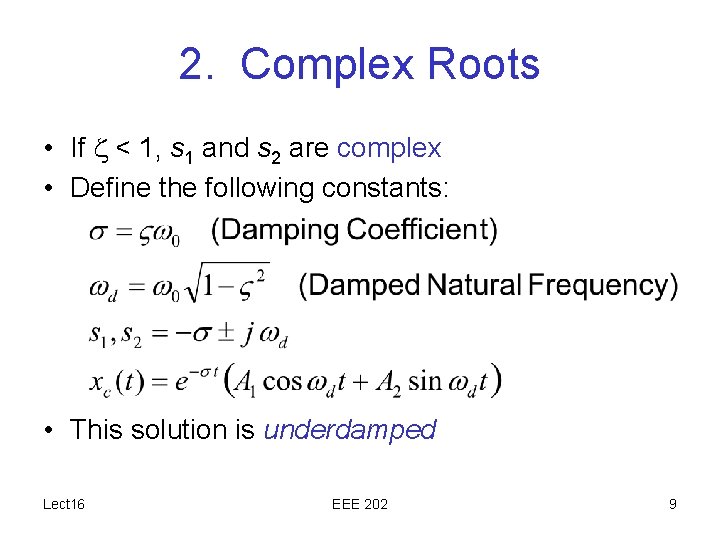
2. Complex Roots • If < 1, s 1 and s 2 are complex • Define the following constants: • This solution is underdamped Lect 16 EEE 202 9
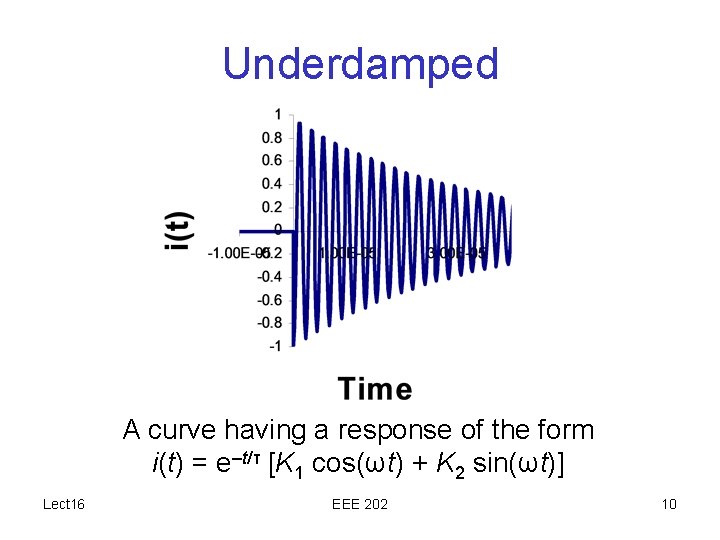
Underdamped A curve having a response of the form i(t) = e–t/τ [K 1 cos(ωt) + K 2 sin(ωt)] Lect 16 EEE 202 10
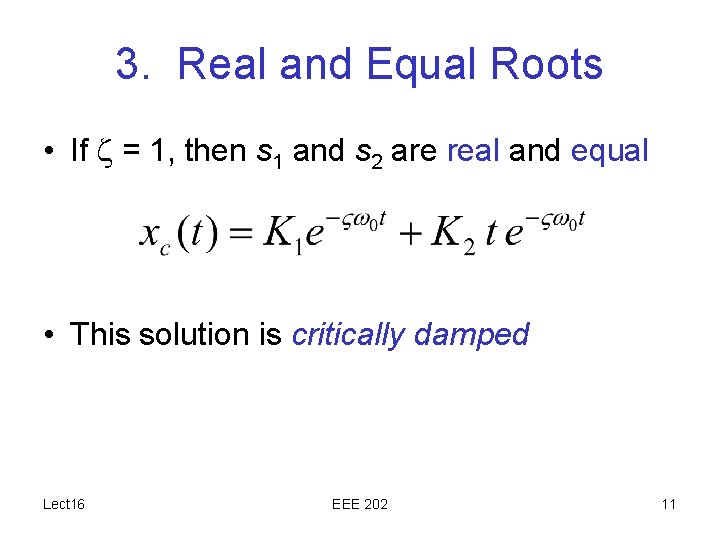
3. Real and Equal Roots • If = 1, then s 1 and s 2 are real and equal • This solution is critically damped Lect 16 EEE 202 11
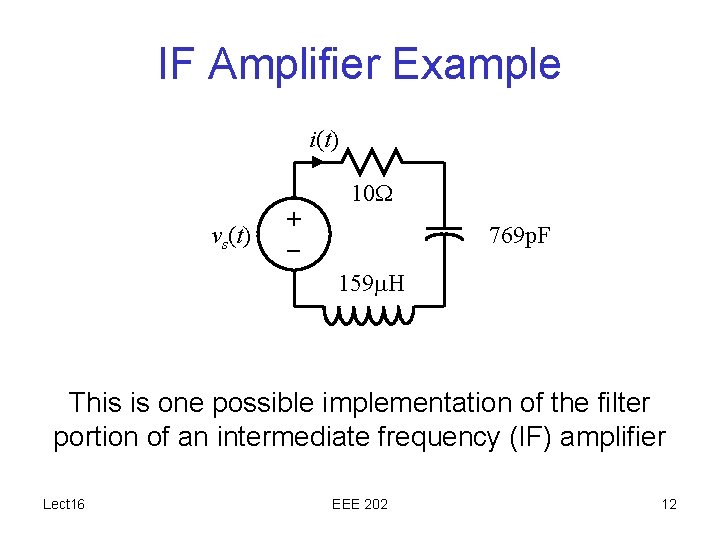
IF Amplifier Example i(t) 10 W vs(t) + – 769 p. F 159 m. H This is one possible implementation of the filter portion of an intermediate frequency (IF) amplifier Lect 16 EEE 202 12
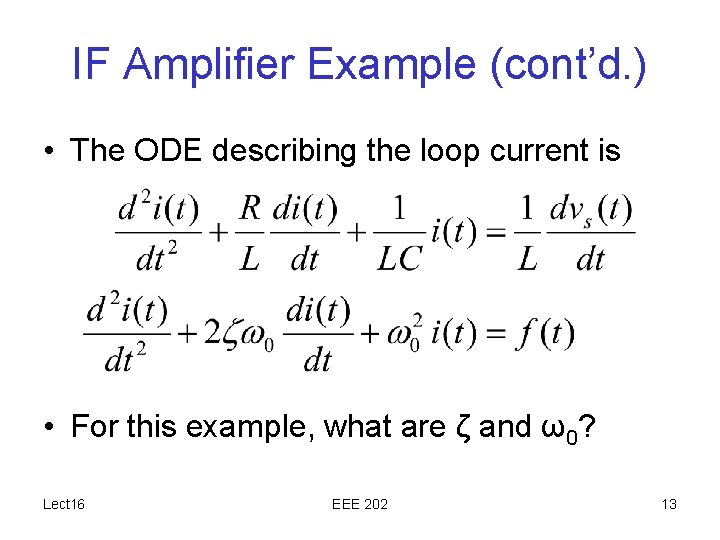
IF Amplifier Example (cont’d. ) • The ODE describing the loop current is • For this example, what are ζ and ω0? Lect 16 EEE 202 13
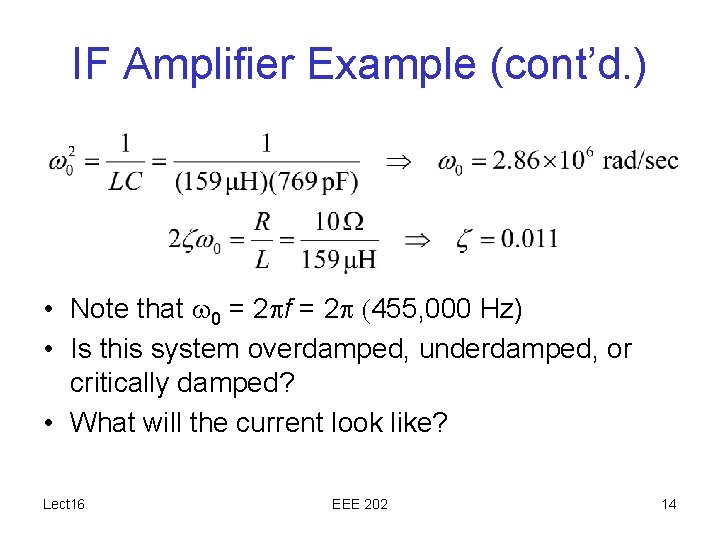
IF Amplifier Example (cont’d. ) • Note that 0 = 2 pf = 2 p (455, 000 Hz) • Is this system overdamped, underdamped, or critically damped? • What will the current look like? Lect 16 EEE 202 14
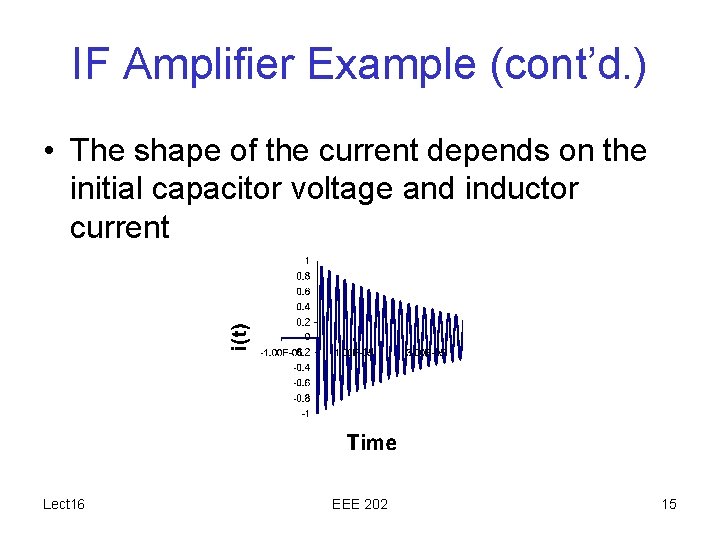
IF Amplifier Example (cont’d. ) • The shape of the current depends on the initial capacitor voltage and inductor current Lect 16 EEE 202 15
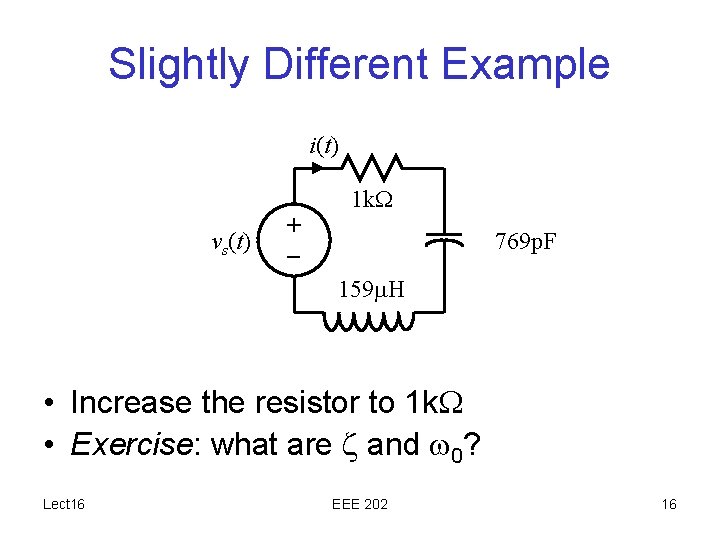
Slightly Different Example i(t) 1 k. W vs(t) + – 769 p. F 159 m. H • Increase the resistor to 1 k. W • Exercise: what are and 0? Lect 16 EEE 202 16
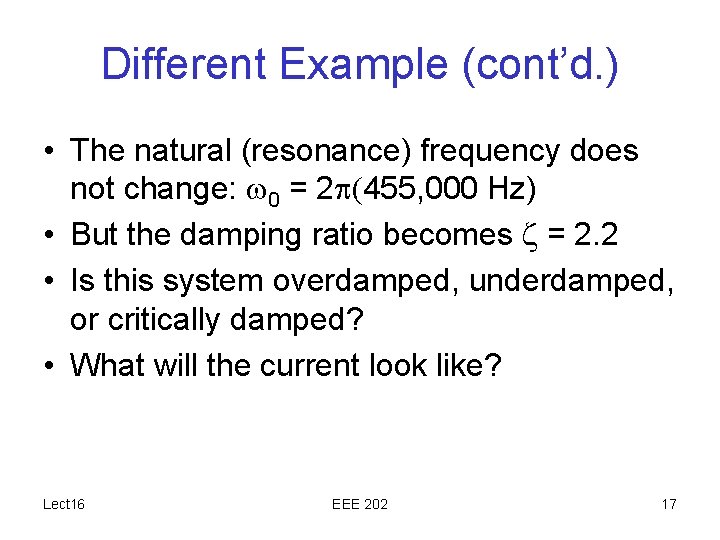
Different Example (cont’d. ) • The natural (resonance) frequency does not change: 0 = 2 p(455, 000 Hz) • But the damping ratio becomes = 2. 2 • Is this system overdamped, underdamped, or critically damped? • What will the current look like? Lect 16 EEE 202 17
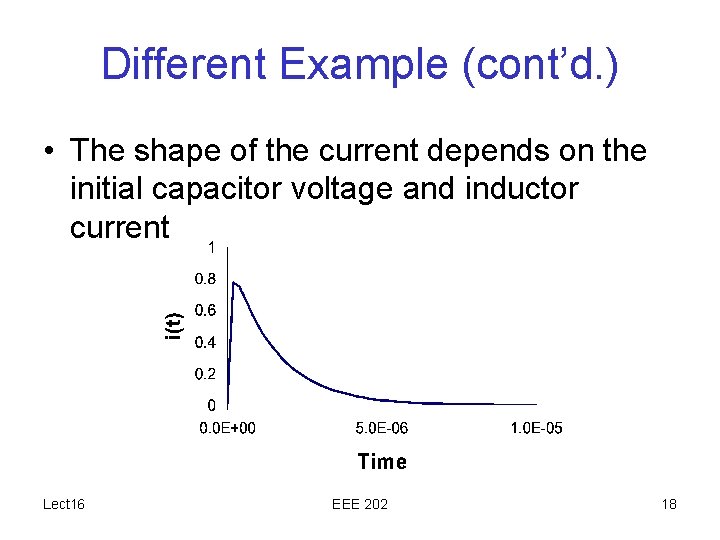
Different Example (cont’d. ) • The shape of the current depends on the initial capacitor voltage and inductor current Lect 16 EEE 202 18
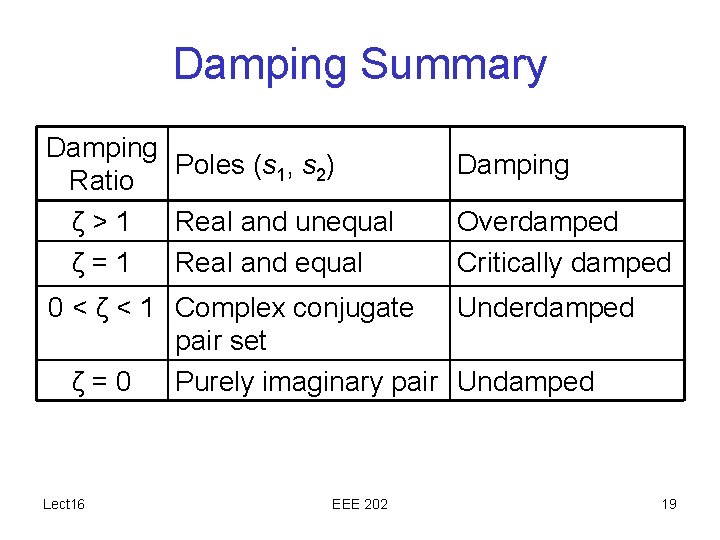
Damping Summary Damping Poles (s 1, s 2) Ratio ζ>1 Real and unequal ζ=1 Real and equal Damping Overdamped Critically damped 0 < ζ < 1 Complex conjugate Underdamped pair set ζ=0 Purely imaginary pair Undamped Lect 16 EEE 202 19
Transient and Steady-State Responses • The steady-state response of a circuit is the waveform after a long time has passed, and depends on the source(s) in the circuit – Constant sources give DC steady-state responses • DC steady-state if response approaches a constant – Sinusoidal sources give AC steady-state responses • AC steady-state if response approaches a sinusoid • The transient response is the circuit response minus the steady-state response Lect 16 EEE 202 20
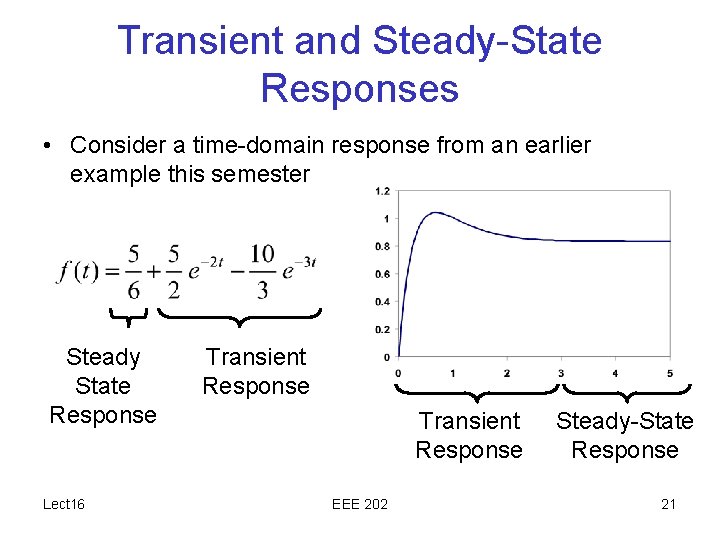
Transient and Steady-State Responses • Consider a time-domain response from an earlier example this semester Steady State Response Lect 16 Transient Response EEE 202 Steady-State Response 21
Class Examples • Drill Problems P 7 -6, P 7 -7, P 7 -8 Lect 16 EEE 202 22
- Slides: 22