
System Programming August 29 2017 Jongmoo Choi Dept
- Slides: 11
System Programming August 29, 2017 Jongmoo Choi Dept. of Software Dankook University choijm@dankook. ac. kr http: //embedded. dankook. ac. kr/~choijm
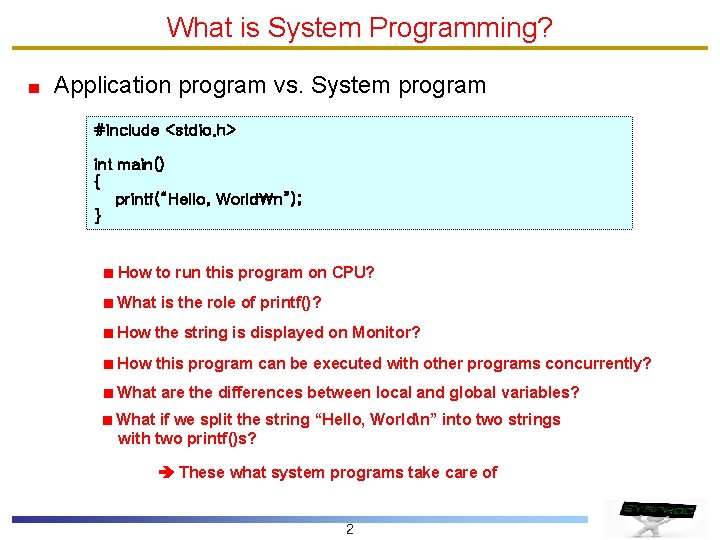
What is System Programming? Application program vs. System program #include <stdio. h> int main() { printf(“Hello, Worldn”); } How to run this program on CPU? What is the role of printf()? How the string is displayed on Monitor? How this program can be executed with other programs concurrently? What are the differences between local and global variables? What if we split the string “Hello, Worldn” into two strings with two printf()s? These what system programs take care of 2
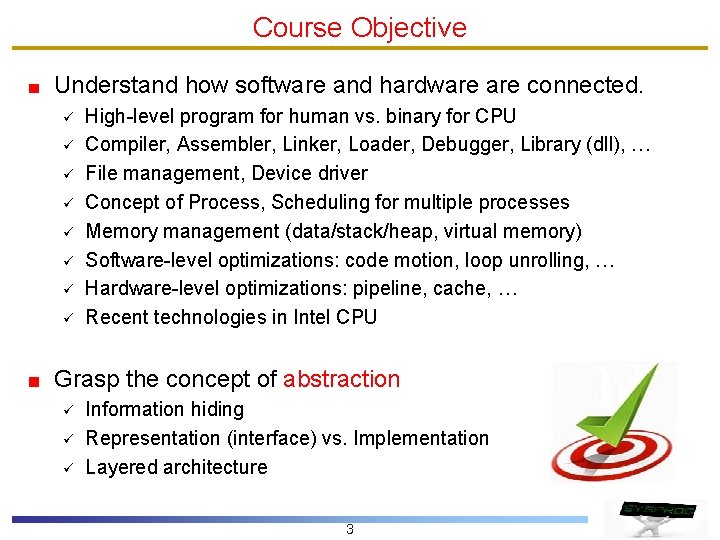
Course Objective Understand how software and hardware connected. ü ü ü ü High-level program for human vs. binary for CPU Compiler, Assembler, Linker, Loader, Debugger, Library (dll), … File management, Device driver Concept of Process, Scheduling for multiple processes Memory management (data/stack/heap, virtual memory) Software-level optimizations: code motion, loop unrolling, … Hardware-level optimizations: pipeline, cache, … Recent technologies in Intel CPU Grasp the concept of abstraction ü ü ü Information hiding Representation (interface) vs. Implementation Layered architecture 3
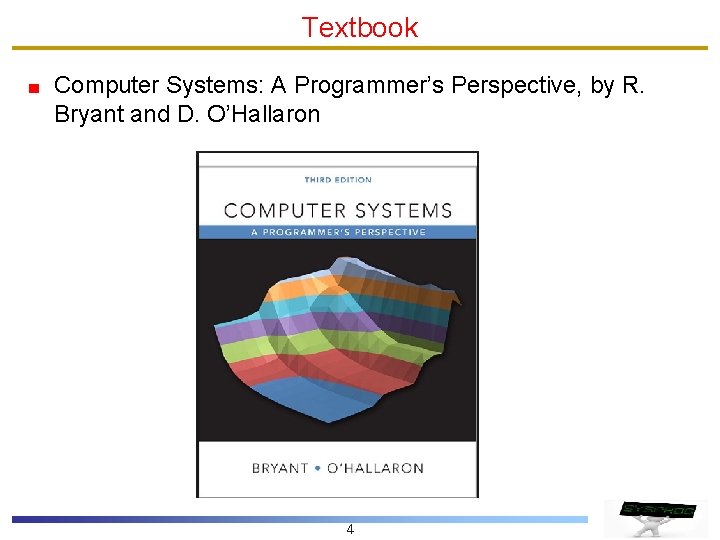
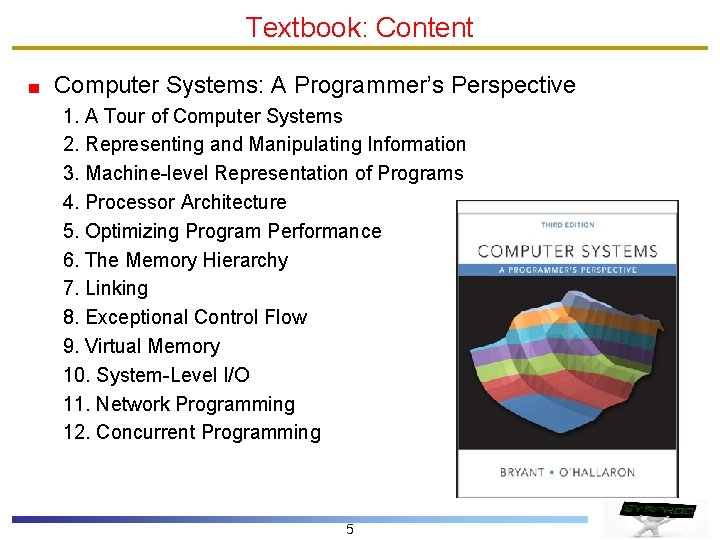
Textbook Computer Systems: A Programmer’s Perspective, by R. Bryant and D. O’Hallaron 4
Textbook: Content Computer Systems: A Programmer’s Perspective 1. A Tour of Computer Systems 2. Representing and Manipulating Information 3. Machine-level Representation of Programs 4. Processor Architecture 5. Optimizing Program Performance 6. The Memory Hierarchy 7. Linking 8. Exceptional Control Flow 9. Virtual Memory 10. System-Level I/O 11. Network Programming 12. Concurrent Programming 5
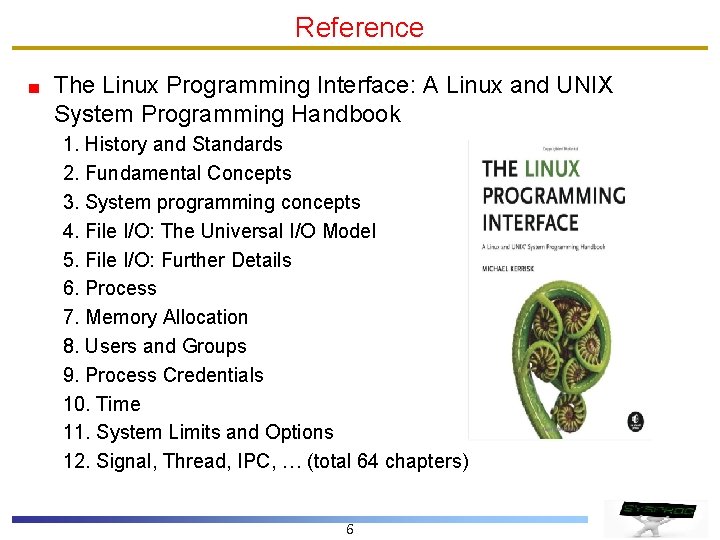
Reference The Linux Programming Interface: A Linux and UNIX System Programming Handbook 1. History and Standards 2. Fundamental Concepts 3. System programming concepts 4. File I/O: The Universal I/O Model 5. File I/O: Further Details 6. Process 7. Memory Allocation 8. Users and Groups 9. Process Credentials 10. Time 11. System Limits and Options 12. Signal, Thread, IPC, … (total 64 chapters) 6
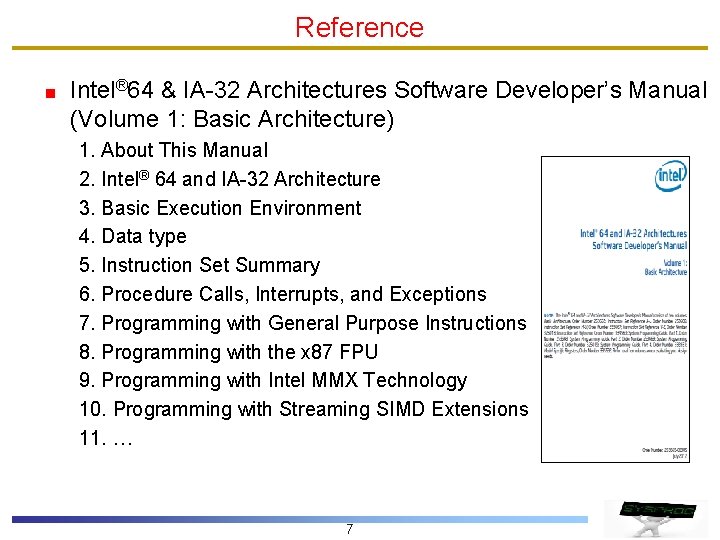
Reference Intel® 64 & IA-32 Architectures Software Developer’s Manual (Volume 1: Basic Architecture) 1. About This Manual 2. Intel® 64 and IA-32 Architecture 3. Basic Execution Environment 4. Data type 5. Instruction Set Summary 6. Procedure Calls, Interrupts, and Exceptions 7. Programming with General Purpose Instructions 8. Programming with the x 87 FPU 9. Programming with Intel MMX Technology 10. Programming with Streaming SIMD Extensions 11. … 7
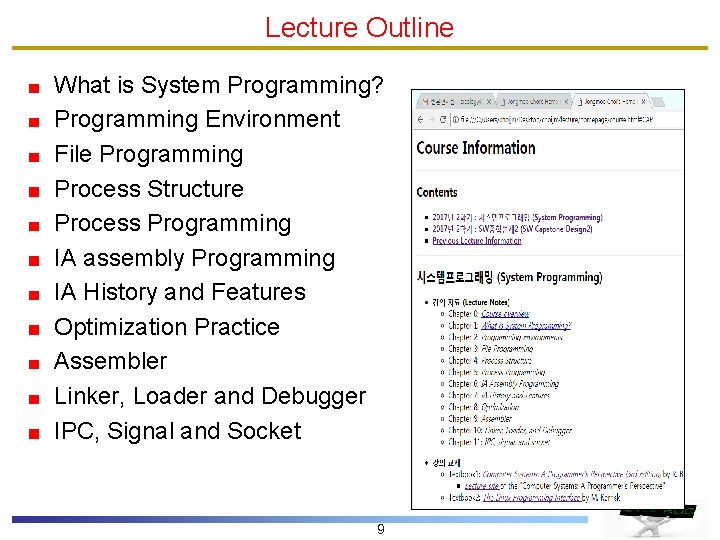
Lecture Outline What is System Programming? Programming Environment File Programming Process Structure Process Programming IA assembly Programming IA History and Features Optimization Practice Assembler Linker, Loader and Debugger IPC, Signal and Socket 9
Assignment ü Programming Project: Personal § Make programs in Linux Environment • • Linux Server: 220. 149. 236. 2 (primary), 220. 149. 236. 4 (secondary) TA: Yongjae Choi, Junho Park (Room 515, Natural Science Bldg) § Program examples (4 or 5) • ü Using vi editor, file I/O, process manipulation, shell, assembly, optimization, … Design Project: Team (2 persons) § Open problem: Choose an item from what you have learned in this course and propose a new idea § Criteria: Creativity and Design methodology • • Creativity: Novelty and Feasibility Design methodology: Requirement analysis(why), Proposal (what), Design and Implementation (how), Test (how), Results (what), Plan (who, when), … 10
Evaluation ü ü Mid exam. (30%) Final exam. (30%) Assignment (30%) Attendance/Q&A (10%) § Q&A is quite important while lecturing ü Notice § Absence more than 5 times or Exam. score below 20 or Do not submit assignments at all F 11