
System Operation Training and System Restoration at Grant
- Slides: 47
System Operation Training and System Restoration at Grant County PUD
Presentation Outline • • • PER-005 Requirements Grant’s Approach to Meeting the Requirements EOP-005 Requirements Grant’s Approach to Building a Simulator Model Use of the Black Start Restoration Model to Verify Grant PUD Restoration Plan • Summary of Grant’s Restoration Plan • Vision of the Future from Grant County PUD’s Perspective
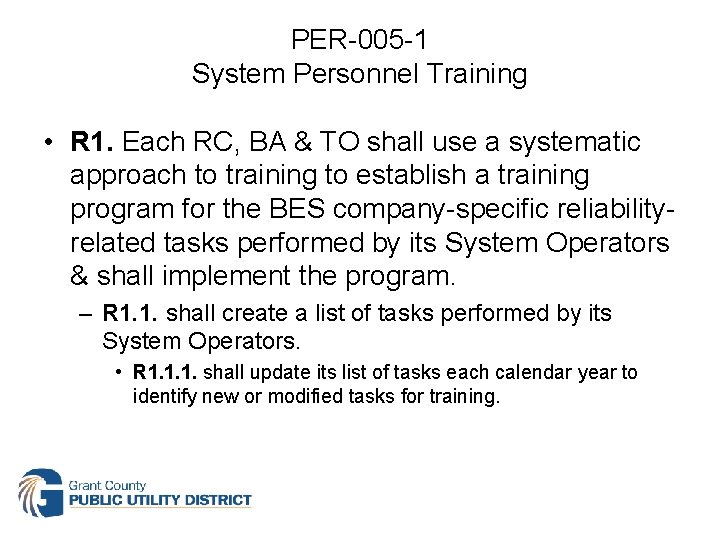
PER-005 -1 System Personnel Training • R 1. Each RC, BA & TO shall use a systematic approach to training to establish a training program for the BES company-specific reliabilityrelated tasks performed by its System Operators & shall implement the program. – R 1. 1. shall create a list of tasks performed by its System Operators. • R 1. 1. 1. shall update its list of tasks each calendar year to identify new or modified tasks for training.
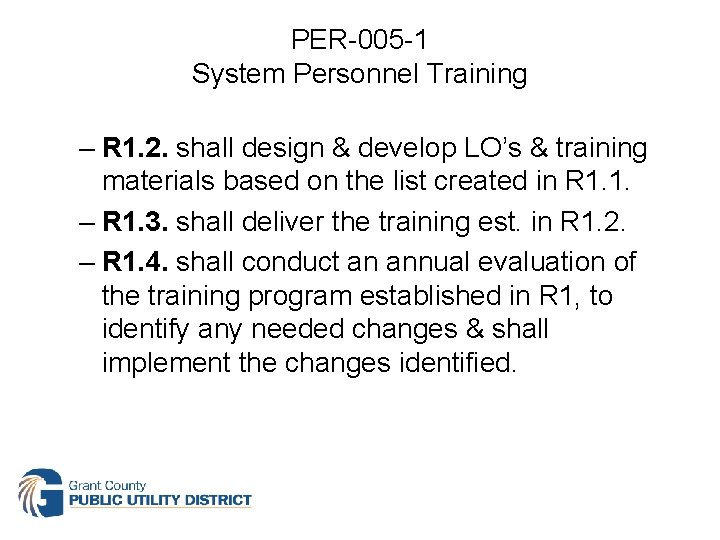
PER-005 -1 System Personnel Training – R 1. 2. shall design & develop LO’s & training materials based on the list created in R 1. 1. – R 1. 3. shall deliver the training est. in R 1. 2. – R 1. 4. shall conduct an annual evaluation of the training program established in R 1, to identify any needed changes & shall implement the changes identified.
PER-005 -1 System Personnel Training • R 2. shall verify each System Operator’s capabilities to perform each assigned task identified in R 1. 1 at least one time. – R 2. 1. Within six months of a modification of a task, shall verify each System Operator’s capability to perform the new/modified tasks.
PER-005 -1 System Personnel Training • R 3. At least every 12 months shall provide at least 32 hours of EOPs training applicable to its organization that reflects emergency operations topics, which includes system restoration using drills, exercises or other training required to maintain qualified personnel.
PER-005 -1 System Personnel Training – R 3. 1. Each RC, BA and TO that has operational authority or control over Facilities with established IROLs or established operating guides or protection systems to mitigate IROLs shall provide each System Operator with EOPs training using simulation technology such as a simulator, virtual technology, or other technology that replicates the operational behavior of the BES during normal and emergency conditions.
PER-005 -1 System Personnel Training • R 1. Each RC, BA & TOP shall use a systematic approach to training to establish a training program for the BES company-specific reliabilityrelated tasks performed by its System Operators and shall implement the program. • What is a “Systematic Approach to Training”?
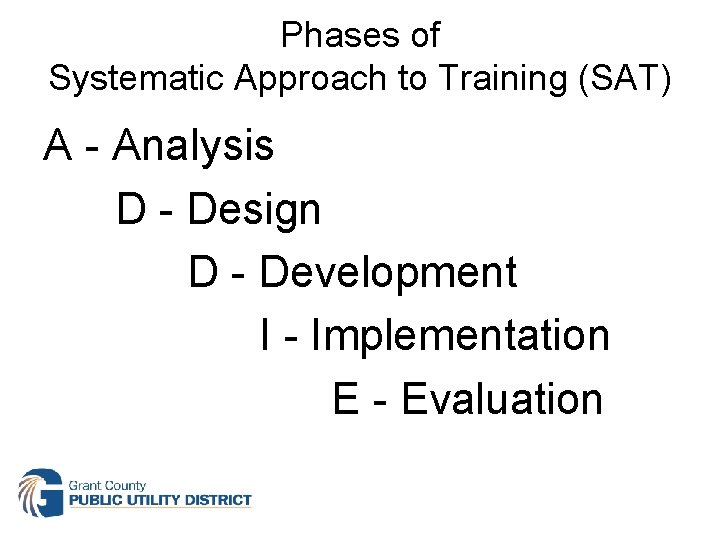
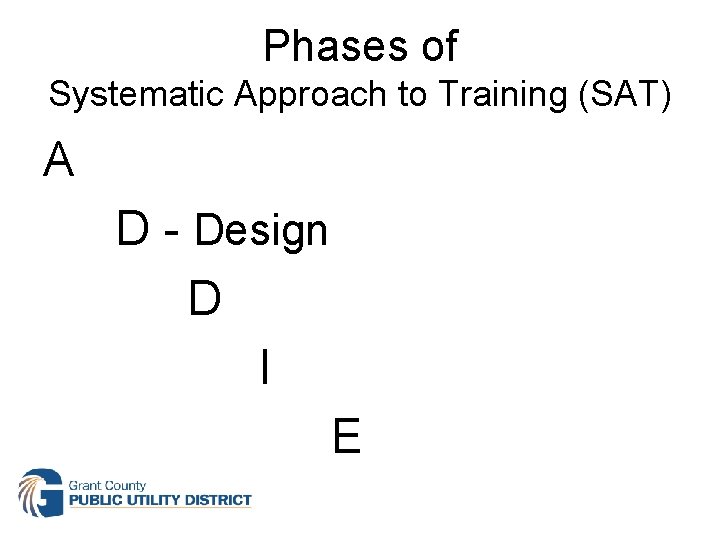
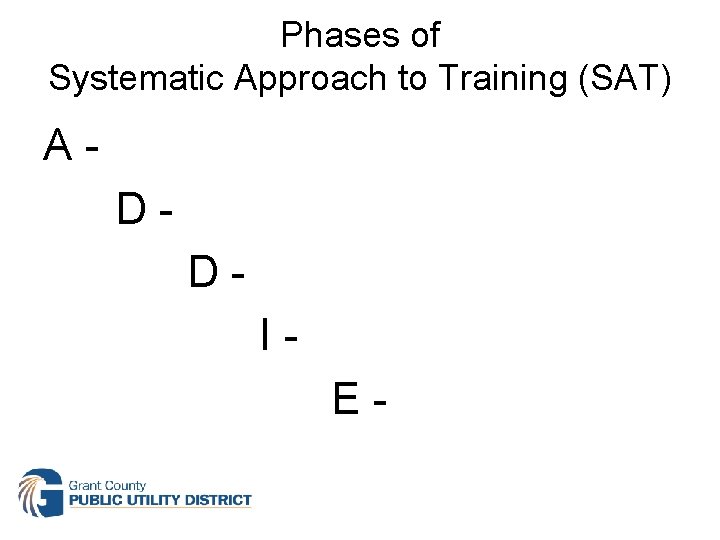
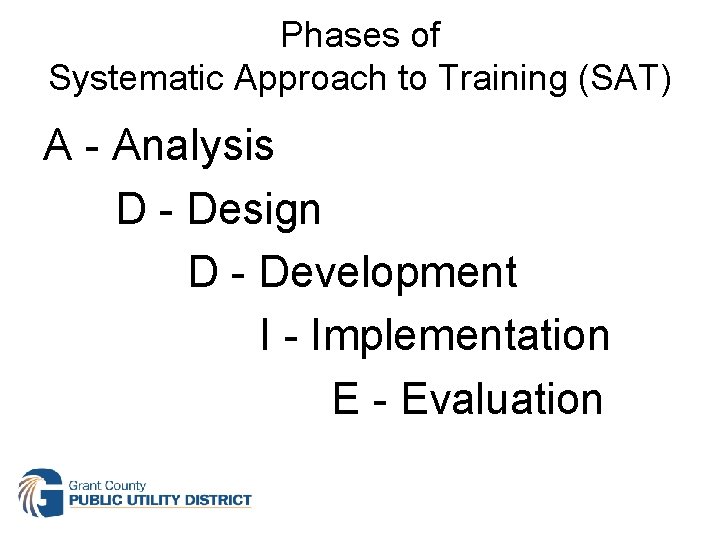
Systematic Approach to Training • The term “Systematic Approach to Training” (or SAT) is being used by NERC to signal that a specific process be used to develop training. • SAT describes a systematic method for establishing and maintaining training programs. • Widely used by the military, DOE and nuclear. • SAT includes five distinct, yet interrelated, phases. These phases include analysis, design, development, implementation, and evaluation.
Phases of Systematic Approach to Training (SAT) A - Analysis D - Design D - Development I - Implementation E - Evaluation
Phases of Systematic Approach to Training (SAT) A - Analysis D D I E
Determine Training Needs • How to identify what training is needed for personnel doing a specific job. • A needs analysis basically looks at events and performance issues to see if training would help prevent recurrence. • A Job/Task analysis looks in detail at duty areas and tasks for a position. • Training mandated by a regulatory requirement is simply included in the training program. You assume the analysis part is already done.
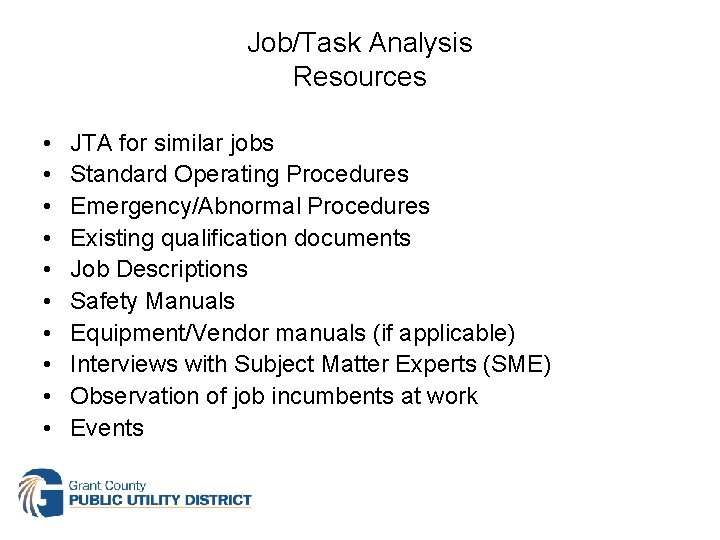
Job/Task Analysis Resources • • • JTA for similar jobs Standard Operating Procedures Emergency/Abnormal Procedures Existing qualification documents Job Descriptions Safety Manuals Equipment/Vendor manuals (if applicable) Interviews with Subject Matter Experts (SME) Observation of job incumbents at work Events
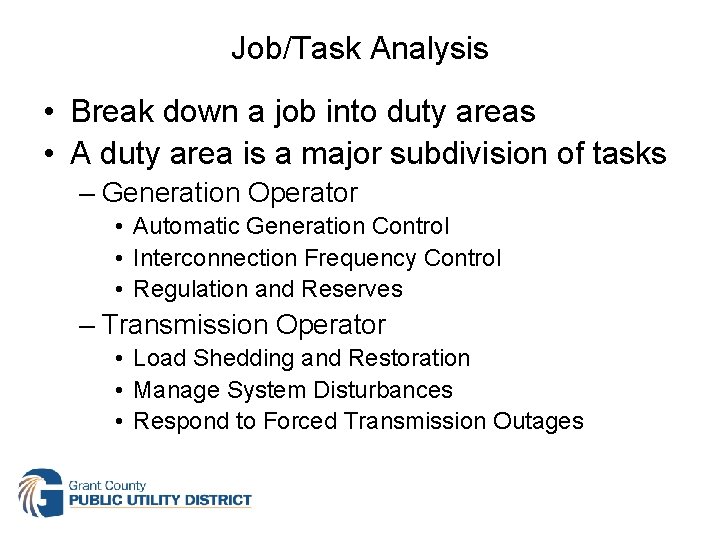
Job/Task Analysis • Break down a job into duty areas • A duty area is a major subdivision of tasks – Generation Operator • Automatic Generation Control • Interconnection Frequency Control • Regulation and Reserves – Transmission Operator • Load Shedding and Restoration • Manage System Disturbances • Respond to Forced Transmission Outages
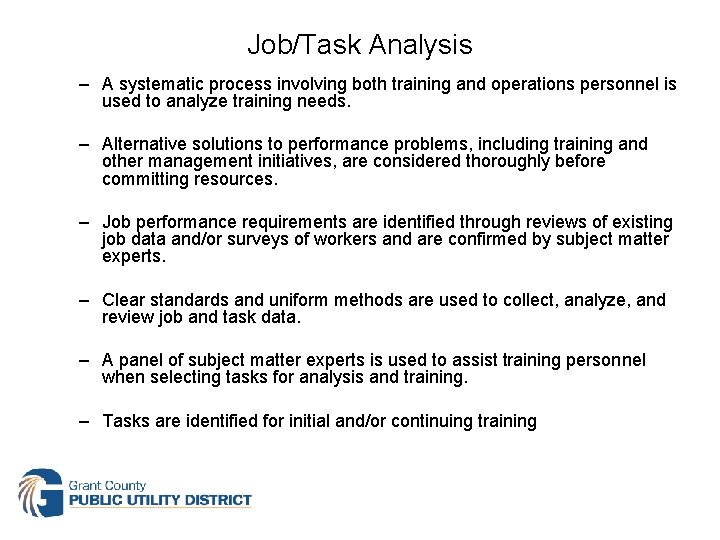
Job/Task Analysis – A systematic process involving both training and operations personnel is used to analyze training needs. – Alternative solutions to performance problems, including training and other management initiatives, are considered thoroughly before committing resources. – Job performance requirements are identified through reviews of existing job data and/or surveys of workers and are confirmed by subject matter experts. – Clear standards and uniform methods are used to collect, analyze, and review job and task data. – A panel of subject matter experts is used to assist training personnel when selecting tasks for analysis and training. – Tasks are identified for initial and/or continuing training
Phases of Systematic Approach to Training (SAT) A D - Design D I E
Design • Learning Objectives – The Learning Objectives come from the skills and knowledge identified in the Task Analysis • • • Length of class Location of class Delivery method Skill levels of trainees (are they the same? ) How will the trainee’s learning be assessed? – Use of a written exam, a practical exercise or ?
Design • If a check list is used to document the outcome, the following methods are acceptable. – On the Job Training (OJT) – Simulation – Classroom – Field Visit
Learning Objectives • Statements that specify what the trainee will – Be able to do – Be able to demonstrate • Should be – – • Use common action words – – – • Attainable Specific Clear Measurable List Perform Verify Evaluate Diagnose and respond Have a standard – Restore system conditions before automatic protection actuates.
Phases of Systematic Approach to Training (SAT) A D D - Development I E
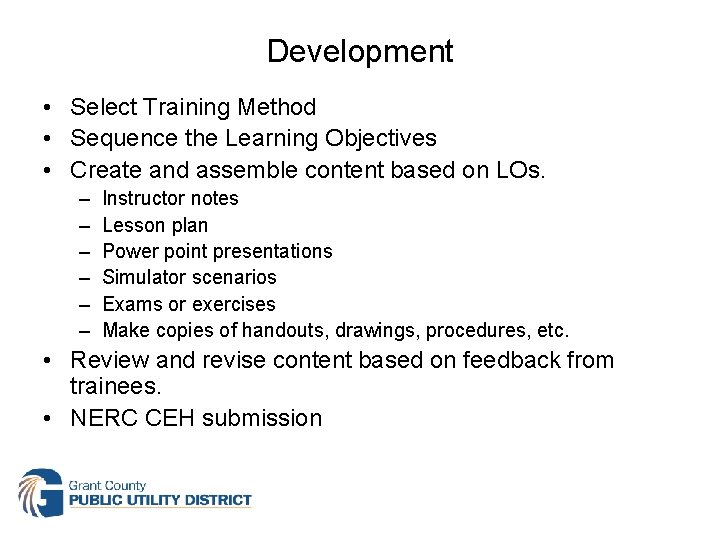
Development • Select Training Method • Sequence the Learning Objectives • Create and assemble content based on LOs. – – – Instructor notes Lesson plan Power point presentations Simulator scenarios Exams or exercises Make copies of handouts, drawings, procedures, etc. • Review and revise content based on feedback from trainees. • NERC CEH submission
Phases of Systematic Approach to Training (SAT) A D D I - Implementation E
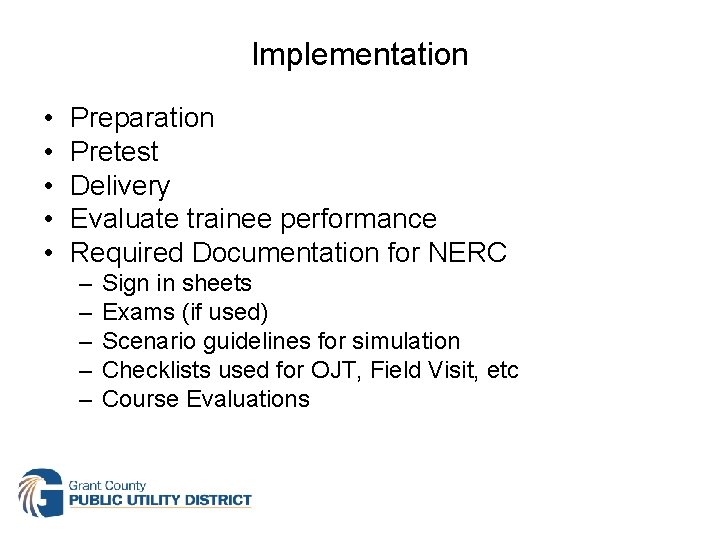
Implementation • • • Preparation Pretest Delivery Evaluate trainee performance Required Documentation for NERC – – – Sign in sheets Exams (if used) Scenario guidelines for simulation Checklists used for OJT, Field Visit, etc Course Evaluations
Phases of Systematic Approach to Training (SAT) A D D I E - Evaluation
Evaluation • Evaluation of the Training Program itself • Includes: – Review of events for training implications (not just inhouse events) – Trainee feedback received after training – Supervisor feedback – Review of procedure changes – Review of changes to equipment or tools – Review of changes in Regulatory Requirements
Phases of Systematic Approach to Training (SAT) ADDIE-
Phases of Systematic Approach to Training (SAT) A - Analysis D - Design D - Development I - Implementation E - Evaluation
PER-005 -1 System Personnel Training • R 2. shall verify each System Operator’s capabilities to perform each assigned task identified in R 1. 1 at least one time. – R 2. 1. Within six months of a modification of a task, shall verify each System Operator’s capability to perform the new/modified tasks.
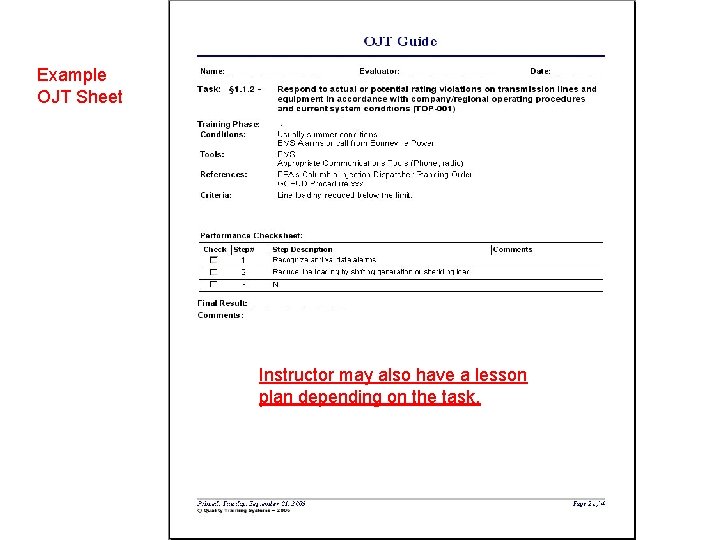
PER-005 -1 System Personnel Training • Use an OJT checklist. • OJT check list comes directly from the task list developed for R 1. 1 • System Operators to become qualified as OJT instructors. • Chief Dispatcher interview to validate the OJT. • Make sure changes are reviewed for impact on task list.
Example OJT Sheet Instructor may also have a lesson plan depending on the task.
PER-005 -1 System Personnel Training • R 3. At least every 12 months shall provide at least 32 hours of EOPs training applicable to its organization that reflects emergency operations topics, which includes system restoration using drills, exercises or other training required to maintain qualified personnel. • Essentially the same as current requirement in PER-002. Except “ 5 days” has been changed to 32 hours to reflect reality.
PER-005 -1 System Personnel Training – R 3. 1. Each RC, BA and TO that has operational authority or control over Facilities with established IROLs or established operating guides or protection systems to mitigate IROLs shall provide each System Operator with EOPs training using simulation technology such as a simulator, virtual technology, or other technology that replicates the operational behavior of the BES during normal and emergency conditions. • Currently the District does not have any N-1 conditions identified as an IROL. • We do have a simulator (AREVA DTS) use of which is manpower intensive. • Also have the “Brick” but it’s not ready for this sort of simulation.
NERC Standard EOP-005 -1 System Restoration Plans • R 1. Each TOP shall have a restoration plan to reestablish its system in event of a partial or total shutdown. • R 2. Each TOP shall review and update its plan at least annually and when changes are made in the power system, and correct deficiencies found during exercises. • R 3. Each TOP shall develop restoration plans with a priority of restoring the integrity of the Interconnection.
NERC Standard EOP-005 -1 System Restoration Plans • R 4. Each BA/TOP shall coordinate its restoration plans with Generators & other BA/TOP’s in its area and its RC. • R 11. 1 Following a disturbance each BA/TOP shall work in conjunction with it’s RC to determine the extent and condition of the isolated area (s).
NERC Standard EOP-005 -1 System Restoration Plans • R 11. 2. Affected BA/TOP’s shall take the necessary actions to restore Bulk Electric System frequency to normal, including adjusting generation, placing additional generators on line, or load shedding. • R 11. 3. Affected BA’s, working with their RC’s, shall immediately review Interchange Schedules between BA Areas or fragments within the separated area and make adjustments as needed to facilitate restoration. – The affected Balancing Authorities shall make all attempts to maintain the adjusted Interchange Schedules, whether generation control is manual or automatic. • R 11. 4. Affected TOP’s shall give high priority to restoration of offsite power to nuclear stations.
NERC Standard EOP-005 -1 System Restoration Plans • R 11. 5. Affected TOP’s may resynchronize isolated area(s) with surrounding area(s) when the following conditions are met: – R 11. 5. 1. Voltage, frequency, and phase angle permit. – R 11. 5. 2. Size of the area being reconnected and capacity of transmission lines effecting the reconnection and number of synchronizing points across the system are considered. – R 11. 5. 3. RC and adjacent areas are notified and RC approval is given. – R 11. 5. 4. Load is shed in neighboring areas, if required, to permit successful interconnected system restoration.
NERC Standard EOP-005 -1 System Restoration Plans Attachment 1 – Elements for Consideration in Development of Restoration Plans • 3. The plan must account for the possibility that restoration cannot be completed as expected. • 8. The functions to be coordinated with RC and neighboring TOP’s. • 9. Notification shall be made to other operating entities as the steps of the restoration plan are implemented.
NERC Standard EOP-006 -1 Reliability Coordination – System Restoration • Purpose: The RC must have a coordinating role in system restoration. • Requirements: – R 1. Must be aware of each BA/TOP’s restoration plan. – R 2. Monitor progress of restoration and coordinate any needed assistance. – R 3. Shall have a Reliability Coordinator Area restoration plan – R 4. Is the primary contact for disseminating information regarding restoration – R 5. Coordinate and approve resynchronizing major islands. – R 6. Restore normal operations once the emergency has been mitigated.
Building the Grant System Restoration Model • Tried to use our Areva Operating System Model (EMS) • Switched to using our GE Power Flow model • Under Estimated the number of substations needed to use the model successfully • Interactive process with Incremental Systems technical people.
Testing the Grant System Restoration Plan (EOP-005 -1 R 7) • Assembled team of Subject Matter Experts Ø System Operations Manager, Training Coordinator, T&D Engineer(modeling person) and Senior System Operator • Used our Written Restoration Procedure Ø Found voltage issues with the path used in our original plan Ø Found manpower issues at Wanapum in our original plan • Set the Original plan aside and tried other ways to solve the voltage and manpower issues • Revised and resubmitted our Restoration Plan
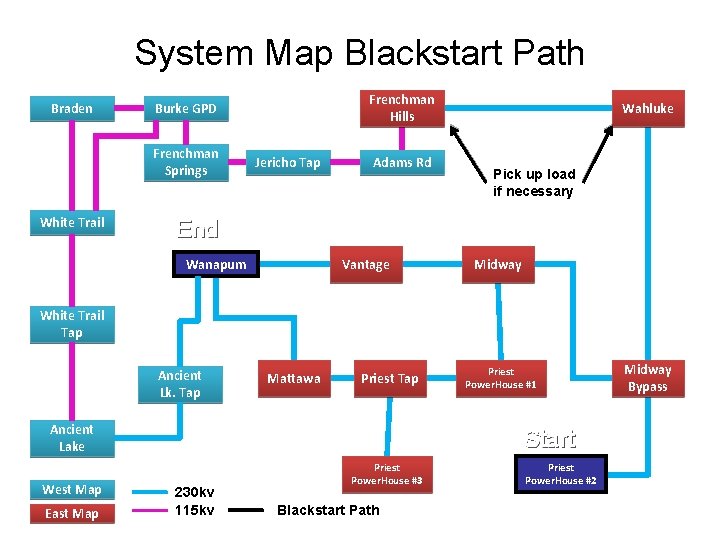
Basic Concepts of the Grant County PUD System Restoration Plan • Get Wanapum and Priest Rapids tied together as soon as possible • Pick up just enough load to stabilize voltage while working to connect Priest Rapids and Wanapum • Length of outage and time of year determine how much incremental feeder load to add in each step. • After Wanapum and Priest Rapids are tied together begin restoring the rest of the county • Be flexible to accommodate some elements not being useable and to allow for re-connection with BPA at any time during the process
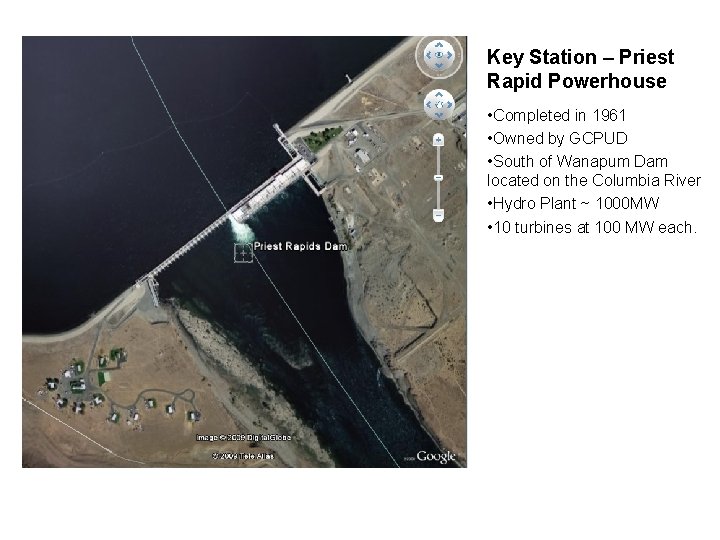
Key Station – Priest Rapid Powerhouse • Completed in 1961 • Owned by GCPUD • South of Wanapum Dam located on the Columbia River • Hydro Plant ~ 1000 MW • 10 turbines at 100 MW each. 2009 Copyright Incremental Systems Corporation
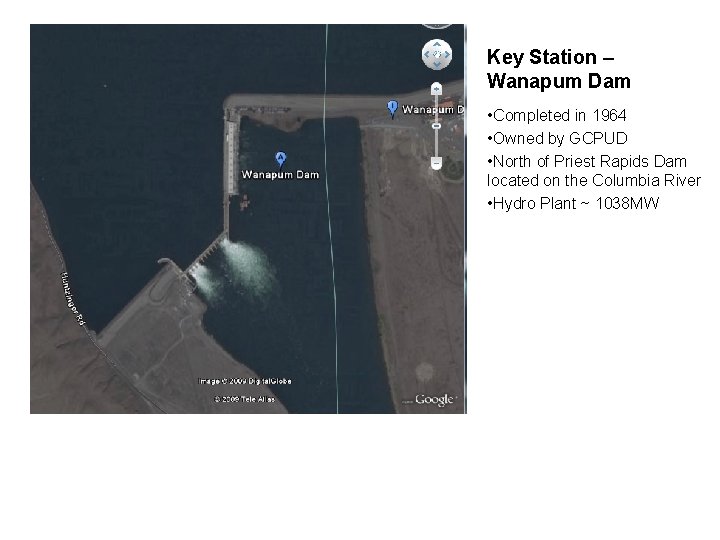
Key Station – Wanapum Dam • Completed in 1964 • Owned by GCPUD • North of Priest Rapids Dam located on the Columbia River • Hydro Plant ~ 1038 MW 2009 Copyright Incremental Systems Corporation
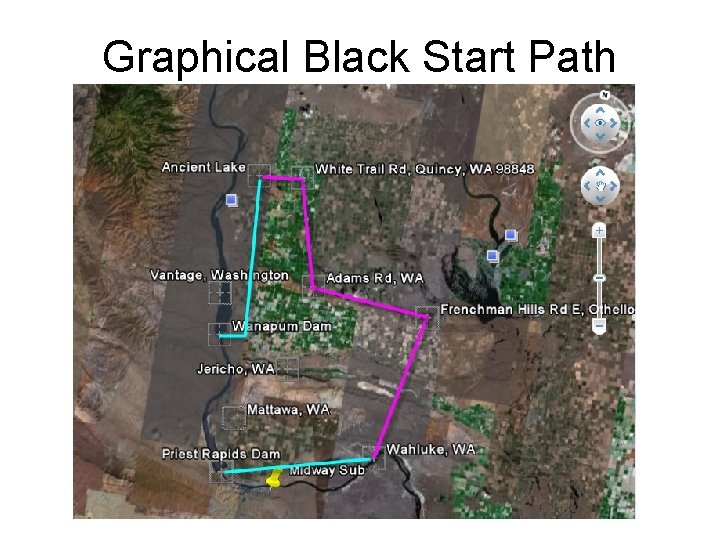
Graphical Black Start Path 2009 Copyright Incremental Systems Corporation
System Map Blackstart Path Braden Frenchman Springs White Trail Frenchman Hills Burke GPD Jericho Tap Adams Rd Wahluke Pick up load if necessary End Wanapum Vantage Midway White Trail Tap Ancient Lk. Tap Mattawa Priest Tap Ancient Lake West Map East Map Priest Power. House #1 Start 230 kv 115 kv Priest Power. House #3 Blackstart Path 2009 Copyright Incremental Systems Corporation Priest Power. House #2 Midway Bypass
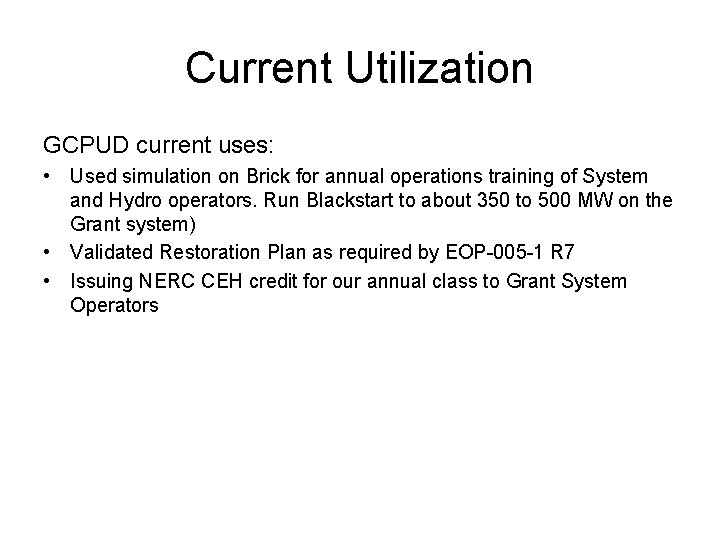
Current Utilization GCPUD current uses: • Used simulation on Brick for annual operations training of System and Hydro operators. Run Blackstart to about 350 to 500 MW on the Grant system) • Validated Restoration Plan as required by EOP-005 -1 R 7 • Issuing NERC CEH credit for our annual class to Grant System Operators 2009 Copyright Incremental Systems Corporation
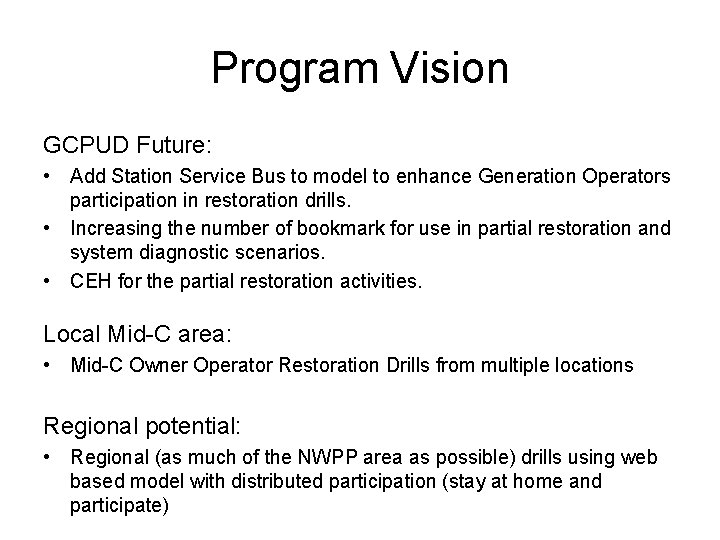
Program Vision GCPUD Future: • Add Station Service Bus to model to enhance Generation Operators participation in restoration drills. • Increasing the number of bookmark for use in partial restoration and system diagnostic scenarios. • CEH for the partial restoration activities. Local Mid-C area: • Mid-C Owner Operator Restoration Drills from multiple locations Regional potential: • Regional (as much of the NWPP area as possible) drills using web based model with distributed participation (stay at home and participate) 2009 Copyright Incremental Systems Corporation