
System of Linear Equations Nattee Niparnan LINEAR EQUATIONS

- Slides: 57
System of Linear Equations Nattee Niparnan
LINEAR EQUATIONS
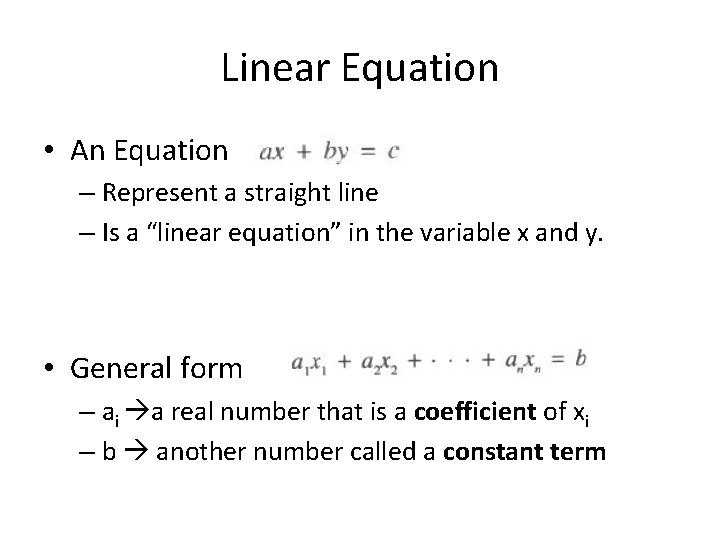
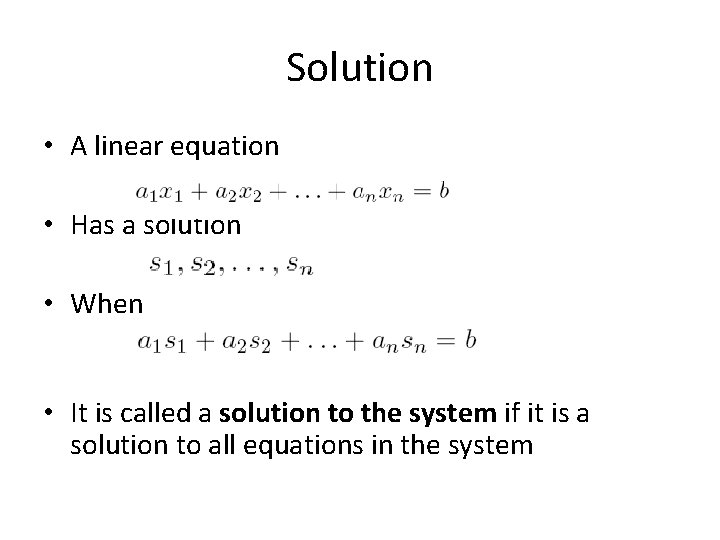
Linear Equation • An Equation – Represent a straight line – Is a “linear equation” in the variable x and y. • General form – ai a real number that is a coefficient of xi – b another number called a constant term
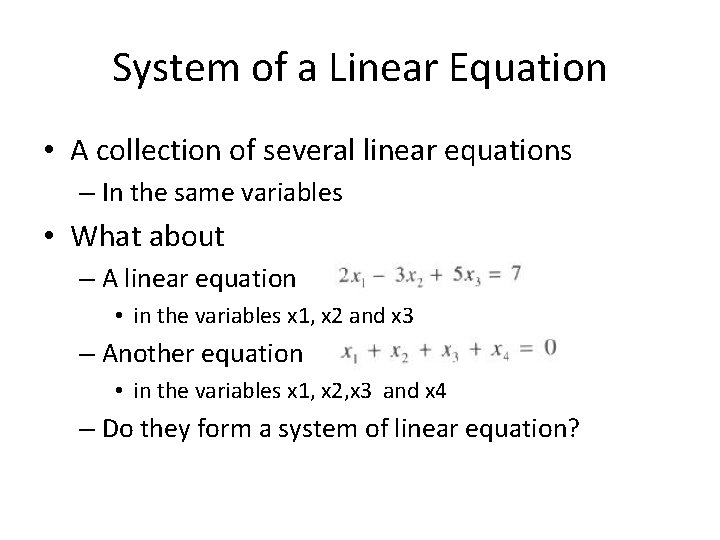
System of a Linear Equation • A collection of several linear equations – In the same variables • What about – A linear equation • in the variables x 1, x 2 and x 3 – Another equation • in the variables x 1, x 2, x 3 and x 4 – Do they form a system of linear equation?
Solution • A linear equation • Has a solution • When • It is called a solution to the system if it is a solution to all equations in the system
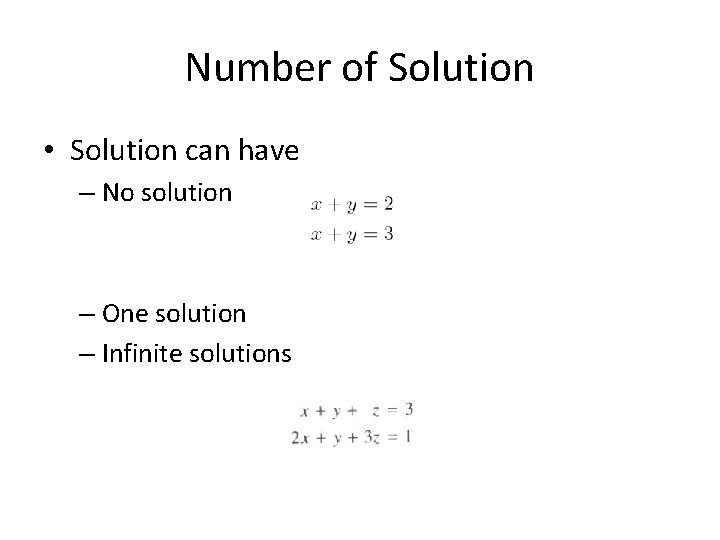
Number of Solution • Solution can have – No solution – One solution – Infinite solutions
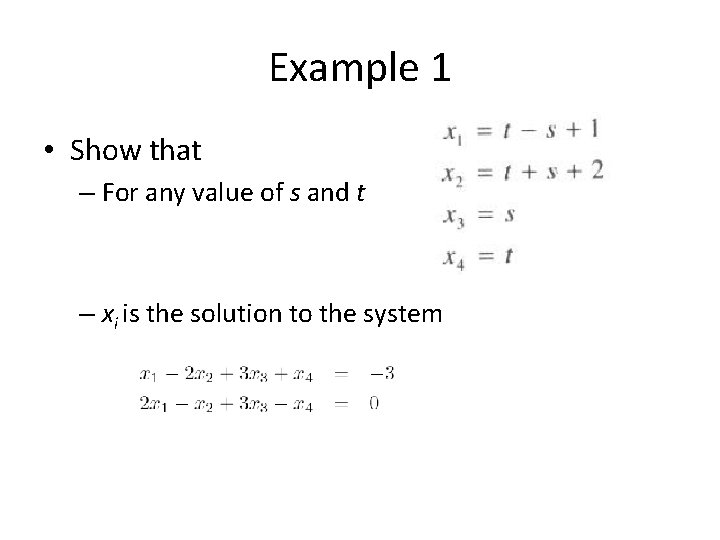
Example 1 • Show that – For any value of s and t – xi is the solution to the system
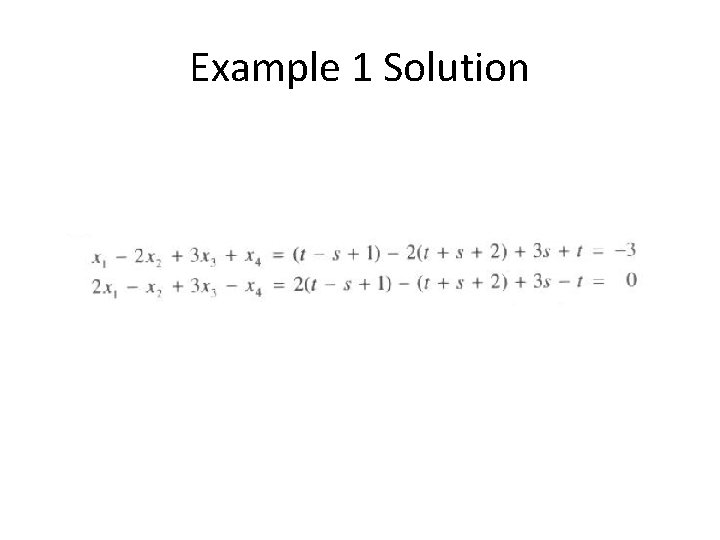
Example 1 Solution
Parametric Form • Solution of the system in Equation 1 is described in a – It is given as a function in – It is called a s and t of the system • Every linear equation system having solutions – Can be written in parametric form
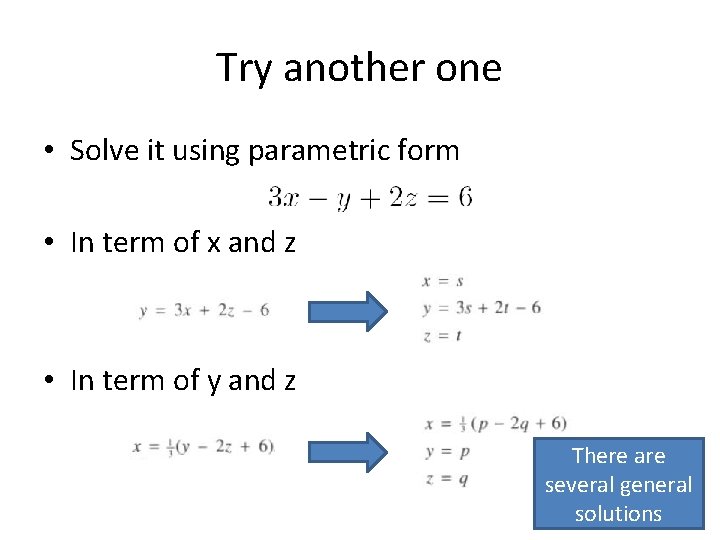
Try another one • Solve it using parametric form • In term of x and z • In term of y and z There are several general solutions
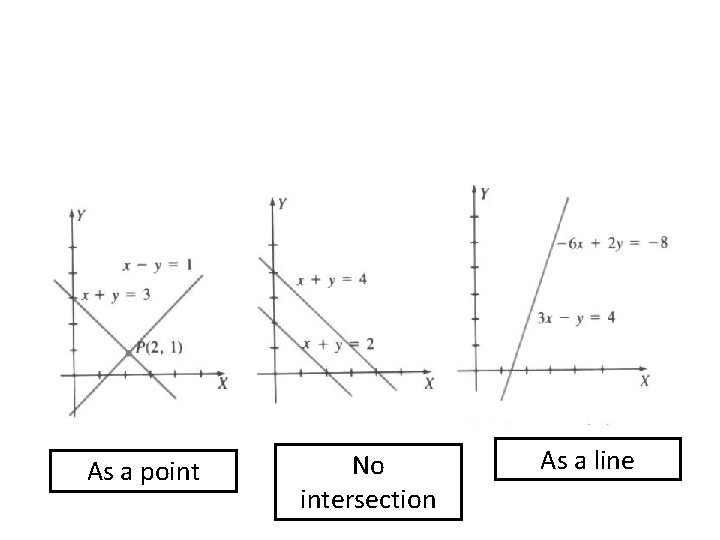
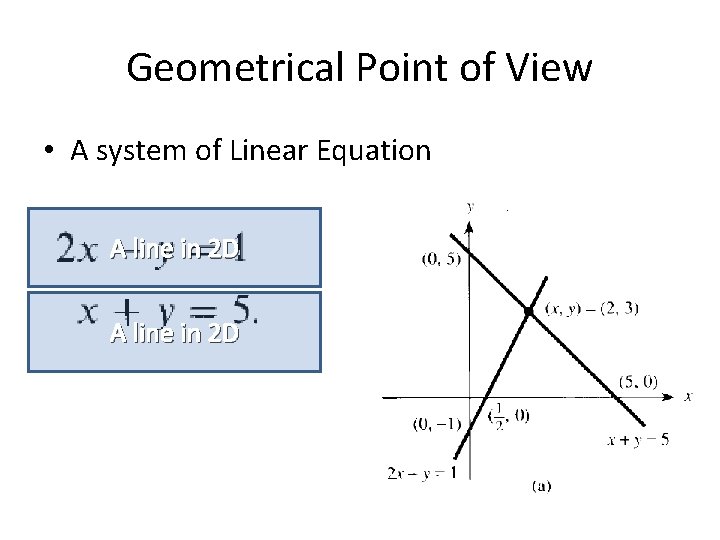
Geometrical Point of View • In the case of 2 variables – Each equation is represent a line in 2 D – Every point in the line satisfies the equation • If we have 2 equations – 3 possibilities • Intersect in a point • Intersect as a line • Parallel but not intersect
As a point No intersection As a line
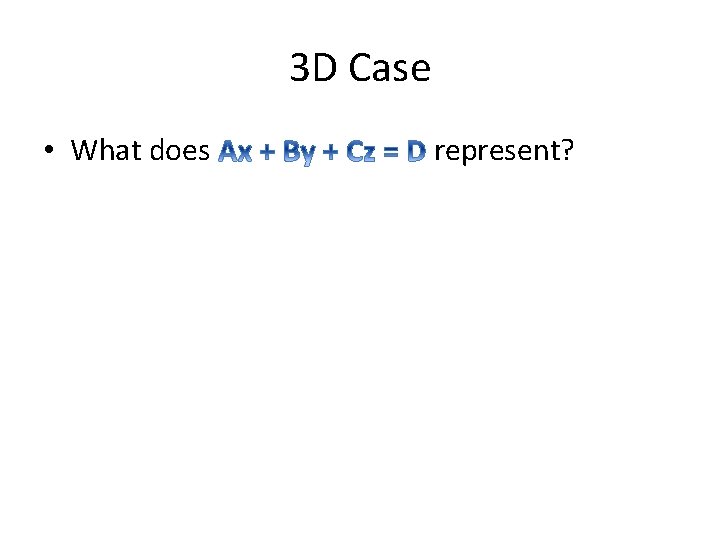
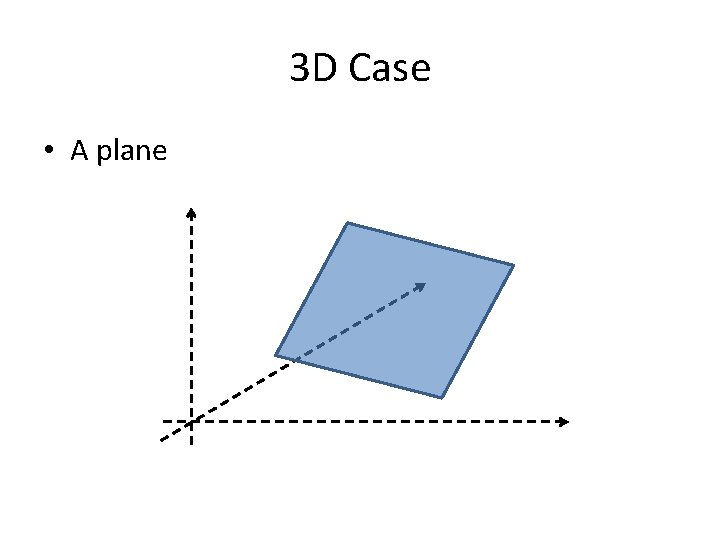
3 D Case • What does represent?
3 D Case • A plane
Higher Space? • Somewhat difficult to imagine – But Linear Algebra will, at least, provides some characteristic for us Cogito, ergo sum I also speak Calculus
MANIPULATING THE SYSTEM
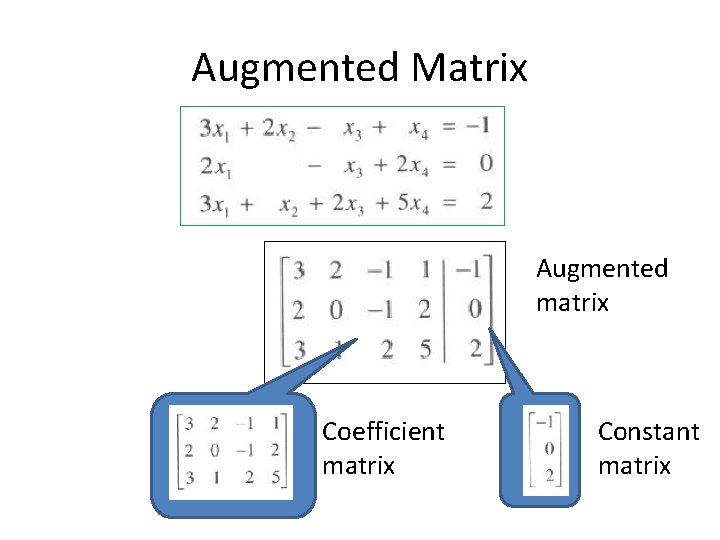
Augmented Matrix Augmented matrix Coefficient matrix Constant matrix
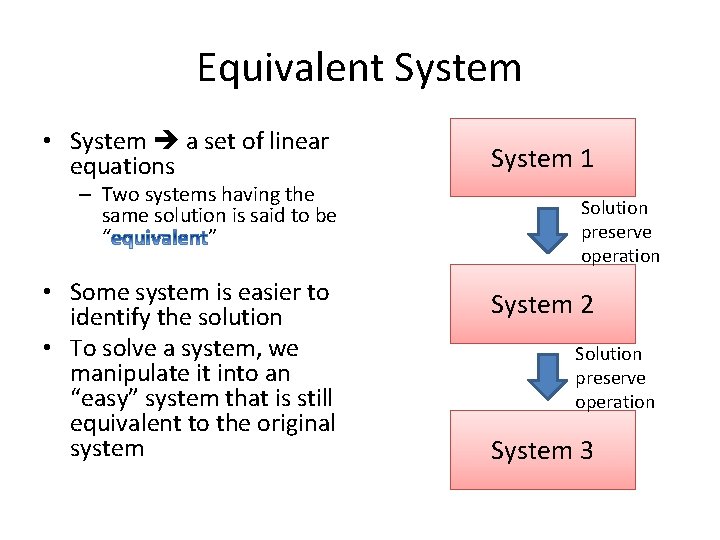
Equivalent System • System a set of linear equations – Two systems having the same solution is said to be “ ” • Some system is easier to identify the solution • To solve a system, we manipulate it into an “easy” system that is still equivalent to the original system System 1 Solution preserve operation System 2 Solution preserve operation System 3
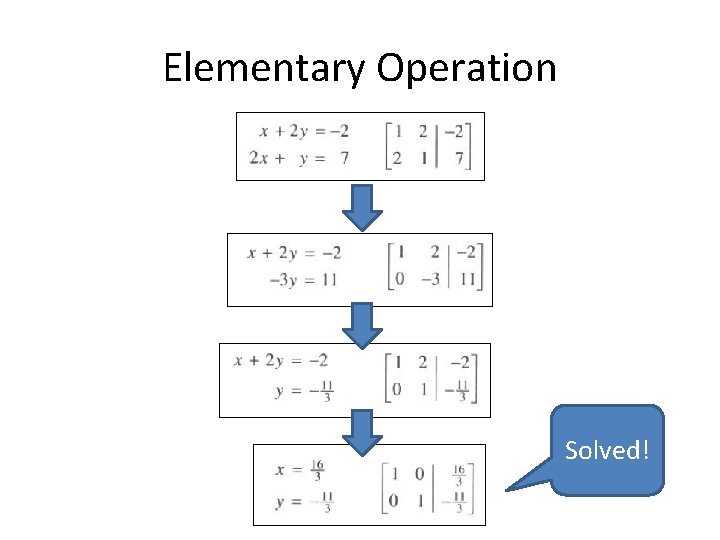
Elementary Operation Solved!
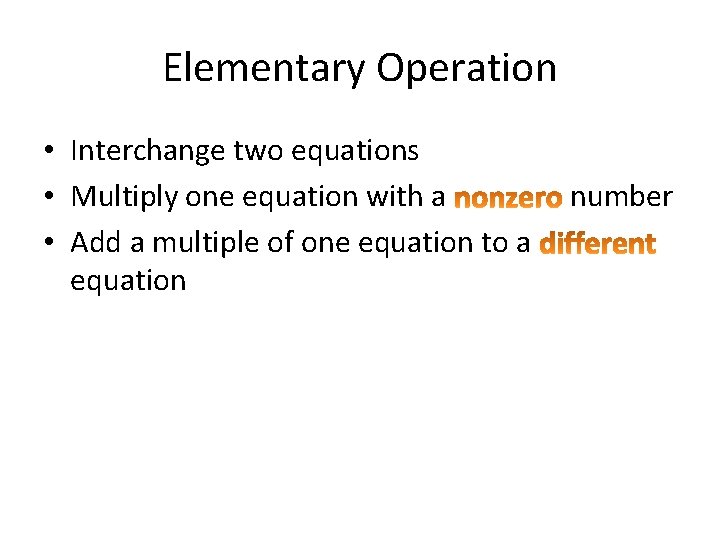
Elementary Operation • Interchange two equations • Multiply one equation with a • Add a multiple of one equation to a equation number
Theorem 1 • Suppose that an elementary operation is performed on a linear equation system – Then, there solution are still the same
Proof
Elementary Row Operation • We don’t really do the elementary operation • We write the system as an augmented matrix and then perform “ ” on that matrix
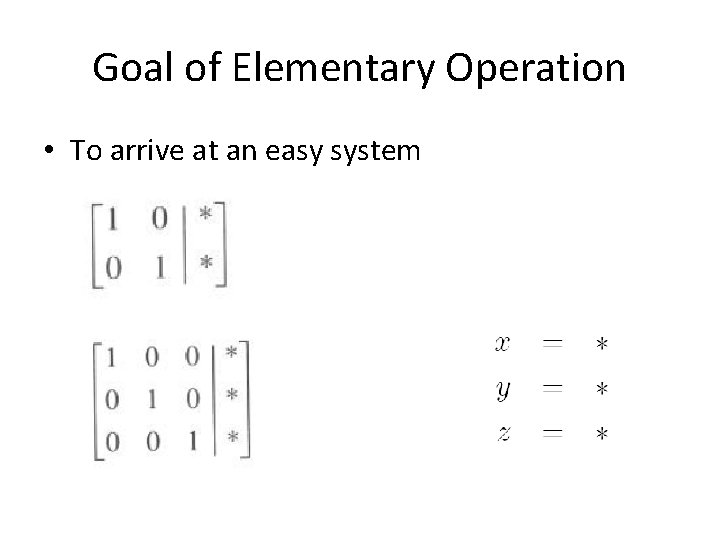
Goal of Elementary Operation • To arrive at an easy system
GAUSSIAN ELIMINATION
Gaussian Elimination • An algorithm that manipulate an augmented matrix into a “nice” augmented matrix
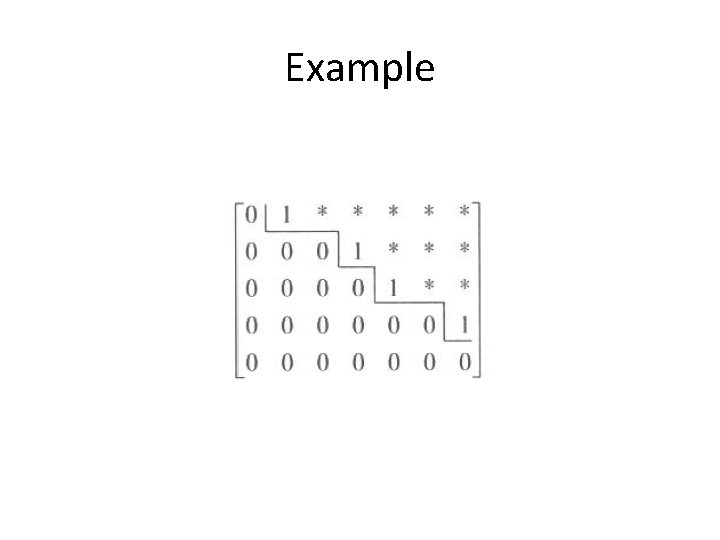
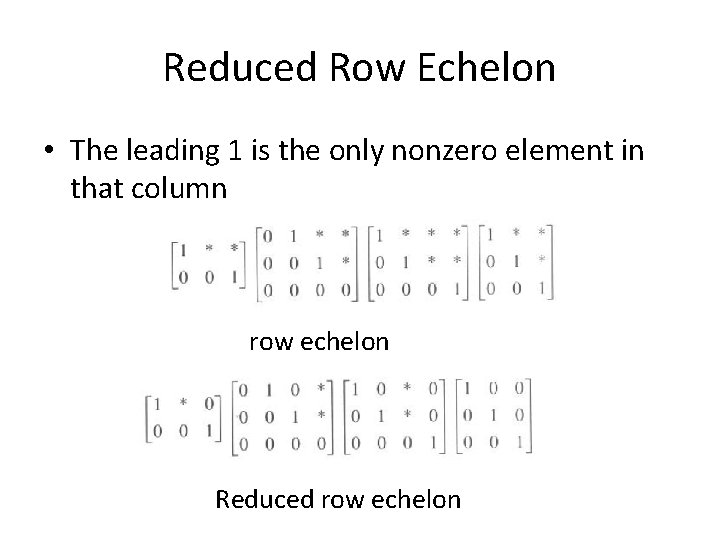
Row Echelon Form • A matrix is in “Row Echelon Form” (called row echelon matrix) if – All zero rows are at the bottom – The first nonzero entry from the left in each nonzero row is 1 • (that 1 is called a leading 1 of that row) – Each leading 1 is to the right of all leading 1’s in the row above it
Example
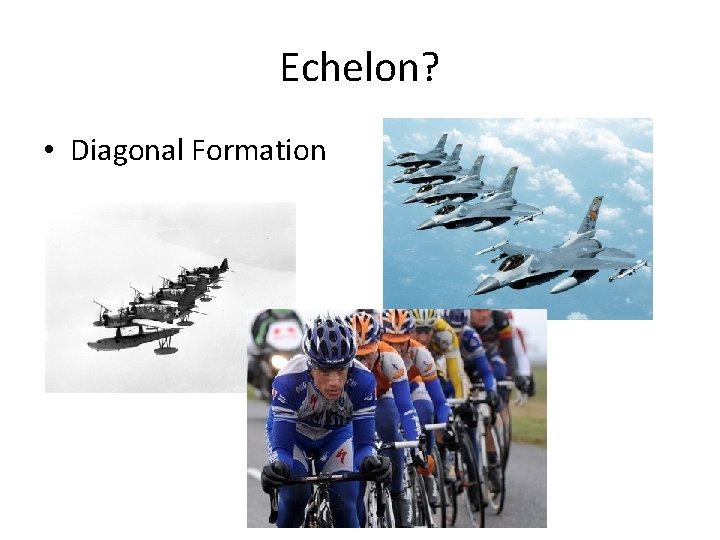
Echelon? • Diagonal Formation
Reduced Row Echelon • The leading 1 is the only nonzero element in that column row echelon Reduced row echelon
Theorem 2 • Every matrix can be manipulated into a (reduced) row echelon form by a series of elementary row operations
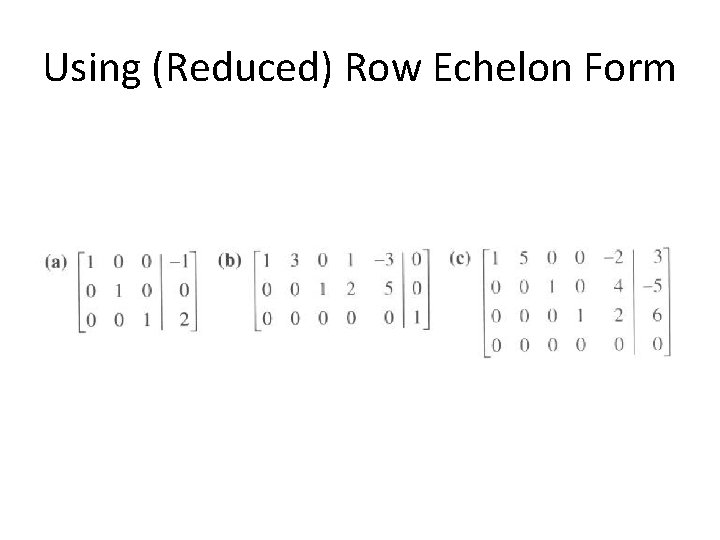
Using (Reduced) Row Echelon Form
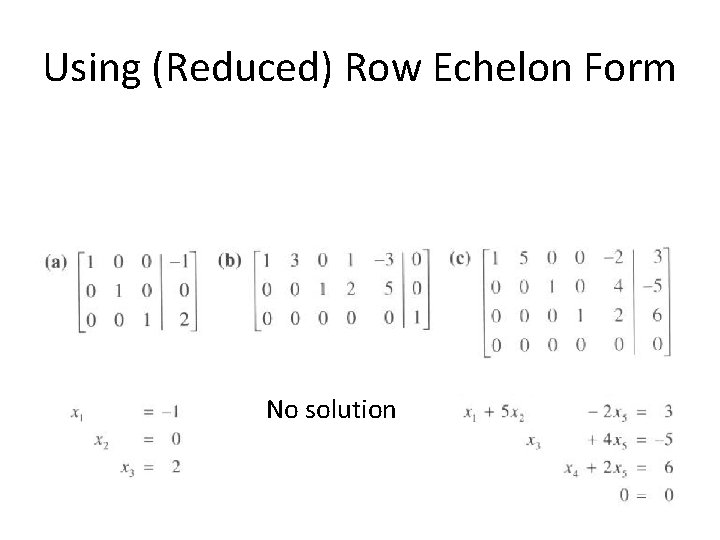
Using (Reduced) Row Echelon Form No solution
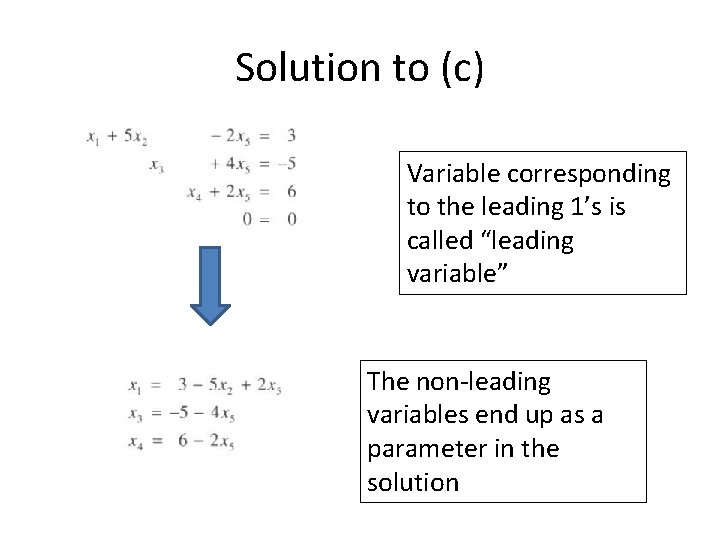
Solution to (c) Variable corresponding to the leading 1’s is called “leading variable” The non-leading variables end up as a parameter in the solution
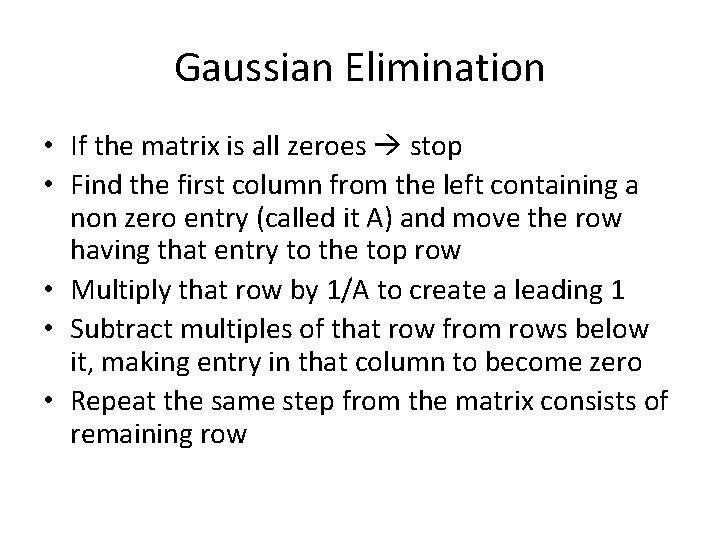
Gaussian Elimination • If the matrix is all zeroes stop • Find the first column from the left containing a non zero entry (called it A) and move the row having that entry to the top row • Multiply that row by 1/A to create a leading 1 • Subtract multiples of that row from rows below it, making entry in that column to become zero • Repeat the same step from the matrix consists of remaining row
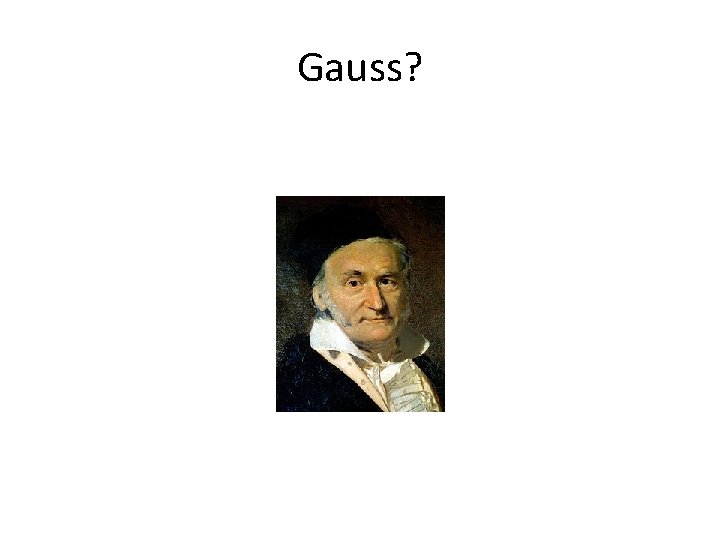
Gauss?
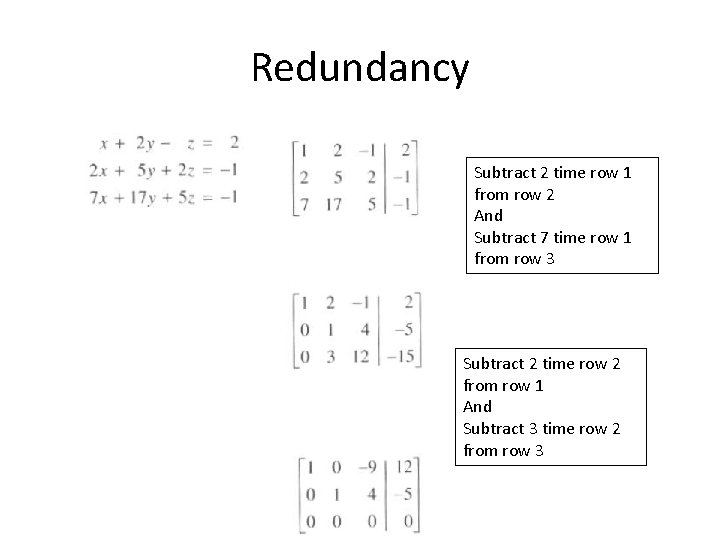
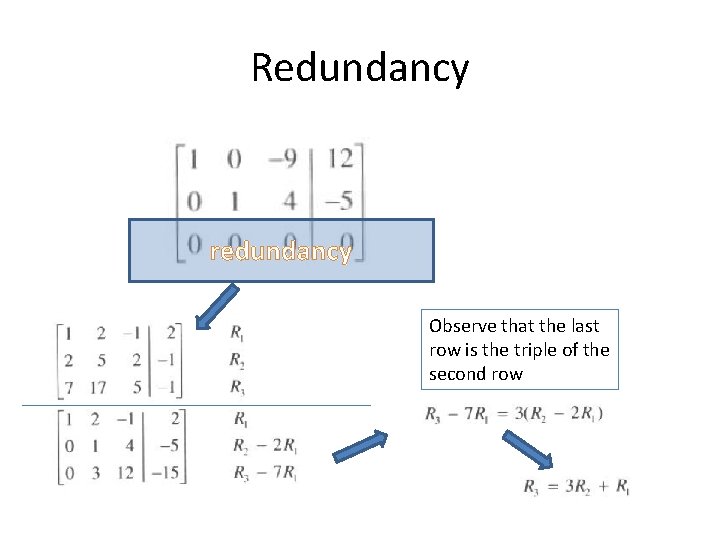
Redundancy Subtract 2 time row 1 from row 2 And Subtract 7 time row 1 from row 3 Subtract 2 time row 2 from row 1 And Subtract 3 time row 2 from row 3
Redundancy redundancy Observe that the last row is the triple of the second row
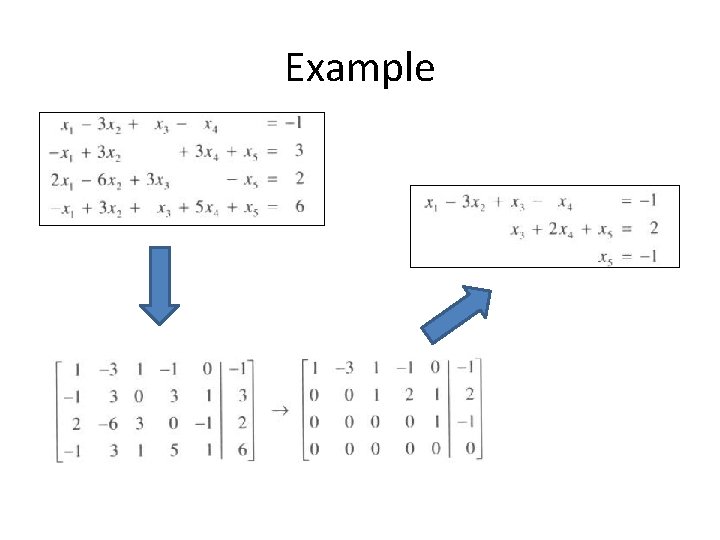
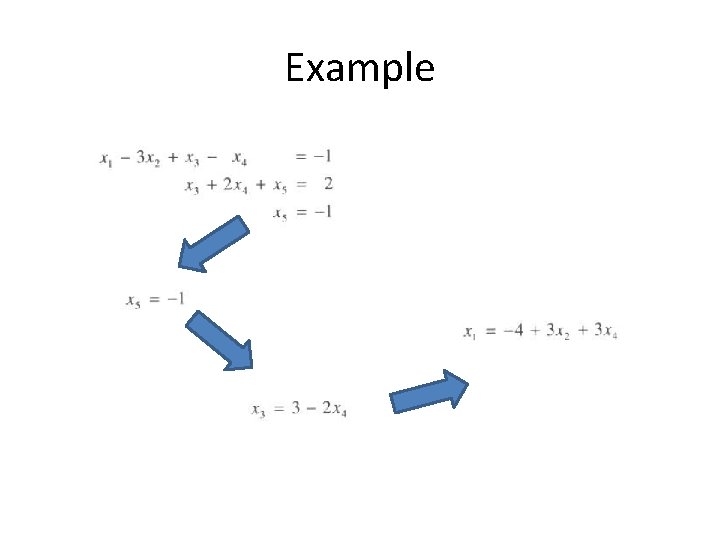
Back Substitution • Gaussian Elimination brings the matrix into a row echelon form – To create a reduced row echelon form • We need to change step 4 such that it also create zero on the “above” row as well • Usually, that is less efficient • It is better to start from the row echelon form and then use the leading 1 of the bottommost row to create zero
Example
Example
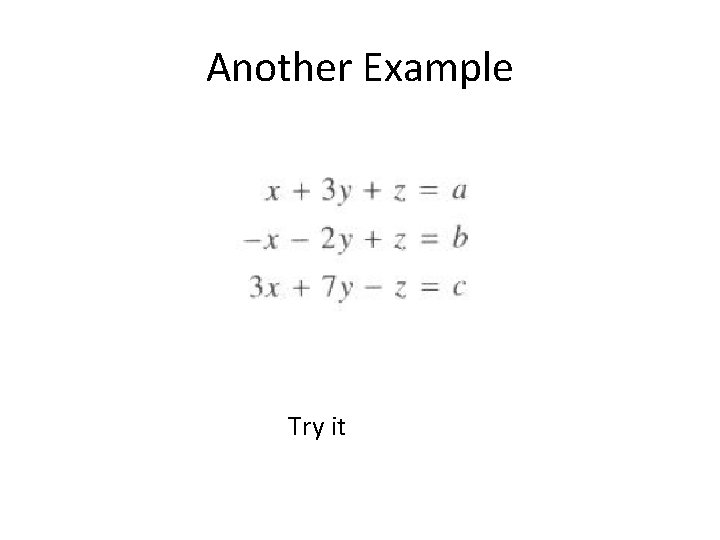
Another Example Try it
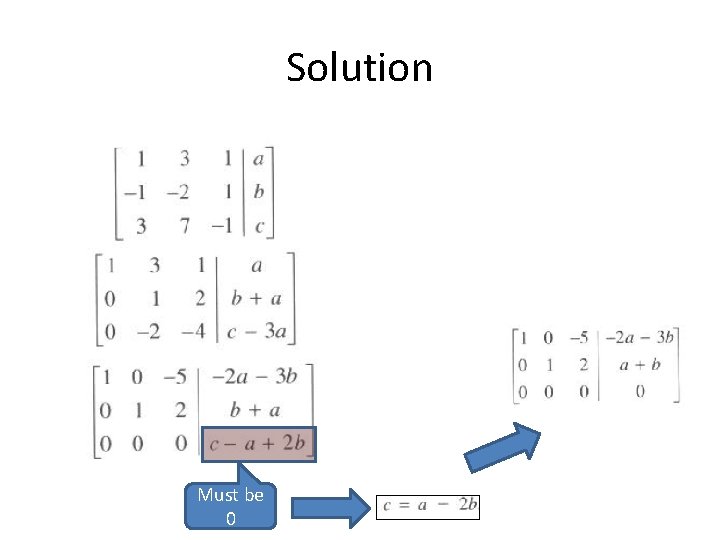
Solution Must be 0
Rank • It is (later) shown that, for any matrix A, it has the same “Reduced row echelon form” – Regardless of the elementary row operation performed • But it s not true for “row echelon form” – Different sequence of operations leads to different row echelon matrix • However, the number of leading 1’s is always the same – Will be proved later • Hence, the number of leading 1’s depends on A
Theorem 3 • Suppose a system of equation on variables has a solution, if the rank of the augmented matrix is – the set of the solution involve exactly parameters
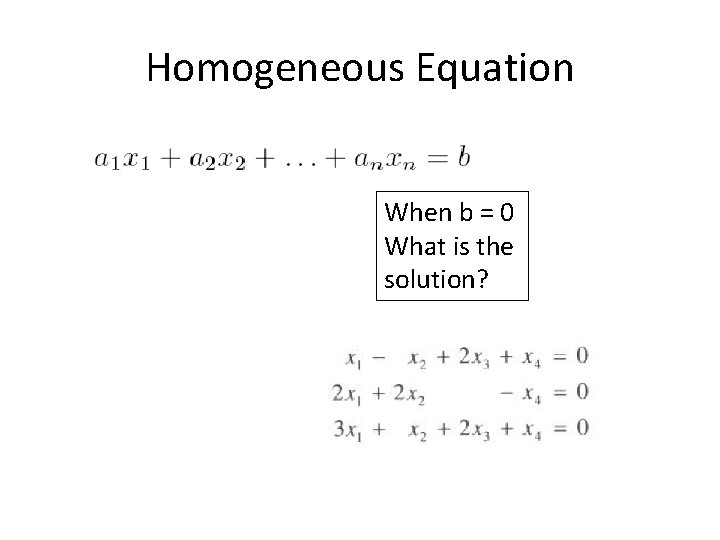
Homogeneous Equation When b = 0 What is the solution?
Homogeneous Linear System • Xi = 0 is always a solution to the homogeneous system – It is called “trivial” solution • Any solution having nonzero term is called “nontrivial” solution
Existence of Nontrivial Solution to the homogeneous system • If it has non-leading entry in the row echelon form – The solution can be described as a parameter • Then it has nonzero solution!!! – Nontrivial • When will we have non-leading entry? – When we have more variable than equation
GEOMETRICAL VIEW OF LINEAR EQUATION
Geometrical Point of View • A system of Linear Equation A line in 2 D
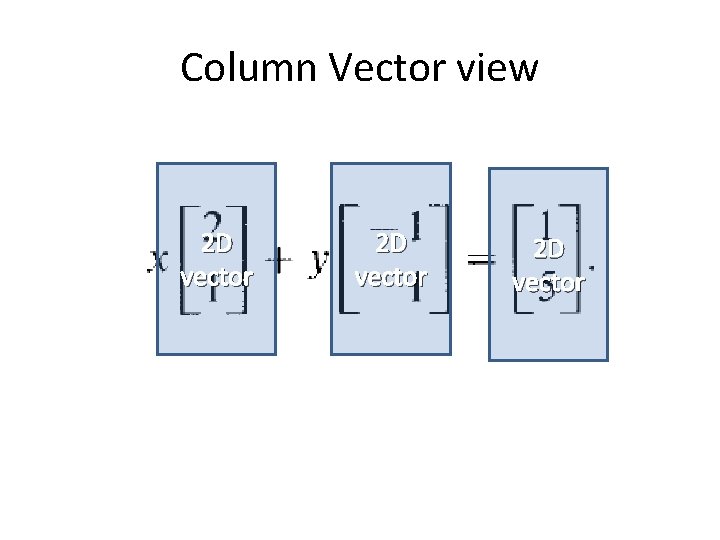
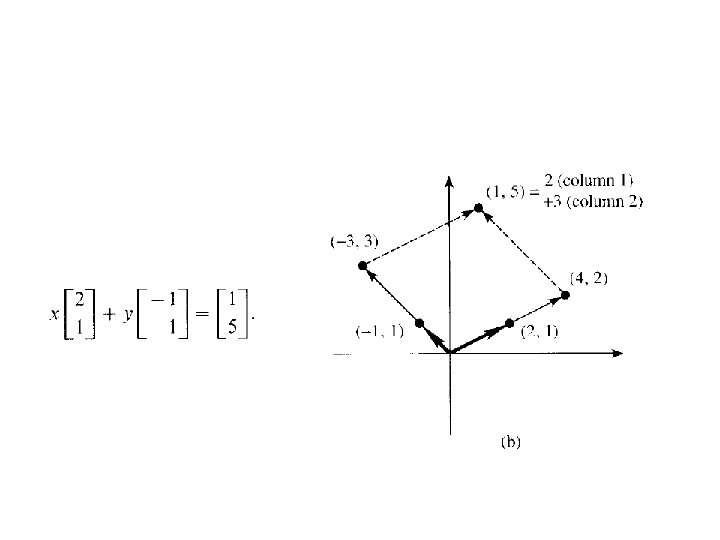
Column Vector view 2 D vector
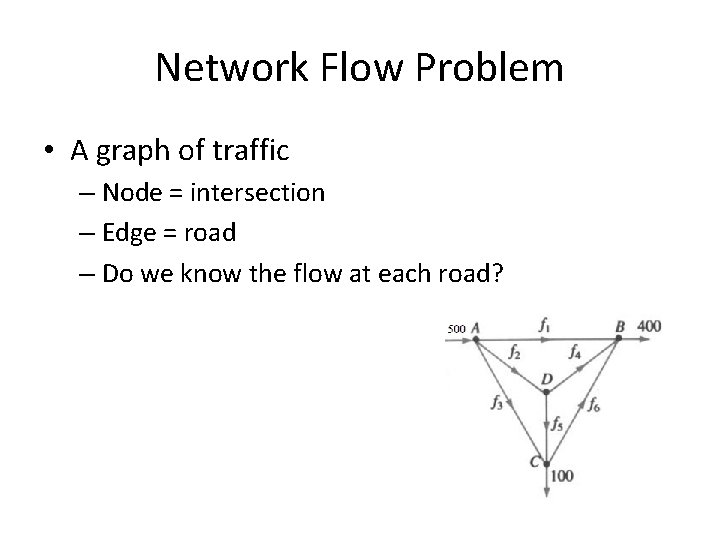
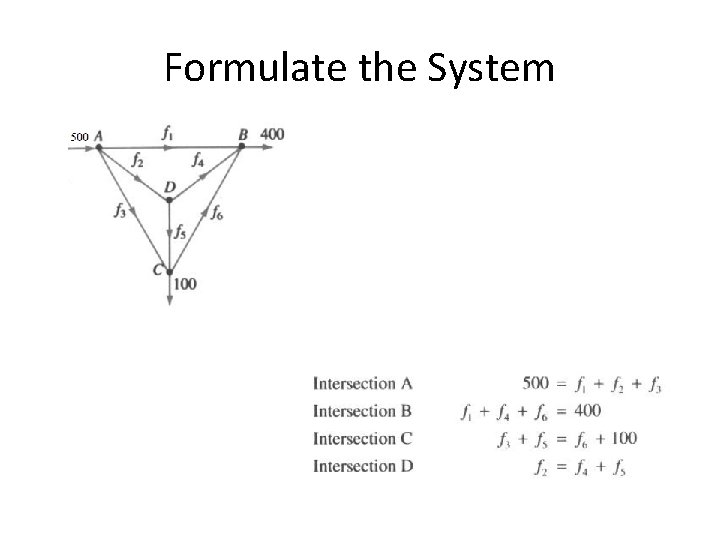
Network Flow Problem • A graph of traffic – Node = intersection – Edge = road – Do we know the flow at each road?
Network Flow Problem • Rules – For each node, traffic in equals traffic out
Formulate the System
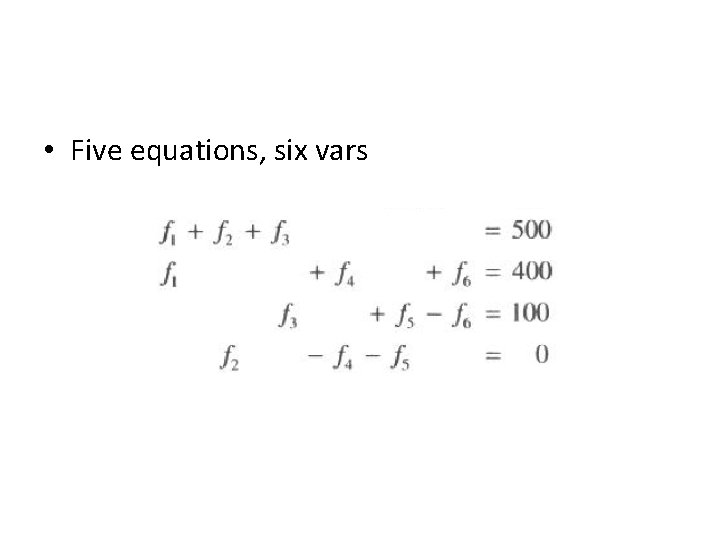
• Five equations, six vars
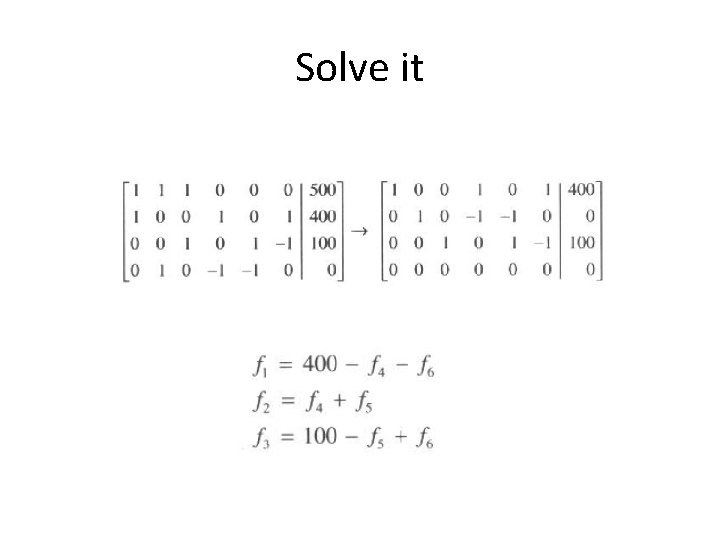
Solve it