
System of EnvironmentalEconomic Accounting SEEA Experimental Ecosystem Accounting
- Slides: 34
System of Environmental-Economic Accounting SEEA Experimental Ecosystem Accounting Sokol Vako United Nations Statistics Division Training for the worldwide implementation of the System of Environmental Economic Accounting 2012 - Central Framework for Latin America and the Caribbean 7 -10 July 2015, Santiago, Chile
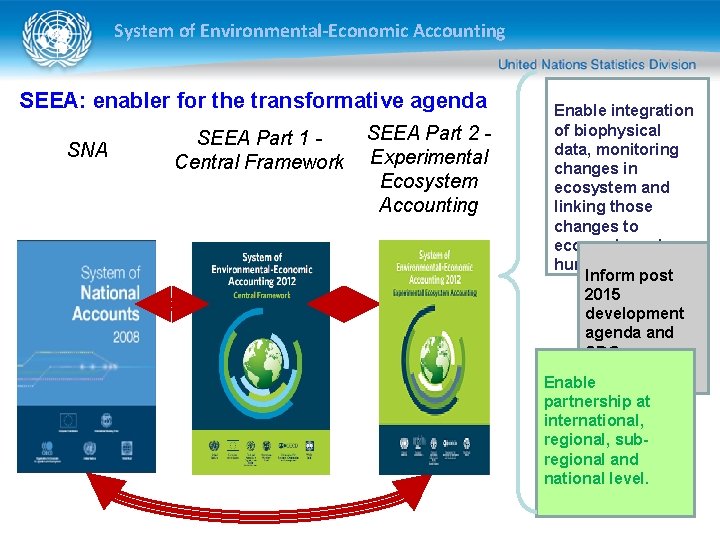
System of Environmental-Economic Accounting SEEA: enabler for the transformative agenda SNA SEEA Part 1 Central Framework SEEA Part 2 Experimental Ecosystem Accounting Enable integration of biophysical data, monitoring changes in ecosystem and linking those changes to economic and human activity Inform post 2015 development agenda and SDGs Enable partnership at international, regional, subregional and national level.
System of Environmental-Economic Accounting SEEA Experimental Ecosystem Accounting § Complements SEEA Central Framework § Integrated statistical framework for accounting for ecosystem assets and associated ecosystem services § Important first step in development of statistical framework for ecosystem accounting
System of Environmental-Economic Accounting SEEA-Experimental Ecosystem Accounting Background § Complements SEEA Central Framework with focus on ecosystems perspective § Developed as part of broader process of revising SEEA 2003 § Integrated system of information on distinct stocks and flows § Not a statistical standard but synthesizes current knowledge related to ecosystem services, ecosystem condition and related concepts § “Experimental” because significant methodological challenges remain and further testing of concepts needed
System of Environmental-Economic Accounting Relationship to SEEA Central Framework § Extends range of flows (production boundary) for accounting compared to SNA and SEEA in physical and monetary terms § Many flows from Central Framework also included in Experimental Ecosystem Accounting (e. g. flows of timber), but extension of EEA is to attribute flows to spatial areas § Some Central Framework natural input flows are excluded from Experimental Ecosystem Accounting (e. g. mineral and energy resources)
System of Environmental-Economic Accounting SEEA Experimental Ecosystem Accounting § Ecosystem accounting is a tool to understand monitor the contributions of ecosystems to economic and human activity § Ecosystems include natural as well as mandominated systems such as croplands or intensive pastures § Requires a spatial approach (combination of maps and statistics)
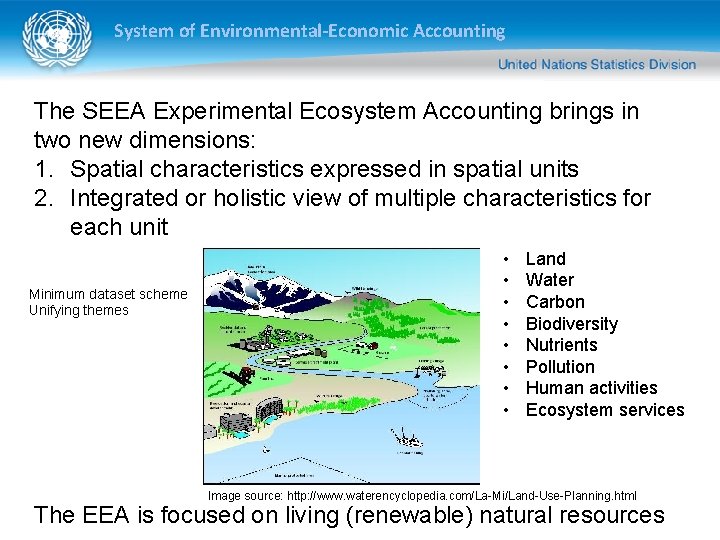
System of Environmental-Economic Accounting The SEEA Experimental Ecosystem Accounting brings in two new dimensions: 1. Spatial characteristics expressed in spatial units 2. Integrated or holistic view of multiple characteristics for each unit Minimum dataset scheme Unifying themes • • Land Water Carbon Biodiversity Nutrients Pollution Human activities Ecosystem services Image source: http: //www. waterencyclopedia. com/La-Mi/Land-Use-Planning. html The EEA is focused on living (renewable) natural resources
System of Environmental-Economic Accounting SEEA-EEA • Basic concepts and definitions • Ecosystems as “Assets” • The Ecosystem Services “Cascade” • Ecosystem structure and processes, function, services, benefits and values • Accounting (not just “counting”) Principles • Assets, stocks and flows • Balancing the books • Ecosystem Accounting is Spatial • Geographic information systems (GIS) 8
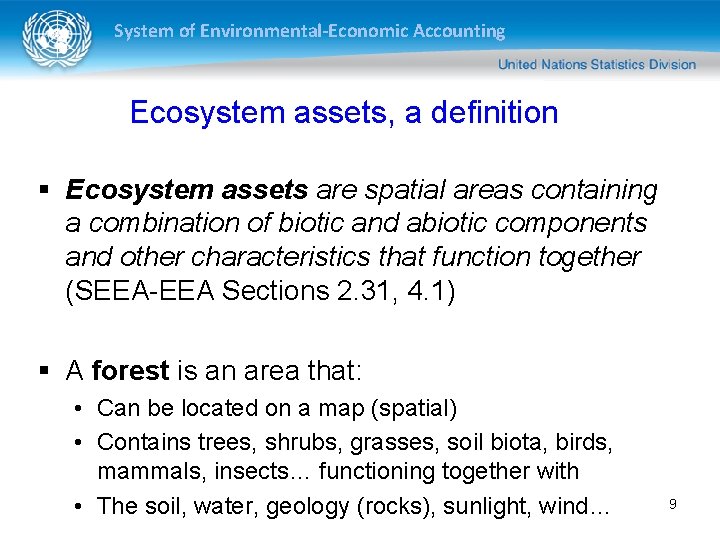
System of Environmental-Economic Accounting Ecosystem assets, a definition § Ecosystem assets are spatial areas containing a combination of biotic and abiotic components and other characteristics that function together (SEEA-EEA Sections 2. 31, 4. 1) § A forest is an area that: • Can be located on a map (spatial) • Contains trees, shrubs, grasses, soil biota, birds, mammals, insects… functioning together with • The soil, water, geology (rocks), sunlight, wind… 9
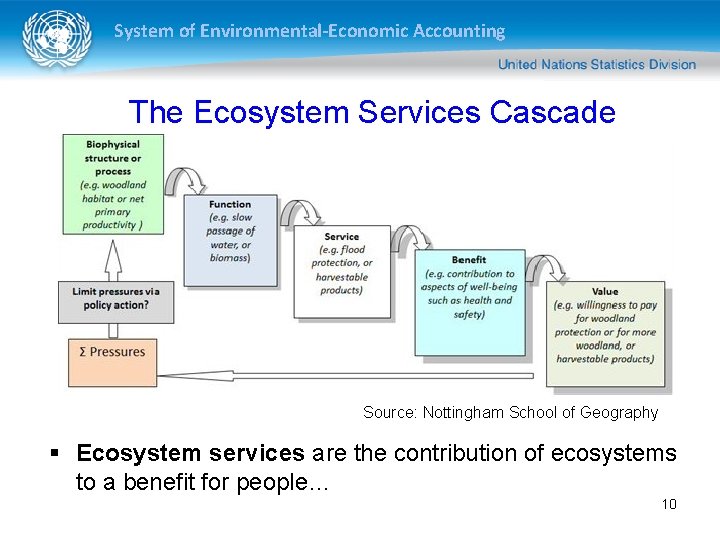
System of Environmental-Economic Accounting The Ecosystem Services Cascade Source: Nottingham School of Geography § Ecosystem services are the contribution of ecosystems to a benefit for people… 10
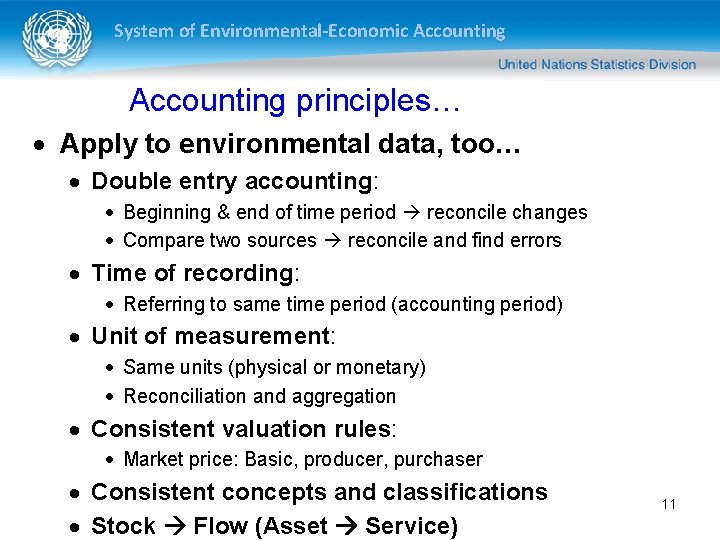
System of Environmental-Economic Accounting principles… Apply to environmental data, too… Double entry accounting: Beginning & end of time period reconcile changes Compare two sources reconcile and find errors Time of recording: Referring to same time period (accounting period) Unit of measurement: Same units (physical or monetary) Reconciliation and aggregation Consistent valuation rules: Market price: Basic, producer, purchaser Consistent concepts and classifications Stock Flow (Asset Service) 11
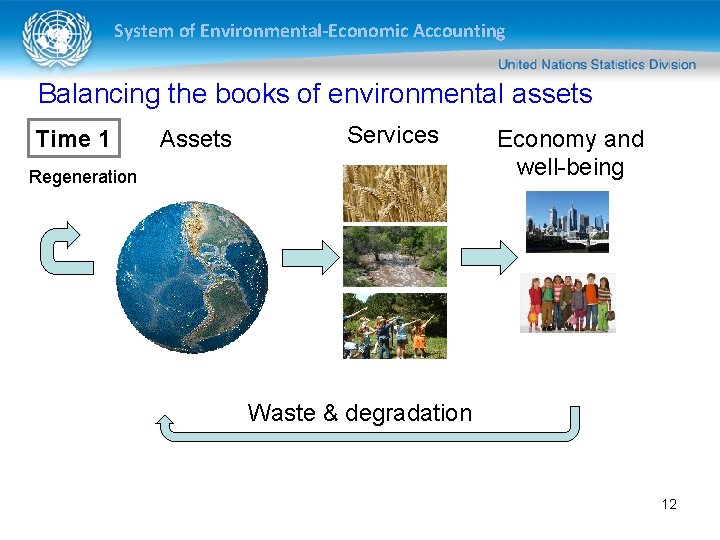
System of Environmental-Economic Accounting Balancing the books of environmental assets Time 1 Assets Services Regeneration Economy and well-being Waste & degradation 12
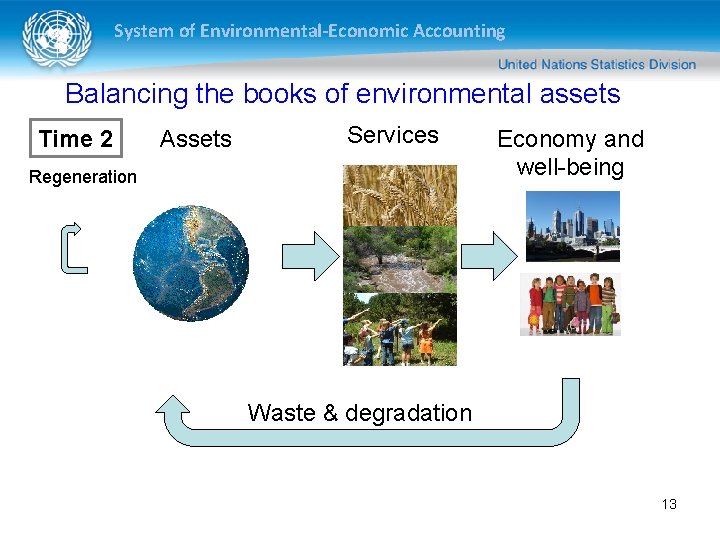
System of Environmental-Economic Accounting Balancing the books of environmental assets Time 2 Assets Services Regeneration Economy and well-being Waste & degradation 13
System of Environmental-Economic Accounting Ecosystem accounting is spatial § Ecosystems are different and function differently depending on where they are § Their capacity to supply services depends on their location § The benefits of many services depends on whether or not the ecosystems are accessible § Therefore…Ecosystem accounting needs to integrate spatial and non-spatial data § For example, wetlands in northern Canada may have the capacity to purify water, but there is no 14 population there to benefit from it.
System of Environmental-Economic Accounting Ecosystem accounting is spatial § Geographic information systems (GIS) • Manage spatial information as layers • Have tools to integrate spatial information: ▫ Overlay different data where space is the common denominator ▫ Aggregate point information (e. g. , water sampling station) to larger areas (polygons) ▫ Attribute information from larger areas to smaller ones (downsampling) ▫ Geospatial statistics (interpolation, modelling) • Generate tables based on common properties (e. g. , land cover and land cover change) 15
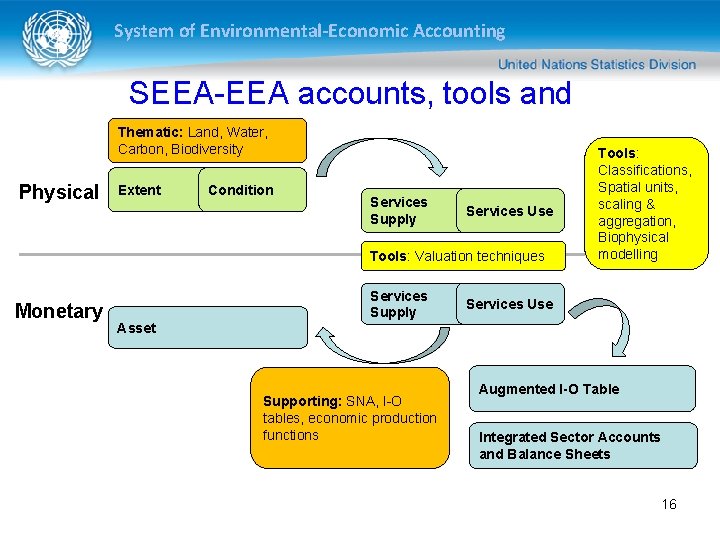
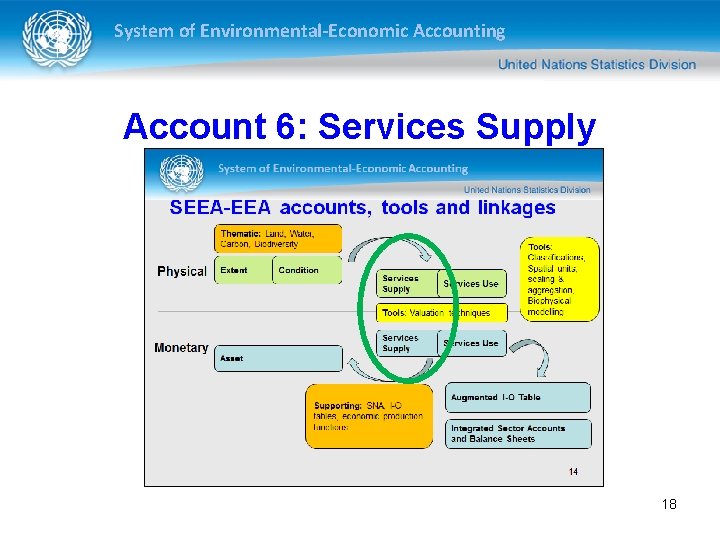
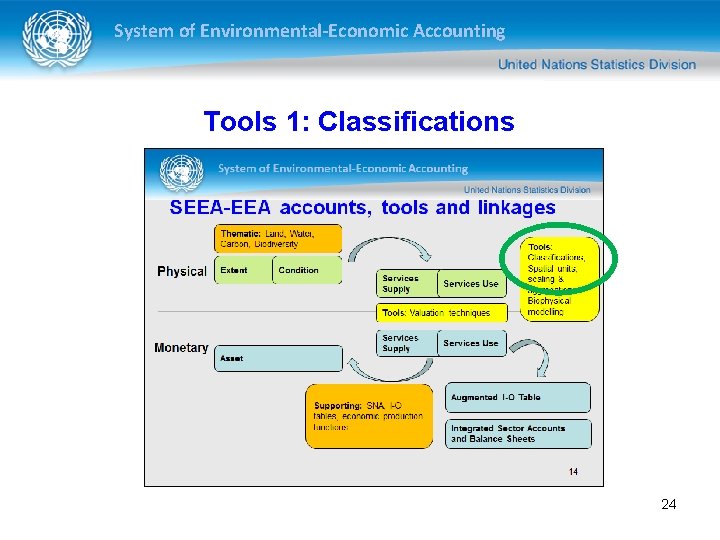
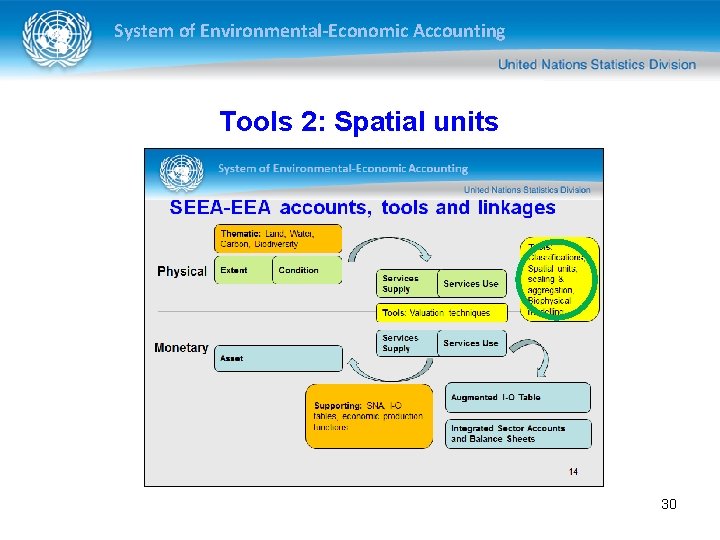
System of Environmental-Economic Accounting SEEA-EEA accounts, tools and Thematic: Land, Water, linkages Carbon, Biodiversity Physical Extent Condition Services Supply Services Use Tools: Valuation techniques Monetary Asset Services Supply Supporting: SNA, I-O tables, economic production functions Tools: Classifications, Spatial units, scaling & aggregation, Biophysical modelling Services Use Augmented I-O Table Integrated Sector Accounts and Balance Sheets 16
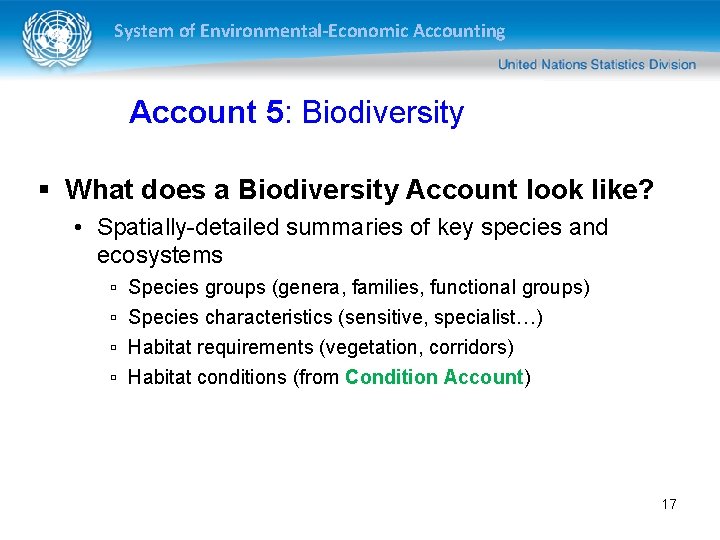
System of Environmental-Economic Accounting Account 5: Biodiversity § What does a Biodiversity Account look like? • Spatially-detailed summaries of key species and ecosystems ▫ ▫ Species groups (genera, families, functional groups) Species characteristics (sensitive, specialist…) Habitat requirements (vegetation, corridors) Habitat conditions (from Condition Account) 17
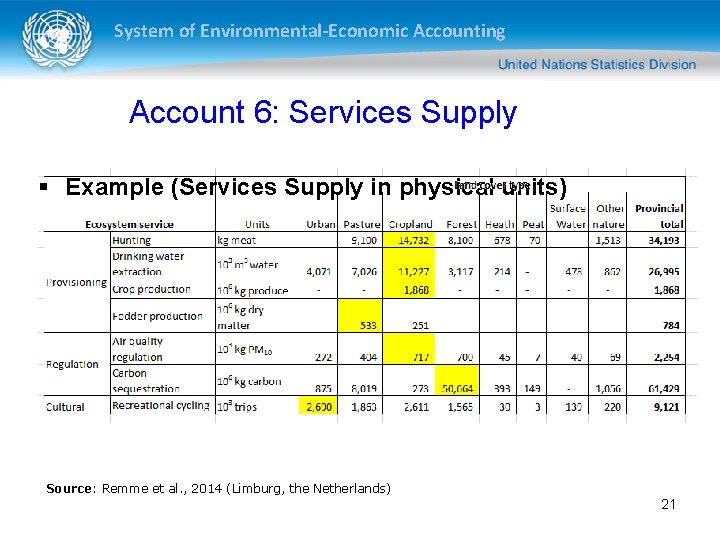
System of Environmental-Economic Accounting Account 6: Services Supply 18
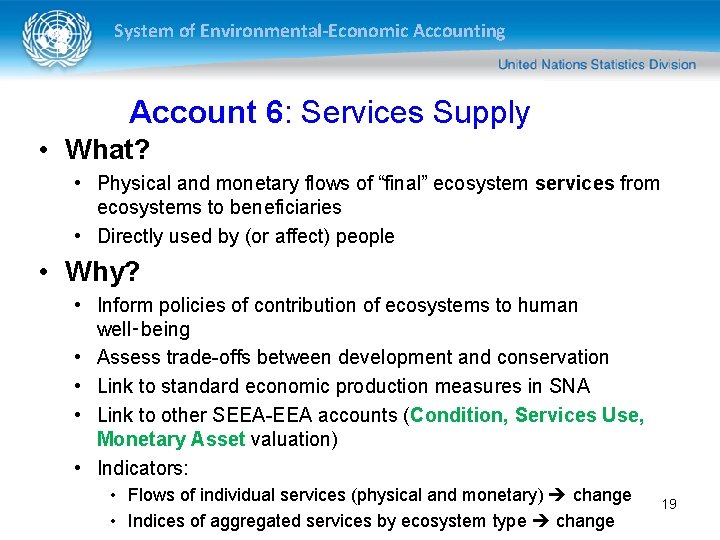
System of Environmental-Economic Accounting Account 6: Services Supply • What? • Physical and monetary flows of “final” ecosystem services from ecosystems to beneficiaries • Directly used by (or affect) people • Why? • Inform policies of contribution of ecosystems to human well‑being • Assess trade-offs between development and conservation • Link to standard economic production measures in SNA • Link to other SEEA-EEA accounts (Condition, Services Use, Monetary Asset valuation) • Indicators: • Flows of individual services (physical and monetary) change • Indices of aggregated services by ecosystem type change 19
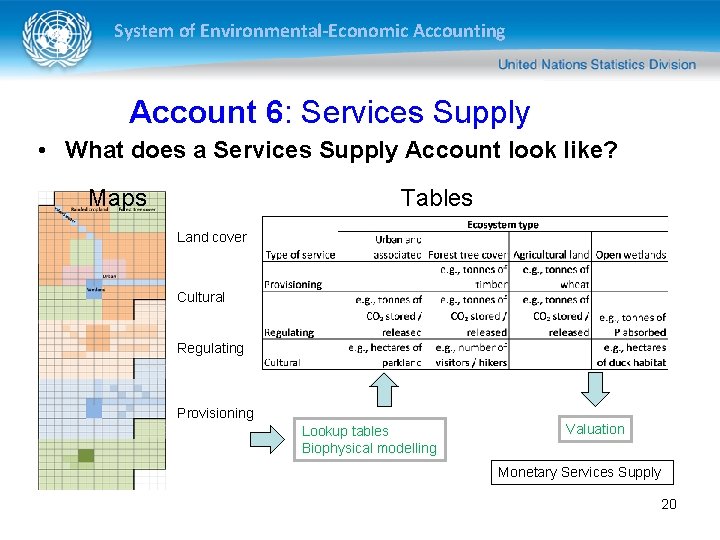
System of Environmental-Economic Accounting Account 6: Services Supply • What does a Services Supply Account look like? Maps Tables Land cover Cultural Regulating Provisioning Lookup tables Biophysical modelling Valuation Monetary Services Supply 20
System of Environmental-Economic Accounting Account 6: Services Supply § Example (Services Supply in physical units) Source: Remme et al. , 2014 (Limburg, the Netherlands) 21
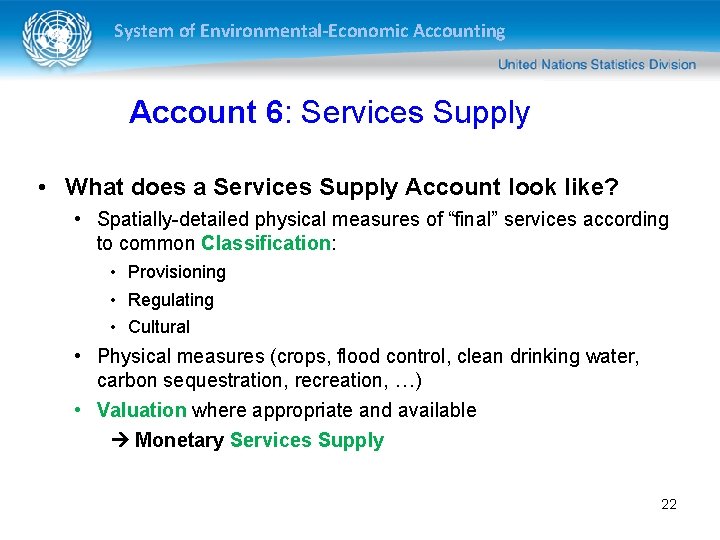
System of Environmental-Economic Accounting Account 6: Services Supply • What does a Services Supply Account look like? • Spatially-detailed physical measures of “final” services according to common Classification: • Provisioning • Regulating • Cultural • Physical measures (crops, flood control, clean drinking water, carbon sequestration, recreation, …) • Valuation where appropriate and available Monetary Services Supply 22
System of Environmental-Economic Accounting Other accounts • • • Ecosystem Services Use Account Ecosystem Capacity Augmented I-O Tables Integrated Sector Accounts and Balance Sheet Supporting information 23
System of Environmental-Economic Accounting Tools 1: Classifications 24
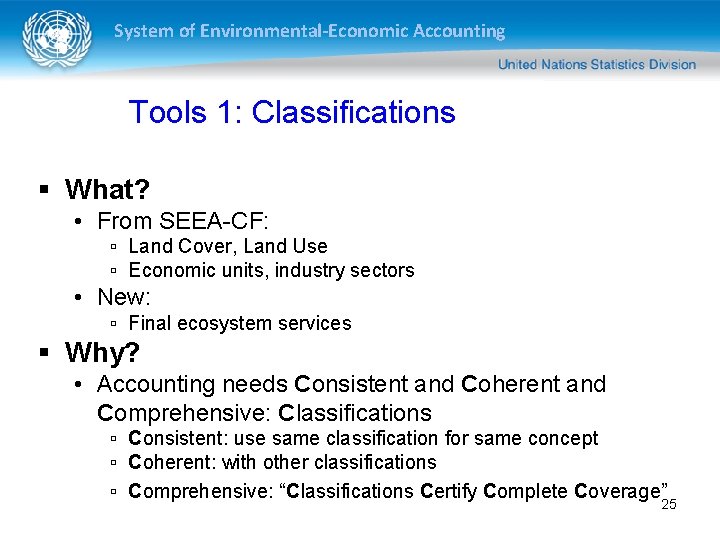
System of Environmental-Economic Accounting Tools 1: Classifications § What? • From SEEA-CF: ▫ Land Cover, Land Use ▫ Economic units, industry sectors • New: ▫ Final ecosystem services § Why? • Accounting needs Consistent and Coherent and Comprehensive: Classifications ▫ Consistent: use same classification for same concept ▫ Coherent: with other classifications ▫ Comprehensive: “Classifications Certify Complete Coverage” 25
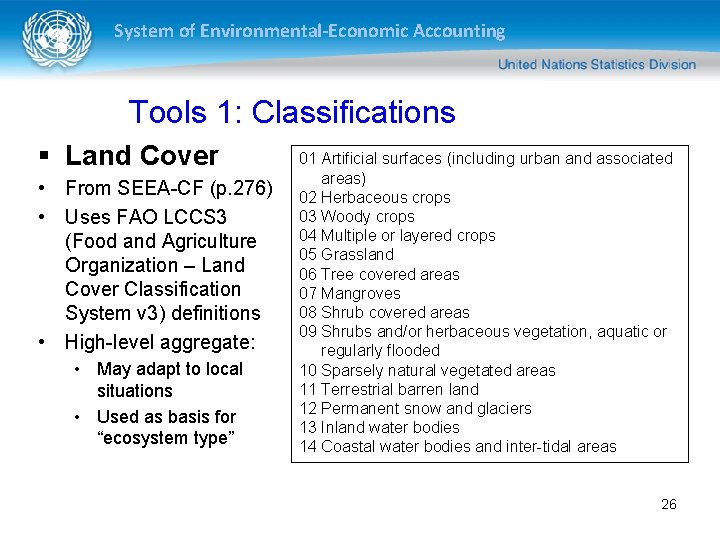
System of Environmental-Economic Accounting Tools 1: Classifications § Land Cover • From SEEA-CF (p. 276) • Uses FAO LCCS 3 (Food and Agriculture Organization – Land Cover Classification System v 3) definitions • High-level aggregate: • May adapt to local situations • Used as basis for “ecosystem type” 01 Artificial surfaces (including urban and associated areas) 02 Herbaceous crops 03 Woody crops 04 Multiple or layered crops 05 Grassland 06 Tree covered areas 07 Mangroves 08 Shrub covered areas 09 Shrubs and/or herbaceous vegetation, aquatic or regularly flooded 10 Sparsely natural vegetated areas 11 Terrestrial barren land 12 Permanent snow and glaciers 13 Inland water bodies 14 Coastal water bodies and inter-tidal areas 26
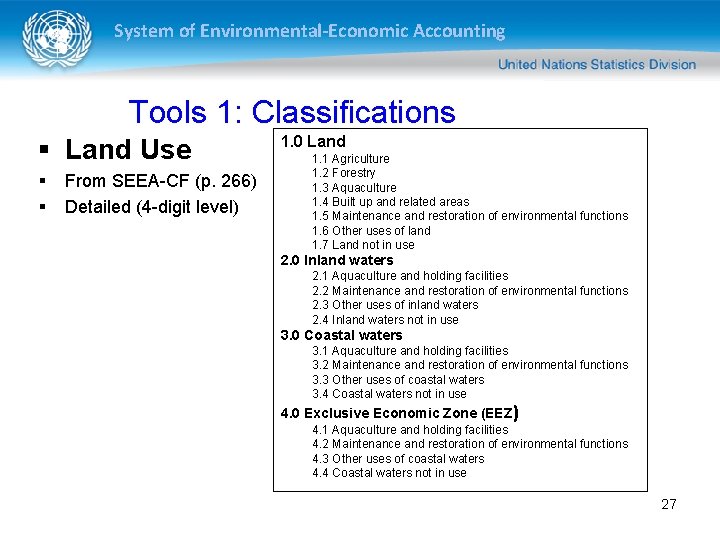
System of Environmental-Economic Accounting Tools 1: Classifications § Land Use § § From SEEA-CF (p. 266) Detailed (4 -digit level) 1. 0 Land 1. 1 Agriculture 1. 2 Forestry 1. 3 Aquaculture 1. 4 Built up and related areas 1. 5 Maintenance and restoration of environmental functions 1. 6 Other uses of land 1. 7 Land not in use 2. 0 Inland waters 2. 1 Aquaculture and holding facilities 2. 2 Maintenance and restoration of environmental functions 2. 3 Other uses of inland waters 2. 4 Inland waters not in use 3. 0 Coastal waters 3. 1 Aquaculture and holding facilities 3. 2 Maintenance and restoration of environmental functions 3. 3 Other uses of coastal waters 3. 4 Coastal waters not in use 4. 0 Exclusive Economic Zone (EEZ) 4. 1 Aquaculture and holding facilities 4. 2 Maintenance and restoration of environmental functions 4. 3 Other uses of coastal waters 4. 4 Coastal waters not in use 27
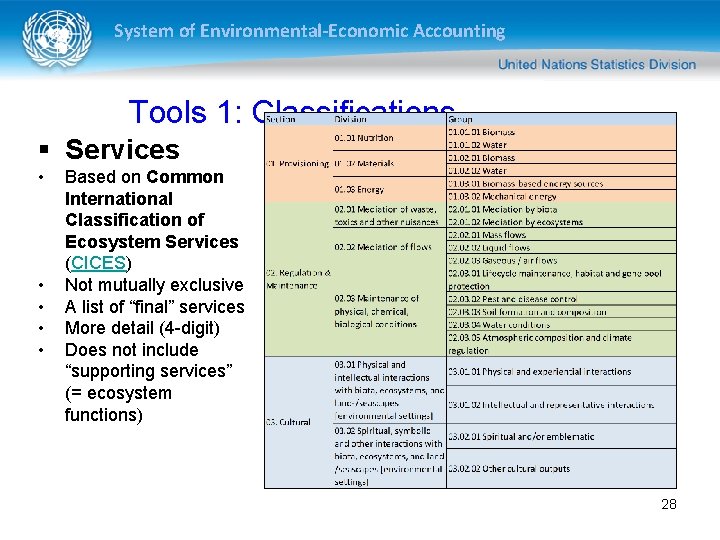
System of Environmental-Economic Accounting Tools 1: Classifications § Services • • • Based on Common International Classification of Ecosystem Services (CICES) Not mutually exclusive A list of “final” services More detail (4 -digit) Does not include “supporting services” (= ecosystem functions) 28
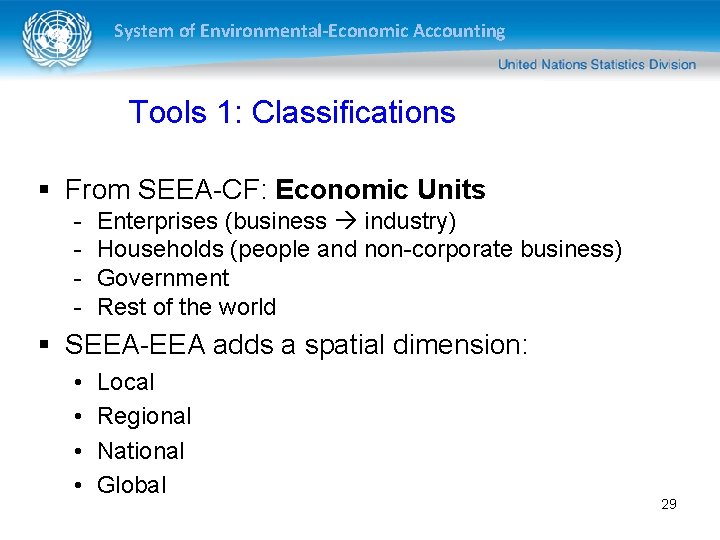
System of Environmental-Economic Accounting Tools 1: Classifications § From SEEA-CF: Economic Units - Enterprises (business industry) Households (people and non-corporate business) Government Rest of the world § SEEA-EEA adds a spatial dimension: • • Local Regional National Global 29
System of Environmental-Economic Accounting Tools 2: Spatial units 30
System of Environmental-Economic Accounting Tools 2: Spatial units § What? • A common definition of Spatial Units for all accounts • Based on surface characteristics (terrestrial, freshwater, coastal and marine) § Why? • Accounting needs statistical units about which information is compiled, derived, reported and compared ▫ e. g. , business statistics are built on locations, establishments, companies and enterprises • Information is collected on many spatial levels ▫ Needs to be consolidated within a GIS or spatial model • First step in tabulating & aggregating more detailed data ▫ Not everybody is a GIS expert • Links accounts together: ▫ (Extent, Condition, Services Supply…) 31
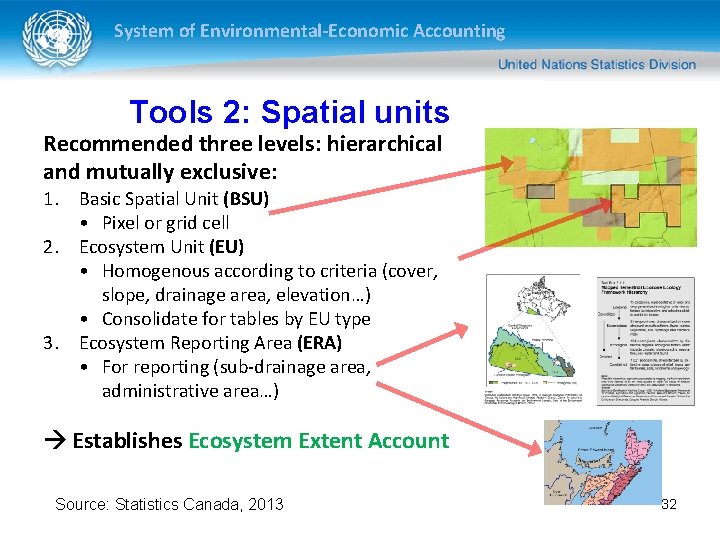
System of Environmental-Economic Accounting Tools 2: Spatial units Recommended three levels: hierarchical and mutually exclusive: 1. Basic Spatial Unit (BSU) • Pixel or grid cell 2. Ecosystem Unit (EU) • Homogenous according to criteria (cover, slope, drainage area, elevation…) • Consolidate for tables by EU type 3. Ecosystem Reporting Area (ERA) • For reporting (sub-drainage area, administrative area…) Establishes Ecosystem Extent Account Source: Statistics Canada, 2013 32
System of Environmental-Economic Accounting § § Other tools Scaling Aggregation Biophysical Modeling Valuation 33
System of Environmental-Economic Accounting Thank You! seea@un. org 34