
System of CareOverview Principles and Values Coordinated System
- Slides: 19
System of Care-Overview Principles and Values
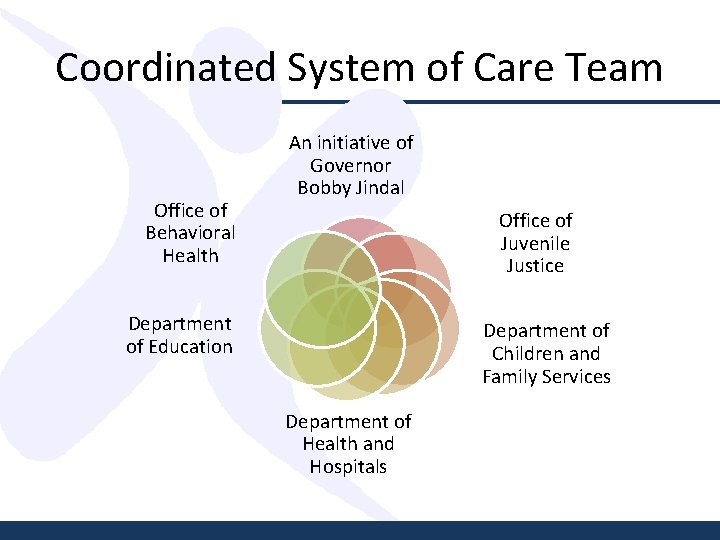
Coordinated System of Care Team Office of Behavioral Health An initiative of Governor Bobby Jindal Office of Juvenile Justice Department of Education Department of Children and Family Services Department of Health and Hospitals
Louisiana’s current system • The needs of children and families are served through a fragmented service delivery model that is not well coordinated and is often times difficult to navigate. • Louisiana’s children with the highest level of need are often detained in secure or residential settings, which are proven the highest cost services with the poorest outcomes.
Louisiana’s current system • State Departments are not currently pooling resources and leveraging the ‘smartest’ financing to provide a coordinated system of behavioral health services.
How can we bridge the gap between families and services? Through a System of Care approach
Definition of a System of Care System of care is, first and foremost, a set of values and principles that provides an organizing framework for systems change on behalf of children, youth and families. Pires, S. 2005. Human Service Collaborative. Washington, D. C.
Definition of a System of Care A system of care incorporates a broad array of services and supports for a defined population that is: • Organized into a coordinated network • Integrates care planning and management across multiple levels • Is culturally and linguistically competent • Builds meaningful partnerships with families and youth at service delivery, management, and policy levels Pires, S. (2002). Building systems of care: A primer. Washington, D. C. : Human Service Collaborative.
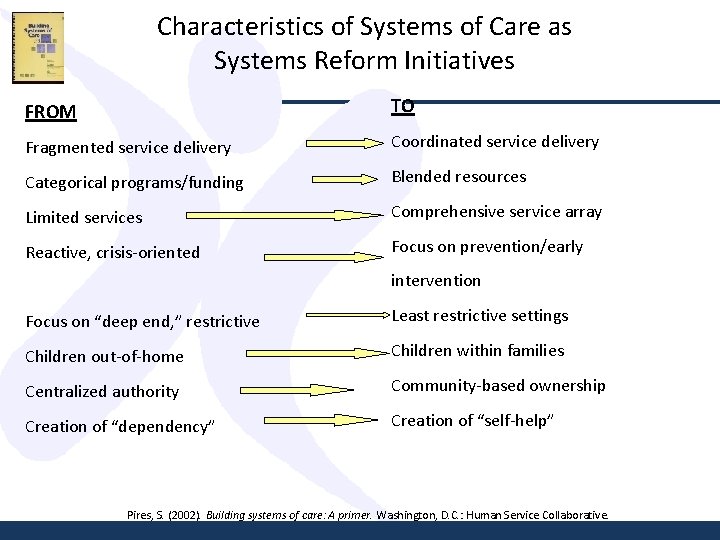
Characteristics of Systems of Care as Systems Reform Initiatives FROM TO Fragmented service delivery Coordinated service delivery Categorical programs/funding Blended resources Limited services Comprehensive service array Reactive, crisis-oriented Focus on prevention/early intervention Focus on “deep end, ” restrictive Least restrictive settings Children out-of-home Children within families Centralized authority Community-based ownership Creation of “dependency” Creation of “self-help” Pires, S. (2002). Building systems of care: A primer. Washington, D. C. : Human Service Collaborative.
Coordinated System of Care (CSo. C) Model for Youth and Adolescents • The Coordinated Systems of Care (CSOC) is an evidence-based model that is part of a national movement to develop family driven and youth guided care, keep children at home, in school, and out of the child welfare and juvenile justice system. • Coordinated System of Care will offer an integrated approach to providing services for atrisk children and youth served within the child welfare and juvenile justice populations.
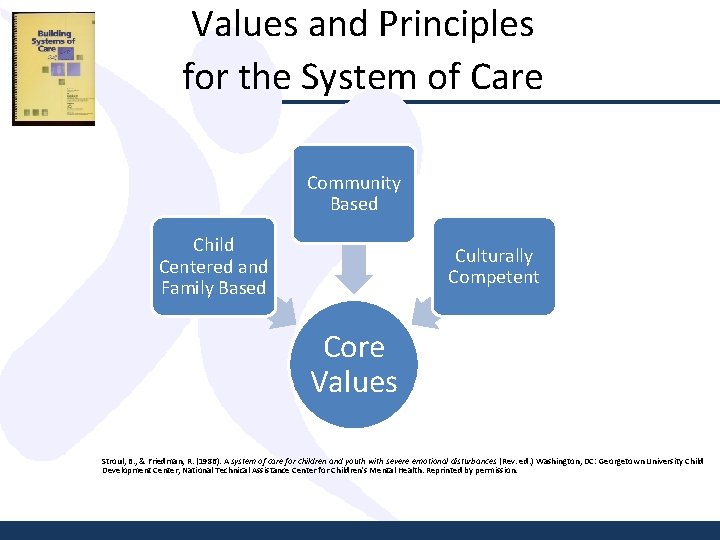
Values and Principles for the System of Care Community Based Child Centered and Family Based Culturally Competent Core Values Stroul, B. , & Friedman, R. (1986). A system of care for children and youth with severe emotional disturbances (Rev. ed. ) Washington, DC: Georgetown University Child Development Center, National Technical Assistance Center for Children's Mental Health. Reprinted by permission.
System of Care Values and Principles • Incorporates a broad, flexible array of effective services and supports for a defined population • Is organized into a coordinated network • Integrates care planning and management across multiple levels • Is culturally and linguistically competent. • Builds meaningful partnerships with recipients, families and youth at service delivery, management, and policy levels • Has supportive policy and management infrastructure
System of Care Values and Principles for Services • • Family-driven and youth-guided Home- and community-based Strength-based and individualized Culturally and linguistically competent Integrated across systems Connected to natural helping networks Data-driven, outcomes oriented
Principles of Family Support Practice • Staff & families work together in relationships based on equality and respect. • Staff enhances families’ capacity to support the growth and development of all family members. • Families are resources to their own members, other families, programs, and communities. • Programs affirm and strengthen families’ cultural, racial, and linguistic identities. • Programs are embedded in their communities and contribute to the community building. Family Support America. (2001). Principles of Family Support Practice in Guidelines for Family Support Practice (2 nd ed. ). Chicago, IL.
Principles of Family Support Practice • Programs advocate with families for services and systems that are fair, responsive, and accountable to the families served. • Practitioners work with families to mobilize formal and informal resources to support family development. • Programs are flexible & responsive to emerging family & community issues. • Principles of family support are modeled in all program activities. Family Support America. (2001). Principles of Family Support Practice in Guidelines for Family Support Practice (2 nd ed. ). Chicago, IL.
Why Family Driven Care? Families know what works for them Families know what their limitations are Families can keep track of services and changes Families and youth comfort and buy in are necessary for success • Families face the challenges all day and every day • Families are passionate and will not give up • Families have the most to lose and most to gain • • Libby Jones-Family Advocate-NC Families United
Goals of the System of Care • Reduction in the number of targeted children and youth in detention and residential settings • Reduction of the state’s cost of providing services by leveraging Medicaid and other funding sources • Improving the overall outcomes of these children and their caretakers.
Benefits of System of Care • Keeps children and families together by: – Reducing costly out-of-home placement for treatment or incarceration, unnecessary custody relinquishment – Reduces trauma to child and their family due to separation – Reduces the number of moves a child in placement experiences
Benefits of System of Care • Provides incentives for community to engineer enduring positive change by: – Increasing school attendance and performance – Decreasing instances of abuse, neglect, juvenile just involvement – Increasing family involvement and satisfaction in meeting the behavioral, mental, physical, education and safety needs of their children
Benefits of System of Care • Establishes a system that promotes – Family strengths – Greater self-reliance, and – Children who will grow up in success