
System level testing status in the radiation effects
- Slides: 17
System level testing status in the radiation effects community A. Coronetti CERN, 1211 Geneva, Switzerland RADSAGA System Level Test Review November 12 th, 2019 RADSAGA is a project funded by the European Union’s Horizon 2020 research and innovation programme under the MSC agreement no. 721624.
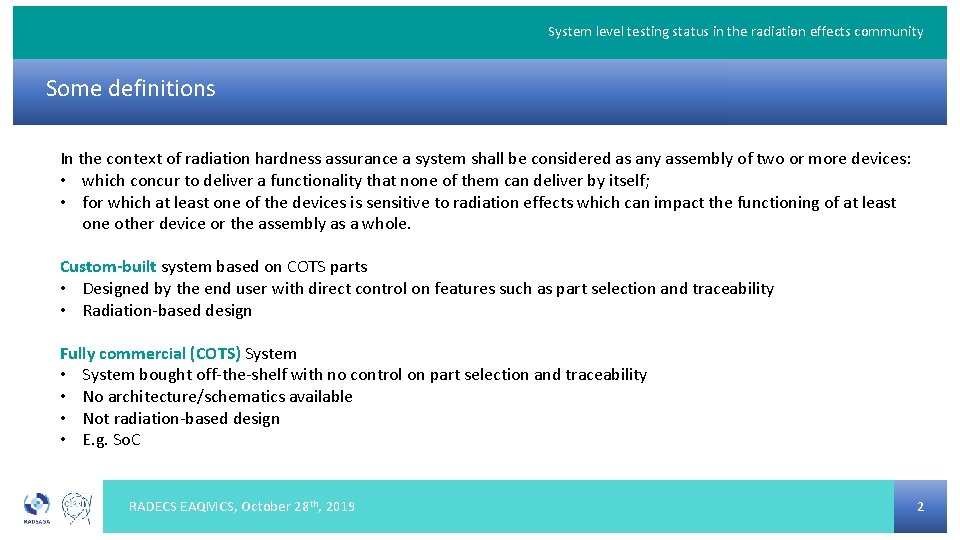
System level testing status in the radiation effects community Some definitions In the context of radiation hardness assurance a system shall be considered as any assembly of two or more devices: • which concur to deliver a functionality that none of them can deliver by itself; • for which at least one of the devices is sensitive to radiation effects which can impact the functioning of at least one other device or the assembly as a whole. Custom-built system based on COTS parts • Designed by the end user with direct control on features such as part selection and traceability • Radiation-based design Fully commercial (COTS) System • System bought off-the-shelf with no control on part selection and traceability • No architecture/schematics available • Not radiation-based design • E. g. So. C RADECS EAQMCS, October 28 th, 2019 2
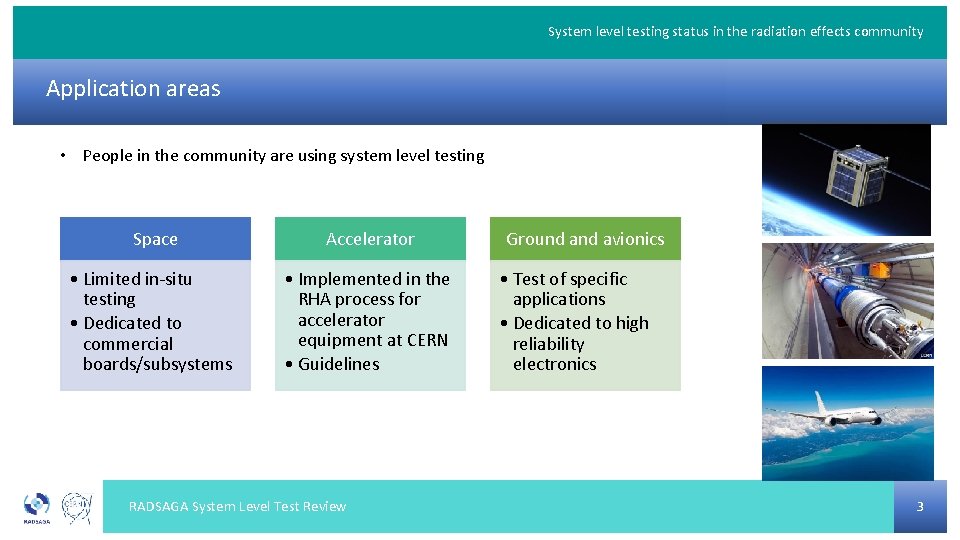
System level testing status in the radiation effects community Application areas • People in the community are using system level testing Space Accelerator • Limited in-situ testing • Dedicated to commercial boards/subsystems • Implemented in the RHA process for accelerator equipment at CERN • Guidelines RADSAGA System Level Test Review Ground avionics • Test of specific applications • Dedicated to high reliability electronics 3
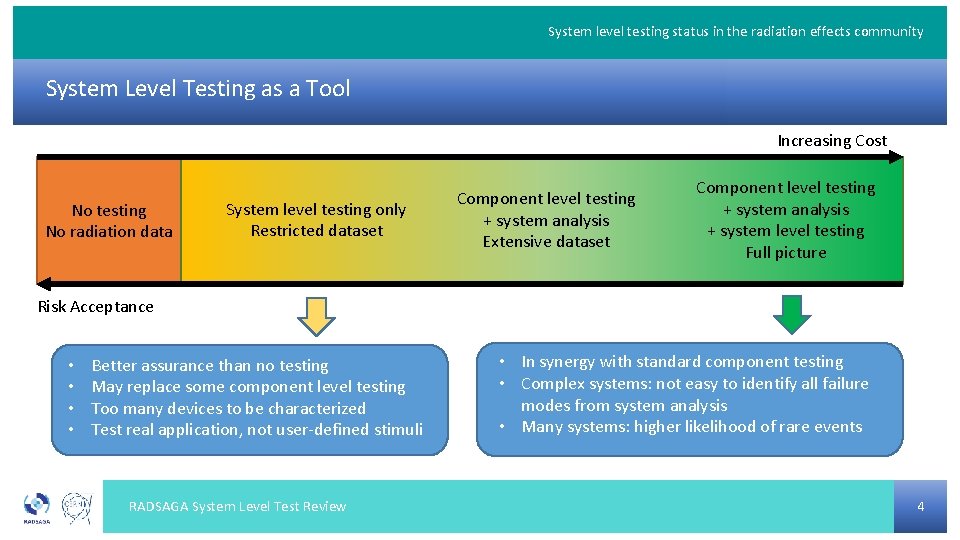
System level testing status in the radiation effects community System Level Testing as a Tool Increasing Cost No testing No radiation data System level testing only Restricted dataset Component level testing + system analysis Extensive dataset Component level testing + system analysis + system level testing Full picture Risk Acceptance • • Better assurance than no testing May replace some component level testing Too many devices to be characterized Test real application, not user-defined stimuli RADSAGA System Level Test Review • In synergy with standard component testing • Complex systems: not easy to identify all failure modes from system analysis • Many systems: higher likelihood of rare events 4
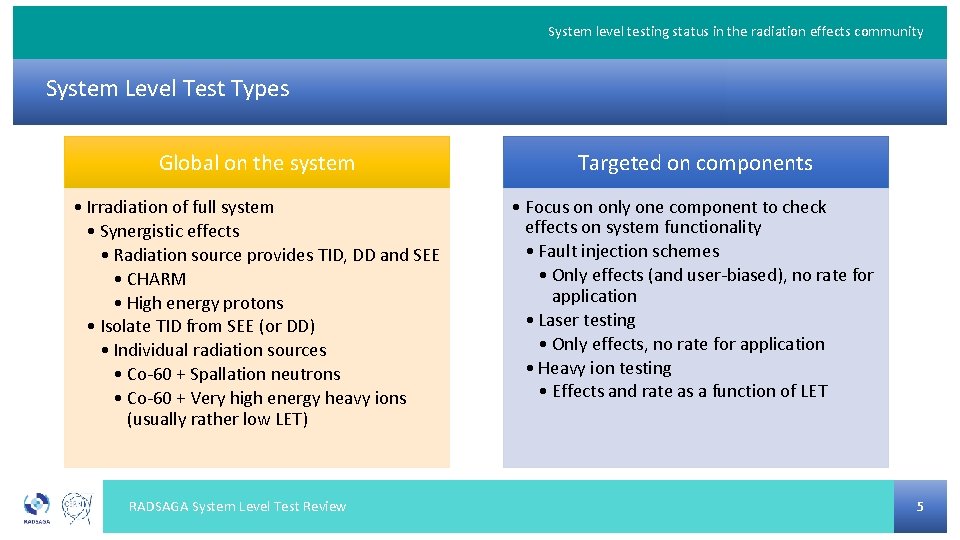
System level testing status in the radiation effects community System Level Test Types Global on the system Targeted on components • Irradiation of full system • Synergistic effects • Radiation source provides TID, DD and SEE • CHARM • High energy protons • Isolate TID from SEE (or DD) • Individual radiation sources • Co-60 + Spallation neutrons • Co-60 + Very high energy heavy ions (usually rather low LET) • Focus on only one component to check effects on system functionality • Fault injection schemes • Only effects (and user-biased), no rate for application • Laser testing • Only effects, no rate for application • Heavy ion testing • Effects and rate as a function of LET RADSAGA System Level Test Review 5
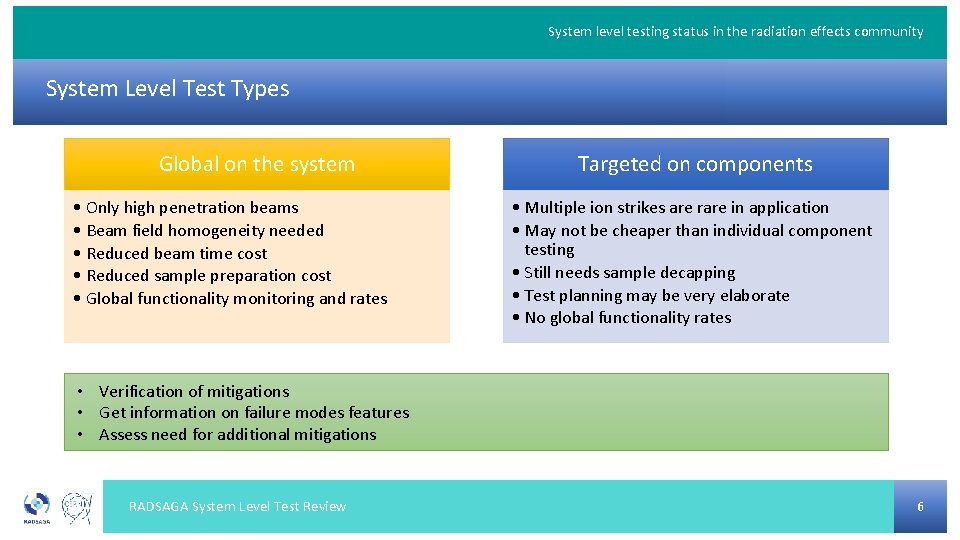
System level testing status in the radiation effects community System Level Test Types Global on the system • Only high penetration beams • Beam field homogeneity needed • Reduced beam time cost • Reduced sample preparation cost • Global functionality monitoring and rates Targeted on components • Multiple ion strikes are rare in application • May not be cheaper than individual component testing • Still needs sample decapping • Test planning may be very elaborate • No global functionality rates • Verification of mitigations • Get information on failure modes features • Assess need for additional mitigations RADSAGA System Level Test Review 6
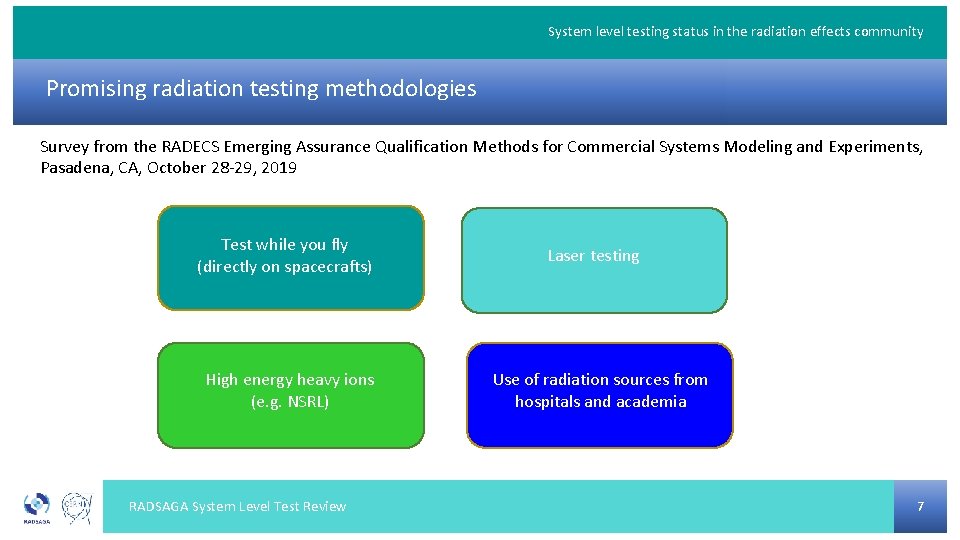
System level testing status in the radiation effects community Promising radiation testing methodologies Survey from the RADECS Emerging Assurance Qualification Methods for Commercial Systems Modeling and Experiments, Pasadena, CA, October 28 -29, 2019 Test while you fly (directly on spacecrafts) High energy heavy ions (e. g. NSRL) RADSAGA System Level Test Review Laser testing Use of radiation sources from hospitals and academia 7
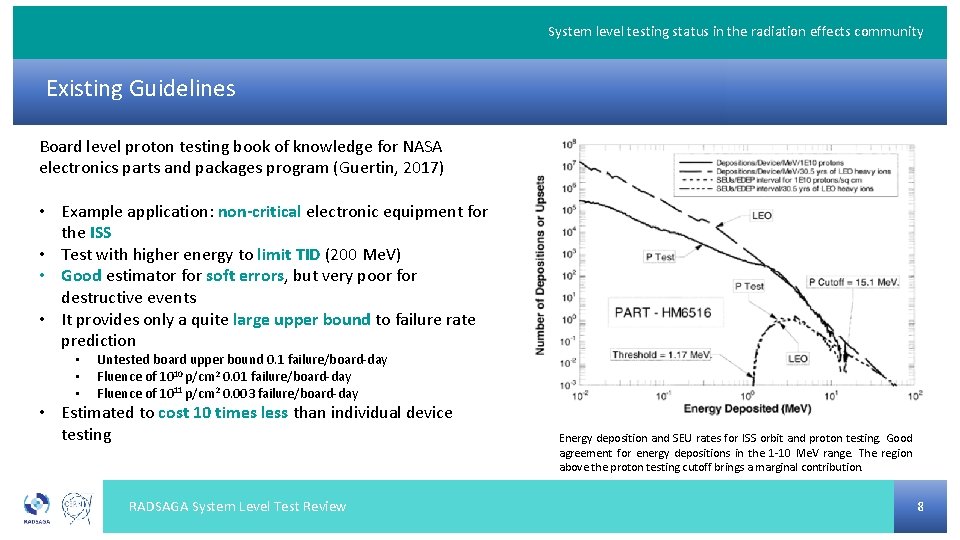
System level testing status in the radiation effects community Existing Guidelines Board level proton testing book of knowledge for NASA electronics parts and packages program (Guertin, 2017) • Example application: non-critical electronic equipment for the ISS • Test with higher energy to limit TID (200 Me. V) • Good estimator for soft errors, but very poor for destructive events • It provides only a quite large upper bound to failure rate prediction • • • Untested board upper bound 0. 1 failure/board-day Fluence of 1010 p/cm 2 0. 01 failure/board-day Fluence of 1011 p/cm 2 0. 003 failure/board-day • Estimated to cost 10 times less than individual device testing RADSAGA System Level Test Review Energy deposition and SEU rates for ISS orbit and proton testing. Good agreement for energy depositions in the 1 -10 Me. V range. The region above the proton testing cutoff brings a marginal contribution. 8
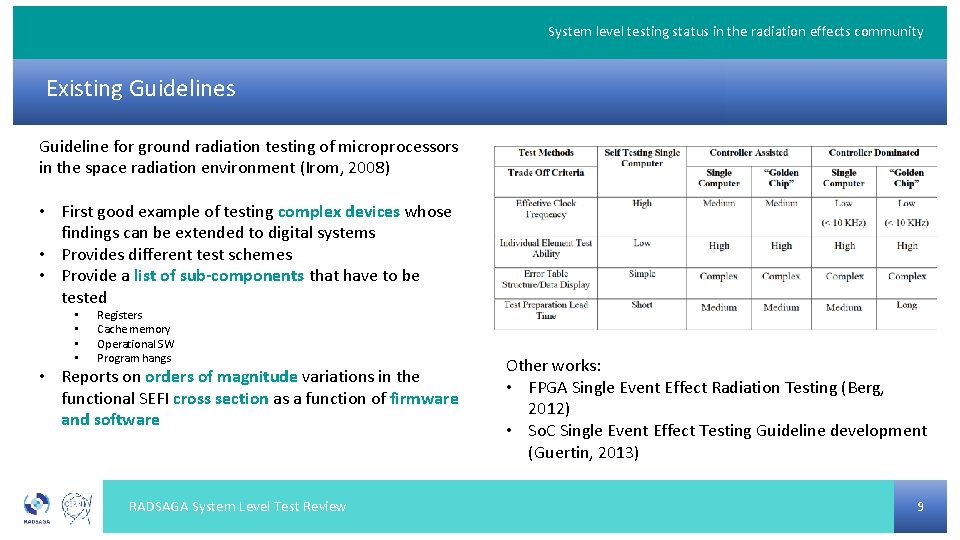
System level testing status in the radiation effects community Existing Guidelines Guideline for ground radiation testing of microprocessors in the space radiation environment (Irom, 2008) • First good example of testing complex devices whose findings can be extended to digital systems • Provides different test schemes • Provide a list of sub-components that have to be tested • • Registers Cache memory Operational SW Program hangs • Reports on orders of magnitude variations in the functional SEFI cross section as a function of firmware and software RADSAGA System Level Test Review Other works: • FPGA Single Event Effect Radiation Testing (Berg, 2012) • So. C Single Event Effect Testing Guideline development (Guertin, 2013) 9
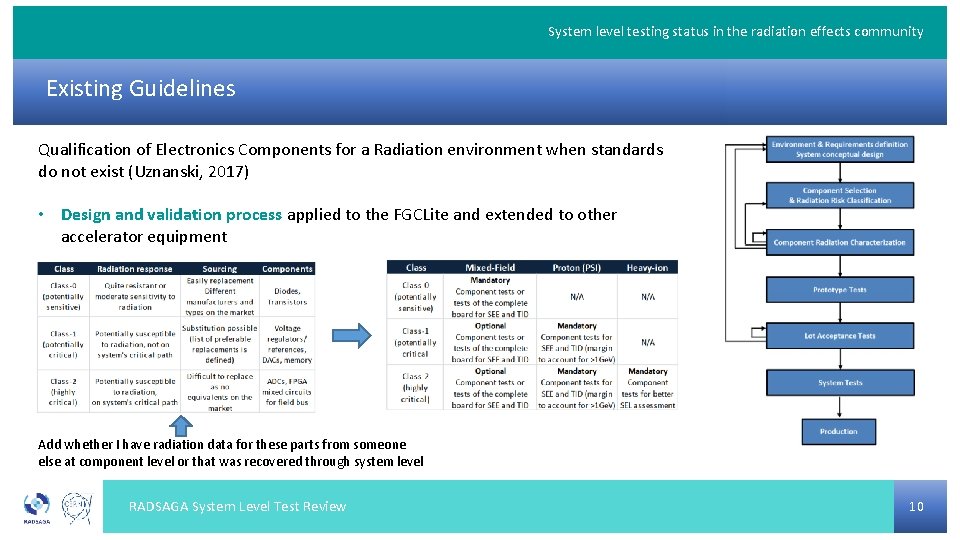
System level testing status in the radiation effects community Existing Guidelines Qualification of Electronics Components for a Radiation environment when standards do not exist (Uznanski, 2017) • Design and validation process applied to the FGCLite and extended to other accelerator equipment Add whether I have radiation data for these parts from someone else at component level or that was recovered through system level RADSAGA System Level Test Review 10
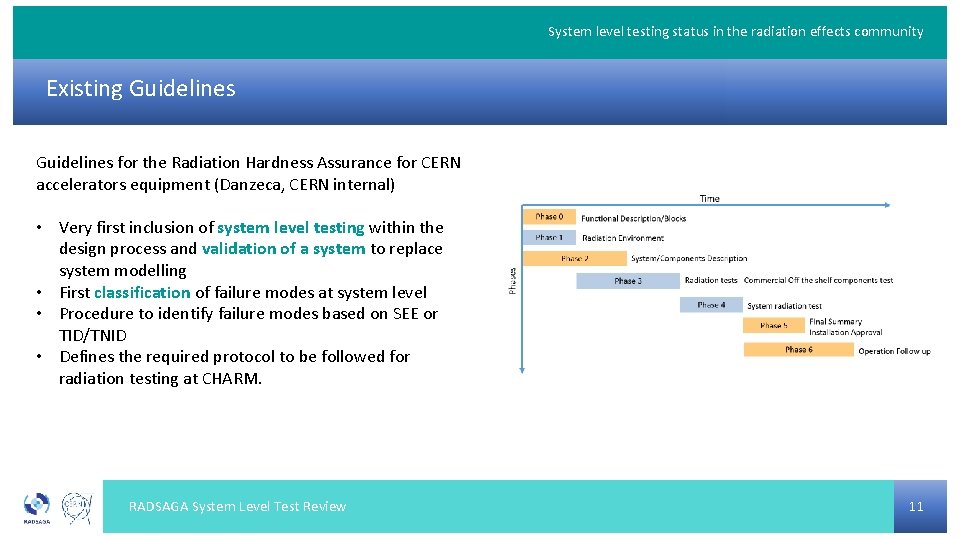
System level testing status in the radiation effects community Existing Guidelines for the Radiation Hardness Assurance for CERN accelerators equipment (Danzeca, CERN internal) • Very first inclusion of system level testing within the design process and validation of a system to replace system modelling • First classification of failure modes at system level • Procedure to identify failure modes based on SEE or TID/TNID • Defines the required protocol to be followed for radiation testing at CHARM. RADSAGA System Level Test Review 11
System level testing status in the radiation effects community Within the community • Radiation effects engineers have been doing board/module/sub-system/system level testing over the last 20 years • There’s currently no session in conferences for radiation effects at system level and some publications may fall out of scope within TNS • There’s very poor documentation in literature of such tests • Tested applications may be IPs • Confidentiality needed for parts used within the system • Lack of standardization on how system level data shall be reported • e. g will the test report of a commercial PCB contain all the information that are needed if someone wants to buy and use the same PCB? RADSAGA System Level Test Review 12
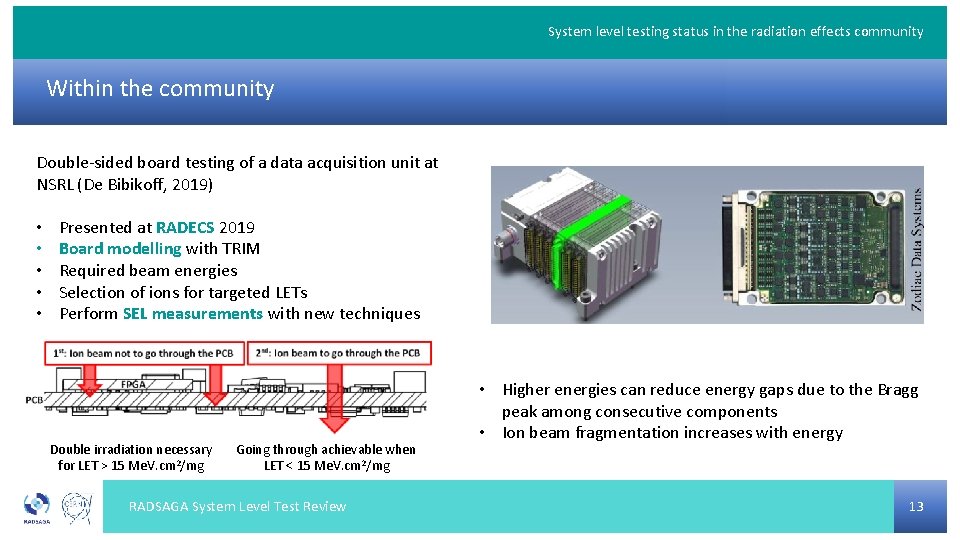
System level testing status in the radiation effects community Within the community Double-sided board testing of a data acquisition unit at NSRL (De Bibikoff, 2019) • • • Presented at RADECS 2019 Board modelling with TRIM Required beam energies Selection of ions for targeted LETs Perform SEL measurements with new techniques Double irradiation necessary for LET > 15 Me. V. cm 2/mg Going through achievable when LET < 15 Me. V. cm 2/mg RADSAGA System Level Test Review • Higher energies can reduce energy gaps due to the Bragg peak among consecutive components • Ion beam fragmentation increases with energy 13
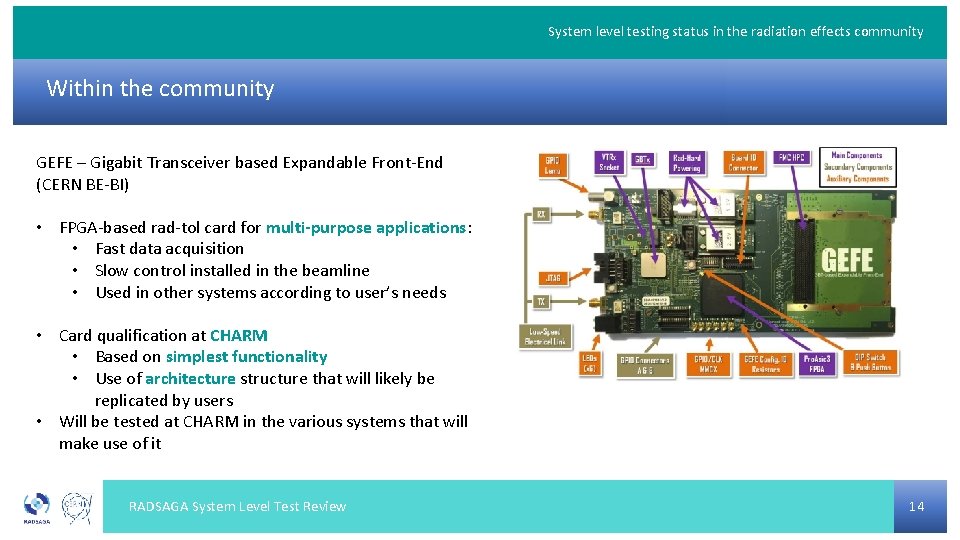
System level testing status in the radiation effects community Within the community GEFE – Gigabit Transceiver based Expandable Front-End (CERN BE-BI) • FPGA-based rad-tol card for multi-purpose applications: • Fast data acquisition • Slow control installed in the beamline • Used in other systems according to user’s needs • Card qualification at CHARM • Based on simplest functionality • Use of architecture structure that will likely be replicated by users • Will be tested at CHARM in the various systems that will make use of it RADSAGA System Level Test Review 14
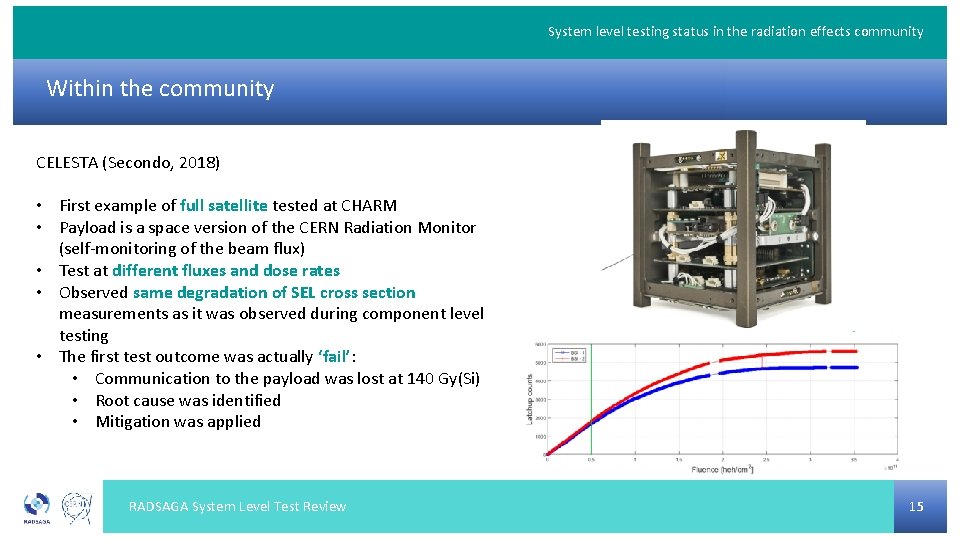
System level testing status in the radiation effects community Within the community CELESTA (Secondo, 2018) • First example of full satellite tested at CHARM • Payload is a space version of the CERN Radiation Monitor (self-monitoring of the beam flux) • Test at different fluxes and dose rates • Observed same degradation of SEL cross section measurements as it was observed during component level testing • The first test outcome was actually ‘fail’: • Communication to the payload was lost at 140 Gy(Si) • Root cause was identified • Mitigation was applied RADSAGA System Level Test Review 15
System level testing status in the radiation effects community Objections to system level testing With respect to no testing • It is expensive • I don’t know how to do it • It’s not recognized by certification institutes as a way to perform RHA • It is done only for in-house developments With respect to replacing component level testing • It is a pass/fail test • Not clear what to do if the outcome is ‘fail’ • Lack of observability • I may not understand what went wrong • Worst Case Analysis for TID • Cannot be performed without individual component level testing • Data portability • I have to start over even if I use same components • Limited level of confidence RADSAGA System Level Test Review 16
System level testing status in the radiation effects community A. Coronetti CERN, 1211 Geneva, Switzerland RADSAGA System Level Test Review November 12 th, 2019 RADSAGA is a project funded by the European Union’s Horizon 2020 research and innovation programme under the MSC agreement no. 721624.