
System Level Neuroengineering Modeling of the Nervous System





- Slides: 67
System Level Neuroengineering Modeling of the Nervous System Cancun Dec 2008 I. Steve Massaquoi i. iii. iv. v. The Problem Overview of sensorimotor control system Attention to cerebellar system architecture RIPID control model as example of medium high level model Preliminary implications of model II. Kazutaka Takahashi i. iii. iv. Cerebrocerebellar system architecture in greater detail RICSS Quantitative model of internal signal generation Model adequacy and modeling issues Relation of dynamic models to point process signal analysis
System Level Neuroengineering Modeling of Nervous System I. Massaquoi CDC Cancun 2008 I. The Problem to develop increasingly comprehensive, integrated, multi-resolution engineering models of nervous system structure and function Motivations Scientific: i. understanding the principles of human behavior and intelligence in quantitative, mechanistic terms ii. understanding the principles of neurological and psychiatric disease in quantitative, mechanistic terms Engineering: i. design of devices to mimic and potentially supersede human behavior artificially ii. development of devices that better interact with the nervous system to study, restore or extend human function
System Level Neuroengineering Modeling of Nervous System I. Massaquoi CDC Cancun 2008 I The Problem (cont’d) Key Challenges (constraints) for Neuroengineering models: A. Models must respect known or highly suspected neuroantomical connections B. Models must respect known time delays and phase lags (these are non-trivial) C. Models must utilize functions that are known to be achievable by collections of neurons. (e. g. Quantitative multiplication ? ) D. Models must be consistent with both normal human function, and pathological dysfunction. E. Models of human function should be able to be related to those of animals in a manner consistent with natural evolution (i. e. continuously) F. Models must ultimately account for the firing behavior of system neurons (i. e. must be multi-resolution)
System Level Neuroengineering Modeling of Nervous System I. Massaquoi CDC Cancun 2008 I The Problem (cont’d) Style of approach: Ideal features of Neuroengineering models: A. Models should seek to explain the nervous system in terms of established engineering principles and abstractions (e. g. filters, estimators, feedback/feedforward controllers, registers, switches not simply to formulate a computational model) B. Models should point to potentially fruitful areas of engineering research where current engineering methods are lacking. • Models are more profitably driven by science, and guided by engineering principles. . . Rather than vice versa (editorial remark!)
System Level Neuroengineering Modeling of Nervous System I. Massaquoi CDC Cancun 2008 I The Problem (cont’d) Neuroengineering strategy Modeling and analysis Behavior & Intelligence: Bottom up Primitive complex mimicking evolution editorial comment #2 Intelligence will emerge
System Level Neuroengineering Modeling of Nervous System I. Massaquoi CDC Cancun 2008 I The Problem (cont’d) Neuroengineering strategy Modeling and analysis Behavior & Intelligence: Bottom up Primitive complex mimicking evolution editorial comment #2 Intelligence will emerge Modeling and analysis of Physiology: Simultaneous multi-resolution neuron circuits architecture Massaquoi
System Level Neuroengineering Modeling of Nervous System I. Massaquoi CDC Cancun 2008 I The Problem (cont’d) Neuroengineering strategy Modeling and analysis Behavior & Intelligence: Bottom up Primitive complex mimicking evolution editorial comment #2 Intelligence will emerge Modeling and analysis of Physiology: Simultaneous multi-resolution neuron circuits architecture Takahashi
System Level Neuroengineering Modeling of Nervous System I. Massaquoi CDC Cancun 2008 I The Problem (cont’d) Neuroengineering strategy Modeling and analysis Behavior & Intelligence: Bottom up Primitive complex mimicking evolution editorial comment #2 Intelligence will emerge Modeling and analysis of Physiology: Simultaneous multi-resolution neuron circuits architecture Emphasis for rest of session
System Level Neuroengineering Modeling of Nervous System I. Massaquoi CDC Cancun 2008 I The Problem (cont’d) Neuroengineering strategy Modeling and analysis Behavior & Intelligence: Bottom up Primitive complex mimicking evolution editorial comment #2 Intelligence will emerge Modeling and analysis of Physiology: Simultaneous multi-resolution neuron circuits architecture Investigate both health and disease
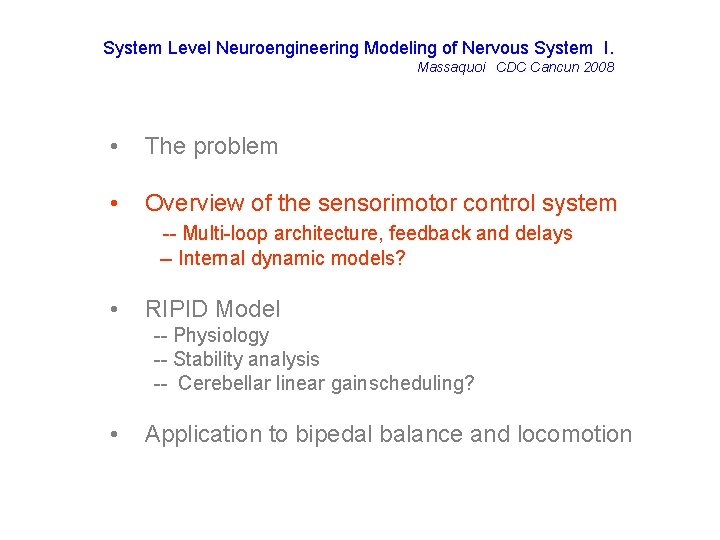
System Level Neuroengineering Modeling of Nervous System I. Massaquoi CDC Cancun 2008 • The problem • Overview of the sensorimotor control system -- Multi-loop architecture, feedback and delays -- Internal dynamic models? • RIPID Model -- Physiology -- Stability analysis -- Cerebellar linear gainscheduling? • Application to bipedal balance and locomotion
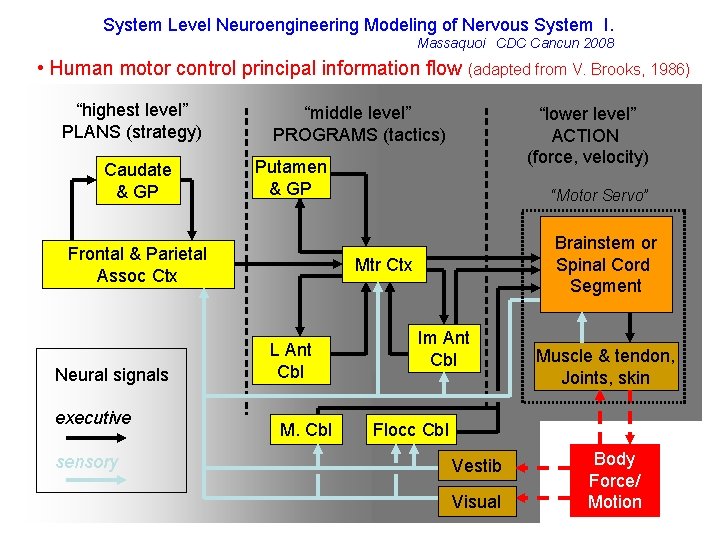
System Level Neuroengineering Modeling of Nervous System I. Massaquoi CDC Cancun 2008 • Human motor control principal information flow (adapted from V. Brooks, 1986) “highest level” PLANS (strategy) Caudate & GP “middle level” PROGRAMS (tactics) Putamen & GP Frontal & Parietal Assoc Ctx Neural signals executive sensory “lower level” ACTION (force, velocity) “Motor Servo” Brainstem or Spinal Cord Segment Mtr Ctx L Ant Cbl M. Cbl Im Ant Cbl Muscle & tendon, Joints, skin Flocc Cbl Vestib Visual Body Force/ Motion
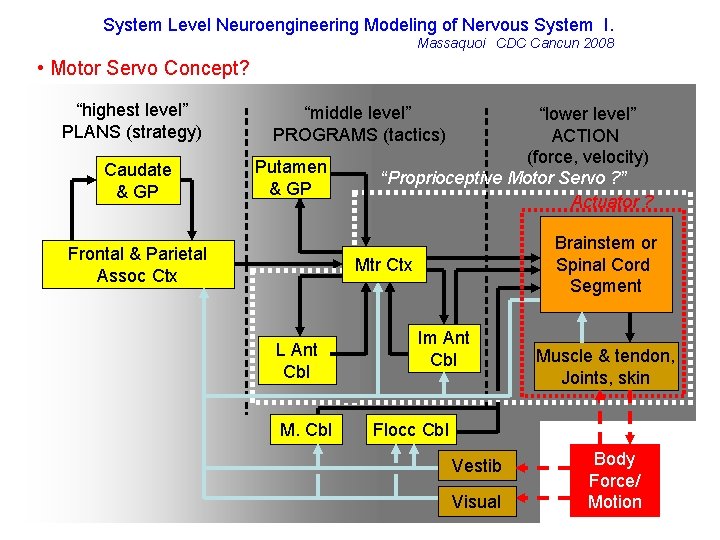
System Level Neuroengineering Modeling of Nervous System I. Massaquoi CDC Cancun 2008 • Motor Servo Concept? “highest level” PLANS (strategy) Caudate & GP “middle level” PROGRAMS (tactics) Putamen & GP Frontal & Parietal Assoc Ctx “lower level” ACTION (force, velocity) “Proprioceptive Motor Servo ? ” Actuator ? Brainstem or Spinal Cord Segment Mtr Ctx L Ant Cbl M. Cbl Im Ant Cbl Muscle & tendon, Joints, skin Flocc Cbl Vestib Visual Body Force/ Motion
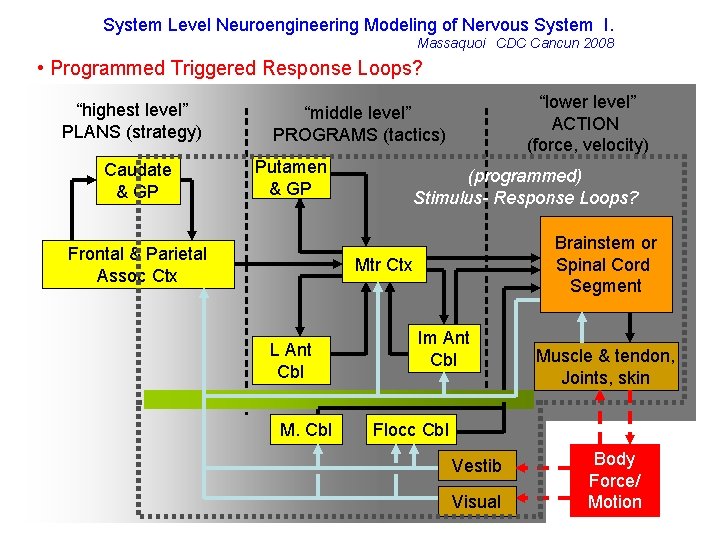
System Level Neuroengineering Modeling of Nervous System I. Massaquoi CDC Cancun 2008 • Programmed Triggered Response Loops? “highest level” PLANS (strategy) Caudate & GP “lower level” ACTION (force, velocity) “middle level” PROGRAMS (tactics) Putamen & GP Frontal & Parietal Assoc Ctx (programmed) Stimulus- Response Loops? Brainstem or Spinal Cord Segment Mtr Ctx L Ant Cbl M. Cbl Im Ant Cbl Muscle & tendon, Joints, skin Flocc Cbl Vestib Visual Body Force/ Motion
System Level Neuroengineering Modeling of Nervous System I. Massaquoi CDC Cancun 2008 • Possible refinement of upper portion “high level” “highest level” PROGRAMS PLANS, (discrete control) ALGORITHMS (tactics: trajectories (free assoc, strategy) cues) Caudate & GP “intermediate level” CONTROL (continuous control) (stability, tracking, stiffness, scaling, movement time) Putamen & GP, SN “Proprioceptive Motor Servo ? ” Frontal & Parietal Assoc Ctx Primary & Peri. Sensorimotor Ctxs L Post Crerebellum Cognitive Programming? Mtr Ctx L Ant Cbl M. Cbl (programmed) Stimulus- Response Loops? Im Ant Cbl Flocc Cbl
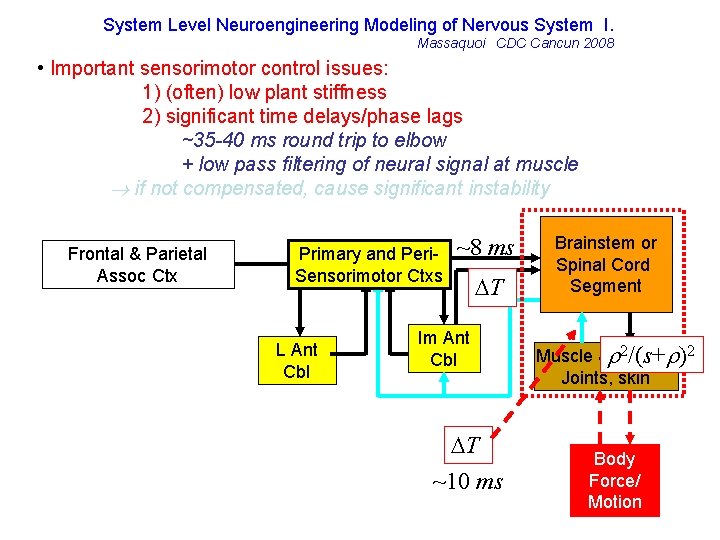
System Level Neuroengineering Modeling of Nervous System I. Massaquoi CDC Cancun 2008 • Important sensorimotor control issues: 1) (often) low plant stiffness 2) significant time delays/phase lags ~35 -40 ms round trip to elbow + low pass filtering of neural signal at muscle if not compensated, cause significant instability Frontal & Parietal Assoc Ctx Primary and Peri. Mtr Ctx Sensorimotor Ctxs L Ant Cbl ~8 ms DT Im Ant Cbl DT ~10 ms Brainstem or Spinal Cord Segment 2/(s+r)2 Muscle &rtendon, Joints, skin Body Force/ Motion
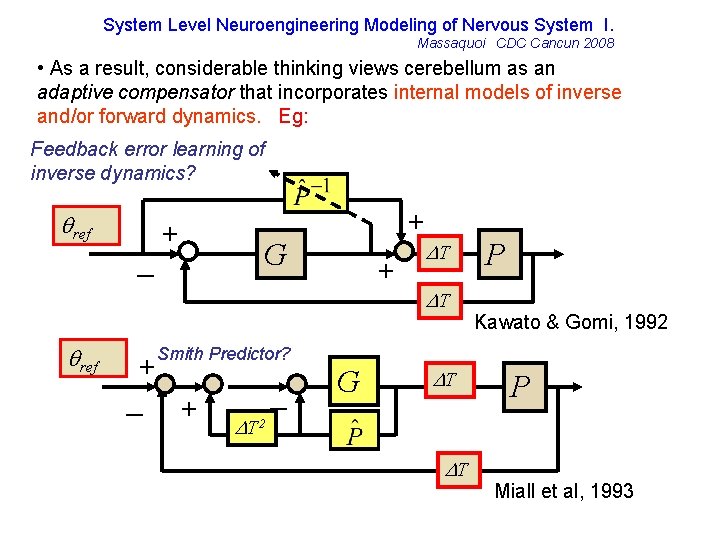
System Level Neuroengineering Modeling of Nervous System I. Massaquoi CDC Cancun 2008 • As a result, considerable thinking views cerebellum as an adaptive compensator that incorporates internal models of inverse and/or forward dynamics. Eg: Feedback error learning of inverse dynamics? qref + G – qref + – + Smith Predictor? + D T 2 – + G DT DT P Kawato & Gomi, 1992 P Miall et al, 1993
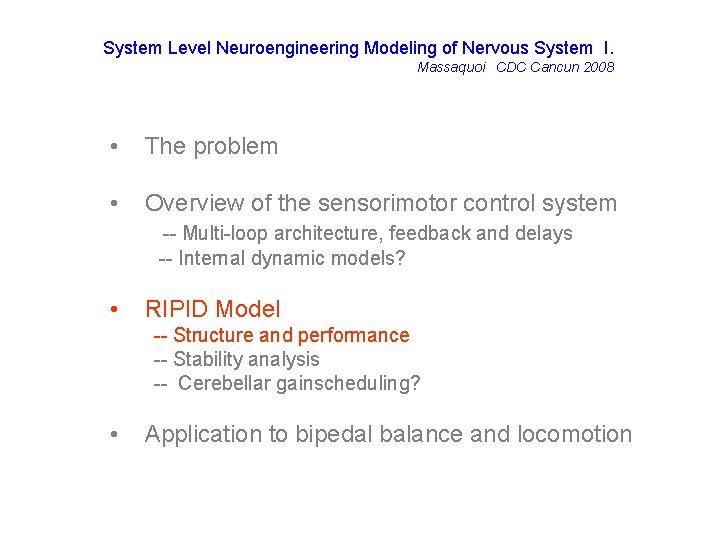
System Level Neuroengineering Modeling of Nervous System I. Massaquoi CDC Cancun 2008 • The problem • Overview of the sensorimotor control system -- Multi-loop architecture, feedback and delays -- Internal dynamic models? • RIPID Model -- Structure and performance -- Stability analysis -- Cerebellar gainscheduling? • Application to bipedal balance and locomotion
Simpler control approaches may also fit better with what is known about cerebellar architecture
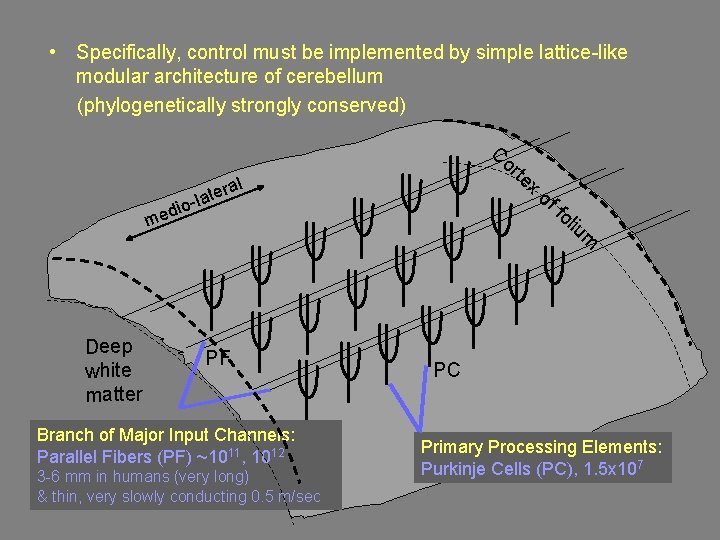
• Specifically, control must be implemented by simple lattice-like modular architecture of cerebellum (phylogenetically strongly conserved) Co r te ral e t la dioe m Deep white matter PF Branch of Major Input Channels: Parallel Fibers (PF) ~1011, 1012 3 -6 mm in humans (very long) & thin, very slowly conducting 0. 5 m/sec x of fo liu m PC Primary Processing Elements: Purkinje Cells (PC), 1. 5 x 10⁷
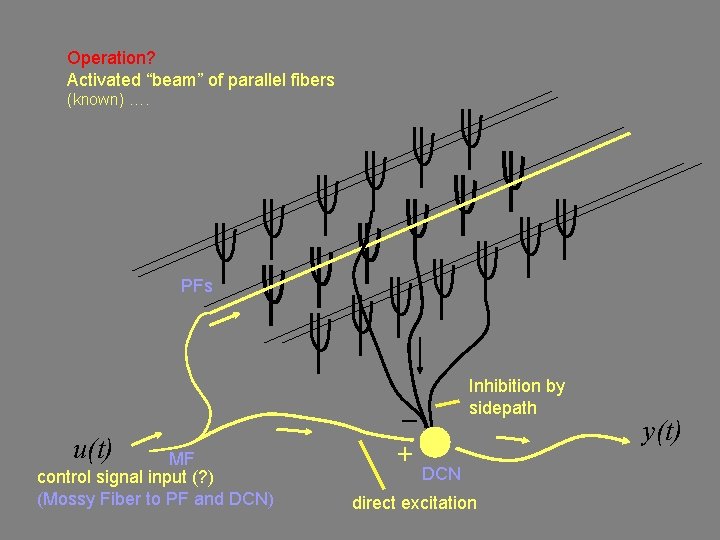
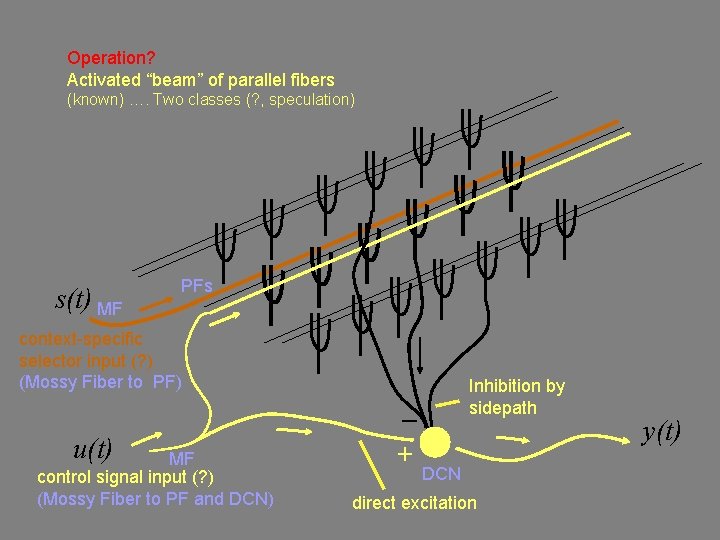
Operation? Activated “beam” of parallel fibers (known) …. PFs u(t) MF control signal input (? ) (Mossy Fiber to PF and DCN) – + Inhibition by sidepath DCN direct excitation y(t)
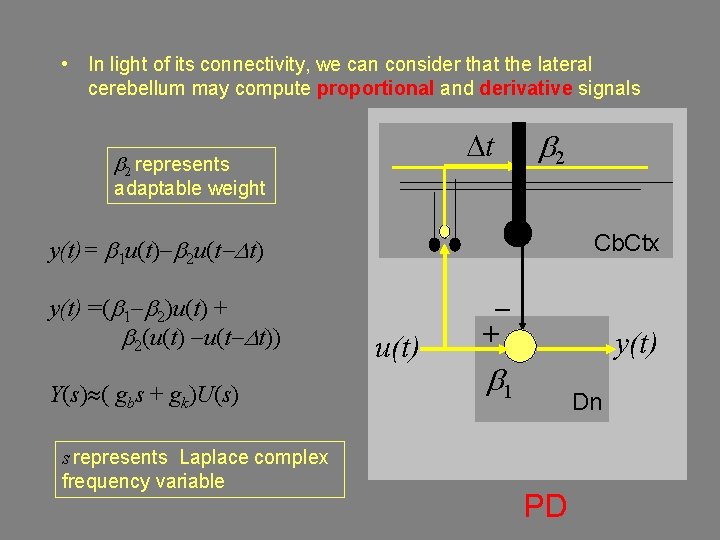
• In light of its connectivity, we can consider that the lateral cerebellum may compute proportional and derivative signals Dt b 2 represents b 2 adaptable weight Cb. Ctx y(t)= b 1 u(t)-b 2 u(t-Dt) y(t) =(b 1 -b 2)u(t) + b 2(u(t) -u(t-Dt)) Y(s) ( gbs + gk)U(s) s represents Laplace complex frequency variable u(t) + y(t) b 1 Dn PD
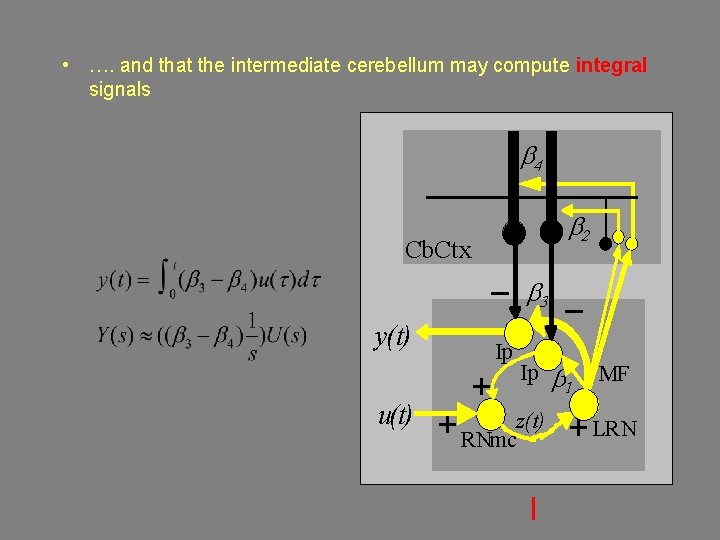
• …. and that the intermediate cerebellum may compute integral signals b 4 b 2 Cb. Ctx - b 3 y(t) u(t) + + Ip - Ip b 1 z(t) RNmc I MF + LRN
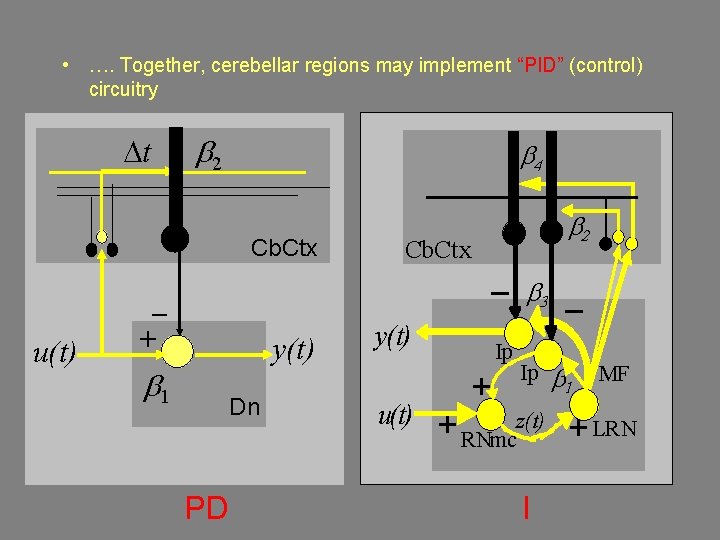
• …. Together, cerebellar regions may implement “PID” (control) circuitry Dt b 2 b 4 Cb. Ctx u(t) b 2 Cb. Ctx - b 3 + y(t) b 1 Dn PD y(t) u(t) + + Ip - Ip b 1 z(t) RNmc I MF + LRN
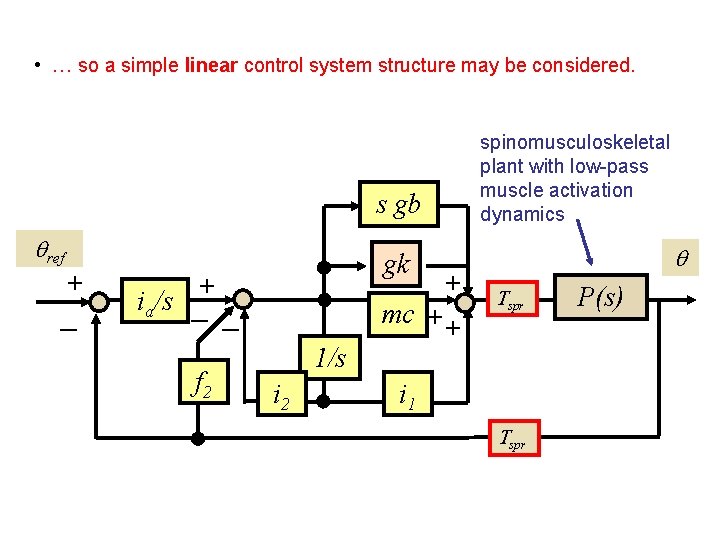
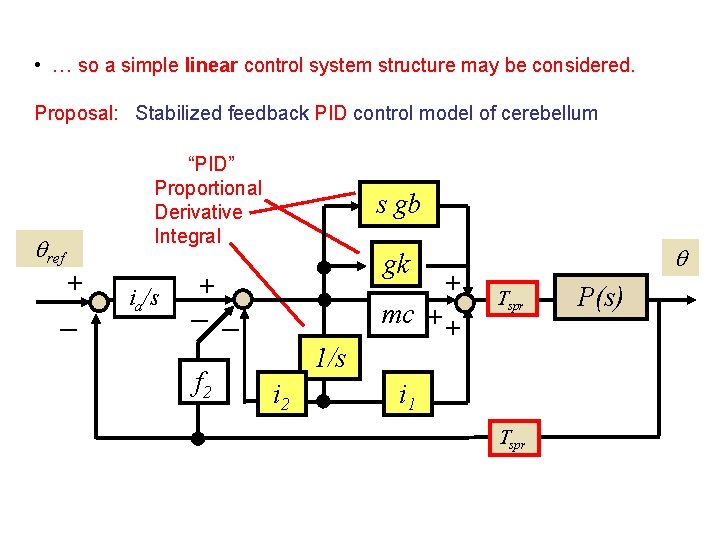
• … so a simple linear control system structure may be considered. spinomusculoskeletal plant with low-pass muscle activation dynamics s gb qref + – ia/s gk + – – f 2 1/s i 2 + mc + + q Tspr i 1 Tspr P(s)
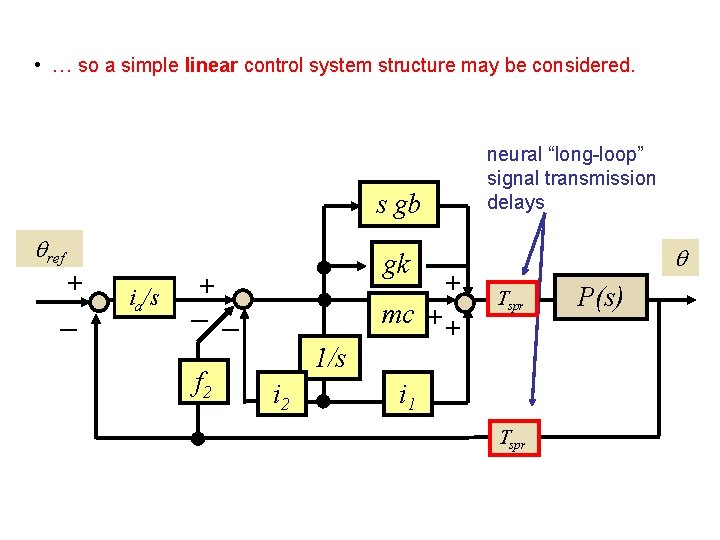
• … so a simple linear control system structure may be considered. neural “long-loop” signal transmission delays s gb qref + – ia/s gk + – – f 2 1/s i 2 + mc + + q Tspr i 1 Tspr P(s)
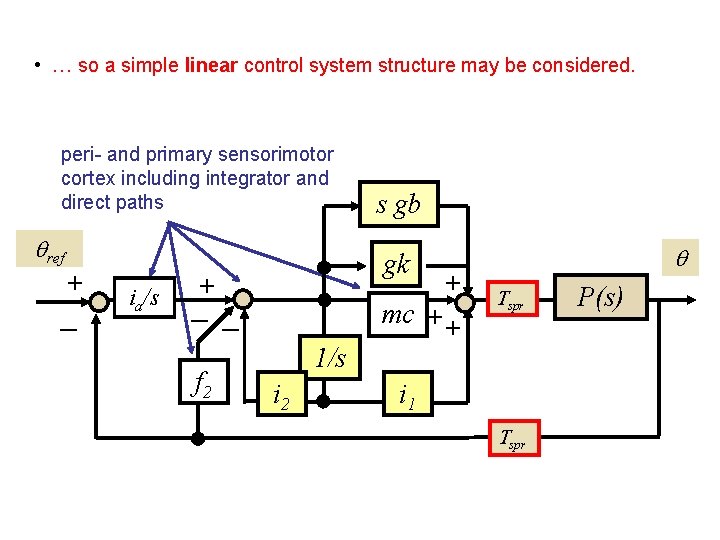
• … so a simple linear control system structure may be considered. peri- and primary sensorimotor cortex including integrator and direct paths qref + – ia/s gk + – – f 2 s gb 1/s i 2 + mc + + q Tspr i 1 Tspr P(s)
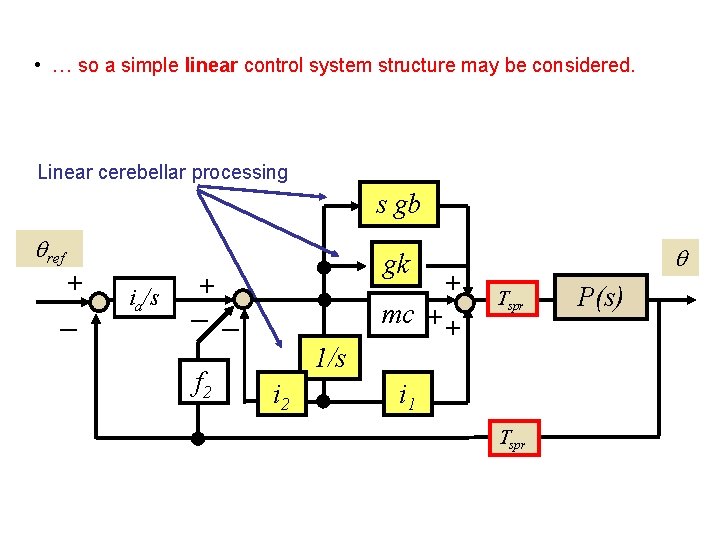
• … so a simple linear control system structure may be considered. Linear cerebellar processing s gb qref + – ia/s gk + – – f 2 1/s i 2 + mc + + q Tspr i 1 Tspr P(s)
• … so a simple linear control system structure may be considered. Proposal: Stabilized feedback PID control model of cerebellum “PID” Proportional Derivative Integral qref + – ia/s s gb gk + – – f 2 1/s i 2 + mc + + q Tspr i 1 Tspr P(s)
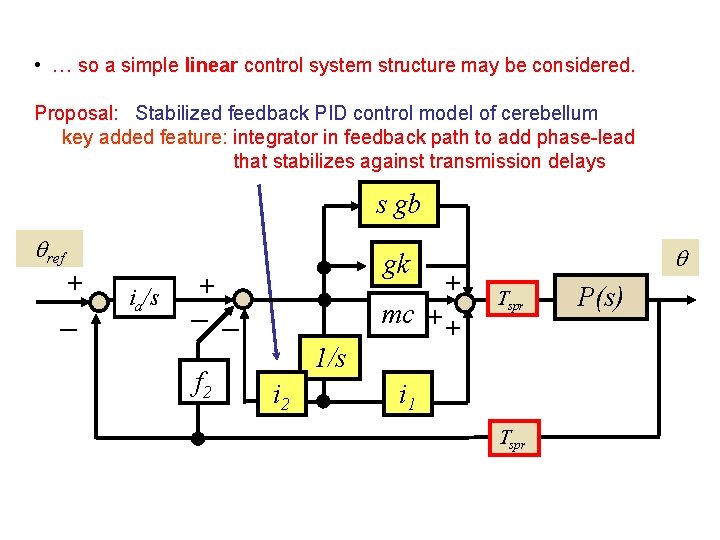
• … so a simple linear control system structure may be considered. Proposal: Stabilized feedback PID control model of cerebellum key added feature: integrator in feedback path to add phase-lead that stabilizes against transmission delays s gb qref + – ia/s gk + – – f 2 1/s i 2 + mc + + q Tspr i 1 Tspr P(s)
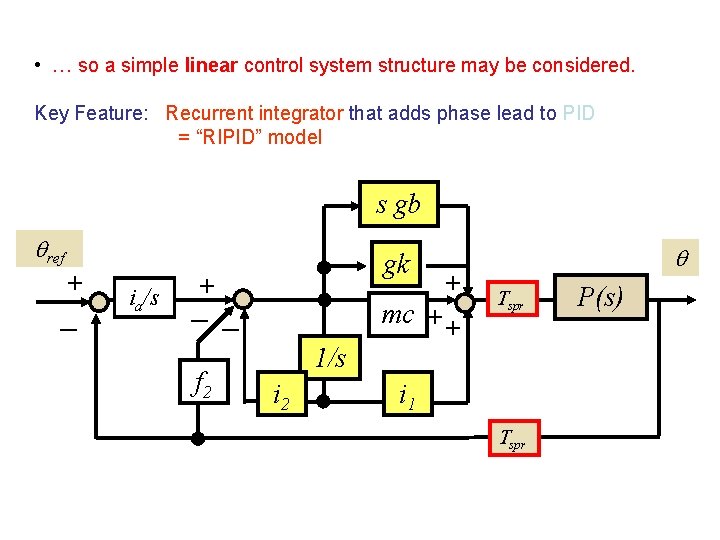
• … so a simple linear control system structure may be considered. Key Feature: Recurrent integrator that adds phase lead to PID = “RIPID” model s gb qref + – ia/s gk + – – f 2 1/s i 2 + mc + + q Tspr i 1 Tspr P(s)
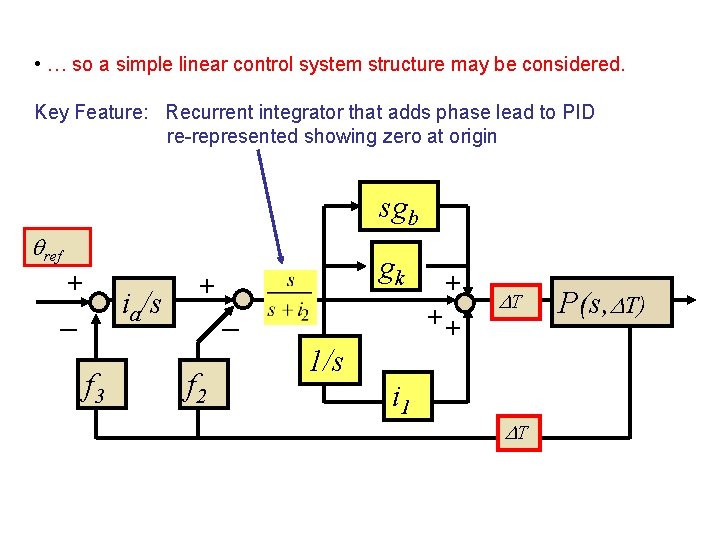
• … so a simple linear control system structure may be considered. Key Feature: Recurrent integrator that adds phase lead to PID re-represented showing zero at origin sgb qref + ia/s – f 3 gk + – f 2 + ++ 1/s i 1 DT DT P(s, DT)
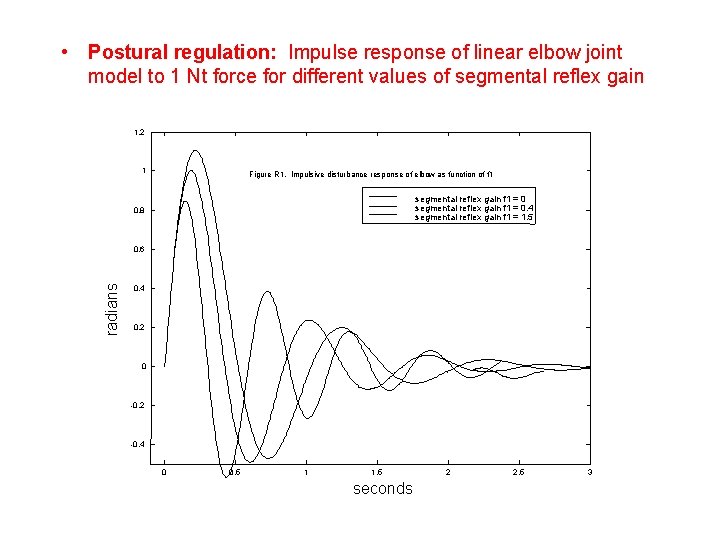
• Postural regulation: Impulse response of linear elbow joint model to 1 Nt force for different values of segmental reflex gain 1. 2 1 Figure R 1. Impulsive disturbance response of elbow as function of f 1 segmental reflex gain f 1 = 0. 4 segmental reflex gain f 1 = 1. 5 0. 8 radians 0. 6 0. 4 0. 2 0 -0. 2 -0. 4 0 0. 5 1 1. 5 seconds 2 2. 5 3
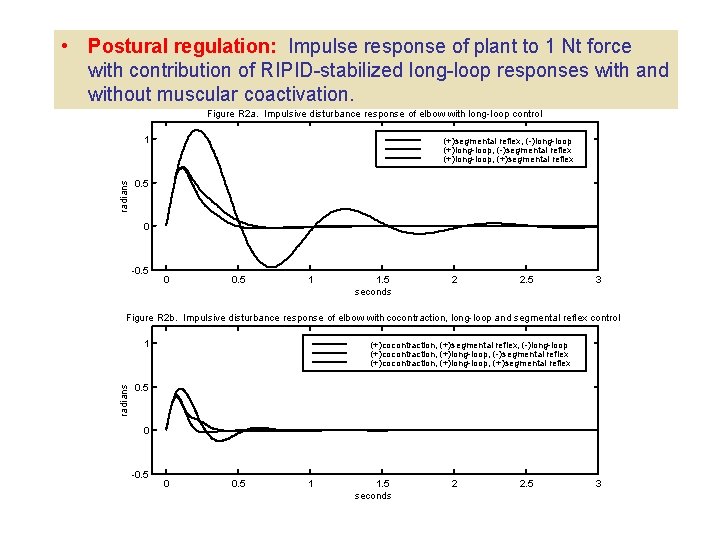
• Postural regulation: Impulse response of plant to 1 Nt force with contribution of RIPID-stabilized long-loop responses with and without muscular coactivation. Figure R 2 a. Impulsive disturbance response of elbow with long-loop control radians 1 (+)segmental reflex, (-)long-loop (+)long-loop, (-)segmental reflex (+)long-loop, (+)segmental reflex 0. 5 0 -0. 5 0 0. 5 1 1. 5 seconds 2 2. 5 3 Figure R 2 b. Impulsive disturbance response of elbow with cocontraction, long-loop and segmental reflex control radians 1 (+)cocontraction, (+)segmental reflex, (-)long-loop (+)cocontraction, (+)long-loop, (-)segmental reflex (+)cocontraction, (+)long-loop, (+)segmental reflex 0. 5 0 -0. 5 0 0. 5 1 1. 5 seconds 2 2. 5 3
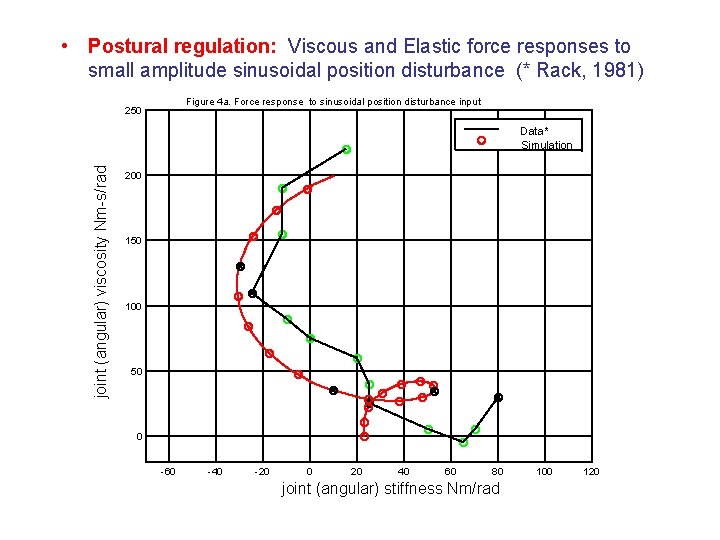
• Postural regulation: Viscous and Elastic force responses to small amplitude sinusoidal position disturbance (* Rack, 1981) Figure 4 a. Force response to sinusoidal position disturbance input 250 joint (angular) viscosity Nm-s/rad Data* Simulation 200 150 100 50 0 -60 -40 -20 0 20 40 60 80 joint (angular) stiffness Nm/rad 100 120
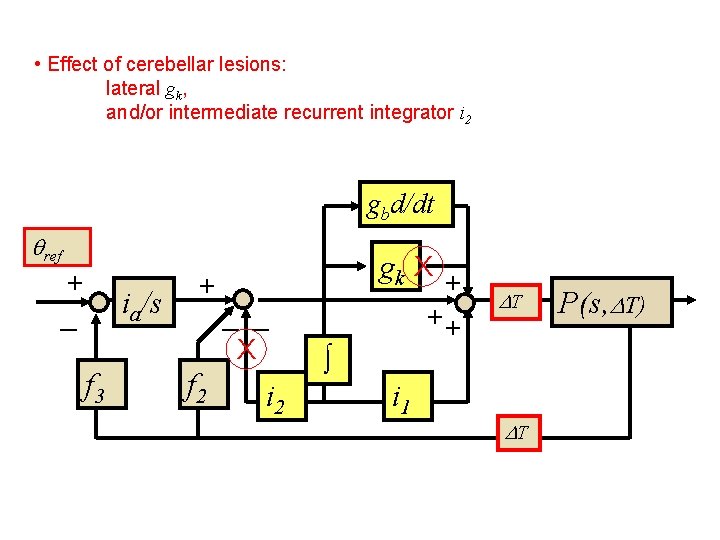
• Effect of cerebellar lesions: lateral gk, and/or intermediate recurrent integrator i 2 gbd/dt qref + ia/s – gk X + + – – X f 3 f 2 i 2 ++ ∫ i 1 DT DT P(s, DT)
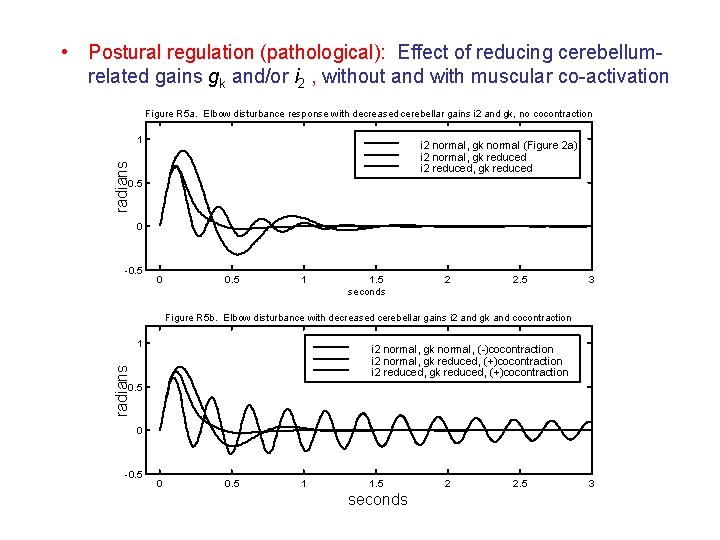
• Postural regulation (pathological): Effect of reducing cerebellumrelated gains gk and/or i 2 , without and with muscular co-activation Figure R 5 a. Elbow disturbance response with decreased cerebellar gains i 2 and gk, no cocontraction 1 radians i 2 normal, gk normal (Figure 2 a) i 2 normal, gk reduced i 2 reduced, gk reduced 0. 5 0 -0. 5 0 0. 5 1 1. 5 seconds 2 2. 5 3 Figure R 5 b. Elbow disturbance with decreased cerebellar gains i 2 and gk and cocontraction 1 radians i 2 normal, gk normal, (-)cocontraction i 2 normal, gk reduced, (+)cocontraction i 2 reduced, gk reduced, (+)cocontraction 0. 5 0 -0. 5 0 0. 5 1 1. 5 seconds 2 2. 5 3
System Level Neuroengineering Modeling of Nervous System I. Massaquoi CDC Cancun 2008 • The problem • Overview of the sensorimotor control system -- Multi-loop architecture, feedback and delays -- Internal dynamic models? • RIPID Model -- Structure & performance -- Stability analysis -- Cerebellar gainscheduling? • Application to bipedal balance and locomotion
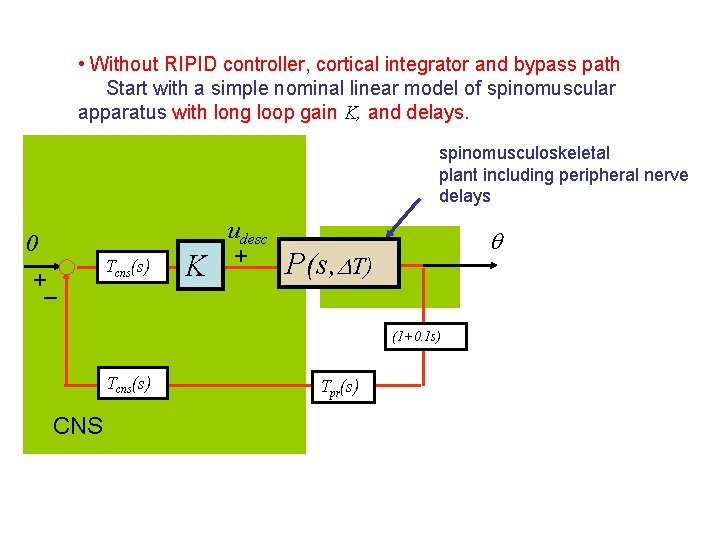
• Without RIPID controller, cortical integrator and bypass path Start with a simple nominal linear model of spinomuscular apparatus with long loop gain K, and delays. spinomusculoskeletal plant including peripheral nerve delays 0 + – Tcns(s) K udesc + q P(s, DT) (1+0. 1 s) Tcns(s) CNS Tpr(s)
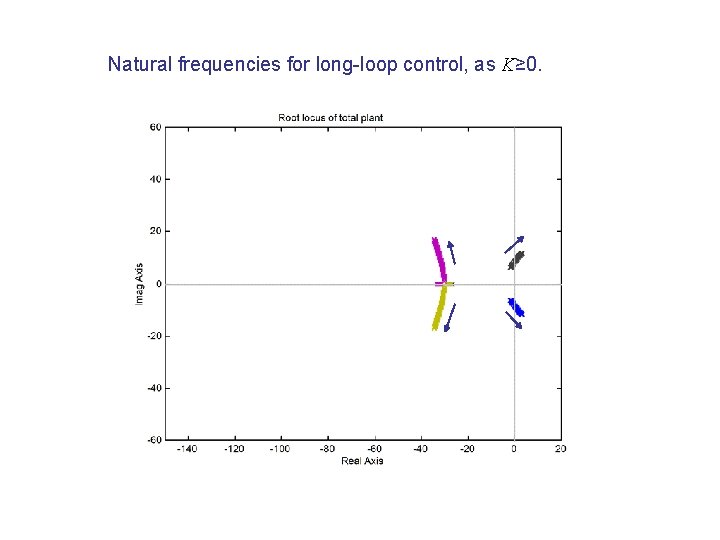
Natural frequencies for long-loop control, as K≥ 0.
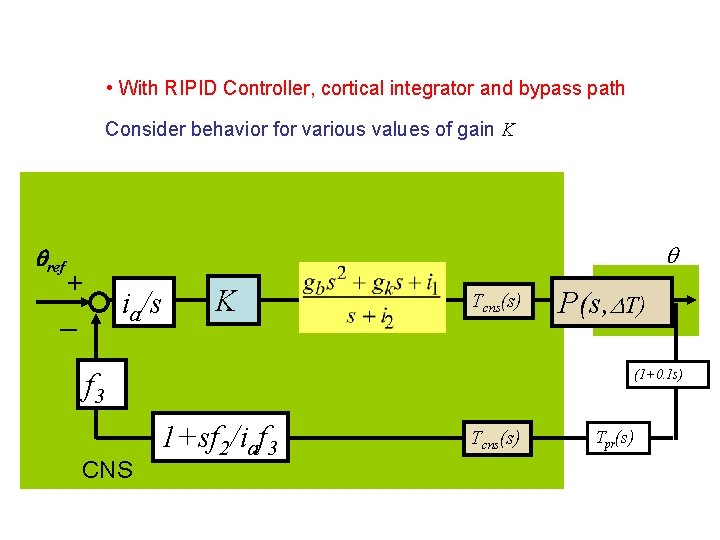
• With RIPID Controller, cortical integrator and bypass path Consider behavior for various values of gain K qref q + ia/s – K Tcns(s) f 3 CNS P(s, DT) (1+0. 1 s) 1+sf 2/iaf 3 Tcns(s) Tpr(s)
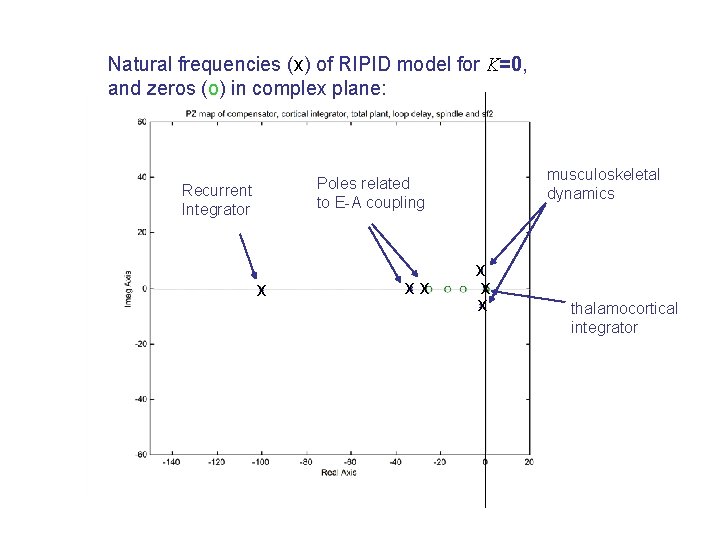
Natural frequencies (x) of RIPID model for K=0, and zeros (o) in complex plane: musculoskeletal dynamics Poles related to E-A coupling Recurrent Integrator x xx x thalamocortical integrator
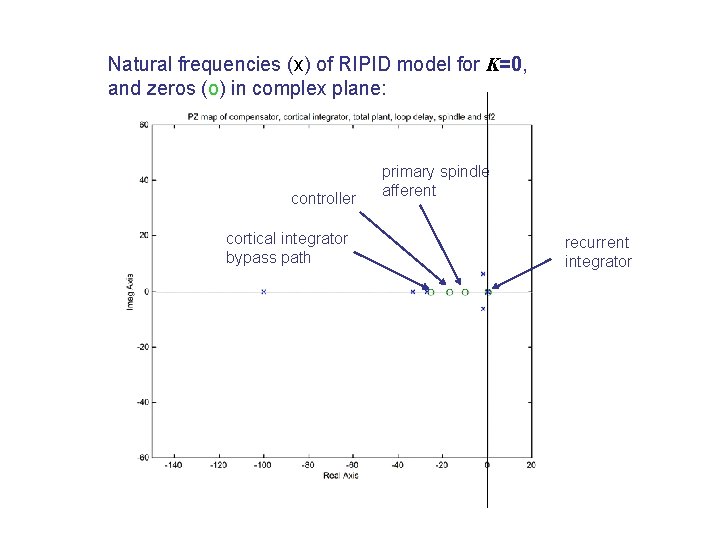
Natural frequencies (x) of RIPID model for K=0, and zeros (o) in complex plane: controller cortical integrator bypass path primary spindle afferent recurrent integrator
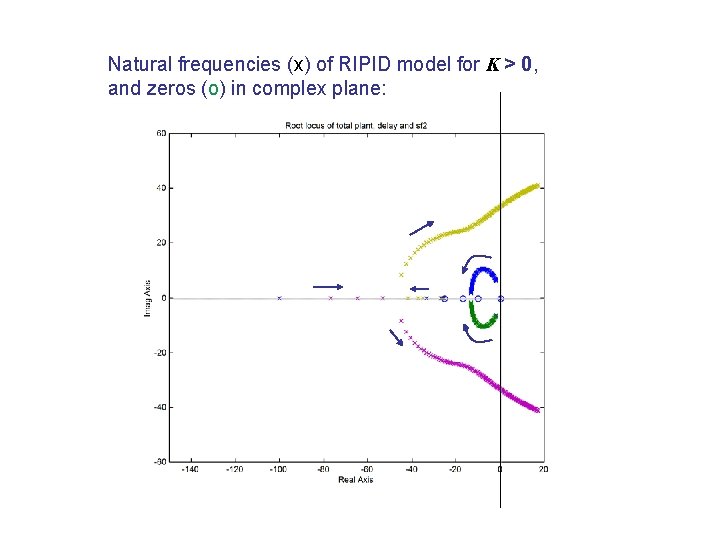
Natural frequencies (x) of RIPID model for K > 0, and zeros (o) in complex plane:
System Level Neuroengineering Modeling of Nervous System I. Massaquoi CDC Cancun 2008 • The problem • Overview of the sensorimotor control system -- Multi-loop architecture, feedback and delays -- Internal dynamic models? • RIPID Model -- Structure & performance -- Stability analysis -- Cerebellar gainscheduling? • Application to bipedal balance and locomotion
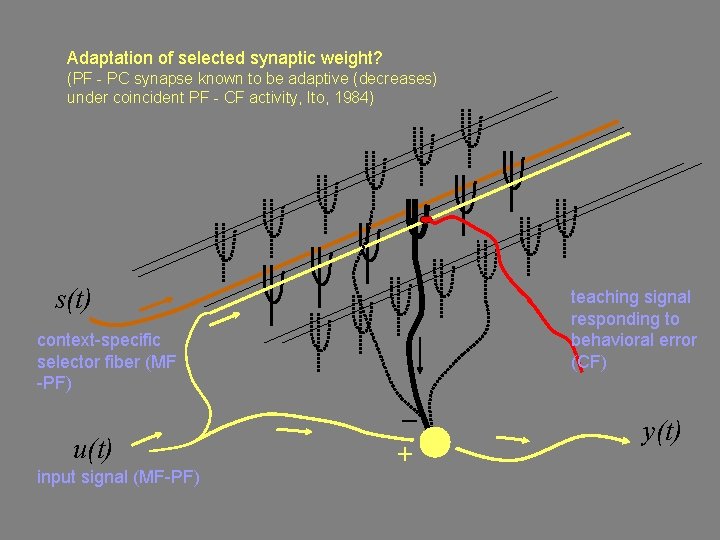
Operation? Activated “beam” of parallel fibers (known) …. Two classes (? , speculation) s(t) MF PFs context-specific selector input (? ) (Mossy Fiber to PF) u(t) MF control signal input (? ) (Mossy Fiber to PF and DCN) – + Inhibition by sidepath DCN direct excitation y(t)
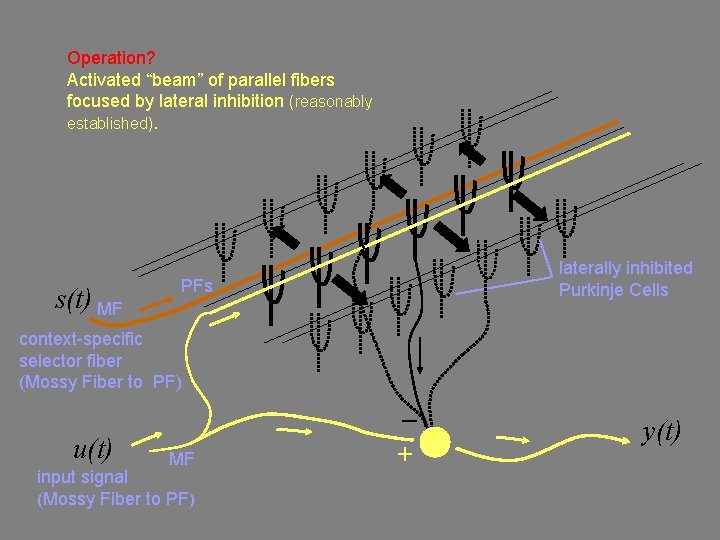
Operation? Activated “beam” of parallel fibers focused by lateral inhibition (reasonably established). s(t) MF laterally inhibited Purkinje Cells PFs context-specific selector fiber (Mossy Fiber to PF) u(t) MF input signal (Mossy Fiber to PF) – + y(t)
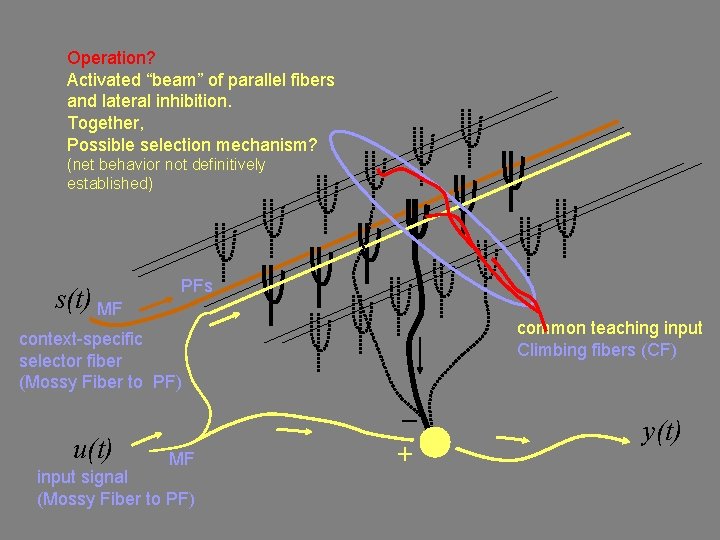
Operation? Activated “beam” of parallel fibers and lateral inhibition. Together, Possible selection mechanism? (net behavior not definitively established) s(t) MF PFs common teaching input Climbing fibers (CF) context-specific selector fiber (Mossy Fiber to PF) u(t) MF input signal (Mossy Fiber to PF) – + y(t)
Adaptation of selected synaptic weight? (PF - PC synapse known to be adaptive (decreases) under coincident PF - CF activity, Ito, 1984) s(t) teaching signal responding to behavioral error (CF) context-specific selector fiber (MF -PF) u(t) input signal (MF-PF) – + y(t)
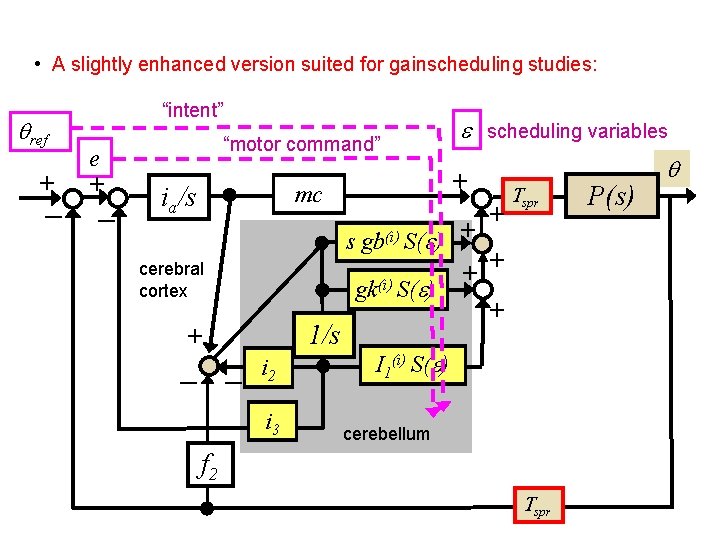
• A slightly enhanced version suited for gainscheduling studies: qref + – “intent” “motor command” e + – s gb(i) S(e) + cerebral cortex 1/s + – – i 2 i 3 scheduling variables + mc ia/s e + Tspr + + gk(i) S(e) + I 1(i) S(e) cerebellum f 2 Tspr P(s) q
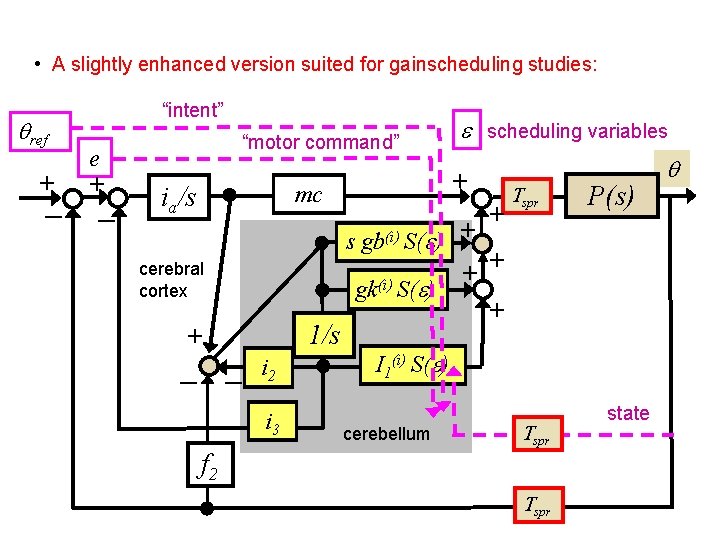
• A slightly enhanced version suited for gainscheduling studies: qref + – “intent” “motor command” e + – s gb(i) S(e) + cerebral cortex 1/s + – – i 2 i 3 scheduling variables + mc ia/s e + Tspr P(s) + + gk(i) S(e) + I 1(i) S(e) cerebellum Tspr f 2 Tspr state q
System Level Neuroengineering Modeling of Nervous System I. Massaquoi CDC Cancun 2008 • The problem • Overview of the sensorimotor control system -- Multi-loop architecture, feedback and delays -- Internal dynamic models? • RIPID Model -- Structure & performance -- Stability analysis -- Cerebellar gainscheduling? • Application to bipedal balance and locomotion
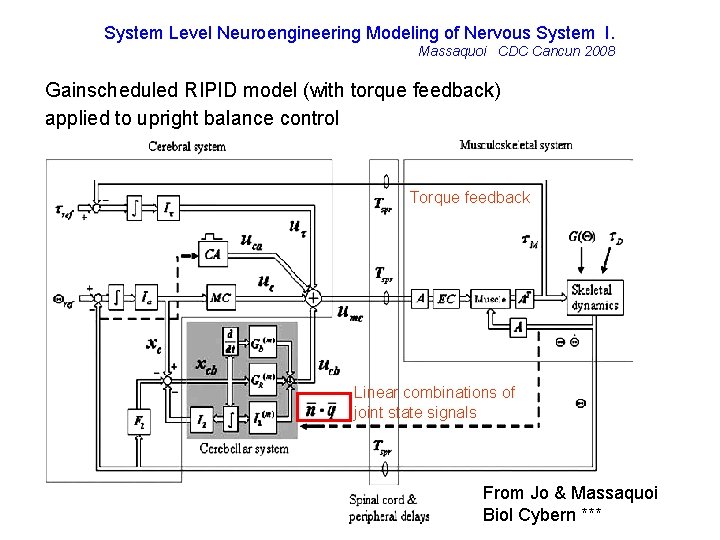
System Level Neuroengineering Modeling of Nervous System I. Massaquoi CDC Cancun 2008 Gainscheduled RIPID model (with torque feedback) applied to upright balance control Torque feedback Linear combinations of joint state signals From Jo & Massaquoi Biol Cybern ***
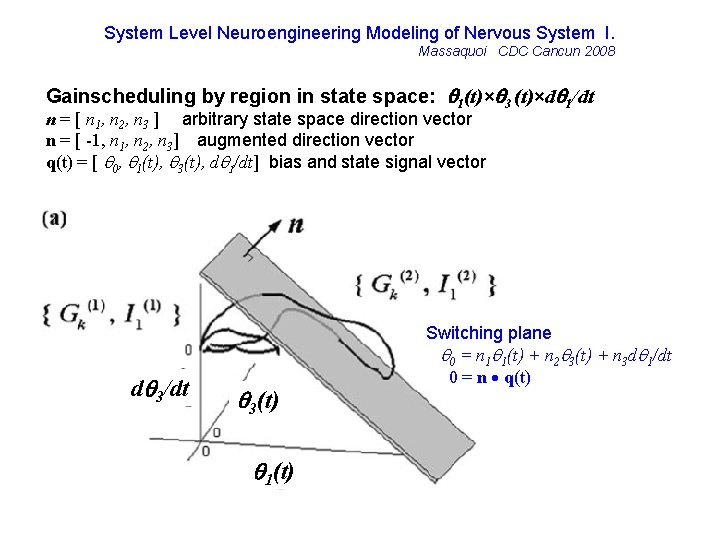
System Level Neuroengineering Modeling of Nervous System I. Massaquoi CDC Cancun 2008 Gainscheduling by region in state space: q 1(t)×q 3 (t)×dq 1/dt n = [ n 1, n 2, n 3 ] arbitrary state space direction vector n = [ -1, n 2, n 3] augmented direction vector q(t) = [ q 0, q 1(t), q 3(t), dq 1/dt] bias and state signal vector dq 3/dt q 3(t) q 1(t) Switching plane q 0 = n 1 q 1(t) + n 2 q 3(t) + n 3 dq 1/dt 0 = n q(t)
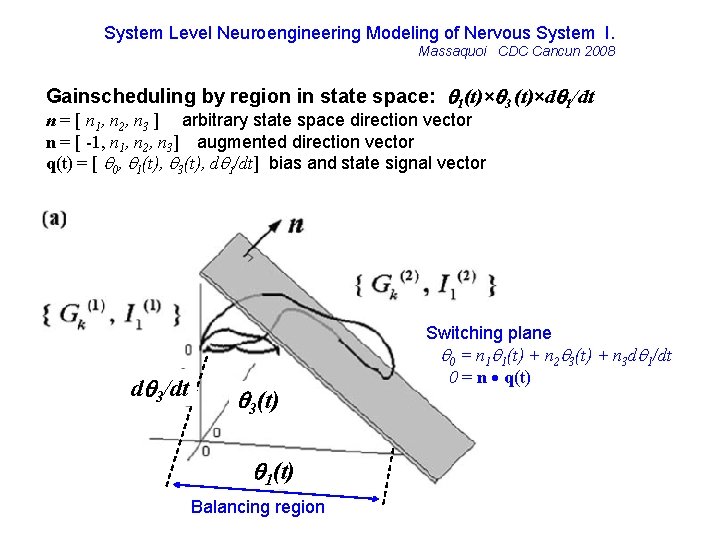
System Level Neuroengineering Modeling of Nervous System I. Massaquoi CDC Cancun 2008 Gainscheduling by region in state space: q 1(t)×q 3 (t)×dq 1/dt n = [ n 1, n 2, n 3 ] arbitrary state space direction vector n = [ -1, n 2, n 3] augmented direction vector q(t) = [ q 0, q 1(t), q 3(t), dq 1/dt] bias and state signal vector dq 3/dt q 3(t) q 1(t) Balancing region Switching plane q 0 = n 1 q 1(t) + n 2 q 3(t) + n 3 dq 1/dt 0 = n q(t)
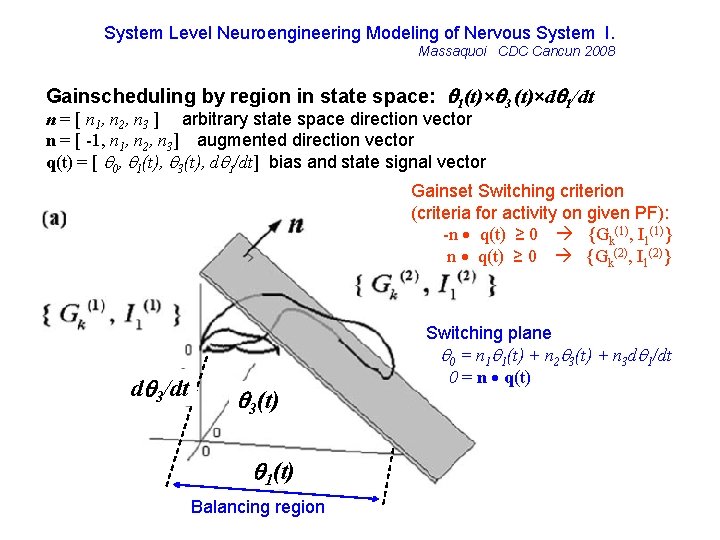
System Level Neuroengineering Modeling of Nervous System I. Massaquoi CDC Cancun 2008 Gainscheduling by region in state space: q 1(t)×q 3 (t)×dq 1/dt n = [ n 1, n 2, n 3 ] arbitrary state space direction vector n = [ -1, n 2, n 3] augmented direction vector q(t) = [ q 0, q 1(t), q 3(t), dq 1/dt] bias and state signal vector Gainset Switching criterion (criteria for activity on given PF): -n q(t) ≥ 0 {Gk(1), I 1(1)} n q(t) ≥ 0 {Gk(2), I 1(2)} dq 3/dt q 3(t) q 1(t) Balancing region Switching plane q 0 = n 1 q 1(t) + n 2 q 3(t) + n 3 dq 1/dt 0 = n q(t)
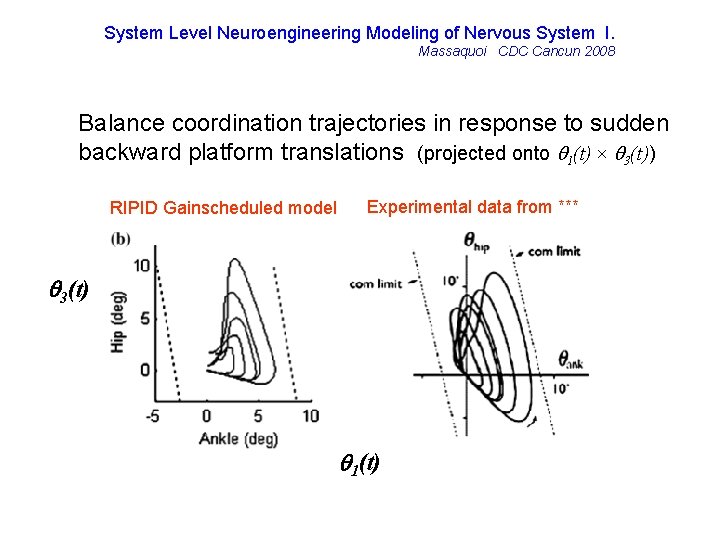
System Level Neuroengineering Modeling of Nervous System I. Massaquoi CDC Cancun 2008 Balance coordination trajectories in response to sudden backward platform translations (projected onto q 1(t) × q 3(t)) RIPID Gainscheduled model Experimental data from *** q 3(t) q 1(t)
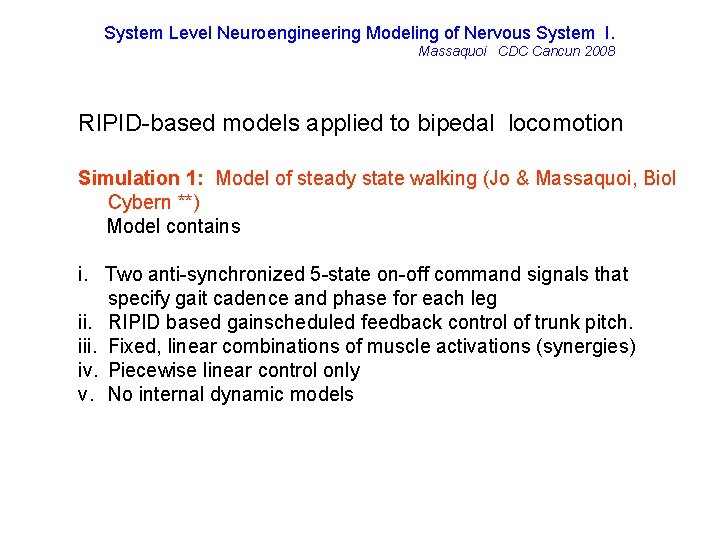
System Level Neuroengineering Modeling of Nervous System I. Massaquoi CDC Cancun 2008 RIPID-based models applied to bipedal locomotion Simulation 1: Model of steady state walking (Jo & Massaquoi, Biol Cybern **) Model contains i. Two anti-synchronized 5 -state on-off command signals that specify gait cadence and phase for each leg ii. RIPID based gainscheduled feedback control of trunk pitch. iii. Fixed, linear combinations of muscle activations (synergies) iv. Piecewise linear control only v. No internal dynamic models
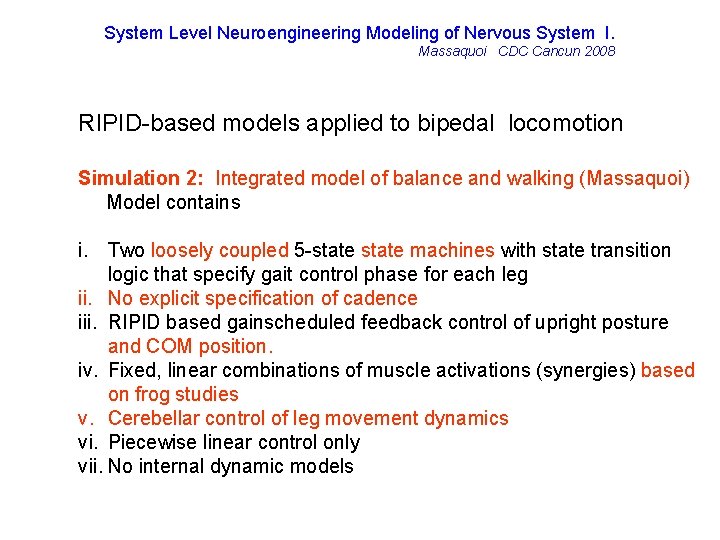
System Level Neuroengineering Modeling of Nervous System I. Massaquoi CDC Cancun 2008 RIPID-based models applied to bipedal locomotion Simulation 2: Integrated model of balance and walking (Massaquoi) Model contains i. Two loosely coupled 5 -state machines with state transition logic that specify gait control phase for each leg ii. No explicit specification of cadence iii. RIPID based gainscheduled feedback control of upright posture and COM position. iv. Fixed, linear combinations of muscle activations (synergies) based on frog studies v. Cerebellar control of leg movement dynamics vi. Piecewise linear control only vii. No internal dynamic models
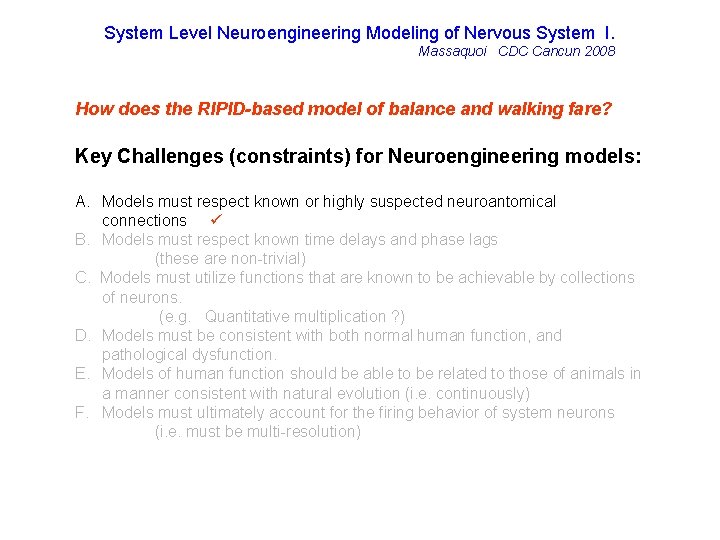
System Level Neuroengineering Modeling of Nervous System I. Massaquoi CDC Cancun 2008 How does the RIPID-based model of balance and walking fare? Key Challenges (constraints) for Neuroengineering models: A. Models must respect known or highly suspected neuroantomical connections B. Models must respect known time delays and phase lags (these are non-trivial) C. Models must utilize functions that are known to be achievable by collections of neurons. (e. g. Quantitative multiplication ? ) D. Models must be consistent with both normal human function, and pathological dysfunction. E. Models of human function should be able to be related to those of animals in a manner consistent with natural evolution (i. e. continuously) F. Models must ultimately account for the firing behavior of system neurons (i. e. must be multi-resolution)
System Level Neuroengineering Modeling of Nervous System I. Massaquoi CDC Cancun 2008 How does the RIPID-based model of balance and walking fare? Key Challenges (constraints) for Neuroengineering models: A. Models must respect known or highly suspected neuroantomical connections B. Models must respect known time delays and phase lags (these are non-trivial) model includes full delays and lags C. Models must utilize functions that are known to be achievable by collections of neurons. (e. g. Quantitative multiplication ? ) D. Models must be consistent with both normal human function, and pathological dysfunction. E. Models of human function should be able to be related to those of animals in a manner consistent with natural evolution (i. e. continuously) F. Models must ultimately account for the firing behavior of system neurons (i. e. must be multi-resolution)
System Level Neuroengineering Modeling of Nervous System I. Massaquoi CDC Cancun 2008 How does the RIPID-based model of balance and walking fare? Key Challenges (constraints) for Neuroengineering models: A. Models must respect known or highly suspected neuroantomical connections B. Models must respect known time delays and phase lags (these are non-trivial) model includes full delays and lags C. Models must utilize functions that are known to be achievable by collections of neurons. model uses -- piecewise linear functions and low order linear filters, -- no quantitative multiplication of signals with each other, -- neural parameter specification to two significant digits or less. D. Models must be consistent with both normal human function, and pathological dysfunction. E. Models of human function should be able to be related to those of animals in a manner consistent with natural evolution (i. e. continuously) F. Models must ultimately account for the firing behavior of system neurons (i. e. must be multi-resolution)
System Level Neuroengineering Modeling of Nervous System I. Massaquoi CDC Cancun 2008 How does the RIPID-based model of balance and walking fare? Key Challenges (constraints) for Neuroengineering models: A. Models must respect known or highly suspected neuroantomical connections B. Models must respect known time delays and phase lags (these are non-trivial) model includes full delays and lags C. Models must utilize functions that are known to be achievable by collections of neurons. model uses -- piecewise linear functions, -- no quantitative multiplication of signals with each other, -- neural parameter specification to two significant digits or less. D. Models must be consistent with both normal human function, and pathological dysfunction. Comparing with ataxic gait in progress E. Models of human function should be able to be related to those of animals in a manner consistent with natural evolution (i. e. continuously)
System Level Neuroengineering Modeling of Nervous System I. Massaquoi CDC Cancun 2008 How does the RIPID-based model of balance and walking fare? Key Challenges (constraints) for Neuroengineering models: A. Models must respect known or highly suspected neuroantomical connections B. Models must respect known time delays and phase lags (these are non-trivial) model includes full delays and lags C. Models must utilize functions that are known to be achievable by collections of neurons. model uses -- piecewise linear functions, -- no quantitative multiplication of signals with each other, -- neural parameter specification to two significant digits or less. D. Models must be consistent with both normal human function, and pathological dysfunction. Comparing with ataxic gait in progress E. Models of human function should be able to be related to those of animals in a manner consistent with natural evolution (i. e. continuously) ( ) -- model uses leg control synergies very similar to those of frogs
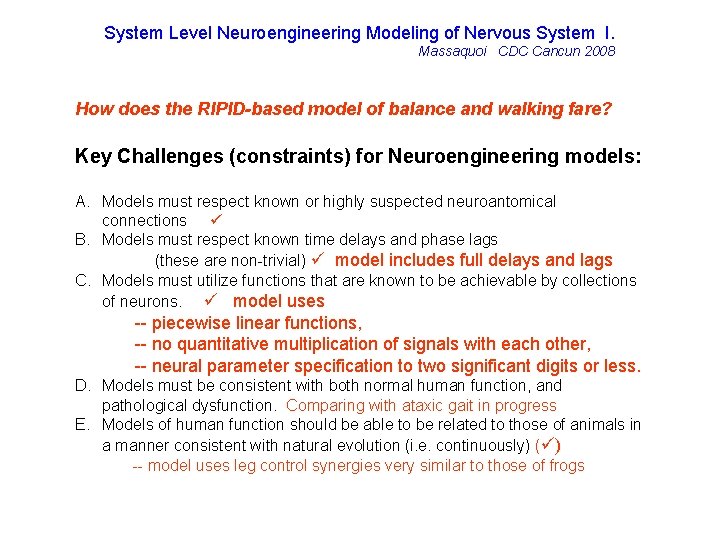
System Level Neuroengineering Modeling of Nervous System I. Massaquoi CDC Cancun 2008 How does the RIPID-based model of balance and walking fare? Key Challenges (constraints) for Neuroengineering models: A. Models must respect known or highly suspected neuroantomical connections B. Models must respect known time delays and phase lags (these are non-trivial) model includes full delays and lags C. Models must utilize functions that are known to be achievable by collections of neurons. model uses -- piecewise linear functions, -- no quantitative multiplication of signals with each other, -- neural parameter specification to two significant digits or less. D. Models must be consistent with both normal human function, and pathological dysfunction. Comparing with ataxic gait in progress E. Models of human function should be able to be related to those of animals in a manner consistent with natural evolution (i. e. continuously) ( ) -- model uses leg control synergies very similar to those of frogs
System Level Neuroengineering Modeling of Nervous System I. Massaquoi CDC Cancun 2008 How does the RIPID-based model of balance and walking fare? Key Challenges (constraints) for Neuroengineering models: F. Models must ultimately account for the firing behavior of system neurons (i. e. must be multi-resolution) ( ) Dr. Takahashi working in this direction.
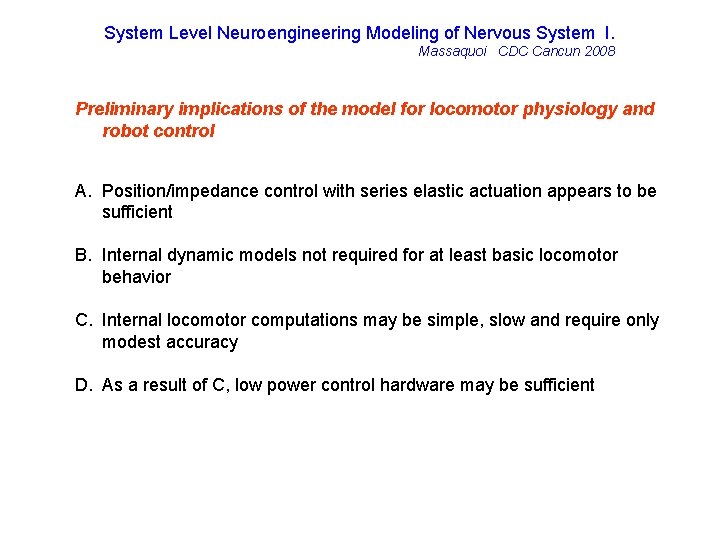
System Level Neuroengineering Modeling of Nervous System I. Massaquoi CDC Cancun 2008 Preliminary implications of the model for locomotor physiology and robot control A. Position/impedance control with series elastic actuation appears to be sufficient B. Internal dynamic models not required for at least basic locomotor behavior C. Internal locomotor computations may be simple, slow and require only modest accuracy D. As a result of C, low power control hardware may be sufficient
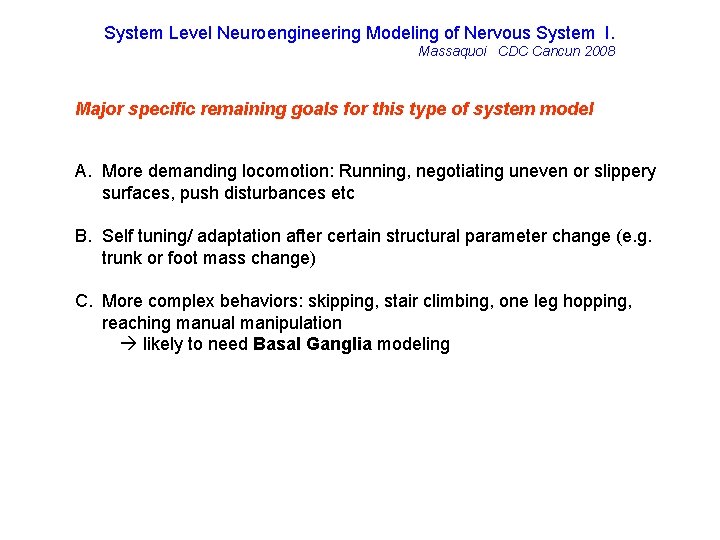
System Level Neuroengineering Modeling of Nervous System I. Massaquoi CDC Cancun 2008 Major specific remaining goals for this type of system model A. More demanding locomotion: Running, negotiating uneven or slippery surfaces, push disturbances etc B. Self tuning/ adaptation after certain structural parameter change (e. g. trunk or foot mass change) C. More complex behaviors: skipping, stair climbing, one leg hopping, reaching manual manipulation likely to need Basal Ganglia modeling