
System Level Low Power Design A Case Study

- Slides: 34
System Level Low Power Design: A Case Study Sonali Chouhan*, M. Balakrishnan#, and Ranjan Bose* *Electrical Engineering Department #Computer Science and Engineering Department Indian Institute of Technology Delhi, India
Outline • • Introduction Problem definition Design space exploration framework Energy models Trade-offs in using error control codes (ECCs) Exploration of the design space Validation 9 th Dec 2015 SLD Workshop Case Study 2
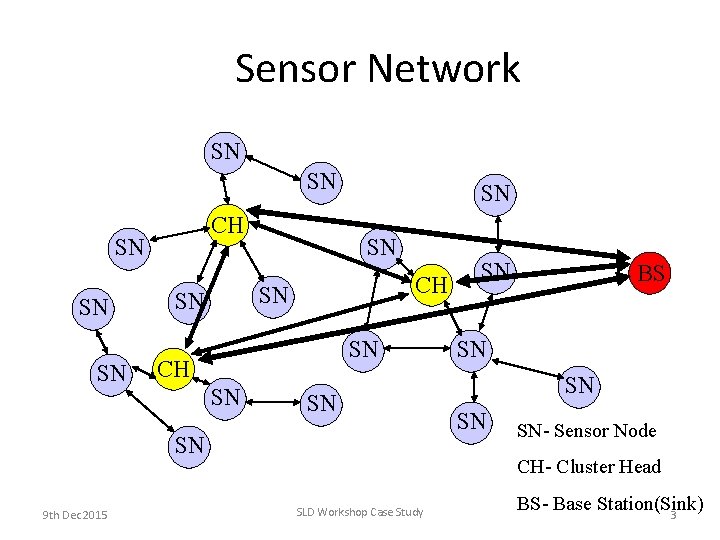
Sensor Network SN SN CH SN SN SN 9 th Dec 2015 SN BS SN SN- Sensor Node CH- Cluster Head SLD Workshop Case Study BS- Base Station(Sink) 3
Advantages • Intimate connection with immediate environment • Useful in unsafe and repeated field studies • Economical for long term data collection • Single deployment, multiple utilization 9 th Dec 2015 SLD Workshop Case Study 4
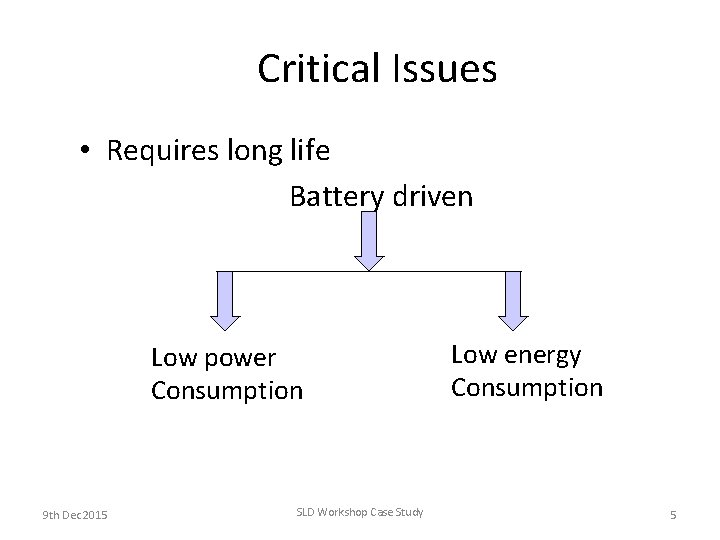
Critical Issues • Requires long life Battery driven Low power Consumption 9 th Dec 2015 SLD Workshop Case Study Low energy Consumption 5
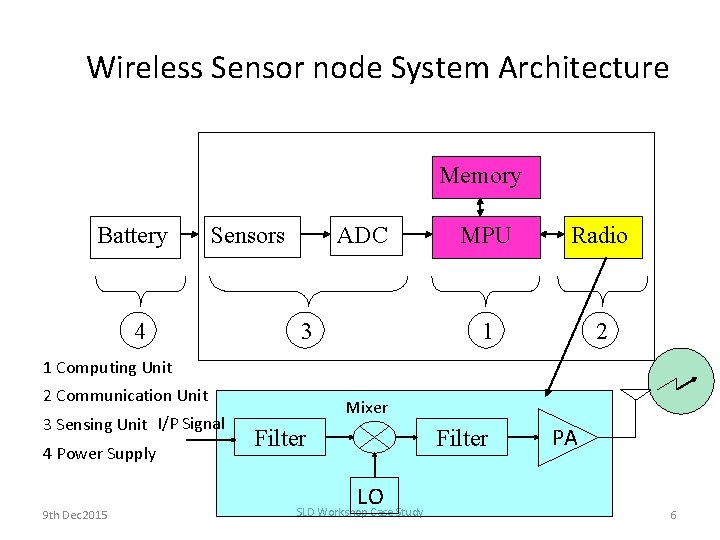
Wireless Sensor node System Architecture Memory Battery Sensors 4 ADC 3 MPU Radio 1 2 1 Computing Unit 2 Communication Unit 3 Sensing Unit I/P Signal 4 Power Supply 9 th Dec 2015 Mixer Filter LO SLD Workshop Case Study PA 6
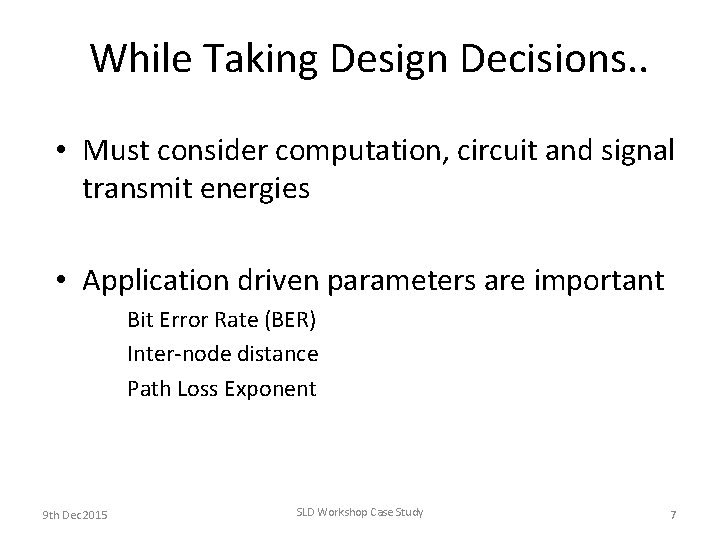
While Taking Design Decisions. . • Must consider computation, circuit and signal transmit energies • Application driven parameters are important Bit Error Rate (BER) Inter-node distance Path Loss Exponent 9 th Dec 2015 SLD Workshop Case Study 7
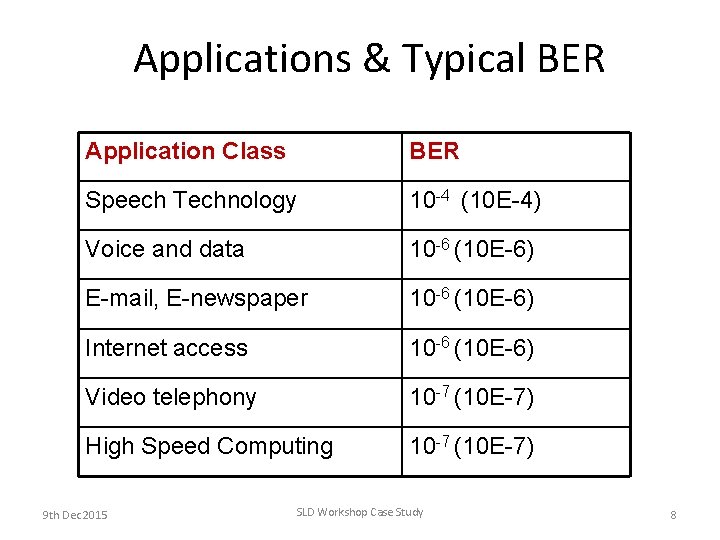
Applications & Typical BER Application Class BER Speech Technology 10 -4 (10 E-4) Voice and data 10 -6 (10 E-6) E-mail, E-newspaper 10 -6 (10 E-6) Internet access 10 -6 (10 E-6) Video telephony 10 -7 (10 E-7) High Speed Computing 10 -7 (10 E-7) 9 th Dec 2015 SLD Workshop Case Study 8
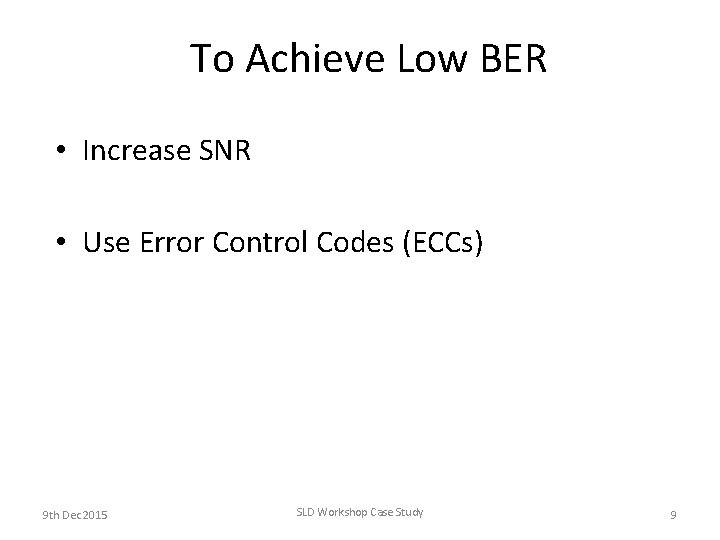
To Achieve Low BER • Increase SNR • Use Error Control Codes (ECCs) 9 th Dec 2015 SLD Workshop Case Study 9
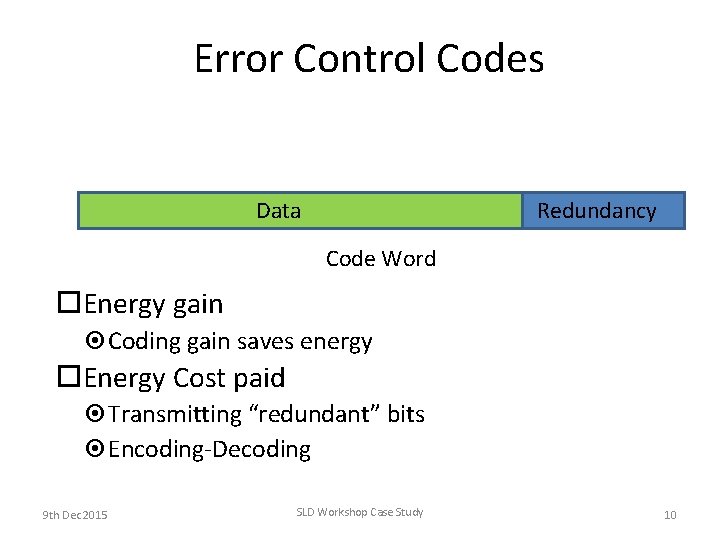
Error Control Codes Redundancy Data Code Word Energy gain Coding gain saves energy Energy Cost paid Transmitting “redundant” bits Encoding-Decoding 9 th Dec 2015 SLD Workshop Case Study 10
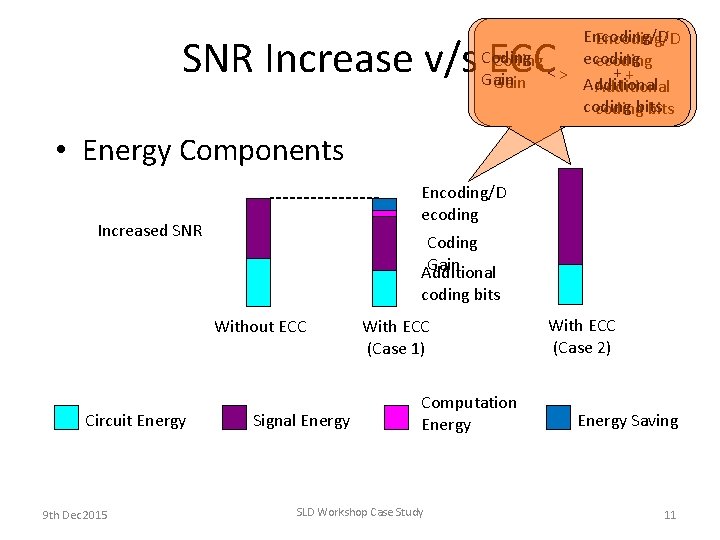
Encoding/D Coding ecoding < ++ > Gain Additional codingbits SNR Increase v/s ECC • Energy Components Encoding/D ecoding Increased SNR Coding Gain Additional coding bits Without ECC Circuit Energy 9 th Dec 2015 Signal Energy With ECC (Case 1) Computation Energy SLD Workshop Case Study With ECC (Case 2) Energy Saving 11
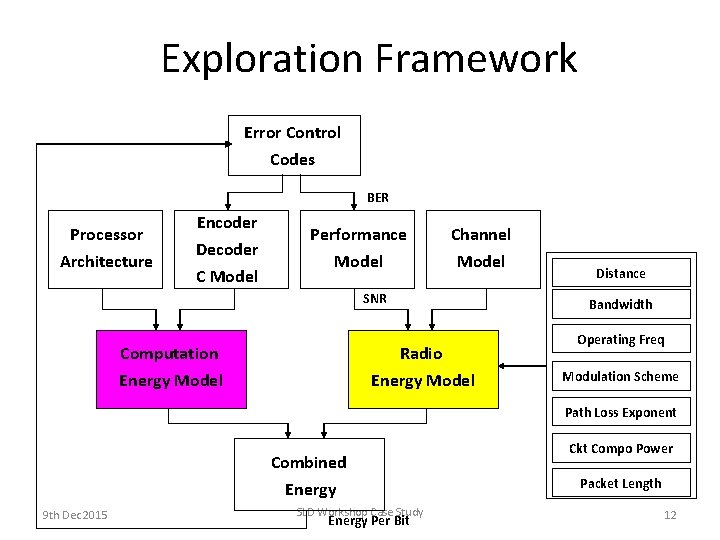
Exploration Framework Error Control Codes BER Processor Architecture Encoder Decoder C Model Performance Model Channel Model SNR Computation Energy Model Radio Energy Model Distance Bandwidth Operating Freq Modulation Scheme Path Loss Exponent Combined Energy 9 th Dec 2015 SLD Workshop Case Study Energy Per Bit Ckt Compo Power Packet Length 12
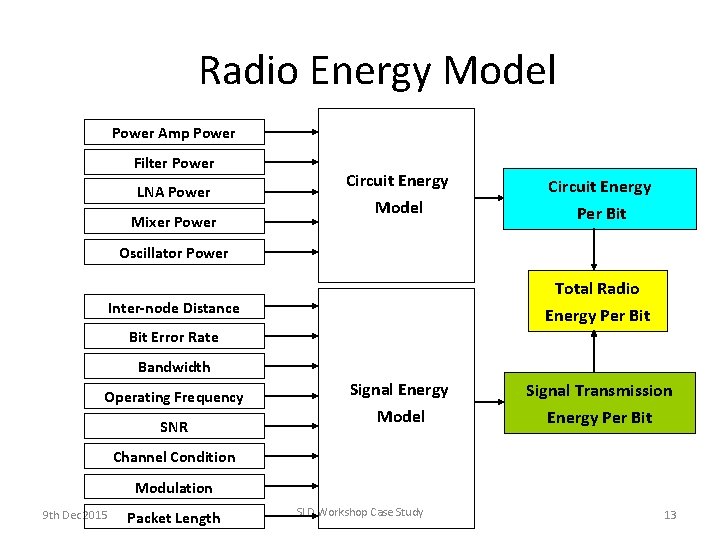
Radio Energy Model Power Amp Power Filter Power LNA Power Mixer Power Circuit Energy Model Circuit Energy Per Bit Oscillator Power Total Radio Energy Per Bit Inter-node Distance Bit Error Rate Bandwidth Operating Frequency SNR Signal Energy Model Signal Transmission Energy Per Bit Channel Condition Modulation 9 th Dec 2015 Packet Length SLD Workshop Case Study 13
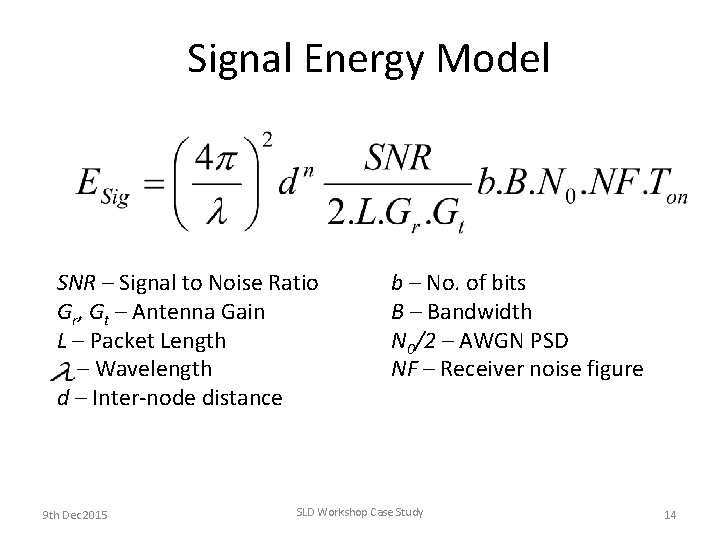
Signal Energy Model SNR – Signal to Noise Ratio Gr, Gt – Antenna Gain L – Packet Length – Wavelength d – Inter-node distance 9 th Dec 2015 b – No. of bits B – Bandwidth N 0/2 – AWGN PSD NF – Receiver noise figure SLD Workshop Case Study 14
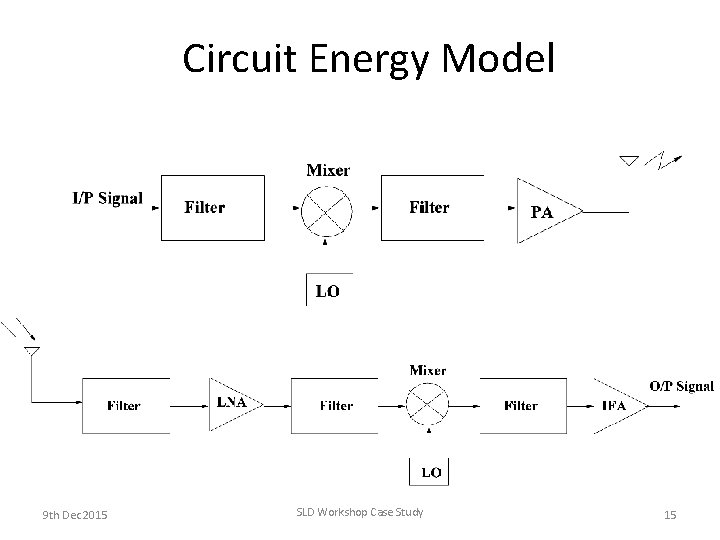
Circuit Energy Model 9 th Dec 2015 SLD Workshop Case Study 15
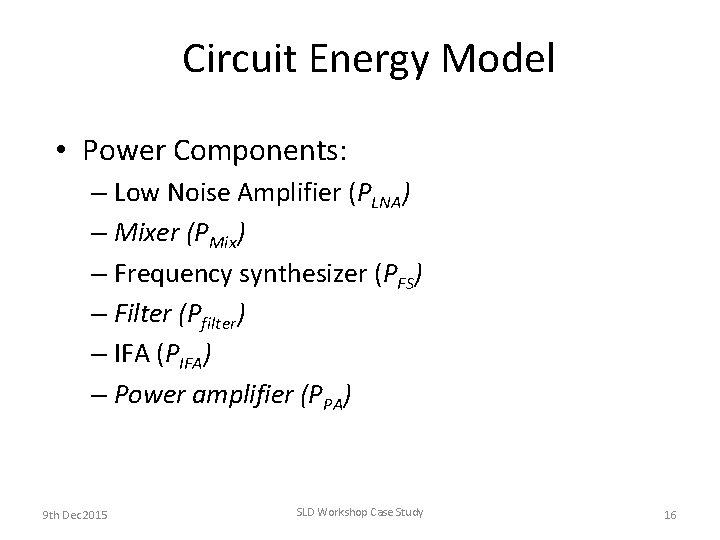
Circuit Energy Model • Power Components: – Low Noise Amplifier (PLNA) – Mixer (PMix) – Frequency synthesizer (PFS) – Filter (Pfilter) – IFA (PIFA) – Power amplifier (PPA) 9 th Dec 2015 SLD Workshop Case Study 16
Computation Energy Model • Sim-Panalyzer’s energy simulator – Cycle accurate – Simulates Strong. Arm SA 1100 processor – Models • • 9 th Dec 2015 Cache power Datapath & execution unit power Clock tree power I/O power SLD Workshop Case Study 17
Design Space Exploration • Error Control Codes – Hamming – Reed-Solomon – Convolution • Application and deployment parameters – Distance – Environment – Bit error rate 9 th Dec 2015 SLD Workshop Case Study 18
Exploration Setup • Configured computation energy simulator for node – operating frequency – Instruction and data cache • Considered O-QPSK modulation scheme • Considered 2 types of nodes – Type I : decoding done at non-energy constraint end – Type II: decoding done at battery powered node 9 th Dec 2015 SLD Workshop Case Study 19
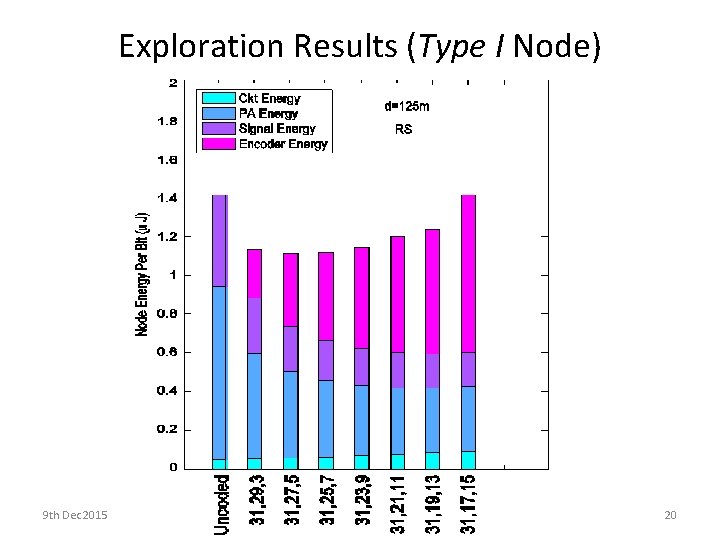
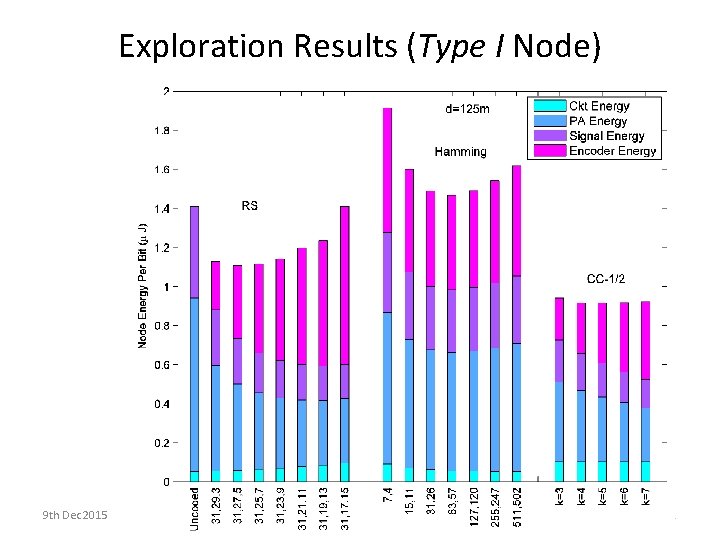
Exploration Results (Type I Node) 9 th Dec 2015 SLD Workshop Case Study 20
Exploration Results (Type I Node) 9 th Dec 2015 SLD Workshop Case Study 21
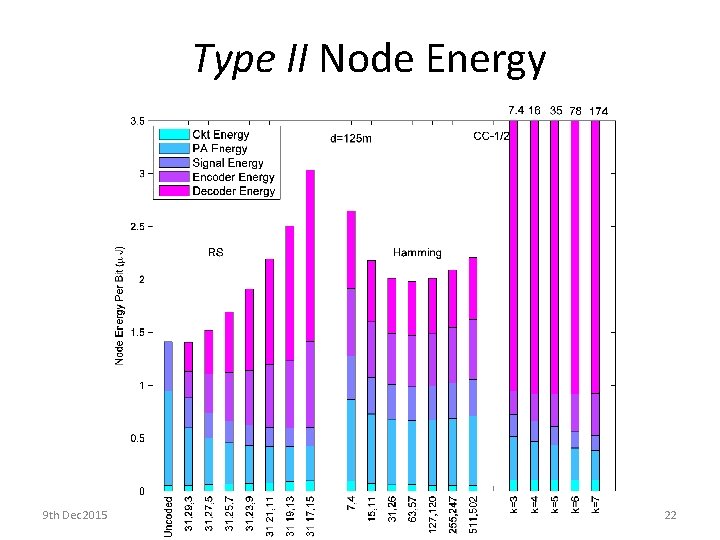
Type II Node Energy 9 th Dec 2015 SLD Workshop Case Study 22
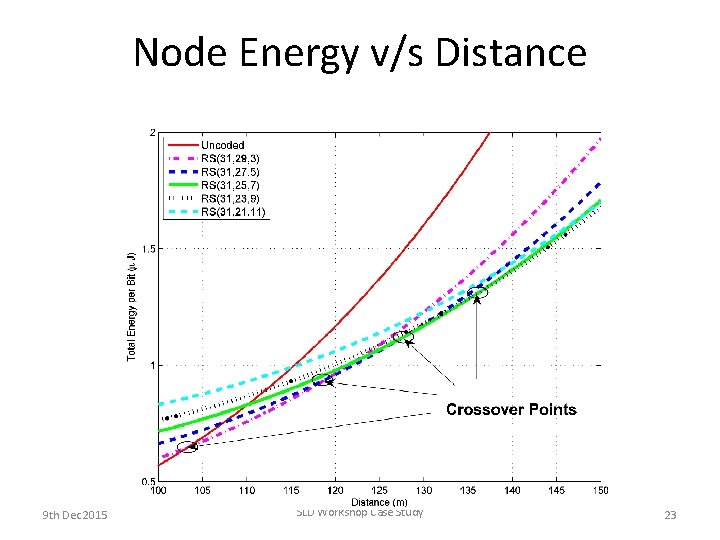
Node Energy v/s Distance 9 th Dec 2015 SLD Workshop Case Study 23
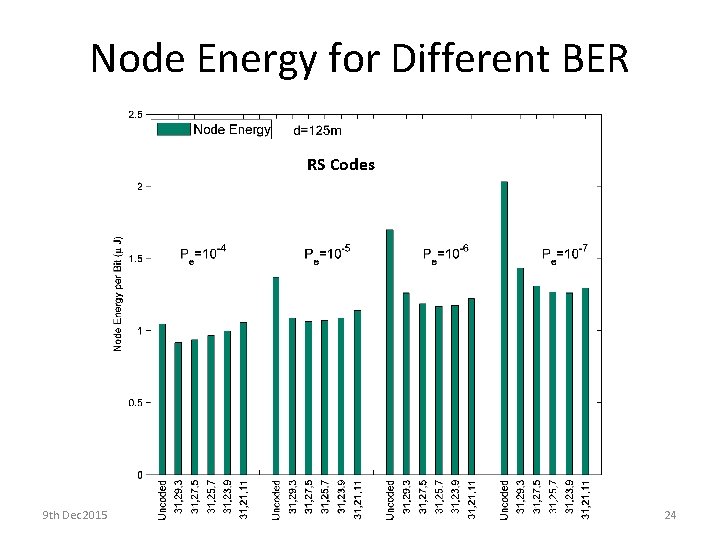
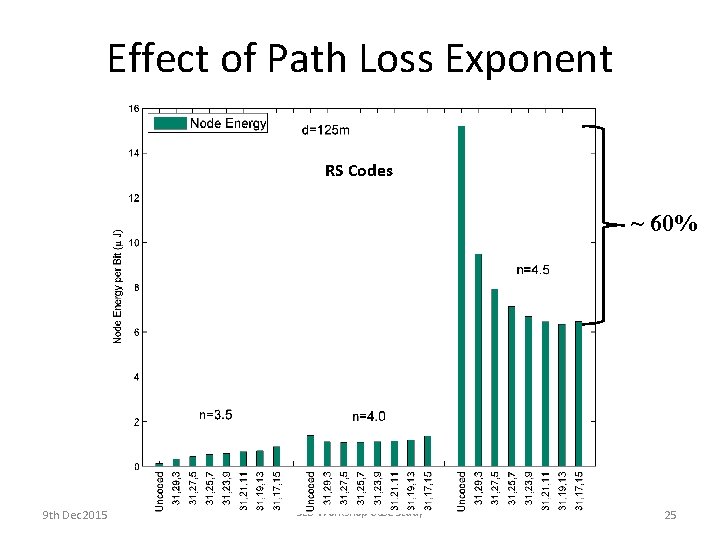
Node Energy for Different BER RS Codes 9 th Dec 2015 SLD Workshop Case Study 24
Effect of Path Loss Exponent RS Codes ~ 60% 9 th Dec 2015 SLD Workshop Case Study 25
Conclusions • Proposed methodology for energy consumption based design space exploration • Trade-off between computation-radio energy • Integrated framework takes into account – Computation energy – Radio energy • Framework is generic, can account for different processors, ECCs, modulation schemes, application parameters 9 th Dec 2015 SLD Workshop Case Study 26
Framework for Validation of Computation-Radio Energy Trade-off in Sensor Node
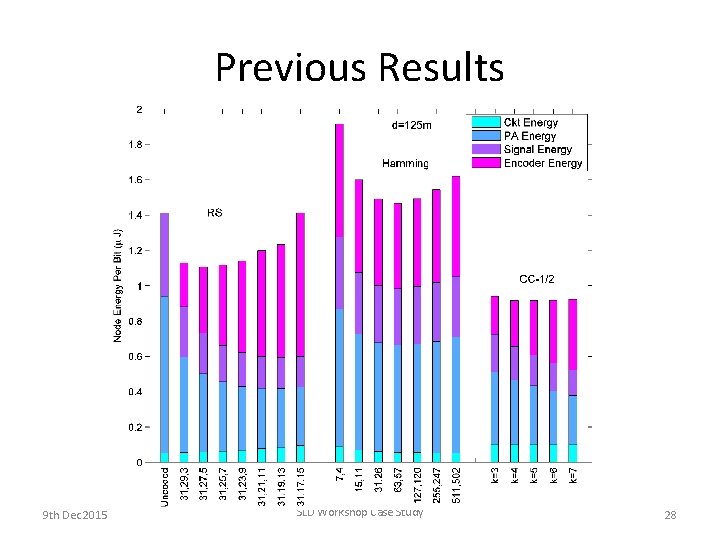
Previous Results 9 th Dec 2015 SLD Workshop Case Study 28
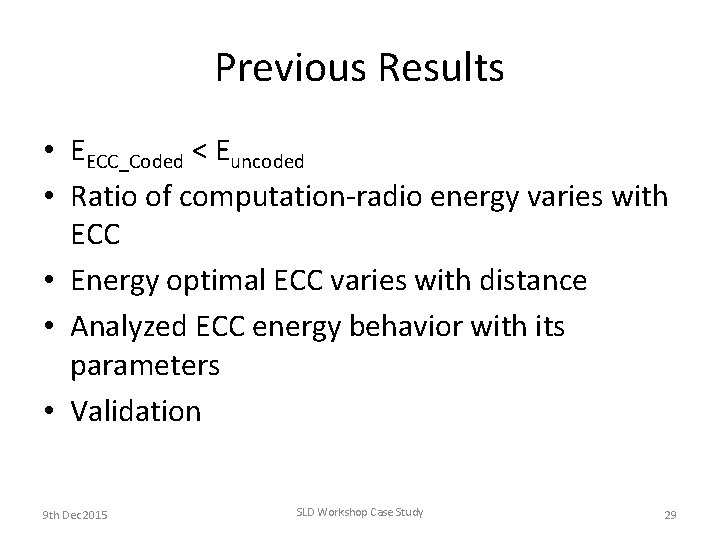
Previous Results • EECC_Coded < Euncoded • Ratio of computation-radio energy varies with ECC • Energy optimal ECC varies with distance • Analyzed ECC energy behavior with its parameters • Validation 9 th Dec 2015 SLD Workshop Case Study 29
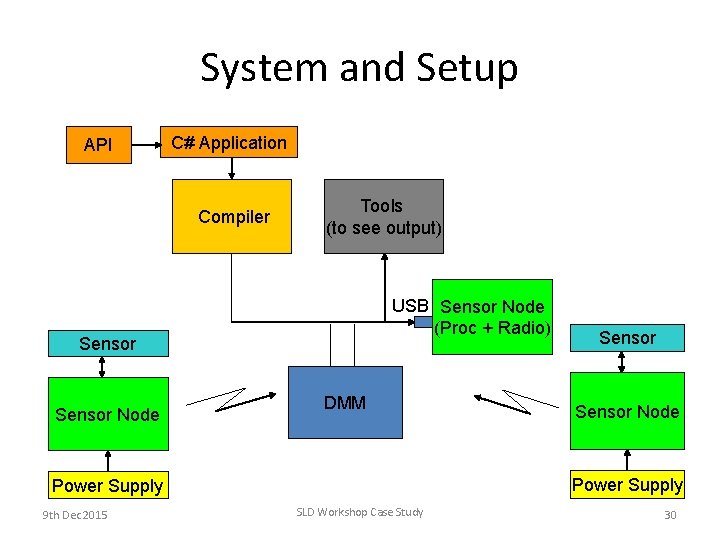
System and Setup API C# Application Compiler Tools (to see output) USB Sensor Node (Proc + Radio) Sensor Node DMM Sensor Node Power Supply 9 th Dec 2015 Sensor SLD Workshop Case Study 30
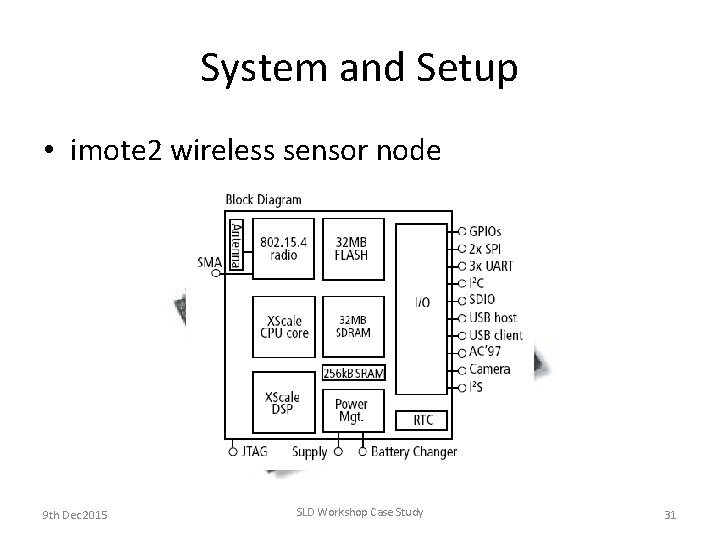
System and Setup • imote 2 wireless sensor node 9 th Dec 2015 SLD Workshop Case Study 31
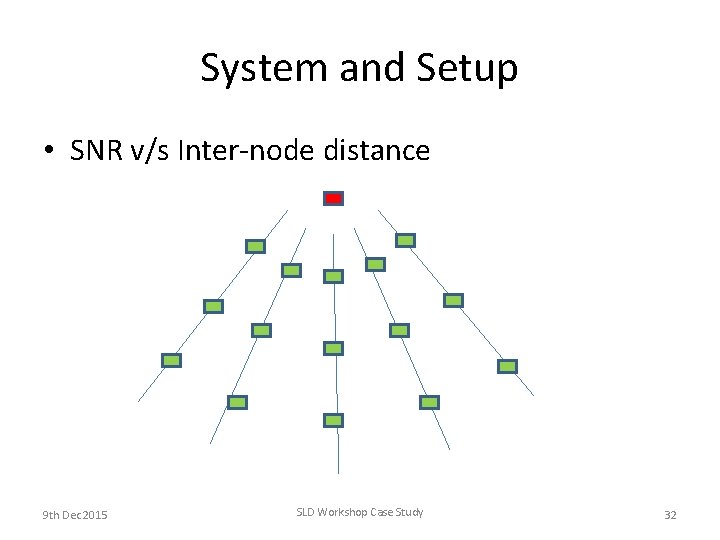
System and Setup • SNR v/s Inter-node distance 9 th Dec 2015 SLD Workshop Case Study 32
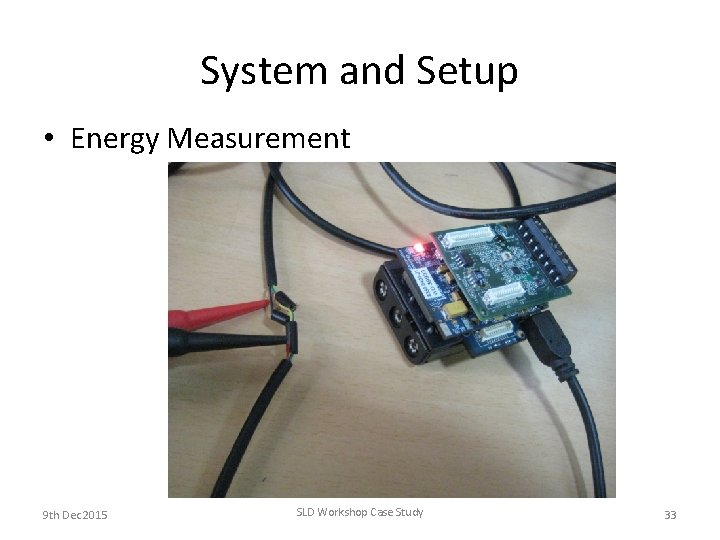
System and Setup • Energy Measurement 9 th Dec 2015 SLD Workshop Case Study 33
9 th Dec 2015 SLD Workshop Case Study 34