
System Level Effects on Solder Joint reliability Maxim


System Level Effects on Solder Joint reliability Maxim Serebreni Df. R Solutions Beltsville, MD 20705

o o o 3 Trends in Electronic Packaging Failure Mechanisms in Solder Interconnects Package Dependent Solder Fatigue Vibrational Fatigue of Solder Interconnects Practical Examples of System Level Effects o Example 1: Effect of Glass Style on Solder Fatigue o Example 2: Solder Fatigue in LEDs under Power Cycling o Example 3: Influence of Mean Temperature on Underfilled BGAs o Example 4: Board level Reliability Assessment

Trends in Electronic Packaging Electrification and Hybridization of vehicles High Reliability Board level, Sub-systems, connectors 4 Cell phones and mobile devices Evolution of electronic packaging Low Reliability High density solder interconnects Source: polymer Innovation Blog Package specific interconnects Lau, John H. "Recent advances and new trends in flip chip technology. " Journal of Electronic Packaging 138, no. 3 (2016): 030802.

Package Dependent Solder Fatigue Ø Ø Trend in characteristic life based on package design for thermal cycle of 0ºC to 100ºC with 10 minute dwell time. Influence of die size and mirroring are largest contributors to reduction in characteristic life. Ø Reduction and effective components CTE Ø Increase tensile loads due to package warpage Ø Over-constraining PCB Solder mask defined 5 Package warpage Tae-Kyu Lee, Thomas Bieler, Choong-un Kim and Hongtao Ma, “Fundamental of solder and interconnect technology”, Springer, Chapter 5, 132 -133 (2014)

Failure Mechanisms in Solder Interconnects o Mechanical Failures: Fatigue High Cycle Vibration o Low Cycle Thermal cycling Drop Overstre ss Single load failure Steinberg D. S. Vibration analysis for electronic equipment. John Wiley & Sons, 2000. Board bending Chemical: Corrosion, dendritic growth and tin whiskers. Vandevelde, Bart, et al. "Four-point bending cycling: The alternative for thermal cycling solder fatigue testing of electronic components. " Microelectronics Reliability 74 (2017): 131 -135. 6 Shock
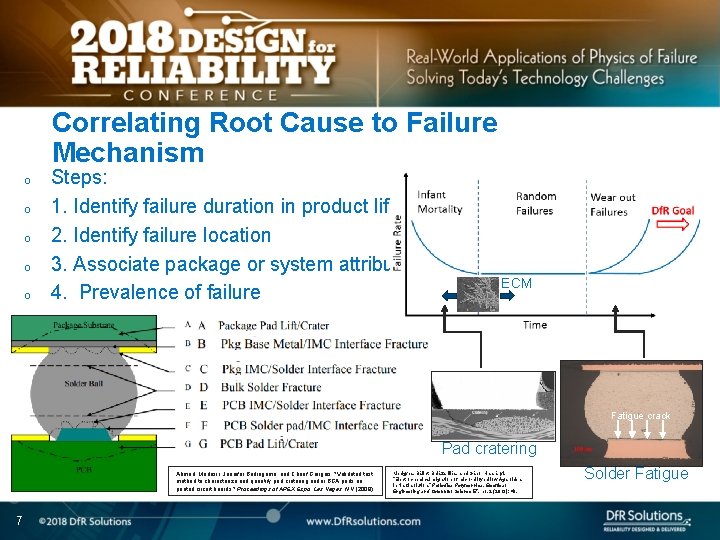
Correlating Root Cause to Failure Mechanism o o o Steps: 1. Identify failure duration in product life 2. Identify failure location 3. Associate package or system attributes 4. Prevalence of failure ECM Fatigue crack Pad cratering Ahmad, Mudasir, Jennifer Burlingame, and Cherif Guirguis. "Validated test method to characterize and quantify pad cratering under BGA pads on printed circuit boards. " Proceedings of APEX Expo, Las Vegas, NV (2009). 7 Medgyes, Bálint, Balázs Illés, and Gábor Harsányi. "Electrochemical migration of micro-alloyed low Ag solders in Na. Cl solution. " Periodica Polytechnica. Electrical Engineering and Computer Science 57, no. 2 (2013): 49. Solder Fatigue
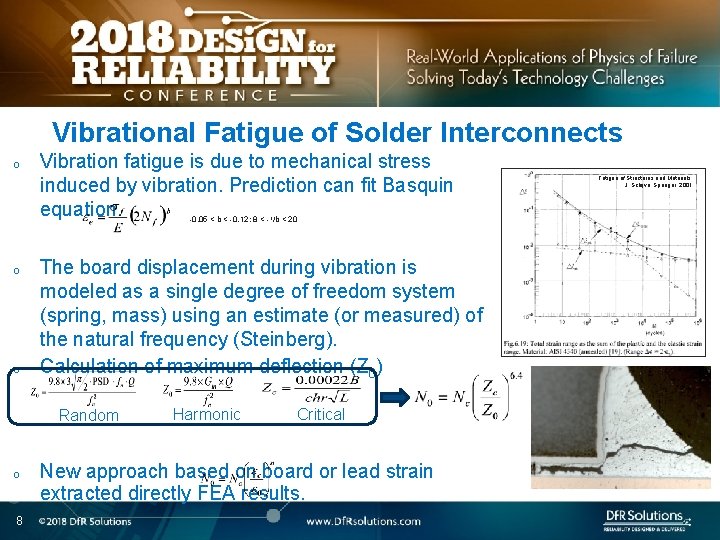
Vibrational Fatigue of Solder Interconnects o Vibration fatigue is due to mechanical stress induced by vibration. Prediction can fit Basquin equation. -0. 05 < b < -0. 12; 8 < - 1/b < 20 o o The board displacement during vibration is modeled as a single degree of freedom system (spring, mass) using an estimate (or measured) of the natural frequency (Steinberg). Calculation of maximum deflection (Z 0) Random o 8 Harmonic Critical New approach based on board or lead strain extracted directly FEA results. Fatigue of Structures and Materials, J. Schijve, Springer, 2001
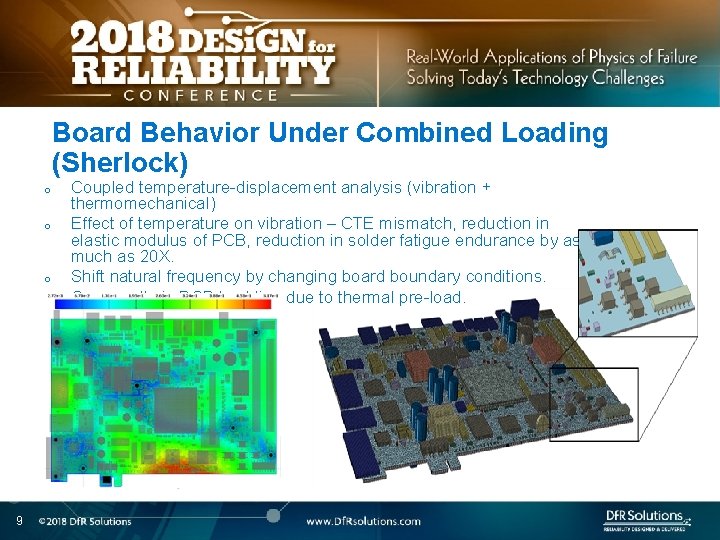
Board Behavior Under Combined Loading (Sherlock) o o 9 Coupled temperature-displacement analysis (vibration + thermomechanical) Effect of temperature on vibration – CTE mismatch, reduction in elastic modulus of PCB, reduction in solder fatigue endurance by as much as 20 X. Shift natural frequency by changing board boundary conditions. Can results in PCB buckling due to thermal pre-load.

Predicting Fatigue Failure in Solder Interconnects o o o Fatigue life prediction depends on leveraging deterministic and probabilistic aspects responsible for failure mechanism. Statistical variation in time to failure is inherent to the uncertainty in material properties and manufacturing tolerances. Probabilistic approach: Probabilistic o Weibull reliability function Mechanistic o Cumulative density function CDF or Hazard Function 2 parameter 10 3 parameter
o o o 11 Trends in Electronic Packaging Failure Mechanisms in Solder Interconnects Package Dependent Solder Fatigue Vibrational Fatigue of Solder Interconnects Practical Examples of System Level Effects o Example 1: Effect of Glass Style on Solder Fatigue o Example 2: Solder Fatigue in LEDs under Power Cycling o Example 3: Influence of Mean Temperature on Underfilled BGAs o Example 4: Board level Reliability Assessment

Example 1: Effect of PCB Glass Style on Solder Fatigue Large variation in cycles to failure of solder joints 400 cycles to 1150. due to variation in manufacturing process. 2512 R Small pad 2512 R Large pad 1080 Glass Style Small Pad 7628 Glass Style 1206 R 1080 Glass Style Small pad 12 1206 R 1080 Glass Style Large pad Large Pad 1080 Glass 7628 Glass Style o
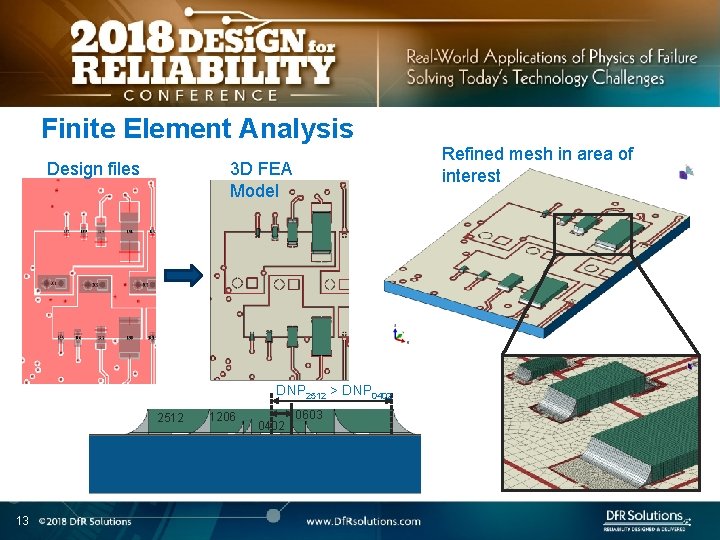
Finite Element Analysis Design files 3 D FEA Model DNP 2512 > DNP 0402 2512 13 13 1206 0402 0603 Refined mesh in area of interest
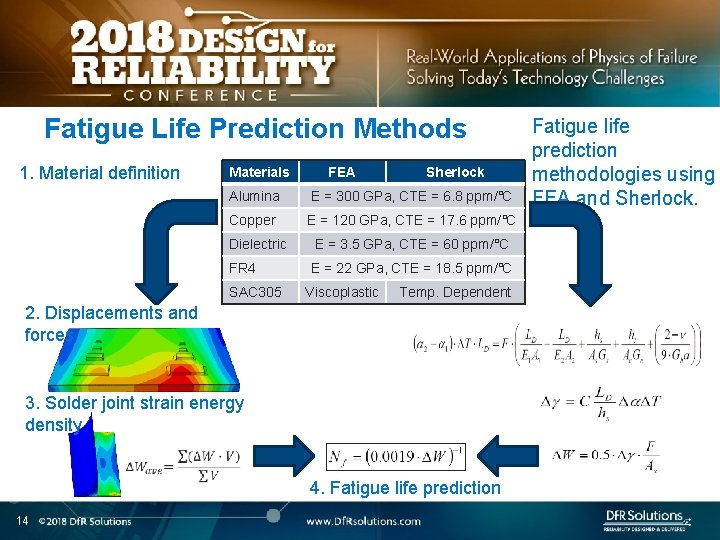
Fatigue Life Prediction Methods 1. Material definition Materials FEA Sherlock Alumina E = 300 GPa, CTE = 6. 8 ppm/°C Copper E = 120 GPa, CTE = 17. 6 ppm/°C Dielectric E = 3. 5 GPa, CTE = 60 ppm/°C FR 4 E = 22 GPa, CTE = 18. 5 ppm/°C SAC 305 Viscoplastic Temp. Dependent 2. Displacements and forces 3. Solder joint strain energy density 4. Fatigue life prediction 14 Fatigue life prediction methodologies using FEA and Sherlock.
o o o 15 Trends in Electronic Packaging Failure Mechanisms in Solder Interconnects Package Dependent Solder Fatigue Vibrational Fatigue of Solder Interconnects Practical Examples of System Level Effects o Example 1: Effect of Glass Style on Solder Fatigue o Example 2: Solder Fatigue in LEDs under Power Cycling o Example 3: Influence of Mean Temperature on Underfilled BGAs o Example 4: Board level Reliability Assessment
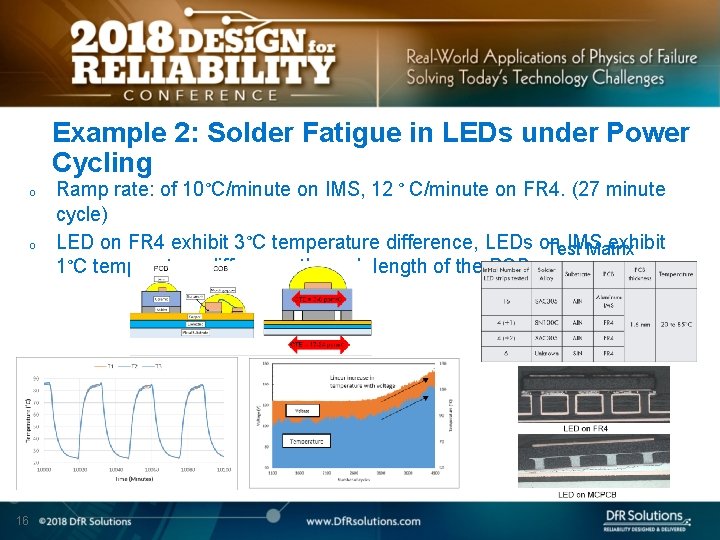
Example 2: Solder Fatigue in LEDs under Power Cycling o o 16 Ramp rate: of 10°C/minute on IMS, 12 ° C/minute on FR 4. (27 minute cycle) LED on FR 4 exhibit 3°C temperature difference, LEDs on IMS exhibit Test Matrix 1°C temperature difference through length of the PCB
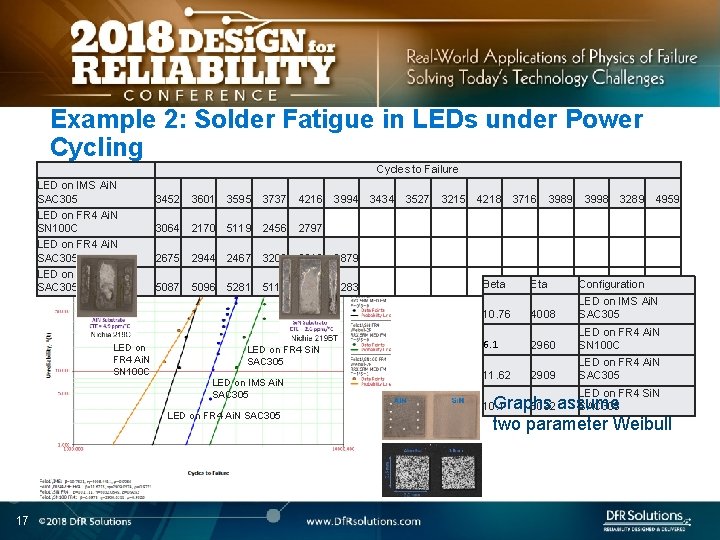
Example 2: Solder Fatigue in LEDs under Power Cycling Cycles to Failure LED on IMS Ai. N SAC 305 LED on FR 4 Ai. N SN 100 C LED on FR 4 Ai. N SAC 305 LED on FR 4 Si. N SAC 305 LED on FR 4 Ai. N SN 100 C 3452 3601 3595 3737 4216 3064 2170 5119 2456 2797 2675 2944 2467 3203 2612 2879 5087 5096 5281 5111 4024 4283 LED on FR 4 Si. N SAC 305 LED on IMS Ai. N SAC 305 LED on FR 4 Ai. N SAC 305 17 3994 3434 3527 3215 4218 3716 3989 3998 3289 4959 Beta Eta Configuration 10. 76 4008 LED on IMS Ai. N SAC 305 6. 1 2960 LED on FR 4 Ai. N SN 100 C 11. 62 2909 LED on FR 4 Ai. N SAC 305 LED on FR 4 Si. N Graphs 5032 assume SAC 305 two parameter Weibull 10. 1
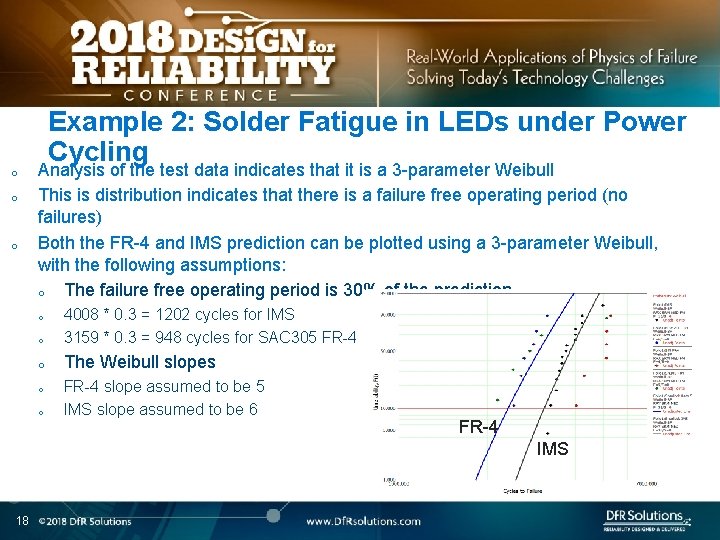
o o o Example 2: Solder Fatigue in LEDs under Power Cycling Analysis of the test data indicates that it is a 3 -parameter Weibull This is distribution indicates that there is a failure free operating period (no failures) Both the FR-4 and IMS prediction can be plotted using a 3 -parameter Weibull, with the following assumptions: o The failure free operating period is 30% of the prediction o 4008 * 0. 3 = 1202 cycles for IMS 3159 * 0. 3 = 948 cycles for SAC 305 FR-4 o The Weibull slopes o o o FR-4 slope assumed to be 5 IMS slope assumed to be 6 FR-4 IMS 18
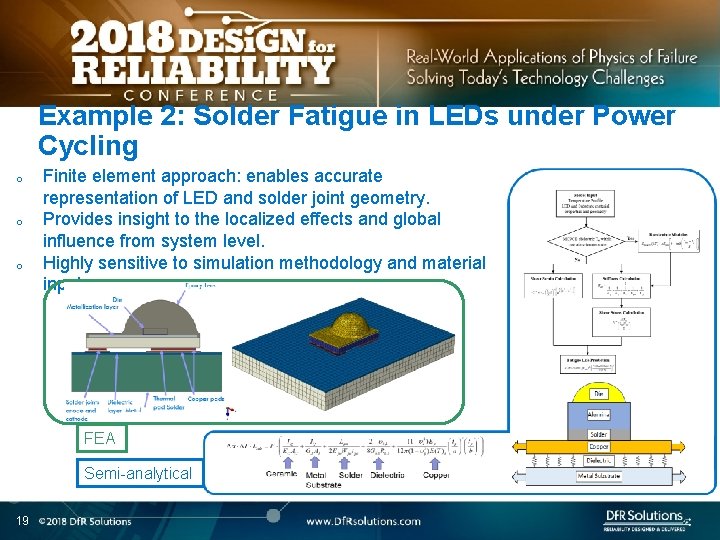
Example 2: Solder Fatigue in LEDs under Power Cycling o o o Finite element approach: enables accurate representation of LED and solder joint geometry. Provides insight to the localized effects and global influence from system level. Highly sensitive to simulation methodology and material input. FEA Semi-analytical 19
o o o 20 Trends in Electronic Packaging Failure Mechanisms in Solder Interconnects Package Dependent Solder Fatigue Vibrational Fatigue of Solder Interconnects Practical Examples of System Level Effects o Example 1: Effect of Glass Style on Solder Fatigue o Example 2: Solder Fatigue in LEDs under Power Cycling o Example 3: Influence of Mean Temperature on Underfilled BGAs o Example 4: Board level Reliability Assessment
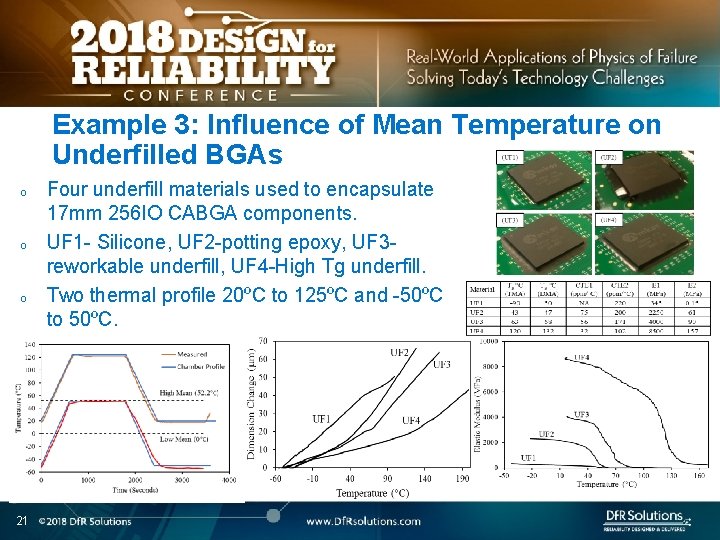
Example 3: Influence of Mean Temperature on Underfilled BGAs o o o 21 Four underfill materials used to encapsulate 17 mm 256 IO CABGA components. UF 1 - Silicone, UF 2 -potting epoxy, UF 3 reworkable underfill, UF 4 -High Tg underfill. Two thermal profile 20ºC to 125ºC and -50ºC to 50ºC.
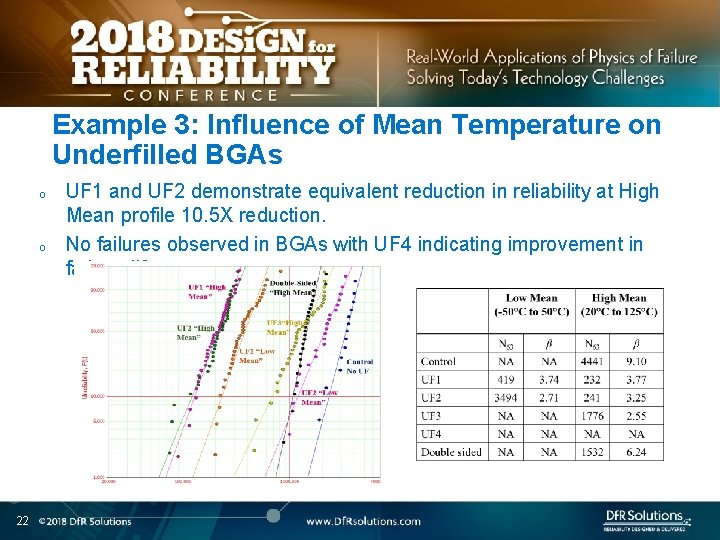
Example 3: Influence of Mean Temperature on Underfilled BGAs o o 22 UF 1 and UF 2 demonstrate equivalent reduction in reliability at High Mean profile 10. 5 X reduction. No failures observed in BGAs with UF 4 indicating improvement in fatigue life.
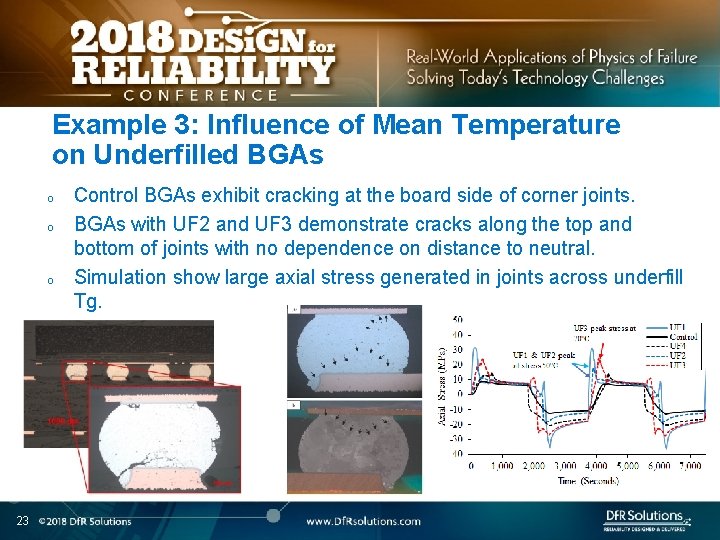
Example 3: Influence of Mean Temperature on Underfilled BGAs o o o 23 Control BGAs exhibit cracking at the board side of corner joints. BGAs with UF 2 and UF 3 demonstrate cracks along the top and bottom of joints with no dependence on distance to neutral. Simulation show large axial stress generated in joints across underfill Tg.
o o o 24 Trends in Electronic Packaging Failure Mechanisms in Solder Interconnects Package Dependent Solder Fatigue Vibrational Fatigue of Solder Interconnects Practical Examples of System Level Effects o Example 1: Effect of Glass Style on Solder Fatigue o Example 2: Solder Fatigue in LEDs under Power Cycling o Example 3: Influence of Mean Temperature on Underfilled BGAs o Example 4: Board level Reliability Assessment
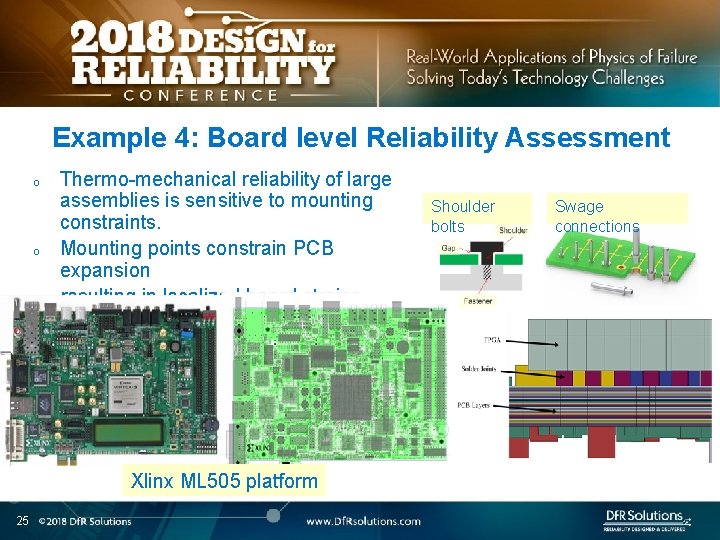
Example 4: Board level Reliability Assessment o o Thermo-mechanical reliability of large assemblies is sensitive to mounting constraints. Mounting points constrain PCB expansion resulting in localized board strains. Xlinx ML 505 platform 25 Shoulder bolts Swage connections
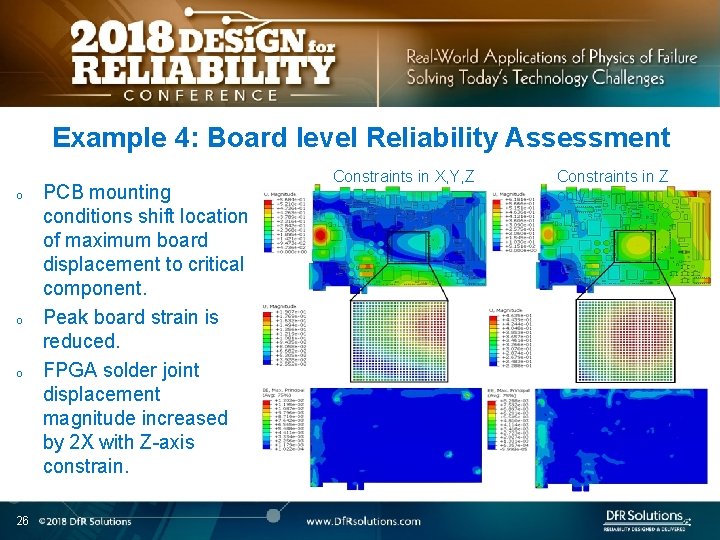
Example 4: Board level Reliability Assessment o o o 26 PCB mounting conditions shift location of maximum board displacement to critical component. Peak board strain is reduced. FPGA solder joint displacement magnitude increased by 2 X with Z-axis constrain. Constraints in X, Y, Z Constraints in Z only
Conclusion o o 27 Solder fatigue is greatly influence by package characteristics. Physics of failure methodology should focus on the mechanism dominating damage at a known environment. Underfills can reduce thermal cycling reliability. Underfill properties selection requires consideration to temperature dependent properties and environmental conditions. During system level simulation special attention should be placed on local and global factors influencing solder fatigue (i. e. mounting conditions, underfills, solder alloy…)
- Slides: 27