
System Investigation and Analysis Overview of SD SD

- Slides: 53
System Investigation and Analysis Overview of SD SD nin an Pl Participants of SD SD Pl an nin g g Initiation of SD 1
LEARNING OBJECTIVES 1. Identify the key participants in the systems development process. 2. Learn the roles of the participants the development process. 3. Learn and understand the traditional systems development life cycle (SDLC). 4. Learn and understand end-user development systems. 5. Review creative and critical analyses. 2
Systems Development • Systems development is the activity of creating new or modifying existing business systems. • Refers to all aspects: • Systems Investigation • Identifying problems or opportunities. • System analysis and design. • System implementation. • System maintenance and review. 3
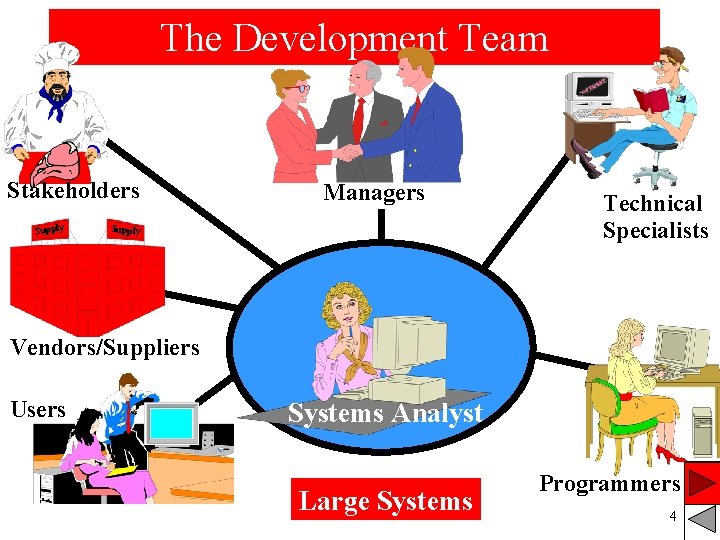
The Development Team Stakeholders Supply Managers Supply Technical Specialists Vendors/Suppliers Users Systems Analyst Large Systems Programmers 4
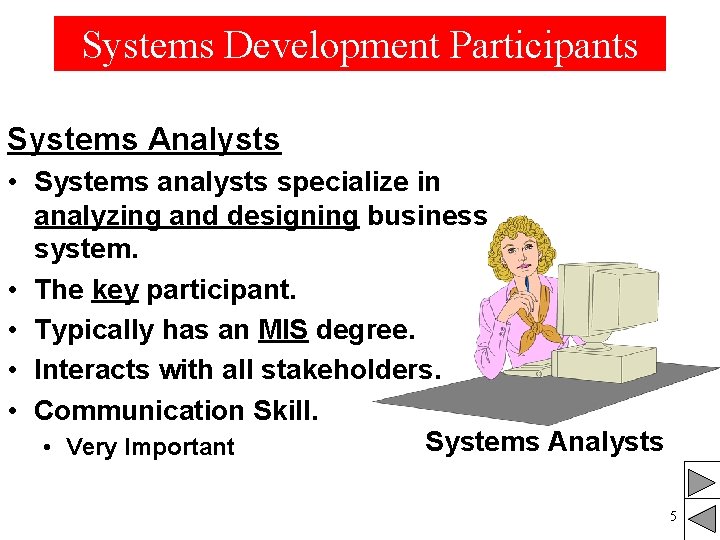
Systems Development Participants Systems Analysts • Systems analysts specialize in analyzing and designing business system. • The key participant. • Typically has an MIS degree. • Interacts with all stakeholders. • Communication Skill. Systems Analysts • Very Important 5
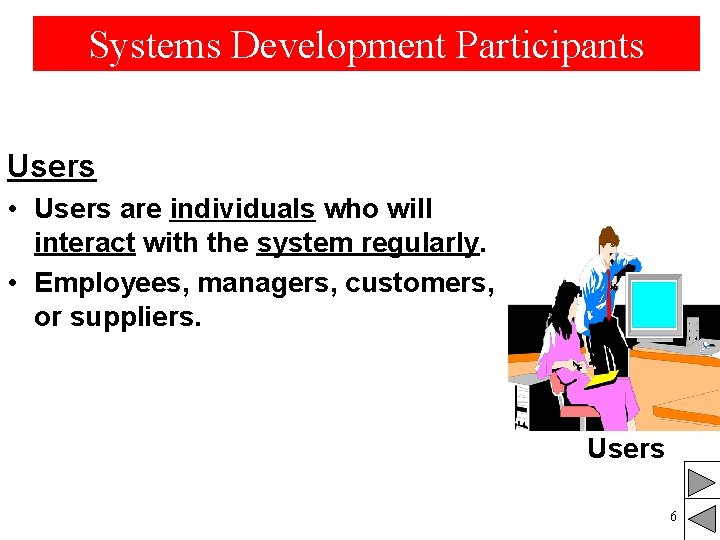
Systems Development Participants Users • Users are individuals who will interact with the system regularly. • Employees, managers, customers, or suppliers. Users 6
Systems Development Participants Vendors/Suppliers • Close involvement is extremely important when developing EDI and JIT systems. • EDI Supply • Electronic Data Interchange • Computers talking to computers • JIT Vendors/Suppliers • Just In Time inventory control 7
Systems Development Participants Stakeholders • Stakeholders are individuals who, either themselves or through the area of the organization they represent, ultimately benefit from the systems development project. Stakeholders 8
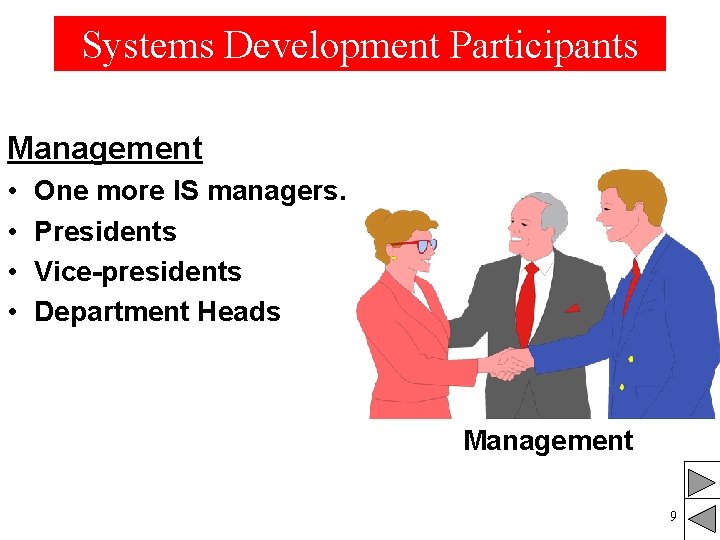
Systems Development Participants Management • • One more IS managers. Presidents Vice-presidents Department Heads Management 9
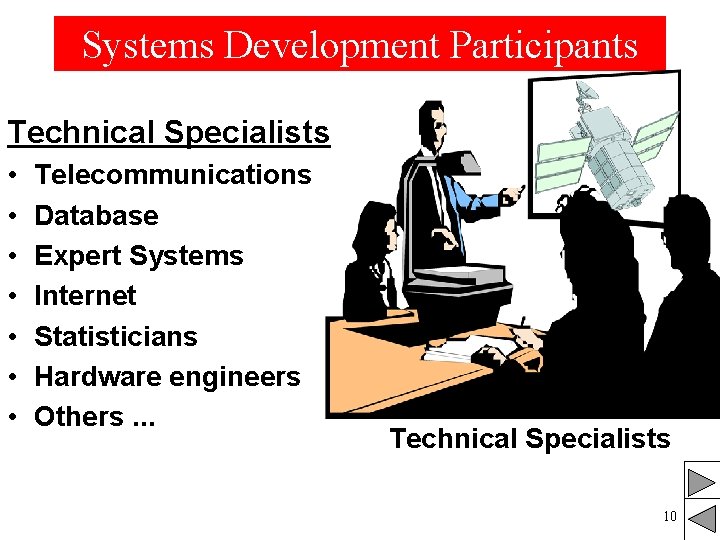
Systems Development Participants Technical Specialists • • Telecommunications Database Expert Systems Internet Statisticians Hardware engineers Others. . . Technical Specialists 10
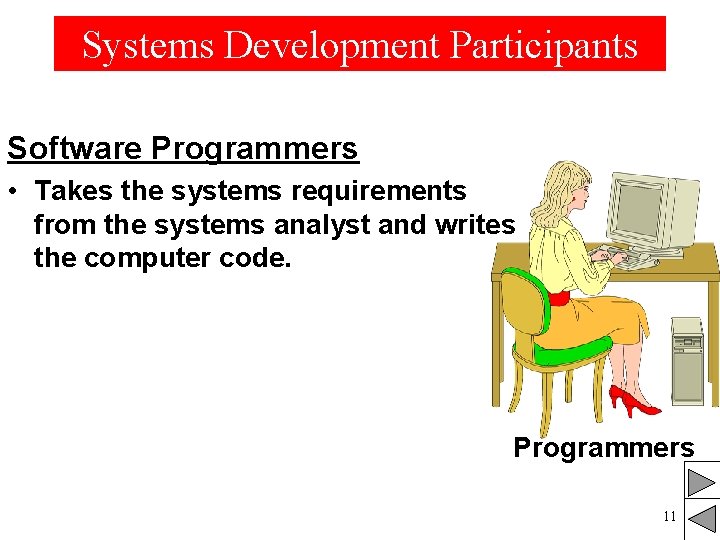
Systems Development Participants Software Programmers • Takes the systems requirements from the systems analyst and writes the computer code. Programmers 11
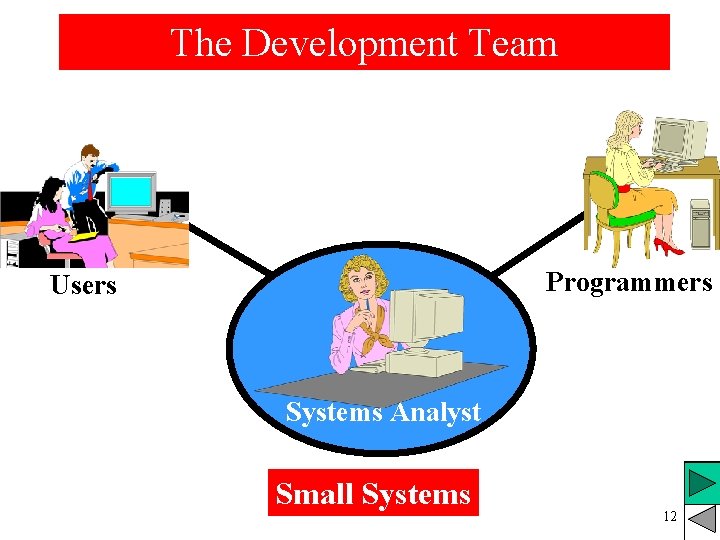
The Development Team Programmers Users Systems Analyst Small Systems 12
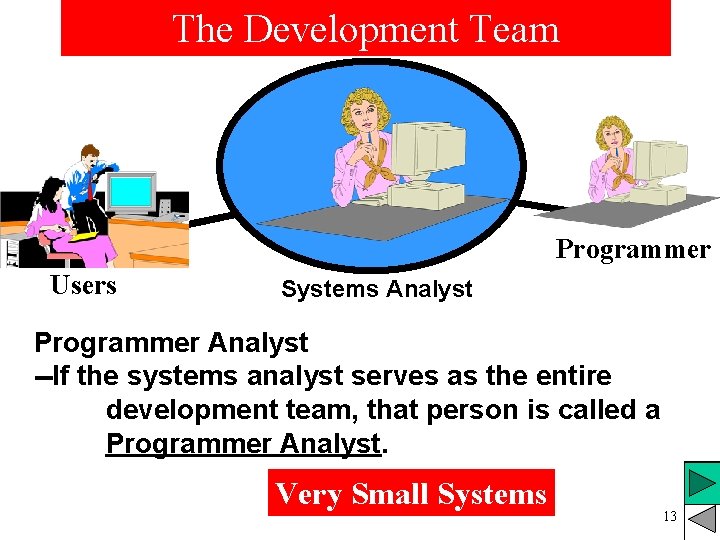
The Development Team Programmer Users Systems Analyst Programmer Analyst --If the systems analyst serves as the entire development team, that person is called a Systems Analyst Programmer Analyst. Very Small Systems 13
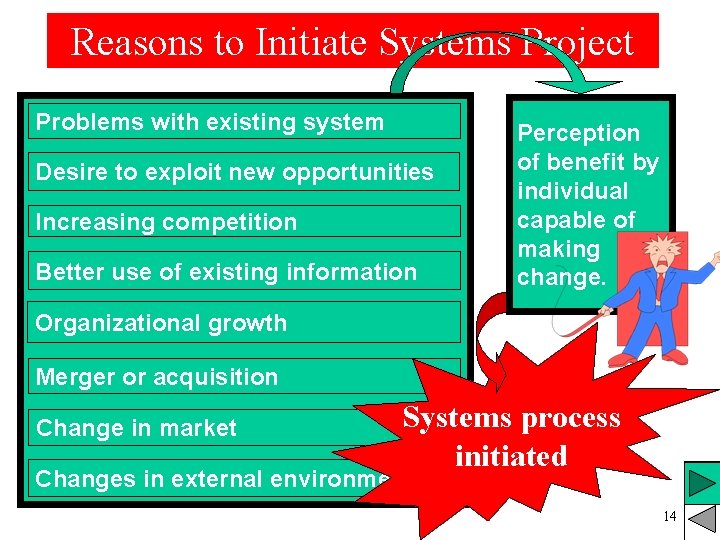
Reasons to Initiate Systems Project Problems with existing system Desire to exploit new opportunities Increasing competition Better use of existing information Perception of benefit by individual capable of making change. Organizational growth Merger or acquisition Change in market Systems process initiated Changes in external environment 14
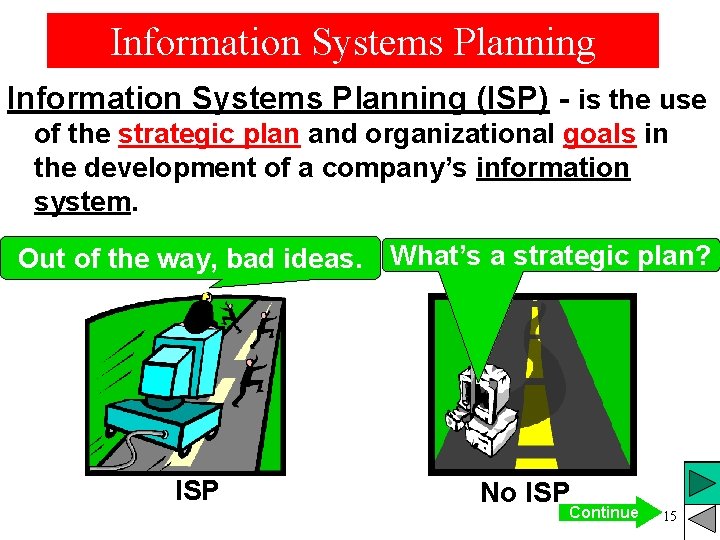
Information Systems Planning (ISP) - is the use of the strategic plan and organizational goals in the development of a company’s information system. Out of the way, bad ideas. What’s a strategic plan? ISP No ISP Continue 15
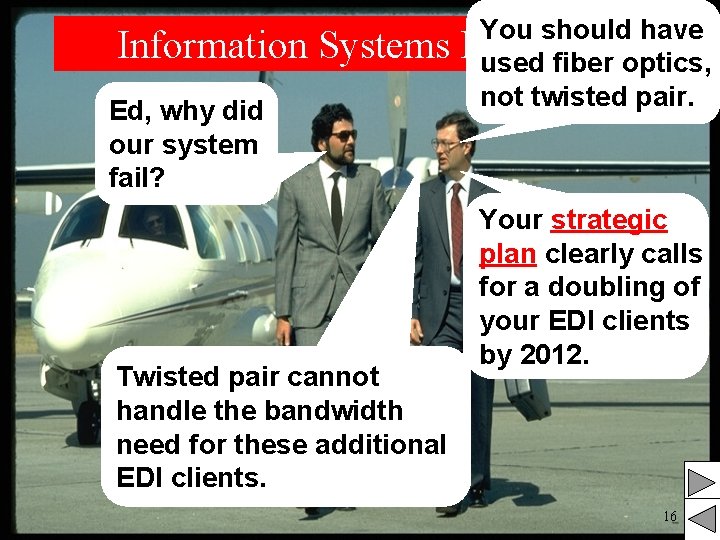
Information Systems Ed, why did our system fail? Twisted pair cannot handle the bandwidth need for these additional EDI clients. You should have Planning used fiber optics, not twisted pair. Your strategic plan clearly calls for a doubling of your EDI clients by 2012. 16
Developing a Competitive Advantage Through Creative Analyses Developing a competitive advantage often requires: • Creative analysis: • It involves looking at problems in new or different ways and introducing new approaches to existing problems. • In involves coming up with new approaches to existing problems. 17
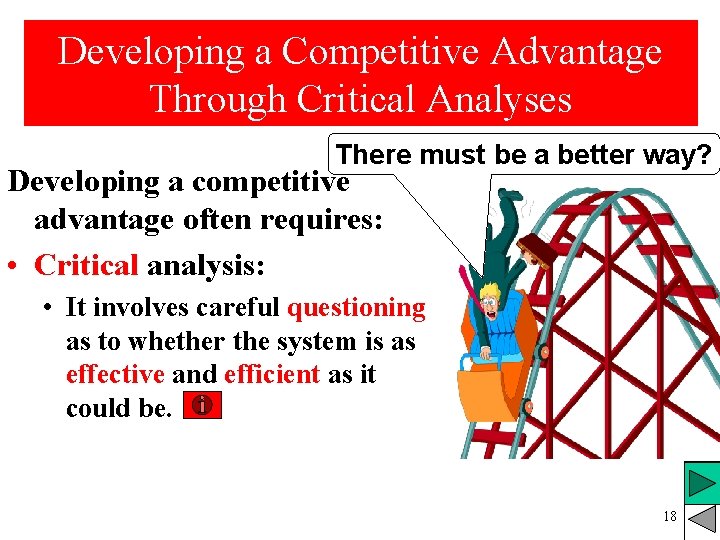
Developing a Competitive Advantage Through Critical Analyses There must be a better way? Developing a competitive advantage often requires: • Critical analysis: • It involves careful questioning as to whether the system is as effective and efficient as it could be. 18
Developing a Competitive Advantage Through Critical Analyses Critical analysis involves these actions: 1. Questioning the assumptions about the present system. • Should COSTCO be specializing in just “bulk” sales? • Should we continue capturing retail sales through wholesale orders for a product, or use point-of-sale devices? • Do we really need a large inventory, or should we use JIT. 19
Developing a Competitive Advantage Through Critical Analyses Critical analysis involves these actions: 2. Going beyond automating a manual system: • If the underlying manual system is fundamentally flawed, automation could just magnify its impact. • Critical analysis should be used to question why thing are done a particular way. 20
Developing a Competitive Advantage Through Critical Analyses Critical analysis involves these actions: 3. Identifying and resolving conflicting orientations and objectives within an organization. • Example: Marketing might be orientated toward selling high QUANTITIES of the product NOW, but production wants QUALITY NOW. (HP) 21
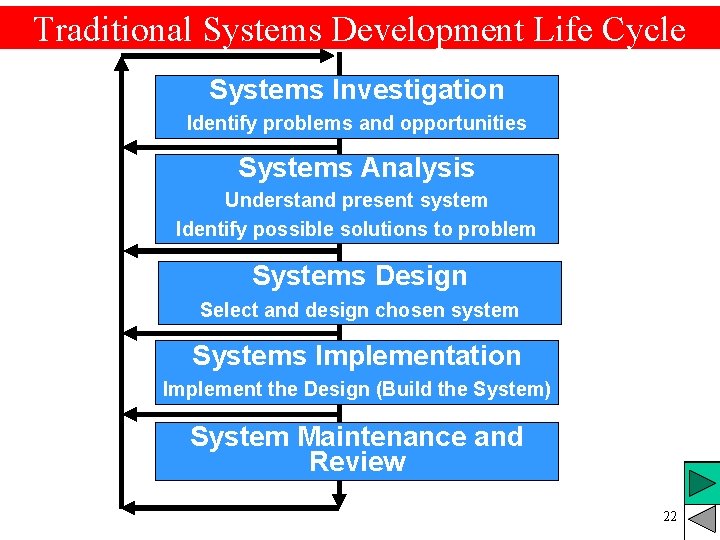
Traditional Systems Development Life Cycle Systems Investigation Identify problems and opportunities Systems Analysis Understand present system Identify possible solutions to problem Systems Design Select and design chosen system Systems Implementation Implement the Design (Build the System) System Maintenance and Review 22
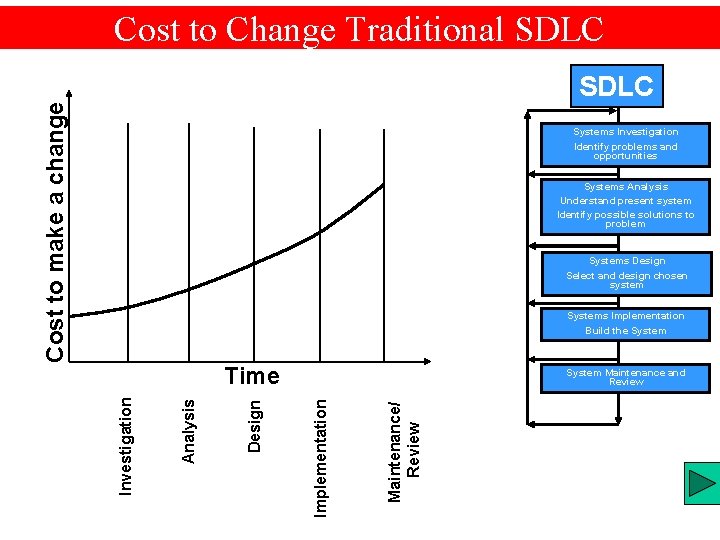
Cost to Change Traditional SDLC Cost to make a change SDLC Systems Investigation Identify problems and opportunities Systems Analysis Understand present system Identify possible solutions to problem Systems Design Select and design chosen system Systems Implementation Build the System Maintenance/ Review System Maintenance and Review Implementation Design Analysis Investigation Time
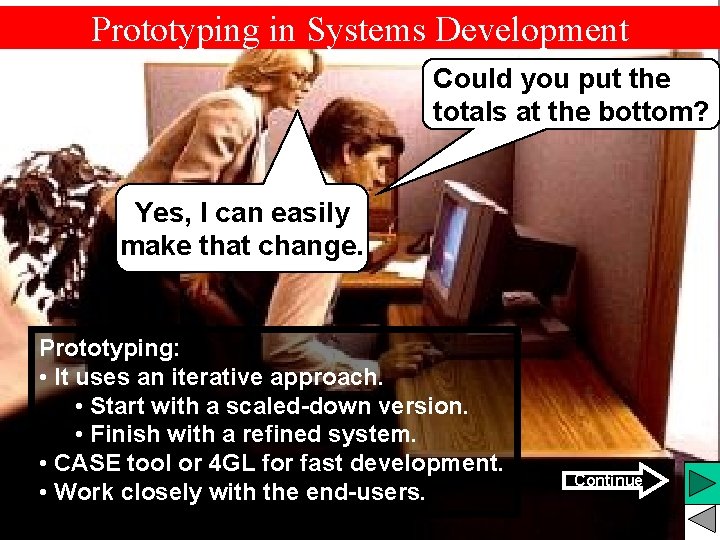
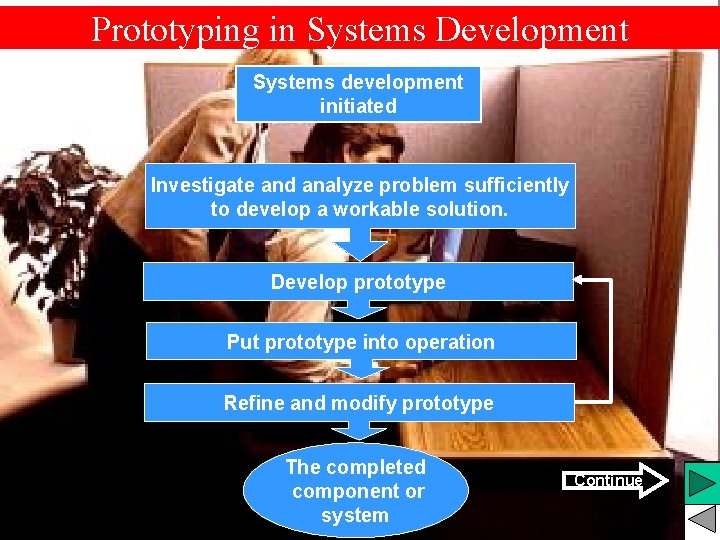
Prototyping in Systems Development Could you put the totals at the bottom? Yes, I can easily make that change. Prototyping: • It uses an iterative approach. • Start with a scaled-down version. • Finish with a refined system. • CASE tool or 4 GL for fast development. • Work closely with the end-users. Continue 24
Prototyping in Systems Development Systems development initiated Investigate and analyze problem sufficiently to develop a workable solution. Develop prototype Put prototype into operation Refine and modify prototype The completed component or system Continue 25
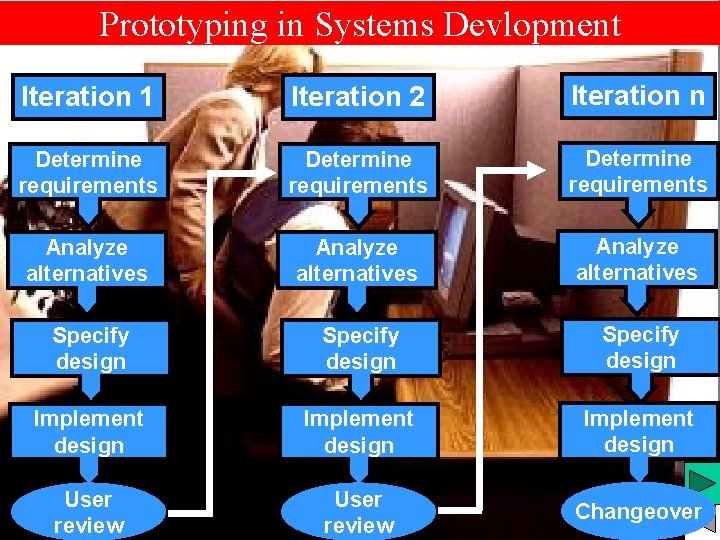
Prototyping in Systems Devlopment Iteration 1 Iteration 2 Iteration n Determine requirements Analyze alternatives Specify design Implement design User review Changeover 26
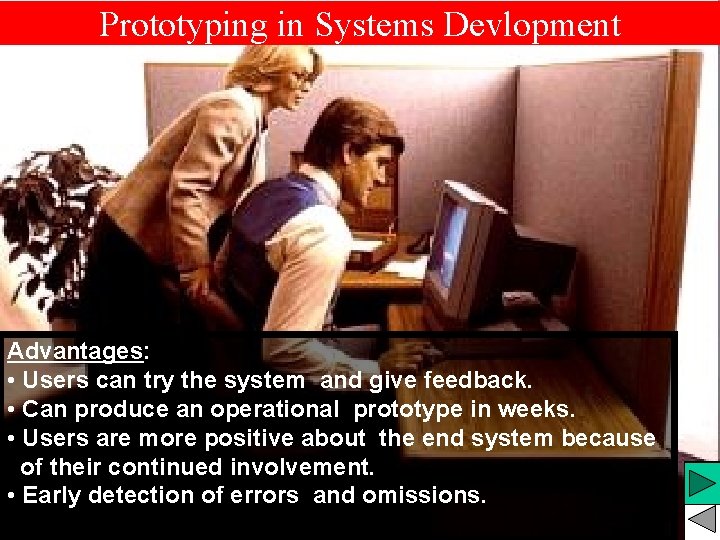
Prototyping in Systems Devlopment Advantages: • Users can try the system and give feedback. • Can produce an operational prototype in weeks. • Users are more positive about the end system because of their continued involvement. • Early detection of errors and omissions. 27
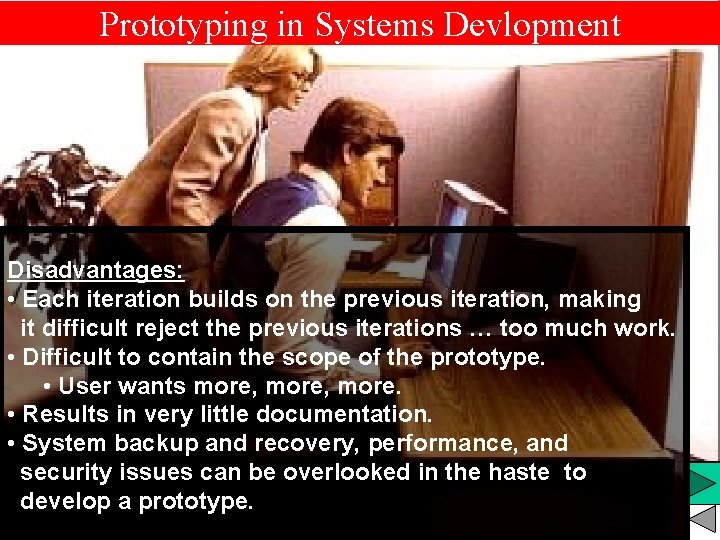
Prototyping in Systems Devlopment Disadvantages: • Each iteration builds on the previous iteration, making it difficult reject the previous iterations … too much work. • Difficult to contain the scope of the prototype. • User wants more, more. • Results in very little documentation. • System backup and recovery, performance, and security issues can be overlooked in the haste to develop a prototype. 28
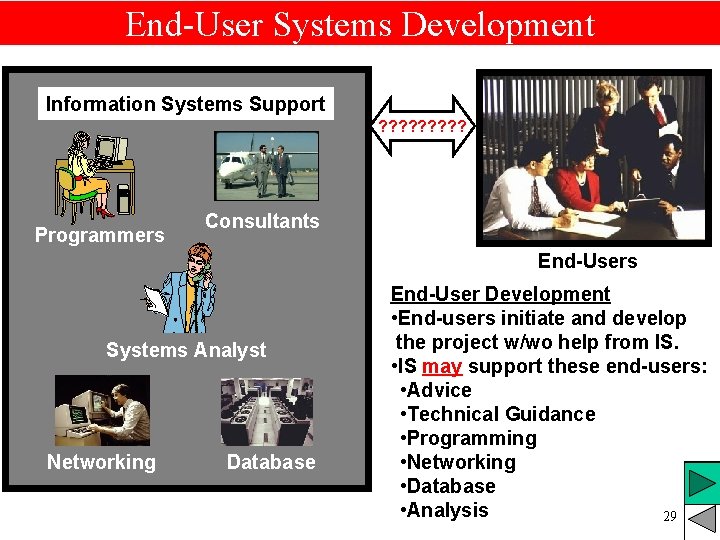
End-User Systems Development Information Systems Support ? ? ? ? ? Programmers Consultants End-Users Systems Analyst Networking Database End-User Development • End-users initiate and develop the project w/wo help from IS. • IS may support these end-users: • Advice • Technical Guidance • Programming • Networking • Database • Analysis 29
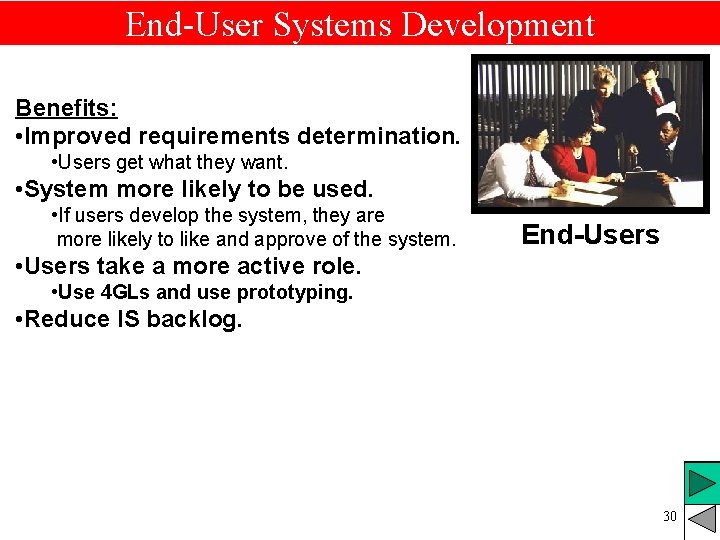
End-User Systems Development Benefits: • Improved requirements determination. • Users get what they want. • System more likely to be used. • If users develop the system, they are more likely to like and approve of the system. End-Users • Users take a more active role. • Use 4 GLs and use prototyping. • Reduce IS backlog. 30
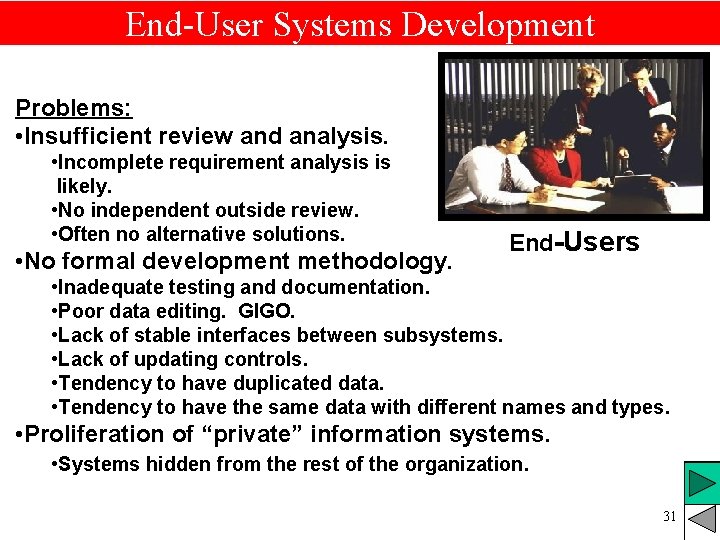
End-User Systems Development Problems: • Insufficient review and analysis. • Incomplete requirement analysis is likely. • No independent outside review. • Often no alternative solutions. • No formal development methodology. End-Users • Inadequate testing and documentation. • Poor data editing. GIGO. • Lack of stable interfaces between subsystems. • Lack of updating controls. • Tendency to have duplicated data. • Tendency to have the same data with different names and types. • Proliferation of “private” information systems. • Systems hidden from the rest of the organization. 31
32
Sample Test Question: Systems Development 1. In which SDLC stage would a feasibility analysis be done? a. Investigation b. System anlysis c. Systems design d. Systems implementation e. Systems maintenance and review 33
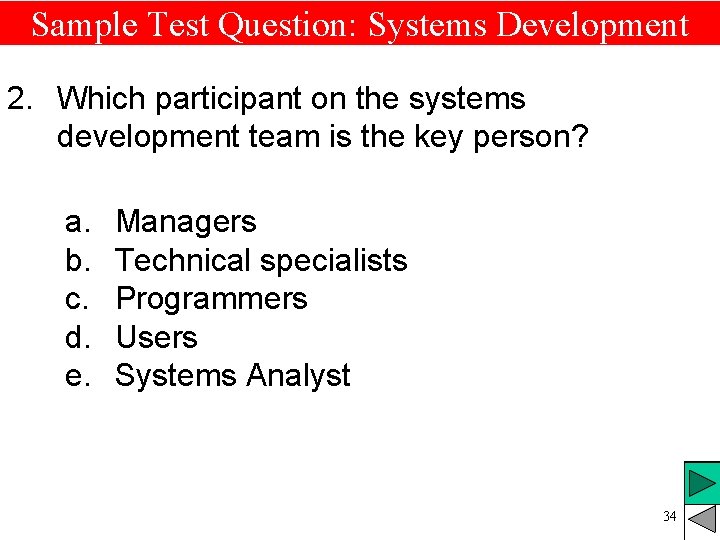
Sample Test Question: Systems Development 2. Which participant on the systems development team is the key person? a. b. c. d. e. Managers Technical specialists Programmers Users Systems Analyst 34
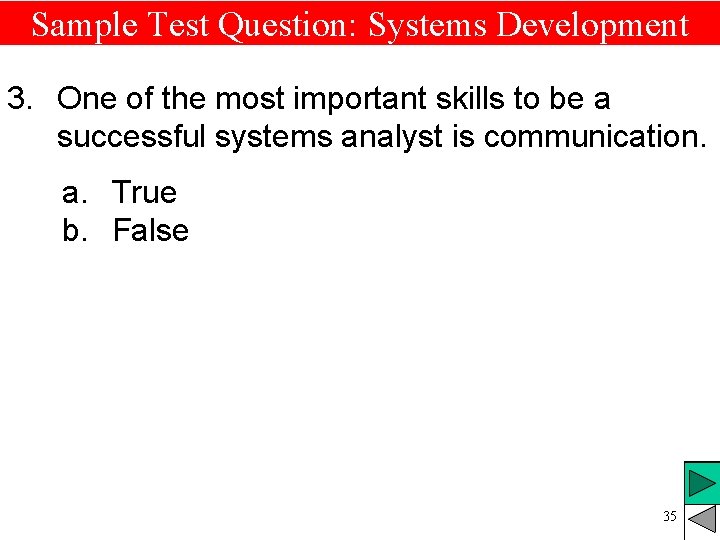
Sample Test Question: Systems Development 3. One of the most important skills to be a successful systems analyst is communication. a. True b. False 35
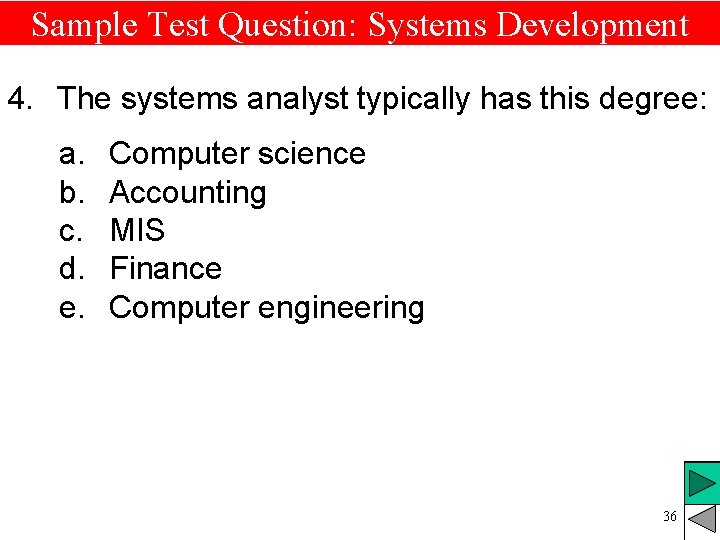
Sample Test Question: Systems Development 4. The systems analyst typically has this degree: a. b. c. d. e. Computer science Accounting MIS Finance Computer engineering 36
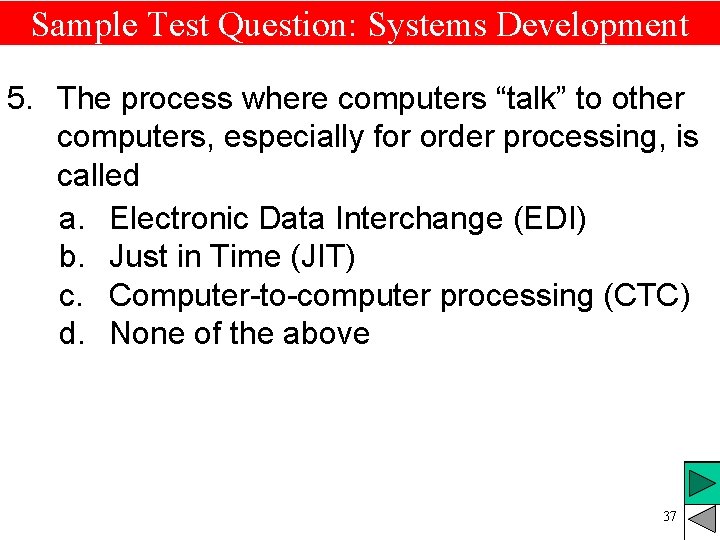
Sample Test Question: Systems Development 5. The process where computers “talk” to other computers, especially for order processing, is called a. Electronic Data Interchange (EDI) b. Just in Time (JIT) c. Computer-to-computer processing (CTC) d. None of the above 37
Sample Test Question: Systems Development 6. _______ are individuals who, either themselves or through the area of the organization they represent, ultimately benefit from the systems development project. a. Users b. Stakeholders c. Steakholders d. Managers e. Programmers 38
Sample Test Question: Systems Development 7. This person on the systems development team has high visibility to management. a. Users b. Stakeholders c. Programmers d. Technical specialists e. Systems analysts 39
Sample Test Question: Systems Development 8. When the systems analysts serves as the entire development team, the position is called a. b. c. d. e. Programmer analysts Technical specialist Systems manager Programmer None of the above 40
Sample Test Question: Systems Development 9. When initiating a systems development project it is very important to have a person who has the power to make change. a. True b. False 41
Sample Test Question: Systems Development 10. When planning an information system, it is very important to consider the strategic plan and organizational goals. a. True b. False 42
Sample Test Question: Systems Development 11. This type of analysis involves coming up with new approaches to existing problems. a. b. c. d. e. Creative analysis Brain storming analysis Group analysis Psychoanalysis None of the above 43
Sample Test Question: Systems Development 12. Dr. Ertle, a physiological psychologist believes that a creative person a. b. c. d. e. has a noisy brain. is able to work well with others has a fixed pattern of thinking is brain damaged is a non-conformist 44
Sample Test Question: Systems Development 13. Critical analysis involves careful questioning as to whether the system is as effective and efficient as it could be. a. True b. False 45
Sample Test Question: Systems Development 14. This type of analysis involves questioning the assumptions about the present system (best answer). a. b. c. d. Critical analysis Pattern analysis Concept analysis Logical analysis 46
Sample Test Question: Systems Development 15. Systems development today usually just automates a manual system. a. True b. False 47
Sample Test Question: Systems Development 16. In which stage of systems development is it bests to discover errors in the process. a. b. c. d. e. Investigation Analysis Design Implementation Maintenance and review 48
Sample Test Question: Systems Development 16. The type of systems development that allows for rapid changes as the system is being created is called a. b. c. d. e. Prototyping SDLC Creative systems development Data driven development None of the above 49
Sample Test Question: Systems Development 17. In general, users are more satisfied with prototyping than traditional SDLC methods. a. True b. False 50
Sample Test Question: Systems Development 18. In the haste to develop quickly a prototype, some problems may develop. Which items below are some of these problems? a. The user wants more, and more… b. Very little documentation c. Neglected performance and security issues. d. Backup and recovery issues. e. All of the above are correct. 51
Sample Test Question: Systems Development 19. End-user development without working with the information systems specialists often leads to a. insufficient review and analysis. b. development without any formal development methodology. c. poorly designed systems. d. proliferation of private information systems. e. All of the above are correct. 52
Sample Test Question: Systems Development 20. End-user developed systems are more likely to be used by these user-developers. a. True b. False 53