
System Fusion by Yaesu Roger Reini KD 8
System Fusion by Yaesu Roger Reini, KD 8 CSE
Overview l Digital communications in amateur radio and the case for C 4 FM l Yaesu’s implementation of C 4 FM: System Fusion

History of Digital Modes in Land Mobile l 1980’s: first digital LMR radios appear, using GMSK (GFSK) technique l Now, GMSK is out of favor, and C 4 FM (4 -level Frequency Shift Keying) is dominant l 2003: first GMSK transceiver released for amateur radio market l 2004: Icom’s D-STAR released; it also uses GMSK l 2011: Motorola LMR’s Digital Mobile Radio released, using C 4 FM; DMRMARC demonstrated it for Amateur Radio at Dayton
Types of Digital Communication Systems l Modulation: GMSK, π/4 DPQSK, C 4 DM (4 -level FSK) l Communication type: FDMA (Frequency Domain Multiple Access), TDMA (Time Domain Multiple Access) l Protocol
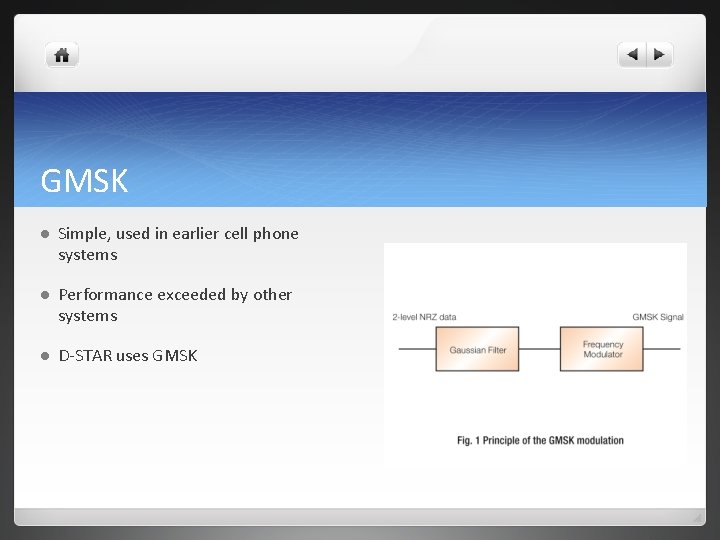
GMSK l Simple, used in earlier cell phone systems l Performance exceeded by other systems l D-STAR uses GMSK
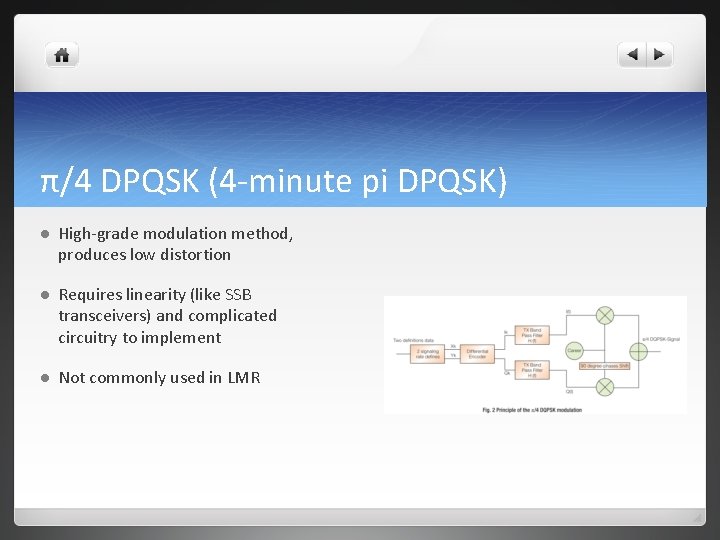
π/4 DPQSK (4 -minute pi DPQSK) l High-grade modulation method, produces low distortion l Requires linearity (like SSB transceivers) and complicated circuitry to implement l Not commonly used in LMR
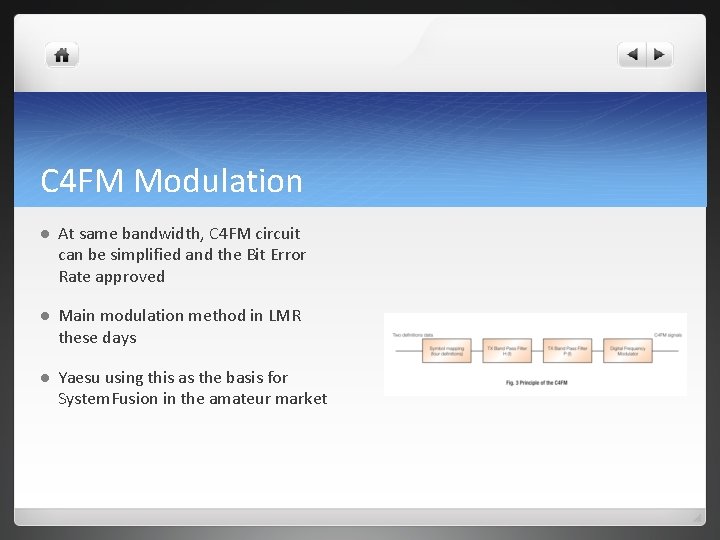
C 4 FM Modulation l At same bandwidth, C 4 FM circuit can be simplified and the Bit Error Rate approved l Main modulation method in LMR these days l Yaesu using this as the basis for System. Fusion in the amateur market
FDMA vs TDMA l FDMA circuitry is simpler than TDMA l TDMA reduces transmission time by one-half or more, reducing power consumption
Is C 4 FM compatible with D-STAR? l No, it’s not; different modulation techniques (GMSK vs C 4 FM) l Is this a problem in the amateur radio world? l Not really; an example of the experimentation that amateur radio is known for
Is C 4 FM Digital always the superior mode? l No, it isn’t; there will be instances when analog is superior l We amateurs know that different modes have different advantages and that some are preferred in certain circumstances l C 4 FM is another mode available to amateurs, increasing our capabilities; it’s another tool in our toolbox
Yaesu’s implementation: System Fusion l Three C 4 FM modes, using 12. 5 k. Hz bandwidth: l V/D Mode – Voice/Data simultaneous communication, half for voice, half for data and error correction l Voice FR (full rate) Mode – all bandwidth used for voice, top audio quality l Data FR Mode – all bandwidth used for data l Analog FM – 25 k. Hz; used when signals too weak for digital
AMS (Automatic Mode Select) l Transceiver recognizes the incoming mode (C 4 FM digital or analog FM) and switches over to match that mode l No need to remember to manually switch the mode on the transceiver l Enables mixed-mode communication on compatible repeaters l If a System. Fusion repeater is installed, you’re not locked out if you don’t have a System. Fusion transceiver
New Functions Gained with C 4 FM l Digital GM (Group Monitor) Function – see where group members are located l Snapshot Function – transmit images taken with camera microphone l Smart Navigation Functions l Simultaneous Voice and Data transmissions allows APRS-type position data to be sent while transmitting l Backtrack navigation – allows one to return to a preset point (useful for hiking)
Equipment that is C 4 FM capable l Repeater DR-1 144/430 dual band C 4 FM/FM repeater l HT FT 1 DR 144/430 dual band C 4 FM/FM 5 W transceiver l Mobile FTM-400 DR 144/430 dual band C 4 FM/FM 50 W transceiver
For More Information l Yaesu – www. yaesu. com; link to System Fusion page l FT 1 DR 2 m/70 cm HT l FTM-400 DR 2 m/70 cm mobile l DR-1 X digital 2 m/70 cm repeater
- Slides: 15