
System Elements High Point Broadband Delivery System Sector
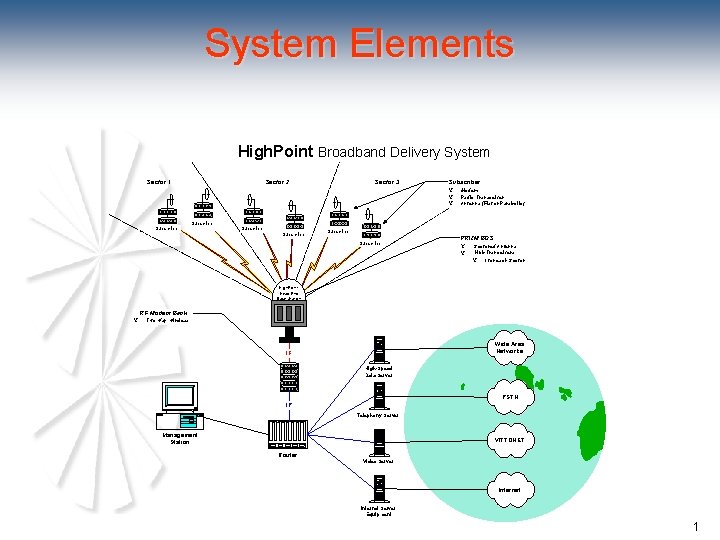
System Elements High. Point Broadband Delivery System Sector 1 Sector 2 Sector 3 Subscriber Ÿ Ÿ Ÿ Modem Radio Transceiver Antenna (Flat or Parabolic) Subscriber Subscriber PRIZM BDS Ÿ Sectored Antenna Ÿ Hub Tranceivers 1 for each Sector Ÿ High. Point Head-End Base Station RF Modem Bank Ÿ Two Way Wireless Wide Area Networks IF High-Speed Data Server PSTN IP Telephony Server Management Station VITTONET Router Video Server Internet Server Equipment 1
System Elements Ø Head-end (hub or base-station) Equipment Ø Subscriber Equipment Ø Network Management / Provisioning Server Ø Network Access (router, switch or bridge) 2
Base Station Equipment Ø Base-station Outdoor Unit (ODU) 24 C, 6 B Ø Antenna Ø Transceiver(s) Ø Duplexer(s) Ø 24 C System will support up to 24 sectors in one enclosure, high end system for high subscriber density. Ø 6 B system has ODU similar to Subscriber but uses 60 or 90 degree antennas. 3
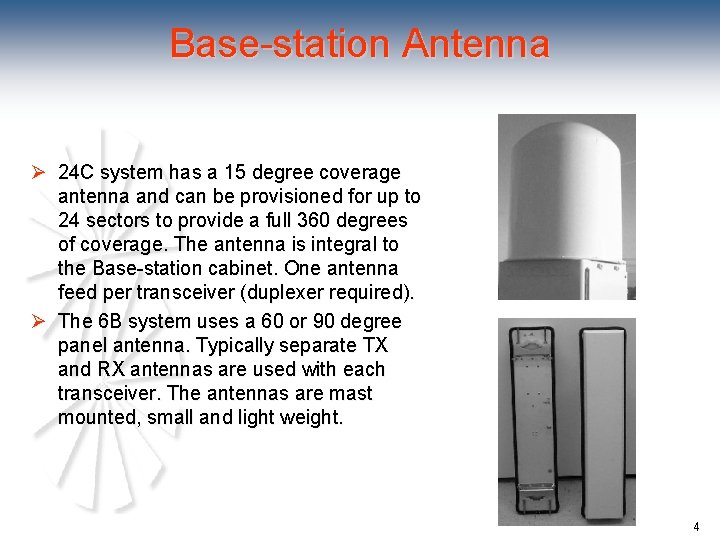
Base-station Antenna Ø 24 C system has a 15 degree coverage antenna and can be provisioned for up to 24 sectors to provide a full 360 degrees of coverage. The antenna is integral to the Base-station cabinet. One antenna feed per transceiver (duplexer required). Ø The 6 B system uses a 60 or 90 degree panel antenna. Typically separate TX and RX antennas are used with each transceiver. The antennas are mast mounted, small and light weight. 4
24 C Outdoor Unit Ø Major Components of 24 C ODU Ø Power Distribution Box Ø Power Supply(s) Ø Card Cage(s) Ø Fan Tray Ø Transceivers Ø Duplexers Ø Hub Antenna Ø Pedestal (optional) 5

24 C ODU Power Distribution Box Ø AC Distribution Box Ø Provides a connection point for the AC service. Ø Filters out noise on the AC service. Ø Provides a convenient accessory power outlet. Ø Contains circuit breakers for main power and the accessory receptacle. 6
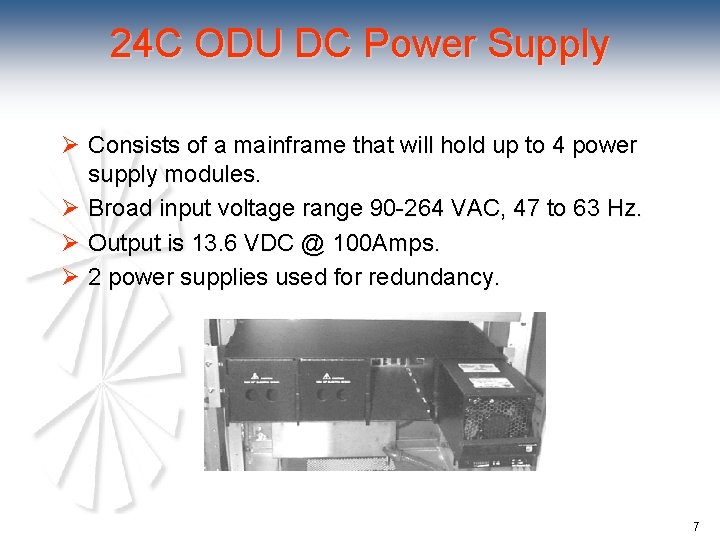
24 C ODU DC Power Supply Ø Consists of a mainframe that will hold up to 4 power supply modules. Ø Broad input voltage range 90 -264 VAC, 47 to 63 Hz. Ø Output is 13. 6 VDC @ 100 Amps. Ø 2 power supplies used for redundancy. 7

24 C ODU Equipment Enclosure Ø Mechanical Components of Cabinet Ø The pedestal which supports the cabinet and antenna provides a 4 hole flange for securing the base station to its mounting surface. It also provides a convenient cable entry way. Ø The cabinet contains an integral rack which provides a mounting surface for the card cages, power supply and fan tray. The antenna assembly is mounted to the top of the cabinet. Ø A card cage will hold up to 12 transceivers or duplexers and one controller card. Multiple card cages can be mounted in a cabinet Ø The fan tray provides air circulation to cool the electronics. 8
6 B Hub Transceiver Ø Outdoor, weather proof, mast mounted enclosure Ø DC Power and remote communications are diplexed on to the IF cable, single cable between ODU and IDU. Requires a Bias “T” with indoor transceiver power supply. Ø 2 frequency bands, 2. 5 and 3. 5 GHz Ø Can use 2 antennas which improves system gain and tuning range, no duplexer limitations. Ø Single antenna option available at 2. 5 GHz 9
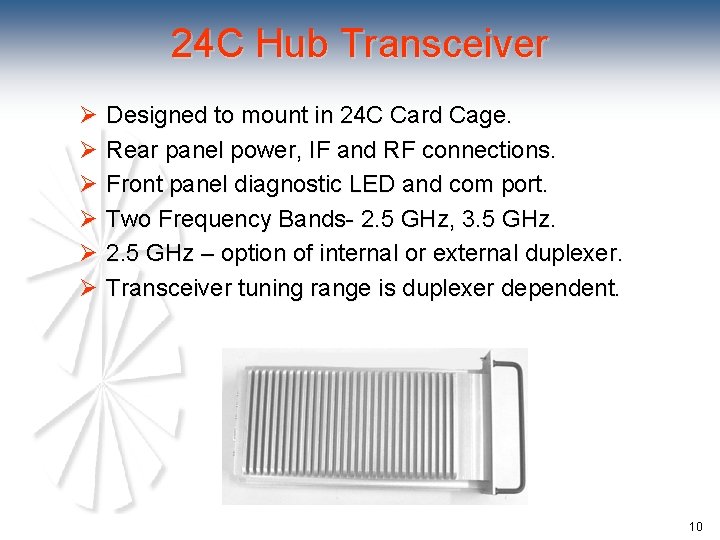
24 C Hub Transceiver Ø Designed to mount in 24 C Card Cage. Ø Rear panel power, IF and RF connections. Ø Front panel diagnostic LED and com port. Ø Two Frequency Bands- 2. 5 GHz, 3. 5 GHz. Ø 2. 5 GHz – option of internal or external duplexer. Ø Transceiver tuning range is duplexer dependent. 10
Transceiver Features Ø Frequency Agile Ø Adjustable TX and RX gain Ø Local & remote diagnostics & configuration Ø Single cable modem connection Ø Diagnostic LED 11
Hub Transceiver Connectors Ø TX Output Ø RX Input Ø Antenna (optional internal duplexer) Ø IF Ø Test, serial interface (1/8 stereo phone jack) Ø DC Power (24 C only) 12
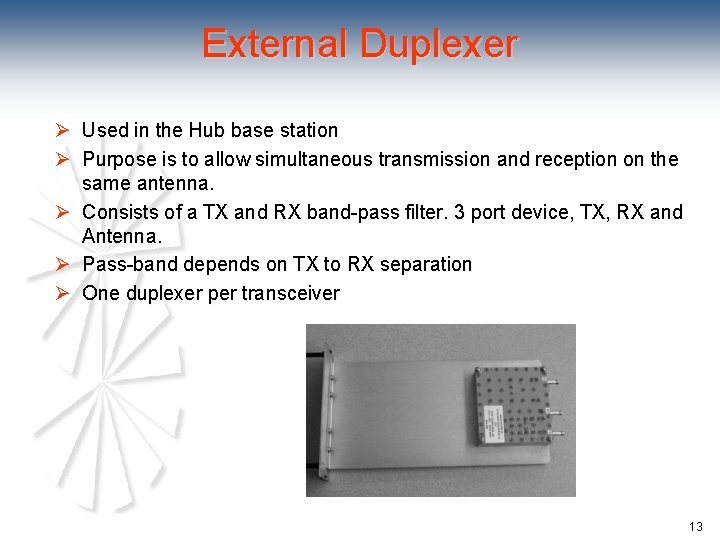
External Duplexer Ø Used in the Hub base station Ø Purpose is to allow simultaneous transmission and reception on the same antenna. Ø Consists of a TX and RX band-pass filter. 3 port device, TX, RX and Antenna. Ø Pass-band depends on TX to RX separation Ø One duplexer per transceiver 13
Head-end Modem Ø Consists of a cabinet that can support up to 4 modems. Ø A modem is made up of 3 cards. Ø Power Supply Card Ø CPU Card Ø RF Card Ø Additionally the head-end modem requires a forward path frequency translator and a diplexer. 14
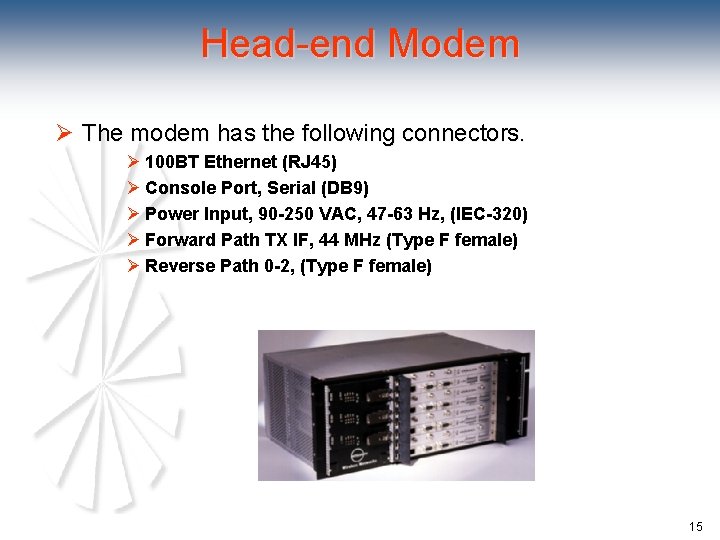
Head-end Modem Ø The modem has the following connectors. Ø 100 BT Ethernet (RJ 45) Ø Console Port, Serial (DB 9) Ø Power Input, 90 -250 VAC, 47 -63 Hz, (IEC-320) Ø Forward Path TX IF, 44 MHz (Type F female) Ø Reverse Path 0 -2, (Type F female) 15
Head-end Modem Ø Visual Indicators are as follows. Ø Forward Path Traffic (10 segment LED) Ø Reverse Path Traffic (10 segment LED) Ø Summary Fault (Red) Ø Forward Path Active (Green) Ø Reverse Path 0 -2 Active (Green) 16
Head-end Modem Features Ø Up to 22 Mbit/s downstream throughput Ø Up to 4. 9 Mbit/s upstream throughput per channel Ø Bridging for up to 4096 work stations Ø Support up to 100 subscribers per carrier Ø SNMP management Ø Over the air firmware upgrades Ø User controllable parameters Ø Forward error correction 17
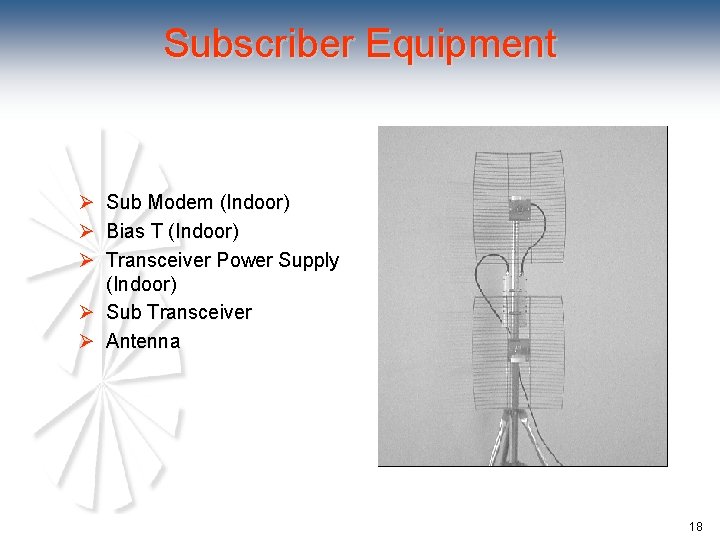
Subscriber Equipment Ø Sub Modem (Indoor) Ø Bias T (Indoor) Ø Transceiver Power Supply (Indoor) Ø Sub Transceiver Ø Antenna 18
Sub Transceiver Ø Outdoor, weather proof, mast mounted enclosure. Ø DC Power and remote communications are diplexed on to the IF cable, single cable between ODU and IDU. Ø 2 frequency bands, 2. 5 and 3. 5 GHz. Ø Can use 2 antennas which improves system gain and tuning range, no duplexer limitations. Ø Single antenna option available at 2. 5 GHz. 19
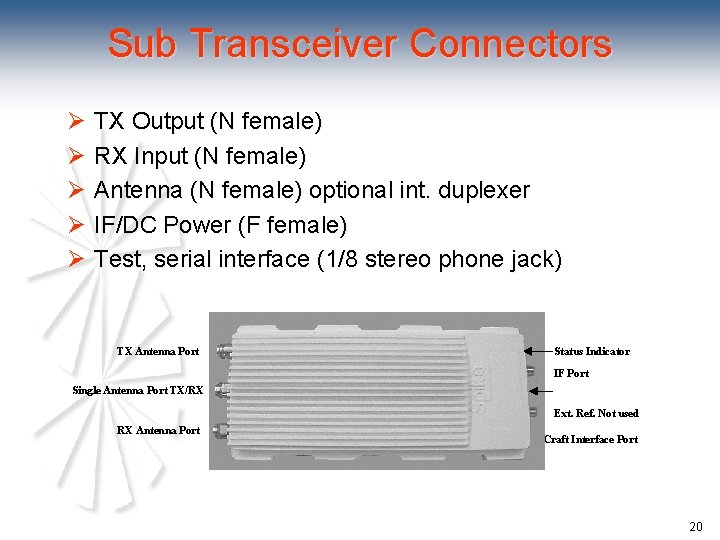
Sub Transceiver Connectors Ø TX Output (N female) Ø RX Input (N female) Ø Antenna (N female) optional int. duplexer Ø IF/DC Power (F female) Ø Test, serial interface (1/8 stereo phone jack) TX Antenna Port Status Indicator IF Port Single Antenna Port TX/RX Ext. Ref. Not used RX Antenna Port Craft Interface Port 20
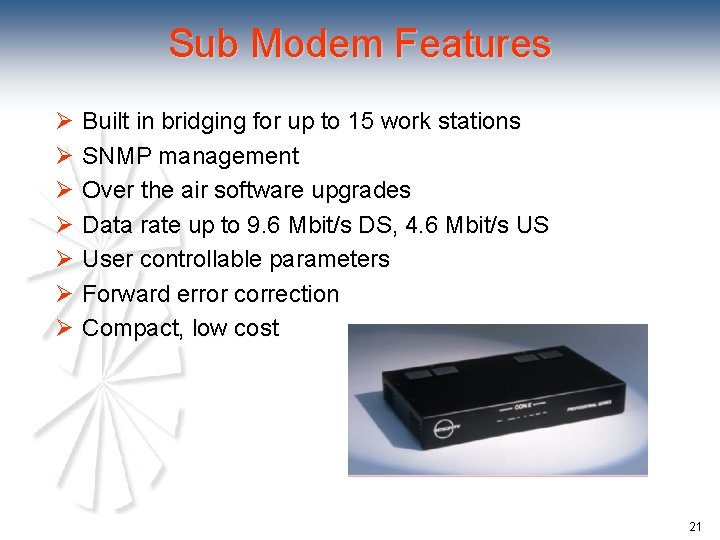
Sub Modem Features Ø Built in bridging for up to 15 work stations Ø SNMP management Ø Over the air software upgrades Ø Data rate up to 9. 6 Mbit/s DS, 4. 6 Mbit/s US Ø User controllable parameters Ø Forward error correction Ø Compact, low cost 21
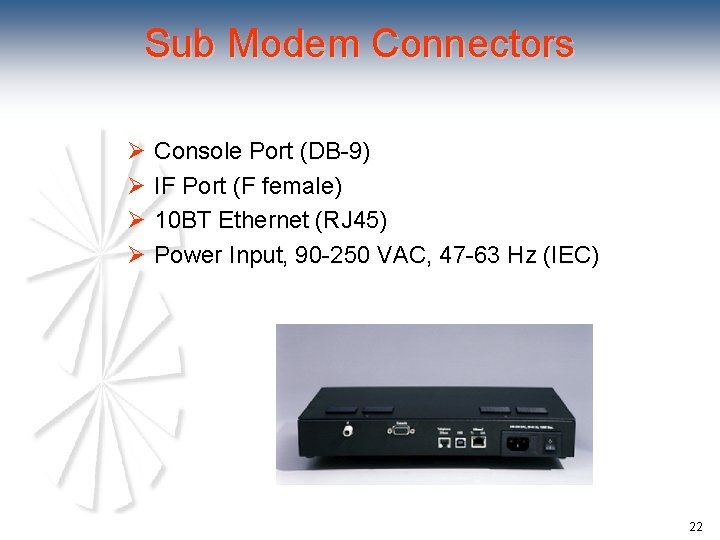
Sub Modem Connectors Ø Console Port (DB-9) Ø IF Port (F female) Ø 10 BT Ethernet (RJ 45) Ø Power Input, 90 -250 VAC, 47 -63 Hz (IEC) 22
Sub Modem Visual Indicators Ø Power (Green) Ø Ethernet Activity (Green) Ø TX (Yellow) Ø RX (Yellow) Ø Fault (Red) Ø Ready (Green) Ø Sync (Green) 23
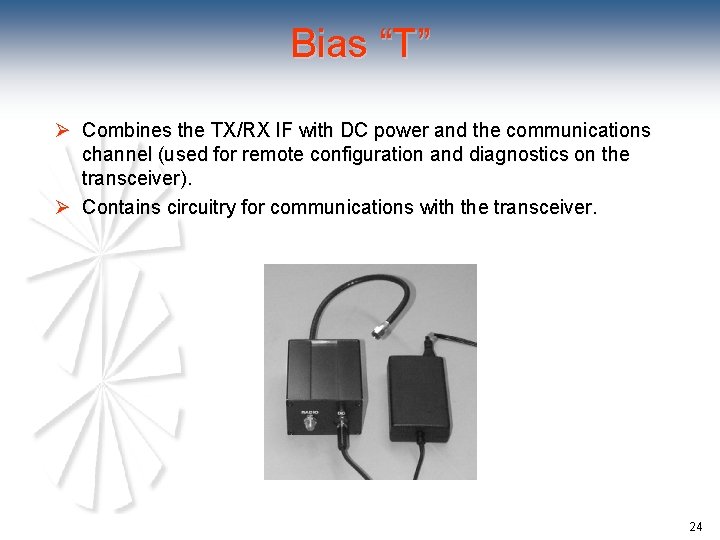
Bias “T” Ø Combines the TX/RX IF with DC power and the communications channel (used for remote configuration and diagnostics on the transceiver). Ø Contains circuitry for communications with the transceiver. 24
Bias “T” Ports Ø “Modem” modem connects to this port (F female) flexible cable attached. Ø “Radio” transceiver connects to this port (F female) DC power on this connector be careful when connecting test equipment. Ø “DC” transceiver power supply connection (3. 5 MM). Ø “Comm” serial interface (1/8 inch stereo female). 25
- Slides: 25