
System Design Visible Spectro Polarimeter for the ATST
System Design: Visible Spectro. Polarimeter for the ATST Principal Investigator: Instrument Scientist: Project Manager: Lead Engineer: Electrical Engineer: Mechanical Engineer: Michael Knölker Héctor Socas Navarro Kim Streander David Elmore (SDR author) Greg Card Clarke Chambellan
Afternoon Contents • • • Performance model Interfaces Verification and Test Risk analysis Resources Vi. SP SDR HAO 2 -3 March 2006
Performance model • • • Spectral resolution and sample size Spatial resolution Optical performance Camera summary Flux budget Vi. SP SDR HAO 2 -3 March 2006
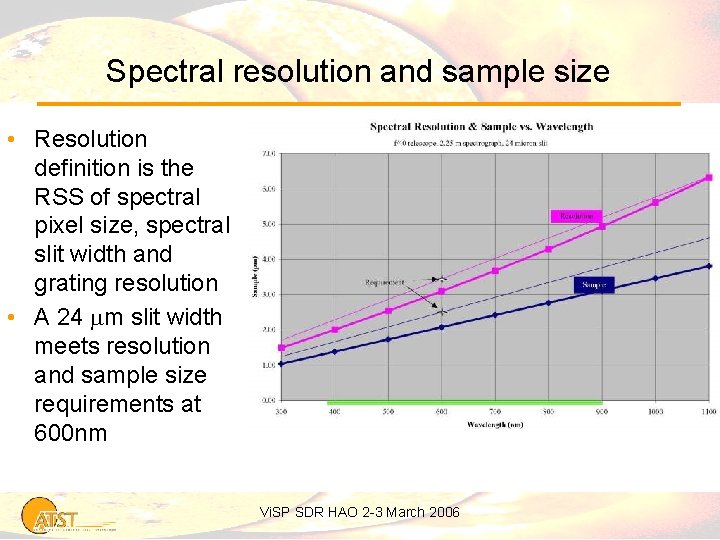
Spectral resolution and sample size • Resolution definition is the RSS of spectral pixel size, spectral slit width and grating resolution • A 24 mm slit width meets resolution and sample size requirements at 600 nm Vi. SP SDR HAO 2 -3 March 2006
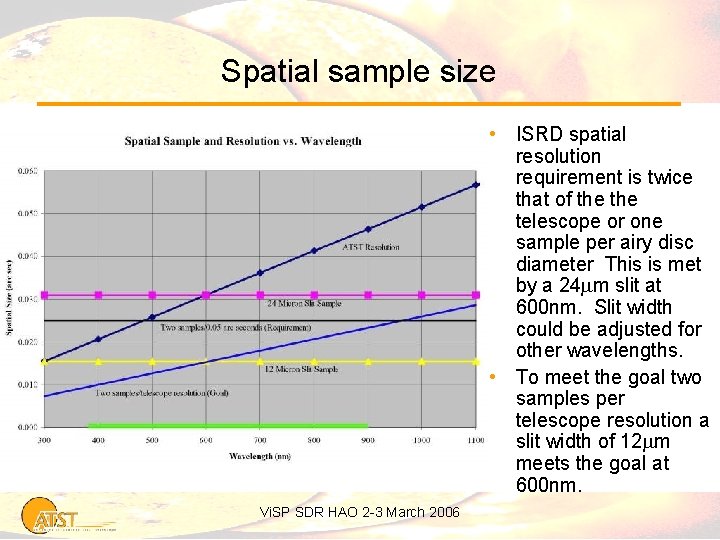
Spatial sample size • ISRD spatial resolution requirement is twice that of the telescope or one sample per airy disc diameter This is met by a 24 mm slit at 600 nm. Slit width could be adjusted for other wavelengths. • To meet the goal two samples per telescope resolution a slit width of 12 mm meets the goal at 600 nm. Vi. SP SDR HAO 2 -3 March 2006
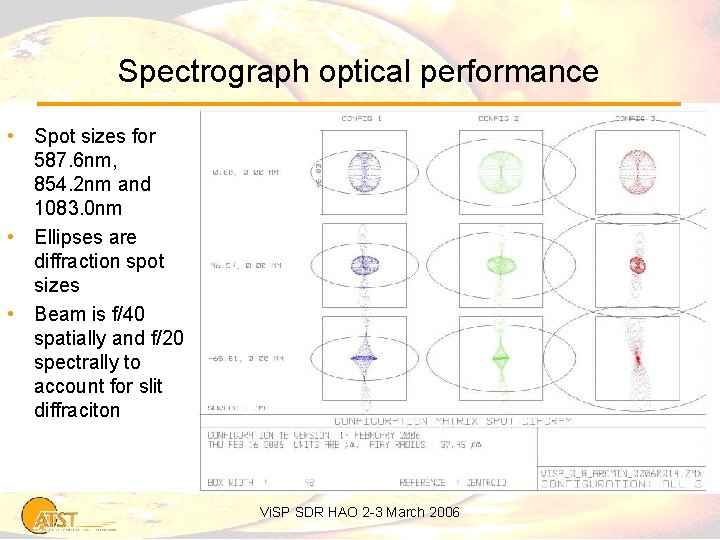
Spectrograph optical performance • Spot sizes for 587. 6 nm, 854. 2 nm and 1083. 0 nm • Ellipses are diffraction spot sizes • Beam is f/40 spatially and f/20 spectrally to account for slit diffraciton Vi. SP SDR HAO 2 -3 March 2006
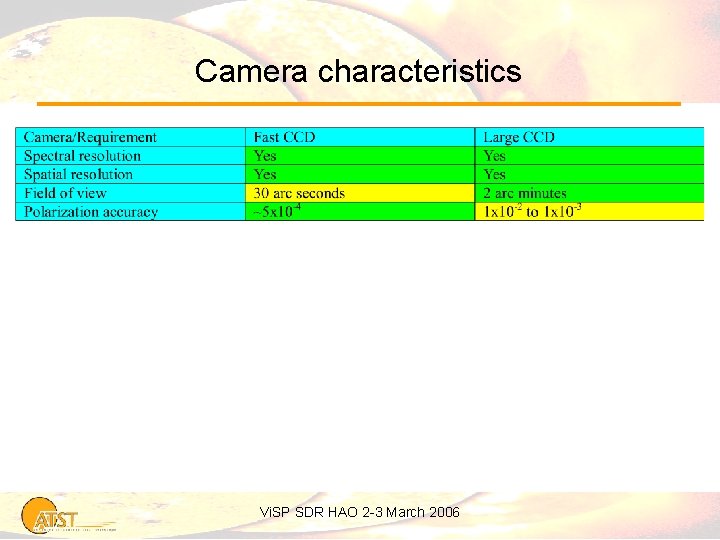
Camera characteristics Vi. SP SDR HAO 2 -3 March 2006
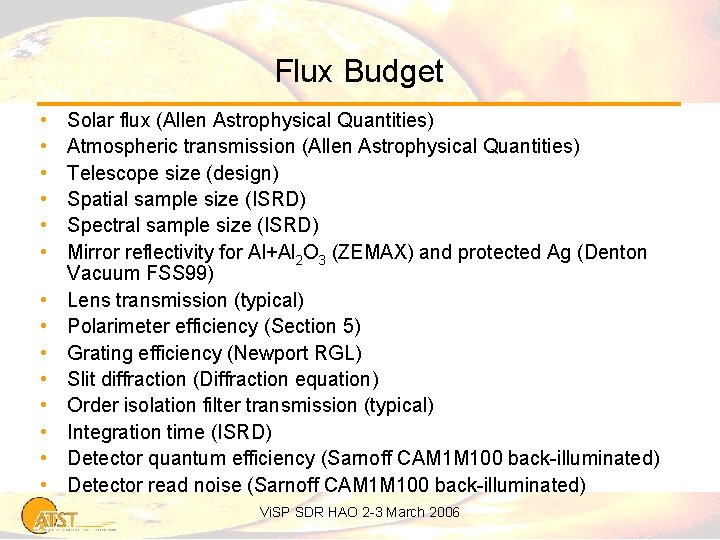
Flux Budget • • • • Solar flux (Allen Astrophysical Quantities) Atmospheric transmission (Allen Astrophysical Quantities) Telescope size (design) Spatial sample size (ISRD) Spectral sample size (ISRD) Mirror reflectivity for Al+Al 2 O 3 (ZEMAX) and protected Ag (Denton Vacuum FSS 99) Lens transmission (typical) Polarimeter efficiency (Section 5) Grating efficiency (Newport RGL) Slit diffraction (Diffraction equation) Order isolation filter transmission (typical) Integration time (ISRD) Detector quantum efficiency (Sarnoff CAM 1 M 100 back-illuminated) Detector read noise (Sarnoff CAM 1 M 100 back-illuminated) Vi. SP SDR HAO 2 -3 March 2006
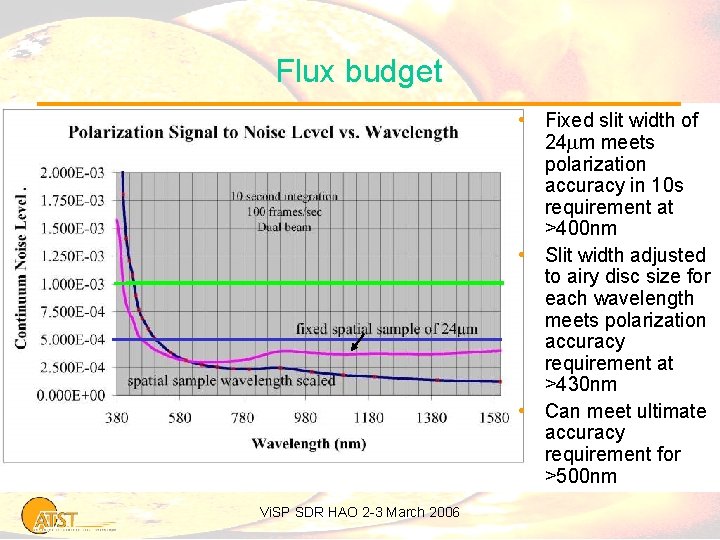
Flux budget • Fixed slit width of 24 mm meets polarization accuracy in 10 s requirement at >400 nm • Slit width adjusted to airy disc size for each wavelength meets polarization accuracy requirement at >430 nm • Can meet ultimate accuracy requirement for >500 nm Vi. SP SDR HAO 2 -3 March 2006

Interfaces • According to the Interface Control Organizational Chart (N 2 diagram), the Vi. SP is connected to six other ATST facilities • Other instruments and their Instrument Control Systems are shown Data Handling System Vi. SP SDR HAO 2 -3 March 2006

Coudé station optical interface • An interface has been demonstrated using ZEMAX • The Vi. SP can connect to the telescope using a triplet lens that images the Sun on the slit and collimates the pupil Vi. SP SDR HAO 2 -3 March 2006
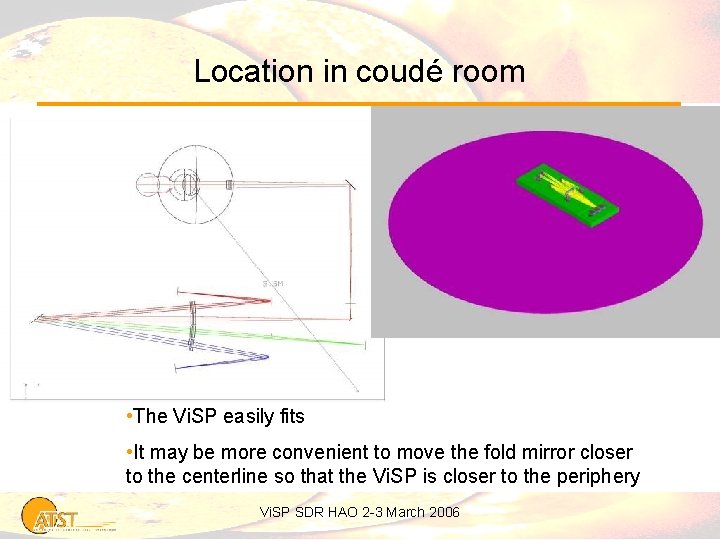
Location in coudé room • The Vi. SP easily fits • It may be more convenient to move the fold mirror closer to the centerline so that the Vi. SP is closer to the periphery Vi. SP SDR HAO 2 -3 March 2006
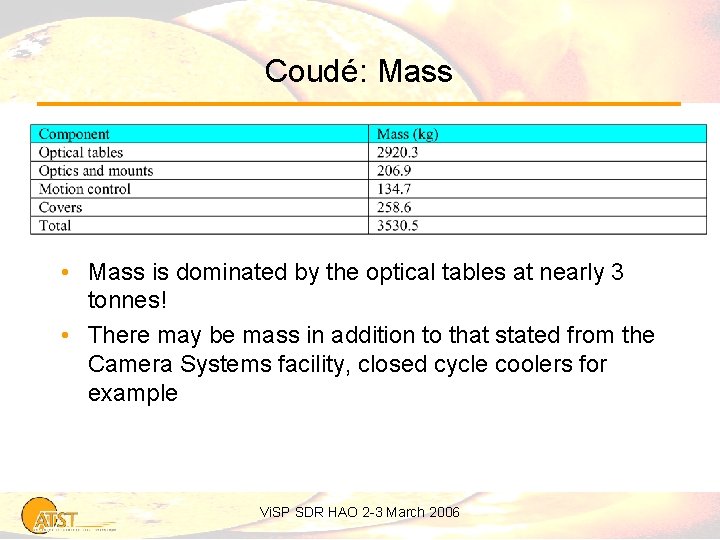
Coudé: Mass • Mass is dominated by the optical tables at nearly 3 tonnes! • There may be mass in addition to that stated from the Camera Systems facility, closed cycle coolers for example Vi. SP SDR HAO 2 -3 March 2006
Coudé: Vibration • An ergonomic work environment is anticipated – Freedom from strong drafts – Freedom from high sound levels • Foot traffic like at the DST could be a problem – Avoid foot traffic during observations – Air suspension of optical tables is expensive and makes coupling to the telescope difficult so will be avoided Vi. SP SDR HAO 2 -3 March 2006
Coudé: HVAC • An ergonomic work environment is anticipated – Temperature controlled to within ± 2 C in the 20 C to 22 C range is desired • Humidity control is desired – High enough to avoid arcing – Low enough so that temperature stabilized CCD cameras can be used • Particulates should be controlled especially for AO – Tacky mats and shoe cleaners at entrances – HEPA filtration of circulated air Vi. SP SDR HAO 2 -3 March 2006

Coudé: Utilities • Rated power for motion control dominates the budget. Actual power will be lower • Actuators are assumed to all be running simultaneously • At this time there is no requirement for compressed air • There is no requirement for water in the coudé room • Depending upon camera requirements, it may be necessary to duct camera cooling air out of the spectrograph Vi. SP SDR HAO 2 -3 March 2006
Coudé: Cable management • The Vi. SP optical tables will have cable feed through holes approximately every meter near their periphery • Actuator cables will be collected at panels under the table and fed through the floor to networked control system racks • We request the Camera Systems facility plan for simplified cable management Vi. SP SDR HAO 2 -3 March 2006

PA&C: GOS • Dark Slide – Precedes all other GOS optics – Fast <1 second • Upper GOS: Band pass limiting, Calibration linear polarizer & Calibration retarder station – Band pass limit to reflect flux – Band pass limiting filter, calibration linear polarizer and calibration retarder are inserted simultaneously – Polarizer and retarder rotate independently to any angle at a rate >45º /second ATST_GOS_Rev-B. pdf Vi. SP SDR HAO 2 -3 March 2006

PA&C: GOS • Upper GOS: Polarization modulator station – Contains a rapidly rotating retarder (900 RPM) – Contains a low voltage solid state retarder position for LC modulators – LC modulators can be interchanged easily (after hours) – Band pass limiting is needed for solar flux and rejection of UV for LC modulators – LC modulators must rotate with the solar image • Lower GOS: Gregorian focus station – – Alignment targets Variable sized aperture LASER injection White light injection for flat fielding Vi. SP SDR HAO 2 -3 March 2006
PA&C Sub-aperture calibration unit • Located in front of M 1 in single beam • Linear polarizer and retarder move into the beam together – <5 seconds • Linear polarizer rotates to any angle – >45°/second rotation • Retarder rotates to any angle – >45°/second rotation Vi. SP SDR HAO 2 -3 March 2006
PA&C Sub-aperture pupil mask • Located at any convenient pupil • Same optical size as image of sub-aperture calibration unit • Moves in and out of the beam <5 seconds Vi. SP SDR HAO 2 -3 March 2006

Camera Systems: Mechanical • Height above optical surface desired to be 200 mm • Universal camera mount has been designed as part of Vi. SP effort – Height – Tip-tilt – Focus Vi. SP SDR HAO 2 -3 March 2006
Camera Systems: Hardware setup • Parameters loaded into the ‘camera’ – – – – X window Y window X binning Y binning Gains Offsets Frame rate Vi. SP SDR HAO 2 -3 March 2006

Camera Systems: Software setup • High frame rate focus mode display with – – – Row plots Column plots Histogram Pan Zoom • Science mode – Virtual image monitor Vi. SP SDR HAO 2 -3 March 2006
Camera Systems: Science Observations • Vi. SP requires demodulation mode – High rate frames are summed into buffers that are delivered at the end of an integration at a much slower rate • Other instruments might want – – Burst mode Frame selection Cadence … Vi. SP SDR HAO 2 -3 March 2006
Instrument Control System • Vi. SP has no computer of its own but does have an ICS that resides somewhere on the network • Vi. SP ICS provides – An engineering GUI to test all mechanism functional and performance specifications – Engineering support for diagnosing Vi. SP problems – The agreed to interface to the OCS – Ability to execute sequences downloaded from the OCS Vi. SP SDR HAO 2 -3 March 2006
Observatory Control System • Downloads sequences to the ICS for particular instrument setups • Supervises multi-instrument experiments – Telescope calibration – Point telescope to disc center – Set up Vi. SP, NIRSP, … – Configure sub-aperture calibration unit and pupil mask – Record science data at various configurations – Polarimeter response calibration – Flat field – Spectro-polarimetric maps Vi. SP SDR HAO 2 -3 March 2006
Observatory Control System • Use cases are a high priority Vi. SP SDR HAO 2 -3 March 2006
Data Handling System • Provides experiment tags to various ICS • ICS then produce tagged science data, pointing information, experiment status, instrument status • DHS gathers tagged information • Simple display of quick-look science data such as I, Q, U, V maps – – Plots Gain adjustment Pan Zoom Vi. SP SDR HAO 2 -3 March 2006
Interconnects and Services • Network for ICS to mechanism controllers • High speed polarimetric synchronization between PA&C and Camera Systems Vi. SP SDR HAO 2 -3 March 2006

Verification and Test • Each requirement in the ISRD must be demonstrated during Integration, Test, and Calibration (IT&C) • Test characteristics – – Setup Procedure Requirements verified Analysis Vi. SP SDR HAO 2 -3 March 2006
Verification and Test example • Wavelength diverse spectro-polarimetric calibration • Setup: Configure the Vi. SP with visible cameras spanning the range 380 nm to 900 nm and an infrared camera at 1. 5648 mm. • Procedure: Run through an instrument polarization calibration configuring calibration optics at the GOS to standard calibration configurations and recording Stokes data. Vi. SP SDR HAO 2 -3 March 2006
Verification and Test example • Requirements verified: – – – Wavelength range Simultaneous wavelengths Polarimetric Sensitivity Polarimetric accuracy Temporal resolution Spectral sample size • Analysis. Use polarization calibration data to compute polarization signal to noise as a function of wavelength and location within the field of view. Compute the spectral sample size using solar features. Polcal_analysis. pro Vi. SP SDR HAO 2 -3 March 2006
Verification and Test: Other tests • • • Spectro-polarimetric map Spatial resolution Instrument spectral profile Slit scan performance Vi. SP – NIRSP spectro-polarimetric map Vi. SP – VTF simultaneous observation Vi. SP SDR HAO 2 -3 March 2006
Risk Analysis • No risk – Any questions Vi. SP SDR HAO 2 -3 March 2006
Risk Analysis • Interface definition – What are the bounds of the Vi. SP – Can ATST facilities meet Vi. SP requirements – Are there conflicting requirements on facilities from other instruments • PA&C and CS are main interface concerns • Vi. SP optical design needs refinement after interfaces are defined • Vi. SP context imaging path is TBD Vi. SP SDR HAO 2 -3 March 2006
Risk Analysis • Internals of Vi. SP spectrograph are low risk – No new technology – Heritage in mechanism motions • Camera Systems – To meet baseline requirements, Fast CCD and Large CCD present technology will work – A fast-large CCD may become available – To meet polarization accuracy goal new technology is required (DID) Vi. SP SDR HAO 2 -3 March 2006
Risk Analysis • PA&C – Modulators and calibration optics break no new ground – Size is larger but vendors are willing to produce these sizes for a price – LCs meet baseline requirement and will continue to improve in performance Vi. SP SDR HAO 2 -3 March 2006
Resources • Consider these preliminary, they are not yet part of a proposal • There is uncertainty due to interfaces for example: – What CS items are to included in our estimates – Location and mounting of optical interface optics is TBD • Estimates are 2006 dollars • Details in Supplemental documents, ATST_Vi. SP_Budget. pdf Vi. SP SDR HAO 2 -3 March 2006
Resources: Now to CDR • 1. 5 EY • At least six people contribute • Approximately 12 months of calendar time is required due to pacing of contributing items – Meetings to resolve interfaces with the project and with other experimenters – Vendor’s estimates Vi. SP SDR HAO 2 -3 March 2006
Resources: CDR to Integration • 4. 5 effort years • At least six people contribute • No less than 15 months of calendar time is required due to pacing of contributing items – Long lead time optics – Shipping – Pacing of IT&C Vi. SP SDR HAO 2 -3 March 2006

Resources: Purchased hardware • No contingency • $ 2006 • Includes $96 k for camera mounts inside Vi. SP SDR HAO 2 -3 March 2006

Resources: Bottom line • • Interfaces TBD $ 2006 Current hardware prices Includes $96 k for camera mounts inside Vi. SP SDR HAO 2 -3 March 2006

Summary • We presented flow down from science requirements to instrument design – Two modes of operation • Fast CCD that meets polarization accuracy requirement • Large CCD that meets field of view requirement – No new technology inside spectrograph • Main area of risk is lack of definition of interfaces Vi. SP SDR HAO 2 -3 March 2006
Summary: Action Items • Initial action items moving towards CDR – Research all interfaces and prepare Interface Control Documents. Work with other instrument builders to extract requirements to merge with those of Vi. SP – Refine the Vi. SP optical design based upon the newly defined coudé station optical interface including a context imager path, appropriate focal length lenses, and the polarizing beam splitters – Define Vi. SP use cases in collaboration with the Vi. SP Science Working Group – Define the Vi. SP ICS based upon the ICDs and use cases – Prepare a management plan Vi. SP SDR HAO 2 -3 March 2006
Dinner • Fettuccini Alfredo? Vi. SP SDR HAO 2 -3 March 2006
- Slides: 46